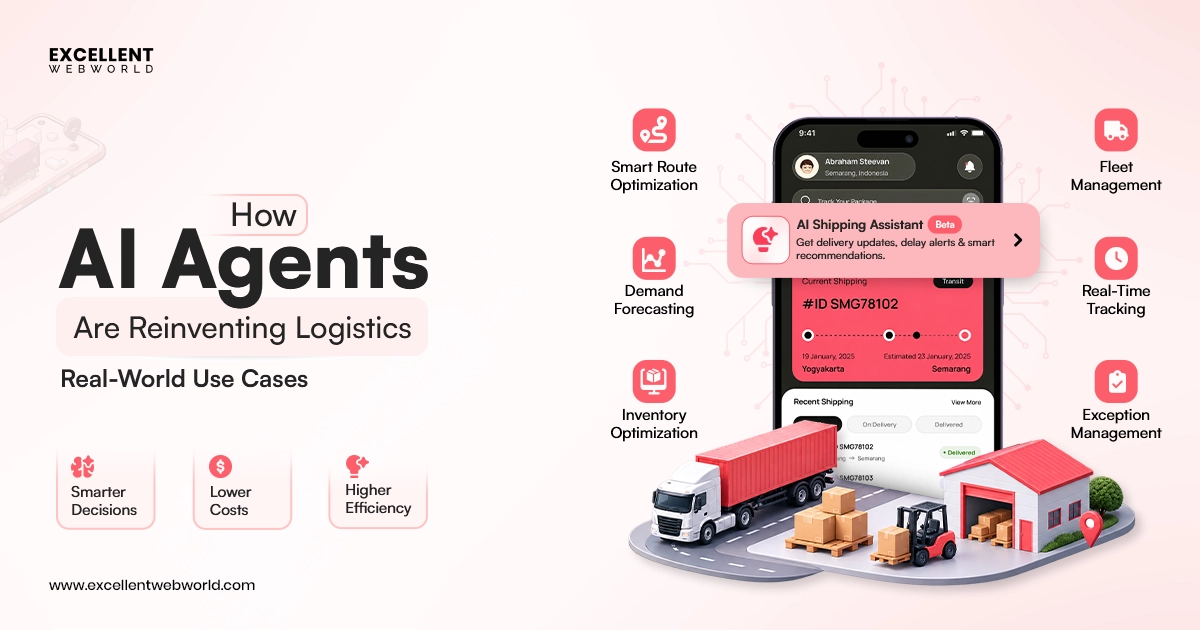
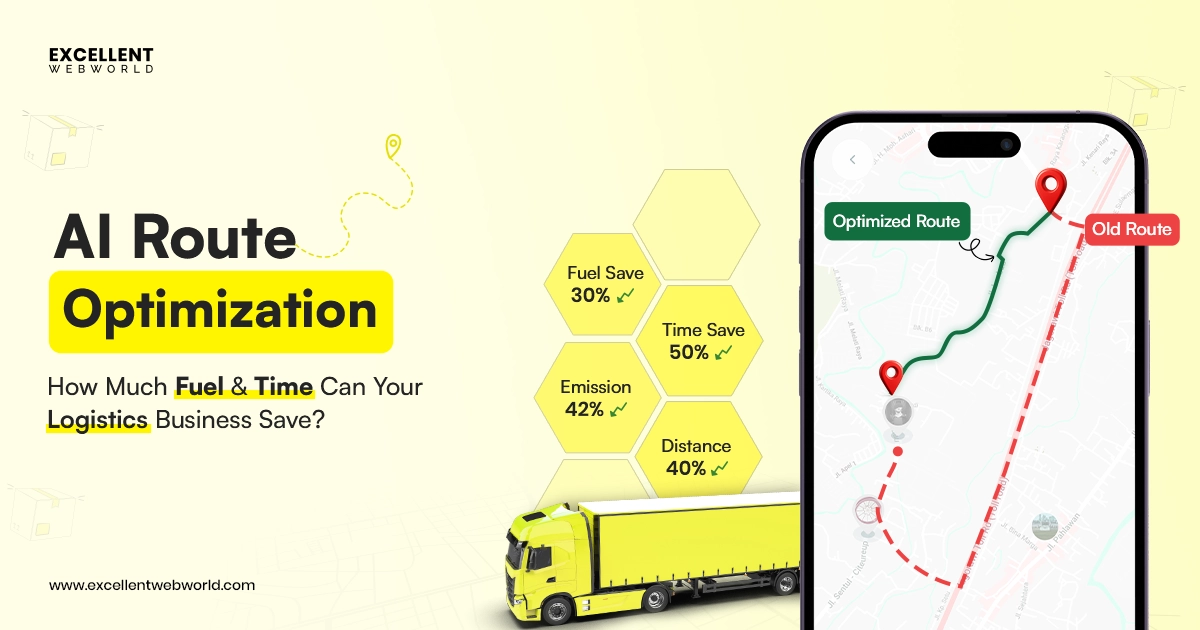
The clock shows 2 p.m., and at the same time, a traffic incident cascades in your network. Route delays put drivers behind, SLA slips, and customer updates are held up.
If you have a traditional TMS: The dispatcher notices and analyses the options, and decides which ones are the best. The dispatcher chooses the right options, and what you see is that multiple routes are compromised. Not only that, customers are disappointed, and your team loses 3 hours.
Having an AI Agent for TMS: The system analyzes the route data in real time and autonomously reoptimizes routes. It reallocates the capacity, and everything is notified to the customer. You have the time to review what happens and why.
What’s the problem here? “AI-powered TMS” is marketing shorthand that covers everything from rule engines to autonomous systems. What separates these is whether AI just suggests options for humans to approve or it decides autonomously within a governance framework.
By 2030, 50% of the supply chain solutions are expected to use intelligent agents to autonomously carry out decisions, according to Gartner’s report. Enterprise spending could go from under $2 billion today to $53 billion by 2030.
The gap you see between businesses adopting agentic AI today and those waiting to implement it is huge and is growing every quarter. Early adopters are starting to move beyond the supply chain bottlenecks that traditional systems create.
Let’s look at what AI Agent-Led TMS is, how it’s different from traditional, and what changes operationally.
The 3 Generations of Transport Management System: Which One Can Scale With Your Enterprise?
Here are the 3 distinct architectural generations where most logistics operations run today, on a combination of all three. This is a part of the problem businesses are unaware of.
1st Generation: Rule-Based Transport Management System
If Carrier A is available with a cost below $150, the system assigns the load. Let’s say a driver is ahead of schedule; then the system checks the adjacent zones, and if the delivery fails twice, then it triggers escalation to the team lead. The system operates predictably, but it struggles when real conditions differ from the assumptions behind those rules.
| Enterprise Benefits | Enterprise Constraints |
|---|---|
| The system’s behavior is predictable | Existing rules weaken as operations evolve |
| Ideal for stable and repeatable operations | Local decisions become less optimal across the network |
| It includes mature platforms | Variation requires manual intervention |
| Every new requirement expands the rulebook |
The rule-based TMS is something that works for operations with stable volume, along with documented processes and low intra-day variation. However, it breaks when reality outpaces the rulebook.
2nd Generation: ML-Optimized Transport Management System
The system understands and analyses the historical data to train ML models. Then, it optimizes the morning batch plan and executes the best possible route. The optimization gets better, but the timing constraints remain the same.
Let’say traffic conditions shift at exactly 11 a.m. A vehicle breaks down, suddenly changes the route plan, and the driver cancels unexpectedly. Obviously, the morning plan optimized early no longer fits current conditions. With the system, live responses still depend on human approvals. The engine then identifies a better option where driver X goes to Zone Y for the dispatcher to approve. If you are open to taking this step further, you can choose AI-powered route optimization to execute routing autonomously.
| Enterprise Benefits | Enterprise Constraints |
|---|---|
| Recognizes patterns that manual analysis misses | Model retrains periodically (weekly/monthly) |
| Delivers better results than fixed rules | Human approval becomes the bottleneck |
| More data volume improves optimization | Scaling means adding more dispatchers |
| Governance depends on external controls. |
ML-optimized TMS is more capable than the fixed rules. Yet it still reacts after condition changes. Also, human approval is still required for mid-day changes.
3rd Generation: AI Agent-Led Transport Management System
The system constantly monitors and analyzes live conditions, and continuous reasoning is carried out. It makes decisions without depending on human approvals. The loop of constantly learning, adapting, and executing is performed. No reliance on batch planning and human review cycle. Decision flow is not limited by dispatcher capacity and governance controls built into the architecture.
| Live Enterprise Scenarios | AI Agent-Led TMS Response |
|---|---|
| Traffic is disrupted by an incident at 2 p.m. | Routes re-optimize automatically as conditions change |
| Delivery completes earlier than planned | System adjusts downstream sequencing |
| Driver cancels while the route is underway | Next available resource is automatically assigned |
| SLA at risk appears 4 hours out | Corrective action is already underway |
| Customer becomes available ahead of schedule | System immediately adjusts the route sequence |
Operational decisions are made on a live basis. Your team focuses on outcomes instead of reviewing every option. Volume scales without proportional headcount growth. Let’s have a quick comparison to let you know which generation you are running on.
| Decision Type | Rule-Based TMS Response | ML-Optimized Response | Agent-Led Response |
|---|---|---|---|
| Dispatch timing | Morning batch + manual | Morning batch + human review | Real-time autonomous |
| Exception at 2 p.m. | Alert dispatcher | Recommend re-route | System already handled it |
| Learning | Manual rule updates | Quarterly retraining | Continuous, daily improvement |
| Throughput ceiling | Rules maintainers | Dispatch team | None (Scales with volume) |
Which Capabilities Make AI Agent for TMS Truly Agentic?
Not all AI systems are agentic. Here are the six operational capabilities that distinguish genuinely autonomous systems from AI-assisted recommendation engines.
1. Autonomous Dispatch & Assignment
Orders move from intake to driver assignment in seconds, not planning cycles. Real-time capacity matching against vehicle availability, driver location, skills, cost, and SLA fit. A shipment arriving at 2:47 p.m. is dispatched in seconds, not held for the 3 p.m. planning wave.
2. Live Route Re-Optimization
When conditions change (traffic, driver performance, capacity shifts), the system recalculates sequencing automatically. Not the next morning. Immediately. Without dispatcher initiation.
3. Predictive AI-powered SLA Management
Hours before an SLA miss occurs, the system identifies at-risk deliveries. Proactive intervention: re-sequence to accelerate, escalate to faster capacity, reset customer expectation before the promise fails. Reactive firefighting becomes strategic prevention.
4. Live Delivery Exception Resolution
Delivery failures, driver cancellations, vehicle breakdowns trigger automatic reallocation to the next-best available resource, with visibility comparable to the infrastructure of a fleet telematics platform. The system resolves the exception; dispatchers review outcomes rather than making recovery decisions under time pressure.
5. Multi-Fleet Orchestration From Single System
Most operations run hybrid fleets: owned drivers, 3PL partnerships, gig capacity. An agentic system allocates each shipment across all capacity types dynamically, evaluated against cost, SLA fit, real-time availability, and performance history. No manual coordination between fleet silos.
6. Constant Learning From Every Operation
Each delivery, each exception, each outcome feeds back into future decisions. The system improves weekly, not quarterly. Tomorrow’s routes are informed by today’s executed performance.
How AI-Assisted TMS Differs from an Autonomous TMS (Where Vendors Blur the Line)
Here is where evaluations go wrong. Most platforms claiming “agentic” or “AI-powered” are actually AI-assisted: AI recommends, humans decide. They are genuinely better than rule-based systems and are marketed with vocabulary identical to autonomous platforms. Also, they behave completely differently when something goes wrong at 2 p.m.
| What Happens | AI-Assisted TMS | AI Agent-Led TMS |
|---|---|---|
| Dispatch timing | Batch planning + human review + assignment | Continuous autonomous assignment; seconds to execute |
| Exception at 2 p.m. | System alerts → dispatcher reviews → manual re-route (15-30 min) | System auto-detects → auto-resolves → logs decision (90 seconds) |
| Carrier allocation | Rule-based priority with AI scoring | Real-time reasoning across all capacity simultaneously |
| SLA management | Reactive alerts when thresholds cross | Proactive intervention before breach materializes |
| Learning | Static models; quarterly retraining | Continuous; adapts to next day’s conditions |
| Scaling | Throughput capped by human review velocity | Throughput scales with volume; humans supervise by exception |
The difference that matters operationally: An AI-assisted TMS platform improves the quality of each decision a human makes. It does nothing about the number of decisions a human can make in a day. That ceiling is why dispatch headcount tends to scale with volume, even at organizations running “AI-powered” platforms.
What Actually Changes for Your Logistics Operations
This isn’t just a technology upgrade. It’s an operational model shift. Here’s what changes for different stakeholders:
For Dispatch and Planning Teams
You stop managing execution details and start managing network strategy. Instead of routing 200 loads per day, you optimize 5,000 per day by setting policy boundaries and monitoring outcomes. Instead of deciding “which carrier for this load,” you design the rules that govern allocation for entire customer segments. Your value moves from tactical execution to strategic design.
- Dispatch time per decision: 8 minutes → 8 seconds (captured for higher-level work)
- Time spent on carrier relationships and network optimization: 15% → 45% of day
- Crisis management (exception firefighting): 30% → 5% of day
For Operations Leadership
Real-time visibility replaces end-of-day reporting. Decision-making accelerates from days to hours. Competitive response tightens. You see network state as it unfolds, not as a summary after the fact. You can identify capacity optimization opportunities, adjust pricing strategy, or rebalance resources mid-day rather than quarterly. You scale volume without proportional headcount growth.
For Finance and Compliance
Explainable decisions reduce audit burden. Traceability means every action is logged with context, not reconstructed in spreadsheets. Risk events surface with data, not surprises.
- Manual reconciliation: Eliminated
- Audit time per shipment: 3 minutes → 30 seconds
- Compliance evidence trail: Reconstructed → Native to system
The Governance Frameworks That Make Autonomy Safe
Autonomous decisioning without governance is a risk you cannot accept. This is where most platforms fail; they build autonomy without the infrastructure that makes it enterprise-deployable. AI-powered TMS solution requires six formalized governance mechanisms:
- Explainability: Why did the system choose Carrier X over Carrier Y? Answers in operational terms (cost, SLA fit, capacity match).
- Traceability: Complete audit trail. What did the agent observe? What constraints were active? Which alternatives were considered? Why was this one chosen? Supports compliance audits and incident investigation.
- Autonomy Levels: Not all decisions execute autonomously. High-cost decisions, SLA-critical moves, and customer-specific rules can require approval. Routine decisions (micro-route optimization, capacity micro-allocation) run freely. Calibrated to risk.
- Evaluation Infrastructure: Continuous monitoring of agent behavior against expectations. Alerts when patterns drift. Early detection of bias or unintended behavior, the kind of rigor embedded in data science practices.
- Execution Sandbox: Test new decision logic against historical scenarios before live deployment. Catch risky changes before they cascade across the network.
- Human-in-the-Loop Controls: Final authority remains with operations leaders for decisions that carry material risk. Autonomy improves human capability, doesn’t replace it.
Why does governance matter? An auditor or internal risk function asks for exactly these mechanisms. The engineering requirement and compliance requirement converge. Governance isn’t a constraint on agentic systems; it’s the architectural foundation that makes them deployable.
How This Translates to Real Operations: Excellent Webworld’s Approach
Implementing AI-powered TMS software isn’t a platform swap. It’s an operational transformation that requires assessment, staged implementation, and continuous refinement. Before implementation, you need clarity on 3 questions:
- Which decisions are candidates for autonomy? (high-volume, repeatable, low-cost failure)
- What constraints must every decision respect? (regulatory, customer, operational)
- What outcome changes matter most? (cost reduction, throughput gain, SLA improvement, team reallocation)
Our agentic AI development services audit your current TMS and processes, map decision points, build constraint inventory, and quantify business impact. The result: a concrete implementation roadmap.
Launch with high-volume, low-risk decisions. A system that autonomously handles 80% of your orders (straightforward routing, single-carrier allocation, no special handling) delivers immediate value while your team builds confidence. Expand scope incrementally. Multi-carrier orchestration, exception handling, SLA-at-risk detection. Governance frameworks scale with autonomy scope.
Monitor agent performance against KPIs weekly. Capture operational feedback from your team. Refine decision boundaries quarterly. Expand to new decision categories as organizational confidence builds.
In the first month, the system handles dispatch and basic exception detection. We’ve deployed this with clients managing AI in logistics operations at scale. By month six, the system expands to carrier tendering, customer communication, and settlement orchestration. By year two, you’re running a fully autonomous network under human governance.
FAQs
An AI agentic TMS uses AI agents to continuously monitor transportation operations, make decisions, and execute actions within predefined business rules and governance controls. It can respond to changing conditions without requiring human approval for every routine decision.
AI agents can monitor shipments, optimize routes, assign drivers or carriers, detect exceptions, and adjust transportation plans in real time. Enterprises define the policies, constraints, and approval thresholds that control what the agent can execute.
An AI-Assisted TMS analyzes data and recommends actions for a human to approve. An Agentic TMS can reason through routine operational decisions and execute them autonomously within defined governance controls.
“AI-powered” describes any system using machine learning or algorithms. AI Agent-Led specifically means autonomous decisions within governance frameworks. One is a technology category; the other is an architectural commitment to autonomous operational decisioning.
Pilot to full deployment: 3-6 months depending on scope and existing system integration. ROI realization (payback) typically 6-12 months for high-volume operations. Implementation cost is negligible against first-year operational gains.
Governance catches patterns before they cascade. Sandboxed testing prevents bad logic deployment. Autonomy levels prevent high-cost mistakes. Humans can override any decision. Agentic systems fail gracefully; rule engines fail brittle.
High-volume (500+ orders/day), multi-fleet (owned + 3PL + gig), tight windows (same-day), variable demand, compliance-heavy (cross-border). Retail, FMCG, 3PLs, and quick commerce are strongest fits. Operations with stable, predictable volume see marginal improvement.

Article By


Mayur Panchal is the CTO of Excellent Webworld. With his skills and expertise, he stays updated with industry trends and utilizes his technical expertise to address problems faced by entrepreneurs and startup owners.