Machine Learning Development Services
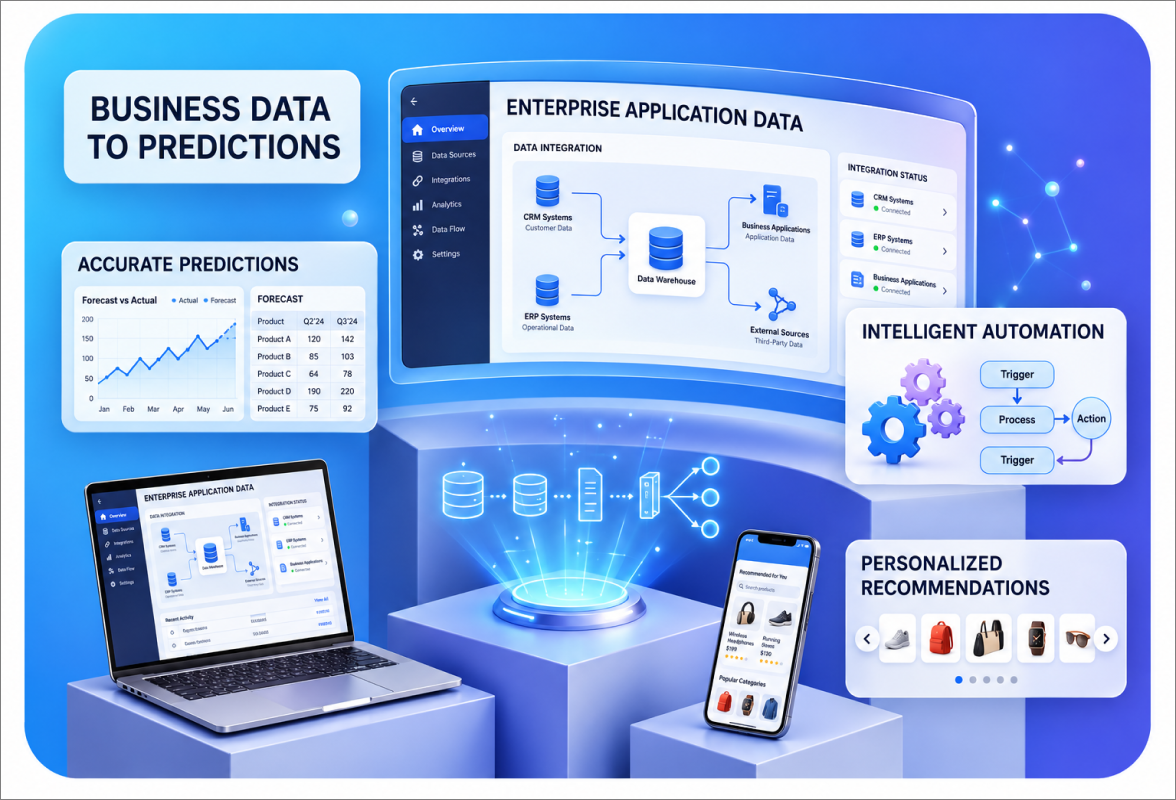
We built production-ready machine learning solutions that translate business data into accurate predictions, intelligent automation, recommendations & measurable outcomes. Our machine learning development services cover model development, training, deployment, MLOps, integration, monitoring, & optimization across enterprise applications & data environments.
AI & ML Engineers
Projects Delivered
Years Building at Scale
Countries Served


- Custom ML Model Development
- Predictive Analytics & Forecasting
- NLP & Generative AI Solutions
- Computer Vision & Image Intelligence
- MLOps, Model Deployment & Monitoring


Machine Learning That Creates Business Value, Not Just Models
Machine learning creates business value when predictions tend to improve decisions, automate work processes, reduce operational uncertainty, or enhance customer experiences. We developed ML systems around measurable business objectives, quality datasets, production-ready environments, and insights grounded in data science & effective data engineering.
01
Convert Business Data Into Predictive Intelligence
Turn historical and real-time business datasets into predictive signals for forecasting, risk analysis, customer intelligence, operational planning, & automated decision-making.
02
Automate Data-Driven Decisions
Utilize machine learning processes to classify, score, recommend, detect, and predict at scale, thus reducing repetitive analysis and keeping humans focused on judgment.
03
Move Beyond Proof-of-Concept Models
We develop ML solutions with production architecture, thus connecting models to applications, APIs, data pipelines, cloud infrastructure & workflows using product engineering.
04
Improve Forecasting & Planning
We apply predictive models to demand, revenue, inventory, customer behavior, maintenance, resource utilization & other variables where better forecasts can improve planning.
05
Build Around Your Proprietary Data
Build ML systems around proprietary datasets, processes, domain knowledge bases, & business rules that distinguish your organization from relying on generic models.
06
Operate Models Reliably in Production
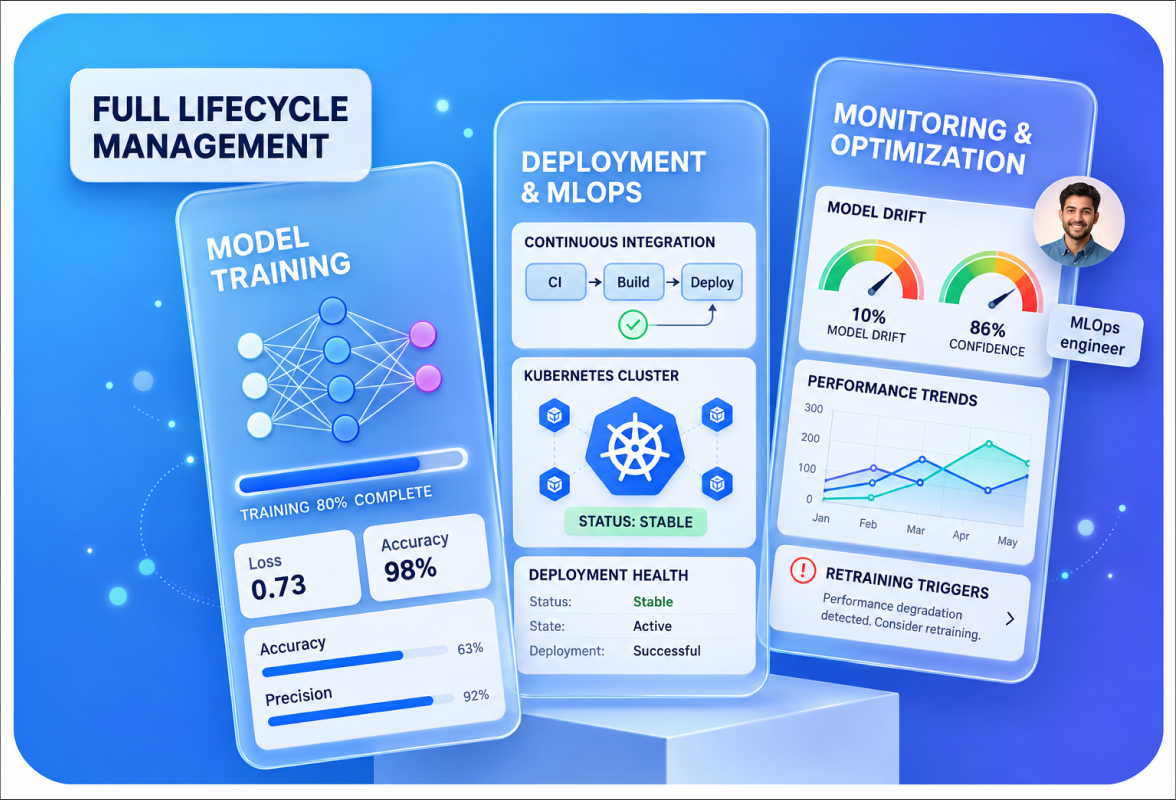
We support the machine learning cycle with deployment, model versioning, tracking, data drift detection, performance evaluation, retraining & ongoing optimization.
Proven Delivery Experience
From ML models to production-grade software, we bring experience across complex business applications and data environments.

Deep Engineering Experience
Backed by experienced engineers, architects, and AI specialists, we support machine learning initiatives from development through production optimization.

AI & ML Implementation Expertise
Our teams build and deploy intelligent solutions spanning predictive analytics, automation, recommendations, and AI-powered applications.

Machine Learning Development Services for Production Systems
Our machine learning services expand across strategy, data preparation, model development, deployment, integration & MLOps that give businesses the engineering capabilities to take the ML shift from an initial use case to a reliable production-grade system.
Machine Learning Consulting
Analyzes ML opportunities, data readiness, feasibility, architecture, model needs & priorities to define the right path far before the development process.
Custom ML Development
Build tailored ML models utilizing proprietary datasets, business goals, application requirements, and production needs for reliable performance.
Predictive Analytics Development
Build predictive models for forecasting, classification, regression, risk scoring, anomaly detection, customer insights & operational intelligence.
Machine Learning Integration
Integrates ML models with applications, API databases, data platforms, CRM, ERP, IoT systems, and existing enterprise workflows.
MLOps & Deployment
Deploy & operate ML through automated training processes, testing, versioning, monitoring, infrastructure, deployment, and model retraining workflows.
ML Model Optimization
Optimize ML models for accuracy, inference speed, scalability, maintainability, & cost efficiency as data & production demands increase.
Engineering Expertise Behind Production-Ready ML Solutions
Our machine learning projects need more than model experimentation; they require software and data engineering, cloud, integration, security, and production delivery.
Years of Software Engineering
Projects Delivered
Technology Experts
Countries Served

Top Health & Wellness Development Company
Top Software Developers USA 2024
Top App Development Company

Best Design Awards 2025

Top AI Development Company

Top UI/UX Design Company 2026
Why Machine Learning Projects Fail in Production
A machine learning model can perform well in terms of experimentation, yet fail to create business value when data deployment, integration, monitoring or workflows aren’t product engineered.
| Challenge Area | What’s Happening | What Changes With Production-Ready ML | ||
|---|---|---|---|---|
|
Data Quality Problems
|
What’s Happening | The poor quality, incomplete, duplicated or shifting datasets create unreliable inputs, thus weakening model accuracy. | What Changes With Production-Ready ML | Data Readiness ensures clean, consistent, well-structured data inputs for reliable model training, predictions & production performance. |
|
Model-to-Production Gaps
|
What’s Happening | A model that performs well in a notebook still needs deployment architecture, APIs, infrastructure, testing, monitoring & integration. | What Changes With Production-Ready ML | Production architecture connects the models with API infrastructure, applications, testing, monitoring & integration for reliable use. |
|
Model Drift
|
What’s Happening | Changes in customer behavior, market conditions, processes & incoming datasets that cause existing models to have lower accuracy. | What Changes With Production-Ready ML | Continuous monitoring tends to track model performance & data changes to detect early drifts & maintain accuracy with evolving conditions. |
|
Scaling ML Workloads
|
What’s Happening | There is rising demand for training & inference with the increase in datasets, users, prediction volumes, & model complexity. | What Changes With Production-Ready ML | Model governance utilizes versioning, access, lineage, and evaluation to maintain operational control as ML workloads increase. |
Machine Learning Solutions Built Around Real Business Problems
We built deployable machine learning solutions around specific business decisions, data environments, application requirements & production constraints, not as isolated data science exercises.
Predictive Analytics
- Demand and revenue forecasting
- Customer behavior prediction
- Risk and probability scoring
- Classification and regression models
- Operational outcome prediction
Recommendation Engines
- Personalized product recommendations
- Content and service recommendations
- Behavioral pattern analysis
- Context-aware ranking models
- User preference prediction
Anomaly Detection
- Transaction anomaly identification
- Operational behavior monitoring
- Equipment performance anomalies
- Network activity analysis
- Unusual pattern detection
Computer Vision
- Image classification systems
- Object detection models
- Visual quality inspection
- Image segmentation workflows
- Automated visual analysis
Natural Language Processing
- Text classification models
- Named entity recognition
- Document information extraction
- Sentiment and intent analysis
- Semantic text processing
Forecasting Systems
- Demand forecasting models
- Time-series prediction
- Inventory forecasting
- Resource utilization prediction
- Capacity planning models

Machine Learning Solutions Across Business Functions
From customer intelligence & financial risk to predictive maintenance & intelligent document processing, machine learning enables smarter operational decision-making, aligning with datasets, models, and also architecture with specific business requirements.
Customer Intelligence
- Customer segmentation and profiling
- Churn probability prediction
- Customer lifetime value modeling
- Behavioral pattern identification
- Personalized experience optimization
Financial Intelligence
- Fraud detection models
- Credit risk prediction
- Transaction classification
- Financial forecasting systems
- Risk scoring workflows
Operational Intelligence
- Predictive maintenance models
- Resource demand prediction
- Operational anomaly detection
- Capacity forecasting systems
- Process performance prediction
Document Intelligence
- Document classification models
- Information extraction pipelines
- Text categorization systems
- Document similarity analysis
- Automated document routing
Supply Chain Intelligence
- Demand forecasting models
- Inventory prediction
- Supplier risk analysis
- Delivery prediction
- Supply planning optimization
Product Intelligence
- Recommendation systems
- Usage prediction models
- Feature adoption analysis
- Customer behavior modeling
- Product personalization
Machine Learning Features Built for Production Applications
Machine learning creates value when predictions reach users, applications, & workflows through production-ready systems that are built around data & operations.
Demand Prediction
Helps forecast future demand using historical trends, seasonality, market signals & operational data for better planning.
Revenue Forecasting
Estimates future revenue utilizing historical performance, business drivers, & predictive modeling for decisions.
Customer Churn Prediction
Predicts which customers are most likely to leave, utilizing behavioral patterns & historical datasets.
Risk Scoring
Generates predictive risk scores using historical outcomes, behavioral patterns, transactions & business-specific datasets.
Lead Scoring
Ranks prospects using predictive signals from customer attributes, engagement behaviors, & past conversion patterns.
Failure Prediction
Predict equipment, systems, or any operational failures early utilizing historical performance & condition data to reduce disruptions.
Automated Classification
It automatically classifies documents, transactions, customers, and products using ML models trained on business-specific datasets.
Anomaly Detection
Helps to detect unusual transaction patterns, systems, operations, customer activity, & machine data in real time.
Recommendation Engines
Offers personalized suggestions using user behavior, product relationships, historical interactions & context signals.
Document Processing
This extracts, classifies, & structures datasets from high-volume business documents using ML & intelligent automation.
Intelligent Routing
It helps route cases, requests, documentation processes, leads, & operations using predictive models & workflow rules.
Predictive Prioritization
It helps prioritize tasks, customer opportunities, & events utilizing the predicted outcomes that are tailored to business objectives.
Model APIs
Expose the trained ML models by secure APIs so applications and enterprise systems can use them in production decisions.
Batch Inference
It runs predictions across large datasets when scheduled processing is more efficient than real-time inference.
Real-Time Inference
It offers low-latency model predictions inside application workflows, where immediate datasets can drive operational decisions.
Model Monitoring
Helps in monitoring & tracking model behavior, prediction performance, data drift & operational signals after launch.
Automated Retraining
Build repeatable retraining pipelines that tend to update models with changing business situations & new data additions.
Model Versioning
Helps teams manage controlled model versions for evaluation, deployment, rollbacks, governance & production ML lifecycle changes.
Turn Your Data Into Predictive Intelligence
Machine learning helps to predict demand, anomalies, personalize experiences, analyze risks, automate classification & improve operational decisions.

- Build a production-ready ML system
- Turn historical data into predictions
- Integrate models into existing applications
- Establish reliable ML operations
Why Choose EWW for Machine Learning Development?
Machine learning development combines data science and software engineering through our forward-deployed engineering, bringing together cloud, data workflows, APIs, integrations, and production delivery processes.
Engineering-Led Machine Learning
Our approach is to connect the ML models with the applications, data pipelines, APIs, infrastructure & specific problem requirements.
Business-First Model Selection
We select the models based on the first objectives, datasets, performance, explainability, infrastructure & specific problem requirements.
Production-Ready Architecture
We design ML systems for deployment from the start, thus integrating production architecture instead of leaving it for the final stage.
End-to-End ML Lifecycle
This covers feasibility, data preparation, model development, validation, deployment, monitoring, optimization, & continuous improvement.
Flexible Technology Choices
Utilize proven ML frameworks, cloud services, data technologies & deployment tools based upon project & production requirements.
Integration With Existing Systems
We integrate ML capabilities, including Computer Vision, with APIs, CRM, ERP, databases, IoT, data platforms & enterprise workflows.
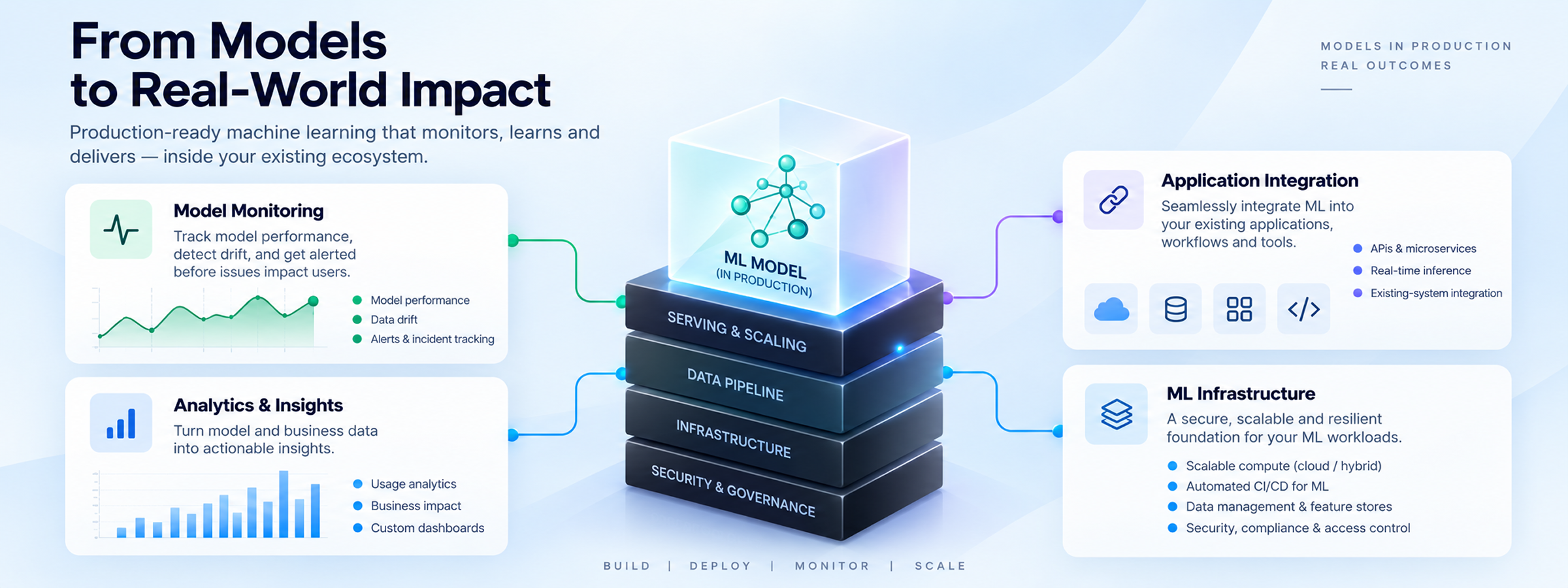
MLOps Practices That Keep Models Production-Ready
Machine learning continues beyond the deployment process, requiring model versioning, monitoring, evaluation, data quality, & retraining as business conditions tend to evolve.
Model Versioning
It manages model versions, configurations, training datasets, and evaluation results to maintain controlled & traceable production releases.
Model Monitoring
Helps monitor production model behavior to detect changes affecting prediction quality, data patterns, & operational reliability.
Automated Training
Built repeatable training pipelines that actually process new datasets & generate updated models under controlled conditions.
Model Deployment
Deploy ML models through APIs, batch workflows, applications, or architectures aligned with the required inference pattern & operational needs.
ML Observability
Creates visibility across the data pipelines, model behavior, infrastructure, prediction workloads & production performance.
Continuous Optimization
Optimize production performance by refining the models, inference infrastructure, & also data workflows with business requirements.
Our Recent AI Integration Projects
See how we’ve integrated AI into existing products and business systems, turning standalone capabilities into something teams can use in their day-to-day operations.
Integrating AI into Sports Platform
Integrated AI-driven intelligence with athlete data and external licensing systems, connecting intelligent analysis to established workflows within a UAE sports governance platform.
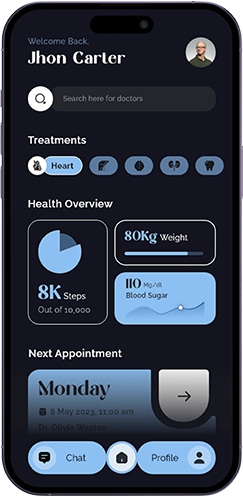
AI Integration with Clinical Systems
Integrated an AI-powered virtual health assistant with EHR, laboratory, and imaging data through HL7 and FHIR, giving it clinical context for healthcare workflows.

Standards Supporting Responsible Machine Learning Development
ML governance spans across data, models, infrastructure, access, monitoring, privacy & security with frameworks that are aligned to the industry, geography, data & deployment.
GDPR
Supports privacy & data protection requirements when ML systems process individuals’ personal data in applicable European contexts.
UK GDPR
Addresses data protection principles for applicable personal data processing in the United Kingdom.
CCPA / CPRA
Addresses California consumer privacy rights & requirements for organizations covering personal information.
HIPAA
This applies to covered healthcare environments where ML systems process protected health information under applicable requirements.
SOC 2
It provides a framework for evaluating controls covering security, availability, processing integrity, confidentiality & privacy.
ISO/IEC 27001
This standard offers a framework for establishing & maintaining an information security management system.
NIST AI RMF
Provides guidance for identifying & managing risks across the design, development, deployment & use of AI systems.
NIST Cybersecurity Framework
This provides a structured approach to managing cybersecurity risks across ML infrastructure & connected systems.
ISO/IEC 23894
Provides guidance for identifying & managing risks that are associated with artificial intelligence systems.
ISO/IEC 42001
This provides requirements for establishing & maintaining an artificial intelligence management system.
Data Governance
This mainly establishes controls for data accessibility, lineage, quality, retention, processing & use throughout the ML lifecycle.
Model Governance
Maintains visibility into the standard model versions, evaluations, deployment status, performance & production changes.
Access Control
This restricts access to datasets, models, infrastructure, APIs, & production environments that is based upon organizational needs.
Auditability
Helps in maintaining relevant records that cover data, model versions, deployments, evaluations & production activity.
Responsible AI Practices
This approach addresses applicable requirements for transparency, fairness, explainability, privacy, security & human oversight.
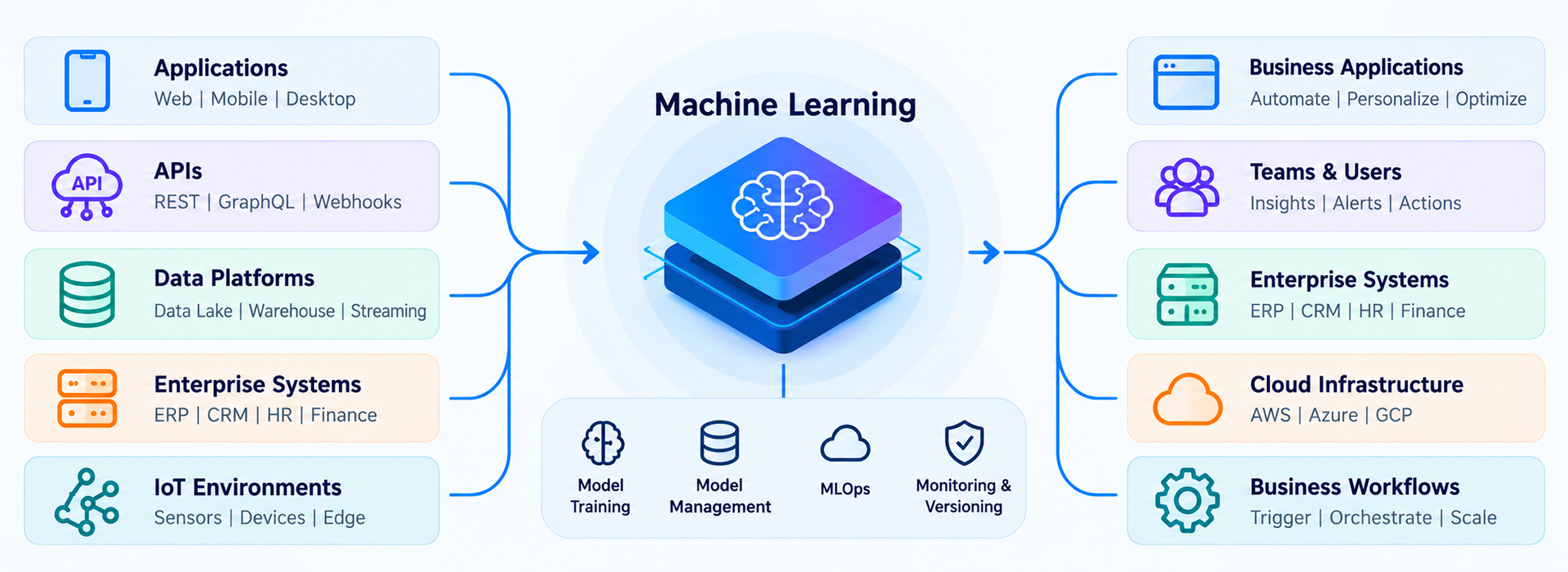
Integrate Machine Learning Into Your Existing Technology Stack
Machine learning delivers value when predictions reach destination systems through applications, APIs, data platforms, enterprise systems, IoT, and business workflows.
Who Benefits Most From Machine Learning Development?
Machine learning creates value when meaningful data, repeatable decisions, measurable outcomes & business processes let better predictions drive actions.
 Data-Rich Businesses
|
|---|
|
|

|
Growing Technology Products
|
|---|
|
|

Make Machine Learning Work in Production
Transform ML experiments into production-ready systems aligned with your applications, data environment, infrastructure & business workflows.

- Deploy models into real applications
- Monitor production model performance
- Connect ML with enterprise systems
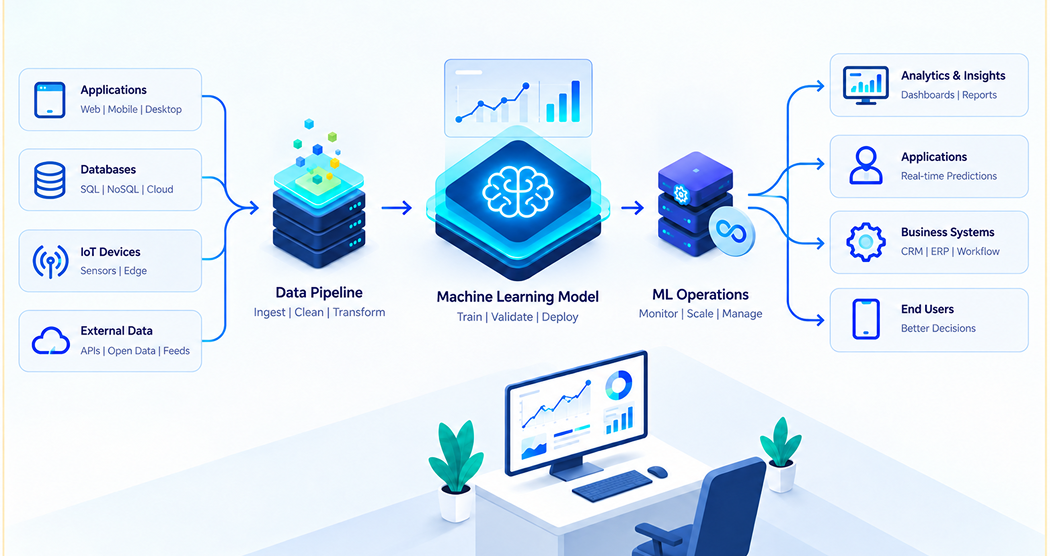
Advanced Technologies We Use for Machine Learning Solutions
We select ML technologies based on use case, dataset, model requirements, infrastructure, application environment, deployment architecture, and long-term maintenance needs.
Python
Core language for machine learning development, data processing, experimentation, model training, & also production workflows.
TensorFlow
It is a deep learning framework that supports building, training, and deploying neural network-based machine learning solutions at scale.
PyTorch
Includes a flexible deep learning framework for building, training, evaluating, and deploying neural network models.
Scikit-learn
Machine learning library supporting classification, regression, clustering, preprocessing, model selection, & traditional ML workflows.
XGBoost
Gradient boosting framework for structured & tabular ML workloads, where strong predictive performance is needed.
LightGBM
This gradient boosting framework is optimized for efficient training processes on large structured datasets & predictive modeling workloads.
Apache Spark
The distributed data processing technology for large-scale data preparation, feature engineering, analytics & ML pipelines.
MLflow
The ML lifecycle platform for tracking experiments, managing models, recording metadata, & supporting model operations.
Kubernetes
The container orchestration platform needed for scalable deployment, management, & operation of production machine learning workloads.
How Much Does Machine Learning Development Cost?
Machine learning development costs vary with data readiness, model complexity, training needs, integrations, infrastructure, deployment architecture, & ongoing MLOps. A predictive model & enterprise ML platform can differ significantly in scope.
Discovery & Proof of Concept
Validate an ML Use Case Before Full-Scale Development
- Use case assessment and feasibility analysis
- Data readiness and model feasibility
- Proof-of-concept model development
- Initial performance validation
Custom ML Development
Build and Integrate Custom ML Solutions Around Your Business Data
- Custom model development and training
- Business data integration
- Application and API integration
- Production model deployment
Enterprise ML Platform
Scale Machine Learning Across Production Environments
- Enterprise ML platform development
- MLOps and continuous monitoring
- Model lifecycle management
- Scalable production infrastructure
| Pricing Factor | What Influences Cost |
|---|---|
| Data Readiness | Collection, cleaning, labeling, validation |
| Model Complexity | Algorithms, deep learning, ensembles |
| Training Requirements | Dataset size, compute, training frequency |
| Integration Scope | APIs, CRM, ERP, IoT, databases |
| Deployment Model | Cloud, on-premises, edge, real-time |
| MLOps Scope | Monitoring, CI/CD, retraining, governance |
Machine Learning Technology Stack Built Around Your Needs
We tailor the ML stack to the model type, data environment, application architecture, infrastructure, inference requirements, scalability, and engineering standards.
Programming
- Python
- R
- SQL
- Java
- C++
ML Frameworks
- Scikit-learn
- TensorFlow
- PyTorch
- XGBoost
- LightGBM
Data Processing
- Pandas
- NumPy
- Apache Spark
- SQL
- Data Pipelines
Deep Learning
- CNNs
- RNNs
- LSTMs
- Transformers
- Transfer Learning
Computer Vision
- OpenCV
- YOLO
- Image Classification
- Object Detection
- Segmentation
NLP
- Transformers
- Embeddings
- NER
- Text Classification
- Semantic Search
MLOps
- MLflow
- Model Registry
- CI/CD
- Model Monitoring
- Automated Retraining
Cloud & Infrastructure
- AWS
- Microsoft Azure
- Google Cloud
- Docker
- Kubernetes
Our Machine Learning Development Process
We align business objectives with data, model development, application engineering, deployment & ongoing production operations through a structured ML process.
Define the Business Problem
We define the decision, prediction, classification, or automation problem and outcome.
Assess Data Readiness
We assess the datasets, sources, quality, labeling, coverage, access, structure, and gaps.
Establish ML Feasibility
Determine ML suitability, viable approaches, & success metrics for the development.
Prepare the Data
We clean, transform, label & validate structured data by repeatable workflows.
Develop & Train Models
We select algorithms, engineer features, train models, tune parameters, & compare results.
Validate Model Performance
Evaluate the accuracy, robustness, generalization & relevant metrics using datasets.
Integrate With Applications
We connect model inference with APIs, applications, databases, platforms, and workflows.
Deploy & Monitor
Deploy models and monitor performance along with the data behavior, infrastructure & operations.
Optimize & Retrain
We improve the models, data pipelines, inference, infrastructure, and also for retraining purposes as required.
Related Services That Extend Machine Learning Development
Machine learning projects often rely on AI, data engineering, software development, cloud infrastructure, and integration across every ML lifecycle.
Artificial Intelligence Development
Build AI systems that actually combine machine learning, generative models, intelligent automation, computer vision, NLP, and other AI capabilities.
Cloud Services
Design cloud infrastructure for ML training, model deployment, scalable inference, data processing, tracking, and production workloads.
Generative AI Development
Develop applications powered by large language models, generative models, retrieval-augmented generation, multimodal AI, and AI-driven workflows.
AI Consulting Services
Analyzes AI & ML opportunities, technical feasibility, implementation approaches, architecture & technology priorities.
AI Integration Services
Integrates AI and machine learning capabilities across existing applications, enterprise systems, workflows, APIs, and technology environments.
Software Development Services
Build applications, platforms, APIs, and enterprise software that translate machine learning capabilities into production-ready products.
Data Engineering Services
Build data pipelines, processing systems, storage architecture, and infrastructure that support reliable ML development.