RAG Development Services
Excellent Webworld helps enterprises architect high-precision Retrieval-Augmented Generation (RAG) systems for improved AI response accuracy. We connect AI models and LLMs to your enterprise data sources and knowledge bases to build custom RAG pipelines that combine advanced retrieval with generative fluency, producing traceable responses grounded in your actual data.


- RAG Pipeline Development
- Vector & Hybrid Search
- Enterprise RAG Development
- Agentic & Graph RAG
- RAG Integration & Deployment

Contextual AI Responses Grounded in Trustworthy Business Sources
General-purpose LLMs often produce generic responses based on their training data. RAG pipelines ground their outputs in relevant business sources for better context.
01
Grounded Answers, Reduced Hallucination
With well-engineered RAG systems in place, enterprise LLM responses are generated from retrieved, relevant source content, not the model’s parametric memory alone.
02
Up-to-date Responses without Retraining
As your knowledge bases get updated, so do your generative AI responses. RAG systems require no fine-tuning cycles for newly added information to your data sources.
03
Traceable Answers Across Every Source
Reviews and audits become easier to conduct as you get generative AI responses with sources cited to known and specific enterprise documents, sections, or records.
04
Unify Structured and Unstructured Sources
We help you implement enterprise RAG systems that accurately combine document retrieval with structured data lookups (SQL, APIs, etc.) into a single, unified pipeline.
05
Access Controls for Authorized Content
The retrieval layer engaged in response generation respects document-level and field-level permissions, so users only ever retrieve what they’re authorized to see.
06
Improve Over Time Without Rebuilding
We continuously tune retrieval, re-ranking, and chunking strategies, improving system performance without requiring changes to the underlying large language model.
No Black-Box Answers
We build RAG systems with source-level traceability, giving your teams clear visibility into the knowledge behind AI responses and greater confidence in every answer.
No Unauthorized Content
Our retrieval architecture keeps knowledge access aligned with user permissions, so sensitive enterprise information stays within the organization boundaries you define.
Always Current Knowledge
We keep your knowledge layer separate from the underlying model, making it possible to refresh enterprise content as it changes without retraining the LLM or AI model.
RAG Development Services for Enterprise Knowledge Systems
Our 350+ engineering specialists across AI and data deliver the full RAG lifecycle, from ingestion and retrieval to grounding and production applications.
RAG Architecture & Design
We work with business leadership to design scalable, governance-ready RAG solutions, defining the architecture around your data, retrieval needs, and accuracy requirements.
Knowledge Ingestion & Processing
The underlying data is as important as the final response, so our data management approach supports ingestion and processing of PDFs, wikis, SharePoint, and Confluence.
Embedding & Vector Indexing
We implement embedding models from OpenAI, Cohere, and BGE, then index them into vector stores suited to your RAG system’s scale, retrieval needs, and latency requirements.
Retrieval Pipeline Engineering
Beyond basic similarity search, we build retrieval logic using hybrid search with BM25 and vector search, metadata filtering, multi-hop retrieval, query rewriting, and HyDE.
Re-Ranking & Relevance Tuning
Sharper retrieval starts with better relevance. Our engineers tune cross-encoder and LLM-based re-ranking, including Cohere Rerank, to improve the quality of generated results.
Grounded Generation & Citation
We make RAG outputs traceable by connecting retrieved context to generation with source attribution, so your teams can verify answers against the original document or record.
Agentic & Graph RAG Development
For complex knowledge needs, we build agentic RAG and graph RAG solutions that enable iterative retrieval and relationship-based search across connected enterprise knowledge.
RAG Evaluation & Optimization
Our RAG engineers evaluate retrieval quality and answer groundedness, using performance benchmarks to identify gaps and continuously refine retrieval logic and knowledge sources.
RAG Application Development
Our custom RAG application development expertise helps you build domain-specific AI applications, from knowledge assistants to conversational AI and enterprise search experiences.
Recognized for Engineering Depth Across AI and Data
Industry recognition reflects our ability to engineer AI and data systems around real operational requirements, with the technical depth needed for production use.
Clutch Global Ranking (Software Development)
Years of enterprise engineering
Software Development Talent
Countries with Active IT Deployments
Top Clutch 100 Fastest Growing Companies2026
Top Clutch Artificial Intelligence CompanySalt Lake City – 2026
Top Clutch Recommendation Systems CompanyUnited States – 2026
Top Clutch AWS CompanyUnited States – 2026
Top Clutch Azure CompanyUnited States – 2026

Top Clutch Machine Learning CompanySalt Lake City – 2026
Building Past the Challenges of RAG Implementation
RAG failures often stem from retrieval and grounding rather than the model itself. We design the pipeline to address these challenges before they affect production.
| Challenge Area | What Can Go Wrong | How We Solve It | ||
|---|---|---|---|---|
|
Chunking Can Destroy Context
|
What Can Go Wrong | Fixed-size chunking can split related content mid-sentence or mid-table, leaving retrieval with fragments that lack context needed to produce useful answers. | How We Solve It | We tailor chunking to each content type, using semantic chunking for prose and structure-aware methods for tables and code rather than one fixed size. |
|
Similarity Search Can Miss Relevant Content
|
What Can Go Wrong | Pure vector similarity can surface semantically close but incorrect content, particularly when queries depend on exact terms, numbers, or key identifiers. | How We Solve It | We combine hybrid search using BM25 and vector search with re-ranking, so exact matches and semantic relevance both influence what reaches generation. |
|
Grounding Can Break During Generation
|
What Can Go Wrong | Even when retrieval is accurate, the model may overlook useful context or blend it with information from its training data, producing unsupported answers. | How We Solve It | We apply grounding constraints and generation prompts that prioritize retrieved context, then add citation-verification checks to validate responses. |
|
Knowledge Access Can Ignore Permissions
|
What Can Go Wrong | Without permission-aware retrieval, RAG can surface documents or fields that users are not authorized to access, creating serious data exposure risks. | How We Solve It | We enforce document- and field-level access controls in the retrieval layer, keeping authorization within your RAG pipeline rather than an afterthought. |
|
Retrieval Can Degrade At Scale
|
What Can Go Wrong | A retrieval setup that performs well with 1,000 documents may struggle at 100,000, as the larger search spaces affect latency and relevance over time. | How We Solve It | We design for scale using appropriate vector indexes and metadata filtering, while tracking retrieval relevance and drift as key knowledge bases grow. |
|
Complex Questions Need Multiple Retrieval Steps
|
What Can Go Wrong | Questions spanning multiple documents can fail with single-shot retrieval, because the first result may not contain enough context to answer it fully. | How We Solve It | We build agentic or iterative retrieval that can issue follow-up searches based on earlier results, so it can gather context across knowledge sources. |
RAG Architecture Matched to Your Accuracy and Scale Needs
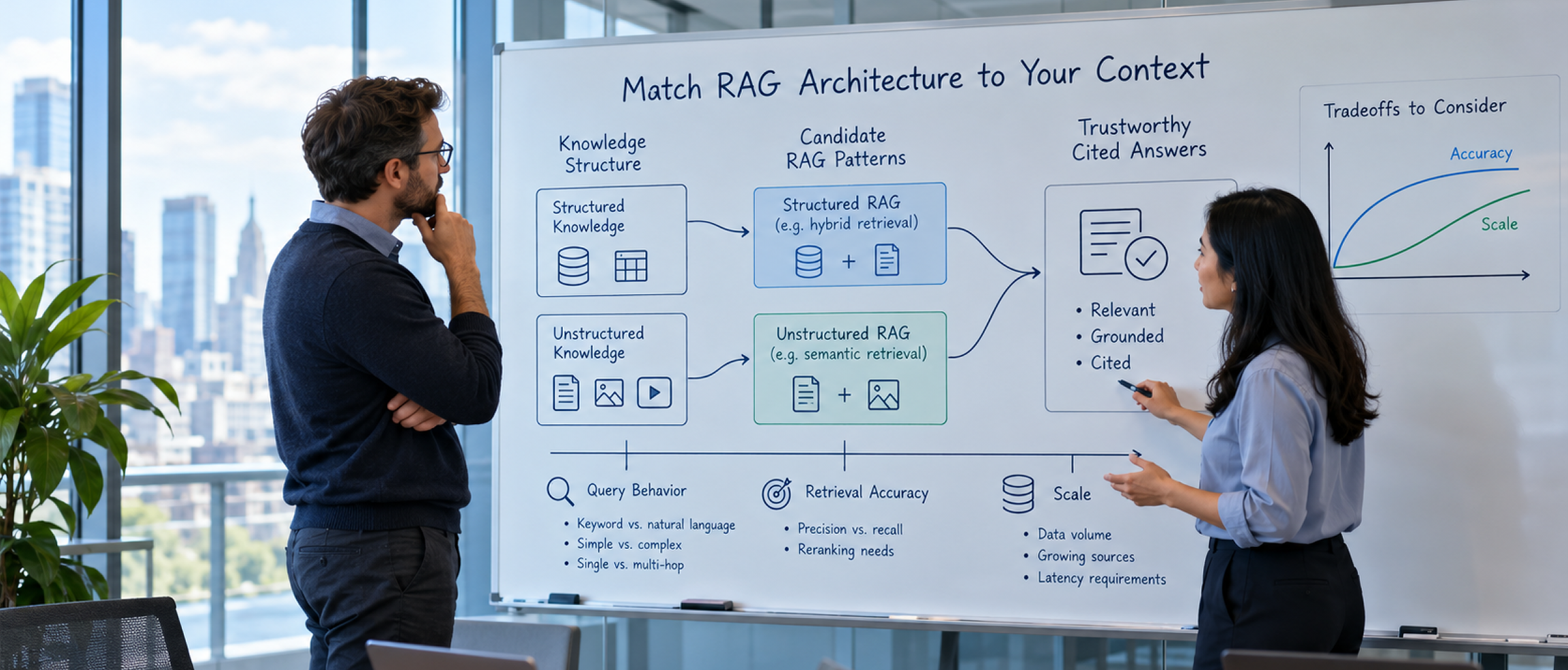
RAG architecture should reflect how your knowledge is structured and how users query it. We select patterns that balance retrieval accuracy, complexity, and scale.
01. Naive RAG (Baseline Retrieval)
For straightforward document Q&A, we use Naive RAG when knowledge is well-structured and queries are clear, providing a fast baseline for optimization.
02. Hybrid Search RAG
Where all terms matter, we combine vector search with keyword and BM25 retrieval, then re-rank results to improve relevance for names, IDs, and codes.
03. Re-Ranked RAG
To improve relevance without replacing your retrieval stack, we use broad vector recall followed by cross-encoder re-ranking to surface right answers.
04. Query Transformation RAG
When queries are vague or multi-part, we apply query rewriting, HyDE, or decomposition before retrieval to improve relevant knowledge matches at scale.
05. Agentic RAG
For questions spanning multiple sources, we build Agentic RAG that can retrieve, evaluate, and retrieve again across steps before synthesizing answers.
06. Graph RAG
Where relationships matter as document content, Graph RAG can combine knowledge graph traversal with vector retrieval to connect entities across data.
RAG Development for Real-World Knowledge Complexity
Our RAG development services support organizations with complex knowledge environments, from large document bases to regulated data and multi-source retrieval needs.
01. Large Enterprise Knowledge Bases
Large knowledge bases need more than search. We turn wikis, PDFs, and file stores into queryable enterprise knowledge without relying on manual tagging at scale.
02. Regulated Knowledge Environments
Regulated use cases demand traceability. We ground AI answers in source documents, giving teams evidence behind outputs across sensitive workflows safely today.
03. Support & Service Operations
Support teams need answers grounded in product docs and policies. We build RAG systems that surface relevant knowledge instead of model guesses at scale today.
04. Existing RAG Implementations
Already have RAG but retrieval falls short? We tune the retrieval pipeline, addressing ranking and grounding gaps that keep prototypes from production use here.
05. Multi-Source Knowledge Environments
When knowledge spans databases and documents, we connect both within the retrieval layer so your RAG system can query structured and unstructured sources as one.
06. Advanced RAG Initiatives
For teams moving beyond single-shot retrieval, we engineer agentic and graph RAG for multi-hop questions and relationship-heavy knowledge environments at scale.
Is Your Enterprise Knowledge AI-Ready?
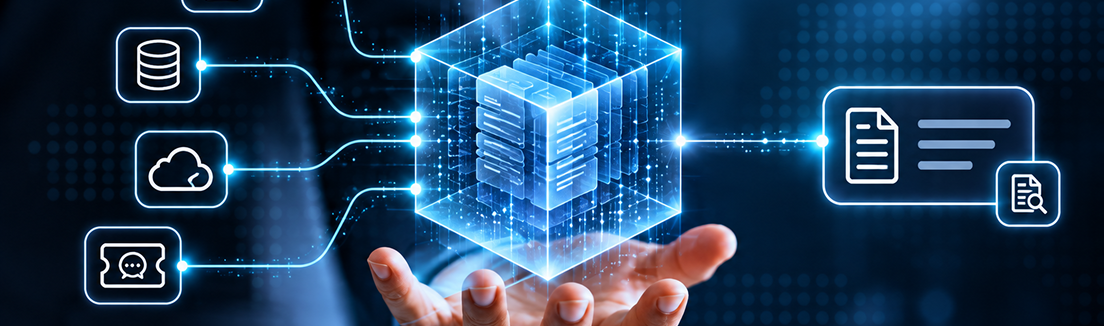
Your knowledge is only as useful as an AI system’s ability to retrieve and ground it. We design RAG architectures that turn enterprise knowledge into reliable answers.
Why Enterprises Choose Us for RAG Development Services
RAG is an engineering discipline in its own right, not a chatbot layered over documents. We bring the domain expertise and strategic prowess to tackle its complexity.
A Retrieval-First Engineering Team
Rather than just prompt-tuning the generation step, we address retrieval failure chances by prioritizing chunking, indexing, and re-ranking.
Hybrid Retrieval Comes As Standard
While vector similarity search may represent a starting point, our complete RAG pipeline solution supports hybrid retrieval with re-ranking.
Permission-Aware Retrieval Design
We embed access control into the retrieval layer, ensuring unauthorized content is neither surfaced during retrieval nor within a response.
Production-Grade Retrieval At Scale
Beyond current sources and volumes of data, we architect for knowledge bases that grow past the point where a naive RAG pipeline may degrade.
Agentic and Graph RAG Expertise
We engineer multi-hop and relationship-aware retrieval where the use calls for deeper context, without forcing every RAG system into one pattern.
Forward-Deployed Engineering Model
Our Forward-Deployed Engineering Model puts RAG engineers alongside your team for collaboration across development, integration, and production.
How a RAG Pipeline Works from Data Source to Response
A standard RAG pipeline typically involves 7 core processes, each handling a distinct stage in retrieving and delivering relevant context for a grounded AI response.
Ingest
Your enterprise documents, records, and other data sources become the foundation for RAG. We structure data from your data platforms for reliable downstream retrieval.
Chunk
Large bodies of source content are split into retrieval-appropriate units, making it easier for RAG to isolate and return the specific information relevant to a query.
Embed
Each chunk is then converted into a vector representation that captures its semantic meaning, allowing the RAG system to identify relevant content during retrieval.
Index
We store vector representations in a searchable index, enabling fast similarity searches while supporting hybrid retrieval that combines semantic and keyword matching.
Retrieve
The moment a user submits a query, the RAG system searches indexed content for relevant context using vector search, keyword matching, or a combination of both.
Generate
The LLM utilizes the retrieved context and produces a grounded response, with citations connecting the answer back to the source information used to generate it.
See How We’ve Integrated RAG Into Enterprise Applications
See how our RAG engineering work helps organizations turn enterprise knowledge into reliable, contextual AI experiences built around real business requirements.
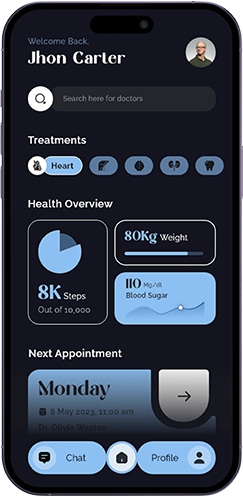
Integrating AI into Sports Platform
Integrated AI-driven intelligence with athlete data and external licensing systems, connecting intelligent analysis to established workflows within a UAE sports governance platform.
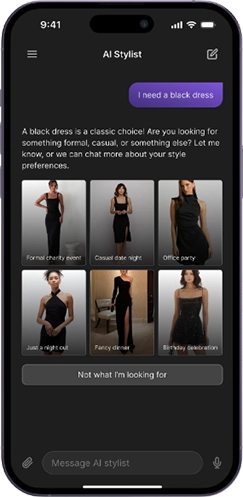
AI Integration with Clinical Systems
Integrated an AI-powered virtual health assistant with EHR, laboratory, and imaging data through HL7 and FHIR, giving it clinical context for healthcare workflows.
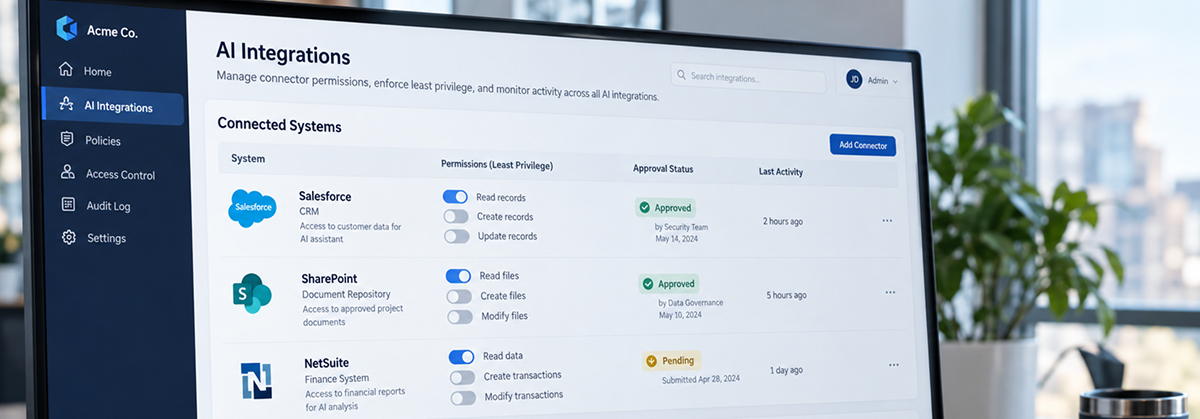
Security and Permission Controls Across the RAG Pipeline
Since AI can access sensitive business information and enterprise documentation, we build security and governance into the retrieval layer from the outset.
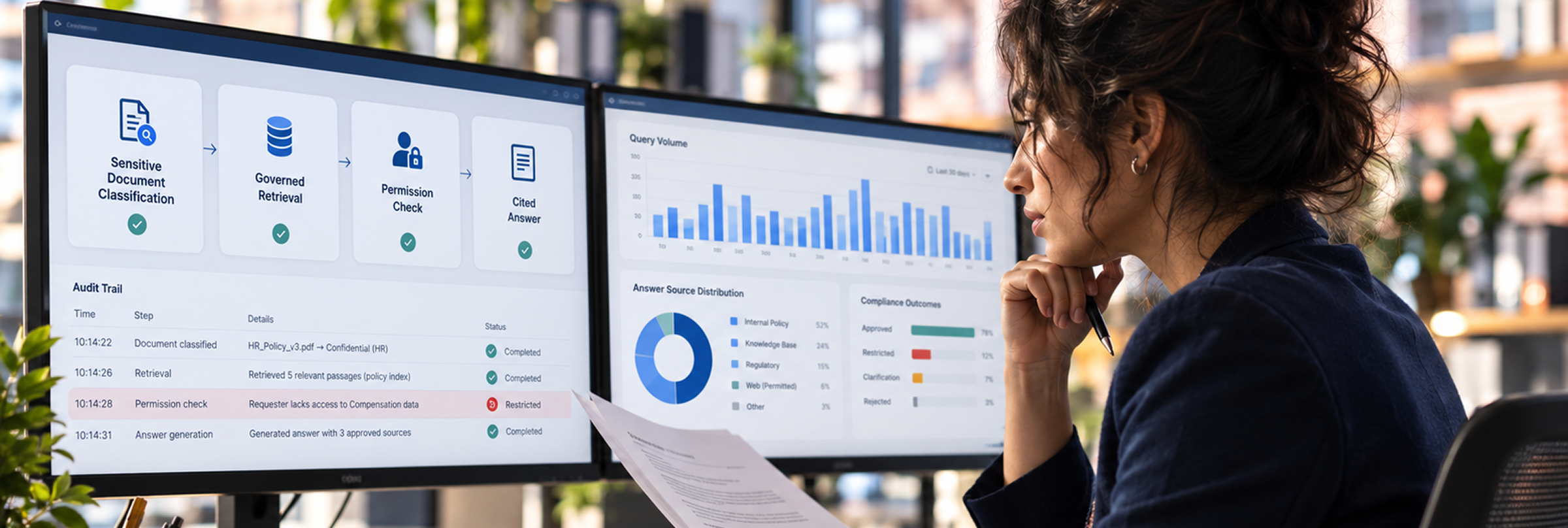
Engineering RAG Systems to Meet Enterprise Compliance Needs
We incorporate compliance into the architecture from the outset, helping organizations maintain control over sensitive knowledge throughout retrieval and generation.
SOC 2 Type II
Helps establish stronger controls for secure RAG operations and data access.
ISO/IEC 27001
A structured security approach supports controlled handling of enterprise RAG data.
GDPR
Personal data handling remains aligned with applicable privacy obligations.
EU AI Act
Risk-based governance can guide oversight across applicable RAG use cases.
NIST AI RMF
Risk considerations extend from retrieved knowledge through generated responses.
ISO/IEC 42001
AI governance principles can shape how RAG systems are managed across their lifecycle.
HIPAA
For healthcare use cases, safeguards help protect PHI within RAG workflows.
HITECH
Electronic health information receives added protection across applicable system use.
CCPA/CPRA
Privacy obligations influence how California residents’ data is handled by RAG.
FedRAMP
Federal cloud deployments can align RAG environments with required controls.
NIST SP 800-53
Applicable security and privacy controls can be incorporated into RAG deployments.
HITRUST CSF
Healthcare-focused security requirements can inform sensitive RAG implementations.
Connecting RAG to Your Existing Knowledge and Systems
RAG works best when it can access the knowledge your teams already rely on. We connect retrieval across existing sources, systems, applications, and access controls.
RAG → Document Sources
RAG connects to document repositories across cloud environments, turning sources such as SharePoint, Confluence, and file stores into searchable enterprise knowledge.
RAG → Structured Data
Structured data from SQL databases, data warehouses, and internal APIs can become part of the retrieval layer, bringing operational data into grounded AI responses.
RAG → Enterprise Search
Existing enterprise search tools can feed RAG rather than being replaced, extending established search capabilities with grounded generation and richer answers.
RAG → Applications
We connect RAG with enterprise platforms like support tools, internal copilots, and case-management systems, bringing grounded knowledge into everyday workflows.
RAG → Agents
RAG retrieval can be exposed as a callable tool for AI agents, allowing them to retrieve relevant enterprise knowledge as part of broader agentic workflows.
RAG → Access Control
Identity and permission systems connect directly to retrieval controls, ensuring RAG only surfaces knowledge users are authorized to access within enterprise workflows.
How RAG Development Creates Value Across Your Organization
The case for RAG does not end with the AI experience. Its implications extend into the decisions leaders make and the engineering work required to sustain the system.
 For Leadership
|
|---|
|
|

 For Practitioners
|
|---|
|
|
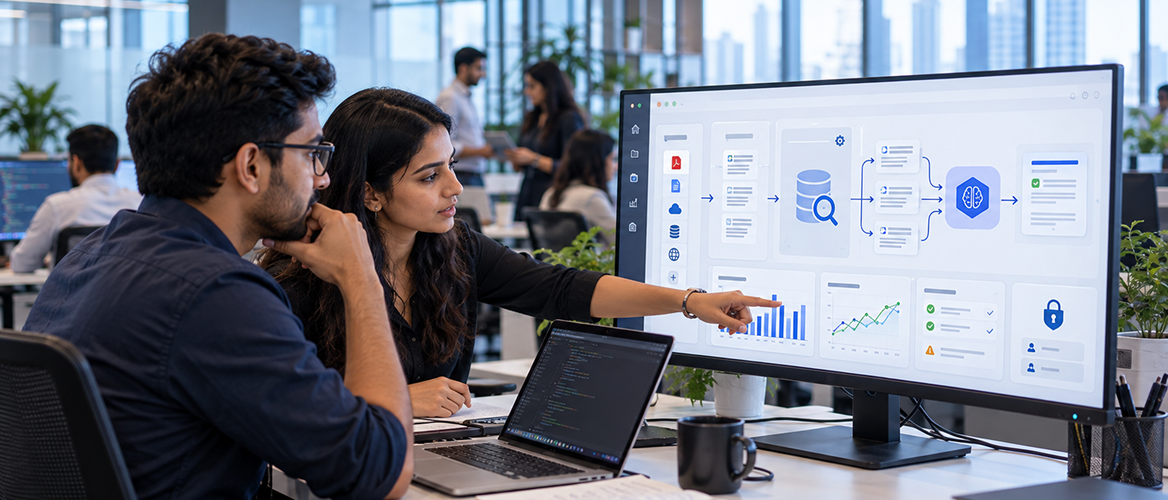
Ground AI in the Information You Can Trust
Your business already has the knowledge AI needs. We make that knowledge accessible through RAG so users can get relevant answers backed by trusted sources.
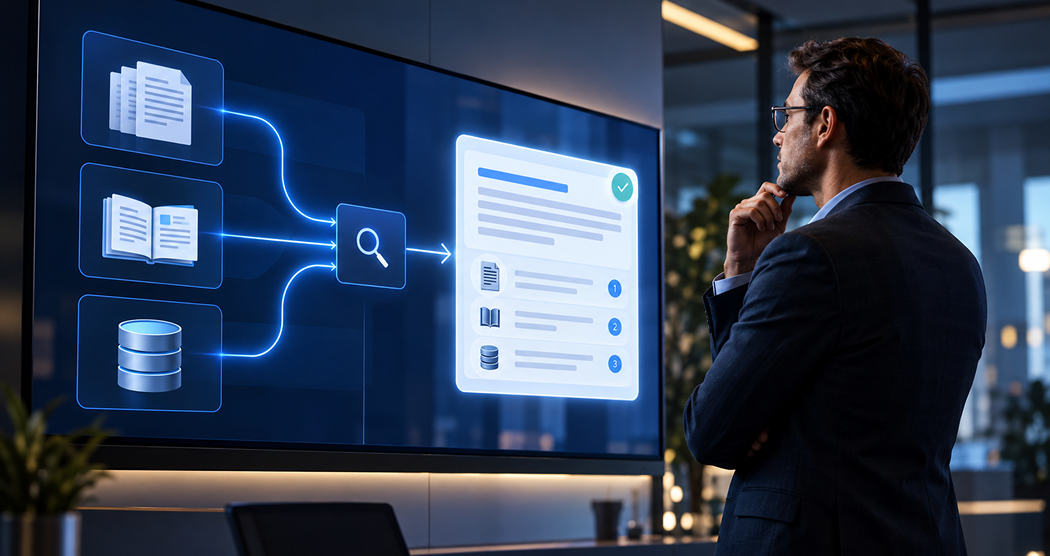
- Ground AI in your trusted business knowledge
- Connect enterprise data to reliable AI answers
- Deliver source-backed answers users can trust
Technologies We Use To Build Production-Ready RAG Systems
Our RAG engineers stay current with emerging technologies, combining domain knowledge and engineering expertise to select the right stack for your requirements.
Embedding Models & Frameworks
- OpenAI Embeddings
- Cohere Embed
- Voyage AI
- BGE
- Sentence Transformers
Vector Stores
- Pinecone
- Weaviate
- Milvus
- Chroma
Generation Models & Platforms
- OpenAI GPT
- Anthropic Claude
- Google Gemini
- Azure OpenAI
- Amazon Bedrock
- Meta Llama
- Mistral
Re-Ranking
- Cross-Encoders
- LLM-based re-ranking
Orchestration
- LangChain
- LlamaIndex
- Haystack
Search Infrastructure
- Elasticsearch
- BM25 hybrid search
Data Infrastructure
- PostgreSQL
- MySQL
- MongoDB
- Snowflake
- BigQuery
Cloud & Deployment
- AWS
- Microsoft Azure
- Google Cloud Platform
- Docker
- Kubernetes
What Does RAG Development Cost with Excellent Webworld?
RAG implementations vary considerably in scope, so we’ve structured our engagements across four broad categories to reflect different levels of engineering investment.
- One single source connected to RAG
- Hybrid or vector retrieval setup
- One defined business use case only
- Production-ready RAG foundation
- Multiple sources connected to RAG
- Hybrid retrieval with re-ranking
- Access-scoped retrieval controls
- Unified enterprise retrieval layer
- Agentic and graph RAG architectures
- Multi-hop retrieval and reasoning flows
- Ongoing tuning for retrieval performance
- Continuous monitoring across production
| Pricing Factor | What Drives The Number |
|---|---|
| Data Volume & Sources | More data volume and more sources cost more |
| Document Complexity | Scanned files always need OCR text extraction |
| Access Control | Fine-grained access adds query-time filtering |
| Retrieval Sophistication | Hybrid and agentic steps add real tuning work |
| Latency & Scale | Real-time scale needs caching plus more infra |
Our RAG Development Process for Production-Ready Systems
A RAG system must perform reliably with users and enterprise knowledge. Our process accounts for retrieval quality, grounding, governance, and ongoing performance.
Knowledge & Source Audit
We map knowledge sources, formats, access requirements, and query patterns early.
Retrieval Architecture Design
Chunking, embeddings, vector stores, and retrieval patterns are defined for your needs.
Access & Governance Design
Permission scoping, data residency, and audit requirements are defined before ingestion.
Knowledge Ingestion & Indexing
Source content is processed and indexed into a structured, retrieval-ready pipeline.
Retrieval Tuning & Optimization
Real queries guide tuning across hybrid search, re-ranking, and query transformation.
Grounded Generation & Citation
Retrieved context is connected to generation with source attribution and citations.
RAG Evaluation & Validation
We test retrieval precision, recall, and groundedness against real query sets.
Production Deployment
Our engineers deploy the validated RAG system into the target production environment.
Monitoring & Ongoing Refinement
Retrieval quality, latency, and drift are monitored as the knowledge base grows.
Take Your RAG Strategy Further with Related AI Services
RAG can establish the knowledge layer for wider AI initiatives. We help you build on that foundation while keeping architecture aligned with long-term objectives.
AI Development Services
From core intelligence to the user experience, we engineer complete AI products.
AI Agent Development
For defined business tasks, we engineer agents that reason, use tools, and act.
Generative AI Development
Generative AI becomes practical when it is shaped around a specific business need.
AI Integration Services
AI connected to existing systems so intelligence works within established workflows.
AI Consulting
Before engineering begins, we help establish where AI makes technical and business sense.
Business Intelligence
When reporting is no longer enough, AI and analytics can reveal what needs attention.
Data Engineering & Platforms
We help you build the data foundations that support enterprise analytics and AI.
AI Copilot Development
Context-aware AI assistance embedded directly into the workflows users already follow.
RAG Development for the Demands of Different Industries
RAG in Healthcare
Our RAG expertise covers clinical guidelines and patient records for healthcare applications.
RAG in Fintech
We develop RAG solutions around compliance manuals and product terms for fintech teams.
RAG in Insurance
RAG development expertise extends to policy documents and claims data for insurers.
RAG in Legal
Our RAG engineers work with case law and contracts to support legal research and drafting.
RAG in Public Sector
Our RAG expertise extends to government data and public-sector information systems.
RAG in SaaS
RAG solutions grounded in product documentation for in-app assistance and user onboarding.
Frequently Asked Questions About RAG Development Services
RAG retrieves relevant content from documents, databases, or knowledge bases and provides it to an LLM as context, grounding responses in current enterprise knowledge rather than training memory alone.
Fine-tuning changes a model’s weights using training examples, while RAG retrieves knowledge at query time. RAG can also cite retrieved sources and update knowledge without retraining.
No. RAG can substantially reduce hallucinations by grounding responses in retrieved content, but models may still misinterpret context. Grounding constraints and citation verification provide additional safeguards.
Naive RAG typically relies on single-pass vector similarity search. Advanced RAG adds techniques such as hybrid search, re-ranking, query rewriting, and multi-step retrieval to improve relevance.
Yes. RAG can retrieve from structured databases through SQL or APIs alongside unstructured documents, allowing both data types to contribute context to a single response.
Access control is enforced within the retrieval layer itself. Permissions are checked before content is retrieved, rather than filtering unauthorized information after retrieval.
Agentic RAG allows the system to determine what to retrieve and when, issuing multiple retrieval steps when needed. This makes it suitable for complex multi-hop questions.
Graph RAG combines retrieval from knowledge graphs with vector search when needed, making it useful for domains where relationships between entities matter as much as document content.
RAG development costs vary with knowledge sources, document volume and complexity, access-control requirements, and retrieval sophistication. Advanced retrieval and agentic architectures generally require greater engineering effort.
Yes. We diagnose whether accuracy issues stem from chunking, retrieval, or re-ranking, then tune the existing pipeline rather than assuming the system needs to be rebuilt.