Agentic AI Development Services
Let’s move your business from AI-assisted to agentic AI. As an experienced agentic AI development company, we support enterprises in architecting and rolling out operating models where AI systems act toward defined goals. Each model involves governance and human oversight according to the level of control each operation requires. Enterprises receiving our top-notch agentic AI development services report a 3X average improvement in ROI and a 60%+ reduction in approval bottlenecks.
Years of Tech Experience
Software Engineers & AI Experts
Artificial Intelligence Deployments
Client Retention Rate


- Dynamic Planning & Reasoning
- Live Decision Support
- Autonomous Process Management
- End-to-End Workflow Ownership
- Goal-Oriented Process Execution


Connect Isolated AI Solutions to Agentic Operating Models
A point solution is where a single AI agent automates one task. Agentic AI takes it further, using autonomous execution to achieve defined goals as part of day-to-day business operations. We design operating models that connect autonomous agents to coordinate and execute work across business functions.
01
Shift From Automating Tasks to Goal-Driven Operations
What we do is define outcomes upfront instead of automating individual steps. This lets coordinated agent systems define the best path with established controls.
02
Make Real-Time Decisions Without Waiting for Human Approval
It’s too late for manual processes to respond in case conditions change. Autonomous systems assess these situations and act on decisions within seconds.
03
Scale Human Oversight Through Exception
Instead of placing every action through human approval, the operating model brings human reviewers in place when anomalies and high-stakes decisions require intervention.
04
Build Audit-Ready Autonomy From Day One
Your business is compliance-ready without retrofitting audit layers after deployment. How? Since every autonomous decision is recorded, traceable from the outset, and explainable.
05
Measure Autonomous Operation With Business Metrics
Business ROI is something that requires more than uptime metrics. Measure cost impact, decision quality, time savings, and customer outcomes to track the value generated across operations.
06
Align Your Organization Before Scaling Autonomy
Having only technical capability in place is not enough. So before expanding autonomous scope, we validate risk ownership, governance, and team buy-in within each function.
Cut Manual Handoffs With Cross-Functional Agents
Rather than manual routing, departments, sales, finance, operations, and support work via coordinated agents. This reduces the bottlenecks that slow down decision-making and create rework.
Free Your Team to Execute Strategic Work
Human review focuses on meaningful exceptions, not routine activity. It covers areas like customer escalations, competitive moves, and policy exceptions.
Build Agentic Capabilities With Control at Every Step
Autonomy expands tier by tier as organizational readiness is established. This ensures governance and trust are assessed before moving to a higher tier.
Agentic AI Development Services for Enterprise Operating Models
Whether the priority is about evaluating business readiness or governing autonomous decisions, each capability is aligned with a specific agentic adoption stage. Our focus remains constant on how autonomous systems operate across business functions, not on the engineering part for an individual AI agent.
Agentic Maturity Assessment
Before expanding autonomy, we evaluate AI maturity across the AI-Enabled → AI-Augmented → AI-Native → Agentic curve. Also, we identify functions ready to support autonomous operation.
Agentic Operating Model Design
By defining escalation paths, decision rights, and points where human oversight enters the workflow, we set the boundaries for goal-directed autonomy.
Cross-Functional Agent Ecosystem Strategy
Our AI experts are experienced in designing cross-department coordination for independently built agent systems. It allows sharing context while keeping actions aligned.
Autonomy Governance Framework
We determine the autonomy policy that controls everything. From which decisions can proceed without approval to how the scope of autonomy changes over time.
Agentic Rollout & Change Management
Our team ensures to roll out the transformation in a sequence across functions. This covers the process and organizational change required to support autonomous operations.
Agentic Performance & Risk Monitoring
We define business and risk metrics for autonomous operation. How does it help? It combines technical uptime with ongoing monitoring of decision quality and behavioral drift.
Agentic Transformation Backed by Full-Stack Delivery Capability
Our expertise in software engineering, AI & ML, cloud services, tool integrations, and enterprise platforms supports the technical demands of complex AI initiatives. Such a level of engineering capabilities addresses and supports the technical delivery needs beyond the initial AI implementation.
Clutch Global Ranking — IT Services
Digital & Software Projects Delivered
Years of Engineering Expertise
Countries with Global Client Presence

Top AI Development Company (United States 2024)
Top Clutch Machine Learning Company Salt Lake City 2026
Top Clutch AWS Company United States 2026
Top Clutch Azure Company United States 2026
Top Clutch Google Cloud Company United States 2026
Top Clutch Systems Integration Company Dubai 2026
Why Agentic Programs Struggle to Move Beyond Pilot
We assess and identify the operational conditions that limit agentic adoption, like disconnected approval processes, unclear risk ownership, governance gaps, and conflicting agents. Our team maps each challenge to specific actions that support a controlled path to greater autonomy.
| Challenge | Why It’s Hard | EWW’s Approach | ||
|---|---|---|---|---|
|
Legacy workflows can’t capture AI decisions
|
Why It’s Hard | When approvals are spread across Salesforce, email, and manual sign-offs, autonomous agents struggle to see the full approval context needed to handle exceptions. | EWW’s Approach | We connect agent actions to existing workflows, APIs, and audit logs so autonomous actions follow the same approval structures as human actions. |
|
AI autonomy weakens audit controls
|
Why It’s Hard | Your finance, legal, or compliance teams need a clear decision trail showing who or what authorized an action, while autonomous execution can leave limited traceability behind. | EWW’s Approach | We establish decision auditability before deployment by capturing agent actions, governing policies, timestamps, confidence levels, and human interventions. |
|
Greater autonomy doesn’t mean greater trust
|
Why It’s Hard | Leadership often lacks a clear view of how much autonomy is safe to grant, leading to overly restrictive controls or autonomy that extends beyond acceptable risk. | EWW’s Approach | We define maturity stages and autonomy boundaries using measurable trust signals. This allows scope to expand as performance is validated. |
|
Agents duplicate cross-functional work
|
Why It’s Hard | Separate agent systems interfere with one another when these agents act on shared business processes without a common coordination operational model. | EWW’s Approach | Before expanding deployment, we establish coordination protocols and shared context layers that allow agent systems to operate consistently. |
|
No clear owner for agentic risk
|
Why It’s Hard | Traditional ownership models struggle to accommodate autonomous decision-making that crosses compliance, risk, and engineering functions. | EWW’s Approach | Clear accountability for agentic risk and performance is built into the operating model alongside the technical implementation. |
|
The path to autonomy is too steep
|
Why It’s Hard | Taking a direct jump from AI-Augmented to fully Agentic expands autonomy faster than technical capabilities, governance, and organizational trust can support. | EWW’s Approach | Each function follows a defined maturity path, with clear milestones marking when it is ready to progress to the next tier. |
Enterprise Transformation Approaches for Agentic Operation
There is no single rollout model that fits every organization’s path to agentic transformation. That is why our operating patterns account for existing systems, autonomy requirements, cross-functional dependencies, and the level of trust required for independent agent execution.
Legacy System Integration Retrofit
Rather than replacing established systems, this pattern adds agents to approval workflows already running across email, SAP, and Salesforce.
Parallel Pilot Validation
For organizations using phased validation to build confidence in autonomous decisions before scaling deployment.
Cross-Functional Agent Ecosystem
Move beyond isolated point solutions by coordinating autonomous systems across departments around shared processes and business goals.
Governed Autonomy Boundary
For enterprises that need to define and enforce consistent boundaries for autonomous decisions across agentic systems.
Agentic Center of Excellence
Establish common governance standards across agentic initiatives instead of allowing each function to define its own approach.
Phased Trust Expansion
For organizations that need to build trust in autonomous operations through measured performance before expanding scope.
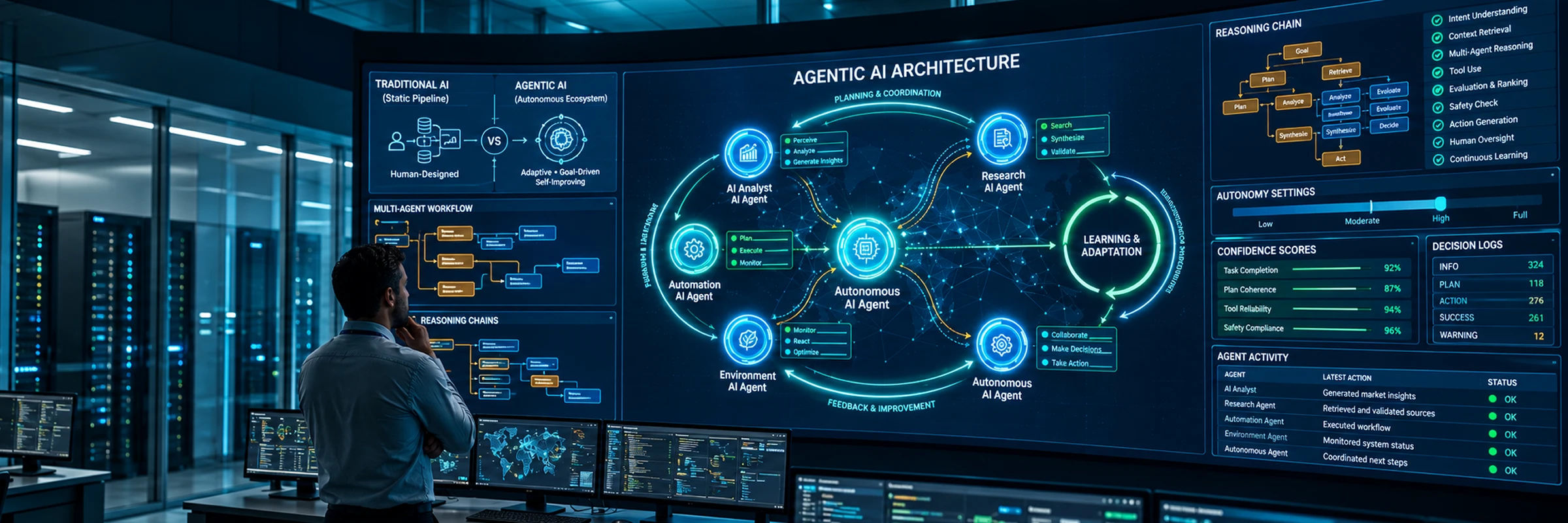
Agentic Transformation Built Around Real Organizational Readiness
The starting point is the organization’s current state, not a predetermined autonomy level. We assess AI capabilities, governance structures, risk ownership, and transformation priorities to determine where autonomy can be introduced and what needs to follow.
Disconnected Agent Systems
Running multiple autonomous workflows that need consistent coordination, governance, and operating rules.
CIOs/COOs Scaling Autonomy
Require a maturity assessment to determine where greater autonomy is appropriate and what controls are needed.
Compliance-Driven Enterprises
Are preparing for broader autonomy while ensuring governance meets industry-specific compliance requirements.
Beyond AI-Native Capabilities
Have established AI-native capabilities and need to determine where autonomous, goal-directed execution fits next.
Multi-Year AI Roadmaps
Want to coordinate a multi-year transition to agentic operations without committing to a big-bang rollout.
Agentic Risk Ownership
Need to establish organizational ownership for autonomous decisions before scaling agentic operations.
Ready to Move From AI-Assisted to Agentic?
Let us know where your business positions on the maturity curve today, and which functions you are considering for autonomous operation. We are here to help you map your path.

- Assess your current level of AI maturity
- Identify workflows ready for autonomous AI
- Map the right path for agentic adoption
- Align autonomy with business goals and controls
How Agentic AI Development Differs From Related AI Services
Need one agent for a defined task? That is a different requirement from moving an entire function toward autonomous operation. The table below separates these services by what they build, where they operate, and when each approach fits.
| Service | What It Actually Builds | Not This Page If… | ||
|---|---|---|---|---|
|
Agentic AI Development
|
What It Actually Builds | Establishes the operating model for autonomous, goal-directed operations through maturity assessment, cross-functional coordination, and governance. | Not This Page If… | — |
|
AI Agent Development Services
|
What It Actually Builds | Focuses on engineering individual agents that include reasoning loops, tool selection, memory, and guardrails for task-specific execution. | Not This Page If… | You need to build a specific agent, not an organization-wide operating-model shift. |
| What It Actually Builds | Links deployed agents or AI systems with the enterprise platforms and workflows required for execution. | Not This Page If… | You already have the AI capability and need it connected to your enterprise systems. | |
|
RAG Development Services
|
What It Actually Builds | Focuses on retrieving and grounding relevant information that agents can use as part of their execution. | Not This Page If… | The use case centers on knowledge retrieval and grounded responses. |
| What It Actually Builds | Shapes the overall AI strategy and architecture across use cases, platforms, and adoption priorities. | Not This Page If… | The priority is defining an AI strategy, use cases, and architecture across the organization. | |
|
AI Automation
|
What It Actually Builds | Uses AI and workflow orchestration to automate structured, largely predictable business processes. | Not This Page If… | Your process is already defined and repeatable, so you need automation instead of a redesign of how the function operates. |
Why Choose Excellent Webworld for Agentic AI Development
We bring strategy and implementation together so agentic operating models can be designed around what can actually be built, integrated, governed, and measured. Our teams stay close to the systems and workflows that determine whether autonomy works in practice.
Strategy That Reaches Production
We assess systems, dependencies, constraints, and rollout risks before shaping the operating model. Strategy stays grounded in what can be implemented.
Execution Backed by Experience
We ground every operating-model recommendation in the technical ability to build its underlying agents, integrations, and retrieval systems.
We Own the Governance Gap
We operationalize AI Governance through audit trails, escalation paths, performance monitoring, and policy updates within your existing systems and operational constraints.
Cross-Functional Ecosystem
Our approach accounts for how agents across departments coordinate and share context, rather than focusing on one agent’s task alone.
Explicit, Staged Trust Expansion
Our expert AI team expands autonomy based on measured performance and established trust, not a single decision made at the outset.
Forward Deployed Engineering
We place engineers within client environments to support delivery, backed by experience across Government of Dubai, Torod, Braive, and Shopping Gate.
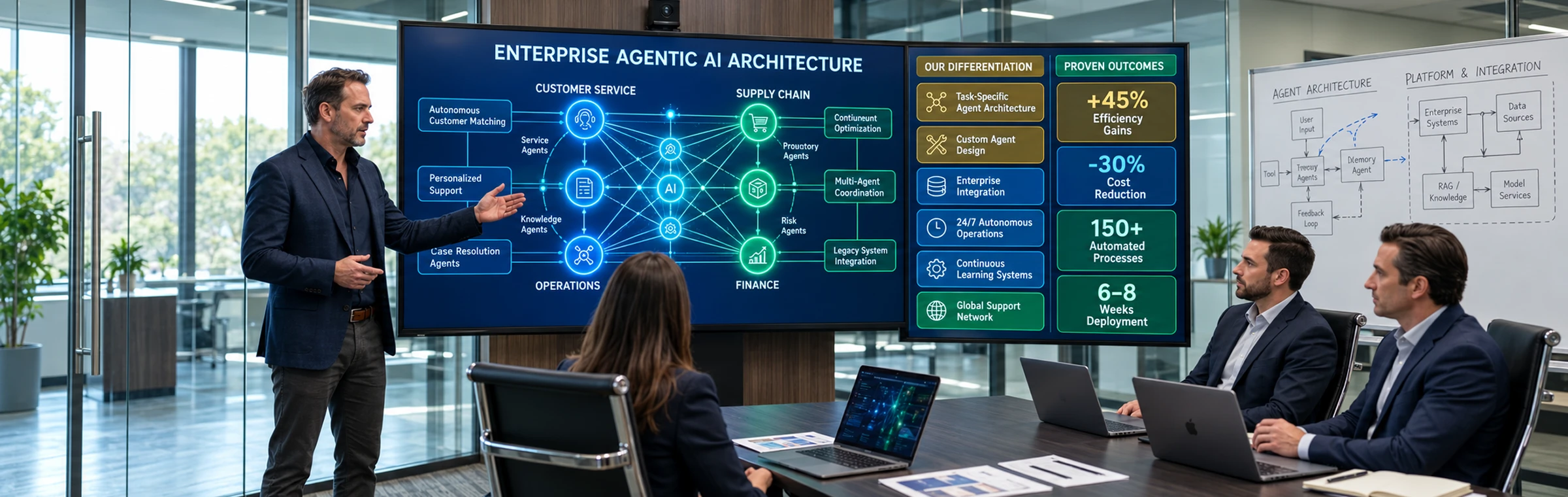
The Agentic Maturity Curve (From Assisted AI to Autonomous Operations)
Your position on the AI maturity curve defines what agentic adoption must look like. Being in the AI field for such a long time, we are experts at assessing workflows, capabilities, governance, and human oversight to map a practical path between all the maturity tiers.
AI-Enabled
AI supports human work within existing tools, with people controlling decisions, actions, and workflow progression.
AI-Augmented
AI assists with decisions and execution across workflows, with human oversight still required at most stages.
AI-Native
AI is embedded into the architecture of systems and processes rather than added as a separate capability.
Agentic
AI systems plan and execute towards defined goals across workflows, while humans oversee exceptions.
Our Recent AI Integration Projects
See how we’ve integrated AI into existing products and business systems, turning standalone capabilities into something teams can use in their day-to-day operations.
Integrating AI into Sports Platform
Integrated AI-driven intelligence with athlete data and external licensing systems, connecting intelligent analysis to established workflows within a UAE sports governance platform.
AI Integration with Clinical Systems
Integrated an AI-powered virtual health assistant with EHR, laboratory, and imaging data through HL7 and FHIR, giving it clinical context for healthcare workflows.

Governance for Enterprise Autonomous Operation
Build governance around the organization, not just the agent. We define who owns autonomous decisions, what agents are permitted to decide, when exceptions reach people, and how performance, decision quality, coordination, and cybersecurity protocols are monitored as autonomy expands.
How Agentic Transformation Connects to the Rest of Your Stack
Your existing AI systems and enterprise integrations do not need to operate as separate layers. We connect them via shared context, governance, and escalation logic to support coordinated autonomous workflows.

What Agentic Transformation Changes for Your Business
We help organizations establish an agentic operating model where leadership has visibility into autonomy, risk, and performance while practitioners have clear boundaries for working with autonomous systems. The result? You get a model designed around defined responsibility rather than ambiguous authority.
|
For Leadership
|
|---|
|
|

|
For Practitioners
|
|---|
|
|

Move Toward Agentic Operation at Your Pace
Whether you’re coordinating existing agents or preparing a function for greater autonomy, our team is here to help you define the priorities, boundaries, and rollout stages.

- Set priorities for your agentic roadmap
- Define clear boundaries for AI autonomy
- Plan rollout stages around your business
What Underpins Agentic Transformation
From agent orchestration and foundation models to enterprise APIs, knowledge systems, observability, governance, and cloud, each technology layer supports a different part of autonomous operation. We select the combination based on the system’s workflow, integration needs, risk profile, and deployment environment.
Agentic AI Frameworks
- LangGraph
- CrewAI
- Microsoft AutoGen
- Semantic Kernel
- OpenAI Agents SDK
- Google ADK
Foundation Models
- OpenAI GPT
- Anthropic Claude
- Google Gemini
- Meta Llama
- Mistral
- Azure OpenAI
Agent Communication
- MCP
- A2A
- OpenAPI
- Function Calling
Enterprise Integration
- REST APIs
- GraphQL
- Webhooks
- OAuth 2.0
- API Gateways
Memory & Data Infrastructure
- Pinecone
- Weaviate
- Redis
- PostgreSQL
- MongoDB
- DynamoDB
RAG & Knowledge Systems
- LangChain
- LlamaIndex
- Elasticsearch
- OpenSearch
- Pinecone
- Weaviate
Observability & Evaluation
- LangSmith
- Langfuse
- OpenTelemetry
- MLflow
- Datadog
Cloud & Deployment
- AWS Bedrock
- Microsoft Azure
- Google Cloud
- AWS Lambda
- Azure Functions
- Kubernetes
- Docker
Security & Governance
- Azure AI Content Safety
- AWS Bedrock Guardrails
- Microsoft Purview
- Azure API Management
- AWS IAM
What Agentic Transformation Actually Costs
Know what you are paying for before the transformation begins. We scope engagements around the number of functions involved, governance complexity, autonomy requirements, rollout stages, and engineering support needed to move from assessment to operation.
Single-Function Maturity Assessment & Roadmap
Perfect For Organizations Evaluating Agentic Readiness
- One business function
- Current-state assessment
- 12-month phased roadmap
Function-Level Agentic Rollout
Perfect For Teams Ready to Go Autonomous
- Operating-model design
- Governance framework
- Phased autonomy rollout for one function
Enterprise Agentic Transformation Program
Perfect For Multi-Function Organizational Change
- Multi-function rollout
- Cross-functional ecosystem governance
- Center-of-excellence setup
| Cost Drivers | Breakdown |
|---|---|
| Number of Functions in Scope | One department or enterprise-wide transformation |
| Current vs. Target Maturity | Gap from AI-Augmented to Agentic determines governance complexity |
| Regulatory Environment | Compliance requirements add assessment, audit, and policy overhead |
| System Integration Complexity | Legacy system connectivity, API development, data migration needs |
| Cross-Functional Coordination | Isolated function vs. ecosystem-wide agent orchestration |
| Risk Ownership & Governance | Clear accountability structure vs. gap-filling across departments |
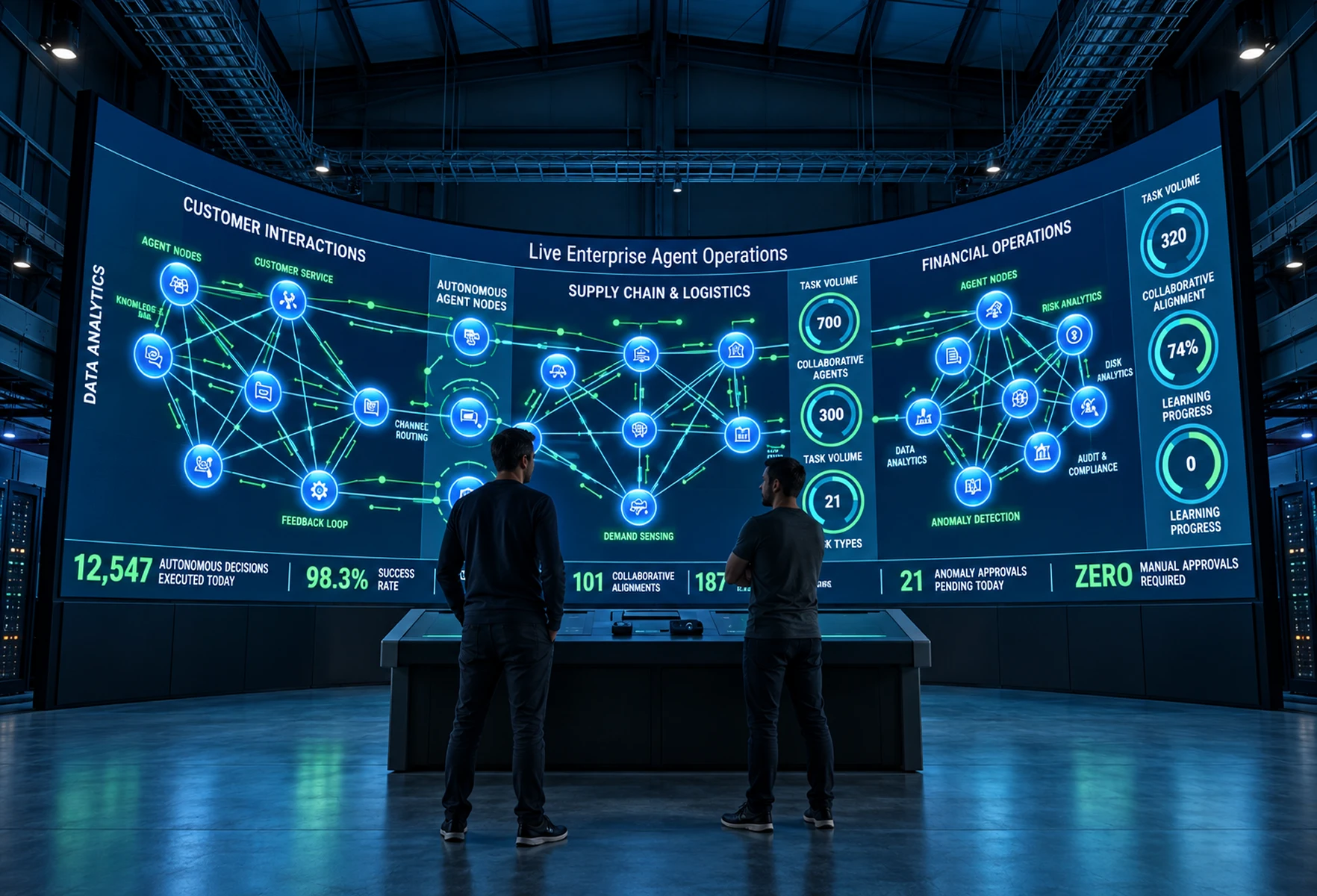

Our Agentic Transformation Process
Each phase answers a different operational question: where can autonomy work, how should it operate, what boundaries apply, and when is it ready to expand? This creates a structured path from assessment to ongoing governance.
Agentic Readiness Assessment
We assess each function against the AI-Enabled, AI-Augmented, AI-Native, and Agentic curve to identify maturity and readiness for autonomy.
Target Operating Model Design
Your target operating model defines how autonomous work will function, including decision rights, human responsibilities, and escalation paths.
Governance Framework Design
Set clear autonomy boundaries, risk ownership, approval requirements, and exception-handling rules before autonomous workflows enter production.
Roadmap Sequencing
Each function receives defined milestones for progressing between maturity tiers, with rollout priorities aligned to technical and operational readiness.
Agent Build & Integration
Our engineering teams build the required agents, work with enterprise LLM solutions, and connect them with enterprise systems, workflows, data sources, and audit mechanisms.
Performance & Risk Monitoring Setup
Track decision quality, exception rates, autonomy performance, and operational risk through business-level metrics alongside technical monitoring.
Trust Expansion Review
Before autonomy expands, we review performance data, risk signals, and exception patterns against the criteria established for the current stage.
Cross-Functional Coordination
Shared context, decision policies, and governance extend across functions as multiple agentic workflows begin operating within connected environments.
Ongoing Governance Operation
Your governance model stays operational through shared standards, risk reviews, performance monitoring, and policy updates as initiatives scale.
Related AI Engineering Services
The scope of an AI initiative determines the engineering capability it needs. Use these services to build a specific agent, connect existing systems, ground AI responses, automate defined workflows, or establish the infrastructure required for production.
AI Agent Development Services
Build the reasoning loop, tools, memory, and guardrails for a specific agent or bounded agent system.
AI Integration Services
Integrate AI capabilities with enterprise applications, APIs, data sources, and workflows already used across the business.
RAG Development Services
Ground AI with enterprise knowledge through retrieval, indexing, contextual search, and source-aware response pipelines.
AI Consulting
Define AI strategy and architecture broadly, including for organizations not yet ready for an agentic conversation.
AI Automation
Automate repeatable business workflows by combining AI capabilities with workflow orchestration and process logic.
MLOps
Keep AI and machine learning workloads reliable in production through continuous deployment, monitoring, and operational management.
Agentic Transformation Across Industries
From financial reconciliation to logistics exceptions and citizen services, agentic opportunities look different across industries. We map autonomous workflows to industry-specific processes, risk requirements, and points where human judgment remains necessary.
Finance
For financial operations, agents can coordinate monitoring and reconciliation workflows and escalate exceptions according to predefined decision boundaries.
Healthcare
Allow agentic coordination across scheduling, intake, and administrative workflows without extending autonomy into clinical decision-making.
Government / Public Sector
Build coordinated agentic operations for citizen services, with autonomy structured around public-sector workflows and governance requirements.
Logistics
Routing, dispatch, and exception handling can work as a coordinated agentic system rather than separate operational workflows.
Retail / eCommerce
Coordinate inventory, fulfillment, and customer service through goal-directed agents operating within defined business boundaries.
Insurance
For insurers, agents can coordinate claims and underwriting workflows while applying predefined boundaries to autonomous decisions and exceptions.
What Our Clients Are Saying
The strongest measure of an engineering partnership comes from the organizations that have experienced it firsthand. See what our clients say about working with Excellent Webworld.

Abdulaziz Alotaibi

I chose Excellent Webworld for its quality, fair pricing, and collaboration. They treated my app ‘Move Coins’ like their own, ensuring success.

Thomas Devito

I’ve been working with Excellent Webworld for over 10 years and have received dozens of web productions for small businesses.

Nick Wright

The designers took the challenge to redesign my app and website from scratch and give my brand a newly updated identity.
Frequently Asked Questions
Agentic AI systems make and execute decisions autonomously toward business goals without human approval at each stage. It’s not similar to AI assistants that respond to prompts; agentic systems plan workflows, adapt to real-time conditions, and complete tasks independently.
AI Agent Development builds individual agents: the reasoning loop and guardrails for one system. Agentic AI Development designs how multiple agents coordinate across your organization under shared governance.
The curve runs AI-Enabled (AI as a feature), AI-Augmented (AI supports human decisions), AI-Native (systems built around AI), and Agentic (autonomous with human oversight on exceptions).
No. Automation follows fixed rules. Agentic AI reasons through decisions and adapts in real time. A rule approves invoices under $1,000. Agentic evaluates vendor history, payment terms, and cash position for each invoice.
You can start narrow with autonomous decisions under $5K, measure for 90 days, then expand only if you think that the metrics are justifying it. Each expansion is backed by data showing agent accuracy, escalation rates, and business impact.
Risk ownership must be assigned explicitly in the operating model. The owner monitors decision quality and approves policy changes. Without this, risk falls through the gaps between departments. Clear ownership also determines who decides whether to expand autonomy scope or tighten it based on performance.
Yes. However, it requires shared context layers and conflict-resolution policies. When agents conflict, governance determines priority and routes exceptions to the right human.
Not strictly. AI-Native functions reach agentic faster. Others need intermediate phases like data cleanup and governance setup. The maturity assessment identifies your timeline. Functions at different maturity levels can advance at different speeds, so you don’t have to wait for the entire organization to be ready.
A single-function assessment takes around $150K-$300K. A function rollout would take around $400K-$800K. And an enterprise program would range from $ 1 M to $ 3M+. The exact cost depends on the maturity gap, system integration, no. of functions, and regulatory complexity.
The time it takes for a single function pilot is around 3-4 months. For a function rollout, it is around 6-9 months, and for enterprise transformation, it stays around 12-18 months. Pace is driven by organizational readiness. Rushing the timeline means governance frameworks fail under operational pressure, so staged progression protects both your systems and your teams.
Traditional RPA follows pre-programmed rules for specific tasks, while agentic AI makes autonomous decisions and adapts to new situations. Agentic AI handles unstructured data and complex scenarios better than rule-based RPA systems.