“If a hospital already knows how much stock it has, why does it still end up with shortages and emergency purchases?”
This isn’t supposed to be a rhetorical question. In fact, it was a question my team and I explored at length during a recent team sync.
On the surface, it seems almost too simple to ask. But it starts to get uncomfortable once you realize that healthcare organizations have been relying on healthcare software and inventory management technologies for years now and the challenge still prevails.
Hospitals have no shortage of data that could help: stock levels, consumption trends, supplier lead times, and more. What’s missing is an intelligence layer with the agency to turn those signals into timely, cost-saving decisions.
That gap is where the conversation around AI agents for medical inventory management begins.
What Is an AI Agent for Medical Inventory Management
An AI agent for medical inventory management is a software system that monitors inventory and demand signals, reasons about what action is required, and executes authorized inventory tasks with limited human intervention.
This is a markedly different approach from conventional medical inventory management software, which tracks inventory levels and triggers predefined actions based on configured rules.
The important term to hold on to here is “agent”. A rules-based or RFID-only inventory system lacks agency. Sure, it can automatically respond when the medical inventory falls below its minimum threshold, but an agentic AI inventory system has the agency to determine what should happen next, based on its evaluation of factors such as current stock, consumption trends, upcoming demand, and supplier lead times.
Our CTO explained the underlying difference between the two in one simple line during the discussion.
“In any decision-making workflow, prediction alone does not constitute agency.”
 Mayur PanchalCTO, Excellent Webworld
Why Hospitals Are Moving Past Manual and Rule-Based Inventory Systems
Imagine this scenario: An OR schedule shows a sharp increase in procedures next week. The hospital has enough surgical consumables to meet the current demand, so there’s no alert or trigger for an urgent reorder. But then you discover that the additional procedures will push consumption beyond the current stock before the next routine delivery arrives.
You’ll realize that it’s not so unrealistic. Hospitals do already rely on practical and auditable replenishment rules, but research shows that rules based on fixed thresholds can respond slowly when demand patterns change.
The harder question to answer is what happens after that signal appears. Do you place another order for a larger quantity? Do you pull stock from another facility? Or do you wait because a delivery is already scheduled?
Decision-makers need better supply chain visibility across demand, supply, and available stock before choosing the most appropriate action.
Key Challenges in Hospital Supply Chains That AI Agents Solve
Stockouts & Emergency Shortages
To even begin to address this challenge, we have to get to the root of it. I don’t think that the issue is a nurse finding a shelf empty when it’s supposed to still have a week’s worth of supplies. By then, the problem had already been compounding for some time. Procedure volumes may have changed or a supplier may have extended its lead time. The real concern is that a fixed reorder point doesn’t necessarily account for that.
The hospital needs to catch these changes early enough to be able to do something about them. With an AI agent, you can connect these signals to support stockout prevention before a routine replenishment issue turns into an emergency.
Overstock and Expired-Stock Waste
Just as a shortage disrupts care delivery, persistent overstocking ties up capital and creates avoidable waste. If there’s a box of surgical supplies sitting unused in one facility while another facility orders the same supplies, I wouldn’t exactly call that useful inventory. The same goes for medication that expires before it can even be prescribed. Agentic AI can support inventory optimization by reasoning across demand, location, expiry, and future requirements.
Fragmented Data Across Departments
This is one area where AI agents for medical supply inventory management can be particularly useful. They can operate across different systems and bring relevant context together to make a more informed inventory decision.
Think about it: a healthcare organization has large volumes of data in the form of consumption records, purchase orders, ERP/MMIS data, procedure schedules, barcode or RFID events. The problem is that these systems and the data within them are often siloed.
→ The procedure schedule may surface demand trends.
→ The ERP may tell you what’s already been ordered.
→ RFID may show what’s physically available.
Unless those signals are brought together, no single system has the complete picture needed to make the right inventory decision.
Manual Recording & Staff Burden
There’s also a less obvious cost of manual replenishment. People end up doing coordination work that software should be able to handle.
I’d say (and I think you’ll agree too) that none of these steps is especially intricate, but repeating them across a large inventory can quickly turn into a significant burden.
In my view, that is a better use of agentic AI automation: taking care of defined, repetitive workflows while keeping people involved when the decision carries real clinical, financial, or compliance consequences.
How AI Agents Work: Architecture Behind Autonomous Inventory Management
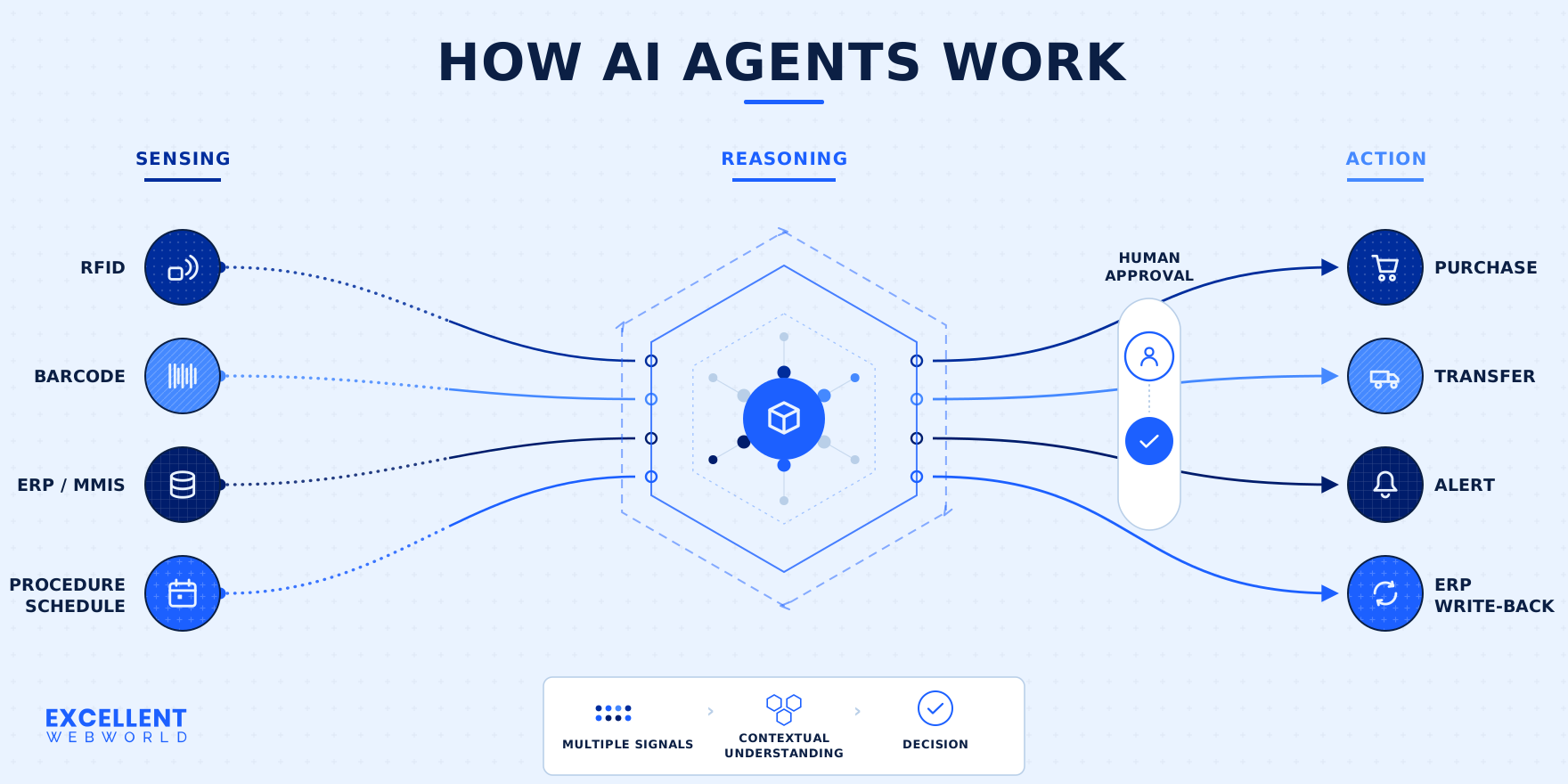
I’d look at an AI inventory agent as an additional decision and execution layer, not as a replacement for the healthcare organization’s existing inventory infrastructure. The RFID reader, IoT devices, barcode scanners, ERP/MMIS and other systems still play an active role. Getting that layer right is really a matter of thoughtful agentic AI development, not just plugging a model into existing systems.
The Sensing Layer
For an AI Agent to work, it needs something to work with and that something is the aforementioned large volumes of data. You’ve got RFID tracking that can report an item’s movement out of a storage location. You have barcode scans that capture a consumption event. Then there are RTLS or IoT devices in healthcare that provide location or environmental signals.
You don’t need to replace the existing sensing infrastructure with an AI Agent. Interestingly enough, the agentic workflow depends on it. The agent’s job is to bring those signals into a broader operational context, which is really a question of AI integration rather than replacing what’s already in place.
The Reasoning Layer
This is where things get even more interesting. Suppose the AI agent sees that inventory for a surgical consumable is approaching its periodic automatic replenishment (PAR) level. That data point by itself isn’t complete enough to decide whether another order is necessary.
An AI agent for medical inventory management can look at
- recent consumptions
- demand forecasts
- upcoming procedures
- supplier lead times
- open purchase orders
- inventory at other facilities
- relevant business rules
A demand forecasting model might tell you that demand is likely to increase next week. An optimization layer can then compare the available options. The AI agent can use those outputs, along with defined rules and constraints, to decide what should happen next.
That’s how you distinguish prediction from agency.
On AI Prediction vs. AI Agency
“An AI forecasting model can tell you that stock is likely to run low. But only an AI agent can take that forecast, look at the rest of the situation, and work through the next decision.”
 Mahil JasaniCOO, Excellent Webworld
The Action Layer
Once the agent decides on an action, it needs write access to take the necessary action, which could be preparing a purchase order, initiating an inventory transfer, sending out an alert/notification, checking supplier availability, or using an ERP integration to write an approved transaction into the ERP or procurement system through an API.
However, I wouldn’t give every workflow unrestricted write access. Routine restocking may be suitable for bounded automation, but you’d want critical actions like a high-cost purchase or clinical substitution gated behind a human approval layer before the agent can execute them.
That approval layer is part of the architecture, not an afterthought.
And if multiple AI agents are involved, each should have a specific role rather than simply addressing the system as “multi-agent.” For instance, a monitoring agent can spot a potential shortage, while an execution agent can prepare the approved transaction. This kind of multi-agent orchestration helps clarify what each agent can access, what it can change, and where human oversight comes into the workflow.
The result is a progression that looks something like this:
See what is happening → understand why it is happening → determine what should happen next → get approval where required → execute and verify the action.
Compliance & Regulatory Considerations for AI Inventory Agents
I always tell my team to follow a simple rule of thumb for healthcare software engineering projects: “Never treat compliance as a checklist item that gets reviewed after the architecture is complete.” What the AI agent can access, decide, and write back must be considered during system design.
- HIPAA Security Rule & Privacy Rule: To begin with, I should clarify that by definition, medical inventory data isn’t automatically PHI. But when an AI agent starts interacting with patient-linked utilization data, HIPAA-compliant development becomes non-negotiable. Specifically, the Security Rule governs ePHI safeguards and the Privacy Rule governs permitted use and disclosures of PHI. In that case, you need a system with appropriate controls around what information it can access, transmit, and retain.
- HL7 FHIR: If an upcoming procedure or another EHR event signals a need for replenishment, AI-powered EHR integration through FHIR can standardize the exchange of relevant healthcare data. Although, you must define which resources the AI inventory agent needs instead of giving it unrestricted access to the EHR.
- FDA Unique Device Identification (UDI): For medical devices, UDI enables you to link inventory records to device-level identifiers such as lot or batch numbers, serial numbers, and expiration dates. This supports FDA medical device tracking and recall traceability when an agent identifies affected inventory or isolates stock.
- Explainability & Auditability: If an AI-driven forecast impacts a high-cost or clinically significant inventory decision, “the model recommended it” isn’t much of an audit trail. I would want the system to retain relevant data signals, rules/models involved, the proposed action, who approved it, and what was ultimately written into the connected system.
- Human-in-the-Loop & Write-Action Gating: I would also draw a clear line between recommending an action and executing it. As I pointed out earlier, routine, low-risk tasks may be suitable for bounded automation. But a decision affecting PHI, care delivery, or perishable stock (medicines with expiration dates) must require human approval before the AI agent writes back the transaction into the ERP or procurement system.
These aren’t separate compliance requirements sitting around the AI inventory agent. They shape the agent itself: its data access, permissions, decision boundaries, and audit trail.
AI Agents for Medical Inventory Management vs. Traditional Inventory Management Systems
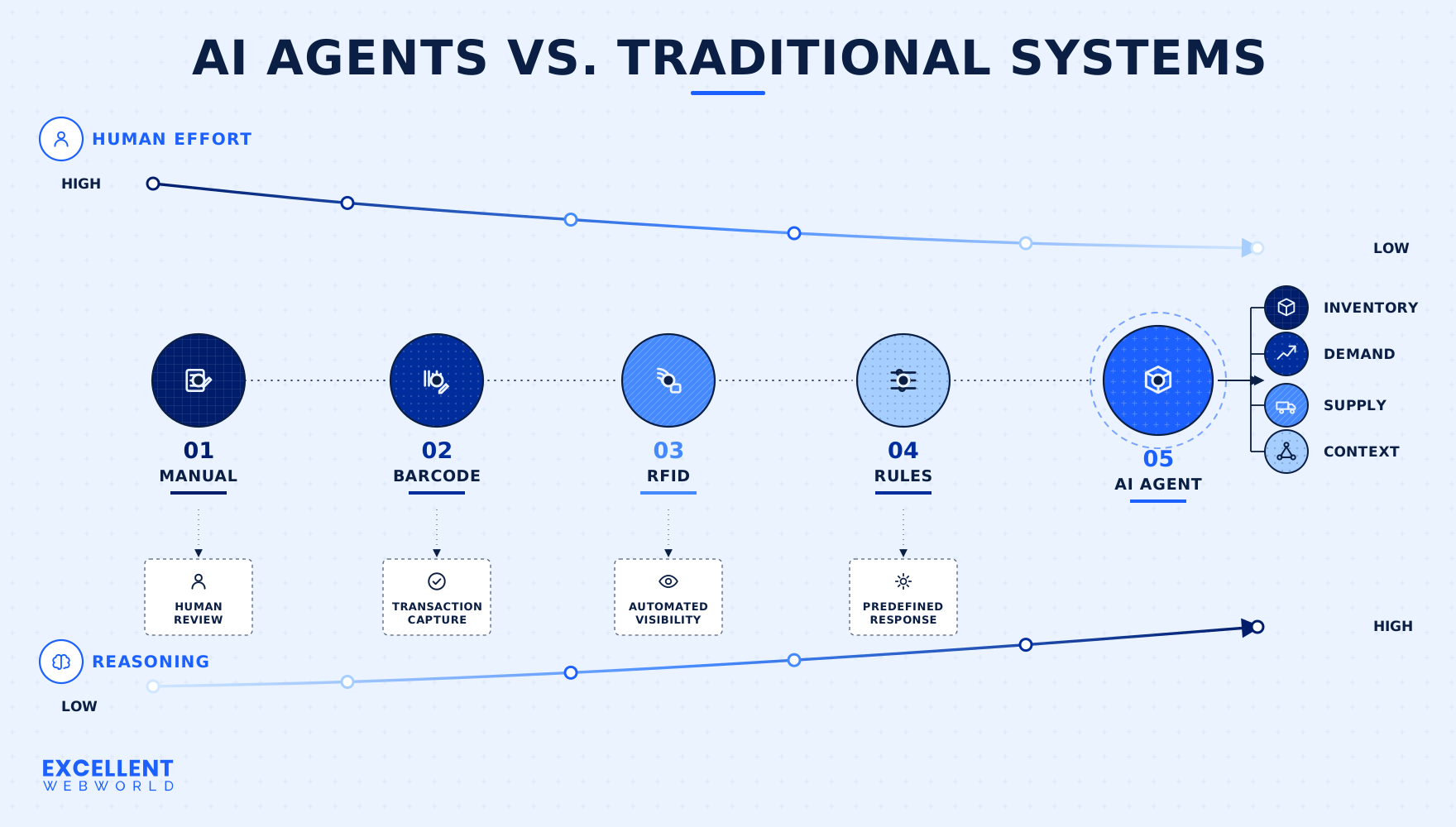
| Method | Reorder Trigger | Human Effort Required | Accuracy Considerations |
|---|---|---|---|
| Manual / spreadsheet tracking | Manual review of stock levels and usage | High | Highly variable |
| Barcode scanning | Recorded scan/transaction reaches a defined threshold | Moderate | High when consistently scanned |
| RFID-only tracking | Inventory movement or stock level crosses a set limit | Low-Moderate | High for captured/tagged items |
| Rules-based reorder software | Predefined PAR levels, reorder points, or rules | Low | High within defined rules |
| AI agent | Contextual assessment of inventory, demand, supply, and other signals | Low-Moderate (depending on approval requirements) | Dependent on data quality, forecasting, and workflow design |
The table is not supposed to tell you if one approach is better than the other or if one hospital inventory management system should replace another. These are distinct systems with different roles. Barcode and RFID inventory management improve the quality of the inventory signals, while ERP/MMIS systems remain the systems of record. Rules-based software can still handle predictable replenishment workflows. An AI agent adds another layer: it can reason across those signals and coordinate the next action.
So I wouldn’t ask whether a hospital should replace its RFID infrastructure with AI. I’d ask whether its existing infrastructure provides enough reliable context to make agentic decision-making worthwhile.
Where AI Inventory Agents Are Used in Hospitals
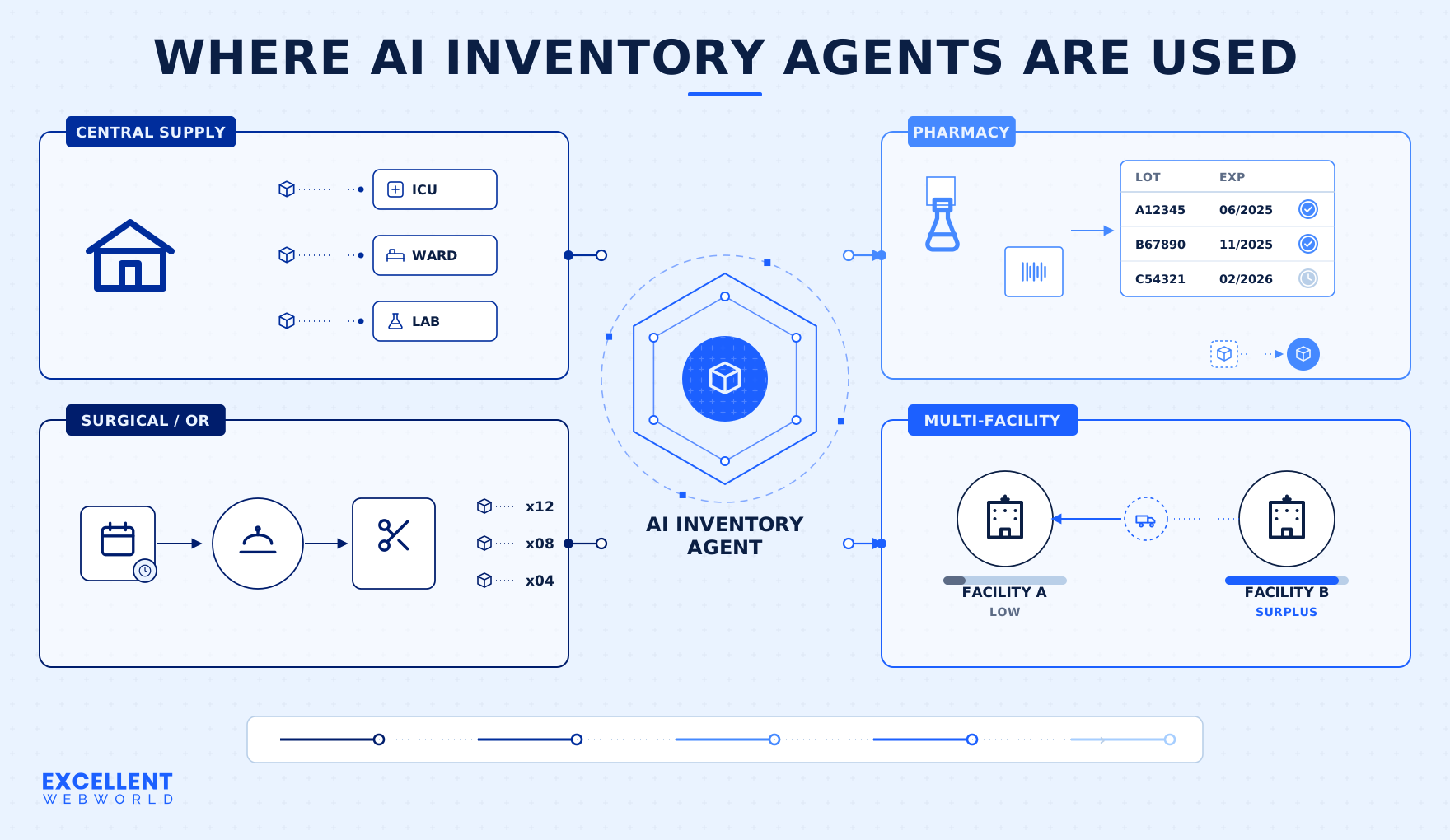
Central Supply & Materials Management
Given the sheer number of restocking-related decisions involved, Central Supply is one of the strongest candidates for agentic AI automation. An agent can look at PAR levels, demand-consumption trends, and other distribution requirements to determine whether a department actually needs more stock. This reduces the time spent on coordinating routine replenishment and ensures better alignment between what is stocked and what departments are actually using.
Pharmacy & Medication Inventory
Pharmacy inventory management software brings a different set of considerations into the equation. Having 500 units on hand doesn’t tell you whether you have the right inventory.
An AI agent can reason across expiration dates, lot-level tracking, current shortages, and restocking schedules to determine which stock should be used or moved first and when extra inventory is actually needed. That becomes particularly useful when medication is nearing its expiration date or a shortage requires more precise allocation.
The outcome is tighter inventory control without treating every unit as interchangeable.
Surgical & OR Supply Rooms
For surgical supply rooms, I would put much more emphasis on the procedure schedule. If next week’s OR schedule changes, the inventory requirement changes with it.
An AI inventory agent can create tangible value here by using the procedure schedule, current stock, historical consumption, and the availability of high-value supplies or implants to forecast each procedure’s needs. That gives the surgical team more time to address a potential shortage and reduces the need to solve inventory problems at the point of care.
Multi-Facility Health Systems
This is where the agent can start looking beyond individual facilities and have a bird’s-eye view of the healthcare organization’s broader supply chain. Consider two situations:
- The hospital at location A may be low on a particular piece of equipment
- At the same time, the facility at location B has more than enough stock to cover the requirement
Instead of treating these as two separate inventory positions, an AI agent can compare facility-level requirements, availability, and restocking schedules to decide whether a transfer or a new purchase makes more sense. The goal shifts from optimizing each medical facility independently to making better use of inventory across the health system.
How to Evaluate an AI Inventory Agent Partner
- AI integration depth matters more than an integration checkbox. You should look into whether the agent can actually work with the hospital’s healthcare inventory management software, EHR, ERP/MMIS, and procurement systems. Pay close attention to what information it can access from each and what it can write back through APIs.
- Compliance needs to be visible in the system itself. The partner should be able to show how access is controlled, what the AI agent records about its decisions, and how an inventory action can be traced back to the data and reasoning that produced it.
- Ask exactly where the human sits in the workflow. A partner should be able to show which actions the agent can execute independently and which ones need approval, particularly when they involve controlled inventory or high-cost purchases.
- Data ownership should be clear before implementation begins. You must have clarity about who owns the operational and inventory data, whether the partner can use it for model training, and what happens to that data if the relationship ends.
- Be realistic about how long deployment will actually take. Integration work, data readiness, security and compliance reviews, workflow configuration, testing, and change management can all affect the timeline, so I’d want those dependencies spelled out rather than a single go-live estimate.
- Production experience tells you more than a polished demo. Ask to see comparable healthcare deployments and understand what the agent was actually allowed to do, which systems it operated across, and how the organization measured the outcome.
How Excellent Webworld Builds AI Agents for Medical Inventory Management
Healthcare inventory is one area where our experience with AI systems, enterprise integration, and healthcare workflows informs our approach to AI agent development.
With an AI-driven inventory management system for an essential-oils platform, we developed AI-powered analytics to evaluate and manage inventory while handling custom product and blend data. The system had to keep inventory information consistent as products and configurations changed, rather than treating stock as a static dataset.
That experience shapes how we approach the development of an AI agent for medical inventory management:
Healthcare interoperability:
In an AI project for a U.S. healthcare group operating across 10+ hospitals, we built an interoperability layer using FHIR and HL7 to unify data from EHRs, labs, and imaging systems. That experience is directly relevant when an inventory agent has to reason across the EHR, ERP/MMIS, procurement, and inventory systems instead of relying only on one system.
Inventory intelligence:
Our work on inventory management involved combining AI-driven data analytics with custom product data and inventory state. For a medical inventory AI agent, the same principle applies when demand, consumption, availability, and product-level context all influence what the system should do next.
Healthcare-grade AI architecture:
With Braive, we engineered an AI-assisted clinical documentation system and decision support within an EU MDR Class IIa medical device, including safety classifiers, audit trails, privacy controls, and FHIR interoperability. That experience informs how we treat AI governance and traceability when the agent operates inside a regulated healthcare environment.
Workflow-specific automation:
We don’t treat the AI inventory agent as a generic chatbot placed on top of hospital data. Its reasoning, permissions, and available actions are tailored to the actual workflow.
Controlled execution:
The agent can be designed with configurable approval boundaries so that its ability to execute an action depends on the workflow and the consequences of that action, rather than assuming that more autonomy is automatically better.
Phased implementation:
We can start with a defined inventory workflow or high-volume SKU category, validate the underlying data and integrations, and expand the agent’s scope once the system has demonstrated that it can operate reliably in the target environment.
The goal is not to replace the hospital’s existing inventory infrastructure, but to add a decision and execution layer that can understand the operational context already present across that infrastructure and act within the boundaries the organization defines.
FAQs About AI Agents for Medical Inventory Management
An AI agent for medical supply inventory management is a software system that monitors inventory and demand signals, reasons about what action is required, and executes authorized inventory tasks with limited human intervention. Unlike a rules-based system, it can check factors such as consumption trends, upcoming procedures, supplier lead times, and inventory across facilities before determining whether to reorder, transfer, or adjust replenishment.
AI agents can improve inventory accuracy by bringing together information from multiple inventory and operational systems instead of relying on a single stock count. RFID, barcode, purchase-order, consumption, and demand data can be evaluated together to identify discrepancies and maintain a more complete view of what is actually available, where it is located, and what is likely to be needed.
Yes, an AI inventory agent can identify potential shortages before inventory reaches a conventional reorder threshold by evaluating current stock against future demand. Upcoming procedures, changing consumption patterns, supplier lead times, open orders, and inventory across facilities can all influence the risk, giving the hospital time to respond.
AI inventory management can be designed to operate in a HIPAA-compliant environment, but using AI does not make the system automatically compliant. The actual requirements depend on the data and workflows involved, including whether the agent accesses patient-linked consumption information.
The right choice depends on how closely the required workflow aligns with existing products and how much control the hospital needs over its architecture. Buying can make sense when a mature product already supports the required systems and workflows, while building becomes more compelling when integration, decision logic, compliance requirements, or deployment constraints demand a more tailored solution.
The cost implications of either approach can vary considerably depending on those requirements, so it’s worth understanding the broader cost of implementing AI in healthcare before making the decision.
AI inventory agents are more likely to reduce repetitive coordination work than replace supply chain and pharmacy staff. An agent can identify risks and prepare replenishment recommendations, while people remain responsible for decisions that need clinical, financial, operational, or compliance judgment.
Yes, an AI inventory agent can integrate with existing EHR and ERP systems when the necessary interfaces and permissions are available. The agent typically operates above these systems rather than replacing them, accessing relevant information through APIs and standards such as HL7 FHIR and writing approved transactions back into systems such as Epic and Oracle Health (formerly Cerner), or an MMIS. The integration approach can vary considerably between EHR platforms, as the differences between Epic and Cerner illustrate.

Article By


Paresh Sagar is the CEO of Excellent Webworld. He firmly believes in using technology to solve challenges. His dedication and attention to detail make him an expert in helping startups in different industries digitalize their businesses globally.