Amazon Video Doorbell Zero-Defect Production Testing System
We built a production testing system for Amazon’s video doorbell platform with custom ICT/FCT fixtures, MES traceability, parallel testing, and an operator dashboard. It validated 14 critical parameters per unit, accelerated testing, improved production accuracy, and ensured zero faulty units reach users.
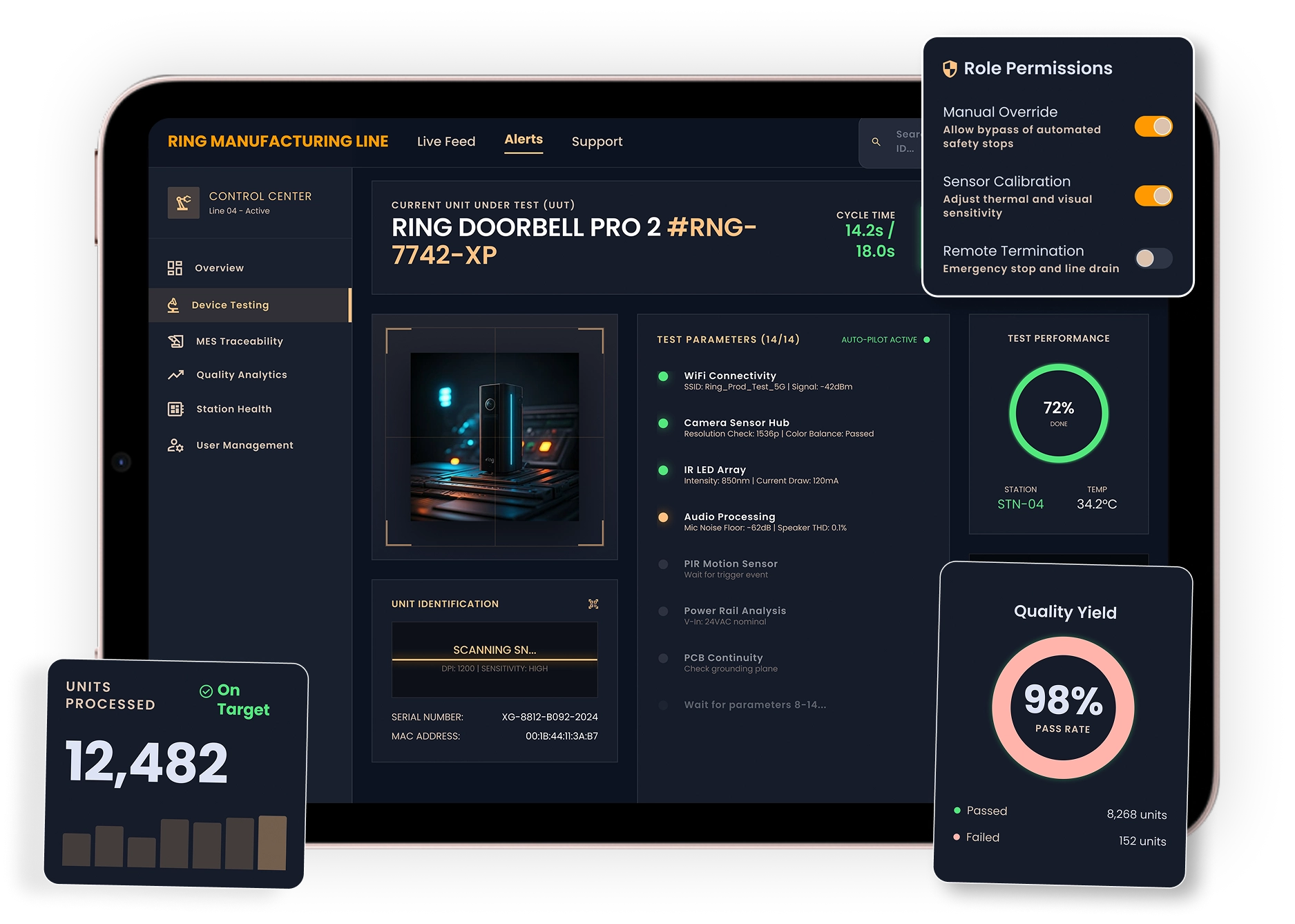
- ICT/FCT Fixture Design
- Pogo Pin Interface
- Camera & IR LED Validation
- Wi-Fi RF Testing
- Parallelised Test Sequencer
- Operator Dashboard UI
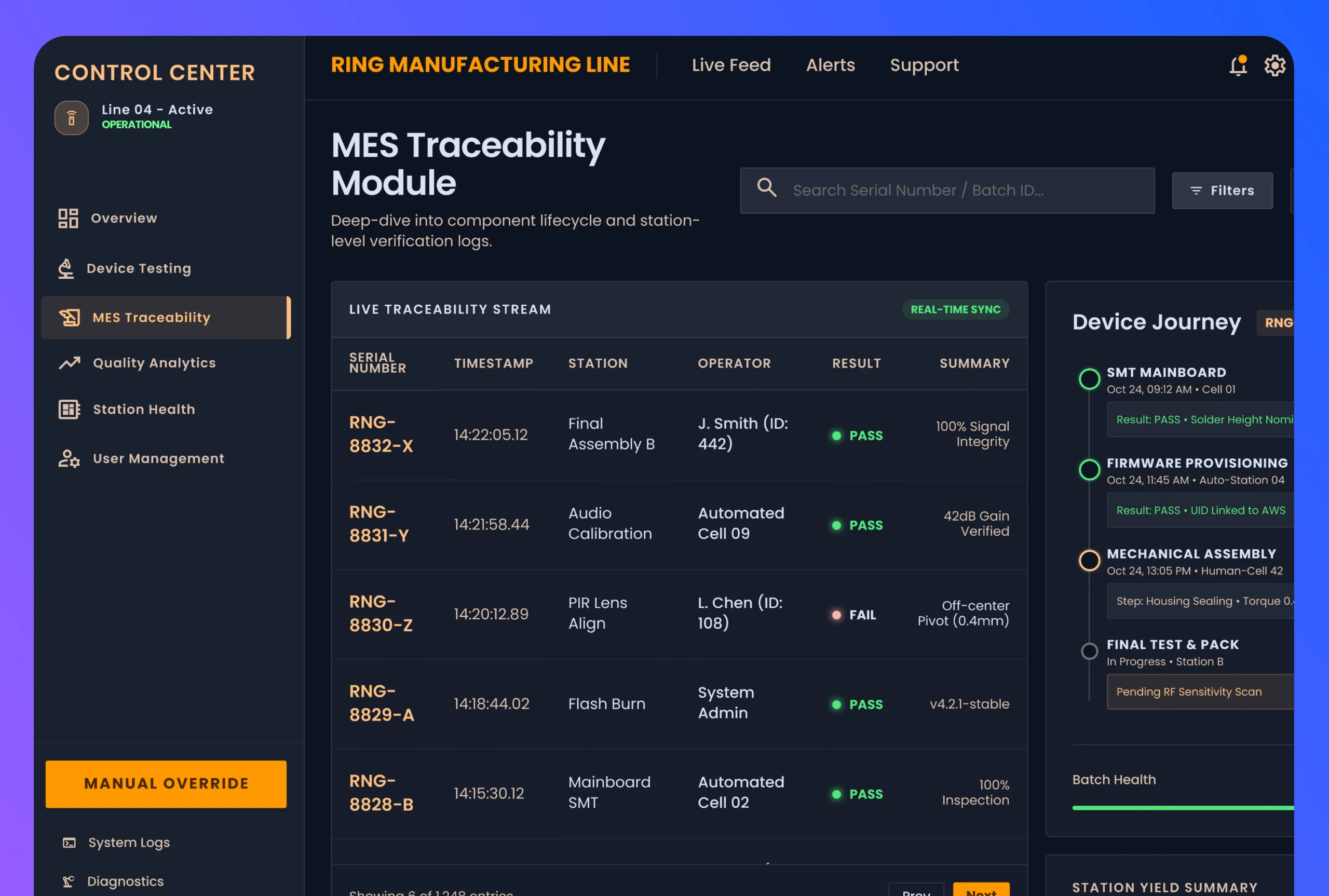
- MES Traceability Pipeline
About the Project & Business Goal
Amazon’s Ring division collaborated with us to design a production testing system with an ICT and FCT fixture for its video doorbell manufacturing unit. There was a need to validate 14 critical parameters across connectivity, sensors, camera, audio, and power modules within a 12-second production cycle. The primary goal here was to reduce field failures that occur due to undetected manufacturing defects while maintaining production efficiency. As there were millions of products shipped annually, the smallest testing error could create quality risks. We needed to deliver reliable hardware testing, accurate PASS/FAIL validation, and consistent performance across every unit.
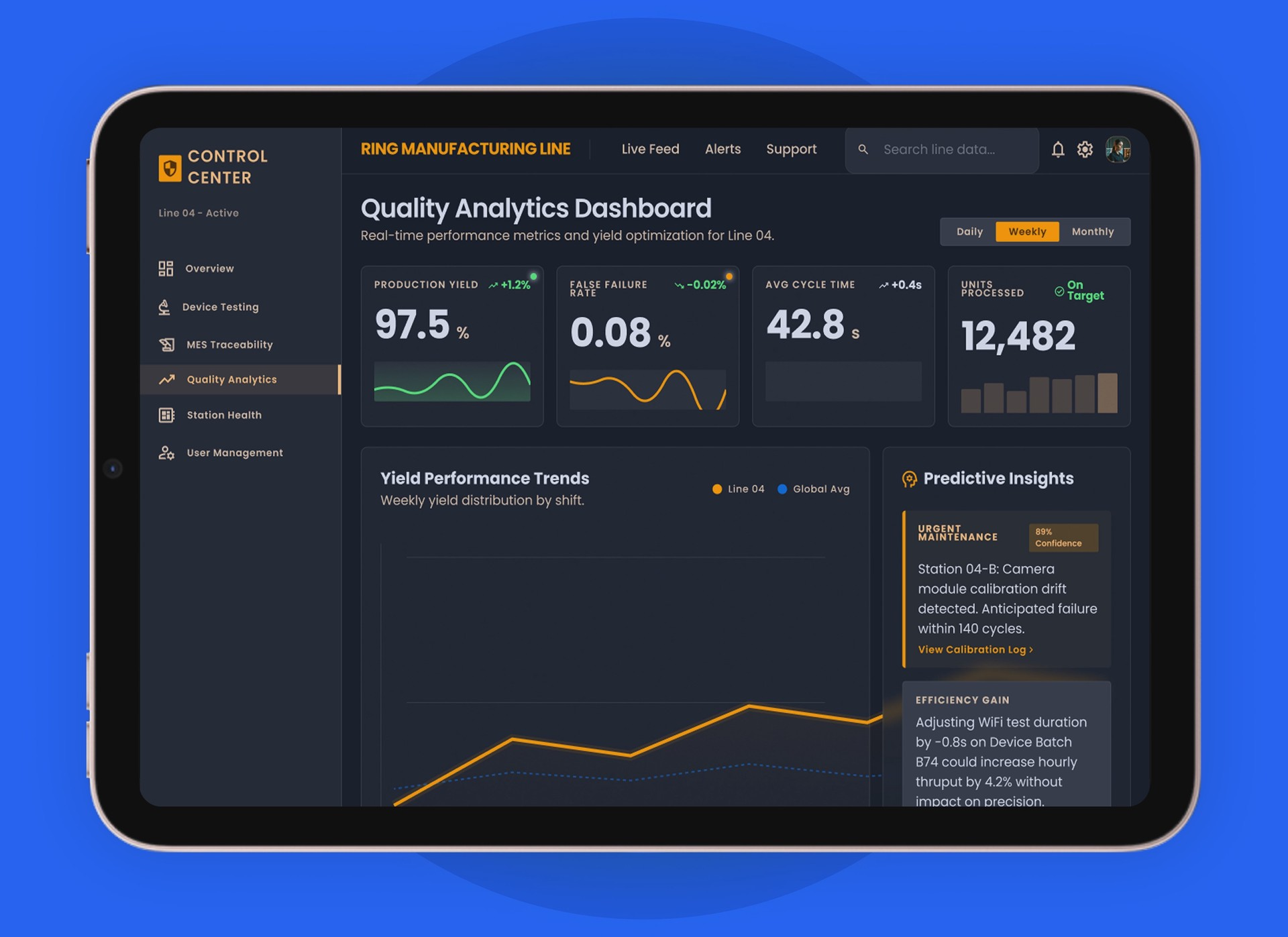
Key Results We Delivered for Amazon Ring Production Testing System
14-Parameter Validation Within 12 Seconds
We built an automated ICT and FCT workflow that validated 14 critical hardware and connectivity parameters within a 12-second cycle. It also helped maintain high manufacturing throughput while ensuring that each product aligns with Amazon’s quality and reliability standards.
Reliable Pogo Pin Contact Across Every Unit
We designed the precision pogo pin interface around the Ring PCB layout to ensure stable electrical contact across the unit-to-unit dimensional interface. The system achieved a failure rate of below 0.1% during fixture qualification testing, reducing production rejection and retesting.
Fully Automated Zero-Calibration Test Workflow
We developed a fully automated test sequence that starts immediately after DUT insertion without requiring operator intervention, manual RF prob, or threshold tuning. Operators need to load devices and review PASS or FAIL audits, improving consistency and reducing manual testing errors.
Key Metrics Behind the Production Testing System
We designed a production testing platform that helped the client maintain high manufacturing throughput without compromising product quality or testing accuracy. Our automated ICT and FCT systems can validate critical hardware, power, audio, and connectivity parameters within seconds while keeping the peak fixture performance intact across large-scale manufacturing operations and assembly lines.
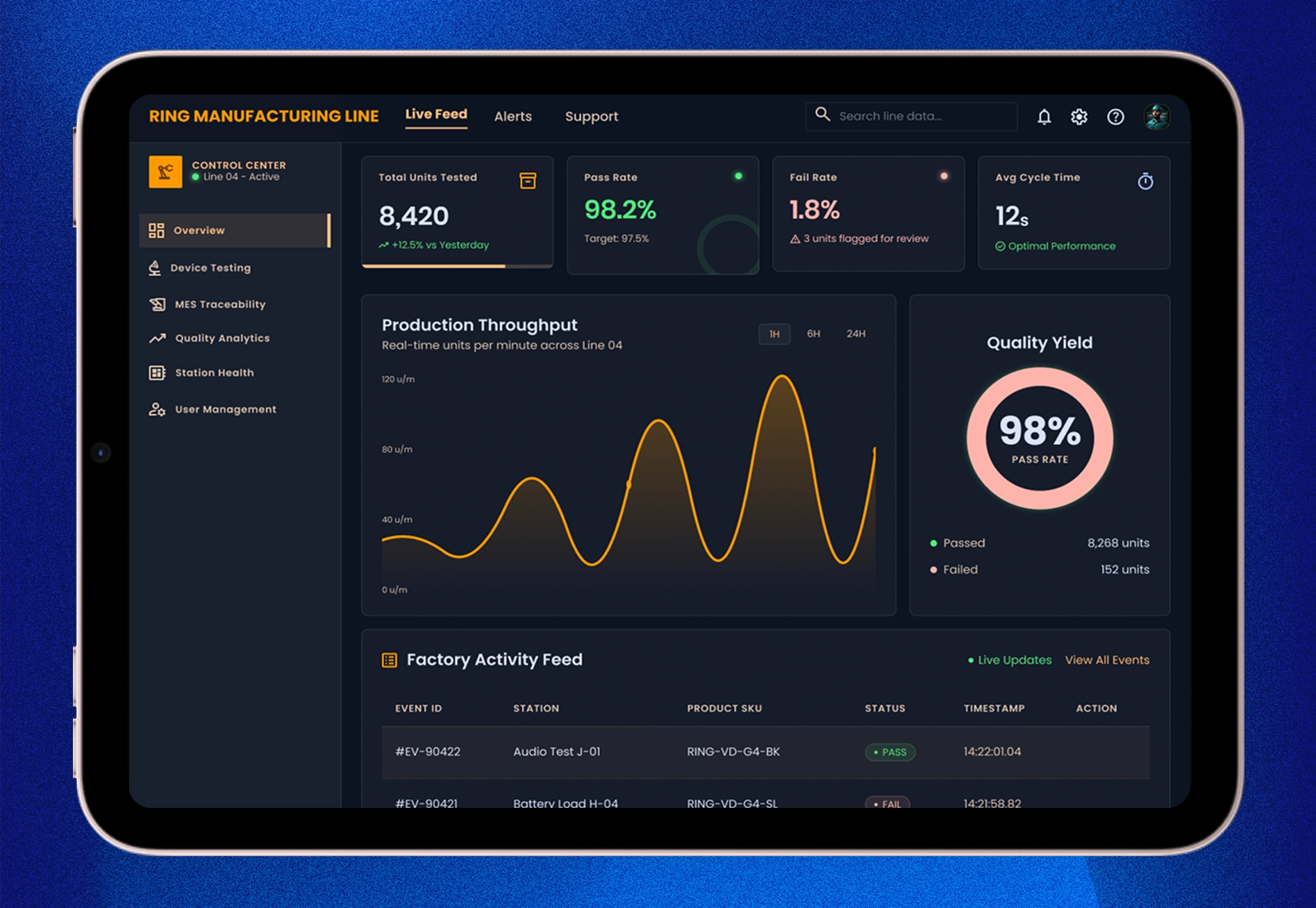
Complete Production Test Cycle
We completed full ICT and FCT validation within 12 seconds, enabling rapid production testing without reducing manufacturing throughput.
Critical Hardware Parameters Validated
Our system validated 14 critical hardware parameters across Wi-Fi, PCB, PIR, camera, audio, and power subsystems accurately and consistently.
False Failure Rate Achieved
We achieved high testing accuracy with a false failure rate below 0.1%, ensuring dependable qualification and high-volume production results.
Fixture Insertion Cycles Supported
We designed our fixture to maintain reliable electrical contact and consistent testing performance across 500,000+ insertion cycles.
Higher Loan-Approval Rate
Faster Underwriting
Automated KYC Verification
Lower Default Rate
Core Platform Challenges
We designed a production testing system for high-volume manufacturing environments where accuracy, reliability, and speed matter. The challenge was to balance out RF shielding, real-time MES traceability, fixture durability, optical validation, and audio isolation without increasing the production cycle time.
Parallel Testing Within 12s Production Cycle
We parallelized ICT and FCT processes to validate multiple hardware functions without slowing down manufacturing throughput.
Reliable Wi-Fi Testing Inside Shielded Fixture
Our designed shielded enclosure prevented signal leakage and maintained accurate dual-band Wi-Fi consistency during testing.
Stable Contact Across 500K+ Insertion Cycles
We created durable pogo pin interfaces that enabled reliable electrical connectivity across 500K+ insertion cycles.
Controlled Camera & IR LED Validation
We created an integrated optical chamber for accurate camera quality and IR LED output testing.
Audio Testing On Noisy Factory Floors
Our damped acoustic enclosure reduced factory noise during the speaker and microphone performance validation procedure.
High-Volume Manufacturing Data Tracking
We implemented real-time MES logging for every PASS/FAIL result, serial-number-based production record, and measurement.
Engineering Solutions Behind Amazon Ring
We designed the production testing system on three constraints: reliability, throughput, and test coverage. Our solution combines RF isolation, parallel testing, MES traceability, and pogo pin architecture without increasing the production cycle.
We developed a smart test sequencer that ran multiple ICT and FCT processes in parallel, which helped validate audio functions, firmware, sensors, RF, and power rails within a 12-second production cycle without reducing testing accuracy or slowing down manufacturing throughput.
We designed a shielded fixture enclosure that could block the outside Wi-Fi interference during testing. It helped the client measure the 2.4 GHz and 5 GHz Wi-Fi signal strength and connectivity accurately while maintaining stable and repeatable RF testing performance.
We utilized gold-plated pogo pins with controlled spring force to maintain stable electrical contact during production usage. The design supported 500K+ insertion cycles while reducing false failure rate, decreasing contact wear, and improving long-term fixture reliability across manufacturing operations.
Our developers created an optical chamber for the IR LED and an automated camera validation inside the fixture. It checked the lighting consistency, image clarity, and infrared LED outputs using calibrated lighting and fixed-focused targets without needing manual inspection during testing.
Our expert team designed a noise-controlled acoustic chamber that reduced factory floor sound during microphone and speaker testing. Our design allowed the fixture to measure the speaker response and microphone clarity accurately while maintaining testing speed and stable audio validation.
We implemented an automated MES logging system that stores PASS/FAIL results, serial numbers, and measurement values after every testing cycle. The logging process is completed during unit unloading, thereby maintaining production speed while ensuring complete traceability for quality analysis.
Built for High-Speed Manufacturing Accuracy and Reliable Production Testing System
We designed the production testing interface to simplify manufacturing workflows with zero operator intervention, PASS/FAIL visibility, and automated test execution. Our fixture design combines a fast validation process, real-time traceability, and reliable hardware interaction to support continuous operations.
Four-Layer Fixture Architecture Behind Amazon Ring
We designed the fixture architecture to deliver accurate and consistent test results for the production testing system. By combining reliable electrical connectivity, controlled test environments, mechanical precision, and automated test management, we help manufacturers maintain production quality across every shift and location.

Device Handling Layer
Our precision aluminium fixture holds each device during testing. Also, controlled clamping helps maintain reliable contact alignment, consistent positioning, and smooth operations for high testing volumes.

Controlled Testing Layer
Our RF, acoustic, and optical chambers help create a stable testing environment. By reducing outside noise, we accurately validated audio performance, camera quality, and wireless connectivity.

Electric Interface Layer
We use a custom pogo pin interface board to connect communication, signal, and power lines to the device. It enabled communication, firmware programming, and electrical validation without human intervention.

Automation & Traceability Layer
We manage the testing process through MES and industrial PC integration. It helped us record results, apply PASS/FAIL criteria, control testing, and provide visibility into production quality.

Security, Governance & Infrastructure Standards
We designed the production testing system to support reliable manufacturing, secure device validation, and controlled testing. By following industry standards and quality frameworks, we maintain production consistency, compliance, integrity, and traceability.


Tech Stack That Empowers Amazon Ring
We combine automated test software, precision hardware, secure data systems, and calibrated measurement instruments to create a reliable production testing environment. The technology stack we used helped the client improve manufacturing consistency, accelerate production, validate device quality, and maintain traceability.
- SolidWorks
- CNC Aluminium Machining
- Pneumatic Clamp Actuator
- GD&T Tolerance Analysis
- Altium Designer
- Gold-Plated Pogo Pins
- OSP Test Pad Interface
- DFT Compliance Review
- Keysight E4438C Signal Generator
- Rohde & Schwarz FSV Spectrum Analyser
- Mu-Metal RF Shielding
- Audio Precision APx515
- Calibrated Reference Microphone
- Acoustic Isolation Chamber
- Chirp Stimulus Testing
- OpenCV
- IEC 62676 Test Chart
- Calibrated Photodiode
- Controlled LED Illumination
- Python 3.11
- asyncio
- concurrentfutures
- DAG Execution Graph
- PyVISA
- pyserial
- React.js
- WebSocket
- Barcode Scanner Integration
- Role-Based PIN Authentication
- JSON Schema
- REST API
- SQLite
- OAuth 2.0
- Git Version Control
Our Methodology for Building Amazon Ring
Our developers followed a test-first engineering approach, where validation needs drove every fixture decision. From design reviews to failure analysis and from qualification to production handover, we emphasize building a scalable, repeatable, and reliable production testing system that consistently delivers accurate manufacturing results.
Failure Analysis & Test Planning Strategy
Our developers analyzed failure data, identified critical test parameters, and defined measurable PASS/FAIL criteria.
Test Point Mapping & DFT Review Process
Before the fixture design approval, we mapped PCB test points and addressed all accessibility issues.
Fixture Design & Simulation Validation
Our developers designed RF, acoustic, mechanical, and optical systems and validated performance through simulation.
Interface Development & Software Integration
We built automated testing software and interface hardware to ensure reliable device validation.
Fixture Qualification & Repeatability Testing
Our testing experts verified the long-term fixture reliability, failure detection capability, and measurement accuracy.
Production Deployment & Team Training
We provided detailed documentation, trained manufacturing teams, and defined maintenance procedures for manufacturing operations.
What Our Client Says
For this project, our developers had to build a production-ready testing fixture architecture that could support high-volume manufacturing without sacrificing reliability, accuracy, and long-term operational dependability across the production environment, leveraging best practices commonly associated with hardware engineering services.




The fixture needed to cover every failure mode we’d ever seen in the field, run in 12 seconds, and survive half a million cycles before maintenance. Excellent Webworld understood that this wasn’t a test jig; it was a manufacturing tool. The GR&R results and the false failure rate gave us the confidence to deploy directly to volume production.
We help you build production-ready testing ecosystems, right from automated validation software and fixture engineering to operator interfaces, MES traceability, and RF testing for scalable manufacturing operations.