Computer Vision Development Services and Solutions
We help you turn raw visual data into live decisions. Our team excels at engineering custom computer vision models that detect, classify, and track objects with production-grade accuracy. From early proof of concept to full-scale deployment, our engineers design vision systems that hold up on the cloud, on the edge, and everywhere in between.
Computer Vision Models Deployed
Years in AI/ML Development
Industries Served
Average Model Accuracy


- Object Detection & Tracking
- Facial & Biometric Recognition
- Edge AI Deployment
- OCR & Document Intelligence
- Image/Video Analytics & Surveillance AI


Why Enterprise Trusts Us For Computer Vision Expertise
You get a reliable partner who treats every vision model as production software, not a research experiment. That means it is engineered for scale, backed by a team that stays accountable long after deployment day, and monitored after launch.
01
Engineering Focused on Production
We plan deployment before writing the first training script, which is why the systems we hand over to you rarely stall at the pilot stage, unlike most in-house experiments.
02
Data Governance for Every Project
Compliance starts with the data. Every dataset is managed with version tracking, built-in access controls, and audit trails to support governance requirements.
03
Built for Real World Edge Environment
We keep your model reliable in real operating conditions. How? Hardware and bandwidth limitations guide our architecture decisions from day one.
04
End-to-End Dedicated Technical Ownership
Your project stays with one senior engineer from implementation through ongoing support to ensure continuity instead of frequent team changes.
05
Continuous AI Performance Improvement
Our automated pipelines track model health continuously, while scheduled retraining helps maintain reliable performance without waiting for failures.
06
Models Tuned as Per Your Specific Industry
Retail shelf analytics and manufacturing defect detection demand completely different tuning, and we build for exact conditions instead of repurposing a generic template.
Transparent Engagement Models
You get flexibility to choose from fixed scope, dedicated teams, or staff augmentation, with the flexibility to adjust your engagement as business requirements change.
Full-Stack AI Team
Instead of juggling multiple vendors, you work with one team that combines MLOps, vision engineering, annotation, and backend development expertise.
Cross-Industry Playbooks
Experience with diverse industries means we recognize common implementation challenges early, helping your project avoid unnecessary setbacks.
Full Lifecycle Computer Vision Development Services
From early feasibility testing to long-term model retraining, we cover every stage of your computer vision journey, and you never have to hand the project between separate vendors along the way.
Custom CV Model Development
Our engineers design and train models around the specific edge cases since generic pre-trained templates rarely match your exact objects and environments.
Feasibility Analysis & Strategy (PoC)
We validate your idea with real data before significant budget decisions are made. This proof of concept helps confirm accuracy, estimate costs, and uncover technical risks.
Data Pipeline & Annotation
We prepare training data through structured annotation and quality checks, replacing noisy inputs with accurate labeled datasets for better results.
Vision System Integration
Being a reliable partner for computer vision, we integrate your vision model with cameras, IoT devices, ERPs, and dashboards to ensure insights reach the right teams automatically.
Edge Model Optimization & Deployment
With us, your model is optimized with compression and quantization. This allows for efficient edge deployment while maintaining consistent production accuracy.
MLOps, Monitoring & Retraining
Drift detection and scheduled retraining are built into the pipeline from launch. Something that keeps your models accurate for months and years after the initial rollout.
Award-Winning Computer Vision Engineering
Enterprises and product teams bring us in to build vision systems that hold up under real operating conditions, not ones tuned to perform well only against benchmark datasets.
Clutch Global Ranking
Successful Projects
Countries With Active Deployments
Years of Enterprise Engineering
Top Computer Vision Company
Top Generative AI Company 2026
Top AI Agents Company 2025
Top Cloud Consulting Company

Top AI Deployment Company

Top Cybersecurity Company Clutch
Common Roadblocks You Face in CV Project & How We Address Each
Most computer vision initiatives don’t fail during model training. They fail at the handoff between research results and the messy realities of daily business operations.
| Challenge Area | Challenge | How Do We Solve It? | ||
|---|---|---|---|---|
|
Poor Accuracy with Low Quality Data
|
Challenge | Even the best model architecture depends on quality data. Poor labeling and too few examples can limit performance before training begins. | How Do We Solve It? | What we do is we apply rigorous quality checks and labeling standards to every annotation, ensuring your model learns from accurate and dependable data. |
|
Models That are Stuck in Pilot
|
Challenge | Models trained on curated datasets may excel in demos, but fall apart the moment lighting, camera angles, or background noise change on an actual factory floor. | How Do We Solve It? | We validate vision models using footage from your actual environment, helping your vision model perform reliably under actual operating conditions, not benchmark data. |
|
Performance Drop After Launch
|
Challenge | Small changes in camera placement, seasons, or product lines can gradually reduce model accuracy before teams notice the business impact. | How Do We Solve It? | We identify model drift via continuous monitoring and retrain proactively to keep your vision system performing consistently in production. |
|
Latency That Breaks Live Use Cases
|
Challenge | When vision models respond in seconds instead of milliseconds, safety alerts, quality inspections, and live analytics lose their value. | How Do We Solve It? | Our approach includes designing hardware and model architecture together, ensuring inference is fast enough to support time-sensitive decisions. |
Custom Computer Vision Solutions For Every Application
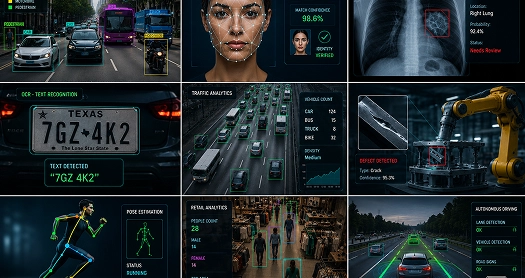
Whatever your industry or use case, we engineer vision systems that recognize, track, interpret, and act on whatever your cameras and sensors are capturing in real time.
Image Tagging & Classification
- Multi-label image classification
- Automated content tagging
- Fine-grained category detection
- Transfer learning on your data
- Batch and real-time processing
Anomaly & Defect Identification
- Surface and product defect scans
- Assembly line quality checks
- Predictive maintenance signals
- Micro-defect image analysis
- Pass/fail automated sorting
OCR & Document Processing
- Printed and handwritten text OCR
- Invoice and form data extraction
- Multi-language text recognition
- ID and document verification
- Structured data output pipelines
AI Object Detection & Tracking
- Multi-object real-time detection
- Bounding box & segmentation
- YOLO, DETR, Faster R-CNN builds
- Edge-optimized inference speed
- Custom object class training
Facial Recognition & Biometrics
- Face detection and matching
- Access control integrations
- Liveness and spoof detection
- Privacy-compliant model design
- Attendance and identity checks
AI Video Analytics & Surveillance
- Live video stream analysis
- Motion and intrusion detection
- Crowd counting and density maps
- Multi-camera event correlation
- Automated incident alerting
Smart Shelf & Retail Analytics
- Shelf availability monitoring
- Planogram compliance checks
- Footfall and heatmap analysis
- Checkout-free store vision
- Customer behavior insights
Autonomous & Robotics Vision
- Obstacle and path detection
- Robotic pick-and-place vision
- Warehouse navigation systems
- Real-time SLAM integration
- Safety-critical inference speed
Motion Tracking & Pose Estimation
- Human pose and joint tracking
- Gesture and activity recognition
- Sports and movement analytics
- Ergonomic and safety monitoring
- Multi-person tracking at scale
AR & Spatial Vision Integration
- Marker-based AR tracking
- Real-world object overlays
- Spatial anchor detection
- Mixed reality vision pipelines
- Real-time scene understanding
3D Mapping & Spatial Sensing
- Depth map generation
- 3D object reconstruction
- LiDAR and stereo camera fusion
- Volume and dimension estimation
- Spatial mapping for robotics
AI-powered Medical Imaging
- X-ray and scan anomaly detection
- Diagnostic support workflows
- DICOM-compatible pipelines
- Cell and tissue image analysis
- Radiology workflow automation
See Measurable Gains From Computer Vision
Manual visual checks get replaced with automated computer vision, and businesses making that shift typically see inspection time and error rates drop within the first few months.

How We Compare to the Alternatives You’re Weighing
Every business exploring computer vision ends up comparing the same handful of paths before choosing a partner, and each one tends to fall short in a different, predictable way.
Vs. a Generic Offshore Dev Shop
Our team combines vision engineering, annotation, and MLOps expertise. This reduces production risks that general development vendors often overlook.
Vs. No-Code Vision Platforms
We architect computer vision solutions around data & environment, not platform templates that struggle with specialized use cases & complex edge cases.
Vs. Traditional Managed IT Provider
Traditional IT providers manage infrastructure and security well, while we engineer, optimize, and maintain the CV models running on top of it.
Vs. Freelance ML Consultant
A freelance consultant builds prototypes quickly, but long-term support becomes hard and time-consuming as projects grow or priorities shift to new engagements.
Vs. Academic Research Partner
Research partnerships prioritize algorithm innovation, while our team is here to focus on production-ready vision systems that support everyday business operations.
Vs. In-House Development Team
Building an in-house computer vision team takes months of hiring and onboarding, while losing key engineers delays delivery and interrupts project continuity.
Our Recent Projects
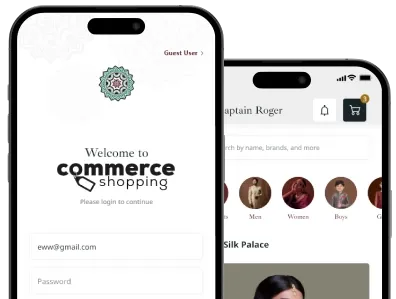
We always believe in serving our clients with best and effective solutions that enables them to get over the startup challenges. Here we’ve showcased a few applications built by our experts based on client requirements.

Enterprise Compliance Coverage for Computer Vision Deployments
As an AI-native engineering partner, we design vision systems that respect regional data privacy, biometric, and AI governance regulations from the very first architecture decision.
Federal data protection standards, healthcare regulations, and state-level biometric privacy laws all get factored into how we design and deploy vision systems for US enterprises.
- HIPAA
- HITECH Act
- NIST AI RMF
- NIST CSF 2.0
- CCPA/CPRA
- VCDPA
- CPA
- BIPA
- SOC 2 Type II
- ISO/IEC 27001
GDPR data subject rights and the EU AI Act’s obligations for high-risk AI systems both shape how your models are built, documented, and deployed across European markets.
- GDPR
- UK GDPR
- EU AI Act
- ISO/IEC 27001
- ISO/IEC 27701
- ISO/IEC 42001 (AI)
Provincial and federal privacy law across Canada is reflected in how we handle data collection, storage, and model design throughout your vision deployment.
- PIPEDA
- Quebec Law 25
- Alberta PIPA
- British Columbia PIPA
- ISO/IEC 27001
- ISO/IEC 27701
- SOC 2 Type II
Regional data protection and emerging AI governance frameworks across Asia-Pacific markets inform how we structure data handling for deployments in that region.
- Singapore PDPA
- Japan APPI
- South Korea PIPA
- India DPDP Act
- Australia Privacy Act 1998
- APPs
- New Zealand Privacy Act 2020
- ISO/IEC 27001
- ISO/IEC 42001
UAE and Saudi data protection requirements, along with regional AI ethics guidelines, get built into how we design vision systems for government and enterprise use there.
- UAE PDPL
- DIFC Data Protection Law
- SDAIA AI Ethics
- Dubai AI Ethics
- ADGM Data Protection Regulations
- Qatar PDPPL
- Bahrain PDPPL
- Saudi PDPL
- ISO/IEC 27001
Ready to Architect Your Product With Vision AI?
A working session with our engineers gets you a feasibility outline built around your specific use case, not a generic pitch deck recycled from someone else’s project.
- No-obligation feasibility review
- Direct access to CV engineers
- Clear next steps within days
Advanced Tech Behind Every Vision System We Engineer
Computer vision isn’t one technology; it’s several working together, and we choose the right combination based on your accuracy, speed, and infrastructure needs.
AI-powered Deep Learning Models
Get models that learn to recognize patterns directly from your labeled training data.
Transparent AI Governance
Every model decision stays documented, so compliance teams get answers, not a black box.
Synthetic Data for AI Models
Generated and augmented data fills gaps when real-world examples run short.
Live Video & Stream Processing
Live feeds get analyzed frame by frame, fast enough for decisions that can’t wait.
Cloud-based AI Infrastructure
Elastic training and deployment that scales with demand without new hardware upfront.
Edge AI & On-Device Inference
Inference runs on the device itself, even where internet connectivity is unreliable.
3D Vision & LiDAR Solutions
Depth data gives robots and autonomous systems real spatial awareness to navigate.
CNN & Transformer Architectures
We match the network design to your task instead of forcing one model to fit all.
MLOps & Automated Retraining
Drift gets caught early through automated pipelines, not discovered months later.
The Named Tools and Frameworks We Build With
Where the section above covers the concepts, this is the actual toolkit our engineers use daily to take a vision model from dataset to production.
Languages & Frameworks
- Python
- C++
- TensorFlow
- PyTorch
- OpenCV
Architectures & Models
- YOLO
- DETR
- ResNet
- U-Net
- Mask R-CNN
Edge & Embedded Deployment
- NVIDIA Jetson
- Google Coral
- Intel OpenVINO
- TensorRT
Cloud & AI Platforms
- AWS Rekognition
- Azure Cognitive Services
- Google Vertex AI
Annotation, MLOps & Monitoring
- CVAT
- Labelbox
- MLflow
- Docker
- Kubernetes
Our End-to-End Computer Vision Development Process
A structured, iterative process moves your idea from raw footage and images all the way to a deployed, monitored vision system running in production.
Project Discovery & Assessment
We assess your data, use case, and constraints all upfront to confirm computer vision is genuinely the right fit before anything else moves forward.
Data Collection & Labeling
Our team makes sure to gather and label training data with detailed quality checks built into every single pass, not just a final review at the end.
AI Model Architecture Design
We choose and design the right architecture to match your accuracy, speed, and hardware needs, not defaulting to whatever’s trending.
Training & Validating Models
Your real data drives the training process, and validation happens against held-out test scenarios your model has not seen before.
Performance Tuning & Compression
We then compress and tune the model until it runs fast without accuracy, as efficiency on your target hardware is the goal here.
AI Integration & API Development
After that, connecting the model to your existing systems happens via APIs and connectors built specifically for your stack
Edge, Cloud & Hybrid Deployment
We deploy your model in the environment that fits latency and scale needs, whether that means edge hardware, cloud infrastructure, or a mix.
Testing Under Real Scenarios
We stress-test the system against lighting, angle, and edge-case variations before going live, so surprises show up in staging only.
Monitor, Maintain, & Improve Models
Live performance stays under continuous watch, and retraining kicks in automatically the moment data or environmental conditions shift.
What Our Clients Say About Us
Teams who’ve deployed computer vision systems with us share what the process actually looked like, from the first working prototype through full production scale.

Abdulaziz Alotaibi

I chose Excellent Webworld for its quality, fair pricing, and collaboration. They treated my app ‘Move Coins’ like their own, ensuring success.

Thomas Devito

I’ve been working with Excellent Webworld for over 10 years and have received dozens of web productions for small businesses.

Nick Wright

The designers took the challenge to redesign my app and website from scratch and give my brand a newly updated identity.
Frequently Asked Questions
Well, it depends on how much your model needs to handle and also your task. However, we rarely wait for a perfect dataset before starting. Here is what actually drives the number: Expanding object classes means collecting more labels,Fine-grained detection and segmentation demand larger datasets,Scale your dataset after early validation succeeds, Changing conditions require more diverse training data
Yes. We optimize many models to run fully on edge devices, whether that’s a camera, gateway, or embedded chip. This is what makes inference locally instead of depending on a live cloud connection. Something that matters most in factories, remote sites, or vehicles where connectivity is unexpected.
Every pipeline is built with privacy controls from the start, not added afterward. That includes: RBAC protects your images and footage, Storage practices align with industry and regional standards, Personal identifiers are removed where regulations require, Complete audit logs support governance and compliance.
As production environments change, model accuracy can gradually decrease until business decisions begin to suffer. We detect model drift early through automated monitoring and retrain before operational performance is affected.
In most cases, we build around your existing infrastructure. Our team assesses your existing hardware first, recommending upgrades only when accuracy or latency goals cannot otherwise be achieved. That keeps your upfront investment focused on what actually moves the project forward.
The timeline scales with data readiness and integration scope rather than following one fixed schedule:
Proof of concept takes a few weeks Custom model development takes several weeks to a few months Full production deployment varies based on integration points & hardware constraints
Yes, they can. Those are built to fit into the existing technology ecosystem. We integrate them with ERP, CRM, MES, WMS, quality management systems, and custom business applications via APIs. This allows visual insights to automatically trigger business actions, reports, alerts, or downstream processes.