- Spot the hidden risks of stale guardrails before outdated rules slow workflows, inflate operational costs, or leave critical security gaps.
- Make every guardrail accountable with a documented rationale, clear ownership, traceable dependencies, and evidence-backed review criteria.
- Build guardrails that evolve with your AI agents using version-controlled rules, automated tests, runtime monitoring, and event-triggered reviews.
- Retire outdated controls without compromising security through risk-based validation, controlled testing, and auditable decisions that protect both compliance and business agility.
Enterprises are rushing to move AI agents into production, which is why the harder question is whether they are prepared when they fail. According to Grant Thornton’s 2026 AI Impact Survey, only 1 in 5 organizations has a practiced response plan for AI failures. That raises an important question for technology, security, and compliance leaders. Are the controls governing AI agents for enterprises designed to manage real risks, or have they simply accumulated after audits?
Over time, AI guardrails can become difficult to manage. Removing a control without validating the risk may weaken a necessary safeguard. As you keep every rule indefinitely, you may risk slowing legitimate workflows. The deeper issue is whether each guardrail has a documented purpose, a clear owner, and a process for review. Even when an AI agent remains unchanged, its underlying platform, policies, dependencies, or business processes may evolve. Thus, leaving existing controls outdated.
This guide explains what AI guardrails are and how to create AI agent guardrails that are justified, accountable, and current. We’ll cover how to document each rule’s rationale, owner, and dependencies. From establishing event-based review triggers to retiring controls only when evidence supports the decision.
What are AI guardrails & their types?
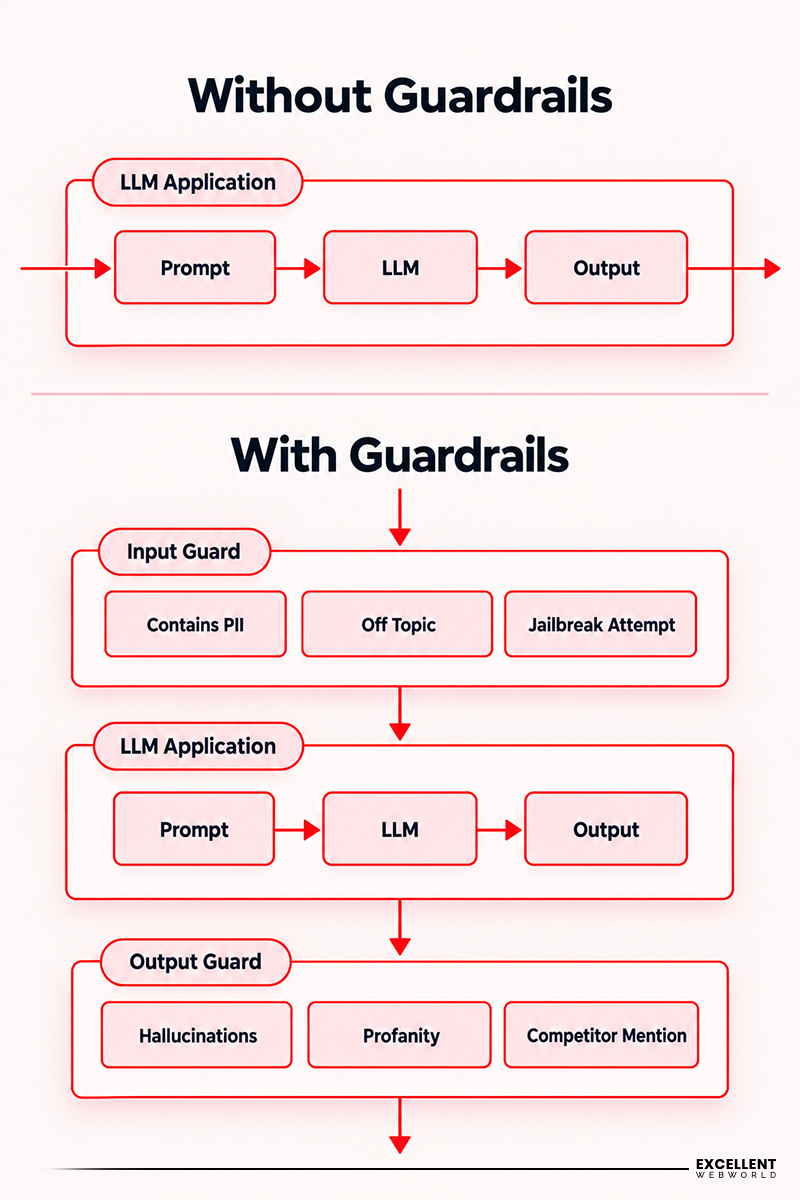
AI guardrails are rules and controls that keep AI systems safe, reliable, and aligned with business policies. They even define what AI can access, say, and do, seamlessly.
Major Types of AI Guardrails:
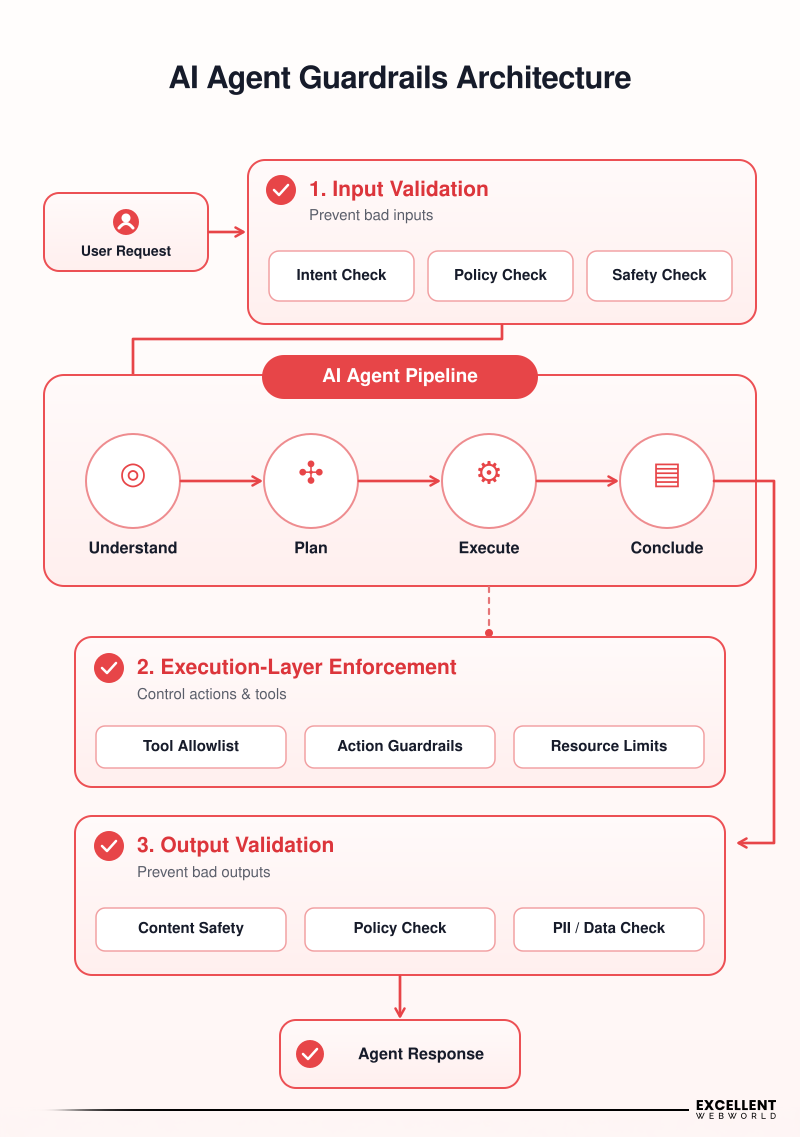
- Input Guardrails: Filter unsafe prompts and malicious inputs.
- Output Guardrails: Prevent harmful, inaccurate, or sensitive responses.
- Behavioral Guardrails: Keep AI decisions within approved boundaries.
- Tool & Action Guardrails: Restrict agent tools and unauthorized actions.
- Data Access Guardrails: Protect sensitive information.
- Operational Guardrails: Limit costs, retries, and execution time.
- Monitoring & Governance Guardrails: Track activity and flag risks.
Guardrails don’t just control what AI says; they help control what it accesses, decides, and does. Let’s move to how expired permissions put AI agents at risk.
How Do Expired Permissions Put Enterprise AI Agents at Risk?
A procurement agent at a B2B distributor had a strict rule: never re-acknowledge a purchase order line. The reason was operational. However, the re-acknowledgment in the AI Agents guardrails for ERP solutions erased notes added by coordinators.
Having an ERP update changed that behavior, but the agent's rule remained unchanged. So, it continued blocking a workflow the team actually needed. Because the team understood the original rationale, they could verify the change and safely remove the restriction. Moreover, without that context, the rule could have remained intact way longer after its purpose disappeared.
Well, this is an example of guardrail drift when controls become misaligned with changing business processes, system behavior, or security requirements. For enterprise AI governance solutions, the undocumented rules and infrequent reviews can leave agents enforcing unnecessary restrictions. Even relying on outdated protections.
That’s why, as AI in procurement deployments scale, guardrails need more than runtime enforcement. They need clear ownership, review conditions, and expiry checks where appropriate. Hence, the permissions and rules remain aligned with recent business and security requirements. Well, that’s highly aligned with the stale guardrail concept.
What is a Stale Guardrail?
A stale guardrail is a basic AI agent rule. It is imposed after the situation that justified it has disappeared. Moreover, a stale guardrail causes guardrail drift, or guardrail debt. No one dares to remove it, because no one understands what it actually protects. So, the technical debt has grown quietly, with costs increasing over time.
Majorly, the stale guardrail fails in one of two directions:
|
Failures |
What happens | Example |
|---|---|---|
| Over-blocking | The risk is gone, but the rule still blocks useful work | Agent is still forbidden from writing what the system now handles safely |
| Under-protecting | The risk changed shape, and the old rule no longer covers it | A spend cap set per month while agents now burn budget per hour |
While over-blocking costs you. On the other hand, under-protecting costs you incidents. Hence, both start the same way: a rule whose reason nobody checks.
How Does Guardrail Drift Occur in AI Systems?
Guardrail drift occurs when AI agent controls remain constant as the systems, workflows, and risks they govern change. A hardcoded restriction may continue to prevent legitimate actions after a software update, whereas an out-of-date permission or spending limit may fail to reflect how an agent now operates.
The problem worsens when teams create new rules to address incidents without first reviewing existing ones. However, over time, overlapping policies become more difficult to maintain. Additionally, the teams lose track of which controls are still required and which risks are actually mitigated.
Without runtime guardrails, agents can execute actions without performing the necessary checks on inputs, permissions, or outputs. So, effective governance requires validating relevant controls during execution and reviewing them. As business conditions change, it pushes beyond simply defining rules at deployment.
Why Do AI Agent Guardrails Outlive Their Reasons?
Because the AI guardrail often outlives its main goal, as teams maintain the rule but miss the reason behind it. So, the rule may remain in code, a system prompt, or a tool configuration. The rationale exists only in a meeting, a Slack thread, or the memory of the engineer who implemented it. Several patterns can cause this:
- The rationale was never documented. As the requirement says “never do X,” but nobody records the risk it is meant to prevent.
- An external dependency changes. A vendor, ERP system, or API update changes the behavior that originally prompted the restriction.
- Ownership changes. The engineer who made the rule leaves. Whereas the remaining team lacks the context to review it confidently.
- Rules assembled without review. Teams add restrictions after incidents but don’t revisit them as the underlying risks change.
- Controls are scattered through systems. Guardrails exist in prompts, application code, and tool configurations. Therefore, it makes it difficult to review them as a whole.
In addition to that, these are governance and lifecycle-management challenges. These are not necessarily model failures. Moreover, the longer outdated rules remain unreviewed. Accordingly, the harder they are to maintain, the more likely they are to obstruct legitimate work or leave gaps in protection.
TheNIST AI Risk Management Framework offers a relevant foundation. Released in January 2023, it is currently under revision. So, it defines four core functions: Govern, Map, Measure, and Manage. Hence, its approach emphasizes managing AI risks throughout the system lifecycle.
What Should Every AI Agent Guardrail Record Include?
Every AI agent guardrail should document what the rule enforces, why it exists, what it depends on, and when it needs to be reviewed. However, a guardrail register brings this information together so teams can maintain, validate, and retire controls as systems and business risks change.
A practical register should include eight fields:
| Field | What it records | Example |
|---|---|---|
| Rule | The action or behavior allowed or prohibited | Never re-acknowledge a purchase order (PO) line |
| Reason | The risk the rule is intended to prevent | Re-acknowledgment may overwrite coordinator notes |
| Dependency | The system behavior, configuration, or assumption the rule relies on | ERP acknowledgment behavior in the current release |
| Owner | The person or team responsible for reviewing and changing the rule | Procurement operations lead |
| Evidence | The test results, incident records, or other evidence supporting the rule | Sandbox test confirming that re-acknowledgment overwrites notes |
| Review trigger | A change or event that requires reassessment | ERP release, PO workflow change, or related incident |
| Last reviewed | The date the rule was last assessed | October 15, 2026 |
| Status | The rule’s current lifecycle state | Active, under review, revised, or retired |
Why the dependency field matters most
The dependency field connects a guardrail to the condition that justifies it. Without that connection, teams may preserve a rule long after the underlying system behavior or business risk has changed.
For example, if an ERP update changes how purchase order acknowledgments work, the procurement team can revisit the guardrail and test whether the original restriction is still necessary. The rule should be changed or retired only after the relevant behavior and risks have been verified.
The register should also distinguish between review triggers and scheduled reviews. So, a system update may require an immediate reassessment, while periodic reviews help catch changes that do not generate an obvious trigger.
A guardrail register does not enforce controls by itself. It complements technical enforcement, runtime monitoring, and audit evidence by making each rule traceable, accountable, and reviewable throughout the AI agent’s lifecycle.
What Does the AI Agent Guardrail Lifecycle Look Like?
AI agent guardrails require ongoing maintenance, not just implementation at launch. A rule that is effective today may become ineffective or overly restrictive as business workflows, system dependencies, and security risks evolve.
A practical guardrail lifecycle consists of six stages: creation, documentation, enforcement, monitoring, review, and decision. Additionally, the final decision completes the loop: keep the rule, revise it, or retire it if it is no longer necessary.
AI Agent Guardrail Lifecycle:
- Six stages. Three review outcomes. A single continuous feedback loop.
- Create: Define the risk and the behavior that the guardrail should allow, restrict, or prevent.
- Document the rule, including its rationale, dependencies, owner, supporting evidence, and triggers for review.
- Enforce: Implement the control at the appropriate level, such as tool permissions, application logic, or runtime checks.
- Monitor guardrail events, blocked actions, exceptions, and any relevant changes in system behavior.
- Review: Using current evidence and test results, determine whether the rule is still effective in addressing the intended risk.
- Decide whether to keep, revise, or retire the guardrail based on the review findings.
Three Possible Review Outcomes
- Keep: The original risk remains, and the guardrail is still effective. Retain it and schedule the next review.
- Revise: The risk, system behavior, or operating conditions have changed. Update the rule and its documentation, then validate the revised control.
- Retire: The original risk no longer applies, or the control is no longer necessary. Verify that removing it will not introduce another risk. Moreover, for consequential controls, use shadow-mode testing or another suitable validation approach where feasible before disabling enforcement.
The critical step is the review loop. Without it, teams may keep enforcing rules that no longer serve their purpose. And this misses new risks that existing controls were never built to address.
AI Guardrails evolve with the systems they protect. So, a documented lifecycle makes that evolution deliberate, evidence-based, and accountable.
How Do You Build AI Agent Guardrails That Stay Current — 7 Steps
Building AI agent guardrails is a continuous task. As agents gain new tools, business systems change, and workflows evolve. So, the controls need to be reviewed and updated.
We recommend a seven-step process: inventory, document, codify, validate, trigger reviews, retire safely, and report. Each step addresses a different weakness in how enterprise teams manage guardrails over time.
1. Inventory Every Guardrail in One Place
We start by identifying every control that influences what an AI agent can access, decide, and execute. Guardrails may exist in system prompts, application code, tool permissions, API gateways, orchestration logic, provider settings, and workflow configurations.
The inventory should capture both policy instructions and technically enforced controls. A prompt that tells an agent not to act is not equivalent to a permission check that prevents the action from executing.
| Where controls may exist | What we need to identify |
|---|---|
| Prompts and policy configurations | Behavioral restrictions and decision boundaries |
| Tool and API permissions | Allowed actions, access scopes, and approval requirements |
| Application and orchestration code | Input validation, action checks, and execution limits |
| Runtime guardrail services | Safety checks, output validation, and escalation rules |
| Monitoring and logging systems | Guardrail events, exceptions, and review evidence |
The objective is visibility. So, we cannot reliably maintain controls that are scattered across systems. When building production agents, teams need to consider permissions, execution boundaries, monitoring, and human oversight alongside the agent’s core functionality. So, these requirements should be part of AI agent development from the initial stage.
2. Record the Reason and Dependency Behind Each Rule
Once we have the inventory, we document why each guardrail exists and what conditions justify it. Our eight-field guardrail register captures the rule, reason, dependency, owner, evidence, review triggers, last-reviewed date, and status.
If a rule's rationale is unknown, we mark it accordingly and investigate before changing it. An undocumented reason is not proof that a guardrail is unnecessary.
For example, a procurement agent might be prohibited from re-acknowledging a purchase order line because the ERP software development process previously overwrote coordinator notes during that action. The dependency is the ERP's acknowledgment behavior. So, if that behavior changes, the team has a clear reason to reassess the restriction.
The key question is not just whether a rule still exists, but whether the situation that justified it still holds.
3. Keep Guardrail Rules and Their Records Versioned
My team at Excellent Webworld suggests maintaining guardrail definitions and their metadata in a version-controlled repository. So, changes are reviewed through the proper product engineering services and AI risk-management process.
A structured record makes controls easier to audit, test, compare across versions, and connect to the systems they protect. Therefore, where practical, automated checks can validate that required fields are present and that each active guardrail has an owner and review criteria.
For example:
id: GR-014
rule: block_write
action: erp.po_line.reacknowledge
reason: Re-acknowledgment may overwrite coordinator notes
dependency: ERP acknowledgment behavior
owner: procurement-ops-lead
evidence: tests/erp/test_reack_preserves_notes
review_triggers:
– erp_release
– po_workflow_change
last_reviewed: 2026-07-01
status: active
This is an illustrative schema, not a universal standard. In a production implementation, we would also link the record to the actual enforcement point, relevant test results, approval history, and next review date. The dependency should be testable where possible, rather than recorded only as descriptive text.
Version control preserves not only the current rule, but also who changed it. That’s why it changed, and what evidence supported the decision.
4. Test the Reason Behind the Rule
A guardrail test should verify two things: whether the control behaves as intended and whether the underlying risk still exists.
For the procurement example, one test checks that the agent cannot re-acknowledge a purchase order line while the restriction is active. A separate test checks whether the current ERP development solutions still overwrite coordinator notes when re-acknowledgment occurs.
If the second test produces a different result, an automated workflow can flag the guardrail for review. A changed test result is a review signal. So, we should also test failure scenarios, including unexpected tool arguments, unauthorized actions, and attempts to bypass prompt-level restrictions.
For high-risk workflows, runtime enforcement and appropriate human approval remain important even when tests pass. Moreover, this approach aligns with the layered guardrail architecture. Hence, it includes policy configuration, checks during execution, and monitoring, all of which contribute to safer agent behavior.
5. Trigger Reviews When Systems or Risks Change
Calendar-based reviews help, but they may not catch problems soon enough. Particularly when a dependency changes between review dates. So, we recommend combining scheduled reviews with event-driven triggers.
| Review Trigger | What My Team Reassess |
|---|---|
| ERP, API, or vendor update | Whether the original system behavior or assumption still holds |
| Workflow or business-policy change | Whether the guardrail still reflects the approved process |
| New tool or permission added | Whether the agent's access and action boundaries remain appropriate |
| Security incident or near miss | Whether the control addresses the observed failure mode |
| Increased blocking or escalation rates | Whether the rule is too restrictive or the operating context has changed |
| Scheduled review date | Whether the rule remains necessary, effective, and correctly documented |
A trigger should initiate an assessment without automatically revising the control. Some events require immediate investigation; others can be handled during the next scheduled review, depending on the potential impact.
Therefore, we should record the review outcome and supporting evidence so the decision remains traceable.
6. Retire Guardrails Only After Validating the Risk
Removing a guardrail can be as consequential as introducing one. A rule that appears obsolete may still protect against an edge case. However, routine testing does not cover it.
We want you to follow a controlled retirement process:
- Reassess the original rationale. Confirm which risk the rule addressed and what has changed.
- Validate the new behavior. Use tests, sandbox experiments, or other suitable evidence to confirm that the original risk has been removed or adequately mitigated.
- Evaluate the proposed change. Where appropriate, run the rule in shadow mode so the team can observe what it would block without enforcing that restriction.
- Review the evidence. Examine representative scenarios, exceptions, and potential consequences, with additional scrutiny for high-impact actions.
- Approve and document retirement. Update the register, record the decision and evidence, and verify that other controls remain effective.
While the shadow mode is useful when it can safely provide meaningful evidence, it is not suitable for every control. In a nutshell, an AI guardrail protecting sensitive data or preventing destructive actions should not be disabled merely to observe what happens.
There is also no universal two-to-four-week retirement window. We determine the observation period based on the risk, traffic volume, range of scenarios, and strength of the available test evidence.
The goal is evidence-based retirement, unlike the removal simply because a rule is old or rarely triggered.
7. Report Guardrail Health Without Counts
Finally, we need to know whether the guardrails are effective and whether they remain appropriate as the agent evolves. A dashboard showing only the number of active rules cannot answer those questions.
We recommend tracking a combination of lifecycle, enforcement, and risk indicators.
| Metric | What it helps us understand |
|---|---|
| Active, overdue, revised, and retired guardrails | Whether the register is being maintained |
| Guardrails missing owners or rationale | Where accountability or documentation is incomplete |
| Trigger frequency and blocking rates | Which controls fire and how often |
| False-positive and false-negative rates, where measurable | Whether controls are unnecessarily blocking valid actions or missing unsafe ones |
| Escalations and approval outcomes | Whether human oversight is working as intended |
| Test failures and unresolved review triggers | Whether known issues remain open |
| Review completion and time to resolution | How quickly the team responds to changes and identified risks |
A guardrail that rarely fires is not necessarily obsolete. It may be protecting against a rare but severe event. Likewise, frequent triggers do not automatically mean a rule is wrong. They may indicate genuine risk, changing usage patterns, or excessive restrictions. Moreover, we should interpret these metrics in context and investigate meaningful changes. Use the findings to prioritize reviews and improvements.
When Should You Re-Check an AI Agent Guardrail?
For developing your AI agent guardrail, it's better to re-check it whenever its underlying dependency, workflow, or risk changes. Well, even scheduled reviews matter too; quarterly reviews provide a practical baseline for many enterprise deployments. Whereas high-risk controls may require more frequent assessment.
Moreover, the major purpose is to detect changes early. Therefore, before an obsolete rule blocks legitimate work or leaves an important risk unnoticed.
| Trigger | Why it matters | Review owner |
|---|---|---|
| Platform or ERP release | System behavior, permissions, or side effects may change | Integration owner |
| Model or provider change | Tool-use behavior, output quality, latency, or costs may shift | AI engineering lead |
| New tool or API connection | The agent gains capabilities that may require additional controls | Agent product owner |
| Business process redesign | Existing restrictions may no longer match the approved workflow | Process owner |
| Policy or regulatory change | Compliance obligations or internal requirements may change | Risk or compliance lead |
| Incident or near miss | The event may reveal a gap in the control or its enforcement | Incident owner |
| Unusual change in guardrail activity | A rise or drop in triggers may indicate changed usage, system behavior, or control effectiveness | Guardrail monitoring owner |
We should incorporate these triggers into release checklists and our AI-driven development process. So that relevant reviews happen alongside system and business changes.
A trigger should initiate an assessment, not automatically change or remove a guardrail. The review should establish what changed, whether the original risk still exists, and what action the evidence supports.
Execution Example of an AI Agent Guardrail in Python
A basic tool gateway can impose authorization, human approval, and amount limits. It’s even before the execution of sensitive operations.
MAX_PAYMENT = Decimal("1000.00")
def execute_payment(user, amount, approval_id=None):
amount = Decimal(str(amount))
# Deterministic policy checks
if not user.is_authenticated:
raise PermissionError("Authentication required")
if "payments:create" not in user.permissions:
raise PermissionError("Payment permission denied")
if amount <= 0 or amount > MAX_PAYMENT:
raise ValueError("Payment amount outside permitted limits")
# Verify approval against a trusted approval service.
# Do not trust an approval ID supplied by the LLM alone.
if not trusted_approval_service.is_valid(
approval_id=approval_id,
user_id=user.id,
amount=amount,
):
raise PermissionError("Valid human approval required")
# Use a trusted payment service with idempotency
return payment_service.create_payment(
amount=amount,
idempotency_key=generate_idempotency_key(),
Note: The illustration above is pseudocode: every guardrail such as the approval service, identity checks, & idempotency-key generation needs to be implemented in a secure manner. The policy must be imposed by the trusted backend, not by the agent itself.
AI Agent Guardrail Review Checklist
Here’s how to use this checklist during scheduled AI agent policy review and whenever a significant change triggers reassessment. So, it helps us verify that each guardrail remains justified, testable, enforceable, and accountable.
This checklist supports governance, but it does not replace technical enforcement or risk-based judgment. If a guardrail fails its review, we should document the findings, assign corrective action, and verify that the change addresses the identified issue.
Get Your AI Guardrails That Evolve With the Agent!
A sustainable AI guardrail program connects documented policies to enforceable controls and validates the assumptions behind those controls. It even uses monitoring and review evidence to guide changes.
We can reduce the risk of preserving outdated restrictions, overlooking emerging threats, or making changes without sufficient evidence. You can explore our AI consulting solutions to better understand how guardrails become part of the AI agent's ongoing lifecycle.
Core Takeaways:
- AI agent guardrails are the underlying aspects that define operational boundaries and help eliminate suspicious actions to protect sensitive data.
- By controlling agents, you can set clear permissions for tools, systems, and actions.
- It primarily works to measure and document the reason behind each rule. So, the guardrail makes the autonomous systems proceed according to the rules.
- Keeping a close eye on guardrail drift. It can navigate changes to models, APIs, or workflows that make existing rules outdated and ineffective.
- Mandatorily review, revise, and retire the rules based on evidence. You can use the predefined review triggers, tracking, and shadow testing whenever appropriate before removing controls.
- Driving through the AI governance solutions in an ongoing process can maintain a guardrail register and monitor rule activity without outdated controls. Accordingly, it preserves the evidence to keep the AI agents aligned with advancing policies and needs.
Frequently Asked Questions
AI agent guardrails are rules that limit what an AI agent can do, say, or change. They include accuracy checks, permission limits, spend caps, retry limits, write restrictions, and human handoff triggers. Therefore, good guardrails are stored with their reason, owner, and dependency. So teams can tell when a rule is still needed and when it should change.
Review guardrails at least quarterly, and immediately when something they depend on changes. Well, Common triggers include platform or ERP releases, model or provider changes, new tools, process redesigns, policy changes, and incidents. Thus, event-based reviews catch stale rules on the day the risk changes, while calendar reviews catch the rest.
A guardrail register is a single list of every rule an AI agent follows. Each entry records the rule, its reason, the system it depends on, its owner, supporting evidence, review triggers, last review date, and status. So, it turns scattered prompt and code rules into something a team can audit, test, and safely change.
First confirm the reason no longer holds, ideally with a test against the system it depends on. Then run the rule in shadow mode, logging what it would have blocked without blocking it, for two to four weeks. If the logged actions look safe, retire the rule and keep its record and evidence in the register.
Guardrails as code means writing agent rules in versioned files, such as YAML or policy code, instead of only in prompts. Each rule sits next to its metadata: reason, owner, dependency, and review triggers. Changes go through code review and automated tests, which makes guardrails auditable and easier to update.
AI guardrails help prevent unsafe outputs, protect sensitive data, and enforce policies. This also keeps AI systems within defined operational and security boundaries.
In agentic AI, guardrails control what agents can access, decide, and execute. So, they enforce permissions, validate actions, limit risks, and trigger human approval whenever needed.

Article By


Mayur Panchal is the CTO of Excellent Webworld. With his skills and expertise, he stays updated with industry trends and utilizes his technical expertise to address problems faced by entrepreneurs and startup owners.