The biggest AI governance risk may no longer be what a model generates, but actually what an AI agent is allowed to do next.
AI systems are shifting from answering questions to making informed decisions, analyzing enterprise data, calling up tools & coordinating actions with minimal human intervention. As organizations are adopting agentic AI development for automating complex workflows, AI governance must move closer to execution.
Gartner predicts that by 2028, around 33% of enterprise software applications will include agentic AI, up from less than 1% in 2024, while at least 15% of day-to-day work decisions could be made autonomously by the AI agents.
That type of autonomy exposes a gap in traditional AI Governance for Enterprise AI. The policies, approvals, and pre-deployment assessments cannot fully govern an AI agent while it’s running and when it accesses data, selects tools, makes smarter decisions, or even triggers downstream actions.
NIST’s AI Risk Management Framework reinforces governance as a continuous & cross-cutting function across the AI lifecycle. This is where runtime AI governance becomes an essential control layer for enterprise AI to become visible, authorized, enforceable, observable, and traceable while it operates.
AI Is Becoming Autonomous. Governance Must Evolve.
Enterprise AI is moving through a fundamental shift, starting from systems that can actually support decision-making to systems that execute properly informed decisions.
It can be said that an AI assistant may draft a response, a Copilot may recommend the next step, while an AI agent can retrieve datasets, select tools, call APIs, update systems, and continue a workflow with limited human interference.
As agentic AI development accelerates, there is the governance challenge that actually changes with it.
| AI Agent | Primary Capability | Governance Priority |
|---|---|---|
| Assistant | Generates information | Quality, privacy, responsible use |
| Copilot | Supports decisions | Accuracy, access, human oversight |
| AI Agent | Executes multi-step tasks | Identity, permissions, tool access, traceability |
| Autonomous System | Operates with limited intervention | Runtime controls, monitoring, escalation, containment |
I would say that the risk also scales with the autonomy. In the case of sending an incorrect AI-generated email, it can basically be rejected under a human loop. But if an agent sends this to thousands of customers, it totally changes the production records, or even initiates an unauthorized transaction that can create a business-critical incident.
That is the reason why AI Governance in AI Agents can’t just be limited to pre-deployment reviews and similar situations.
I will say that the question is no longer only: “Should we deploy this AI system?”; it is increasingly about: “How do we control what this AI system can do while it is running?”
This transformative shift from approval to execution is what makes runtime governance totally essential for enterprise AI.
Why Traditional AI Governance Breaks at Runtime
Traditional AI governance still matters in some cases. Model documentation, risk classification, responsible AI principles, human oversight, compliance reviews, and also the approvals tend to establish the new foundation.
I would say that these control systems answer the question, “What should be allowed?”, while the agentic systems also need to answer the question, in particular, “What is actually allowed right now?”
For example, consider an enterprise procurement agent that may be approved to search supplier database records, compare pricing levels, retrieve contracts, and also update procurement records. But at runtime, the whole context can change.
Suppose an agent tries to access any confidential data, modify any contract, call an unapproved API, or even exceed a certain transaction limit, or delegate work to any other agent with broader permissions. Then, that is the scenario where AI security risks and AI governance actually converge at runtime.
As per OWASP’s Top 10 for Agentic Applications 2026, it mainly focuses on the security risks that are quite unique to autonomous AI systems that can plan, act, and make smarter decisions around workflows.
This shift changes governance from defining rules to enforcing them during the time of execution.
| Traditional AI Governance | Runtime AI Governance |
|---|---|
| Policy definition | Policy enforcement |
| Pre-deployment approval | Continuous control |
| Documentation | Live telemetry |
| Periodic risk assessment | Real-time risk detection |
| Model review | Model behavior monitoring |
| Static access approval | Dynamic authorization |
| Periodic audit | Continuous audit trail |
This is like a fundamental shift: from governance around AI to governance during the AI execution process.
With agents gaining autonomy, runtime AI governance must be able to observe, evaluate, authorize, restrict, and even trace the action outputs in addition to the reviews.
What Is Runtime AI Governance?
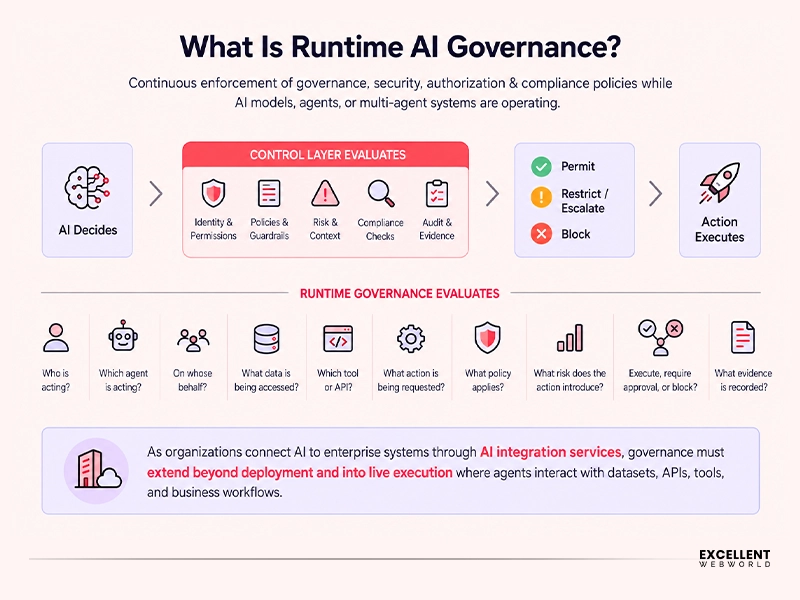
Runtime AI governance can be defined as the continuous enforcement of governance, security, authorization & compliance policies while an AI model, agent, or multi-agent system is operating. Instead of relying totally on pre-deployment controls, runtime governance acts as a decision layer between an AI system and the actions that it performs.
It is like;
AI decides → Control layer evaluates → Policy permits, restricts, escalates, or blocks → Action executes
This basically creates a governance loop around the agent.
The runtime governance generally evaluates;
- Who is acting?
- Which agent is acting?
- On whose behalf is it acting?
- What data is being accessed?
- Which tool or API is being called?
- What action is being requested?
- What policy applies?
- What risk does the action introduce?
- Should the action execute, require approval, or be blocked?
- What evidence should be recorded?
As organizations connect AI to enterprise systems through AI integration services, governance must extend beyond deployment and into live execution, where the agents interact with datasets, APIs, tools, and also in terms of business workflows.
The AI Control Plane: A New Layer for Enterprise AI
As organizations are nowadays deploying more AI systems, governance becomes quite fragmented when every application tends to manage its own permissions, monitoring, and also runtime control across the enterprise AI estate.
The AI control plane extends to AI applications, copilots, AI agents, foundation models, RAG systems, data sources, APIs, enterprise tools, business applications, users, and also automated workflows, thus enabling organizations to manage AI without disrupting any execution process. This becomes especially significant when organizations build & scale enterprise AI through AI development services, where governance, security, integration, and operational controls are considered to be part of the architecture.
This approach is reflected in the Microsoft Foundry Control Plane, which actually provides a unified management layer to observe, govern, secure, and control the AI agents by centralized visibility, runtime guardrails, compliance enforcement and also with the fleet wide management across production-grade systems.
Four Core Capabilities of an AI Control Plane
- Observe: This mainly helps in monitoring the model interactions, agent activity, tool calls, data accessibility, errors, and also policy violations, providing end-to-end visibility.
- Govern: Defines the enterprise-wide policies for the models, agents, data tools, and the workflow system.
- Enforce: This applies runtime guardrails, authorization, action limits, and also the approval requirements for AI execution.
- Trace: Helps in connecting the users, agents, models, datasets, and outcomes into a complete audit trail for standard compliance & investigations.
As a foundation, every AI control plane relies on these 6 core control functions;
Identity | Policy | Security | Observability | Evaluation | Audit
Unlike other AI platforms, the AI control plane layer actually exists to provide smarter control over the production system.
What an Enterprise AI Control Plane Needs to Control
An enterprise AI control plane system should be able to govern the complete AI execution lifecycle, starting from the models & agents to datasets, tools, actions, users, and also the outputs. It helps in creating a proper centralized layer for policy enforcement while keeping the AI systems operating across the enterprise system seamlessly.
Core Control Areas
| Governance Area | What the Control Plane Must Control |
|---|---|
| Agent Identity | Identify which agent is acting, who owns it, and on whose behalf it operates |
| Authorization | Determine what the agent is permitted to access or execute |
| Data Access | Control which data the agent can retrieve, use, share, or expose |
| Tool & API Access | Govern which tools, APIs, and enterprise systems the agent can invoke |
| Policy Enforcement | Apply rules to allow, restrict, escalate, or block actions |
| Runtime Security | Detect and respond to unsafe, anomalous, or unauthorized behavior |
| Observability | Provide visibility into agent decisions, tool calls, data access, and execution flow |
| Evaluation | Continuously assess accuracy, reliability, policy compliance, and behavioral risk |
| Human Oversight | Define when human review or approval is required |
| Auditability | Record what happened, why it happened, and which policies were applied |
| Incident Response | Enable real-time intervention, containment, permission revocation, and recovery. |
These controls are much more significant when they are incorporated into the components of the AI environment.
Models
It helps govern approved models, permitted workloads, production versions, data sharing restrictions, and also model-specific policies. The control plane should maintain visibility into one in which models are being utilized by each application or agent.
Agents
It maintains visibility into agent ownership, purpose, models, tools, data accessibility & authorized actions. But the key question is “What can this agent actually do?”
Data
This controls what information an AI system can retrieve, process, share, or expose in particular. The sensitive datasets should also possess clear rules for the model inputs, outputs, and logging.
Tools & APIs
Helps in treating every connected PI, CRM, ERP, database, cloud platform, code repository, payment system, or communication service as a separate permission boundary aspect.
Actions
In this particular case, the control plane can coordinate what the agents can actually do, other than just simple accessibility. For reading data, modifying records, approving transaction processes, launching code, and deleting resources, there should be different authorization levels.
Users
Here, it controls who can actually utilize the AI systems, create agents, modify instructions, grant permissions, approve actions, override policies, or even access audit records.
Outputs
This applies governance to AI-generated communications, recommendations, content, code & external actions. And the outputs need to be evaluated based on their risk, audience & potential impact.
The governance chain be like;
Identity → AI → Data → Tools → Actions → Outcomes
That is where the runtime governance moves from defining the principles to continuously controlling how AI actually operates.
Real-Time AI Monitoring and Observability
You cannot actually govern an AI system that you haven’t seen. Traditional monitoring systems confirm whether a service is running or not, but in terms of an AI agent, it can be technically healthy while making inappropriate decisions.
A healthy server does not reveal whether an agent is;
- Calling the wrong tool
- Accessing sensitive data unnecessarily
- Producing unsupported outputs
- Violating policy
- Taking unexpected actions
As organizations are now connecting AI across enterprise systems through AI integration services, AI observability must extend beyond the infrastructure into live agent execution.
Organizations should monitor;
- Model calls and retrieved context
- Data and tool access
- Agent actions and API calls
- Policy violations and escalations
- Errors, latency, cost, and performance
A typical execution trail will look something like this pattern;
User Request → Agent Decision → Model Call → Knowledge Retrieval → Tool Selection → API Call → Policy Check → Action → Outcome
This shared execution trail can help engineering, security, and compliance teams detect abnormal behavior while the workflows are still in execution mode. Microsoft’s Observability for AI Systems: Strengthening Visibility for Proactive Risk Detection indicates that AI governance should be able to capture AI native signals like agent actions & outputs, tool invocations, retrieved context, and end-to-end traces of execution that tend to support governance & runtime risk detection systems.
Enforcing AI Policies at Runtime
Policies create potential value only when they can influence the execution process.
An AI agent may be allowed to read customer data records, but not modify them or create payments under the threshold, which require approvals. These become the runtime policies, as they are evaluated when a particular action occurs.
A runtime policy engine typically evaluates an action & returns one of the four outcomes;
| Policy Decision | What It Means |
|---|---|
| Allow | The action complies with policy and executes automatically. |
| Deny | The action violates policy and is blocked. |
| Escalate | The action requires human approval before execution. |
| Constrain | The action is allowed only within predefined limits or conditions. |
For example, in terms of how runtime policy enforcement actually works, it is noted that when an AI agent requests an action, the policy engine mainly evaluates it against some predefined rules and makes further decisions for subsequent proceedings.
| Agent Action | Policy Decision | Outcome |
|---|---|---|
| Finance agent creates a $2,000 payment | Allow | Payment is processed automatically. |
| Finance agent creates a $50,000 payment | Escalate | Payment is paused until a human approves it. |
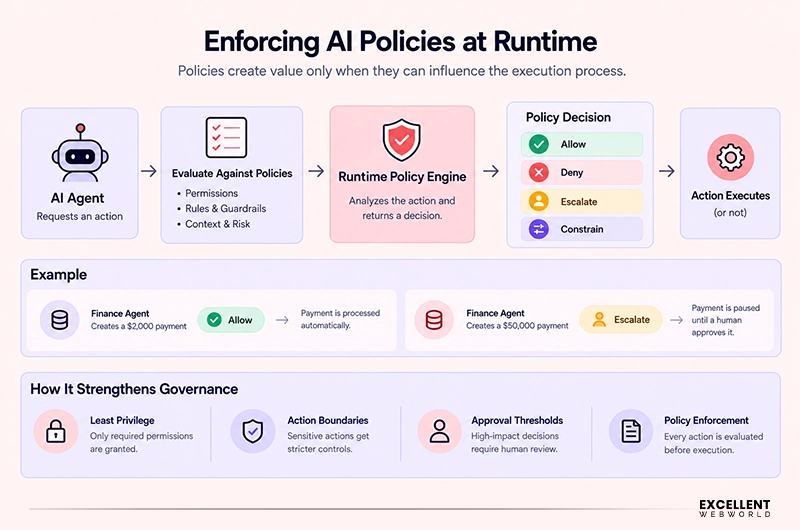
This demonstrates how runtime AI governance actually turns governance into real-time decision-making by applying;
- Least privilege-Agents receive only the permissions they need.
- Action boundaries-Sensitive actions have stricter controls than routine ones.
- Approval thresholds-High-impact decisions require human review.
- Policy enforcement-Every action is evaluated before execution.
This particular approach aligns with Microsoft’s runtime authorization guidance, which suggests evaluating actions against identity, business context, and policy prior to execution, rather than depending on any static permissions.
AI Agent Permissions and Identity
As organizations are building AI agents, every agent needs to have its own identity, and not just the permissions of the employee who created it. Instead, organizations should establish explicit identity and agent authorizations.
A secure AI agent security model actually combines;
- Agent identity
- User identity
- Role-based (RBAC) and Attribute-based (ABAC) access
- Tool permissions
- Delegated authorization
- Least-privilege and temporary permissions
For example, if a development agent may read repositories, create branches, and even run tests, it should not automatically merge into production or access production credentials.
It is important to have every authorization decision answer;
- Who is acting?
- What is acting?
- On whose behalf?
- Against which resource?
- Under what conditions?
The goal is to give every AI agent only the authority that they need, no more or less, while keeping the authority visible, controlled, and also revocable.
AI Audit Trails and Decision Traceability
When an AI system takes a consequential action, organizations need more than just a final output; they actually need evidence of how the decisions were made.
A complete AI audit trail should answer:
- Who initiated the request?
- Which agent acted?
- Which model was used?
- What data was accessed?
- Which tools were called?
- What policies applied?
- Was human approval required?
- What was the outcome?
And a complete simplified trace actually looks like;
Employee Request → Customer Service Agent → Model → Customer Record Retrieved → Refund API Called → Policy Evaluated → Manager Approval → Refund Executed
That creates operational traceability without exposing any private internal model reasoning aspects. In particular, it is important for regulated industries, financial transactions, healthcare workflows, customer-facing systems, security operations, and high-value approvals.
AI Governance for Multi-Agent and Multi-Model Environments
An AI sprawl is no longer just a technology management challenge, but a governance challenge.
An enterprise must have multiple;
- LLM providers and models
- AI applications and agents
- RAG systems and data sources
- Business units and cloud environments
- Third-party AI platforms
Without centralized visibility, each system can develop its own permissions, standard policies, monitoring, security controls, & approval processes.
The result is fragmented governance. An organization may know it uses AI without knowing where AI operates, what data it can access, or what authority each system can imply.
This challenge becomes much more visible as autonomous agents span across enterprise workflows, starting from finance to customer support and AI agents for logistics, where the multiple systems, tools & data sources must operate under consistent controls.
This is where an enterprise AI control plane becomes valuable, serving as a common governance layer across a heterogeneous AI estate. This need for centralized governance becomes even more apparent in complex AI environments, such as our Sports Governance Intelligence Platform, where AI-powered decision support, multiple data sources, and agent-driven workflows operate under a unified governance model to maintain visibility & control across connected systems.
The primary objective becomes: one governance layer across many AI systems.
So the models, applications, agents, and the cloud environments can remain distributed, while the governance provides common capabilities for;
Identity → Policy → Security → Monitoring → Evaluation → Audit
This model in particular aligns with the broader risk management principle in NIST’s AI Risk Management Framework, where the governance is implemented as a cross-cutting function across the AI lifecycle.
Enterprise AI Governance Architecture
An effective AI governance architecture, I would say that it needs to span the AI environment rather than just operating as an isolated application.
It’s like;
Users / Employees / Customers
↓
AI Applications / Copilots / Agents
↓
Models + RAG + Tools
↓
Enterprise Systems + Data
And, across those layers, sits the AI control plane;
Identity | Policy | Security | Monitoring | Evaluation | Audit
The execution layer actually performs the work process, while the control plane determines whether that work is visible, authorized, compliant, and traceable.
For every significant agent action, there is a pattern like;
Agent → Identity → Policy → Security → Monitoring → Audit → Allow / Deny / Constrain / Escalate
While the AI Deployment Architecture focuses mainly on “How AI is deployed?”, the AI Governance Architecture focuses on the control, security, compliance aspects, & accountability that need to be maintained while AI is operational.
For enterprises developing a connected AI agent development ecosystem, this separation becomes an important aspect of agent interaction during the business process, along with the APIs and enterprise datasets.
A Practical AI Governance Blueprint
A practical AI governance framework can be systematically organized into seven layers, thus complementing NIST’s Govern, Map, Measure & Manage approach to continuous AI risk management.
| Layer | Core Control | Objective |
|---|---|---|
| 1. Inventory | Models, agents, apps, data, tools, APIs, vendors | Know what exists |
| 2. Classify | Autonomy, risk, data sensitivity, criticality, regulation | Know what needs stronger controls |
| 3. Define Policies | Data, model, tool, action, approval, workflow rules | Define what AI can do |
| 4. Enforce | Identity, authorization, guardrails, approvals, action limits | Prevent excess authority |
| 5. Observe | Model calls, agent actions, tools, data, violations, performance | See what AI is doing |
| 6. Trace | Audit trails, policy decisions, lineage, approvals, incidents | Know what happened and why |
| 7. Respond | Block, constrain, escalate, suspend, revoke, terminate | Contain and correct risk |
It is like the key shift occurs from the broader principles like “Protect your customer data” to enforceable rules like “ This agent may retrieve customer datasets, but can’t export them to an external model.”
This turns governance standard principles into operational AI controls.
How to Implement Runtime AI Governance
A practical runtime AI governance program can be implemented by the following ten connected steps.
| Steps | Focus | Key Actions | Outcome |
|---|---|---|---|
| 1 | Inventory | It helps identify AI applications, agents, models, data, tools, APIs, and third-party AI services. | Know what exists |
| 2 | Risk Prioritization | Identifies high-risk AI handling consequential decisions, sensitive data, critical systems, financial actions, customer communication, or significant autonomy. | Prioritize highest-impact risks |
| 3 | Operational Mapping | Helps in mapping: Model → Data → Tools → Actions → Approvers. | Define the operational boundary |
| 4 | Identity & Least Privilege | Establish explicit agent identities and grant only required permissions. | Control access and authority |
| 5 | Runtime Policies | It defines the machine-enforceable rules: Allowed → Restricted → Approval Required → Denied. | Control AI actions |
| 6 | Monitoring & Telemetry | Capture model calls, agent activity, tool calls, policy decisions, errors, and outcomes. | See AI behavior |
| 7 | Evaluation & Testing | Continuously assess accuracy, grounding, safety, policy compliance, agent behavior, and business performance. | Validate ongoing behavior |
| 8 | Audit & Traceability | Record significant AI decisions, actions, approvals, and outcomes. | Reconstruct critical activity |
| 9 | Risk-Based Human Oversight | It applies controls based on risks: Low risk: Automatic execution · Moderate risk: Constrained execution · High risk: Human approval · Prohibited: Blocked. | Match oversight to risk |
| 10 | Continuous Improvement | This helps in retesting controls as models, prompts, data, tools, permissions, and agent capabilities change. | Keep governance adaptive |
I can say these overall steps can turn AI governance from a one-time compliance exercise to a continuous runtime control system.
What Good AI Governance Looks Like
I would say that AI governance maturity actually progresses from visibility to continuous control, in the following levels.
| Level | Stage | Capability |
|---|---|---|
| 1 | Invisible | AI exists without comprehensive visibility. |
| 2 | Documented | Systems, ownership, policies, and risks are defined. |
| 3 | Observable | AI activity, data access, tools, violations, and incidents are visible. |
| 4 | Enforced | Runtime policies, permissions, action boundaries, and approvals are enforced. |
| 5 | Adaptive | Governance continuously responds to changing models, behavior, data, workflows, and risk. |
So, I would tell that effective runtime governance is actually not about just adding bureaucracy, but about establishing the crucial effective control layer that tends to offer visibility, authority, security and also accountability that is needed in terms of AI autonomy.
Building Responsible AI Control With Excellent Webworld
You do not govern AI by just trusting the model. You govern it by controlling what it can access, what it can do, which tools it can utilize, when humans must intervene, what happens during execution, & how quickly the organization can respond to it.
As there is a shift in AI from assistant to more of an operator, traditional document-driven governance systems are no longer capable. Enterprises need an AI control plane that provides runtime visibility, policy enforcement, identity & authorization, behavioral monitoring, auditability, & traceability across the AI systems.
At Excellent Webworld, we help enterprises build AI solutions with these controls embedded into the architecture, thus enabling greater autonomy without losing security, accountability, or enterprise control.
The question is no longer as simple as: “Did we approve this AI system?” rather, it is “Can we see what it is doing, control what it is allowed to do, and also prove what happened when it actually acts.
Trust is not a control anymore; visibility, policy, enforcement, and traceability are.
- AI autonomy requires runtime governance, not just pre-deployment policies.
- An AI control plane provides centralized visibility, security, policy enforcement, and traceability.
- Identity and least privilege ensure agents operate only within defined authority.
- Runtime policies control what AI can access, decide, and execute.
- AI observability and audit trails make agent behavior visible and accountable.
- Risk-based human oversight keeps high-impact actions under appropriate control.
- Effective governance must continuously adapt as models, data, tools, and agent capabilities evolve.
Frequently Asked Questions
AI governance is the framework of policies, processes, controls, responsibilities, and technologies used to manage AI risks, security, compliance, accountability, and performance.
Runtime AI governance controls AI systems while they operate through real-time monitoring, policy enforcement, access control, agent permissions, audit trails, evaluation, and human approval.
An AI control plane is a cross-cutting governance layer that provides centralized visibility and control across AI applications, agents, models, data, tools, and enterprise systems.
AI agents can retrieve data, use tools, make decisions, and execute multi-step workflows. Runtime governance ensures these actions remain within defined permissions and policies.
Enterprise AI agents need explicit identities, least-privilege access, defined tool permissions, action boundaries, runtime policies, monitoring, audit trails, continuous evaluation, and human approval for high-impact actions.
AI governance covers risk, accountability, compliance, oversight, responsible use, and performance. AI security focuses on protecting AI systems, agents, models, data, applications, and infrastructure from security threats.
Use AI observability and telemetry to track model calls, tool usage, retrieved context, data access, actions, errors, policy decisions, latency, cost, and workflow outcomes.
An AI audit trail should capture who initiated the interaction, which agent and model acted, data and tools accessed, applicable policies, actions taken, human approvals, and the resulting outcome.
AI governance reduces AI sprawl through centralized inventory, consistent identity and access controls, approved models and tools, common policies, shared monitoring, continuous evaluation, and cross-system auditability.
Runtime policies can be enforced through identity and authorization, policy engines, guardrails, action limits, tool restrictions, approval workflows, and blocking mechanisms based on context and risk.
Least privilege ensures agents receive only the permissions required for their intended tasks, limiting the potential impact of errors, manipulation, or unexpected behavior.
AI observability provides visibility into production behavior, helping organizations detect anomalies, identify policy violations, investigate incidents, evaluate performance, and establish accountability.
An AI governance maturity model shows progression from limited visibility to documented, observable, enforced, and adaptive governance, with controls continuously adjusted as AI systems and risks evolve.

Article By


Mahil Jasani began his career as a developer and progressed to become the COO of Excellent Webworld. He uses his technical experience to tackle any challenge that arises in any department, be it development, management, operations, or finance.