- If you look into the freight and logistics market in the UAE, it’s estimated to reach around USD 31.63 billion that too by 2031. It’s growing with a CAGR of 6.55%.
- Considering the current scenario of 2026, a mid-range logistics app in Dubai would cut your cost up to AED 150,000 – 350,000. Let’s say if you are going with the current trend of AI and multi-system integration, it costs around AED 350,000 – 850,000+.
- Failing to comply with the PDPL leads to fines from AED 50,000 to AED 5 million, that too per violation.
- Ensure not to negotiate capabilities like live GPS tracking, COD-heavy payment handling, and Arabic/RTL UI in the existing market.
If you look at Dubai’s logistics sector, it’s consistently expanding, leaving less room for delayed and inefficient delivery operations. Having a larger number of shipments means you have more responsibility, such as:
- Multiple vehicles to coordinate
- More delivery points to control and manage
- Rise in customer counts who are expecting accurate updates
In routing or dispatch, small gaps can become expensive to track if they recur across a growing fleet. Even the numbers reflect that momentum. Even a Mordor Intelligence report about the freight and logistics of the UAE highlights that the market is expected to reach from $23 billion in 2026 to $31+ billion by 2031.
For all the logistics businesses in this competitive market, it becomes harder to sustain. For them, the real challenge is not handling more deliveries, but it’s about scaling without matching operational complexity.
This is the reason logistics app development in Dubai is best when grounded in operational conditions. Tracking fleet, planning routes, and the dispatch process need to work together while AI supports ETA prediction and demand forecasting as the operations grow.
Are you planning to build a custom logistics app for your audience in Dubai? The right choice requires clarity on scope, technology selection, cost, and integrations. So let’s help you get everything you want for your logistics app development.
Why Dubai Became the Center of the Middle East’s Logistics Operations?
Dubai’s location makes it an ideal option for logistics operations. It sits at the crossroads of Europe, Asia, and Africa, which is supported by decades of investment in airports, ports, free zones, and transport links. The most recognized Jebel Ali Port and AI Maktoum Airport connect the majority of the sea and air freight routes. Dubai International manages 2.2 million tonnes of cargo in a year, as estimated in the last year. The logistics is also backed by the planned expansion of Dubai World Central, targeting around 12 million tonnes of capacity and a 900km national rail network. Here is why Dubai stands out in the logistics market:
- Dubai South / Al Maktoum Airport (Developed to connect air-sea-road cargo flow)
- Jebel Ali Port + JAFZA (A man-made harbor that is the busiest in the world. Also, it sits inside a free zone designed for re-export)
- Government Digitization (Logistics operators being pushed towards connected, auditable systems by Dubai D33 and UAE PASS)
- eCommerce Volume (eCommerce giants like Noon, Amazon.ae, and Talabat last-mile demand growing faster than transportation)
I personally had experienced the same demand curve when our team engineered a reliable eCommerce shipping platform. The challenge we addressed was to architect enough last-mile capacity to manage orders that regional marketing would generate.
The Regional Challenges that are Hard to Avoid with a Generic Logistics App
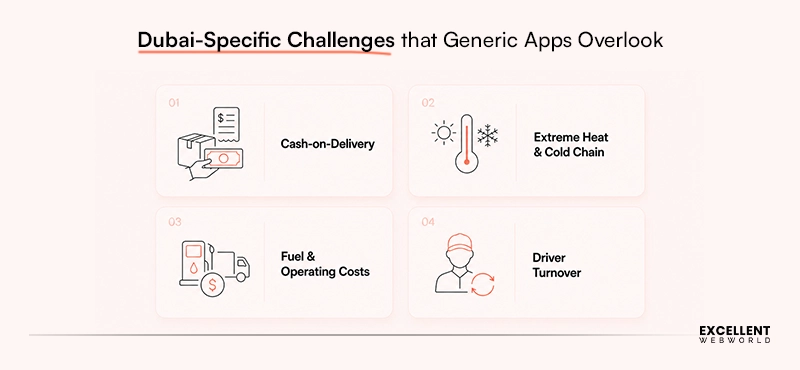 A logistics app developed for the US and Europe markets might rely on standardized addresses and consistent regulations. However, when it comes to the UAE and GCC, logistics apps must accommodate regional variations. Moving freight through these regions requires separate customs requirements, while Jebel Ali’s free zone adds an extra layer of complexity, where your cargo requires additional documentation to move forward. Let’s look at each of the regional factors affecting the logistics app requirements in Dubai:
- Cash-on-Delivery: You require dedicated payments and reconciliation workflows as COD is still dominant in GCC eCommerce.
- Extreme Heat & Cold Chain: Summers in the Gulf reach above 45°C. For F&B and pharma shipments and logistics, this is a must-factor to consider.
- Fuel & Operating Costs: Route efficiency becomes a direct margin concern due to higher fuel charges and toll costs.
- Driver Turnover: Expatriate fleets need multilingual interfaces that drivers use with minimal to no training.
These concerns are not so small that just translating a global logistics app to Arabic is enough. The core logic required for documentation, routing, and payments needs to be designed around operating conditions from the first sprint.
Two Logistics Apps We’ve Built For GCC And Why It’s Ruling The Region
1. Torod (eCommerce Shipping Platform)
Built for our Saudi Arabia client, Torod digitized high-volume eCommerce shipping by consolidating multiple carrier integrations into a single merchant dashboard. With the platform, merchants are no longer toggling between multiple carrier portals. This eCommerce shipping platform manages what most SaaS platforms sidestep. It’s a real-time customs document generation for cross-border shipments via Jebel Ali and bilingual support.
What makes it suited for the local market:
- Multi-carrier label printing and order tracking from a single interface
- Live shipment tracking across carriers
- Arabic/English bilingual UI designed for expatriate drivers & regional merchants
- COD payment workflows built natively
2. Beyati (Waste Management & Construction Logistics)
Client: Saudi Arabia
Beyati is Saudi Arabia’s waste management logistics platform that replaced phone-based dispatches and paper invoices with live booking, GPS fleet tracking, and auditable waste operations. In Beyati, from container bookings to live dispatch, Arabic-first driver workflows, and ZATCA-compliant invoices, every step is connected. The platform grew to manage thousands of bookings on a monthly basis because it was engineered around operational realities.
What makes it built for the region:
- Arabic RTL booking flow with live container availability logic
- Automated driver dispatch + GPS tracking across urban & remote construction sites
- Zone-based dynamic pricing engine
- Compliance-native architecture: ZATCA e-invoicing, PDPL identity verification, VAT handling
Types of Logistics Apps Beneficial for the Dubai Delivery Market
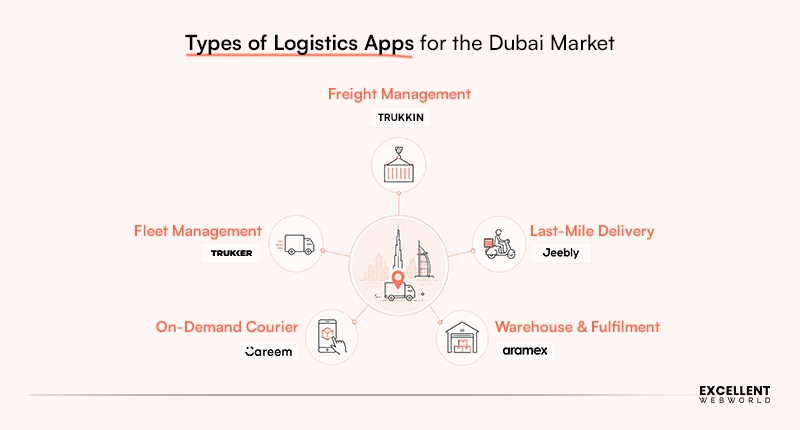
| Type | What it Does | Dubai/GCC Example |
|---|---|---|
| Freight Management | Manages multi-country shipment documentation & matches loads with carriers | Trukkin |
| Fleet Management | Vehicle tracking, driver behavior, fuel usage, and maintenance across the commercial fleet | TruKKer |
| Last-Mile Delivery | Route allocation, manages dispatch, and live order tracking for high-volume delivery | Jeebly |
| On-Demand Courier | Connects individual senders or SMEs with available drivers for point-to-point delivery | Careem |
| Warehouse & Fulfilment | Manages inventory, picking, and order synchronization inside distribution centers | Aramex’s fulfillment app |
Businesses build their logistics stack in stages. A growing third-party logistics (3PL) starts with last-mile delivery first and adds layers in fleet management once vehicle counts justify it. Again, I have experienced this kind of shift when engineering a fleet telematics platform for a GCC operator. We helped the client bring live GPS, OBD diagnostics, as well as driver performance into a unified dashboard once their fleet crossed that same threshold.
Features & Functionalities of a UAE Logistics App that Needs to Get Right
What separates an app based in Dubai from a global template? It’s Arabic/English bilingual support and cash-on-delivery-first payment handling. Every other capability is built around those two, and the fuller feature set breaks down by user role as follows:
| Customer | Driver | Admin |
|---|---|---|
| Live shipment tracking with map view | Turn-by-turn navigation with geofencing | Multi-currency, multi-country dashboard |
| Bilingual (Arabic/English) UI, RTL layout | Proof-of-delivery (Photo, Signature, OTP) | Digital, VAT-compliant invoicing |
| Multiple payment options, including COD | Simplified driver app for low-literacy use | Customs document upload and tracking |
| WhatsApp-based order updates | Route optimization with live traffic | Audit logs for compliance reporting |
| In-app support/chat (Arabic + English) | Digital trip logs and shift management | Driver performance and fleet analytics |
| Delivery scheduling and time-slot selection | Cash collection and COD reconciliation tools | Role-based access control |
| Order history and repeat-order shortcuts | Offline mode for low-connectivity zones | Bulk order import/export (CSV, API) |
| Push notifications for delays/exceptions | In-app earnings and incentive tracking | Real-time fleet map with exception alerts |
A global feature list would not be the same as this one; deliberately broader in a COD-heavy, bilingual, exception-prone market, “nice to have” features like offline mode and cash reconciliation tools tend to become launch blockers rather than v2 additions.
Where Artificial Intelligence Adds Value to a Dubai Logistics App
For the UAE, AI in a logistics app isn’t a bolt-on chatbot; it’s already baked into the types and features above. Here’s where it concentrates:
- ETA prediction for congested urban routes (Models trained on Dubai/Abu Dhabi traffic patterns outperform generic Google ETA estimates, especially around peak commute windows and major highways)
- Arabic-capable WhatsApp support (since WhatsApp Business API is close to universal here, AI-handled bilingual chat resolves tracking queries without a human agent)
- COD fraud and failed-delivery risk scoring (flags high-risk orders before dispatch, which matters far more in a COD-heavy market than in a card-first one)
- Demand forecasting for regional peaks (Ramadan delivery surges and White Friday volume spikes are predictable patterns that a trained model can plan fleet capacity around months in advance)
How to Build a Logistics App that is Ideal for the Competitive UAE Market
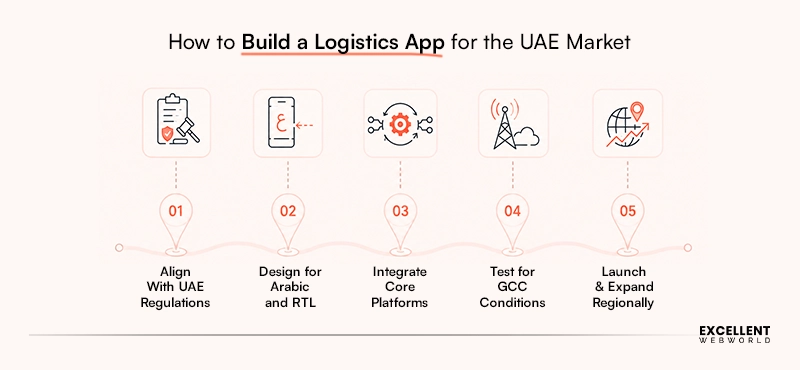 Building for this market follows the same broad phases as anywhere else. However, each phase carries region-specific decisions that, if skipped early, get expensive to retrofit later.
Step 1. Ensure to First Align Your Business Models With Regional Regulations
Decide free-zone vs. mainland registration, since this affects both your own compliance posture and which customs/documentation flows your app needs to support. Identify upfront which regime applies (PDPL for data, VAT for invoicing, Dubai Customs for cross-border goods) because these shape data models and API integrations, not just legal paperwork.
Step 2. Plan the User Experience for Arabic and RTL from the Start
Retrofitting a left-to-right interface into RTL later typically means rebuilding layout logic across the entire app, not just flipping text direction. Treat Arabic as the primary language in design files, with English as the secondary layer, even if most early users are English-first.
Step 3. Integrate Core Platforms and Tools in Parallel
ERP, GPS/mapping, and regional payment gateways (PayTabs, Telr, Network International) should be part of the core build sprint, since COD reconciliation and customs document handling touch almost every other feature. Bolting these on after a “generic” MVP is live is where most cost overruns in this market come from.
Step 4. Test Your App Under GCC Traffic and Connectivity Conditions
This means Arabic-language QA (not just translation checking, but RTL layout and text-truncation testing), device testing across the handset models common locally, connectivity testing for lower-bandwidth zones outside city centers, and a formal compliance review pass before launch.
Step 5. Launch the App for the UAE and Prepare for Regional Expansion
A build that works for Dubai rarely ports cleanly into Saudi Arabia or Oman without a second compliance and payment-gateway pass, different data laws, different dominant payment rails, and often different customs documentation standards. Budget this as a distinct phase.
Logistics App Development Compliance Checklist for UAE & GCC
- PDPL: Governs how customer and rider data is collected, stored, and transferred; fines run AED 50,000–5 million per violation.
- VAT: Invoices need to be VAT-compliant by default.
- Dubai Customs Documentation: Cross-border shipments need digital document trails that your app should generate.
- RTA Rider/Bike Regulation: Dubai’s RTA governs how delivery riders and bikes operate; driver-facing features (registration, route restrictions) should reflect this.
- Data Residency & Audit Logs: UAE-hosted or PDPL-compliant cloud regions, with audit trails ready for a Data Office review.
- Trade Licensing (Mainland vs. Free Zone): Determines which authority governs your operating entity and, indirectly, which compliance reporting applies to your platform.
- Cybersecurity & Critical-infrastructure Rules: Logistics increasingly fall under UAE cybersecurity regulations, given its role in national supply chains, particularly for enterprise and government-adjacent contracts.
- Dangerous Goods & Cold-chain Standards: Relevant if the app handles pharma, chemicals, or F&B shipments; documentation and monitoring requirements sit alongside PDPL and customs rules.
This is closer to a complete checklist than a shortlist. The original set (PDPL, VAT, Customs, RTA, data residency) covers the core, but trade licensing, cybersecurity regulation, and dangerous-goods standards are worth including for any app expected to handle enterprise or cross-border cargo, since gaps there tend to surface late in due diligence rather than at launch.
Tech Stack and Integrations Utilized to Engineer UAE Logistics Apps
The stack itself isn’t exotic. What matters is which regional variants get chosen over their global defaults.
| Category | Logistics App Development Technologies |
|---|---|
| Cloud & Infrastructure | AWS | Microsoft Azure UAE North | Google Cloud Platform |
| Backend | Node.js | Python | Java | Microservices Architecture |
| Database | PostgreSQL | MongoDB | Redis |
| Mobile & Frontend | Flutter | React Native | React | TypeScript |
| Mapping & Geolocation | Google Maps Platform | Mapbox | HERE Technologies | Custom Geofencing Layers |
| Payments | PayTabs | Telr | Network International | Mada/HyperPay |
| Messaging & Notifications | WhatsApp Business API | Twilio | Firebase Cloud Messaging |
| AI/ML | OpenAI API | TensorFlow | AWS SageMaker |
| IoT & Telematics | GPS trackers | RFID | Barcode Scanning | OBD Sensors for Fleet Diagnostics |
Not every project needs the full list, right? A basic last-mile app may only touch mapping, payments, and messaging, while an enterprise fleet platform pulls in IoT and AI layers on top.
How Much Does It Cost to Build a Logistics App in Dubai?
The average cost to build a logistics app in Dubai ranges from AED 70,000 to AED 850,000+. Still, this is not the exact cost, as it varies with different factors like integrations, objectives, team size, and much more. Here is a breakdown of the pricing to get you a detailed overview.
| Tier | AED Range | What’s Included |
|---|---|---|
| Basic/MVP | AED 70,000 – 150,000 |
|
| Mid-range Logistics App | AED 150,000 – 350,000 |
|
| AI-powered Logistics App | AED 350,000 – 850,000+ |
|
Arabic localization, PDPL-driven compliance work, and multi-gateway COD reconciliation are the three line items that push a Dubai build above what the same feature list would cost as a USD-only global app. A few other factors shift the number within each tier:
- Customer + driver + admin, across iOS, Android, and a web admin panel, costs more than a single-role mobile-only build.
- Simple integrations like mapping or SMS gateways add AED 5,000–15,000 each; complex ones (ERP, customs APIs, regulatory systems) can run AED 15,000 – 50,000+ per integration.
- A basic chatbot costs far less than a demand-forecasting or route-optimization model trained on regional data.
- Budget an additional 15–20% of build cost annually for maintenance, compliance renewals, and cloud hosting.
Top Logistics App Development Companies in Dubai
Picking the right logistics software development company here comes down to regional delivery experience, AI capability, and familiarity with UAE compliance.
| Logistics App Dev Companies Dubai | Best For | Regional Presence | Expertise |
|---|---|---|---|
| Excellent Webworld | Enterprises & Government-grade AI-powered solutions | Regional office in Bur Dubai, UAE | 14+ years as a technology partner serving the USA, KSA, APAC, and Europe, with clients like Amazon UAE, Dubai Government, Seen Jeem |
| Apptunix | Fleet-tracking and route-optimization build | Dubai-based, operating since 2013 | Long-standing track record of building AI-based route optimization for regional logistics operators |
| Peerbits | AI, IoT, and blockchain-driven platforms | Dubai-based | Predictive maintenance systems and blockchain-backed shipment records for freight-forwarding clients |
| Code Brew Labs | TMS and warehouse automation | Dubai-based | GPS/IoT integration built in from the start across fleet and warehouse platforms |
What’s Next for Logistics Tech in the Gulf Cooperation Council (GCC)
The next wave of change in Gulf logistics is less about software features and more about the infrastructure and policy layers apps will need to plug into.
- Autonomous & Drone Delivery Pilots: Early-stage trials are already running in parts of the UAE for last-mile use cases.
- Etihad Rail Freight Integration: As the national rail network matures, apps that can plan multimodal routes (road + rail) gain a real edge.
- Blockchain: Faster, tamper-proof customs documentation across GCC borders.
- Deeper UAE PASS Integration: Government-platform tie-ins are becoming an expectation for compliance-heavy logistics apps.
None of these are must-haves for a first build, but a platform architected with these integrations in mind now will scale into them far more cheaply than one that has to be re-engineered later.
Get the Right Partner for Logistics App Development in Dubai
A logistics app built for Dubai is a different brief, shaped by free-zone rules, PDPL, Arabic-first UX, and a COD-heavy payment reality that most guides never mention. Get these fundamentals right from the first sprint, and AI features like ETA prediction or demand forecasting become upgrades to a solid foundation rather than a patch on a mismatched one.
With Excellent Webworld’s regional office in Dubai, UAE, businesses can work with a technology partner that understands both software engineering and the requirements of the Middle Eastern market. Our team boasts 14+ years of experience working with enterprises, funded startups, and government organizations across the USA, KSA, APAC, and Europe. For logistics businesses in Dubai, our expertise covers:
- AI-powered Logistics Solutions: Build features like ETA prediction, demand forecasting, route optimization, and intelligent dispatching around real operational data.
- Region-ready App Development: Design Arabic-first, RTL-ready experiences and account for local workflows, payment preferences, and regulatory requirements.
- Enterprise Integrations: Connect logistics apps with ERP, WMS, TMS, payment gateways, maps, and other systems your operations already rely on.
- Scalable Product Engineering: Build modular systems that can support growing fleets, orders, drivers, warehouses, and multiple business locations.
- On-ground Dubai Expertise: Work with a regional team from our office at Victor Business Center, Bur Dubai, with experience serving organizations including Amazon UAE and the Dubai Government.
If you are about to build a logistics app for Dubai, our local expert team can help you turn the business requirements into a scalable and AI-ready product. Let’s connect.
FAQs About Logistics App Development
Not always. Mainland registration works too, but free-zone status (especially JAFZA, given its port access) often simplifies cross-border logistics operations and can offer full foreign ownership.
You need documented consent, purpose-limited data use, and breach notification within 72 hours. Non-compliance fines range from AED 50,000 to AED 5 million.
PayTabs, Telr, and Network International are the most widely used regionally, and all support the COD reconciliation flows that most Western gateways don’t handle natively.
RTA governs rider/bike registration and permitted operating zones. Your driver-facing app should capture registration status and respect route restrictions rather than assume unrestricted access.
It can, but expect a second compliance and payment-gateway pass per country. A UAE-only build rarely ports cleanly into Saudi Arabia or Oman without rework.
Not legally mandatory in every case, but functionally essential. Both driver retention and customer trust drop sharply without native Arabic/RTL support.
The time it takes to build and launch a basic logistics app in Dubai is around 3 – 5 months. For a mid-range app with Arabic UI and multiple integrations, it takes around 5 – 8 months. For enterprises looking for an AI-driven platform, the timeframe is approximately 9-12 months.
The cost it takes to build a delivery app in the Middle East runs around AED 70,000 – 150,000 for a basic build, AED 150,000 – 350,000 mid-range, and AED 350,000 – 850,000+ for enterprise builds with AI and full compliance/integration coverage.
Here is what you need to consider when choosing the right logistics development partner.
- Ask for proof of regional compliance work (project that actually handled PDPL or VAT requirements)
- Check for real Arabic/RTL delivery history
- Confirm their post-launch support model
- Weigh COD experience specifically (ask how they’ve handled it before)
- Look for on-ground presence & evaluate their AI maturity honestly
- Review integration experience with regional systems (work with PayTabs/Telr, Dubai Customs APIs, or UAE PASS)

Article By


Mayur Panchal is the CTO of Excellent Webworld. With his skills and expertise, he stays updated with industry trends and utilizes his technical expertise to address problems faced by entrepreneurs and startup owners.