Summary:
Agentic AI is transforming financial services by automating complex workflows across banking, lending, fraud, payments, compliance, and insurance. This guide explains key use cases, benefits, challenges, technologies, security needs, implementation steps, costs, and best practices for achieving measurable business value with AI agents.
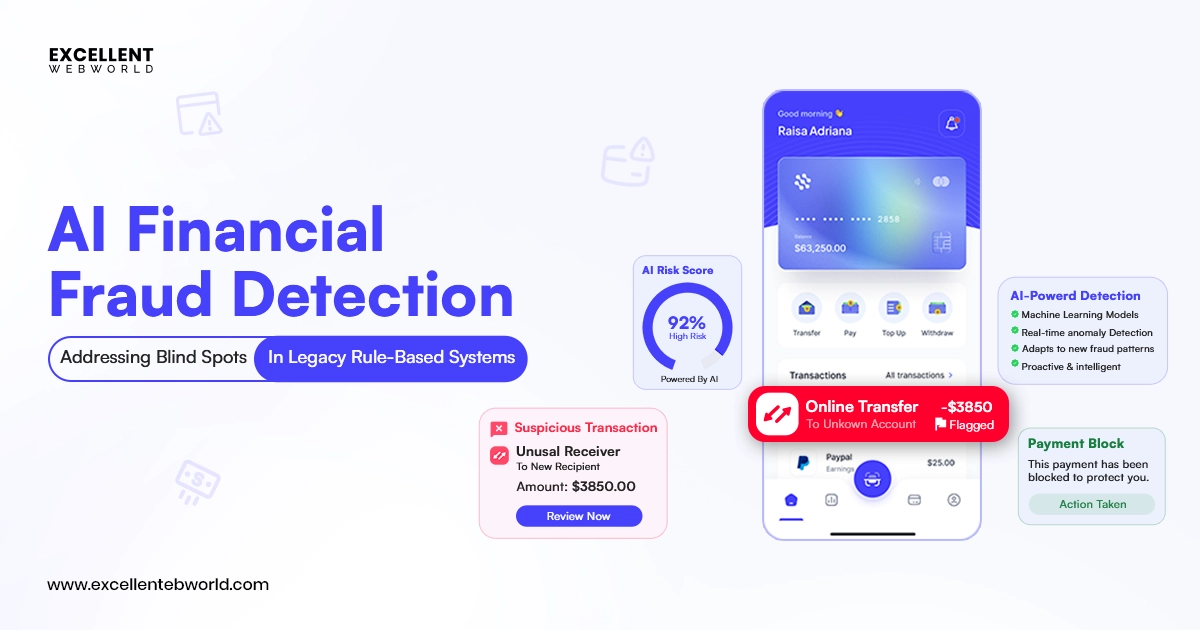
For years, AI in fintech meant using artificial intelligence to support individual tasks: spotting possible fraud, scoring a loan, or giving a recommendation. A human still had to review the result and take action. Agentic AI in financial services changes this.
An AI agent can investigate a flagged transaction, check the customer’s account history, compare it with company policies, and take action. It can then send the case to a human when the decision needs human judgment. PwC’s 2026 Financial Services Industry Survey reflects this shift: 55% of executives rank agentic AI as their top investment priority for 2026.
And there are valid reasons for this shift. Compliance is becoming more expensive, fraud is getting harder to detect, and customers expect faster and more personalized service. Your neobank rivals with leaner headcounts are already piloting AI agents in financial services for AML monitoring, underwriting, and customer operations. If you wait too long, you may have to catch up with competitors that have already started reducing manual work and speeding up decisions. So, this is a now-or-never kind of moment.
In this blog, I’ll break down the real use cases, benefits, architecture, implementation challenges, costs, ROI of agentic AI, and how an experienced fintech app development company can help you build and deploy these systems responsibly.
What is Agentic AI in Financial Services?
Agentic AI in financial services refers to AI systems that can understand a business goal, plan the steps required to achieve that, use pre-approved data and workflows, and take corrective measures with limited human intervention.
I see agentic AI technology as the next layer of intelligent financial automation, as it can help you connect multiple steps across fragmented workflows instead of automating them in isolation. In addition to that, these AI agents can work with core banking platforms, documents, APIs, and compliance systems while operating with pre-defined controls and permissions.
So, the role of AI in fintech will be less about adding another chatbot to handle routine customer queries. It will be more about helping teams to complete complex tasks faster, consistently, and with better human oversight.
Agentic AI vs Generative AI vs Traditional AI: Which Approach Fits Your Financial Workflow?
Financial institutions should choose AI approaches by keeping the business problem in mind rather than just core technology.
An experienced AI agent development company can help you determine whether your workflow requires autonomous execution, predictive analytics, or content generation.
Knowing these differences matters because AI-powered financial agents can handle connected tasks, while traditional AI and GenAI are useful for specific parts of a workflow.
| Parameter | Agentic AI | Generative AI | Traditional AI |
|---|---|---|---|
| Core Function | Autonomous AI in finance plans and completes multiple steps to fulfill a specific goal. | Creates, summarizes, and transforms information. | Predicts outcomes and identifies patterns. |
| Workflow Handling | Agent-based financial automation manages end-to-end workflow across multiple steps. | Handles a specific interaction or content task. | Handles a specific analytical task. |
| Decision-Making | Makes decisions within set permissions and rules. | Provides recommendations and responses. | Produces predictions, classifications, and scores. |
| Ability to Act | Uses approved APIs, tools, and systems to take actions. | Requires a person or an app to act on the output. | Sends its result to another system. |
| Data & Systems | Works across databases, APIs, documents, and applications. | Works with information provided or connected to its application. | Works with a defined dataset. |
| Human Involvement | Humans handle high-risk decisions, exceptions, and actions outside agent permissions. | Human review or act on the output. | Humans review the prediction or final decision. |
| Financial Use Cases | KYC/AML underwriting, fraud detection, payment operations, compliance, and claims. | Financial research, summaries, customer service, and document analysis. | Fraud scoring, credit scoring, risk modeling, and forecasting. |
| Business Impact | Speeds up complex workflows and reduces manual coordination. | Saves time for information-intensive work. | Improves prediction consistency and speed. |
| Main Limitation | Requires strong monitoring, security, permissions, and human oversight. | Produces unsupported or inaccurate information. | Struggles when conditions or patterns change. |
How does Agentic AI Work in Financial Services?
Understanding how agentic AI works for financial institutions requires you to get the hang of the workflow first instead of the underlying technology. Here’s how an agentic AI workflow for financial institutions works in a step-by-step manner:
| Steps | What Happens |
|---|---|
| 1. Perceive | AI agent decision-making workflow collects real-time information from APIs, documents, customer records, transactions, and approved sources. |
| 2. Reasoning | AI agent reasoning workflow evaluates available information, identifies patterns, and determines the areas that require attention. |
| 3. Plan | AI agent planning and execution workflow decides the next course of action by coordinating several tasks. |
| 4. Act | With the AI agent orchestration workflow, the agent connects with APIs, CRM platforms, compliance tools, and banking systems to create an autonomous AI workflow that performs approved actions. |
| 5. Learn & Review | Human feedback and outcomes help improve the workflows, while human-in-the-loop AI keeps fraud leaders involved for high-stakes decisions. |
Note: With the help of a reliable AI development services partner, you can build fallback mechanisms and monitoring controls required to operate these workflows safely.
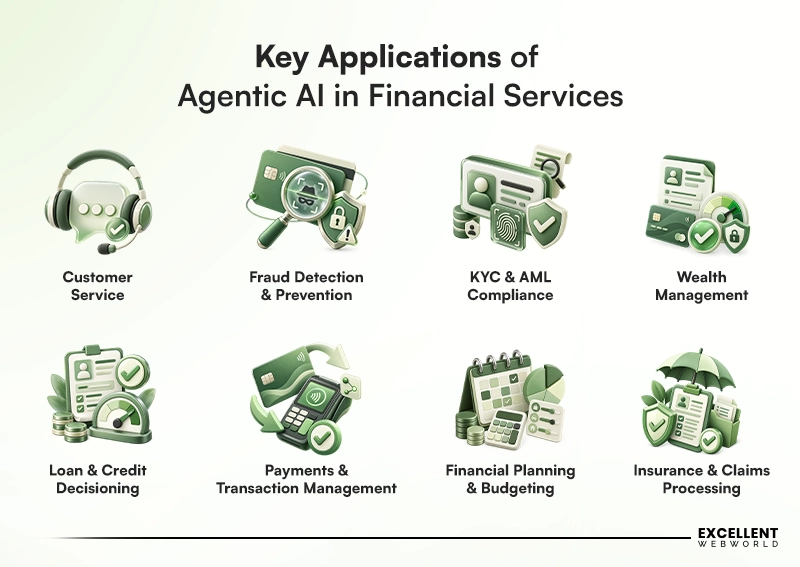
Key Applications of Agentic AI in Financial Services
The strongest agentic AI use cases are not about adding another chatbot to your tech stack. They’re more about taking manual and fragmented workflows and connecting them so that they don’t slow down financial operations teams. Here are some of the key agentic AI use cases and applications for financial services that you need to be aware of:
1. Customer Service & AI Banking Assistants
What AI Agents Can Do:
- AI agents in banking can answer account & transaction questions and provide personalized experiences.
- AI customer service in banking can handle routine queries and escalate complex requests to the support team, which is especially important for projects related to mobile banking app development.
Business Impact:
- Reduces repetitive service-oriented tasks for the operations team, while providing customers with fast and more personalized responses.
Real-World Example:
- Bank of America – Erica: In 2025, more than 20 million customers interacted with Erica 700 million times. Since launch, Erica has handled more than 3.2 billion customer interactions. It also provides personalized, proactive financial guidance to customers.
2. Fraud Detection & Prevention
What AI Agents Can Do:
- AI agents for fraud detection can identify suspicious behavior, monitor transactions, gather supporting evidence, and help investigators move cases forward.
- Data engineering services can connect the fragmented customer and transaction data required for this in-depth analysis.
Business Impact:
- AI financial fraud detection helps risk detection teams detect threats faster and investigate more cases without increasing the team size.
Real-World Example:
- Mastercard – Decision Intelligence Pro: Mastercard reports a 20% improvement in fraud detection, and transaction scoring happens in just 125 milliseconds.
3. KYC & AML Compliance
What AI Agents Can Do:
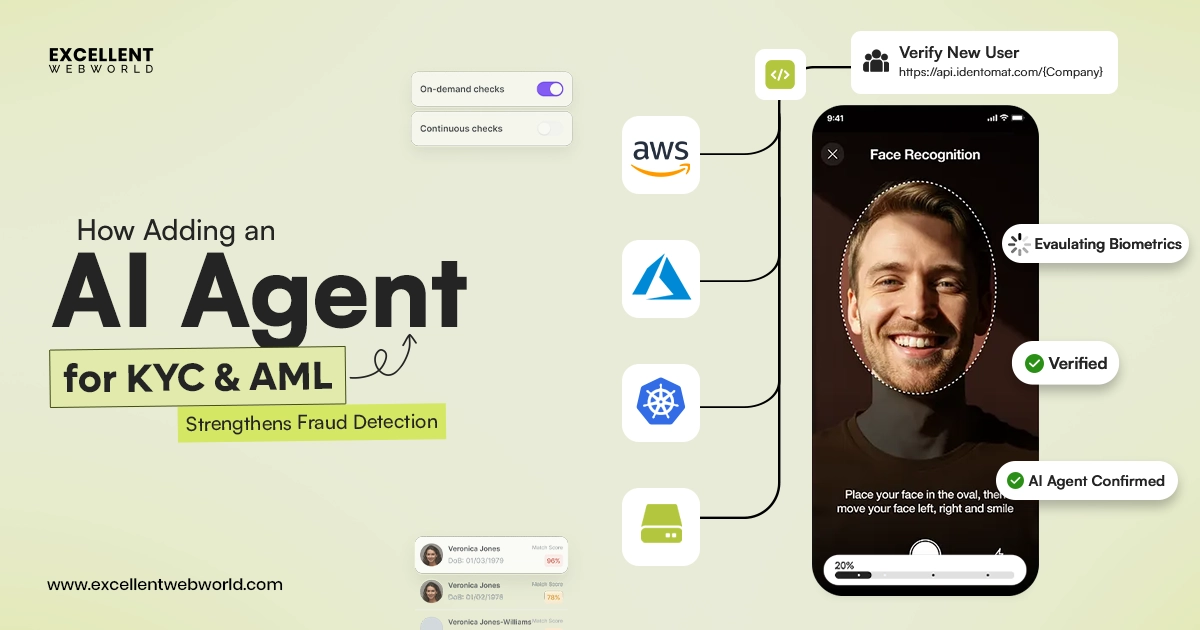
- AI agents for KYC and AML can carry out document analysis, identity verification, customer risk profiling, transaction monitoring, and suspicious-activity detection.
- AI agents for financial services can connect these compliance tasks across approved systems so that fraud detection teams don’t have to manage each step manually.
Business Impact:
- Shorten onboarding & investigation cycles and reduce repetitive compliance work, while keeping high-risk cases under human oversight.
Real-World Example:
- Mastercard + Signzy – Video KYC: Mastercard reports that Signzy’s powerful AI/ML-powered video KYC solution made customer onboarding 99% faster compared to traditional paper-based KYC.
4. Financial Advisory & Wealth Management
What AI Agents Can Do:
- AI agents for wealth management can monitor portfolios, assess risk, analyze market information, and prepare personalized insights for advisors.
- Wealth management software development projects can use these capabilities to enhance existing workflows and deliver next-generation customer experiences.
Business Impact:
- Provides faster access to relevant information and reduces time spent on manual research and insights preparation for clients.
Real-World Example:
- HSBC – Wealth Intelligence: HSBC’s AI-powered platform analyzes and summarizes information from more than 10,000 data sources, thereby helping wealth management staff generate market insights and personalized investment strategies.
5. Loan & Credit Decisioning
What AI Agents Can Do:
- AI agents for lending can coordinate loan monitoring, credit assessment, underwriting, document verification, and application analysis.
- AI agents for loan approval can reduce manual handoffs between these stages, which is pretty useful when you’re creating a money lending application.
Business Impact:
- Reduces the amount of repetitive review required from the lending team and creates a faster lending workflow.
Real-World Example:
- Upstart + DR Bank: DR Bank partnered with Upstart’s AI-powered small-dollar lending products for loans of $250-$2,500, with a repayment window of 3-18 months.
6. Payments & Transaction Management
What AI Agents Can Do:
- AI agents for payments can provide support for anomaly detection, transaction routing, reconciliation, payment verification, and other transaction tasks by fetching data from payment gateway integration workflows and online payment APIs.
Business Impact:
- Enables faster handling of transaction exceptions & payment workflows and reduces manual payment operations.
Real-World Example:
- Visa – Agentic Commerce: Visa reported hundreds of secure agent-initiated transactions completed with various partners across the globe, including B2B and end-to-end consumer purchases.
7. Financial Planning & Budgeting
What AI Agents Can Do:
- AI agents for financial planning can identify cash-flow patterns, analyze spending, provide budget recommendations, and surface personalized financial insights.
- Digital wallet app development projects can integrate these capabilities into everyday money-management experiences.
Business Impact:
- Provides faster access to relevant information and reduces time spent on manual research and insights preparation for clients.
Real-World Example:
- Lloyds Banking Group – Agentic AI Financial Assistant: Lloyds launched the UK’s first agentic AI financial assistant in 2026 for its 21 million customer base. It provides personalized insights on budgeting, savings, investments, and spending.
8. Insurance & Claims Processing
What AI Agents Can Do:
- AI agents for insurance can analyze claim information, identify potential fraud signals, review policy details, and coordinate claim workflows.
- An insurance mobile app development project can bring these capabilities into its ecosystem to enhance the customer experience.
Business Impact:
- Reduces claim processing time and manual workload while allowing complex cases to move to the support team.
Real-World Example:
- Lemonade – AI Jim: As of December 2025, AI Jim handled the first notice for 96% of customers without any human intervention, and roughly 55% of Lemonade’s claims were automated from start to finish through AI Jim.
What are the Benefits and Challenges of Agentic AI in Financial Services
The benefits of agentic AI in finance go beyond automation. The real business value comes when AI agents can connect multiple steps, work with given financial data, and move workflows forward with limited human intervention. However, with these benefits, there are also some challenges that you need to be aware of while implementing agentic AI in financial services.
Benefits of Agentic AI in Financial Services
Here are some of the key agentic AI benefits for financial services you should be aware of:
| Benefit | Business Impact |
|---|---|
| Increased Operational Efficiency | AI agents in financial services can coordinate multiple workflow steps instead of automating separate tasks, thereby reducing processing delays and increasing operational efficiency. |
| Reduced Operational Costs | AI agents in banking can handle documentation, KYC, servicing, and investigation tasks, thereby reducing the cost of processing repetitive tasks. |
| Faster Financial Decision-Making | Agentic AI in financial services can assess context, gather approved data, and move lending, compliance, claims, and fraud cases forward. |
| 24/7 Customer Support | AI agents in financial services can handle routine queries round the clock while escalating complex cases to human teams. |
| Improved Personalization | Agentic AI in finance can use customer and transaction context to provide personalized financial guidance. |
| Better Fraud Detection & Prevention | AI agents for fraud prevention can continuously investigate suspicious patterns, monitor activity, and escalate high-risk cases to support teams. |
| Reduced Manual Work | AI agents in banking can collect relevant information, reconcile records, prepare documentation, and complete repetitive workflow steps. |
| Improved Compliance Operations | AI agents for compliance can coordinate evidence collection, KYC, AML, and monitoring, while keeping high-risk cases under human oversight. |
| Scalable Financial Operations | Financial AI agents can handle increasing transaction and case volumes without having to increase operational team headcount. |
| Enhanced Customer Experience | One of the core Agentic AI use cases in finance that reduces waiting times and creates consistent experiences across lending, servicing, payments, and claims. |
| Faster Workflow Automation | Agent-based financial automation connects multiple tasks into one workflow, thereby reducing manual handoffs between teams and systems. |
| Faster Workflow Automation | Agent-based financial automation connects multiple tasks into one workflow, thereby reducing manual handoffs between teams and systems. |
| Improved Data-Driven Decision-Making | AI agents can retrieve information from approved sources and bring relevant context together to provide accurate recommendations or next steps. |
| Better Resource Utilization | AI agents will improve the overall productivity of financial institutions as employees spend less time on repetitive tasks and more on judgement calls. |
Challenges of Agentic AI in Financial Services
Here are some of the major agentic AI challenges for financial services you should be aware of:
| Challenge | What It Means For Financial Institutions |
|---|---|
| Data Privacy Risks | Agentic AI risks increase when agents can access sensitive transaction and customer data, thereby making stringent role-based access control mandatory. |
| Security Vulnerabilities | AI security risks in finance get multiplied when autonomous systems can access banking applications, financial operations, and APIs — a core concern in enterprise AI security as agent permissions expand. |
| Regulatory Compliance | AI compliance challenges arise as financial institutions have to demonstrate that AI agents’ actions remain within regulatory requirements and internal policies. |
| AI Hallucinations | AI hallucination risks become more prominent when inaccurate information influences financial decisions or triggers downstream actions. |
| Model Reliability Concerns | You must monitor AI model reliability because performance can change as models, data, and workflow evolve. |
| Lack of Transparency & Explainability | AI transparency and explainability are essential when compliance, risk, and audit teams need to understand why an agent took a particular action. |
| Integration Complexity | Managing seamless integration across banking, compliance, CRM, payment, and other legacy systems is one of the major Agentic AI challenges. |
| Legacy Banking Infrastructure | Older banking systems lack consistent data structures, modern APIs, or the controls required for autonomous workflows. |
| Human Oversight | AI agents require defined threshold approvals for decisions involving money, fraud, compliance, or customers. |
| High Implementation Cost | For AI agents to work correctly, fintech institutions need to invest in data integration, infrastructure, security, testing, and governance. |
| Data Quality | You need accurate, current, and consistent data for AI agents to work properly. |
| AI Governance | You need to have clear ownership, audit trails, permissions, escalation rules, and accountability for AI agents. |
| Model Monitoring | You need to monitor AI agents for performance, policy violations, security issues, and unexpected behavior. |
| Operational Risks | An incorrect AI agent automation can affect transactions, customers, compliance, and financial outcomes at scale. |
| Third-Party Dependency | Cloud platforms, APIs, external models, and vendors introduce security, pricing, concentration, and availability risks. |
What are the Key Technologies Behind Agentic AI in Finance
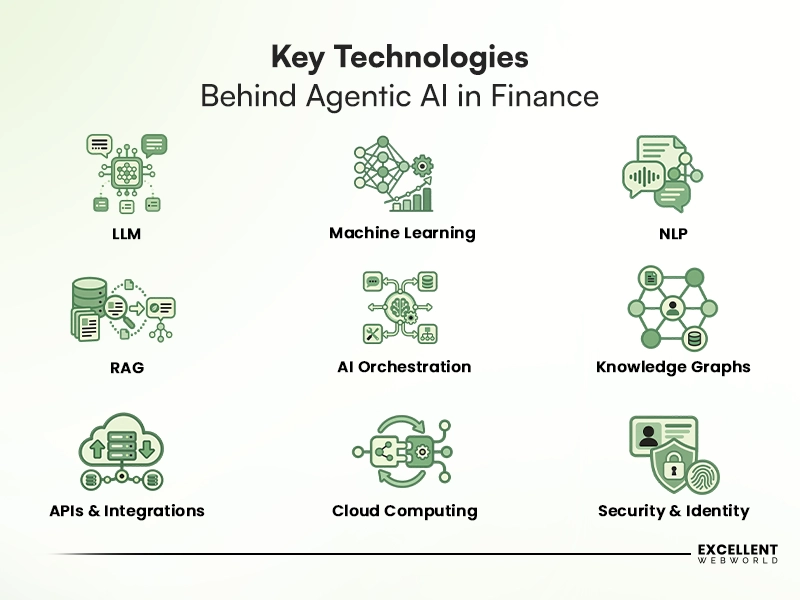
An effective agentic AI technology stack combines data, models, orchestration, integrations, and security into one AI agent architecture. Here are key technologies empowering it:
| Technology | Business Role in Financial Services |
|---|---|
| Large Language Models (LLMs) | Large language models for finance help agents understand customer requests, financial documents, policies, and complex instructions. |
| Machine Learning | Machine learning in finance assesses risk, identifies fraud patterns, analyzes transactions, and detects unusual behavior. |
| Natural Language Processing (NLP) | Natural language processing in finance helps agents understand financial documents, customer conversations, reports, and regulatory content. |
| Retrieval-Augmented Generation (RAG) | RAG for financial AI allows agents to retrieve approved information from internal documents, databases, policies, and knowledge sources before responding. |
| AI Orchestration Frameworks | AI orchestration frameworks create coordination between agents, tools, models, workflows, and approval steps. |
| Knowledge Graphs | Knowledge graphs for finance connect relationships between accounts, customers, businesses, transactions, and other entities to provide stronger context. |
| APIs & Financial Data Integrations | AI APIs for financial services connect AI agents with payment, banking, KYC, CRM, fraud, and compliance systems, supporting various fintech API use cases like money transfer app development and more. |
| Cloud Computing | Cloud AI for financial services facilitates scalable infrastructure for processing large financial datasets and running AI workloads across enterprises. |
| Security & Identity Technologies | It manages authentication, authorization, permissions, encryption, and audit trails to keep agents secure and accountable. |
How Financial AI Agents Integrate With Existing Systems
Enterprise AI integration in finance is not about replacing the core technology; it’s more about making existing systems work together with new-age AI agents. Here’s how financial AI agents integrate with existing systems:
| Existing System | How AI Agents Integrate and Create Business Value |
|---|---|
| Core Banking Systems | Core banking AI integration allows agents to access approved customer, account, and transaction data required to support servicing, fraud, lending, and operations. |
| CRM Platforms | AI integration with CRM systems provides agents with customer context, thereby helping them to automate service requests, personalize interactions, and route complex cases to the support team. |
| Payment Gateways | AI integration with payment gateways provides support for payment monitoring, transaction verification, anomaly detection, and controlled-payment workflows. |
| KYC/AML Platforms | AI integration with KYC and AML platforms helps agents collect documents, monitor transactions, review customer information, and escalate suspicious activities. |
| ERP Systems | Agents can connect financial operations with ERP systems for reporting, invoice processing, reconciliation, and back-office workflows. |
| Financial Databases | Financial data API integration allows agents to retrieve approved information from structured data sources while maintaining required access controls. |
| Open Banking APIs | Open banking API integration facilitates agents to securely access permitted accounts and transaction information for customer services and financial analysis. |
| Third-Party APIs | API connections enable AI agents to access external fintech services without financial institutions having to replace their existing legacy infrastructure. |
Security and Compliance Considerations For Fintech Agents
Here are security and compliance considerations you need to keep in mind for AI agents in finance:
| Security & Compliance Consideration | What It Means for Financial AI Agents |
|---|---|
| Data Encryption | As cloud services & solutions are involved in operating financial AI agents, you need to encrypt sensitive transaction, customer, and financial data in transit and at rest. |
| Access Control | AI automation in financial services doesn’t mean unrestricted access to payment functions, customer records, or banking systems. Give each agent only the required permission. |
| Identity Management | Use strong authentication and agent-level identities so financial institutions can verify which AI agent has accessed the data. |
| Audit Trails | Record decisions, actions, prompts, data retrieval, approvals, and outcomes so compliance teams can investigate incidents and support regulatory reviews. |
| Model Monitoring | Monitor agent behavior, drift, accuracy, unusual actions, and failed workflows continuously. |
| Explainable AI | Financial teams need to understand why an AI agent has reached a particular decision for fraud, lending, and compliance decisions. |
| Regulatory Reporting | Agents can prepare regulatory reports faster, but compliance experts should review and approve the information before it gets submitted to regulatory bodies. |
| Data Governance | Define what data financial AI agents can access, retrain, retrieve, and share. |
| Human Approval for High-Stakes Decisions | Keep qualified employees in the loop for high-stakes actions such as loan decisions, account restrictions, suspicious-activity escalation, or large financial transactions. |
How to Implement Agentic AI in Financial Services
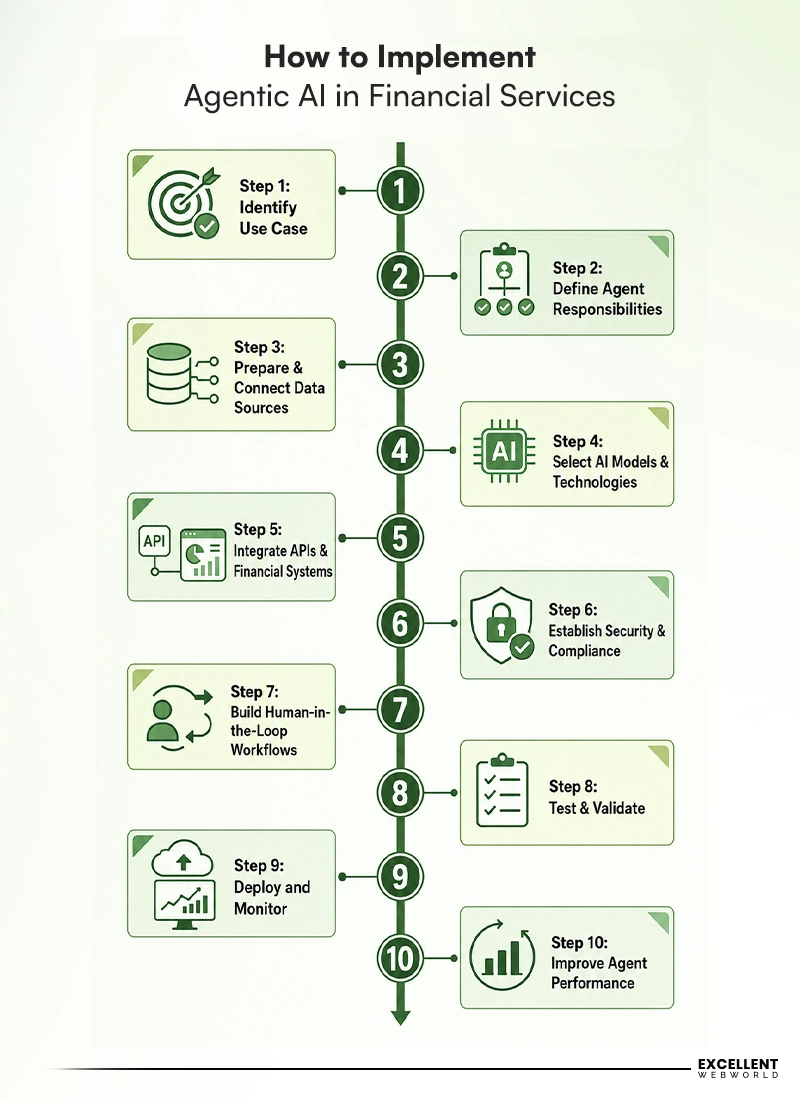
Successful agentic AI implementation starts by finding a business problem and not deciding the AI model. Here’s a step-by-step agentic AI development process that you should follow:
| Step | What To Do | Business Outcome |
|---|---|---|
| Step 1: Identify the Business Use Case | Pick a problem like KYC, loan processing, fraud investigation, or customer support. Define the problem, target KPI, expected outcome, and potential ROI. | Keeps the project tied to a measurable business goal. |
| Step 2: Define Agent Responsibilities | Define what the agent can access, decide, and execute. Set permission limits and specify which decisions require human intervention. | Reduces compliance and operational risk while keeping autonomy in check. |
| Step 3: Prepare and Connect Data Sources | Identify documents, transaction data, internal databases, and external sources. Clean the data and establish secure access before connecting them to the agent. | Provides the agent with reliable information instead of outdated or fragmented data. |
| Step 4: Select AI Models and Technologies | As part of the agentic AI implementation strategy, choose LLMs and ML models based on your business workflow. Evaluate knowledge graphs, RAGs, and orchestration frameworks based on actual business needs. | Keep models aligned with cost, risk, and accuracy requirements and avoid overengineering. |
| Step 5: Integrate APIs and Financial Systems | For AI agent development for finance, you need to connect core banking, ERP, KYC, AML, CRM, payment, and fintech APIs so that the agent can retrieve correct information and take necessary actions. | Helps agents work across the technology stack instead of creating a separate AI app. |
| Step 6: Establish Security and Compliance Controls | Apply access control, data governance, encryption, audit logging, and compliance checks before production deployment. | Creates an auditable operating environment and protects sensitive financial data. |
| Step 7: Build Human-in-the-Loop Workflows | Route high-risk cases to the support team. Define escalation rules and approval thresholds for compliance, lending, payments, and fraud workflows. | Keeps people accountable for decisions where errors could create financial penalties or reputational damage. |
| Step 8: Test and Validate AI Agents | If you’re building a fintech app that supports AI agents, test security, reliability, edge cases, accuracy, and failure scenarios against real-world customer, transaction, and exception scenarios. | Identifies loopholes before they affect transactions, customers, or regulatory processes. |
| Step 9: Deploy and Monitor | Start the agent in a controlled environment, then monitor agent errors, behavior, decisions, latency, and business KPIs post-deployment. | Shows whether the agent is actually improving productivity, speed, cost, and accuracy. |
| Step 10: Continuously Improve Agent Performance | Use production feedback to update knowledge sources, models, permissions, and evaluation test case scenarios. | Helps the system adapt as financial products, regulations, fraud patterns, and customer requirements change. |
Best Practices for Deploying Agentic AI in Finance
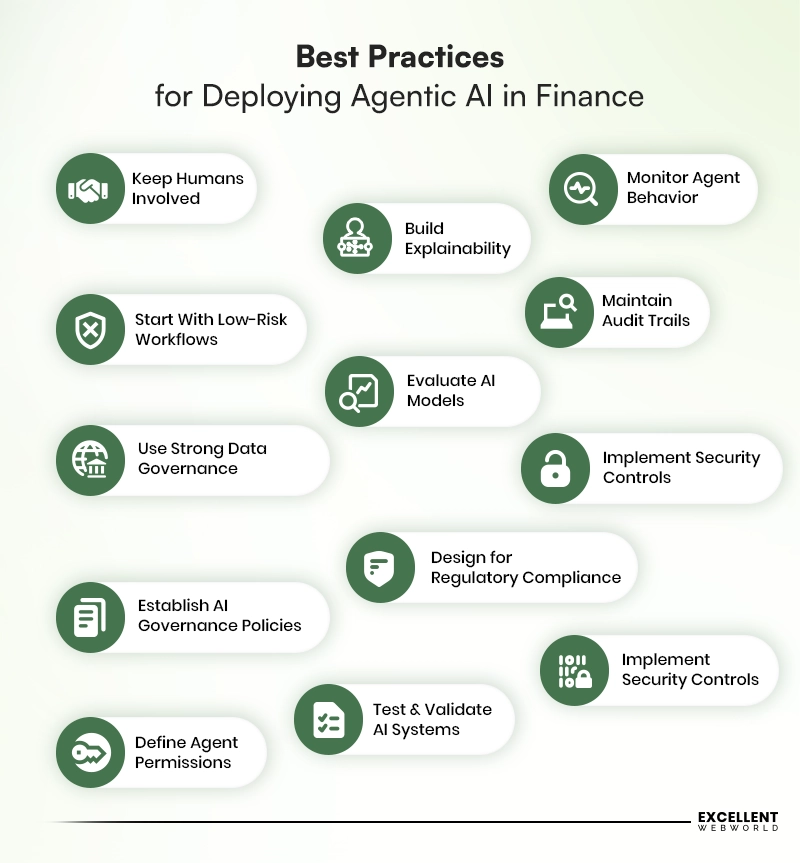
Deploying agentic AI in finance is not about providing AI systems with more autonomy; it’s more about controlling the levels to which autonomy is allowed. Here are the best practices that you need to follow for deploying agentic AI in finance:
| Best Practice | What It Means for Financial Institutions |
|---|---|
| Start With Low-Risk Workflows | Start with tasks like internal research, document review, or customer-service assistance before moving to high-value transactions or financial decisions. |
| Keep Humans Involved in High-Impact Decisions | Keep human intervention mandatory for decisions related to lending, payments, account restrictions, fraud escalations, or other customer outcomes. |
| Use Strong Data Governance | Define what AI agents can access, how it is used, where it is stored, and how long it is retained. |
| Build Explainability Into Workflows | Customers and regulators should be able to understand the information and reasoning behind each action that the agent takes. |
| Monitor Agent Behavior Continuously | Track accuracy, latency, failed tasks, unexpected actions, and business outcomes after deployment. |
| Maintain Detailed Audit Trails | Log data access, agent decisions, approvals, actions, and exceptions so that compliance teams can investigate any issue. |
| Regularly Evaluate AI Models | AI in financial services should be treated as an evolving system and therefore, you should re-test models as fraud patterns, data, regulations, and data change. |
| Design for Regulatory Compliance From the Beginning | Build compliance workflows into testing, permissions, and reporting from day one instead of adding it post-development. |
| Implement Strong Security Controls | Use identity controls, encryption, least-privilege principles, secure APIs, and continuous security testing. |
| Establish Clear AI Governance Policies | Define ownership, escalation rules, acceptable use, accountability, and model approval process before agents reach the production stage. |
| Define Agent Permissions and Limitations | To pursue autonomous financial operations without any undue risk, you need to give the agent only the access and authority needed for the particular role. |
| Continuously Test and Validate AI Systems | Test edge cases, failures, security threats, normal workflows, and agent behavior. It is especially important for projects related to neobank app development where you need reliable AI systems as transaction volume and customer usage increase. |
How Much Does It Cost To Implement Agentic AI in Financial Services?
The cost to implement an AI agent for financial services typically ranges between $25,000-$60,000+ for a focused AI agent/pilot workflow. In comparison, enterprise-level multi-agent deployments can cost somewhere between $150,000 and $500,000+.
However, the final agentic AI implementation cost depends less on the AI model and more on operational scale, data, integrations, security, compliance, and testing.
Here is the cost to build an AI agent for financial services based on the implementation scope:
| Implementation Scope | Estimated Cost | What It Typically Includes |
|---|---|---|
| Focused AI Agent/Pilot | $25K-$60K | One workflow, limited integration, basic testing, and human oversight. |
| Production AI Agent | $50K-$150K+ | Production integration, security, monitoring, compliance controls, and testing. |
| Multi-Agent Enterprise Deployment | $150K-$500K+ | Multiple agents, legacy-system integrations, advanced governance, high-volume processing, and enterprise security. |
Key Factors That Affect Agentic AI Implementation Cost
- Number & Complexity of AI Agents: A single agent for loan-document processing is less expensive compared to several coordinated agents handling the entire loan approval process, including KYC, fraud, compliance, and customer operations.
- AI Model & API Costs: Model usage adds recurring operational costs, which increases the overall budget. For example, OpenAI charges GPT-5.4 at $2.50 per 1 million input tokens and $15 per 1 million output tokens, while some smaller models may charge less.
- Data Infrastructure: Any financial institution requires secure storage, data pipelines, access control, data cleansing, and retrieval systems, which adds to overall costs.
- Third-Party Integrations: Connecting CRM, payment, core banking, KYC/AML, ERP, and fintech platforms increases the development effort significantly.
- Security & Compliance Requirements: Identity management, audit trails, encryption, permissions, regulatory controls, and human approval increase the agentic AI development cost.
- Development Team: AI engineers, data scientists, security specialists, QA teams, software engineers, and fintech domain experts all contribute to the overall budget.
- Maintenance & Monitoring: Production-level agents require ongoing monitoring, model updates, evaluation, incident handling, and workflow improvements, which is a recurring cost.
- Cloud Infrastructure: Storage, compute, networking, and scaling costs depend on the transaction volume and availability needs. For high-volume deployments, infrastructure can become a recurring expense.
- Testing & QA: Financial AI agents need extensive testing for failure scenarios, edge cases, compliance, accuracy, and security.
Future of Agentic AI in Financial Services
Financial services are moving toward AI systems that won’t be limited to answering questions. The next phase will be about agents that handle workflows, work across systems, make faster decisions, and support teams. Here are future trends you should be aware of:
| Future Trends | What It Means for Financial Institutions |
|---|---|
| Multi-Agent Financial Systems | Multiple agents work together across customer service, compliance, fraud, and lending, aligning with the latest fintech trends. |
| Autonomous Financial Operations | Reporting, routine reconciliation, transaction reviews, and other transaction workflows operate with minimal disruption, thereby supporting the latest mobile banking trends. |
| AI-Powered Financial Advisors | AI advisors access market conditions, portfolios, and customer goals to provide personalized financial guidance. |
| Real-Time Autonomous Decision-Making | Agents could evaluate credit signals, transactions, and customer activities in real time, thereby helping financial institutions respond faster to potential risks. |
| Agent-to-Agent Financial Transactions | Agents could communicate with other agents to verify information, coordinate actions, and eventually support financial transactions. |
| Hyper-Personalized Financial Products | Agents analyze financial needs and customer behavior to help institutions offer more relevant insurance, lending, investment, and insurance products. |
| AI-Native Banking and Fintech Platforms | You can design new-age financial platforms around AI-driven workflows instead of adding them later on. |
| Autonomous Financial Risk Management | Agents monitor risk signals, investigate unusual activities, and escalate high-risk cases to the compliance teams. |
| Intelligent Financial Ecosystems | Fintechs, insurers, banks, and payment providers could work as a connected ecosystem where agents can securely share information and coordinate tasks. |
Turn Agentic AI Into Measurable Financial Outcomes
Agentic AI can help fintechs, banks, lenders, insurers, and payment providers move beyond isolated AI pilots and automate end-to-end financial workflows. So, you can reduce processing time, accelerate loan processing & fraud decisions, improve customer response time, and scale operations without increasing the headcount. However, the greater autonomy also requires governance, security, auditability, compliance, and human oversight.
So, you need an experienced partner who has experience implementing AI agents for fintech workflows. That’s where the role of Excellent Webworld, a top-rated agentic AI development company, comes into play. We have experience developing 100+ fintech platforms, modernizing 65+ core banking systems, engineering 120+ payment & banking APIs, and automating 300+ financial workflows.
Maridady Motors, an automotive finance platform, truly demonstrates our capabilities. Here, our developers built an AI-driven workflow that analyzed M-Pesa transaction data, turned it into financial profiles, checked CRB data to identify high-risk applicants, and automated KYC and credit decisions. It helped the client reduce default rates by 31%, increase loan approvals by 38%, and fully automate KYC verification.
Want to know the financial workflow where AI agents can deliver maximum ROI? Connect with our industry experts and get a practical roadmap for your business workflows, risk requirements, and growth goals.
FAQs About Agentic AI in Financial Services:-
Not at all. Agentic AI is here to reduce repetitive work and support compliance teams, not replace them. Any financial institution should keep humans involved for high-risk decisions related to compliance, payments, fraud, lending, and more. AI agents should handle routine workflows while compliance teams can focus on judgment and accountability.
Financial institutions can measure the ROI of agentic AI by looking at processing time, manual workload, fraud losses, operational costs, approval rates, and customer response time. You should establish the KPI in advance of implementation, which will help you know whether your AI agents are delivering measurable results or not.
You should start with repetitive and low-risk workflows like customer-service assistance, document processing, internal research reconciliation, and compliance support. Once agents perform reliably for these repetitive tasks, you can expand their role to high-risk areas like payments, lending, and fraud investigation.
An AI chatbot in finance can explain a transaction and answer basic questions related to it. At the same time, an AI agent in finance can investigate the entire transaction and also initiate an approved workflow in multiple steps.
A focused AI agent pilot can take around 8-12 weeks, while a production-grade AI agent may take around 3-6 months. On the other hand, enterprise multi-agent deployments, which comprise legacy systems, complex integrations, compliance, and security, can take around 6-12 months, depending on scope and business requirements.

Article By


Paresh Sagar is the CEO of Excellent Webworld. He firmly believes in using technology to solve challenges. His dedication and attention to detail make him an expert in helping startups in different industries digitalize their businesses globally.