Ever wondered what web development languages and frameworks do for a web platform? How are some websites so attractive yet so dynamic simultaneously? How is it visually so appealing and also functions just fine? The entire mechanism of a website or a web app is created, controlled, and managed by scripting language development.
The mechanism of a web platform includes:
- Structure
- Styling
- Behavior
There are over a hundred web development languages for developers to learn. Even as per the new trend, businesses want developer expertise on using AI in web development. But it is neither necessary nor practically possible to do so. Hence, we have compiled some of the best technologies developers can learn since they will all trend in the future.
But first, let’s go through the highly in-use programming languages that help build web pages with multimedia content, thus making it easy and accessible to the end users.
3 Major Aspects of Best Programming Languages for Web Development

Each web development language has different uses. Wondering what they are?
- Back-end: The behind-the-scenes logic and infrastructure of a web platform fall under the umbrella of back-end web development languages.
- Front-end: The front end web development languages are visible to the bare eye. Programmers are responsible for a website’s aesthetic appeal.
- CMS: The content management system can be used to manage content and collaborate with other managers of the web platform for its front-end and back-end.
Different programming languages belong to different aspects of web development. Yet, each aspect requires one thing in common – CODING. So, let’s go through 23 different web development languages and frameworks to create websites & web apps in detail.
What are the Top Backend Programming Languages for Web Development?
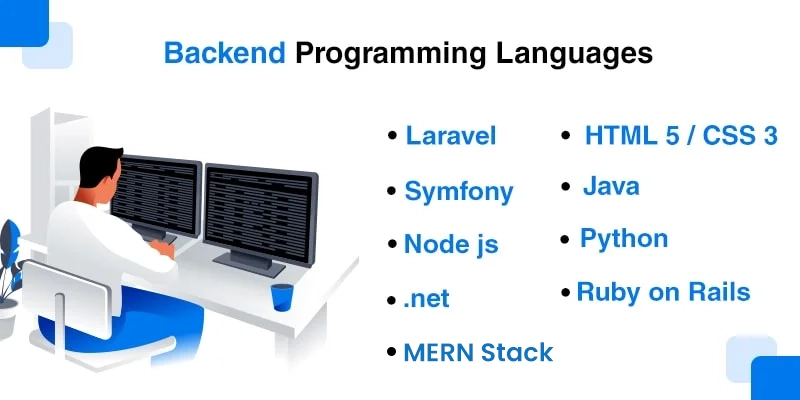 First, the foundation of any web development lies in the backend coding. We have covered Laravel, Symfony, Node, .NET, Ruby on Rails, Python & Java in this section. Let’s dive deep into the backend web development languages.
1. Laravel
If there’s one framework with an expressive yet elegant syntax, it is Laravel. It is known in the industry for the clean coding it allows. The database, queues, WebSockets, and the authentication it offers are robust. It’s of the most popular web development languages in the world.
Pros:
- Unlike other frameworks, this one comes with pre-programmed functionalities that help developers build robust platforms in less time. Coding is simpler using this one.
- This language allows the developers to tackle all the projects regardless of size – small, medium, or large.
- Allows developers to tackle all bugs due to its mechanism easily. Also, it stores the passwords in an encrypted form that helps to protect the confidentiality of data.
- It offers easy data migration.
Cons:
- It is lightweight because it does not have a comprehensive list of built-in features.
- While the new updates are advantageous, Laravel’s older versions quickly become buggy.
- Comparatively, every web developer feels that the speed of Laravel is a bit slow.
Examples:
- Wattpad
- Bank of Texas
- 9GAG
2. Symfony
Symfony is the best pick among programming languages for large web development projects, including much of the work behind web portal development services. If your project has complex features over the long term, Symfony might be your best bet.
Pros:
- It is important to leverage Symfony’s time-saving features.
- Quite an easy-to-maintain programming language. Also, adding a new programmer to the team is easy as there is no complexity.
- Moreover, the framework-written codes are proven already. This, in turn, reduces the rate at which a developer might commit mistakes.
- All components of this framework are secure enough. Also, there are regular updates that take place. These help it become the preferred framework for projects.
- It is designed with incredible flexibility features, which make it all the way more reliable.
Cons:
- Real-time high-load applications have seen a low performance in Symfony.
- As reliable as the platform is, learning this framework takes more time, dedication, and effort.
Examples:
- Daily Motion
- Vogue France/Netherlands
3. Node.js
Node.js is a cross-platform, open-source runtime for developing mainly server-side and networking apps. Besides, it is a top programming languages written in JavaScript, and its runtime runs on OS X, Microsoft Windows, and Linux.
Pros:
- This programming language gives speedier runtime, which is why it excels more than other frameworks.
- It is considered the best due to its built-in error-handling mechanism, which allows handling errors in the runtime.
- Node.js is best for its cost-saving and time-saving capabilities, which is why companies prefer this framework over others.
- The highly scalable programming language responds quickly to the data layers. It can build apps more easily.
- Its reliability, flexibility, and performance make it the most popular programming language.
Cons:
- If you want to manage large callback-based logic, it can be harder to maintain in Node.js.
- Due to its relational database settings, working with this framework is difficult.
- Can struggle with CPU-intensive tasks due to its default single-threaded nature.
Examples:
- Netflix
- Walmart
- Trello
- Uber
Build a modern application with the help of our expert Node.js developers Hire the best Node JS developers!
4. .NET
If you’re looking for a free, cross-platform, and open-source framework for building world-class web applications, then .NET is first name that comes to mind. You can also build desktop applications, microservices, APIs, and cloud-native solutions on Windows, Linux, and macOS with the help of .NET. The latest version of .NET, i.e., .NET 10, provides support for high-performance AI integration, faster development workflows, and enhanced security.
Pros:
- It is an object oriented language that allows developers to work on one part of the software simultaneously.
- .NET is different from other web development languages. It is an easy-to-deploy framework that maintains.
- The programming language comes with built-in Visual Studio support, helping developers build applications without any hassles.
- Automatic monitoring to never miss out on errors while coding and streamlining the processes.
- Besides, cache implementation improves performance and scaling for the developers in the process.
Cons:
- In new database designs, the framework’s flexibility can be questionable.
- Developers might have limited control over the .NET framework if there are any unusual changes in the future.
Examples:
- Microsoft
- GoDaddy
- Outlook
Confused with the never-ending list of existing tech stacks? Check out the blog written by our technology experts on tech stack for web app development.
5. Ruby on Rails
Ruby on Rails is a server-side application development framework in the Ruby programming language for web development. It provides the default structure for databases, web pages, and web services. Developers learning this have a pretty bright programming career.
Pros:
- It is a fast and effective web programming language for development.
- Rails come with numerous helpful tools and libraries that are a tremendous part of the software.
- This programming language is consistently on the rise in popularity.
- It gives developers the freedom to apply their creative solutions.
Cons:
- Convention-over-configuration can make debugging less transparent and harder.
- Smaller developer talent pool compared to other popular frameworks.
- Higher memory usage compared to lightweight modern web frameworks.
Examples:
- GitHub
- Airbnb
- Shopify
6. Python
Python is quite a popular language mainly used to build websites and software and conduct analysis. It is a general language for creating websites and software, data analysis, and data visualization. Moreover, Python is among the most popular programming languages worldwide, ranking 1st in the TIOBE Index and 4th in the Stack Overflow Developer Survey 2025.
Pros:
- For the beginner, it is the best web development language.
- The framework is easy and flexible to use in web development.
- Python has extensive libraries and tools for the hassle-free process of development.
- It is highly scalable and portable in web development, which makes it a strong choice for businesses that partner with a Python development company to build applications that evolve with their needs.
Cons:
- Compared with other top programming languages, it is slower.
- Python has the potency to consume high memory, which can be a big hurdle in development.
- The multi-threading is a bit complex to understand at first.
Examples:
- Spotify
- Dropbox
7. Java
It’s a leading web development language widely used to develop Android apps and mobile operating systems. Mainly used to construct apps in laptops, data centers, game consoles, and other devices. It is considered an object-oriented programming language used for server-side development.
Pros:
- Other web development languages may have security risks, but when it comes to Java, it prevents unauthorized user access.
- Java has a WORA (Write Once, Run Anywhere) feature and can run on any system with a Java runtime.
- It is highly portable, which is why it is trusted more in the development world.
- The program has automatic garbage collection that automatically facilitates the free space.
- Java provides efficiency as it has a mechanism for sharing data and languages, which makes it a distributed language.
Cons:
- Not ideal for GUI development compared to modern frameworks
- Verbose syntax and complexity make it harder to remember
- Slower startup compared to Go and Rust native binaries
- Higher memory usage compared to lightweight modern languages
- Slower iteration speed compared to scripting languages like Python
Examples:
- Opera Mini
- Cash App
- Google Earth
8. PHP
PHP is one of the most popular server-side scripting languages, powering 71.5% of websites worldwide. As of 2026, PHP is still the most popular programming language among developers, with 19.1% still using it according to the Stack Overflow Developer Survey 2025. The latest version of PHP, i.e., 8.5.4, offers business benefits such as enhanced stability, faster execution speeds, and reduced infrastructure costs.
Pros:
- The hosting support is tremendous.
- A huge ecosystem of frameworks and CMS platforms.
- Significant performance enhancement and faster execution speeds with PHP 8.5.4.
Cons:
- For building a standalone API or microservices, PHP is not suitable.
- Older codebases and inconsistent function naming can make maintenance difficult.
Examples:
- WordPress
- Wikipedia
9. Go (Golang)
Developed by Google, Go has become a top programming language for building high-performance web applications, cloud-native microservices, and REST APIs. The USPs of Go are its simple syntax, blazing-fast compilation, and built-in concurrency model (goroutines). Due to these capabilities, it has become a popular choice among development teams that require a scalable, maintainable backend for web apps. Gin, Fiber, and Echo are popular Go web development frameworks.
Pros:
- Deployment is simple and fast because Go uses a single library.
- Clean, readable syntax makes it easy for the team to learn.
- Strong library with support for HTTP servers, JSON handling, and more.
- Native concurrent support via goroutines to handle high-throughput apps.
Cons:
- Requires more boilerplate code for complex applications, as it’s less expressive.
- A very small ecosystem of third-party libraries.
Examples:
- American Express
- Capital One
- Uber
10. Rust
Over the last few years, Rust has emerged as the most exciting languages for web backend development. It focuses on memory safety without garbage collection, which helps it to deliver world-class performance for modern-day web applications. Actix-Web, Axum, and Leptos are some of the popular Rust web frameworks for full-stack WebAssembly applications.
Pros:
- Guarantee of memory safety at compile time.
- Amazing performance compared to C and C++, ideal for latency-sensitive applications.
Cons:
- The learning curve is steep as the Borrow Checker and ownership model takes time to master.
- Small web ecosystem compared to Node.js or Go.
Examples:
- Cloudflare
- Discord
- Figma
What are the Best Front End Web Development Languages?
Front-end programming languages for web development define the look and feel of web platforms, earning them the designation of languages for web designing.
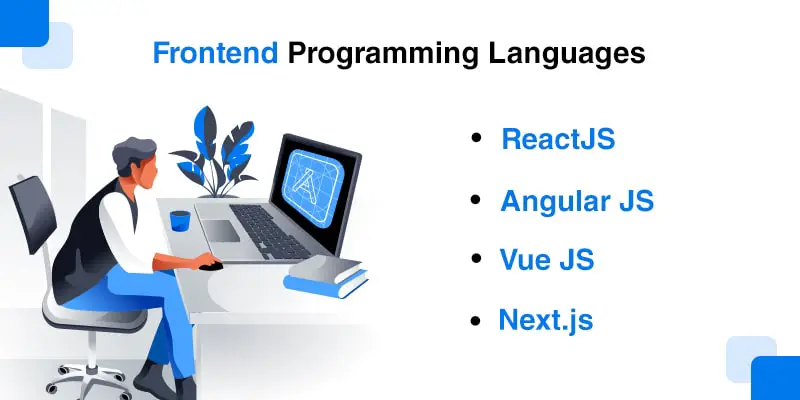
Here are the front-end web development languages that you should be aware of:
1. HTML5/CSS3
HTML5 and CSS3 are foundational front-end technologies that should always be the first to come to mind. While HTML5 provides markup for web pages, CSS handles styling, layout, animations, and responsive design. Every website relies on these technologies for client-side development.
Pros:
- This programming language for web development is lightweight and quite faster to load.
- HTML 5 has multimedia support and has a short and simple syntax.
- Irrespective of the previous markup language, it tends to possess improved security features.
- It gives semantic tags and cross-platform support for the developer’s flexibility.
Cons:
- Local storage is less secure than other web development languages.
- When the run is across a range of devices, it tends to offer lower support than others.
- The client-side rendering becomes a bit difficult with this platform.
Examples:
- Zoho CRM
- Google Docs/Drive
2. ReactJS
It is mainly a JavaScript-based UI development library maintained by Meta and other open-source communities. The library is best for web design languages and offers direct support to React Native, making it one of the top choices for UI development.
Pros:
- React.js is a high level programming language that is convenient for creating scalable single-page applications.
- The framework can work on multiple components simultaneously, giving web pages a refined unit.
- A modular, component-based architecture helps you shorten time-to-market for your applications.
- Unlike other tools, this web programming language is considered SEO-friendly, making it the best for website and app development.
Cons:
- Its higher pace of development can be a hurdle sometimes for development.
- React offers less time for documentation with limited guides and details.
Examples:
- Skype
- Dropbox
- Discord
3. Angular
Developed by Google, Angular (version 2+) is a fully-featured, powerful TypeScript-based software development framework for building enterprise-level web applications. AngularJS or Angular v1. x reached end of life in December 2021, so we don’t recommend it for newer projects. Modern projects now use Angular (v2+), which is a complete rewrite of the earlier version and provides a robust architecture and enhanced performance.
Pros:
- It is an easy-to-extend framework that works faster, and it’s done on a single page only.
- This web programming language is easy to extend as well as customizable.
- Actively developed and supported by Google.
- An easy-to-test framework compared to other platforms.
Cons:
- The learning curve is steeper than that of other web frameworks.
- Highly dependent on TypeScript, so developers need to know that thoroughly.
- For simple apps, it could introduce performance overhead.
Examples:
- Gmail
- Forbes
- Upwork
4. Vue JS
Vue.js is a progressive JavaScript framework that helps build web interfaces and single-page apps. Besides, this web programming language is a great contributor to desktop development and also building apps for Android or iOS.
Pros:
- The simplicity of this language makes it among the top programming languages easy to use.
- Vue JS can be easily integrated into other frameworks according to requirements to create web pages.
- It is very easy to build the UI, which can be an eye-catching factor nowadays.
- Virtual DOM integration accelerates the overall performance of the currently existing application.
Cons:
- Lacks significant funding, so it has fewer updates compared to Angular or React.
- Lower enterprise adoption compared to other web frameworks.
Examples:
- Adobe
- Behance
- Xiaomi
- Alibaba
5. Next.js
Next.js is a React framework that is highly flexible and helps developers build fast-paced web applications. It is a free, open-source front-end library that is considered best for modern stack websites.
Pros:
- It is a framework of a faster-to-build programming language for web development. It helps in building super static websites that behave like dynamic websites.
- Websites built with Next.js are excellent at giving user experience.
- The websites created by Next.js are quite SEO-friendly.
- Next.js provides flexible UI & UX to make more appealing web applications.
Cons:
- The plugin system in this framework is relatively limited.
- Next.js is quite expensive compared to other web development languages.
Examples:
- TikTok
- Hulu
- Deliveroo
6. TypeScript
TypeScript is a superset of JavaScript developed by Microsoft that compiles to plain JavaScript. According to the Stack Overflow Developer Survey 2025, TypeScript (48.8%) is the 5th most popular programming language among developers. One of TypeScript’s USPs is its support for interfaces, static typing, and advanced IDE features, making it a top choice for both frontend and backend applications.
Pros:
- Static typing catches errors at compile time, thereby reducing runtime bugs.
- Help you improve code maintainability in large, collaborative projects.
- Excellent tooling and IDE support
- Works seamlessly with all major JavaScript frameworks
Cons:
- Needs a compilation step that requires additional configuration.
- It can be a steep learning curve for JavaScript beginners
Examples:
- Slack
- Airbnb
- Microsoft
So far, we have covered some of the most popular JavaScript frameworks or runtimes that you must have heard of. Now, let’s talk about other modern JavaScript frameworks or runtimes that have gained serious traction in 2025-2026.
7. Bun & Deno
Bun: It’s a JavaScript toolkit built on the JavaScriptCore engine and acts as a runtime, package manager, bundler, and test runner. It delivers significantly faster performance for web applications than Node.js. Another good thing about Bun is that it’s Node.js-compatible, so all Node.js apps can also run on Bun with minimal configuration. If you want faster performance and a simpler developer experience, consider Bun.
Deno: It was created by Ryan Dahl, who also created Node.js. It aims to overcome the design shortcomings of Node.js. The latest version of Deno, i.e., v.2.7.13, provides you with TypeScript support, native web-standard APIs, a secure permission model, and an integrated package system called JSR (JavaScript Runtime). Over the last few years, it has gained popularity for TypeScript-first server-side projects.
8. HTMX
Modern websites need to feel instant, but using JavaScript can increase costs and complexity. HTMX aims to change that aspect. It’s a lightweight JavaScript library (14kb) that helps you to update web pages dynamically without too much frontend code, allowing developers to deploy faster and businesses to save a lot of time and money. With HTMX, you can create smoother user experiences, even with a smaller codebase.
9. Emerging Frontend Frameworks: Astro, Remix & SvelteKit
Here are three emerging frontend frameworks that have made a name for themselves in the last couple of years or so:
Astro: It’s a content-first web framework that uses JavaScript by default (“Islands Architecture”). If you want a blogging website, documentation repository, marketing pages or any content-heavy website, then Astro should be your best bet.
Remix: It’s a full-stack React framework focused on web standards. It uses nested routing and server-side data loading to build resilient apps. If you want to build dashboards, eCommerce, or data-intensive apps where response time matters, use Remix.
SvelteKit: It’s an app framework for Svelte that removes the concept of virtual DOM. SvelteKit supports server-side rendering, static site generation, and client-side rendering. If you’re prioritizing both performance and simplicity, SvelteKit should be your ideal choice.
What are the widely used CMSs – Content Management Systems for Web Development?
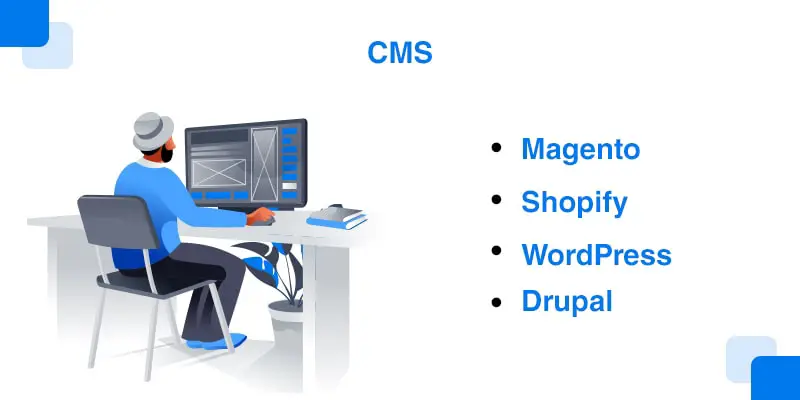
CMS stands for Content Management System. It allows a non-technical user to set up a website. We have covered Magento, Shopify, WordPress & Drupal in this blog. However, one can also employ a web designer to enhance its quality. Furthermore, recent data indicates that the top 1 million sites use CMS.
We have proven ourselves as the best CMS development company in the industry over the years. Below are the four most used CMS platforms.
1. Magento
Magento (now rebranded as Adobe Commerce) is a leading open-source eCommerce platform for building and managing large-scale online storefronts. Adobe Commerce is best known for providing full-fledged enterprise-level eCommerce solutions rather than a general-purpose CMS, though it offers content management capabilities.
Pros:
- It is an open-source platform that is quite flexible for its end users.
- Magento is mobile-friendly and a must for the success of eCommerce platforms.
- The language handles even the largest eCommerce storefronts with ease.
Cons:
- Magento is available in many versions but can still be considered more expensive than others.
- Magento is quite a time-consuming task; it has a slow loading time.
Examples:
- Liverpool
- Land Rover
2. Shopify
It is an eCommerce platform that helps build an online store and helps users buy and sell online through a streamlined dashboard. Mainly, it is a SaaS (Software as a Service) platform.
Pros:
- The simplicity of using this platform makes the range of usage higher than other web developing languages.
- If the storefront theme is the concept of an eCommerce platform, then Shopify is a must-use.
- Shopify tends to enable numerous plugins, which is the most vital aspect of this platform.
- The platform has a dedicated support team that provides 24/7 support to its users.
- Mainly, their marketing tools can help accelerate the Seo rankings of the online store.
Cons:
- Shopify has ten free templates, and a one-time fee will be paid for using others.
- The support system will work efficiently if there are any technical issues.
Examples:
- Kylie Cosmetics
- Sephora
3. WordPress
The CMS tool facilitates building and hosting websites by enabling various plugins and templates, which can be the best fit for easy website development. Installing it on a local web server is easy, and it quickly allows viewing on the proprietary website.
Pros:
- It is one of the most used web development languages, so it is pretty easy to go ahead with it.
- WordPress has numerous themes, which is the most significant advantage for its developer community.
- The platform is SEO-friendly, with plugins that help to optimize individual pages and blog posts.
- With the help of page and blog templates, the content creation process becomes more straightforward.
- It also offers some of the best AI plugins for WordPress.
Cons:
- The platform having many features can be quite an overwhelming task for users.
- WordPress gives the most time-consuming task of managing updates and security.
- Moreover, customized themes and plugins can be pretty expensive at times.
Examples:
- TechCrunch
- Microsoft News
- TED Blog
4. Drupal
Drupal is mainly a free, open-source CMS written in PHP programming language that the users can run and modify. The organizations mainly use corporate websites that help manage corporate websites.
Pros:
- The biggest perk this web development platform offers is that it is free to use.
- Drupal tends to offer systematic updates for a better user experience.
- It takes robust security measures so the site developed with this framework is the least vulnerable.
- There are numerous plugins in Drupal, making the site more mobile-friendly.
Cons:
- Drupal sometimes becomes quite challenging to manage for the developer community.
- Its limited number of modules can easily hinder website development.
Examples:
- Tesla
- Mint
- NASA
Concluding Note – How Do the Most Popular Programming Languages Differ From Each Other?
Some web development languages are faster than the rest. Some are slower yet perform better. A couple of programming languages have a very efficient compiler that impacts the speed. However, every language has beauty in programming, designing, and execution. Explore the website development services by Excellent Webworld and receive a fully-functional and user-centric web platform.

Frequently Asked Questions
A web programming language is a specialized computer programming language used by developers to build and maintain websites and web applications. These languages provide a set of instructions for designing visual layouts, presenting content, and handling interactive features on the internet. The web programming language can help you to create functional, dynamic, and user-friendly web experiences.
A typical web development or web app development needs a combination of front-end and back-end technologies. While the front-end languages like HTML, CSS, and JavaScript help you to handle design and user interaction part, the backend languages such as Node.js, Python, PHP, or Java help you to manage business logic, app functionality, databases, and server-side management. Together, they form an entire web development ecosystem.
There can’t be a single web development language which you can “best” out of all. It all depends on your project’s needs, scalability, performance requirements, development expertise, and complexity of development. If you’re opting for full-stack development, you should consider JavaScript (especially Node.js). When it comes to popular backend technologies nowadays, PHP and Python lead the charts.
Yes, PHP is still widely used for web development. The latest version of PHP, i.e., PHP 8.5.4, offers substantial advantages for businesses, focusing on 5x better performance compared to older 5.x versions, enhanced security, and lower long-term infrastructure costs. It’s supported by most hosting environments, making it a practical choice for startups, CMS-based websites, and scalable web applications.
High-paying programming languages often include Go, Python, Node.js, Ruby on Rails, and Java due to their demand in enterprise systems, cloud computing, and scalable applications. Salaries depend on experience, industry, and location, but these languages consistently rank high because they support modern architectures, automation, and large-scale software development.

Article By


Mayur Panchal is the CTO of Excellent Webworld. With his skills and expertise, he stays updated with industry trends and utilizes his technical expertise to address problems faced by entrepreneurs and startup owners.