PHP is the most popular server-side programming language and is still going strong in the future. So, we decided to talk about the Best MVC frameworks for PHP. Moreover, the popular PHP frameworks discussed here have emerged to build complex, secure, and expansive web applications quicker than ever before.
PHP web frameworks come in various sizes built for various web developers with distinct levels of skills, experience, and development needs. However, before looking at the best web frameworks, let’s brush up a couple of web development basics.
What is PHP?
PHP stands for Hypertext Pre-processor. (Nope there is no typographic error here) However, earlier PHP was called Personal Home Pages which was then updated to Hypertext Pre-processor.
The basic definition states, PHP is a server-side scripting language used to develop static or dynamic websites and Web applications. Likewise, it’s an open-source software development framework that is free to download and use.
Why should you use PHP for your server-side programming?
- It’s open-source, so it’s free.
- PHP can run on all the major platforms showing a platform-independent characteristic.
- It supports many databases like MongoDB, MySQL, Oracle, Sybase, Solid, PostgreSQL, Informix, etc.
- PHP is compatible with almost every server available today.
- The syntax of PHP is straightforward to understand and learn.
- PHP offers multiple security layers against malicious threats and attacks.
What are PHP Frameworks?
You already know that PHP is the most sought after scripting language, but coding in PHP more often becomes repetitive or monotonous. That’s where PHP frameworks enter the scene.
The frameworks make PHP web development easier by streamlining the process. In other words, these popular frameworks help in the rapid application development (RAD) process.
These web frameworks offer an essential structure following which the PHP development becomes fast, stable, and under a standard format.
Top PHP Framework Statistics for 2026:
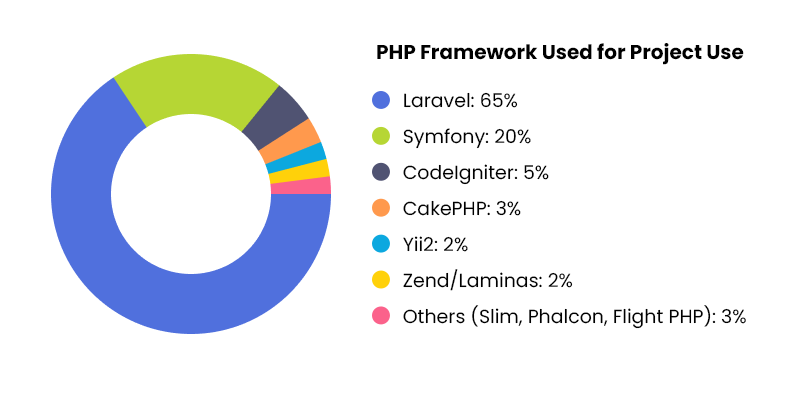
- Pie-Chart of PHP Frameworks usage in Web Projects:
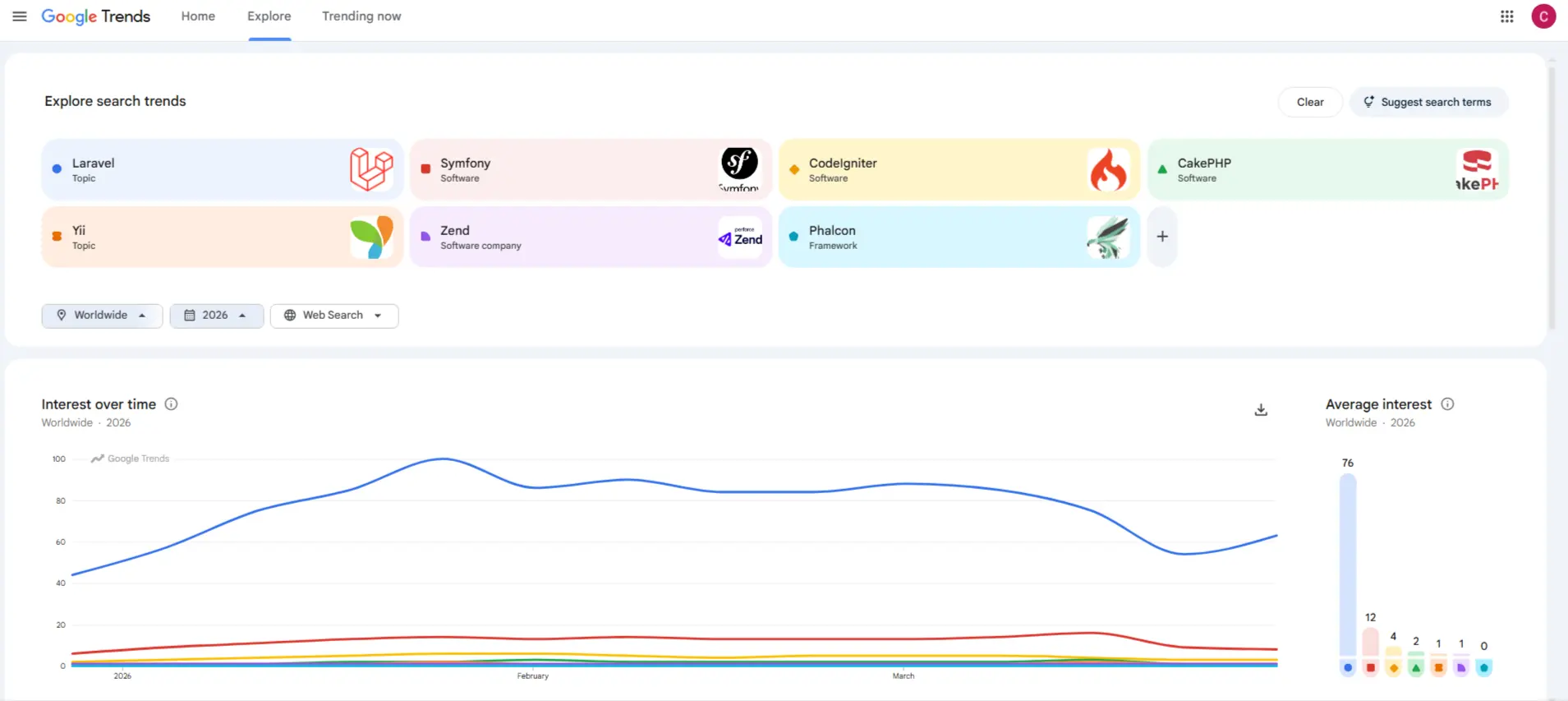
- Google’s Search Trends of PHP Frameworks for the past 12 months:
Now that you know about PHP and its frameworks, we can move on to know about the best MVC PHP frameworks.
Top 9 MVC Web Frameworks in PHP
When we talk about PHP frameworks, the general idea is about Model View Controller (MVC). In other words, when you wish to separate the business logic from the web UI and program them separately, then you go with MVC.
In simple terms, PHP MVC frameworks break down the development process into modules. As a result, the web developers can work on individual modules without affecting the others. And, that is the reason PHP remains a top programming language so far. Whether you compare PHP vs Node.js or PHP vs ASP.NET, PHP rules the roost among all, though in certain cases only.
Enough with the lecture, now let’s meet the top 9 PHP frameworks. Here’s the list of the best PHP frameworks:
1. Laravel
The PHP Laravel Development framework is probably the most popular one among web developers. Further, the Laravel Framework is a free, open-source PHP framework suitable for developing web applications and mobile apps with complex backend requirements. It’s one of the best frameworks for developing SaaS products, eCommerce, and full-stack web apps.
As a leading laravel development company, we recommend Laravel because of the features such as;
- Unit Testing
- Blade Templating Engine
- Eloquent ORM
- A Packaging System
- RESTful Controllers
- Artisan CLI
In other news, Laravel is the first framework to introduce routing in an abstract way. Also, Laravel can easily handle NoSQL databases such as Redis and MongoDB.
Laravel Usage Statistics:
- 685,629 websites are using the Laravel framework.
- At any given time, there are 660,064 live websites built using the Laravel framework.
- The top 5 countries that prefer the Laravel framework are the US, Russia, the UK, Brazil, and the Netherlands (all technologically advanced countries).
- Laravel has the largest market share of 65% among PHP frameworks.
- With more than 84,000 GitHub stars and 470 million Packagist downloads as of 2026, Laravel dominates the PHP framework space.
With Homestead, installing Laravel has become easier, and with the robust Composer built into Laravel, you can easily add packages. Meanwhile, Laravel recently launched Nova, a superior admin panel for skilled Laravel web developers who aim to create new projects while staying equally productive.
It’s such amazing features and possibilities that have made PHP Laravel the go-to PHP framework for web developers.
Why Go With Laravel PHP Framework?
- Perfect for an easy-to-learn framework
- Seamless Data Migration
- Popular among the PHP communities
- MVC Architecture Support
- Tons of Training Materials (Documentations, Images, and Video Tutorials)
- View Template Engine
- Simple Unit for Testing Purposes
2. CakePHP
CakePHP is completely free for personal or commercial use. Thus, you can build feature-loaded and visually impressive websites with the best CakePHP development services. Its convention-over-configuration approach helps speed up development.
Back in the 2000s, CakePHP was the best PHP framework around. After all this time, it’s still one of the best PHP frameworks you can use. To sum up, CakePHP started as a simple, elegant toolkit that has only grown stronger over the past 15 years.
Because of its CRUD (Create, Read, Update, and Delete) scaffolding, CakePHP is the simplest framework to learn. Also, installation is a “piece of cake” with CakePHP; You only need a web server and a copy of the CakePHP framework. That’s why it remains a top pick for beginner-to-intermediate developers in 2026.
CakePHP development is perfect for commercial applications due to security features such as:
- SQL Injection Prevention
- Cross-Site Request Forgery (CSRF) Protection
- Input Validation
- Cross-Site Scripting (XSS) Protection
This framework provides code generation, an ORM, easy routing, and built-in validation to speed up development.
CakePHP provides excellent documentation, numerous support portals, and premium developer support through Cake Development Corporation. It’s ideal for rapid prototyping and projects with tight deadlines.
Why Choose CakePHP Framework?
- Easy Extensions with Plugins & Components
- Proper Class Inheritance
- Zero Configuration
- Modern Framework
3. CodeIgniter
CodeIgniter is probably the most suitable PHP framework for developing dynamic websites. It’s a straightforward PHP framework and is best for beginners, rapid development, and lightweight web projects.
Its size is only about 2 MB (including the documentation). So, inherently, CodeIgniter has a minimal configuration and allows web developers to add third-party plugins to access more complex functionality.
CodeIgniter development also offers several pre-built modules that enable the development of robust, reusable components for web development. This PHP framework is ideal for beginners due to its simple setup process and gentle learning curve.
If you want to avoid a PHP version conflict, CodeIgniter is the right choice. It works seamlessly on almost all the hosting platforms (shared and dedicated). That’s why it’s consistently ranked among the top beginner-friendly PHP frameworks in 2026.
Although CodeIgniter is considered a PHP MVC Framework, it is not based on the MVC architecture completely. So the Model and View classes are optional in CodeIgniter, while the Controller is obligatory.
Why Go With CodeIgniter PHP Framework?
- MVC Architecture
- Top-Notch Error Handling
- Provides Exceptional Performance
- Several tools are available in one package
- Inbuilt Security Tools
- Excellent Documentation
4. Laminas Project (formerly Zend Framework)
Laminas, the official successor of the Zend Framework, is a complete object-oriented PHP framework. This PHP framework is very customizable, which becomes a beneficial point for developers who need to add project-specific functionalities.
Zend is built on the agile methodology, which helps developers to create and deliver high-quality web apps to large-scale clients. With a market share of 12.4%, Lamins or Zend is one of the most widely used PHP frameworks.
It’s modular, works well with PHP 8+, and is a perfect fit for complex, enterprise-level projects that are mainly concerned with security, performance, scalability, and extensibility. Zend Framework is preferred mostly by large IT businesses and financial institutions like banks, as it’s continuously updated for security and performance.
Zend Framework Features:
- Instant Online Debugging
- PHP Unit Testing Tools
- Connected Database Wizard
- Cryptographic Coding Tools
- Drag & Drop Editor with Front-End Tech Support
The Zend Framework can seamlessly integrate with external libraries, so developers can choose to use only the components needed at a given time.
This framework has sufficient documentation and a large community base that supports this popular PHP framework. Zend has also partnered with several major tech companies such as IBM, Adobe, Microsoft, and Google, among many others.
If you like object-oriented coding, Zend Framework is the best PHP framework for you.
Why Go With Zend Framework?
- Superior Front-end Tech Supported Tools
- MVC Components
- Large Developers Community
- Simple Cloud API
- Supports Third-Party Components
- Data Encryption
- Support for AJAX
- Session Management
5. Symfony
Symfony was launched in 2005, making it older than any other PHP framework on our list. This framework is an extensive PHP MVC framework, making it a reliable and mature platform.
Symfony is probably the only framework known to follow PHP standards to the dot. It’s very stable, well-documented, and high-performance. In addition to all that, Symfony is both a framework and a collection of PHP frameworks, making it an ideal choice for developing scalable applications.
One of the key features that make Symfony a unique gem among PHP frameworks is its reusable PHP components. With the reusable components/modular component system, development time is reduced as many modules, like form creation, object configuration, templating, etc., can be built from old components.
Symfony is easy to install and configure on most platforms and provides database-agnostic support. Its highly flexible nature allows it to integrate with larger projects like Drupal. If you want to develop enterprise-grade, complex, long-lived apps, consider Symfony.
Symfony Usage Statistics:
- Symfony is the 2nd-most-popular PHP framework, with a market share of around 20%.
- There are around 4000 Symfony packages on Packagist.
- Symfony components reached 35 billion total downloads in 2025.
- It 1.2 million websites globally.
Why should you consider Symfony?
- Long Term Support
- Most Number of Bundles
- Built-in Testing Functionalities
- Framework Filled with Features
- Official Training Courses & Certifications
6. Yii2
Yii framework stands for Yes, it is! This framework is everything that you would want from a PHP framework. It’s a revised and advanced version of the Yii framework, which was a high-performance, component-based PHP framework.
Yii2 is popular among website developers for its security features, making it suitable for large-scale applications with high performance and security requirements like e-commerce, CMS, portals, forums, and more. With Yii2, you can model the database as objects, so developers can avoid the complexity of writing repetitive SQL statements.
Yii2 is superbly extensible so that you can customize almost every part of its core code. It’s the primary choice when programmers need to ensure extensibility and develop efficient, easily maintainable web applications.
This powerful, easy-to-use framework has become a universal web framework suitable for all kinds of web app development. Lastly, Yii2 has a robust caching system and a rich extension ecosystem, and it also has 14.2% market share as of 2026.
Why Choose the Yii2 Framework?
- AJAX Support
- Efficient Tool to Handle Errors
- Customize Default Setups
- Easy 3rd Party Component Integration
- Strong Community Backing
7. Phalcon
Phalcon is written in C and C++, which means it’s delivered as a C extension. But this doesn’t mean that you have to learn the C programming language to use the Phalcon framework. It may sound odd to have a PHP framework that is basically a C extension, but Phalcon is the fastest PHP framework, providing near-native execution speed.
Phalcon is quite easy to install and is perfect for creating highly customizable web solutions. One of the best things about Phalcon is low storage, as Phalcon itself has almost no files once you install the framework. You just add the modules and libraries you need to work with; this makes the development process very uncluttered.
The PHP Phalcon framework creates websites and web apps that are in line with enterprise mobility development guidelines. It uses MVC architecture, ORM, and templates, making it ideal for high-traffic websites.
Phalcon (among the most popular PHP frameworks) uses very few resources compared to other frameworks, resulting in the fast processing of HTTP requests. It’s ideal for applications dealing with large datasets or complex computations.
Why Choose Phalcon PHP Framework?
- Execution Speed
- Low Overheads
- Asset Management
- Uniquely written in C extension
- Universal Autoloader
- Developer-friendly framework
- Top Security & Caching
- Ideal to Build Performance REST APIs
8. Slim
When you talk about a staple in the PHP micro-framework world, then Slim is one of the first names that comes to your mind. It is one of the lightest-weight PHP frameworks for developing REST APIs and web services, with a robust community support system.
Due to its focused feature set and simplicity, it has become the go-to choice for developers who want a clean backend solution without any complexity. It’s one of the best PHP frameworks for microservices and lightweight APIs.
Lastly, Slim is one of the most downloaded PHP frameworks on Packagist, and it’s widely used in production APIs due to its reliability.
Key features of the Slim framework:
- Lightweight and flexible routing system
- PSR-7 HTTP message support for request/response
- Middleware architecture to handle request pipelines
- Support for named routes and route groups
- Built-in error handling and custom error responses
9. Flight PHP
Flight PHP is one of the rising stars when it comes to one of the most popular and lightweight PHP frameworks in 2026. The main aim of this framework is speed and simplicity. One of the USPs of the Flight PHP is zero dependency on design, which also means no configuration headaches anymore.
As the aim of this framework was to make it developer-friendly, Flight PHP keeps things simple and intuitive. Whether you’re building a microservice or a lightweight REST API, Flight PHP makes it simple for you.
Flight PHP clocks up to 190k RPS on any benchmarks, which is 50% faster than the Slim framework. Also, it reached 2.9K GitHub stars in 2026, showcasing its rising popularity.
Key features of the Flight PHP framework:
- Beginner-friendly setup
- No configuration required
- Zero-dependency architecture
- Simple, intuitive routing
- Blazing-fast execution

Get updates of the latest tech news
Register with your email ID to get the first bite of the most trending news.
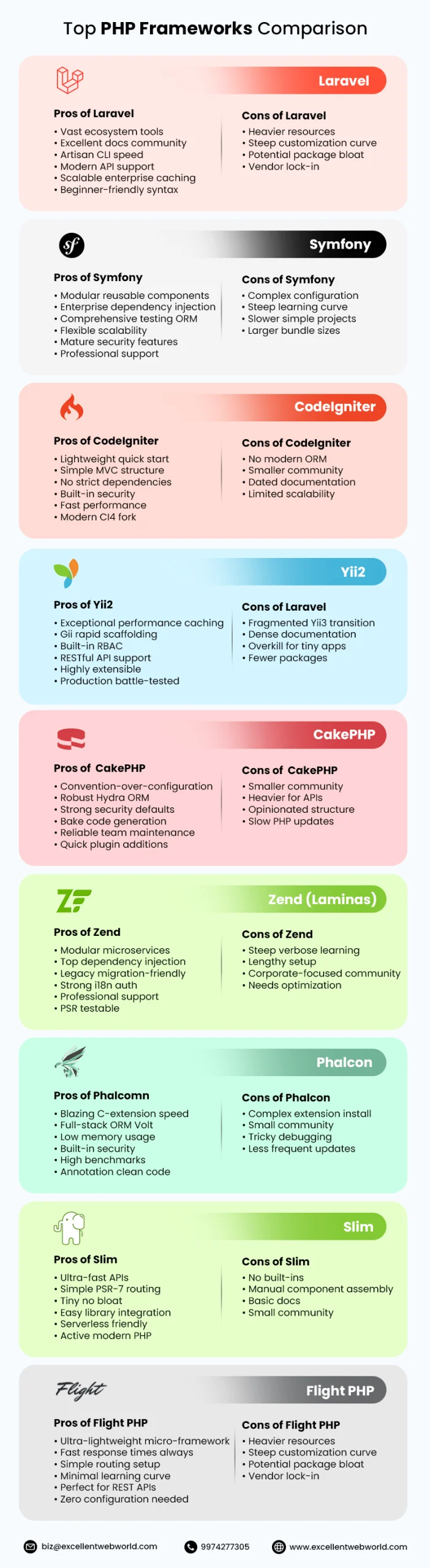
9 Best PHP Frameworks Comparison [Infographic]
Choose the Best PHP Web Frameworks
So now you know which are the 9 most popular PHP frameworks of 2026. You learned about their features, specialties, pros, and cons; now it’s time to make a decision. If you still are confused between the two or three best PHP frameworks, you can talk to our web development expert.
We can help you find the top framework and Provide the best web developer for your next web development project.

Article By


Paresh Sagar is the CEO of Excellent Webworld. He firmly believes in using technology to solve challenges. His dedication and attention to detail make him an expert in helping startups in different industries digitalize their businesses globally.


