A business can invest heavily in a storefront and still wonder why growth stalls. In 2026, shoppers switch between websites, apps, voice assistants, and AI shopping agents to complete purchases. As a result, businesses need to launch new channels, personalize experiences, and support agent-led purchases without repeatedly rebuilding their commerce core. Yet, many discover that their existing architecture lacks the flexibility to support these demands. This is where AI-native headless ecommerce development starts to make a real difference.
The shift toward AI makes that architectural question harder to ignore. According to Deloitte, 55% of digital consumers now begin product research through large language model platforms, while analysts project that AI agents could enable 25% of global e-commerce sales by 2030. For enterprise leaders, this signals a need for commerce architecture that can serve customers, AI applications, and AI shopping agents without tightly coupling them to the storefront.
I personally recommend headless for businesses that need next-generation shopping experiences, omnichannel flexibility, independent frontend scalability, and AI-powered search, personalization, and agentic commerce capabilities without repeatedly modifying their core commerce systems. However, headless ecommerce comes with complexities, investments, and architectural trade-offs that require careful evaluation.
In this guide, I’ll cover how headless eCommerce works, compare it with monolithic and other architectures, explore the rise of agentic commerce, evaluate leading platforms, explain development costs and processes, and examine why API-first, AI-ready architecture is becoming critical for AI-driven commerce.
What Is AI-Native Headless eCommerce Development?
AI-native headless eCommerce development is an architectural approach that separates the customer-facing layer from the systems that run commerce operations while designing the architecture to support AI from the foundation. The storefront manages what shoppers see and interact with, while the commerce backend handles inventory, orders, pricing, payments, and business rules. APIs connect these systems with digital experiences and AI capabilities.
The term “headless” comes from removing the “head,” or presentation layer, from the “body,” or commerce engine. The core systems continue to manage catalogs, transactions, and business logic, while businesses can deliver digital experiences across websites, apps, kiosks, AI interfaces, and other channels without tying every change to the underlying platform.
From my perspective, the real value goes beyond frontend freedom. Headless gives businesses greater control over how they introduce new touchpoints, redesign user experience, and expand digital channels without worrying about the core engine. More importantly, an AI-native approach creates a foundation for AI-powered search, personalization, conversational commerce, and agent-led transactions without treating AI as an add-on after deployment.
How AI-Native Headless Architecture Works?
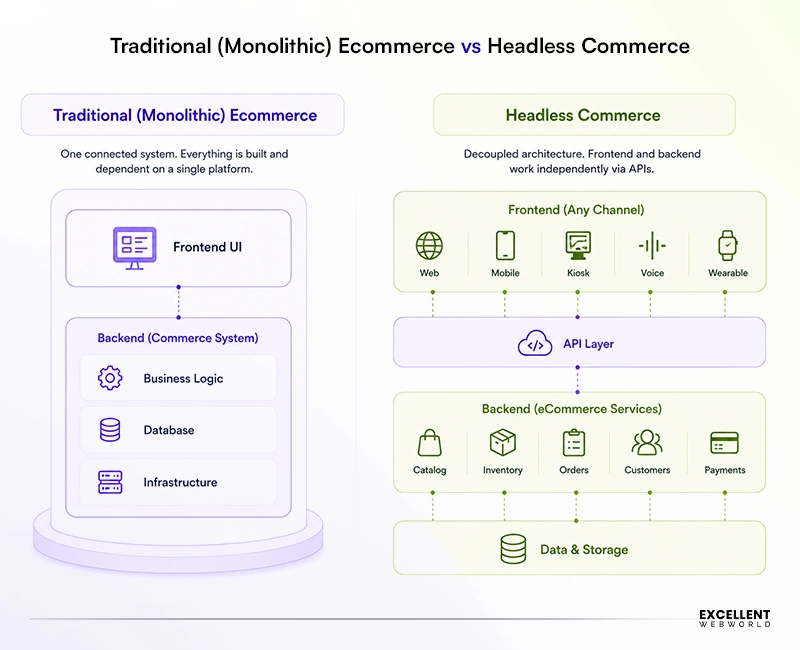
A headless architecture comprises three connected layers: the frontend, backend, and APIs. Among these, the API layer does the real work. The frontend handles the entire customer experience, the backend looks after commerce operations, and the API layer connects them. It allows the presentation layer and commerce backend to exchange data and actions without tightly coupling them.
Consider a shopper opening a product page on a mobile app. The presentation layer sends an API request for product information, pricing, and other relevant data to the backend when the shopper opens the product page. The commerce backend processes the request and sends the relevant data back. The app then displays the requested information through its designed interface.
When a shopper takes any other action, such as updating a cart or completing checkout, the same request-response cycle runs. The shopper never sees what happens in the background, just the result.
Frontend/ Presentation Layer: Delivers the customer experience across websites, mobile apps, kiosks, and other digital touchpoints, built independently with any framework. For AI-native commerce, these APIs can also expose approved commerce data and capabilities to AI applications and agents.
API Layer: Connects digital experiences with commerce capabilities through REST, GraphQL, or other APIs.
Backend/ Commerce Engine: Manages products, inventory, pricing, carts, orders, payments, customers, and business rules.
The real advantage is that one commerce foundation can serve multiple experiences without forcing every channel to share the same presentation layer. For AI-native headless commerce, this can extend beyond traditional digital channels. An AI shopping agent can access approved product information, pricing, inventory, cart, or checkout capabilities through APIs and return the required information or initiate permitted actions.
Headless Commerce vs. Traditional (Monolithic) Ecommerce
In traditional monolithic eCommerce, the storefront and core commerce functionality are connected within one platform, similar to a standard Shopify or WooCommerce theme sitting directly on the platform’s backend.
In headless commerce, the frontend is separated from the backend, which gives businesses complete flexibility to modify the customer-facing layers without even touching the core backend.
For enterprises evaluating two approaches, the question shouldn’t be what is better but which architecture delivers the right balance of flexibility, control, and complexity for the business.
| Factor | Traditional (Monolithic) Ecommerce | Headless Commerce |
|---|---|---|
| Architecture | Frontend and commerce functionality are closely coupled | Frontend and commerce backend are separated through APIs |
| Customization | Primarily works within platform themes, templates, and extensions | Greater control to build custom experiences using the framework of choice |
| Omnichannel | New channels may require additional platform-specific work | One commerce backend can support multiple independent experiences |
| Performance control | More dependent on platform architecture and implementation | Optimized, typically faster page loads |
| Development & Maintenance | Simpler to launch and maintain with fewer architectural layers | More development effort and ongoing engineering complexity |
| AI & Future Readiness | Readiness, Backend logic is closed, not built for agent queries | API-accessible commerce capabilities provide greater flexibility for AI applications, agents, and emerging channels |
For all businesses, the final decision is based on complexity versus control. Monolithic commerce is a valid choice when quick launches, simplified operations, and standard experiences are required. Headless commerce is a suitable option when an enterprise requires greater frontend control, a wide range of customer touchpoints, deeper integrations, or an architecture that can evolve with AI-powered and agentic commerce.
Headless Commerce vs. Composable Commerce vs. Headless CMS: Key Differences
These terms are often used together when we talk about the modern commerce architecture; however, they resolve different problems. Understanding where each approach delivers the best value is essential before choosing an architecture, particularly when the goal is to architect a tech stack that can adapt to new channels and evolving digital experiences.
Headless Commerce: Separates the frontend and backend using APIs, nothing more and nothing less. This provides businesses the freedom to deliver enhanced customer experiences across web, mobile, and emerging channels, along with a flexible foundation for AI-driven search, personalization, and agentic commerce.
Composable Commerce: Follows a broader approach by enabling businesses to assemble commerce capabilities, such as a commerce engine, CMS, search, payments, and personalisation, from separate, interchangeable software building blocks rather than one large system.
Headless CMS: Separates the content management system from the content presentation (the frontend) and delivers content through APIs. A headless CMS is one component you can include in a composable or headless commerce stack, but it doesn’t make an eCommerce platform headless on its own.
Why Headless Ecommerce Is Accelerating in 2026?
Headless commerce is no longer limited to developer preference; it is also becoming a strategic business decision. Businesses are responding to rising customer expectations, expanding digital storefronts, and the shift toward AI-powered commerce. These factors make headless eCommerce increasingly relevant across the latest eCommerce trends.
1. Faster Page Speed and Core Web Vitals
Headless storefronts, particularly those built with Next.js, give developers greater control over rendering, caching, and frontend performance. The separation also reduces dependence on heavy themes, unnecessary frontend code, and tightly coupled presentation logic. That control can contribute to faster load times, stronger Core Web Vitals scores, and higher conversion, since even a one-second delay can affect revenue.
2. Consistent Omnichannel Experience (Web, App, Kiosk, IoT, Voice, AI Agents)
A single headless backend can serve a website, native apps, an in-store kiosk, a voice interface, an AI shopping agent, and other touchpoints, all from the same product catalog and inventory. For businesses, this creates a consistent source of product, pricing, and inventory data across channels, while giving teams more control over how each experience is delivered. This level of flexibility can be difficult to achieve with tightly coupled monolithic platforms.
3. Greater Frontend Customization and Branding
Headless commerce removes many limitations associated with tightly coupled themes and templates. Teams can architect unique storefronts with custom checkout flows, brand-specific interactions, and tailored customer journeys without being as dependent on platform-specific themes or update cycles.
4. Independent Scaling of Frontend and Backend
Frontend apps can be scaled using CDNs or edge networks without relying solely on the backend eCommerce services. Similarly, backend services can be scaled without any dependence. For engineering and infrastructure teams, this offers immense control during flash sales, sudden traffic spikes, and product launches, although overall reliability still depends on the underlying infrastructure and its implementation.
Headless Ecommerce and the Rise of Agentic Commerce
The majority of the headless commerce guides skip this part, but in reality, it is the most important one. AI is turning eCommerce from a storefront-based model into a more conversational and agent-driven buying journey. In 2026, product discovery is now possible using a prompt on AI shopping agents, and these AI agent use cases for eCommerce don’t just offer recommendations but can also now complete transactions on users’ behalf.
This shift changes what it means for an ecommerce business to be discoverable, understandable, and transaction-ready.
How AI Shopping Agents (ChatGPT, Gemini, Perplexity) Are Changing Product Discovery
AI shopping experiences are changing the way customers discover, evaluate, and purchase products. ChatGPT enables users to explore and compare products depending on preferences, price, and constraints, while Perplexity allows users to do real-time research with conversational product discovery, visual search, and, for eligible merchants in the US, checkout through the Instant Buy experience. Similarly, Google AI mode turns simple product search into a tailored conversational shopping assistant.
For businesses, this changes the definition of product discoverability. A product now should be understandable by shoppers, plus systems that interpret product features, prices, availability, reviews, and other signals prior to delivering recommendations.
Why API-First, Headless Architecture Is the Foundation for Agent-Ready Stores
This is the part where Headless eCommerce holds an advantage. A headless store already unveils the product, pricing, and inventory data through APIs. Ensuring the same data is available for AI agent development doesn’t require rebuilding the entire eCommerce platform.
A monolithic store often ensures the same data closely tied to its storefront and platform structure. It was initially designed for browser-based experiences, not for AI agents that can interpret data. Businesses using traditional architecture need to update their stores well for AI-driven discovery and agent-based shopping.
How Do Structured Data, Clean Catalogs, and AEO Make a Store “Agent-Legible”?
AI systems require clean and reliable product information to understand what you sell and whether it satisfies users’ queries. Answer Engine Optimization (AEO) helps structure and present information so AI systems and answer engines can understand, retrieve, and cite it accurately. For eCommerce, it requires.
- Complete Schema Markup: Include accurate product specifications, variants, pricing, availability, shipping, reviews, and return details.
- Consistent Catalog Data: Ensures product names, categories, attributes, and identifiers display the same information across systems.
- Structured Product Data: Use appropriate schema markup to help systems understand product information.
- Reliable APIs and Feeds: Keep frequently changing information such as pricing and inventory accurate and up to date.
Agentic Checkout and Payment Protocols (ACP, AP2, UCP) — Why Headless Is Required for Agent-Led Transactions
Protocols such as ACP, AP2, and UCP are built with the aim to enable AI agents to move from product discovery to actual transactions. That means an agent might have to look after cart creation, checkout, payment authorization, and order completion under specific user permissions. Headless architecture provides businesses the freedom to expose these commerce functions without tightly coupling them to a single storefront experience.
AI-Driven Personalization, Search, and Recommendations on a Headless Stack
A decoupled architecture makes it easier to add AI-powered search, visual search, recommendations, and real-time personalization. Each executes an additional service that the frontend calls via an API, without changing the core commerce system.
For instance, a modern AI tool can decrypt a user’s request, find suitable products, and deliver results via the store. The same approach is applicable for personalized recommendations and conversational shopping keeping all storefront data as it is.
Is Headless Right for Your Ecommerce Business?
Not every business requires a headless architecture. The decision depends on your eCommerce business models, the channels you operate, the customer experience you want to deliver, and your plans for AI-driven commerce.
Signs You’re Ready to Go Headless
Headless is not the right option for every store. It is worth considering when several of these conditions apply to your business:
- Your website remains slow even after ongoing optimization on your current platform.
- Expansion across multiple channels is your priority, including websites, apps, marketplaces, kiosks, social commerce, and other digital storefronts.
- Theme or template limitations restrict the frontend experience you want to deliver.
- You have an internal team, or you are ready to hire a reliable development partner to manage a highly complex system.
- Deep integrations with ERP, CRM, PIM, OMS, payment systems, or custom business tools are required.
- The platform needs to be ready for AI-driven search, personalization, shopping agents, and agent-led transactions.
Which Industries Benefit Most from Headless Ecommerce?
| Industry | Why Headless Fits |
|---|---|
| Fashion and DTC Brands | Frequent seasonal redesigns, campaign-led storefronts, and strong demand for distinctive brand experiences make frontend flexibility valuable. |
| B2B Commerce | Complex catalogs, custom pricing, account-specific experiences, approval workflows, and customer portals need architecture flexibility that templates cannot offer. |
| Marketplaces | Multiple seller storefronts, product catalogs, and buyer journeys run on one backend with a flexible frontend. That structure suits multi-vendor marketplace development. |
| Media & Publishing | Content-heavy sites need a CMS fully decoupled from checkout logic for subscriptions, commerce operations, and editorial experiences. |
| SaaS & Technology Companies | Product-led storefronts, in-app purchases, and subscription journeys benefit from independent frontend management, while existing product APIs remain unchanged. |
What Is MACH Architecture and How Does It Relate to Headless?
MACH is a broader architectural approach that headless commerce usually sits inside. It consists of four principles that enable businesses to engineer flexible systems and replace separate components without rebuilding the entire platform.
- Microservices: Each business function, such as search, checkout, pricing, and inventory, is developed, deployed, and managed independently.
- API-first: Every functionality is exposed through application programming interfaces (APIs) from the beginning, which makes it easier to connect across various platforms and experiences.
- Cloud-native: Applications and services are designed, developed, and managed in cloud environments, with flexible scaling, deployment, and infrastructure management.
- Headless: Frontend and backend remain separate, which allows businesses to deliver solutions in multiple environments in a cost-effective manner.
You do not need a complete MACH stack to implement headless commerce. However, MACH becomes more valuable when an online store’s needs become more complex, and businesses need to add specialized search, personalization, payment, or AI services without changing the entire platform.
Best Headless Ecommerce Platforms and Tech Stack in 2026
There is no ideal headless tech stack for every business. The selection of the right tech stack depends on your commerce backend, frontend requirements, catalog complexity, mobile strategy, existing ecosystem, and plans for AI-driven experiences.
Headless Commerce Backends (Shopify Hydrogen, BigCommerce, commercetools, Medusa, Adobe Commerce)
| Platform | Best Suited For |
|---|---|
| Shopify | Brands already on Shopify and looking for a mature eCommerce platform with headless flexibility, strong APIs, and a relatively streamlined operational model. |
| BigCommerce | Mid-market to enterprise stores that need API-driven commerce, smooth catalog management, and multiple-channel capabilities. |
| commercetools | Enterprises with highly custom commerce requirements, engineering teams, and demand for a flexible, API-first architecture. |
| Medusa | Startups and enterprise teams who want a fully open-source self-hosted option with enhanced control over workflows and integrations. |
| Adobe Commerce | Enterprises handling large catalogs, B2B workflows, integrations, commerce operations, along with businesses already invested in the Adobe ecosystem. |
Web Frontend Frameworks
Next.js, React, Vue, and Nuxt are some of the most common choices for headless storefronts. Next.js, built on React, remains the go-to choice because server-side rendering, caching, and static generation preserve SEO performance, an ideal concern in headless migrations, along with serving structured content faster to AI crawlers indexing product pages. Vue and Nuxt remain suitable options for businesses that have already invested in the Vue ecosystem.
Native & Cross-Platform Mobile Frontends
As the commerce backend is separated from the presentation layer, the same APIs power the websites as well as mobile apps. Flutter and React Native are strong choices for cross-platform development due to their shared codebase, while Swift for iOS and Kotlin for Android are better suited to apps that need deeper platform-specific performance or capabilities.
Businesses planning shopping app development should focus heavily on API complexity, third-party integrations, future performance, and post-launch maintenance instead of just considering mobile apps as a simple frontend extension. However, please note that the overall eCommerce app development cost varies based on the technical and business requirements.
Headless CMS Options (Contentful, Sanity, Storyblok)
For content-heavy brands, a headless CMS, such as, Contentful, Sanity, or Storyblok helps marketing teams to keep content management separate from the storefront code and the commerce backend. With this, marketing teams will have higher control over blogs, campaigns, landing pages, editorial content, and other experiences without relying on the eCommerce releases.
Is Shopify/BigCommerce/WooCommerce Headless?
Is Shopify headless? Not by default, Shopify supports headless storefronts through its Storefront API, while Hydrogen offers Shopify’s purpose-built framework for developing tailored storefronts. Businesses can also use other frameworks, such as Next.js and Vue, with the Storefront API.
Shopify supports headless storefronts through its Storefront API, while Hydrogen is Shopify’s React-based framework for building custom storefronts. Shopify also allows businesses to use other frameworks, including Next.js and Vue.
Is BigCommerce Headless? Yes, BigCommerce offers REST and GraphQL APIs that enables developers to tailor custom storefronts along with keeping commerce backend separate from the frontend.
Is WooCommerce headless? By default, WooCommerce is not headless. However, you can make it headless by decoupling the backend from the frontend using APIs, such as WooCommerce REST API and Store API. The Store API specifically supports customer-facing product, cart, checkout, and related functionality.
AI Commerce and Data Layer
An AI commerce and data layer forms an architectural bridge between raw enterprise data, including product, pricing, inventory, customer, and behavioral data, and autonomous AI systems. It turns complex schemas and business metrics into a machine-readable format for AI applications through APIs, data services, and protocols such as Model Context Protocol (MCP). This enables AI systems to support search, recommendations, personalization, and real-time commerce decisions across digital experiences.
AI and Agent Integration Layer
An AI and agent integration layer acts as a middle layer that connects AI agents with enterprise data sources, APIs, commerce services, and external tools. In ecommerce, it can give AI agents controlled access to product discovery, cart management, checkout, and order information, allowing them to interact with commerce systems without tightly coupling them to the storefront. MCP can provide a standardized mechanism for exposing tools and resources to AI applications.
Best Headless CMS Platforms for eCommerce
The selection of the right CMS depends on the content complexity, developer resources, omnichannel requirements, and how deeply content needs to connect with commerce and AI systems.
| Headless CMS | Best for |
|---|---|
| Sanity | Best for structured content, complex product experiences, and AI-ready architectures that connect content with commerce and other enterprise systems. |
| Strapi | Best for developer-led teams needing an open-source, API-first CMS with flexible content models and control over their technology stack. |
| Contentful | Best for enterprises managing structured content across multiple digital channels where governance, scalability, and content reuse are priorities. |
| Storyblok | Best for commerce teams balancing developer flexibility with visual editing, especially across omnichannel storefronts and localized experiences. |
| ButterCMS | Best for teams seeking faster content publishing with developer flexibility, without building extensive CMS functionality from scratch. |
How Much Does Headless Ecommerce Development Cost?
The cost to build a headless ecommerce store varies based on business requirements, architecture complexity, number of integrations, and the level of AI-powered commerce required.
For enterprise projects, headless commerce development pricing will be significantly higher because it involves custom infrastructure, multiple channels, and AI-native capabilities.
Cost by Business Size (Startup, Mid-Market, Enterprise)
| Tier | Typical One-Time Cost | What’s Included |
|---|---|---|
| Startup/ MVP | $20,000 to $50,000 | A basic headless storefront on an existing backend, Shopify, limited integrations, and essential AI-ready capabilities. |
| Mid-Market | $50,000 to $1,50,000 | A custom frontend, multiple integrations, a design system, CMS setup, and selected AI-powered commerce features. |
| Enterprise | $150,000 to $5,00,000+ | A full custom build with complex ERP and CRM integrations, multi-region and multi-storefront architecture, and advanced AI-native or agentic commerce capabilities. |
One-Time vs. Ongoing Costs
Headless eCommerce pricing splits into two different buckets. The one-time cost of headless eCommerce development usually covers architecture planning, frontend development, backend/API integration, CMS setup, third-party integrations, testing, migration, and launch.
Ongoing costs typically include frontend hosting (Vercel, Netlify, or similar), API usage fees, CMS subscriptions, AI Services, security, monitoring, and post-launch development and maintenance. Headless eCommerce architecture doesn’t work on the principle of “set it and forget it”; budgets need to account for both.
In 2026 and beyond, ongoing costs also include AI–related usage, agent API calls, personalization engine subs, and vector database hosting as recurring expenses besides the initial investment as AI-native features evolve with traffic.
Key Factors Shaping AI-Native Headless Ecommerce Development Costs
- Third-party integrations: ERP, CRM, PIM, OMS, payment, and AI platforms increase costs depending on integration depth and data synchronization requirements.
- Custom UI/UX: Customized storefronts and AI product data structuring add more design and engineering cost than reusable components or templates.
- Multiple frontends: Web, iOS, Android, kiosks, and AI agent interfaces. Each layer adds development, testing, deployment, and maintenance requirements.
- Legacy data migration: Migrating product, customer, order, and content data requires cleansing, mapping, and validation for machine-readable formats, which extends timeline and cost.
- AI data readiness: AI-driven search, personalization, and recommendations need accurate product data, customer context, real-time inventory, and suitable data infrastructure.
- AI Agent integration: Connecting agents to products, carts, checkout, orders, and business logic can require APIs, MCP servers, orchestration, authentication, and additional infrastructure.
- Agentic commerce security: AI-led transactions need robust identity, authorization, payment controls, and protections around actions agents can execute.
- Multi-region commerce: Multiple currencies, languages, markets, tax rules, catalogs, and regional pricing increase architecture and operational complexity.
How to Build a Headless Ecommerce Store in the Age of AI Agents
Engineering a headless commerce storefront is not just limited to separating the frontend from the backend. The process now includes choosing AI-ready data, smart next-gen experiences, agentic AI access, security, and long-term scalability.
A foolproof implementation considers AI and agentic commerce as development needs from the start, instead of features to consider after deployment.
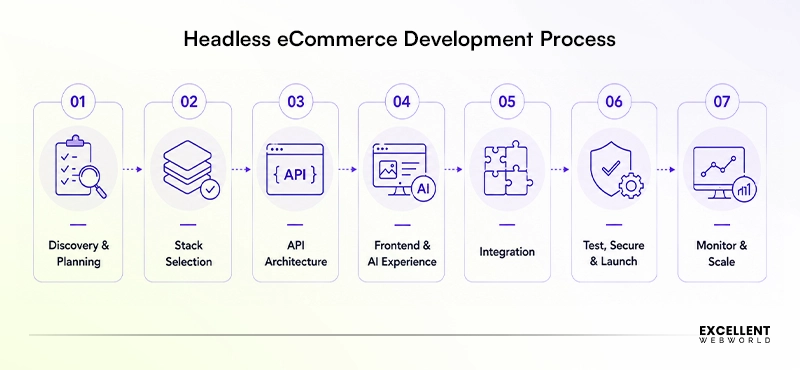
1. Discovery and Architecture Planning
Define business goals, customer journeys, digital channels, integration needs, and scalability requirements before choosing tools and technologies. AI accelerates catalog audits and competitor research, but backend selection, integration scope, and AI-agent readiness still require the judgment of experienced developers.
2. Commerce Backend, CMS, and AI Stack Selection
Choose the most suitable commerce backend and CMS that can manage catalog, orders, integrations, and content in the long term. AI helps compare capabilities such as search, personalization, recommendations, and agentic commerce, but the right choice still depends on business scale and specific requirements.
3. Commerce Data and API Architecture
Build structured product, pricing, inventory, customer, and order data using the most suitable APIs. This creates a consistent foundation for storefronts, AI applications, and agents to access accurate commerce information.
4. Custom Frontend and AI Experience Development
Develop highly intuitive and responsive UI across web, mobile, and other digital storefronts. AI accelerates the frontend component creation; however, building checkout logic and data structures readable by an AI agent still requires the help of a senior engineer. Besides this, integration of AI-powered search, personalization, and conversational shopping requires experts’ help.
5. Commerce, AI, and Agent Integration
Connect the backend to the necessary ERP, CRM, PIM, OMS, payment gateways, and other essential systems the business relies on using APIs. AI can generate integration code quickly, but undocumented edge cases and data quality still require human oversight. Developers ensure that AI agents can access commerce capabilities such as product discovery, cart management, checkout, and order information.
6. Testing, Migration, Security, and Launch
Validate performance, functionality, SEO, Core Web Vitals, structured data, APIs, checkout, and consistency across diverse channels before making the storefront live. AI can generate test cases, automate testing, assess data accuracy and security, and identify potential risks; however, final validation often requires professional review.
7. Post-Launch Monitoring and Scaling
Track storefront performance, API reliability, conversion, AI recommendations, and agent interactions post-launch. AI can detect anomalies, but scaling the architecture as traffic grows still requires human oversight.
What Are the Common Challenges in Headless Ecommerce Development and How Can You Overcome Them?
Headless ecommerce offers enhanced flexibility; however, this flexibility also introduces several architectural and operational trade-offs. With the right approach, businesses can reduce these risks without losing the benefits of a decoupled architecture.
1. SEO and Organic Traffic Risks During Migration
Challenge: Migrating from a traditional monolithic architecture to headless is essentially a complete replatforming exercise. Poor handling of server-side rendering, redirects, metadata, structured data, or internal linking can lead to significant organic traffic loss after launch.
Solution: Build a comprehensive SEO migration plan, audit rendering strategies, validate structured data, and continuously monitor indexing, rankings, Core Web Vitals, and organic traffic after launch.
2. Increased Technical Complexity and Maintenance
Challenge: A headless system involves a separate frontend, backend, APIs, cloud infrastructure, multiple third-party services, and AI-powered services. With more components in place, businesses have more dependencies to monitor, secure, update, troubleshoot, and maintain.
Solution: Centralize monitoring across every layer with clear API ownership, security controls, documentation, and continuous maintenance instead of treating each service as an isolated responsibility.
3. Higher Upfront Investment
Challenge: Without a fixed template or theme, headless requires more custom engineering, particularly when enterprises require multiple channels, integrations, AI-driven experiences, or agentic commerce capabilities. As a result, the upfront investment is typically higher than traditional ecommerce platforms.
Solution: Treat headless as a long-term technology investment rather than an upfront expense. Build the architecture around business priorities and introduce advanced AI capabilities in phases instead of implementing everything from day one. The long-term value comes from faster innovation, greater flexibility, and lower rework costs as the business evolves.
Headless Ecommerce Examples
Real-world headless implementations show why enterprises choose decoupled commerce when performance, frontend flexibility, and scale become business priorities.
1. L.L.Bean
L.L.Bean, the world-renowned retailer of clothing and outdoor gear, adopted a composable, headless architecture to improve site speed, maintain 100% uptime during sales, and accelerate updates across touchpoints. The company onboarded 250,000 SKUs and migrated 5.5 million customer accounts, generating more than $10 million in incremental revenue after launching over 100 platform enhancements.
2. Blume
Blume.com, an online clean beauty, self-care, and wellness DTC brand, faced recurring performance issues when launching new updates. The company adopted headless commerce using Shopify’s Storefront API with a React frontend. The move improved site performance, page speed, and SEO performance.
3. AI-Powered Fashion Marketplace
Our own fashion ecommerce app case study shows this AI-native thinking in practice. Built for a Texas-based fashion marketplace, the platform uses AI for personalized recommendations, visual search, inventory alerts, predictive analytics, and dynamic pricing- the same principles that make a headless architecture worth building toward.
How to Choose the Right AI-Native Headless Ecommerce Development Company?
1. Technical Expertise Across Frontend, Backend, and APIs
Look for a team that has proven production experience across commerce backends, leading frontend frameworks, third-party APIs, and headless ecommerce architecture, not just theme customization.
2. Experience with AI Personalization and Agentic-Commerce Readiness
Businesses need partners who consider AI-ready headless architecture from the beginning rather than adding it later. Ask any prospective company how they structure data, approach AI search integration and agent readiness, and whether they provide AI development services or treat AI as an afterthought.
A headless eCommerce development partner who can’t explain what an AI-native application requires is not the right partner for your business.
3. Proven Track Record and Case Studies
Request real production examples and live URLs instead of relying only on design mockups. Validate whether they have achieved outcomes such as performance improvements, conversion gains, successful SEO-safe migrations, complex integrations, and AI-based commerce implementations.
4. Post-Launch Support and Scalability Planning
Headless is a long-term architecture decision, especially if a wide range of AI services and multiple eCommerce channels are involved. Confirm what post-launch support includes, such as monitoring, security, optimization, and how the partner will support you as channels, traffic, and AI-agent integrations grow.
Why Excellent Webworld Is the Right Partner for AI-Native Headless Ecommerce Development
AI-native headless ecommerce development does not just stop at decoupling the frontend from the commerce backend. It now involves choosing a partner with the right architecture, structured commerce data, API-first integrations, AI-agent capabilities, and engineering expertise to meet the demands of both evolving customers and machines, for years after launch.
With 15+ years of experience, an 80+ member eCommerce specialist team, and 100+ eCommerce apps delivered, Excellent Webworld combines headless architecture with AI-driven search, personalization, conversational commerce, and AI-agent integrations. Our experience with Fortune 500 and mid-market companies shows how we approach headless, AI-native architecture from the planning stage rather than retrofitting it after launch.
At Excellent Webworld, our ecommerce development services have shipped headless builds across fashion, marketplace, and enterprise B2B commerce, providing the kind of production experience that matters more than a generic pitch. If you are evaluating a replatform to headless, our teams combine commerce architecture, third-party integrations, AI capabilities, and scalable frontend experiences to build AI-native headless solutions that support evolving customer experiences and business needs.
Frequently Asked Questions
Usually, headless ecommerce development is not worth it for small businesses as it introduces additional costs, technical complexity, and maintenance overhead. It makes sense when a business wants to deliver customized experiences, sell across multiple channels, manage complex integrations, or support AI-driven and agentic commerce capabilities that traditional platforms can’t support effectively.
A basic headless storefront, such as an MVP (Minimum Viable Product) built with a pre-built starter kit, can take around 8–12 weeks. Mid-market builds with custom integrations, data migration, custom features, and AI capabilities typically take 4–6 months. Enterprise builds with complex ERP or CRM integrations can take 6–12 months or longer, depending on development, testing, migration, and integration requirements.
No, headless ecommerce does not inherently hurt SEO by design, but migration risk is real. SEO problems can occur when developers overlook essential factors such as rendering, page speed, metadata, structured data, canonical URLs, internal linking, redirects, and crawlability. A structured migration plan can help preserve and improve search performance.
Headless commerce decouples the customer-facing frontend from the commerce backend. Composable commerce goes a step further by building the commerce architecture from independent services, such as commerce, CMS, search, payments, personalization, and AI services. Headless is a requirement for composable, not a synonym for it.
No, AI shopping agents will not completely replace traditional ecommerce websites. They are becoming a channel that helps users discover, compare, and increasingly purchase products with minimal clicks, while websites remain the primary source for browsing, brand experience, in-depth product information, account management, customer support, and complex purchases.
Yes. Headless ecommerce supports AI shopping agents through APIs that expose approved product, pricing, inventory, cart, checkout, and order data. Structured commerce data and secure API access let agents interact with commerce systems without being tightly coupled to the storefront.
Headless commerce provides a stronger foundation for AI-driven personalization, since AI services can operate independently from the storefront and commerce backend. This makes it easier to integrate recommendations, semantic search, behavioral data, and real-time personalization across multiple customer touchpoints.

Article By


Paresh Sagar is the CEO of Excellent Webworld. He firmly believes in using technology to solve challenges. His dedication and attention to detail make him an expert in helping startups in different industries digitalize their businesses globally.