You have decided what you are going to sell. You have already decided on your target audience. But the place you are stuck is how to actually structure your online business.
One of the prominent reasons why most online stores fail is failing to select the right ecommerce business model.
Choosing the wrong ecommerce model leads to the wrong audience, poor customer experience, failure to scale due to high customer churn, unsustainable operational costs, the wrong revenue structure, the wrong fulfillment setup, and ultimately total business failure.
By the time you realize it, you have already spent your entire budget fixing what needs to be decided from the start.
The eCommerce business models decide your margins, your operations, and your growth ceiling. And yet, this is the step that most of the founders skip.
At Excellent Webworld, we’ve helped 300+ ecommerce businesses scale from scratch by starting with choosing the model that fits their business goal. Let’s help you get every single piece of information, including types of eCommerce business models, fulfillment & delivery models, process to choose the right model, pros, cons, examples of each, and the latest trends in eCommerce.
What is an eCommerce Business Model?
In simple terms, an eCommerce business model is a plan that demonstrates who sells online products to whom and generates revenue. You get to understand who the buyer is, who the seller is, and how the transaction is carried out. If you are about to open an online store or business, then considering the eCommerce model is a critical step.
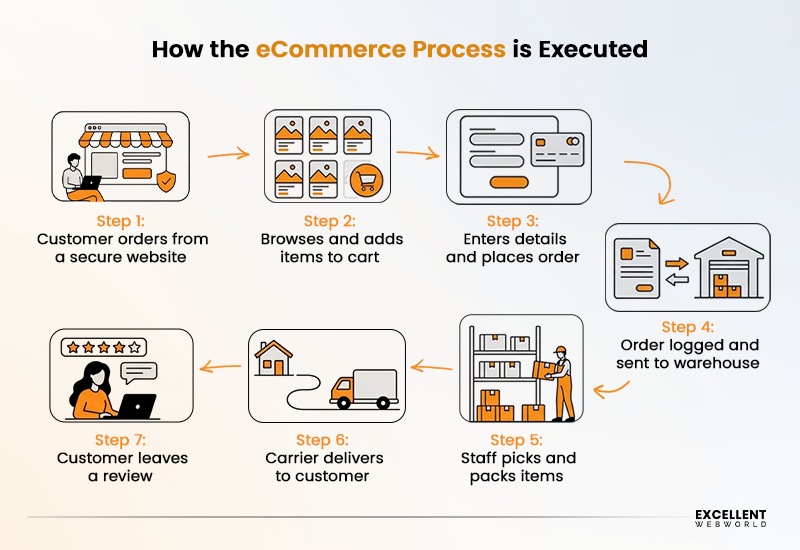
Every eCommerce business model you choose defines how each of these steps is managed and who is responsible for what. The eCommerce process varies as per the selection of the model. Let’s get you all the information required to understand the different models.
8 Types of eCommerce Business Models
The core types of eCommerce business models are categorized by who sells to whom. If you look closely at each model, it solves different market requirements along with a diverse operational setup. Let’s explore model by model.
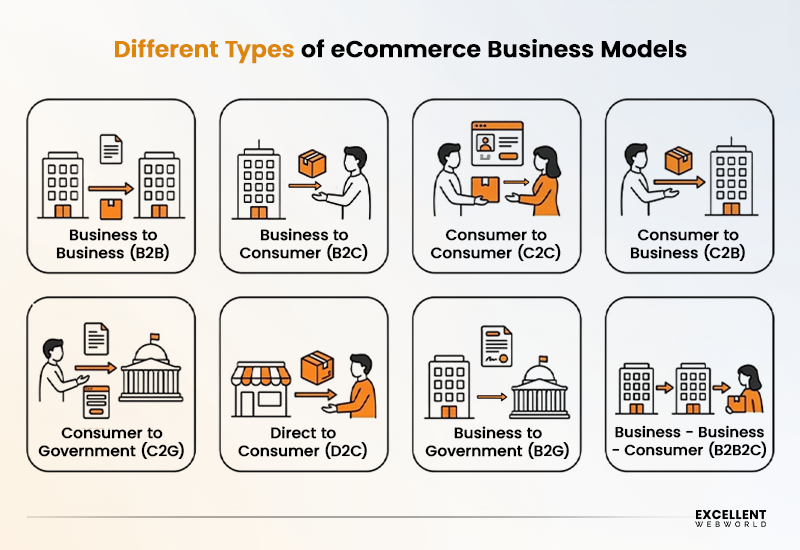
1. Business to Business (B2B)
The product or service is offered from one business to another business. The model focuses more on bulk orders, negotiated pricing, and relationships that are based on short-term and long-term contracts.
The characteristics of these eCommerce business models include:
- Equipped with high-order value
- Recurring bulk purchases with bulk transactions
- Pricing is based on accounts or contracts
- Custom processes with approval hierarchies
| Pros of B2B | Cons of B2B |
|---|---|
| Average order value is high | More decision makers slow down deal closures |
| Runs 24/7 without extra sales staff | Custom setup & integrations need investment |
| Receive bulk repeat orders from the same client | Losing a single client hits revenue hard |
| Automated pricing & reordering cuts manual work | A narrow audience makes acquisition slower & costlier |
B2B Example: Alibaba
It’s the world’s largest B2B wholesale marketplace that connects manufacturers with international retailers or wholesalers. Bulk orders are being processed instead of single-unit purchases.
When B2B is the Best Choice?
If you are selling any of the following things, B2B is for sure the right choice.
- Selling raw materials, which are unprocessed or minimally processed goods.
- Offering SaaS solutions like ERP, CRM, or project management tools.
- Providing equipment or machinery used in manufacturing or so.
- Delivering services like software development, consulting, IT support, and so on.
That said, B2B operations demand solid infrastructure. These require you to have the best order management systems, ERP tools in place, and organized sales pipelines.
2. Business to Consumer (B2C)
You encounter the B2C eCommerce business model in your everyday life. It’s the most common structure where a business sells products or services directly to consumers. For many, this is online shopping. The go-to example that comes to mind after hearing B2C. Here is what sets the B2C model apart.
- The buying cycle remains short
- Purchasing is based on emotions
- You get a fixed price
- Dependency on marketing is more
- The customer base is wide compared to other models
| Pros of B2C | Cons of B2C |
|---|---|
| Large market = more customers to reach | Margins are compromised with high competition |
| Emotion-driven purchases close faster | Customer acquisition cost adds up quickly |
| Low barriers make launching easy | Stock, shipping, and returns get hard to manage |
| Direct sales generate first-party customer behavior data | Customer trends shift fast and unpredictably |
B2C Example: Amazon
It’s one of the largest B2C eCommerce marketplaces where products are sold directly to consumers. The platform delivers everything from groceries to furniture to your doorstep.
When B2C is the Best Choice?
B2C is a natural fit if your product is designed for individual use, like fashion, books, groceries, and so on. The model requires strong branding, user-friendly UX, and digital marketing.
3. Consumer to Consumer (C2C)
The C2C business model includes using third party platform. Products or services are bought, sold, or traded from consumer to consumer via the platform. It gets profit with commissions or listing fees. In this case, the platform owner does not own the inventory. Here is what it includes:
- Structured as a marketplace platform
- Operated with user-generated products
- Transaction commission is a revenue source
- Integrated with trust and verification systems
| Pros of C2C | Cons of C2C |
|---|---|
| Operational cost is lower due to no inventory or warehouse | Peer transactions attract fraud and scams |
| Wide product varieties from multiple sellers | Buyer and seller disputes are hard to resolve |
| Better deals for both sides due to no Middlemen | No quality standards lead to inconsistent experiences |
| Minimal overhead to start selling | Platform fees cut into seller earnings |
C2C Example: eBay
It is a major global eCommerce platform connecting peer-to-peer users to sell and buy products. Individual gets easy access to even secondhand products at affordable pricing.
When is C2C the Best Choice?
There are certain options where it’s best, like resale platforms, rental apps, or freelance marketplaces. If you want a large audience base, sell niche items or second-hand products, or want direct communication without any third-party involvement, C2C is the right option.
4. Consumer to Business (C2B)
Consumer-to-business model entirely flips the traditional structure where individuals (consumers) offer products or services to businesses. Its simple like social media creators or bloggers promoting products while earning commissions and fees via platforms they collaborate with. Here are the characteristics.
- Transactions are initiated through reverse bidding
- The model is fueled by the freelance or creator economy
- Businesses in this model act as buyers
- Revenue is generated via commissions
| Pros of C2B | Cons of C2B |
|---|---|
| Get skilled talent without full-time hiring costs | The quality of data varies across contributors |
| Consumers promoting your brand builds loyalty | Vetting individuals carries security risks |
| User content adds to authenticity and quality | Freelancer pricing and revenue are unpredictable |
| Influencer partnerships boost credibility fast | Relying on individuals makes scaling hard |
C2B Example: Upwork
It is the largest online marketplace that connects businesses to freelancers. Individuals can list and offer their experience and expertise. Whereas companies browse and hire these freelancers directly for the project.
When is C2B the Best Choice?
In situations where a platform connects social media creators, freelancers, or service providers with businesses or brands, then your structural base is surely C2B. To operate in an efficient manner, this model requires rating systems, escrow payments, and contract management workflows.
5. Consumer to Administration (C2A)
Consumer to Administration (C2A) is also known as Consumer to Government (C2G). With this model, individuals use digital platforms to communicate, pay, or access services from government, municipalities, or public authorities. Here is what it consists of.
- Citizens make government service payments via online portals
- Renewals of licenses are processed without any in-person visits
- Simplifies tax filing processes via government-provided platforms
- Public service applications are easy to submit and track online
| Pros of C2A | Cons of C2A |
|---|---|
| Digitized processes cut costs | Government procedures are rigid and slow |
| Government services become more accessible | System downtime disrupts critical services |
| Removes geographical barriers for citizens | Sensitive data raises serious privacy risks |
| Faster processing improves service quality | Implementation is complex as well as costly |
C2A Example: Internal Revenue Service (IRS)
It is a US government agency that offers an online portal for individuals to file taxes. It makes it easier for citizens to submit and manage their tax returns.
When is C2A the Best Choice?
Let’s say you are building a platform for transactions or interactions between government or administrative bodies and individuals, then this model is the right one. Also suitable when you want to avoid in-person visits and connect citizens to the public institutions.
6. Direct to Consumer (D2C)
D2C eCommerce business models allows manufacturer to directly sell their products or services to the end users without any third-party involvement. Brands that require total control over customer relationships and margins prioritize this model. Here is what makes it a valuable model to choose for.
- The products are directly sold to the brand owner’s website or portal
- Access to customer data is so easy with this model
- Intermediates are cut out, which leads to higher profit margins on every sale
- Offers strong branding, as you can craft and control your unique customer experience
| Pros of D2C | Cons of D2C |
|---|---|
| Direct sale gives detailed customer data | In-house operations are costly |
| No middleman means higher margins | Customer acquisition without retail support is expensive |
| You get faster product feedback | All product issues fall directly to you |
| Full control over brand and pricing | Being ideal in the market is tough |
D2C Example: Nike
It is a world-leading athletic footwear and apparel brand that sells directly to users through its online stores. The direct approach allows Nike to have total control over their brand experiences.
When is D2C the Best Choice?
There are 3 case scenarios where you will find D2C the best choice. The first one is if you want full control over the customer and brand experience. The other two are that you want to build a direct relationship with the customers or want higher margins by avoiding or eliminating a mediator.
7. Business to Government (B2G)
Business to government is also known as business to administration. The model includes transactions between private entities and federal, state, or local government agencies. This involves the exchange of goods, services, or any kind of important information like technology solutions, data systems, or infrastructure services. Here is what it includes.
- With a formal bidding process, businesses go for tender-based contracts
- Includes long procurement cycles so companies can plan and prepare in advance
- Operations are aligned with the strict compliance for safety
- The contracts it contains are highly valuable
| Pros of B2G | Cons of B2G |
|---|---|
| Government contracts lead to stable demand | Bidding is slow and complex |
| Payments are guaranteed once the contract is secured | Maintaining strict compliance is costly |
| Direct relationships opens door to repeat orders | Cash flow is delayed with long payment cycles |
| Niche focus reduces competition at a higher level | Change in policies disrupts active contracts |
B2G Example: Lockheed Martin
It is the premier aerospace and defense company supplying products and services to the defense departments of the government. Their contracts are secured through a formal procurement process.
When is B2G the Best Choice?
In cases where businesses offer either infrastructure and defense solutions or enterprise software or public systems, the B2G business model is the priority.
8. Business to Business to Consumer (B2B2C)
B2B2C is the most unique eCommerce business model of all, considered a hybrid model. Here, three parties are involved, where the first party (Business A) deals with the second party (Business B), and then the second party delivers to the third party (End user). In the entire process, the original brands remain visible. Here is what it includes.
- Both businesses share customer ownership
- Platform partnerships allow businesses to have each other’s networks
- Generated revenue is distributed among the businesses
- Businesses can jointly market due to cobranded distribution
| Pros of B2B2C | Cons of B2B2C |
|---|---|
| Partner networks lead to speeding up market entry | Sharing revenue with partners reduces margins |
| Partners bring customers, lowering CAC | Less control over customer experience |
| Direct consumer interactions give in-depth data | Data access is limited by intermediary agreements |
| Multiple revenue streams on both sides | Brand visibility weakens via another business |
B2B2C Example: Shopify
It is a cloud-based eCommerce platform that offers brands tools to sell across different partner channels. This way, the reach and network are expanded for both parties. For building customized storefronts and integrating third-party platforms, businesses can consider Shopify development services from an agency to build a solution that supports their B2B2C operations now and in the future.
When is B2B2C the Best Choice?
If you have a business that is totally dependent on the intermediaries. Even with the reliance, you still want customer visibility and brand recall, so choose B2B2C as your eCommerce business model.
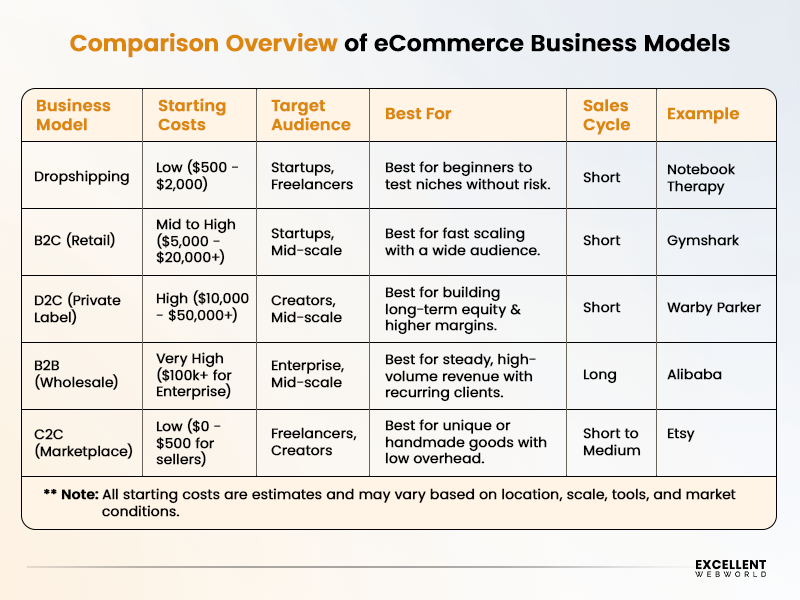 With all the business models explained, let’s check out the fulfillment and delivery models, which are also important to understand.
5 Types of Fulfillment & Delivery Models in eCommerce
Fulfillment and delivery models define how efficiently you deliver your product or services and how much margin you get with the order. A weak or mismanaged structure shrinks profits even when sales are growing. Let’s discuss each of the models in detail.
1. Dropshipping
If you want to sell products without having an inventory, then you are into dropshipping. Here, you are the storefront, and suppliers manage the storage and shipping. Such an approach reduces upfront investment a lot and makes it easier for you to test your new product categories.
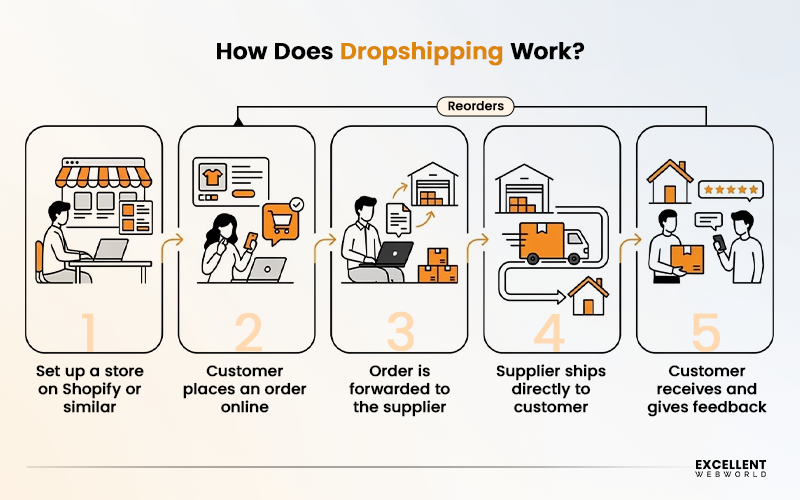
In this model, the delivery timelines and product quality depend on supplier reliability, as you do not have control over manufacturing.
| Pros of Dropshipping | Cons of Dropshipping |
|---|---|
| Investing in inventory, upfront staff, or a warehouse is never an issue | Branding is limited as products are shipped by the supplier |
| Zero to no financial risk, as you only purchase after the customer places the order | Product quality, packaging, and shipping speeds are not in your hands |
| The business can be easily managed from anywhere with just an internet connection | Poor post-purchase control makes customer retention difficult |
| You can diversify your categories of products by listing a wide range of items | Returns and refunds are hard to manage, as you depend on supplier policies |
Examples of Dropshipping
- Fashion Nova, Rocket Dog (Fashion & Apparel)
- Sage & Sill (Home Decor & Lifestyle)
- Inspire Uplift (Gadgets & Gift)
- Kylie Cosmetics (Beauty and Cosmetics)
2. Wholesaling & Warehousing
In this model, order fulfillment is carried out internally. You purchase products from different categories in bulk and store them in either your inventory or third party warehouse. The entire control is with you, from packaging to shipping speed. ,
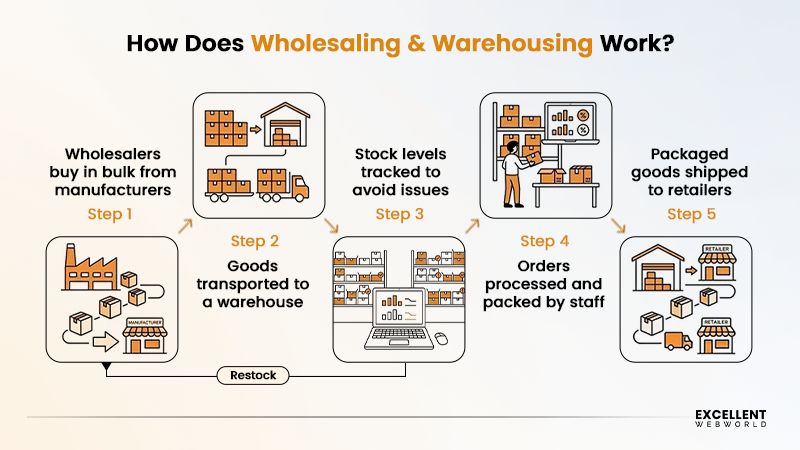 Since bulk buying lowers per unit cost, the profit margins are high with this model. It supports B2B and high-volume B2C eCommerce business models.
| Pros of Wholesaling & Warehousing | Cons of Wholesaling & Warehousing |
|---|---|
| Discounts on bulk purchasing of the products lead to cost savings | If the manufacturer decides to sell directly to retailers, wholesalers suffer |
| Established relationships with retailers lead to recurring orders | Late customer payments and extended credit terms increase the risk of bad debt |
| If you own or lease an inventory, you get full control over everything | An initial investment is required for inventory and warehouse management systems |
| Stock shortages are less encountered as bulk orders are processed | Scaling leads to reinvestment in space, staff, and logistic infrastructure |
Example of Wholesaling & Warehousing
- Costco Wholesale Corp, DollarDays (General merchandise)
- DHL Supply Chain, GEODIS (Logistics/Storage)
- Sysco (Food & Beverage)
- Mothership, XPO (Apparel & Fashion)
3. Private Labeling
You order products from a manufacturer exclusively sold under your own brand identity. With this model, you do not own the factory; you just have control over branding, pricing, and packaging.
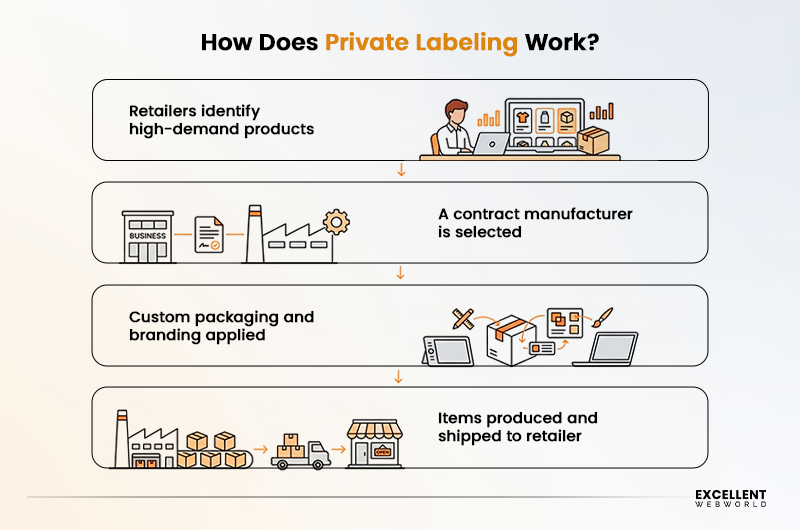 Let’s say your goal is sustained brand equity and not immediate trading margins, so private labeling is what you need to consider. You get ahead of the competition as customers associate the product with your brand and not the manufacturer.
| Pros of Private Labeling | Cons of Private Labeling |
|---|---|
| The production cost is lower, leading to higher margins | You get complete control over the product name, pricing, and design |
| You get complete control over the product name, pricing, and design | Getting the trust of customers in your unique product is a bit tough and time-consuming |
| The product is ideal and unique for your physical or online store | You risk a large amount of unsold inventory due to bulk ordering |
| You build a brand identity that earns customer loyalty | Provides limited flexibility to pivot quickly if market demand shifts |
Examples of Private Labeling
- Kirkland Signature, 365 Everyday Value (Grocery & Consumables)
- Time and Tru, Terra & Sky (Apparel & Accessories)
- Up&Up (Home, Household & Personal Care)
- Equate (Health & Beauty)
4. White Labeling
The manufacturer’s pre-developed products are sold to multiple brands, which rebrand and distribute them, and then sell to end-users. The entire process is white labeling. How does it differ from private labeling? It’s simple in private; the retailer is dedicated only to one, while in white labeling, there are multiple retailers.
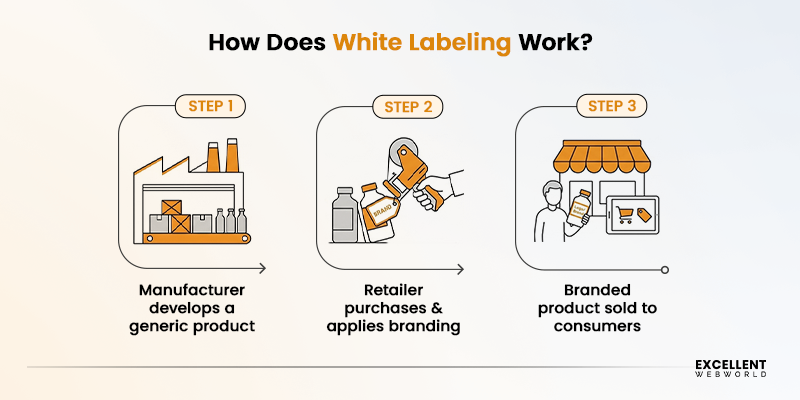 Businesses choose this model when more focused on sales, distribution, and marketing.
| Pros of White Labeling | Cons of White Labeling |
|---|---|
| Makes it easy to expand product lines to fulfill the increasing demands | If a competitor sells the same product, the price and margins are affected a lot |
| The setup cost for manufacturing, research, and development is totally eradicated | You get limitations in customizing the product as it’s produced by a third party |
| Without technical precision, businesses can start selling on an immediate base | For quality control and supply chain, you need to rely on the manufacturer |
| The risk of product failure is less since the products are tested in the market | Reputational damage to the manufacturer’s product affects your business |
Examples of White Labeling
- ColourPop, The Ordinary (Beauty & Cosmetics)
- Bulkanna (Wellness & Supplements)
- Zara, H&M (Apparel & Fashion)
- InnovaGoods (Consumer Electronics/Gadgets)
5. Subscription Models
A customer paying recurring fees to access a product or service on a monthly or yearly basis is what the subscription model means. Stabilized cash flow and customers’ lifetime value are boosted with this model.
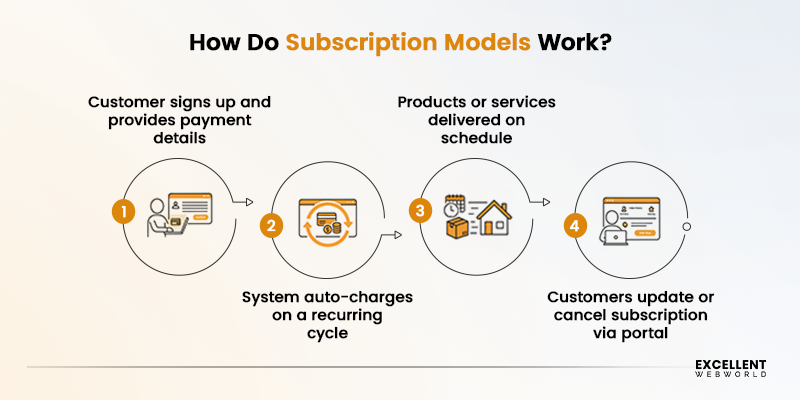
The success of your business is totally dependent on customer retention as well as how you attract new ones.
| Pros of Subscription Models | Cons of Subscription Models |
|---|---|
| You get scheduled payments, so your cash flow is not disturbed | Compromise in quality or delivery leads customers to cancel the subscription |
| Maintaining sustained relationships with the subscribers is easy | Investment in marketing is a must to attract new customers as well as retain existing ones |
| Inventory holding costs are lowered with predictable demands | You need to continuously update products or services to keep customers subscribed |
| Frequent interactions lead to rich data on customer preferences | Offering discounts, trials, or free months hurts short-term profitability |
Examples of Subscription Models
- Vital Proteins (Wellness)
- HelloFresh, Blue Apron (Food)
- Allies Skincare, Birchbox (Beauty)
- BarkBox (Pet Supplies)
6 Common Benefits of eCommerce Business Models
When your model aligns with your product and target audience, growth follows naturally. So, let’s explore the core benefits you receive when you choose the right model.
1. Lower Operational Costs
The cost of overheads like having a physical store, in-person staff, and infrastructure is being reduced. The control over how much capital you commit upfront is with you. However, it depends on whether you choose dropshipping, warehousing, or private labeling. Even your operational expenses remain predictable if you structure them in a correct manner.
2. Global Reach and 24 by 7 Accessibility
An online store is not something that closes at night. Your customers or end uers gets complete access to browse, compare, and purchase from anywhere at any time. Even if you look at B2C and D2C models, you can serve international markets without any physical outlet or store. This way, sales opportunities are increased, and your customer base is expanded.
3. Data Collection and Personalization
If you have the right eCommerce business model, you get to capture and analyze data generated with every transaction, search, and abandoned cart. This process makes it easier for you to define marketing, adjust the pricing of the product you sell, and position your product. Your inventory is optimized, and guesswork is reduced a lot with this data-driven approach.
4. Higher Potential for Recurring Revenue
Not all the models have higher potential for recurring revenue. Subscription and B2B contract-based selling are among the eCommerce business models that help create predictable recurring income. Your reliance on one-time purchases ends here; you build sustained relationships with recurring payments.
5. Improved Efficiency and Automation
Whether it’s inventory tracking or, let’s say, order processing, everything is integrated with automation. Not even payment reconciliation and customer communication are left for automation, showcasing one of the core benefits of AI in eCommerce.
With a clearly defined business model, implementing automation becomes easier. On one side, B2C stores automate abandoned cart reminders, whereas on the other side, B2B systems automate generating invoices and approval workflows.
6. Enhanced Customer Convenience
If convenience is taken care of, everything is perfect with online purchasing. Current innovation in models makes it easier to maintain customer convenience either by offering availability around the clock or cutting out the time to travel to a physical store for shopping, or providing door-to-door delivery within a shorter time. When you fulfill customers’ expectations, like faster delivery and smooth returns, the road is clear for you.
You get what you achieve with an eCommerce business model, but have you figured out how you are going to select the right one for your business? Let’s figure it out.
How to Choose the Right eCommerce Business Model
Picking the right eCommerce business model is very important as it drives how you operate, scale, or generate revenue. Let’s explore the process to choose the right one.
Step 1. Carry Out Product Analysis (Physical vs. Digital vs. Service)
There are several offerings to choose from, whether you have a physical product, a digital product, or a service. You just need to start with any of this which one you have.
- Physical products: Required for logistics planning and shipping partnerships.
- Digital products: Includes courses or software that are more inclined towards subscription or D2C models.
- Services, including consulting or freelancing, are better suited to C2B or B2B business models.
Along with this, your attention must be in assesing how customizable what you sell is, average order value, the frequency of purchases made by the users, and the shelf life or consumption cycle of whatever you are selling.
Take an example. If your product is used on a regular basis and it’s consumable as well, then a subscription model is enough to increase lifetime value. Whereas, B2B is more suitable if your product is high-value and build-oriented.
Step 2. Identify Your Target Audience Demographics & Buying Intent
You need to know: who you are selling your product to? For every individual consumer, businesses behave differently depending on what they require to sustain the consumer.
If you see, government institutions follow procurement protocols, and creators operate with flexible or contract-based pricing. Here is what you need to consider:
- Who are they? (Age group & income range)
- Why do they buy? (Purchase motivation)
- What can they afford? (Budget sensitivity)
- How long can they take to decide? (Decision-making cycle)
- How much trust do they need before buying? (Trust requirements)
If you get this buying intent, then it’s for sure that you are not building features and functionalities that your audience does not need.
Step 3. Evaluate Your Business Capability (Startup, Mid-scale Business, or an Enterprise)
If you are a startup with limited capital its fine to take dropshipping under a B2C structure. For mid scale business, with the advantage of having a wide supplier network can choose warehousing as well as private labeling. An established enterprise with strong compliance resources would surely pursue B2G contracts. Just ask the following questions during this phase:
- How much capital are you willing to invest initially?
- Do you have expertise in shipping and delivery operations?
- Are you strong enough to manage inventory risk like unsold stocks or storage issues?
- Do you have an expert sales team who are expert in handling deal closing processes?
- Are you ready to meet strict regulatory compliance when dealing with the government sector?
During the process, make sure that the complexity of your chosen eCommerce business model matches your internal capabilities.
Step 4. Select the Best eCommerce Model for Your Product
You have everything ready, from product analysis to operational capability. So it’s time to choose the model as per your criteria. Again, let’s get you which model is best suited for which situation.
- Take B2B if you are looking to sell built industrial products on a contract basis.
- Choose D2C when you want to build a branded product line with customer engagement.
- Consider C2C as your base in case you are creating a marketplace where users transact with each other.
- C2B is your choice when you want freelancers to connect with companies.
- The subscription model is right to choose to get recurring profit and customer sustainability.
With the selection of a business model, it’s also important that you pick the right platform for your eCommerce needs. If you are evaluating your options, make sure to understand the difference between Magento and WooCommerce. This will help you pick a platform that supports your operational structure and growth plans.
To get more advantages, what you can do is to combine models. D2C operated via a website can also sell wholesale under a B2B structure. Here, what is important is the alignment.
7 Emerging Trends That Shape eCommerce Business Models
How are you managing and sustaining your customers? Most of it is because of the technologies used and the AI systems involved. When you stay ahead, it means you are keeping a close eye on the best eCommerce trends that shape how businesses operate. So let’s look at what exactly is impacting the models in a positive way.
1. AI-Driven Personalization
In today’s scenario, product recommendations are carried out with perfection when models analyze browsing behavior and engagement signals using AI. Even the big giants like Amazon are investing a huge portion in recommendation engines that adjust live.
2. Hyper Personalization and Dynamic Pricing
Based on various factors like user behavior, demand, inventory levels, and competition, the pricing of your product is adjusted. You might have come across a few airlines that prioritize dynamic pricing. Even Walmart changes the pricing of its categories based on demand signals.
If you compare quick commerce with traditional eCommerce, you see DoorDash and Gopuff adjust product pricing and delivery fees in real time based on local demand spikes and time of day, using personalization and dynamic pricing.
3. AI Agents and Conversational Commerce
Users nowadays want convenience. You know how they are directly asking questions and receive guided suggestions instead of browsing products on different pages until they get the one. You take the Shopify example, how they integrates AI-powered shipping assistant for faster product discovery.
4. Generative AI for Brand Building
Businesses use generative AI for various uses. To perform automated product description, personalize the email campaigns, and not just these, this tech is also used for the creation of visual assets. Currently, many brands in the market use tools integrated with Meta to generate targeted creatives depending on audience segments.
5. Visual and Multimodal Search
As convenience is the key for customers, at times, they do not even type keywords. They just search by uploading images or by voice. If you have notice in Pinterest, it allows users to search for products via images. AI-powered visual search in eCommerce is changing how product catalogs are optimized.
6. AI-Enabled Operational Efficiency
AI is not just refining the frontend but also transforming backend operations. Fraud detection, as well as supply chain optimization, is something that is now data-driven. Even warehouse automation and inventory forecasting are a part of it. For forecasting and coordinating logistics, Alibaba uses artificial intelligence.
These trends are not limited to enterprise giants. If you want your eCommerce business to be successful, make sure to invest in these trends. Let’s check out some of those winners of Shark Tank who are aligned with these trends.
7. Buy Now Pay Later and Flexible Commerce
Buy Now, Pay Later is one of the most essential trends that works absolutely well in some eCommerce business models, such as B2C, D2C, and B2B2C. The trend enables consumers to split payments and pay over time. By integrating BNPL into their eCommerce solution, businesses can remove purchase friction, enhance conversions, and increase average order value without making major changes in their product pricing.
The rise of AI agents and agentic commerce has further accelerated this trend. Intelligent shopping assistants can analyze customer preferences, recommend suitable payment options, and support more personalized purchasing experiences. As customer spending habits evolve, businesses and brands worldwide now invest in BNPL app development to provide a flexible payment experience to their potential users. This approach satisfies customer needs and allows businesses to survive and thrive in competitive digital marketplaces.
Shark Tank’s Top eCommerce Winners
Look at the companies that secured funding. How? Each one has chosen models as per what they are about to sell and who they will be delivering to. It’s a proof that the right eCommerce business model can unlock massive growth for your business.
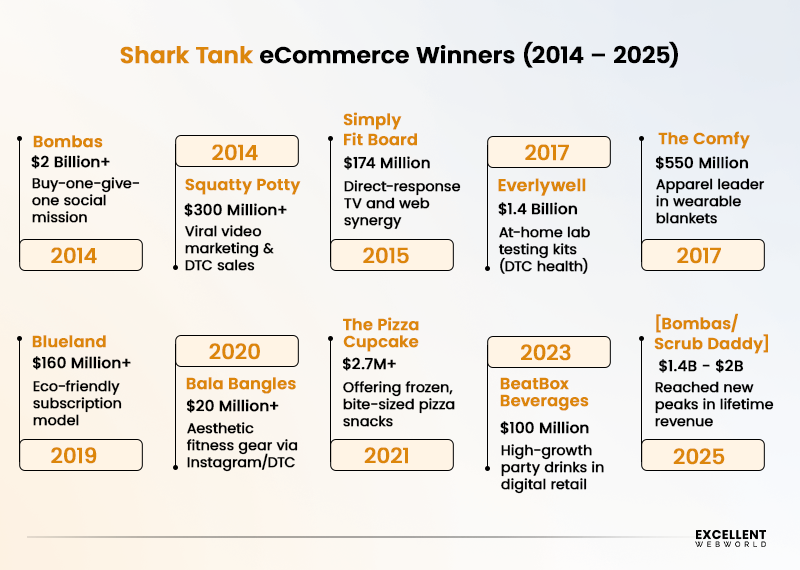 This table shows how these brands were structured on scalable eCommerce business models, whether it be D2C, subscription, or hybrid B2B2C.
Take the lead & Start Your eCommerce Business
eCommerce business model is a blueprint that defines who you sell to and how revenue flows into your business. If you are looking to launch or restructure your business model, you need more than just an online store. This is why we are here. Our experts will help you map your product type, audience intent, and everything you require to convert your idea into a store.
From choosing technology or a model to building eCommerce platform, we have got you covered. Our team consists of expert consultants who guide you through decisions. With our reliable eCommerce development services, we provide experienced developers & designers who help you build an engaging online store.
FAQs on eCommerce Business Models
If you are a beginner in 2026, dropshipping is the best eCommerce business model due to zero management of inventory and low startup costs. New entrepreneurs can test their niches with minimal risk.
The B2C business model involves third-party interaction to sell products or services to customers. Whereas the D2C business model involves selling products or services directly from the manufacturer. To have control over brand, data, and margins, D2C is best, and to get a wide reach via retail channels, B2C is best.
Yes, it’s called a hybrid approach. You can combine D2C with B2B, selling directly to consumers while also serving wholesale to retailers. Also, a traditional B2B wholesaler can run a D2C website.
At first, you need to define the product you want to sell and the audience you are targeting. Then, assess your budget, warehouse capacity, and technical skills. Use Google Trends and available online tools to find high-demand niches. And, at last, evaluate competitors’ websites and how they work.
For sure, the global market of dropshipping is expected to reach from $365 billion in 2024 to over $1.2 trillion by 2030. Even the percentage of average profit margin is around 15-30%, which shows how the dropshipping business model is dominating the market in 2026.
Managing large product catalogs with custom pricing, and that too for different clients, is one of the technical challenges. Integrating it with ERP and CRM systems and maintaining security/compliance at scale are the major ones.
From search-based platforms to hyper-personalized systems, AI agents are changing eCommerce operations to the next level. Its involvement in predictive inventory management and AI-driven purchase journey reduces labor costs and drives high conversion rates.

Article By


Paresh Sagar is the CEO of Excellent Webworld. He firmly believes in using technology to solve challenges. His dedication and attention to detail make him an expert in helping startups in different industries digitalize their businesses globally.