Quick Overview: Get a clear breakdown of sovereign AI and national AI/data governance, plus the enterprise strategy needed to actually achieve it. I have covered the leading sovereign AI platforms already powering government and healthcare deployments today and how your organization can apply the same approach.
Having sat across the table from industrial enterprise leaders for years now, one conversation keeps resurfacing recently regardless of the industry, region, or scale of the business: AI governance, data sovereignty, and infrastructure independence. Well, it’s not three separate concerns but one question dressed up in different language: Who actually controls the process once the model is running?
However, as sovereign AI moves from policy paper to production budget line, that question is no longer academic. It’s the one every board is asking about before the next dollar gets approved. So, this will help clarify the meaning and depth of sovereign AI and platforms.
What is Sovereign AI & Which countries have Sovereign AI?
Sovereign AI is a nation’s capacity to develop, deploy, and govern AI within its own legal, operational, and technological boundaries. With giving it greater control over data, compute, models, infrastructure, and AI governance. Well, this doesn’t always imply the domestic ownership of every layer. Countries can pursue whole, hybrid, regional, or sector-specific sovereignty depending on their strategic requirements. So, this combines data sovereignty and residency with control over infrastructure, AI models, and operations. It helps enterprises and governments meet regulatory, security, and strategic autonomy requirements.
There is another term, “AI sovereignty,” which implies the capability of independently managing the data, infrastructure, models, and regulations to enforce your AI systems. We are all familiar with different types of AI models and agents. Sovereign AI enables organizations to build, deliver, and operate these AI capabilities within their own jurisdiction and infrastructure. Alongside this, it maintains greater control over data, models, and operations.
Although, there is no single nation with genuinely 100% AI sovereignty. However, the USA and China are the only ones with near-full-stack sovereign AI capabilities across infrastructure, data, and hardware. On the other hand, the middle power nations, including France, India, the UAE, the UK, Saudi Arabia, Japan, and Singapore, are actively investing billions to build localized models and data infrastructure.
The Sovereign AI index shows that growing AI dependence has been sped up, with the cumulative Sovereign AI projects reaching 179 by the end of June 2026. You will understand this better from the following tables.
The Superpowers (Near-Full-Stack Control & Compute)
| Country | Sovereign AI Initiative | Key Facts |
|---|---|---|
| United States | Frontier labs, domestic chip design, global cloud hyperscalers | Controls the majority of frontier model research and the GPU supply chain most other nations depend on |
| China | Vertically integrated domestic stack | Domestic chip production, closed-loop training data, and state-backed foundation models operating outside the US/allied compute supply chain |
Middle Powers & Regional Leaders (Strategic Autonomy)
| Country / Region | Sovereign AI Initiative |
|---|---|
| Saudi Arabia | HUMAIN |
| United Arab Emirates | G42, Stargate UAE, TII’s Falcon models |
| India | BharatGen, IndiaAI Mission |
| France | Mistral, Cigeo data center program |
| European Union | InvestAI, EU AI Continent Action Plan |
| Singapore | SEA-LION |
| Japan | LLM-jp |
| Canada | AI Compute Access Fund |
Well, this is quite a predictable picture, as AI becomes a strategic asset, sovereign AI is no longer limited to the developed nations. Governments across regions are investing in domestic computers, foundation models, data ecosystems, and localized AI infrastructure to strengthen security, economic competitiveness, and technological autonomy. Recent reports show a dramatic jump in the sovereign AI infrastructure market, projected to reach USD 301.6 billion by 2040.
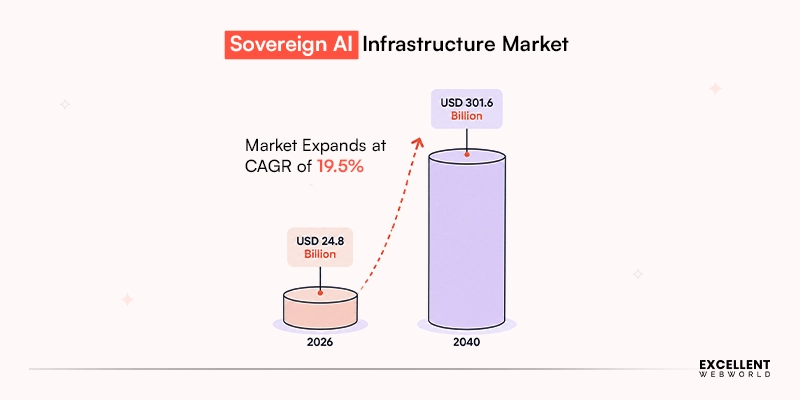
From established AI powers to emerging players, a growing number of countries are building national capabilities to reduce dependence on foreign AI systems. Therefore, it’s creating a rapidly expanding global market for sovereign AI platforms. Due to the rapid acceleration of sovereign AI projects, demand and competition among existing players have intensified. So, let me take you through what sovereign AI platforms are and then move to the top platforms you can explore…
What Is a Sovereign AI Platform? Why Does It Matter for Enterprises?
A Sovereign AI platform enables enterprises to develop, deploy, and govern AI within defined jurisdictional and operational boundaries. Alongside this, it maintains control over their data, infrastructure, models, and AI operations. Unlike basic data residency, it offers true sovereignty that extends across the AI lifecycle, from where workloads run and who controls access to how models are computed, governed, monitored, and audited.
Sovereign AI deployments and overall data sovereignty greatly influence the enterprise’s AI strategy. This simply means greater control over data sovereignty, regulatory compliance, security, model portability, and operational risk. Moreover, it’s particularly important for organizations operating in highly regulated industries or handling sensitive data. A robust sovereign AI platform should therefore support flexible deployment options, strong governance and access controls, auditability, compliance requirements, multi-model support, scalability, and enterprise-grade operations.
Key Efficiency of Best Sovereign AI Platforms
- Data sovereignty and residency: Keeps sensitive data within required jurisdictions while maintaining appropriate legal and operational control.
- Infrastructure control: Provides deployment flexibility across on-premises, private cloud, dedicated environments, hybrid infrastructure, or air-gapped setups where required.
- Model control and portability: Supports multiple models and, where appropriate, bring-your-own-model approaches to reduce dependency on a single AI provider.
- Governance and access control: Enables granular identity, permissions, policy enforcement, monitoring, and audit trails across AI workloads.
- Security and compliance: Supports encryption, key management, regulatory requirements, and industry-specific controls.
- Operational autonomy: It gives enterprises greater control over how AI systems are deployed, updated, monitored, and managed throughout their lifecycle.
- Enterprise scalability: Supports production workloads with the reliability, performance, AI integration capabilities, and SLAs enterprises require.
Ultimately, the value of a sovereign AI platform goes beyond where AI data is stored. It is about who controls the AI stack and how that control is enforced. And most importantly, whether the enterprise can demonstrate that control to regulators, customers, and internal stakeholders. Let’s move to the platforms, for that matter…
Top Sovereign AI Platforms in the World
1. Microsoft Sovereign AI
Microsoft’s sovereign AI offering embeds jurisdictional and operational controls directly into the Azure cloud and AI stack, rather than requiring a separate, isolated sovereign platform.
Capability:
Combines Azure’s AI and cloud infrastructure with sovereignty controls spanning data residency, encryption and key management, confidential computing, access control, and policy-based governance—applied across the full AI lifecycle, from training and fine-tuning through inference and monitoring.
Opportunities:
- Adopt sovereign AI without leaving the broader Microsoft ecosystem (Azure AI, Microsoft 365, Dynamics, developer tools)
- Modernize existing enterprise applications with AI while adding jurisdictional and operational controls
- Strong fit for organizations with significant existing Microsoft infrastructure investment
Limitations:
- Sovereignty is layered onto the existing public-cloud ecosystem, not built as a fully independent environment
- Organizations needing complete infrastructure independence or air-gapped isolation may need Azure’s private-cloud sovereign options instead of the standard public-cloud model
Industry Fit:
- Banking & Financial Services
- Government
- Healthcare
- Defense
- Telecommunications
My POV: The strongest choice for enterprises that want sovereign AI without abandoning the Microsoft ecosystem they’ve already built on.
2. AWS European Sovereign Cloud
An independently operated AWS cloud environment physically and operationally based within the European Union, purpose-built around EU-specific residency and autonomy requirements.
Capability:
Retains AWS’s familiar architecture, APIs, security model, and broad service portfolio. While adding stringent data residency, operational autonomy, resilience, and compliance controls specific to the EU regulatory environment.
Opportunities:
- Move sensitive or regulated workloads into a tightly controlled sovereign environment without a full platform migration
- Practical path for governments and enterprises to bring AI, analytics, and databases under stronger EU sovereignty requirements
- Preserves existing AWS familiarity and tooling for current AWS customers
Limitations:
- The sovereignty proposition is EU-specific, not a universal solution for sovereignty needs outside Europe
- Enterprises must verify that the specific AWS services they need are actually available within the sovereign environment
Industry Fit:
- European Public Sector
- Financial Services
- Healthcare
- Defense & Critical Infrastructure
- Telecommunications
My POV: The most practical option for existing AWS customers in Europe who need sovereignty without a platform migration.
3. Oracle Sovereign AI
Oracle’s sovereign AI approach governs where AI workloads run and how the underlying infrastructure is operated. It is built on Oracle Cloud Infrastructure’s distributed-cloud deployment model.
Capability:
Deploys OCI capabilities across public cloud, dedicated environments, and customer data centers, enabling AI directly on top of existing Oracle databases and enterprise applications rather than requiring a separate AI environment.
Opportunities:
- Bring AI directly into existing Oracle databases and enterprise application estates
- Distributed-cloud and multicloud deployment supports sovereignty while preserving infrastructure across multiple providers
- Strong for database-centric AI use cases (fraud detection, customer intelligence, analytics)
Limitations:
- Value is strongest for organizations already invested in Oracle technologies
- Less naturally aligned for enterprises seeking a fully vendor-neutral AI ecosystem
Industry Fit:
- Financial Services
- Telecommunications
- Government
- Healthcare
- Retail & Manufacturing
My POV: The natural choice for database-heavy enterprises that want AI sovereignty without leaving their existing Oracle infrastructure.
4. Google Sovereign Cloud
Google’s sovereign offering combines Google Cloud AI and data capabilities with sovereignty controls governing data residency and administrative access. In certain configurations, it supports fully isolated or air-gapped environments.
Capability:
Applies controls to sensitive sovereign AI deployments while preserving Google Cloud’s core AI, analytics, and large-scale data processing capabilities. This even includes agentic application development.
Opportunities:
- Strong fit where sovereign AI connects directly to advanced analytics and large-scale data processing
- It enables enterprises to turn large domestic or regulated datasets into AI-driven products
- Specifically compelling for generative AI and enterprise AI agent projects
Limitations:
- Sovereignty requirements vary significantly by country, workload, and deployment model, requiring detailed architecture review per deployment
- More prescriptive sovereignty requirements may demand deeper compliance assessment than other platforms
Industry Fit:
- Government
- Healthcare
- Financial Services
- Telecommunications
- Research & Media
My POV: Best suited for data- and analytics-heavy organizations turning regulated datasets into AI-driven products under sovereign controls.
5. IBM Sovereign Core
The IBM sovereign core is a sovereignty-by-design platform providing a customer-operated control plane. There is no such hyperscale public cloud; it’s built specifically around provable operational independence. Moreover, it is the best sovereign AI platform, mainly falling under the sovereign cloud infrastructure as a service (IaaS).
Capability:
Manages identity, credentials, encryption keys, observability, and compliance within a defined sovereign boundary. From supporting AI inference, models, and governed AI services, it handles everything entirely under the customer’s own operational authority.
Opportunities:
- Delivers provable operational control and continuous compliance evidence. That’s beyond regional data residency alone.
- Well-suited to hybrid or potentially disconnected/air-gapped environments
- Can run on infrastructure controlled by the organization itself or a trusted local provider
Limitations:
- A sovereign software and control-plane foundation, not a hyperscale cloud with the native service breadth of Azure, AWS, or Google Cloud
- Requires additional infrastructure, hardware, and ecosystem components, plus the operational expertise to run a customer-controlled sovereign environment
Industry Fit:
- Government & Defense
- Financial Services
- Healthcare
- Critical Infrastructure
- National & Regional Cloud Providers
My POV: The right choice for organizations that need provable, auditable operational control; it’s not restricted to just a regional data center.
6. NVIDIA Sovereign AI
NVIDIA Sovereign AI infrastructure and accelerated-computing foundation. This combats the conventional barrier of end-to-end sovereign cloud platforms and provides the compute layer that powers national AI factories.
Capability:
GPUs, networking, AI software, reference architectures, and an “AI-factory” model provide the computational foundation to train, fine-tune, and deploy sovereign foundation models within locally controlled infrastructure.
Opportunities:
- The core opportunity is at the national AI infrastructure layer, building domestic “AI factories” on locally controlled compute
- Particularly valuable for countries developing their own foundation models or multilingual AI systems
- Deployed in real sovereign AI initiatives, including India’s Sarvam AI effort
Limitations:
- It does not independently provide governance, data-residency, compliance, or the enterprise application layer of a full sovereign cloud platform
- Well, at times, this requires pairing with local data centers, cloud platforms, systems integrators, and governance frameworks. Moreover, this is to become a complete sovereign AI environment
Industry Fit:
- National AI Programs
- Government & Defense
- Telecommunications
- Healthcare
- Advanced Manufacturing & Research
My POV: The foundational compute layer nearly every other sovereign AI platform on this list ultimately runs on.
Government of Dubai: Sports Governance Intelligence Platform
Built on Microsoft Azure, delivered fully onsite—Engineering AI governance & data control for a federal UAE authority.
- 100% Onsite, Sensitive-Data Execution
- Rule-Bound Agentic AI, Fully Traceable
- Federal Law Encoded Into the Rules Engine
- Certified to ISO/IEC 42001 & NIST AI Standards
- 4+ Entities Unified, Zero Paper Submissions
Now, as you can see, AI sovereignty is closely aligned with data control and compute matters. But the terminology around it is where most confusion sets in. “Data sovereignty” and “data residency” get used interchangeably in boardrooms. Even though they solve two very different problems. That confusion hasn’t slowed momentum, though: Gartner projects worldwide Sovereign Cloud IaaS spending will reach USD 80 billion in 2026. It’s proof that enterprises and governments are committing real budgets to sovereignty. Next, moving on to clear the confusion of terms…
Data Sovereignty vs. Data Residency: The Sovereign AI Platforms
| No. | Dimension | Data Sovereignty | Data Residency | Impact on Sovereign AI Platforms |
|---|---|---|---|---|
| 1 | Core Question | Which country’s laws can compel access to the data, regardless of where it sits | Where the data is physically stored and processed | A sovereign AI platform can meet residency by hosting training data in-country, yet still fail sovereignty if the provider itself falls under a foreign legal jurisdiction |
| 2 | What It Governs | Legal authority and government reach over data | Physical infrastructure location | Sovereign AI buyers must evaluate both the data center’s country and the vendor’s corporate jurisdiction |
| 3 | The Extraterritoriality Risk | Laws like the U.S. CLOUD Act let a home country compel data access from providers even when servers sit abroad | Not applicable; residency is purely geographic and carries no legal-reach dimension | A “sovereign” AI platform built on a U.S.-headquartered hyperscaler can still be legally reachable by U.S. courts, even if every GPU and dataset sits inside the buyer’s own borders |
| 4 | Enforcement Mechanism | Enforced through legal jurisdiction, subpoenas, and cross-border regulatory reach (e.g., GDPR’s extraterritorial application) | Enforced through infrastructure configuration; choosing a specific cloud region or data center | Sovereignty requires legal and corporate structuring (local entities, local encryption-key custody); residency requires only a regional deployment toggle |
| 5 | What “Compliant” Actually Means | Full legal independence from foreign compulsion often requires local encryption-key custody, local corporate ownership, and audit trails proving no foreign access occurred | Data physically never leaves the designated geographic boundary at rest | A sovereign AI initiative that only solves for residency (data sits in-country) can still leave a nation’s most sensitive government or defense data legally exposed to a foreign court order |
| 6 | Strategic Stakes for AI Specifically | Determines whether a nation’s AI training data, model weights, and inference logs can be compelled, subpoenaed, or accessed by a foreign government during a geopolitical dispute | Determines latency, data transfer costs, and baseline regulatory box-ticking (e.g., “our data stays in the EU”) | This is why platforms like Saudi Arabia’s HUMAIN, UAE’s G42, and India’s BharatGen emphasize domestic ownership and control, not just domestic hosting; residency alone doesn’t deliver the strategic independence sovereign AI programs are actually funded to achieve |
How to Use Sovereign AI?
Set Up the Infrastructure
- Deploy on-premises servers or a trusted, jurisdiction-verified sovereign cloud provider
- Isolate the network for inference workloads to eliminate external data leak paths
- Use hardware with Trusted Execution Environments (TEEs) where available, for verifiable computation integrity
Control the Model Layer
- Host models locally using an inference engine like Ollama or vLLM, so no prompt or output ever leaves your boundary
- Select an open-weights model that’s auditable; proprietary, closed models can’t be inspected for what they retain or transmit
- Match the model to your actual language, reasoning, and compliance requirements
Deploy a Governed Interface
- Use a self-hosted workspace layer, such as Open WebUI, to expose approved models and workflows under your own control. Note: This is an application layer sitting above your infrastructure
- Route sensitive prompts only to approved local or private model endpoints, without hosting by the third-party providers
- Keep the deployment boundary explicit: your organization must own the cloud account, cluster, or data center the application runs in
Connect Data and Enforce Governance
- Classify data before ingestion; sensitive IP and private documents stay inside the local boundary by design, not by exception
- Enforce RBAC and SSO so access is tied to identity, not shared credentials
- Keep logs and audit trails stored and reviewed locally, under your own operational control
- Define who can administer the instance, read logs, and manage backups before rollout, not after
Simplify Your Right Sovereign AI Platform Choice—Ask Experts!
Sovereign AI is a stack of decisions, and getting any layer wrong leaves the rest exposed. The organizations that get this right aren’t the ones with the flashiest infrastructure; they’re the ones who engineer governance from day one. That’s the exact discipline behind our own work, building AI systems for federal authorities, under national law, with full auditability and zero compromise on data control. Across industries and business scopes, our team scrutinizes your project to customer solutions; get a free consultation!
FAQs
Yes—a growing set of national and regional platforms operate outside the six covered above.
- Mistral (France) — Europe’s leading open-weight model, built to reduce EU dependency on foreign AI
- G42’s Falcon (UAE) — released fully open-source for complete model transparency
- HUMAIN (Saudi Arabia) — national foundation models on domestically controlled compute
- BharatGen / Sarvam AI (India) — locally built models prioritizing national data and language needs
These platforms typically favor model transparency and domestic ownership over the broad enterprise ecosystems hyperscalers offer.
A sovereign cloud provides jurisdictionally controlled infrastructure, compute, storage, and networking that stay within a defined legal boundary. A sovereign AI platform adds a governed layer on top: model access controls, audit trails, identity management, and AI-specific compliance (like ISO/IEC 42001). So, you can have a sovereign cloud without sovereign AI governance and vice versa; true sovereignty requires both working together.
Yes. Most enterprises don’t need to own physical infrastructure; they need jurisdictional control and legal independence. This is achievable through sovereign cloud regions (like AWS European Sovereign Cloud), self-hosted governance layers (like Open WebUI) running on infrastructure the organization controls. Or these can even be open-weight models deployed on a trusted local or regional cloud provider. My team at Excellent Webworld has delivered this for numerous projects before.
No. An open-weight model (like Falcon or Mistral) removes one risk: a foreign vendor’s ability to change, restrict, or discontinue the model. But sovereignty still depends on where that model runs, who operates the infrastructure, and which legal jurisdiction governs the provider. An open-weight model hosted on a foreign hyperscaler’s standard cloud region is more transparent than a closed model. However, it isn’t automatically sovereign.

Article By


Mayur Panchal is the CTO of Excellent Webworld. With his skills and expertise, he stays updated with industry trends and utilizes his technical expertise to address problems faced by entrepreneurs and startup owners.