During one of our recent healthcare AI projects, a client posed an interesting question to me: “Should I invest in building the AI clinical documentation engine or integrate an existing one?”
That question set off a conversation between the client, me, and our CTO, and got me thinking more seriously about ambient AI medical scribes. After all, the underlying goal is essentially the same: automating clinical documentation without taking clinical judgement out of the process.
I wanted to find a more definitive answer to the build-vs-buy question. The more I looked into it, the more I realized that the answer had less to do with the AI model itself and more to do with the architecture built around it.
That is what led to this guide.
What is an Ambient AI Scribe?
An ambient AI scribe is an AI-powered clinical documentation system that listens to a patient-doctor conversation and turns that interaction into a structured clinical note. In modern healthcare environments, the technology is often built into the very architecture of an AI-native EHR system.
You might wonder, “How is an ambient AI scribe any different from the speech-to-text feature inside my smartphone?” Although it uses the same underlying functionality, an Ambient AI scribe is considerably different from basic dictation or transcription software. It uses clinical language processing to understand context, instead of simply converting speech into text.
In terms of ambient AI scribe development, this functionality is a system of interconnected technology layers rather than a single AI model.
Building one therefore involves decisions around model accuracy, PHI handling, interoperability, deployment, and the degree of control you need over note formats and clinical workflows.
How an Ambient AI Scribe Actually Works
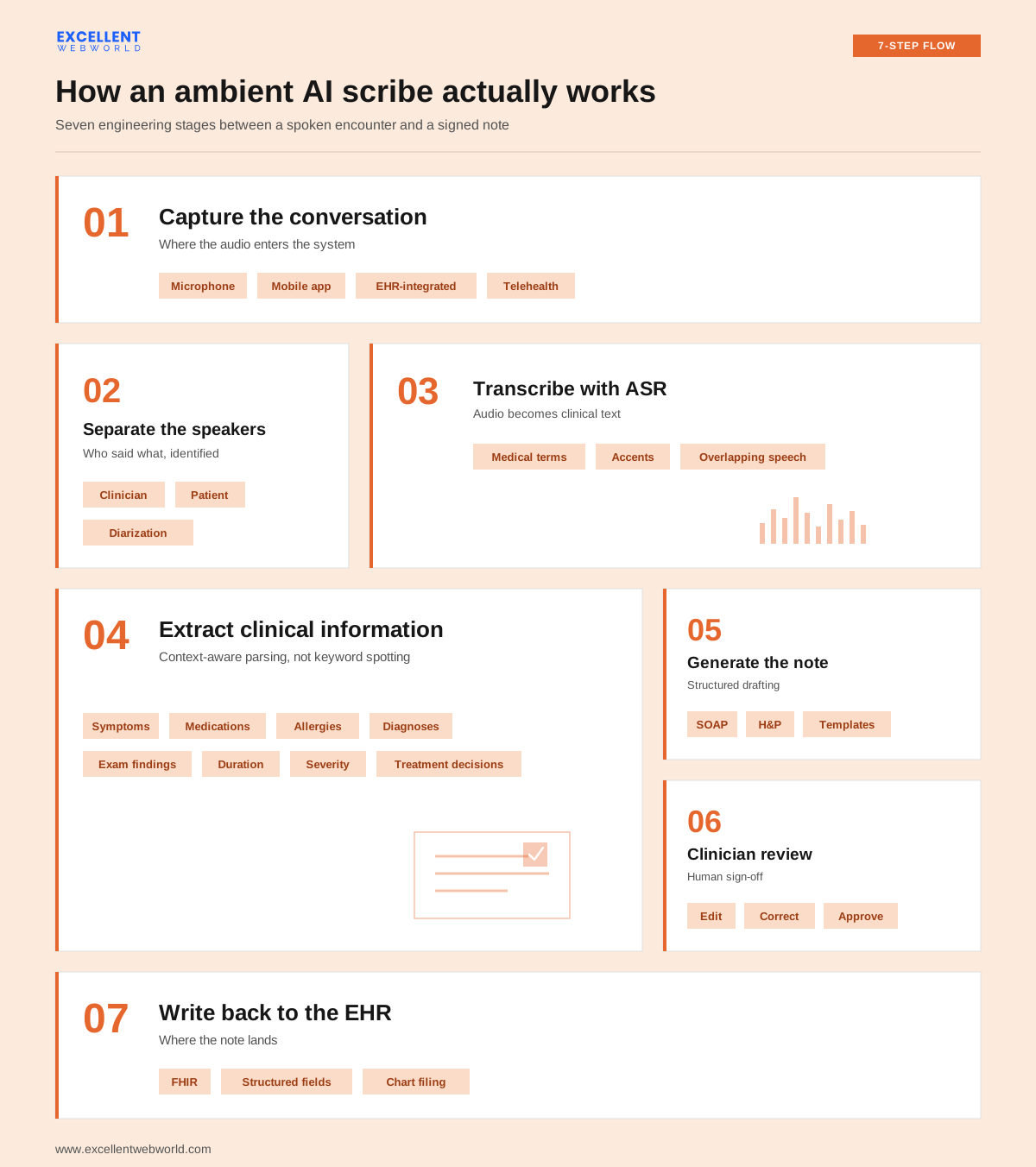
Capture the Conversation Ambiently
The AI scribe captures the patient-clinician conversation via a microphone, mobile device, EHR-integrated application, or telehealth audio stream. The biggest advantage here is that ambient capture facilitates a more engaging encounter, with the doctor not constantly having to switch between note-taking and talking to the patient.
Separate the Speakers
Speaker diarization is the ambient AI scribe’s capability to identify who said what in a conversation, which is especially useful for distinguishing the clinician from the patient and (potentially) other participants. It’s a pivotal function because a clinical statement can have a vastly different meaning based on who said it.
Transcribe the Audio with ASR
This is perhaps the most significant layer with far-reaching consequences as much of what follows depends on the quality and accuracy of the resulting transcript. ASR converts the audio stream/recording into text and for healthcare applications, the speech-recognition layer needs to account for medical terminology, accents, interruptions, overlapping speech, and other conditions affecting transcription accuracy.
Extract Clinical Information
Clinical language processing identifies the information that matters to the medical record, including:
- Symptoms
- Medications
- Allergies
- Diagnoses
- Examination findings
- Duration
- Severity
- Treatment decisions
It must also understand context such as negation, attribution, and temporality.
Generate a Structured Clinical Note
The extracted information is organized into a clinical documentation format such as a SOAP or H&P note. A general LLM can generate the narrative. But when it comes to healthcare applications, it is always advisable to modify and constrain the model using validated clinical facts and specialty-specific templates rather than relying on a raw transcript alone.
Route the Draft for Clinician Review
The physician or the authorized clinician receives the LLM-generated clinical note draft for review and editing. They can correct, remove, or add relevant data before approving the documentation.
Write the Approved Documentation Back to the EHR
The ambient AI scribe workflow ends when the final approved note transfers into the correct patient record through EHR integration. Depending on the depth of integration, your system might also be able to support other downstream documentation workflows like structured fields and ICD-10 coding suggestions.
This should make it perfectly clear that ambient AI scribe technology is indeed not a simple audio-to-text pipeline. Each stage adds clinical context and structure before the information becomes part of the medical record.
That layered approach also makes developing an ambient AI scribe more complex than just connecting a microphone to a general-purpose LLM. Accuracy, validation, security, and EHR interoperability must all work together.
The Architecture Stack Behind a Production-Grade Ambient AI Scribe
As I established early on in the article, an ambient AI scribe (especially one at the production-grade level) is nothing like a speech recognition tool combined with an LLM. The architecture decisions you make at each layer directly affect accuracy, latency, operating cost, clinical safety, and how easily the system can reduce the clinical documentation burden without creating new work for clinicians
The right stack for AI medical scribe software development depends on how the components interact, rather than just choosing the latest or most powerful models.
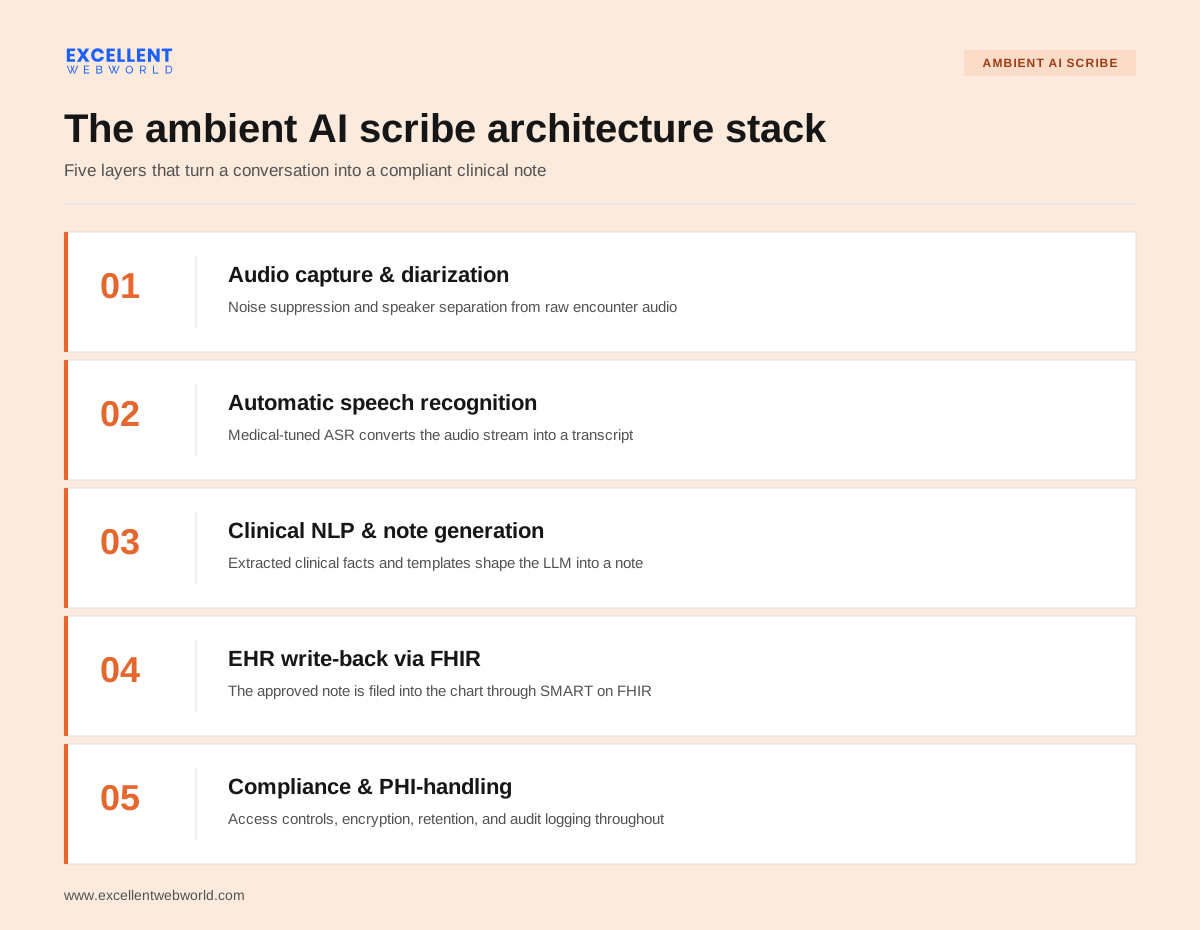
Layer 01
Audio Capture & Diarization
At the risk of stating the obvious, a consultation room does not have the acoustics of a controlled recording studio. Background noise, interruptions, overlapping speech, and multiple speakers can affect input quality. Your capture layer must account for the environments in which the ambient AI scribe will be used: whether that means device-level noise suppression, echo cancellation, streaming audio or support for additional participants.
Now you might realize why diarization is important too. The system must reliably separate the physician’s statements from the patient’s symptoms and history. An otherwise accurate transcript can still become clinically misleading if the system attributes a statement to the wrong speaker.
Layer 02
Automatic Speech Recognition (ASR) Layer: Medical-Tuned vs. General Models
I wouldn’t choose an ASR model based on its headline transcription accuracy alone. From my experience with AI scribe projects, clinicians check the accuracy of the words that carry clinical weight rather than the overall accuracy.
In simple terms, they aren’t concerned whether the tool is “more or less” accurate in its entirety. They want specific assurance that the word “Paracetamol” indeed appears as Paracetamol and not “Pair A See The Mole”.
General-purpose ASR models can be a practical starting point, but medical terminology, abbreviations, drug names, multilingual conversations, accents, and specialty-specific vocabulary can change the equation.
Your evaluation should focus on clinically meaningful errors, latency, language coverage, and per-minute inference cost, not just a single accuracy score.
Layer 03
Clinical NLP & Note Generation (The LLM Layer)
The biggest architectural mistake you could make at this stage is treating the transcript as the final input and asking a general-purpose LLM to “write a medical note.”
A better approach first extracts and structures clinical information, preserving critical clinical context such as negation, attribution, and temporality. The generation layer can then use these validated facts, relevant patient or encounter context, and specialty-specific templates to produce the required SOAP, H&P, or other formats.
This is also where I would pay particular attention to the clinician-review interface. They should be able to spot errors, make corrections, and approve the documentation with ease. If the draft needs constant checking and rewriting, the ambient AI scribe has missed the point.
Layer 04
EHR Write-Back via FHIR & SMART on FHIR
The depth of EHR integration should be decided early because it can materially change the architecture. If the only requirement is writing an approved clinical note, the integration may be relatively straightforward. A more deeply integrated AI scribe may require working with structured patient and encounter data, populate specific documentation fields, or support medical coding and other downstream workflows.
HL7 FHIR provides a standard data-exchange layer, while SMART on FHIR supports secure application access to FHIR-enabled systems. In practice, however, the target EHR still decides what your application can access and write back. Patient and encounter mapping, authorization scopes, and the specific resources exposed by the EHR all need to be accounted for during development.
Layer 05
Compliance & PHI-Handling Layer
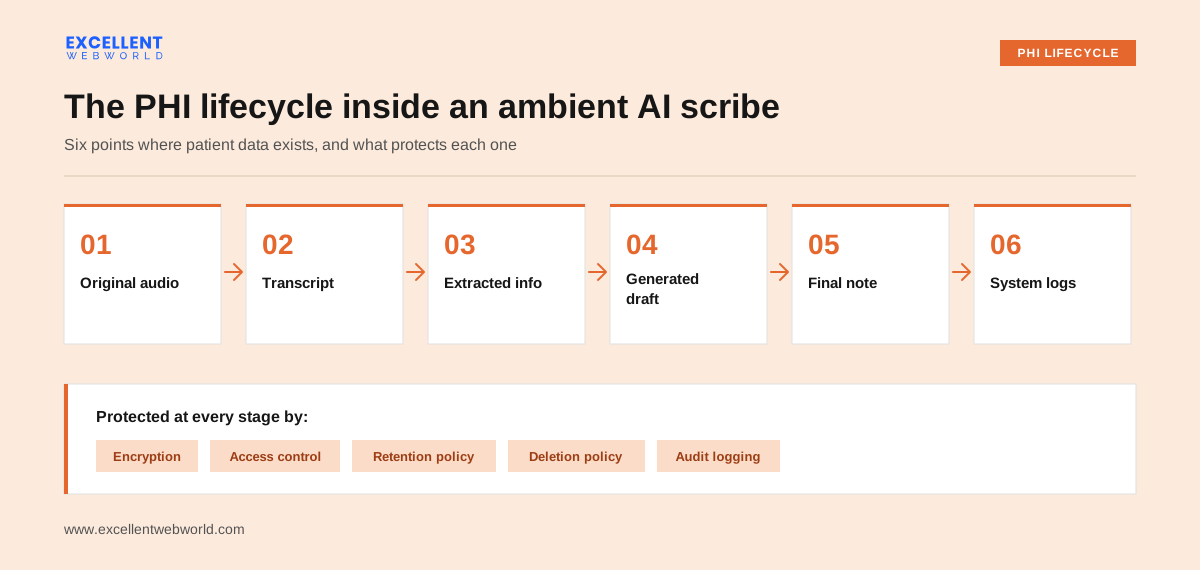
Think about PHI as a lifecycle rather than a single record stored in a database. An ambient AI scribe can generate sensitive patient data at several points:
- Original audio
- Transcript
- Extracted clinical information
- Generated draft
- Final note
- System logs
That makes data retention an architectural decision alongside encryption, access control, audit logging, and deletion policies.
The same consideration applies to third-party AI infrastructure. If an external model processes clinical conversations, your team needs to understand where that data is processed, whether it is retained or used for training, and what contractual and deployment controls are available.
Depending on those requirements, a managed API, private cloud or VPC, or self-hosted model may make more sense.
HIPAA and PHI: What Compliance Actually Requires at the Architecture Level
Even though it goes without saying, I’d still reiterate that HIPAA compliance needs to be embedded into the AI scribe architecture from the beginning. The HIPAA Privacy Rule governs how PHI can be used and disclosed, while the Security Rule establishes safeguards for ePHI.
For a HIPAA-compliant AI scribe, that means thinking about how PHI moves through the system, where it is stored, who can access it, and when it should be deleted.
| Architecture Mechanism | What It Means for an Ambient AI Scribe |
|---|---|
| BAA-Covered Cloud vs. On-Premises/VPC |
|
| Zero-Retention API Configuration |
|
| Audio PHI Retention Policy |
|
| Role-based Access Control |
|
| Audit Logging |
|
A BAA doesn’t make the architecture compliant by itself. It establishes the contractual responsibilities between the covered entity and business associate, while the underlying technical and operational safeguards still need to be implemented. HHS also makes it abundantly clear that a cloud provider acting as a business associate can have direct HIPAA obligations of its own.
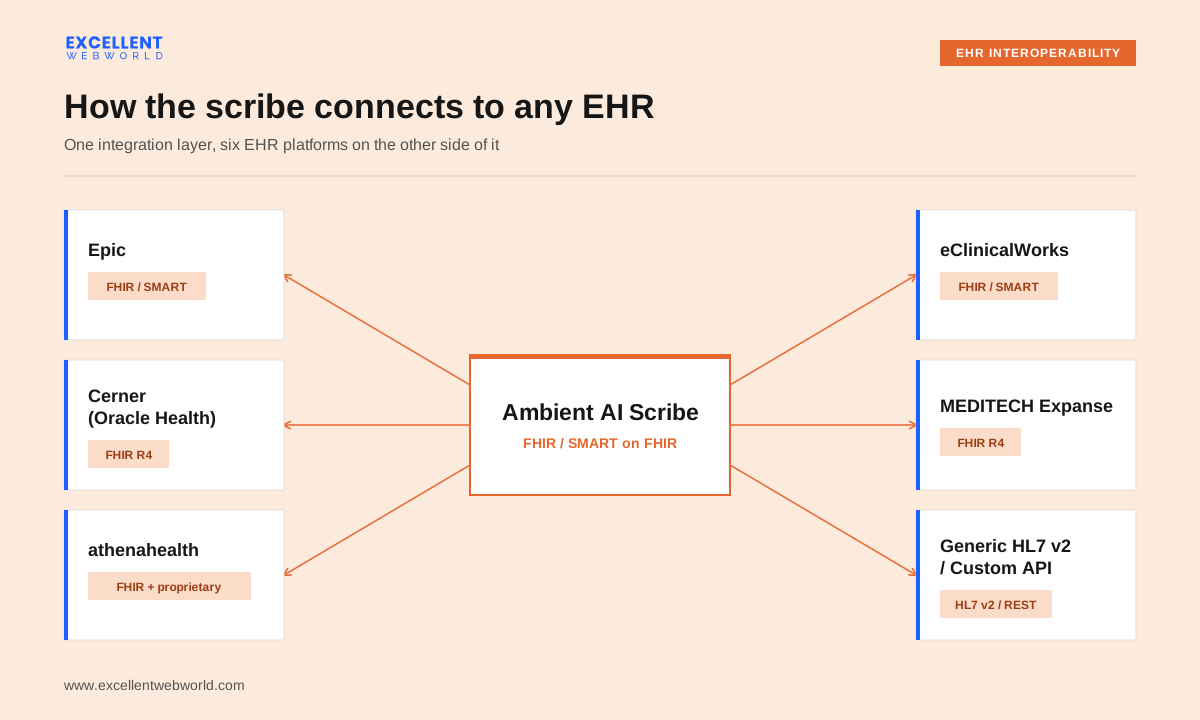
EHR Integration: Getting Notes into Epic, Cerner (Oracle Health), or athenahealth
| EHR Platform | Integration Standard | Write-Back Method | Notes |
|---|---|---|---|
| Epic | FHIR / SMART on FHIR | FHIR DocumentReference | Supports filing clinical notes to open or closed encounters, including pre-charting in supported versions. |
| Cerner (Oracle Health) | FHIR R4 / SMART on FHIR | FHIR APIs | SMART applications can access authorized patient and encounter context; authenticated APIs support write operations. |
| athenahealth | FHIR + proprietary APIs | FHIR DocumentReference and proprietary write APIs | Offers FHIR APIs alongside proprietary APIs with write interactions across clinical, administrative, and financial workflows. |
| eClinicalWorks | FHIR / SMART on FHIR | FHIR APIs; other interfaces where required | Supports provider-facing FHIR integrations, including SMART on FHIR and backend services. |
| MEDITECH Expanse | FHIR R4 | FHIR APIs | Provides patient health data APIs and an application ecosystem for third-party integrations. |
| Generic HL7 v2 / Custom API | HL7 v2, REST, proprietary APIs | Interface engine or vendor-specific endpoint | Useful when the target EHR lacks the required FHIR capability or when deeper vendor-specific integration is needed. |
There’s an important caveat here that you should bear in mind while evaluating AI medical scribe integration: “FHIR supported” doesn’t automatically mean “plug-and-play.” Each EHR offers different resources, API capabilities, authorization scopes, and write-back workflows.
When it comes to developing an ambient AI scribe for multiple health systems, I’d treat each EHR integration as its own implementation. This reflects the broader challenge of integrating AI in EHR: the AI layer has to work within the capabilities, data structures, and workflows of the EHR. Don’t assume one FHIR connector works for all. An Epic ambient AI scribe integration, for example, may use FHIR/SMART workflows, while Oracle Health and athenahealth similarly expose standard FHIR and proprietary interfaces.
I should mention that patient and encounter mapping also deserves particular attention here. Each note must match the correct patient and encounter with proper authorization. Even a technically successful write-back can cause problems if the documentation ends up in the wrong chart or under the wrong encounter.
Build vs Buy: The Real Tradeoffs for Health Systems and Digital Health Companies
| Decision Criteria | Buy Off-the-Shelf | Custom Ambient AI Scribe Development |
|---|---|---|
| Cost Structure | Lower upfront investment, but recurring subscription or usage costs can become significant as clinician (user) volume grows. | Higher upfront development cost, followed by infrastructure, maintenance, model, and engineering costs. |
| Time to Pilot | Usually the faster route. Existing products can often be configured and introduced without building the underlying AI stack. | Takes longer because the engineering team has to develop, test, integrate, and validate the system before a meaningful pilot. |
| Data & Model Ownership | Your data remains subject to the vendor’s infrastructure, policies, and contractual terms. Model behavior is also largely outside your control. | Greater control over your data pipeline, models, infrastructure, and how the system evolves over time. |
| Specialty-Template Depth | Entirely subject to what the vendor already supports. Customization may be limited to available specialties and configuration options. | Clinical workflows, templates, and generation logic can be designed around your specific specialties and documentation standards. |
| Vendor Lock-in | Integration, clinicians getting habituated with the workflows, and accumulated documentation data can make switching providers down the line increasingly difficult. | You assume more responsibility for the technology, but reduce dependence on a single AI scribe vendor and can retain greater control over the underlying architecture. |
| Compliance Control | You depend partly on the vendor’s security architecture, contractual terms, data-handling policies, and available compliance controls. | You have substantially more control over retention policies, access controls, infrastructure, third-party dependencies, and PHI-handling. |
Buying is often the better choice. If your priority is a faster time to pilot, you can probably find a ready-to-use solution from an AI medical scribe company that fits your practice’s specialty and EHR system.
In that case, I’d say that developing an ambient AI scribe from scratch may not provide enough strategic return.
Large healthcare organizations and healthtech companies building a product around the AI scribe itself have to look at things from a different lens.
At that point, specialty-specific workflows, deeper EHR integration, data and model control, long-term operating costs, and differentiation can outweigh the speed advantage that comes with an off-the-shelf solution.
I’d advise building when those factors are central to the product rather than treating the ambient AI scribe as a standalone documentation utility.
On The Build-vs-Buy Dilemma
“Buy when speed and operational efficiency matter more than control. Build when the ambient AI scribe’s architecture, data, workflows, or economics become strategically important to your product. It’s certainly not as straightforward a decision, but that’s the gist.”
 Mayur PanchalCTO, Excellent Webworld
What It Costs to Build a Custom Ambient AI Scribe
The best way to approach ambient AI scribe cost and budget planning is to start with the scope before thinking about the price. A single-specialty pilot with one EHR is a very different engineering exercise from an enterprise deployment spanning multiple specialties, EHRs, and infrastructure environments.
| Scope | Indicative Development Range | The Usual Scope |
|---|---|---|
| Single-department pilot | $50K – $75K |
|
| Multi-department rollout | $150K – $225K |
|
| Enterprise, multi-EHR deployment | $300K – $700K+ |
|
- The number of EHR integrations and specialty-specific workflows is among the first things to consider when estimating a project like this. Every additional EHR can introduce its own APIs, authorization model, patient and encounter mapping, write-back workflows, and testing requirements.
- Deployment also matters: A cloud implementation using managed AI services can have a very different cost profile from a private VPC or on-premises environment.
- Then there’s the compliance requirements. The scope of PHI controls, retention policies, auditability, validation, and any required certification or documentation can all increase the engineering effort.
To sum it all up in a single sentence: The cost of implementing any AI technology in EHR systems is driven by the scope and architectural decisions required to put it into production.
These figures are indicative of standard ranges, not fixed quotations. Your actual cost will depend on the EHR integrations, specialty coverage, deployment model, compliance requirements, and level of customization involved.
How Excellent Webworld Approaches Ambient AI Scribe Development
Clinical documentation is one area where our experience as a healthcare software development company translates directly into practical AI development decisions.
With Braive, we created an AI-powered clinical documentation engine alongside clinical decision support for an EU MDR Class IIa medical device. The system uses fine-tuned models, safety classifiers, audit trails, HL7 FHIR, and privacy controls as part of the wider clinical architecture.
That experience shapes how our healthcare specialists and AI engineers approach ambient AI scribe development:
Clinical documentation with clinician oversight:
Braive Note generates clinical session notes while keeping clinical judgement with the practitioner. The documentation engine achieved 99.8% reported note accuracy and saved clinicians an average of 15 minutes per session.
Healthcare interoperability:
In another healthcare AI project, we architected an interoperability layer using FHIR and HL7, unifying all clinical data from EHRs, labs, and imaging systems. That experience is directly relevant when an ambient AI scribe has to move beyond generating text and work with the clinical data environment around it.
Specialty-aware AI workflows:
Our work on a men’s healthcare platform included domain-specific AI components, specialty-specific data handling, and an AI symptom checker that achieved 93% reported accuracy. The same principle applies to documentation: clinical context should guide the AI workflow instead of being added later.
Security and deployment constraints:
Our healthcare projects have included encrypted data handling, access controls, audit logging, HIPAA/GDPR requirements, and cloud infrastructure. If a project demands a more controlled infrastructure still, we can even design the architecture for private VPC or on-premises deployment.
This experience gives the Excellent Webworld team a clear view of what must work when an ambient AI scribe moves from a controlled demo into real clinical use.
Ambient AI Scribe Development: Frequently Asked Questions
Common questions on how ambient AI scribes work, HIPAA compliance, EHR integration, and what custom development costs.
An ambient AI scribe is an AI-powered clinical documentation system that listens to a patient-clinician conversation, transcribes and interprets it, and generates structured clinical documentation for clinician review. Unlike conventional dictation tools, it can distinguish speakers, extract clinically relevant information, organize it into formats such as SOAP or H&P notes, and transfer approved documentation into the EHR.
- The AI scribe captures the consultation audio, separates speakers through diarization, and converts speech into text using automatic speech recognition (ASR).
- Clinical NLP then extracts relevant information and context before an LLM generates the structured note.
- The clinician reviews and approves the draft before it is written back to the appropriate EHR context.
While an ambient AI scribe can be designed to meet HIPAA requirements, using it does not automatically make a system HIPAA compliant. Compliance depends on how the architecture handles PHI. This includes:
- Access controls
- Encryption
- Audit logging
- Data retention and deletion policies
- Third-party AI infrastructure
Cloud providers handling ePHI may also require a Business Associate Agreement (BAA).
The cost of a custom ambient AI scribe can start around $50,000 – $75,000 for a single-department pilot. A multi-department rollout may range from $150,000 to $225,000. An enterprise deployment spanning multiple EHRs can reach $300,000 – $700,000+.
These are starting ranges; actual costs depend on EHR integrations, specialty coverage, deployment model, compliance requirements, and customization.
Yes, ambient AI scribes can be integrated into Epic and Oracle Health (Cerner) using interoperability frameworks such as FHIR and SMART on FHIR. A basic implementation may file an approved note, while deeper integrations can interact with structured clinical data and other documentation workflows.
An ambient AI scribe automates much of the clinical documentation process using AI, while a regular medical scribe is a human who listens to the encounter and documents it for the clinician.
The difference isn’t simply human versus AI: an ambient scribe handles speaker identification, clinical information extraction, note generation, clinician review, and EHR write-back within a controlled workflow.
A health system should generally consider building when control, customization, deep EHR integration, and long-term economics are strategically important. Buying is usually more practical when speed and operational simplicity are the priority.
A single small practice may not need the engineering burden of a custom build, while a health system or healthtech company may benefit from owning more of the underlying architecture and workflow.

Article By


Paresh Sagar is the CEO of Excellent Webworld. He firmly believes in using technology to solve challenges. His dedication and attention to detail make him an expert in helping startups in different industries digitalize their businesses globally.