Key Takeaways:
- AI in healthcare is a systems problem, not just a modeling problem
- Every example below depends on data pipelines, compliance, and EHR integration
- Real-world impact is determined by how predictions surface in clinical workflows
- HIPAA compliance is a baseline requirement across all use cases
The hospitals and healthtech companies seeing real results from AI aren’t using it everywhere. Successful adoption comes from identifying the right use case and approaching healthcare AI as a systems problem rather than just a modeling exercise. This is increasingly evident across emerging AI in healthcare trends.
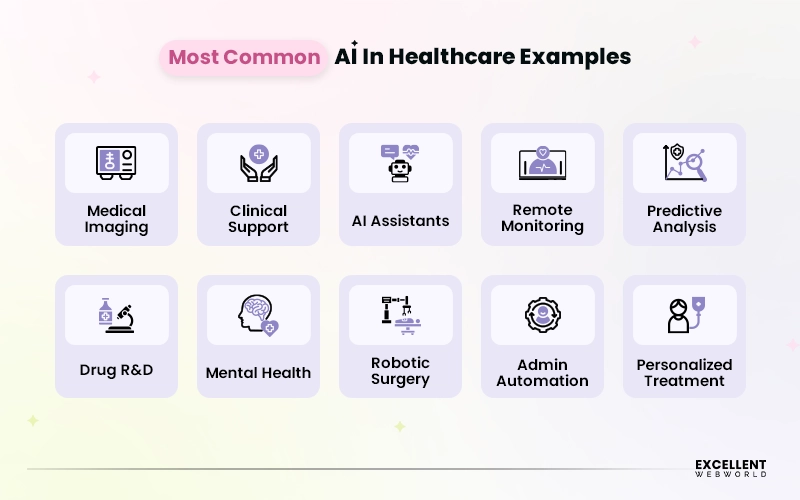
The following ai in healthcare examples are being deployed across hospitals, clinics, and healthcare tech platforms:
- AI-powered diagnostic imaging (radiology, cancer detection)
- Clinical decision support systems (CDSS)
- AI chatbots and virtual health assistants
- Wearable devices for remote patient monitoring
- Predictive analytics for patient outcomes and readmissions
- AI-assisted drug discovery
- Mental health support applications
- Robotic surgery assisted by AI
- Administrative automation (scheduling, billing, EHR documentation)
- Personalized treatment planning
In real-world deployments, these systems improve speed and accuracy.
In one clinical study, AI-assisted radiology workflows reduced wait times for critical scan results from 21.5 minutes to 11.3 minutes, nearly cutting response time in half.
From a development standpoint, these are not standalone AI models trained on healthcare data. These are dedicated systems built on data pipelines, integrations, and strict compliance requirements.
The list of examples of artificial intelligence in healthcare highlights the use cases delivering measurable impact today and what it takes to build them reliably in practice.
1. AI-Powered Diagnostic Imaging in Radiology and Pathology Workflows
Diagnostic imaging sits at the core of clinical decision-making, but the real constraint is volume. Radiologists work through large scan queues where identifying critical findings in time determines the outcome.
AI-powered diagnostic imaging changes how this workflow operates. Instead of sequential review, AI models analyze scans in real time and flag high-risk conditions such as intracranial hemorrhage or pulmonary embolism. This shifts radiology from passive review to prioritized triage, where urgent cases are surfaced first.
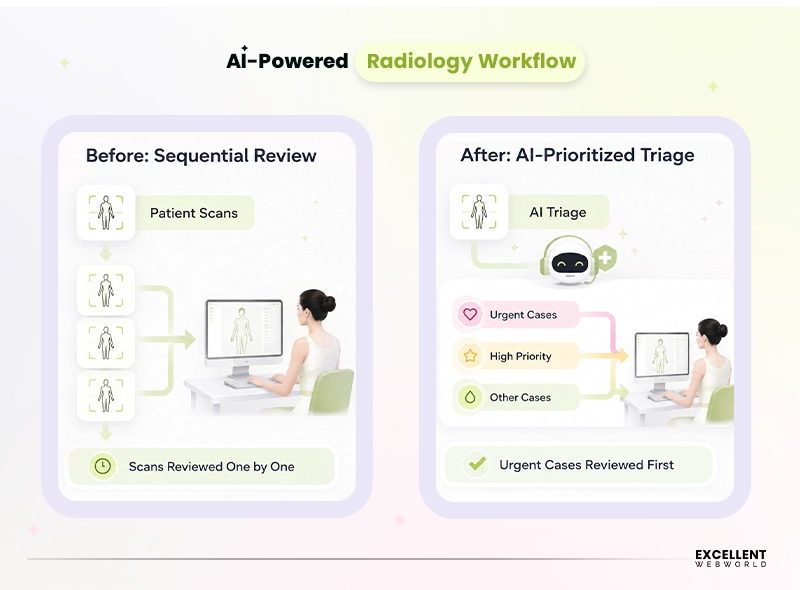
- Aidoc implemented AI-assisted triage in radiology workflows, reducing turnaround time for critical intracranial hemorrhage cases from 53 minutes to 46 minutes by prioritizing them for faster review.
- This is powered by computer vision models trained on DICOM imaging datasets to detect abnormalities and reorder radiology worklists.
These systems rely on pipelines that ingest, process, and interpret medical imaging data in real time, including handling DICOM streams, preprocessing data for model inference, and integrating outputs directly into radiology workflows through PACS and EHR systems.
Compliance note: Since these systems process protected health information (PHI), they must operate within HIPAA-compliant pipelines, including secure data handling, access controls, and audit trails.
For ai in healthcare app development, the challenge is not just training the model, but making the system reliable in clinical environments. Secure data pipelines, HIPAA-compliant processing, and outputs that clinicians can act on instantly are what determine whether these systems improve workflows or create additional operational friction.
2. Clinical Decision Support Systems (CDSS) Embedded in EHR and Hospital Apps
Clinical decision support systems (CDSS) work on top of patient data to help clinicians make earlier, more informed decisions. Hospitals generate massive amounts of data, but much of it is fragmented across systems and reviewed too late to catch early warning signs.
Machine learning models and natural language processing (NLP) can pull together structured records and unstructured clinical notes, continuously analyzing them to flag high-risk scenarios in real time. In ICU settings, this often means catching signs of sepsis, deterioration, or the need for ICU transfer before they become obvious.
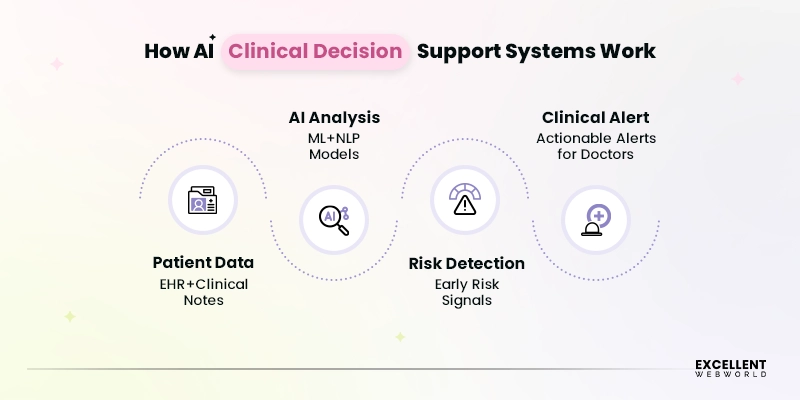
AI-driven CDSS can identify these risks hours before clinical symptoms appear, giving clinicians more time to intervene. This matters because sepsis mortality increases by approximately 8% for every hour treatment is delayed.
- H2O.ai deployed predictive models in hospital environments to identify sepsis risk and anticipate ICU transfers by analyzing both structured EHR data and unstructured clinical notes.
- These systems rely on predictive machine learning models combined with NLP pipelines that process real-time patient data and continuously update risk scores.
In addition to core machine learning and NLP, they depend on real-time data pipelines, proper data normalization, and integration layers that support standards like HL7 FHIR.
Since CDSS applications operate on sensitive patient data, they must be developed within HIPAA-compliant environments with strict data governance and access controls.
From a system standpoint, CDSS rarely becomes a modeling problem. The real challenge is getting clean, consistent data into the system and ensuring it flows reliably across EHRs. Success is not defined by prediction accuracy alone, but by whether those predictions appear at the right moment within clinicians’ workflows, in a way they can act on immediately.
3. AI Chatbots and Virtual Health Assistants Deployed in Patient Triage
AI chatbots in healthcare handle early-stage patient interaction. They are used to collect symptoms, guide patients through structured triage, support mental health conversations, and even route users to the appropriate level of care.
As a matter of fact, the impact of these systems is measurable across both clinical support and patient care.
- In a study comparing AI triage with primary care physicians across 200 clinical scenarios, the Ada health chatbot identified conditions correctly 99% of the time, with diagnostic accuracy of 71%.
- When combined with physician input, overall accuracy increased to 97%, indicating that these systems perform best as clinical support rather than replacements.
- Platforms like Sensely approach this differently. Sensely’s assistant Molly uses an avatar-driven interface to guide patients through care pathways in a more empathetic and structured way.
- This reduces the sense of receiving a generic, automated response and improves patient experience.
But what most software development teams underestimate is the data layer behind these systems. Healthcare chatbots cannot rely on generic language models. They need to be trained on medical ontologies (like SNOMED CT and ICD-10) so that symptom interpretation aligns with clinical standards and avoids incorrect escalation.
For example, in one of our veterinary telemedicine app projects, AI chatbots define how patients first enter the system. They collect initial information, structure it, and route patients to the appropriate care pathway, which can lead to virtual consultation, in-person visit, or guided self-care.
Integrating these systems requires connecting NLP models with scheduling systems, EHR data, and consultation workflows. The takeaway here is straightforward: AI healthcare chatbots only work when they are designed as structured triage systems, and not as generic conversational interfaces.
4. Wearable AI Devices Used for Remote Patient Monitoring
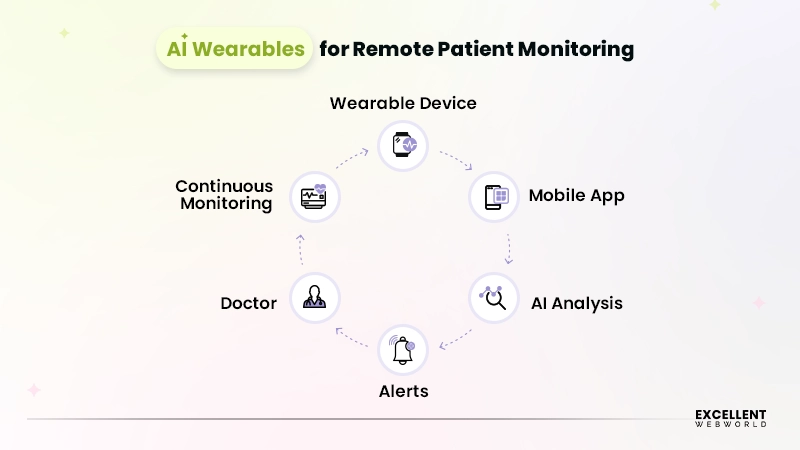
Wearable AI in healthcare enables continuous patient monitoring outside clinical settings. These devices track vital signals such as heart rate, ECG, oxygen saturation, sleep patterns, and activity levels, enabling early detection without hospital visits. Because they integrate into daily life, they shift monitoring from periodic check-ups to continuous observation.
- Perhaps the most widely adopted example is the Apple Watch, which enables users to monitor heart health, detect irregular rhythms, and even share data with clinicians in real time.
- Clinical studies report that the Apple Watch ECG demonstrates a sensitivity of 94.8% and specificity of 95% in detecting atrial fibrillation (AFib), a condition of irregular heart rhythms that can increase stroke risk.
Wearables continuously capture sensor data, which is preprocessed on-device or at the edge, passed through machine learning models for pattern detection, and evaluated through alert logic to trigger notifications or escalate care when needed.
From a development standpoint, this requires reliable data pipelines with low-latency processing and seamless integration with healthcare apps/platforms.
This is the same stack we build at Excellent WebWorld when working on wearable and IoT-driven healthcare systems, one of many examples of ai in healthcare where continuous data streams are transformed into clinically usable signals.
5. Predictive Analytics Applied to Readmission and Deterioration Risk
Predictive analytics in healthcare is used to identify high-risk patients before complications occur. The most common applications include hospital readmission prediction and early detection of patient deterioration.
This matters because nearly 20% of patients are readmitted within 30 days of discharge. This places a significant burden on healthcare systems and often points to gaps in follow-up care.
Machine learning models address this by analyzing historical patient data, clinical records, and real-time inputs. They assign risk scores that help clinicians intervene earlier, leading to either adjusted treatment plans or prioritized follow-ups for high-risk patients.
- At UPMC Presbyterian Hospital in Pennsylvania, machine learning models were used to identify patients at risk of readmission within 7 and 30 days of discharge.
- This led to a reduction in readmissions by approximately 50% in targeted hospital settings, showing how early intervention changes patient outcomes.
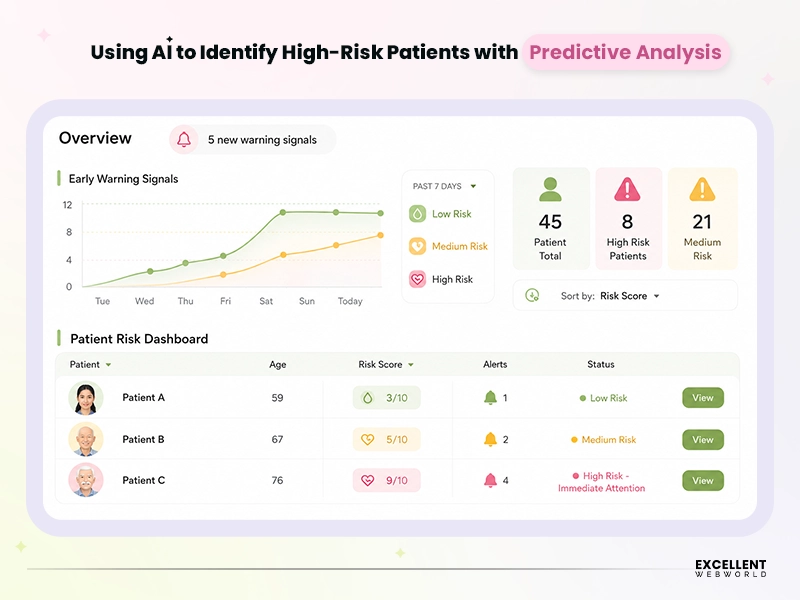
What often gets overlooked, though, is that prediction models are only as reliable as the data they are trained on. Clean, structured, and de-identified datasets are essential for producing reliable outputs. Without that, models tend to overfit, miss edge cases, or even fail when applied across different patient outcomes.
These systems must also meet regulatory compliance requirements. Since these systems rely on patient records, they must be built within HIPAA-compliant environments.
Ultimately, what creates value is the exact context in which these predictions are used, which is a common theme across many examples of artificial intelligence in healthcare. Risk scores need to surface at the right moment, within the clinician’s workflow, and with enough clarity to act on immediately.
Without that, even the most accurate and statistically sound predictive analysis models struggle to drive meaningful patient outcomes.
6. AI-Assisted Drug Discovery and Clinical Trial Optimization
AI-assisted drug discovery focuses on identifying potential drug candidates faster by analyzing large-scale biological and chemical datasets. It is used for target identification, molecule screening, and predicting drug behavior before clinical trials.
Traditional discovery cycles take years to progress from hypothesis to viable candidates. AI reduces this by using machine learning models and simulation techniques to evaluate thousands of compounds simultaneously, narrowing down the most promising options early.
- During the development of PAXLOVID, Pfizer used AI-driven virtual screening to identify and refine drug candidates, helping determine which molecular changes would improve potency.
- AI was also used to optimize manufacturing workflows, reducing cycle times by 67%.
These systems rely on large biomedical datasets such as protein structures, genomic data, and chemical libraries. Techniques like deep learning and molecular simulation are used to predict drug-target interactions before lab testing.
Speed is the obvious advantage, but the effectiveness of the outcomes still depends on data quality and validation.
7. AI-Integrated Mental Health Apps for Mood Tracking and Crisis Detection
AI in mental health support apps is used to extend access to care outside clinical settings. These systems guide users through structured conversations, introduce techniques like Cognitive Behavioral Therapy (CBT), and track emotional patterns over time.
The impact is already visible in controlled settings.
- Apps like Wysa and Woebot deliver CBT-based interventions through conversational interfaces.
- Evidence from recent studies shows that chatbot-based interventions (including Woebot) are effective in reducing depression and anxiety symptoms over a 2-week intervention, while control groups using static self-help materials did not show similar improvements.
Where this category differs from others is how easily things can go wrong. Conversations are not open-ended by default. They are designed within boundaries. The system needs to recognize when inputs indicate distress, self-harm risk, or escalation, and guide the user to human support without delay.
That critical requirement shapes the entire build. Models are trained on therapeutic frameworks, not general dialogue. Responses are constrained. Escalation paths are predefined and testable. Every interaction needs traceability.
These systems also operate within HIPAA-compliant environments, where handling behavioral data comes with stricter oversight than most other use cases.
From our experience working on behavioral health platforms, the way these guardrails and escalation mechanisms are implemented is where most products either become dependable or quietly unsafe.
8. AI-Assisted Robotic Surgery in Minimally Invasive Procedures
AI-assisted robotic systems are increasingly used in procedures that demand precision, including colorectal, urological, and cardiac surgeries. These systems extend a surgeon’s control rather than replacing it, especially in confined or high-risk operation environments.
- Devices like da Vinci Surgical System translate hand movements into stabilized micro-actions, filtering tremors and improving control during surgery.
- Medtronic’s platforms incorporate real-time AI feedback, analyzing intraoperative data to support surgical decisions as the procedure unfolds.
- Research from Johns Hopkins shows that AI-driven surgical robots can perform complex procedures with up to 100% accuracy in controlled settings, while maintaining consistency across repeated trials.
The complexity here stems from the tight integration of software and hardware. These systems combine robotics, computer vision, and real-time control, all operating under strict regulatory pathways such as FDA 510(k) clearance.
In systems like these, even small gaps between software, hardware, and decision logic can affect surgical precision.
9. AI for Healthcare Administration Automation (Scheduling, Billing and Documentation)
Administrative AI is one of the fastest ways healthcare organisations see ROI. It is used to automate scheduling, streamline prior authorizations, assist with billing codes, and reduce the operational load on clinical staff.
Much of this impact comes from integration with existing workflows rather than replacing them.
- At Duke Health, machine learning models improved surgical scheduling accuracy by 13% compared to human schedulers, helping reduce inefficiencies in operating room utilization.
- Platforms like Olive AI focus on automating repetitive administrative tasks such as eligibility checks, claims processing, and prior authorizations, where delays directly affect both revenue and patient experience.
Administrative AI in healthcare sits on top of EHR infrastructure and interacts with multiple data sources in real time. That makes reliable integration critical, especially when working with clinical data, billing codes, and patient records.
This layer also operates within regulated environments since it handles patient data and billing information. In practice, healthcare app development demands HIPAA-compliant processing, along with reliable audit trails across automated actions.
Ultimately, the goal here is quite unambiguous: reducing administrative friction so that clinical teams can focus on care instead of coordination.
10. AI for Treatment Planning Across Oncology and Chronic Care Programs
Personalized treatment planning uses AI to move beyond standard protocols and tailor decisions to each patient’s biology, history, and real-time condition.
A clear example of this is oncology, where treatment decisions are shaped using patient-specific data rather than standard protocols. This is made possible by bringing together genomic insights, imaging results, clinical records, and past treatment outcomes into a single decision layer.
- Platforms like Tempus integrate molecular sequencing, radiology, and EHR data to generate a unified patient profile for oncologists.
- The systems are built on one of the largest libraries of clinical and molecular data, allowing patterns from past patients to inform treatment decisions for current cases.
And it is this very integration that drives the accuracy of AI-powered personalized treatment planning. Studies show that combining multimodal data such as genomics, imaging, and clinical records leads to better outcome prediction compared to single-source models, especially in cancer care.
However, aligning these data in a usable form is a challenge in itself. Genomic data, lab results, and EHR records are generated in different formats, at different times, across different platforms. Getting these signals to work together cleanly is a non-negotiable necessity for the functioning of these systems, let alone their success rates.
This is why personalized AI in healthcare is as much a data integration problem as it is an AI problem, a reality reflected in many ai in healthcare examples across modern care delivery. The systems that work are the ones where these signals are connected cleanly and delivered within clinical workflows, which is where experienced engineering makes the difference.
How to Get Started with Healthcare AI
These 10 examples of AI in healthcare don’t share a spotlight purely because of the tools and technologies behind them. They stand out because someone made that AI usable inside real healthcare systems.
If you are planning to build a healthcare AI feature, the real work starts after the model. Connecting EHRs, imaging, lab data, and workflows into a system that runs reliably is where most projects succeed or fail.
As a healthcare app development company, our team of cross-functional AI engineers have delivered 100+ AI healthcare solutions across our cumulative history of 15+ years. We have developed a practical view of what works and what doesn’t. And you’d be surprised by how many of such successful projects started as a spirited conversation.
Frequently Asked Questions
The most common example is AI-powered diagnostic imaging, where models analyze scans such as X-rays, CT scans, and MRIs to detect conditions like cancer or internal bleeding. It is widely adopted because it improves speed and accuracy in high-volume workflows, especially in radiology departments.
AI does not replace doctors. It supports them by analyzing data, identifying patterns, and surfacing insights that help in decision-making. Clinical judgment, patient interaction, and responsibility for care still remain with medical professionals, making AI a support system rather than a substitute.
The cost depends on the complexity of the feature, data requirements, and level of integration with existing systems like EHRs. Simple AI features may cost a few thousand dollars, while advanced implementations can be significantly higher due to compliance and infrastructure requirements.
Machine learning and computer vision are the most commonly used AI technologies in hospitals today. They are applied in diagnostic imaging, predictive analytics, and workflow automation. Natural language processing is also widely used for analyzing clinical notes and improving documentation efficiency.
The timeline depends on the scope, but adding a well-defined AI feature typically takes 6–10 weeks. From our experience working on 100+ healthcare applications, timelines are influenced by data readiness, integration complexity, and compliance requirements rather than just model development.

Article By


Mayur Panchal is the CTO of Excellent Webworld. With his skills and expertise, he stays updated with industry trends and utilizes his technical expertise to address problems faced by entrepreneurs and startup owners.