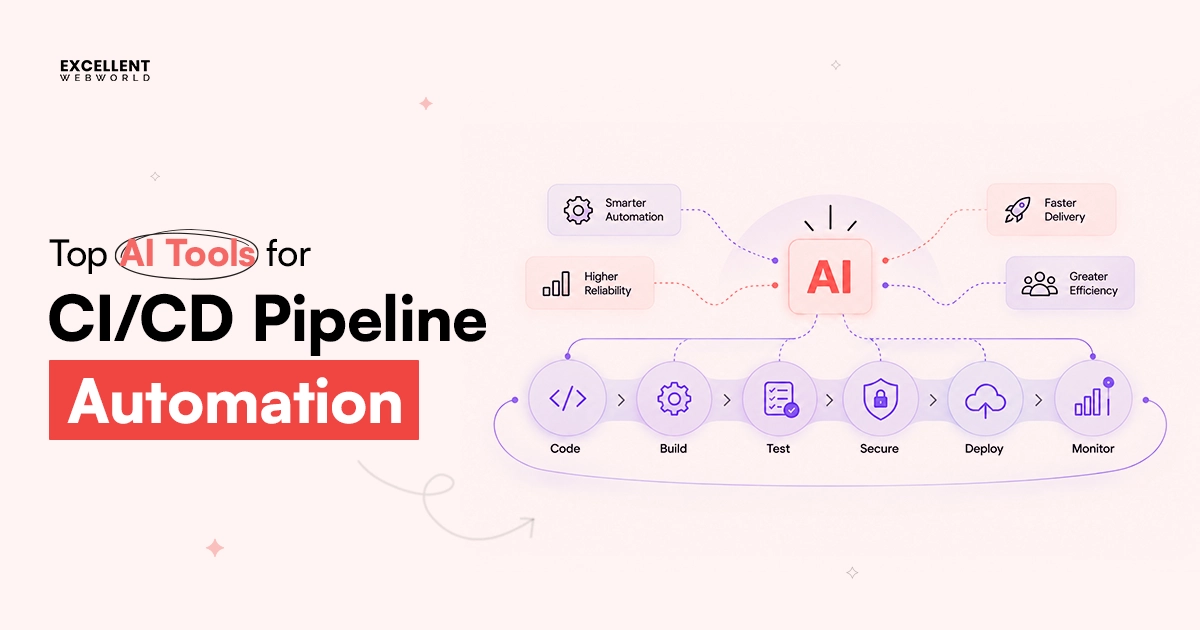
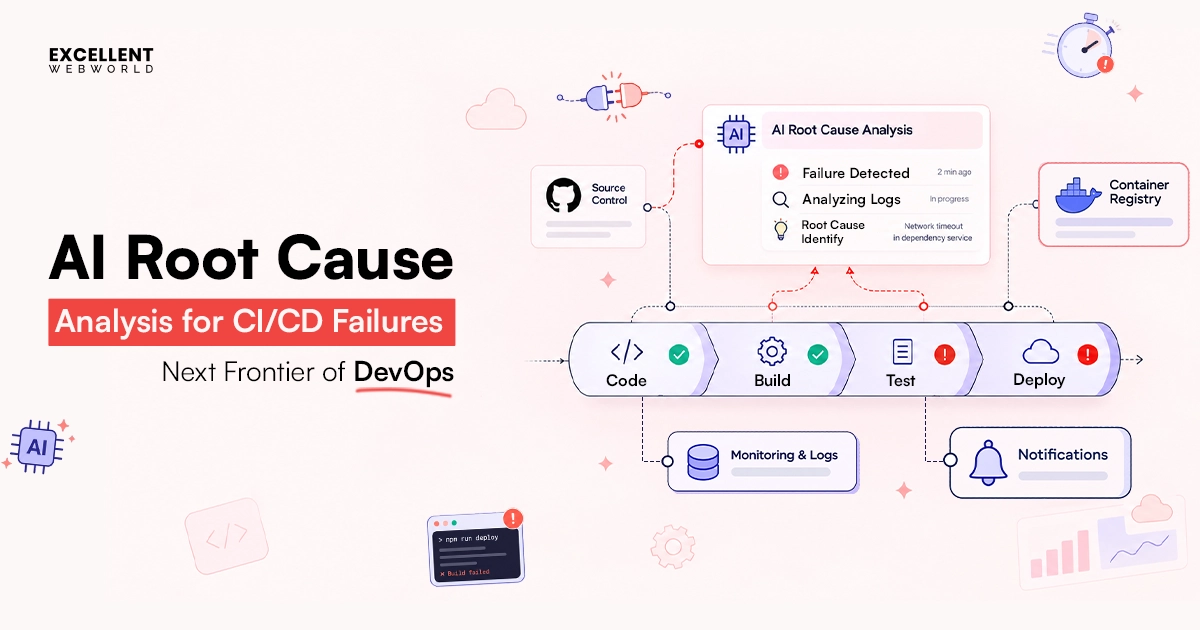
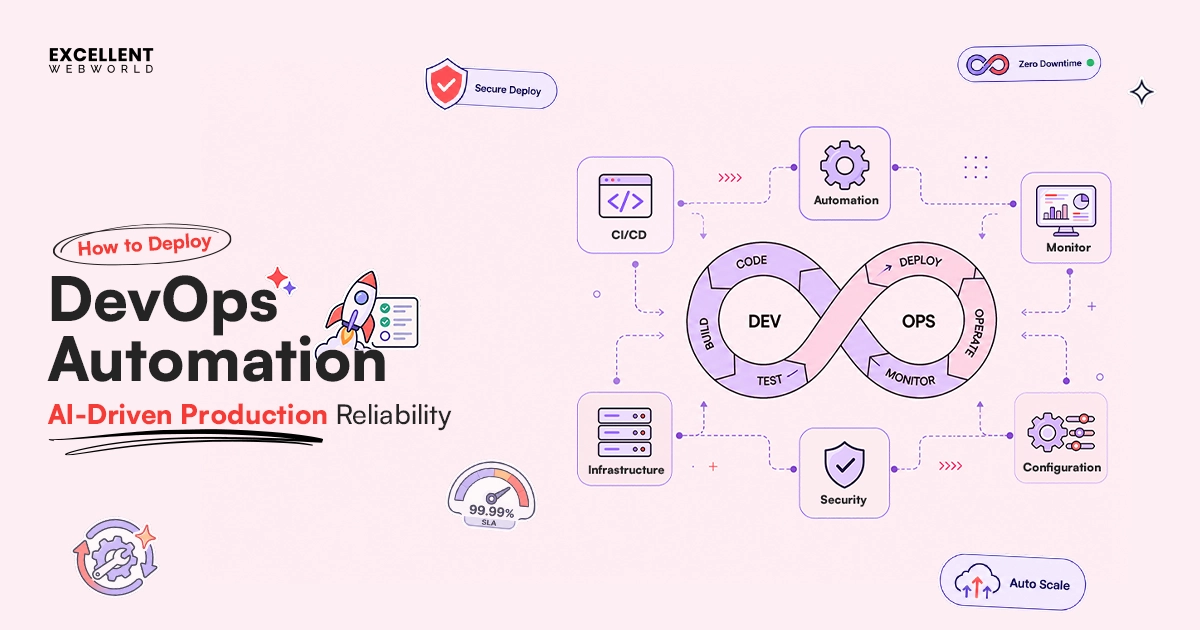
One of the biggest shifts I've noticed over the past two years is how AI in DevOps is changing how and where time is being spent on engineering-related tasks. In our own DevOps automation, I have watched AI take on repetitive investigation, test failures, configuration work, and operational noise, while our engineers focus more on architecture, reliability, and smarter decisions that need experience.
That experience has also made me more skeptical of impressive AI demos. I think a capability is only valuable to me when it survives contact with a real production pipeline and also improves a metric that actually matters.
The opportunity is quite significant. McKinsey’s research across 300 publications of traded companies found that the top-performing AI adopters achieved 16-30% improvement in productivity, time to market & customer experience alongside 31-45% gains in software quality.
So, I can affirm that I don’t view AI in DevOps as any automation shortcut or an engineer replacement. Rather, I see it as a way to remove delivery friction, provided we know what to automate, measure, and where human judgment must remain in control.
What Is AI in DevOps?
I will define AI in DevOps as the use of artificial intelligence, machine learning, generative AI, and increasingly autonomous agents that tend to improve the software development process, testing, deployment, infrastructure management, monitoring & incident response.
Here is a tabular breakdown of the technologies that can be insightful.
| Technology | What it does in DevOps | Practical examples |
|---|---|---|
| Machine Learning | Finds patterns in operational and delivery data | Anomaly detection, predictive scaling, flaky-test prediction |
| NLP | Understands and generates human language | ChatOps, documentation, incident summaries, runbooks |
| Generative AI | Creates or transforms technical content | Code, tests, IaC, queries, remediation suggestions |
| Computer Vision | Interprets visual information | Visual regression and UI testing |
| Agentic AI | Executes multi-step tasks within defined boundaries | Incident investigation, remediation, deployment workflows |
Generally, I don’t recommend you buying something simply because it is marketed as an “AI DevOps platform. Rather, I would identify the capability I need, like faster code reviews, better incident response, predictive infrastructure management, or automated remediation, and then choose the technology around that particular outcome.
These capabilities are based on strong ML, NLP, data, and integration foundations. I would get that layer right prior to adding DevOps-specific AI tooling. This is where AI development services can help to build the models, integrations, automation, and also the MLOps foundation for the enterprise launch.
Why AI in DevOps Matters Now
I am paying closer attention to AI in DevOps as the market data shows that AI adoption is no longer optional and has shifted beyond experimentation and into everyday engineering work.
- As per DORA’s 2025 research report, it has been found that almost 90% of technology professionals actually utilize AI in their work, thus highlighting the speed of the AI-assisted development process and how it has become a significant part of modern engineering, as per the DORA metrics studies from RedMonk.
- Deloitte’s 2026 State of AI in the Enterprise determined that roughly one-third of organizations are shifting beyond simply adding AI to existing workflows & redesigning core processes around it.
- Gartner projects that 30% of enterprises will automate more than half of their network activities by 2026, driven by AIOps & generative AI platform implementations.
But I think that adoption alone can’t tell me whether AI is actually improving engineering performance or not. The real question will be whether the higher AI usage translates into better stability, quality, delivery outcomes, and whether the conversations get more interesting.
AI-Driven DevOps vs. Traditional DevOps
The AI-driven DevOps actually builds on traditional DevOps aspects by adding AI-enabled automation, prediction & decision support, rather than replacing underlying CI/CD, infrastructure & observability foundations.
| Area | Traditional DevOps | AI-Driven DevOps |
|---|---|---|
| Decision-making | This mainly relies on rules, scripts, and human judgment. | Utilizes AI pattern recognition & recommendations, with human approval for production changes. |
| Failure detection | It is primarily reactive, responding to failed tests, alerts, or any issues. | It’s more predictive, identifying anomalies & potential failures earlier. |
| Automation | Automates predefined workflows by CI/CD & Infrastructure as Code. | Extends automation with AI-supported analysis, optimization, and recommendations. |
| Scaling | This needs increasing manual effort as system complexity and deployment volume grow. | Can reduce operational effort through intelligent automation, provided observability & data foundation are strong. |
| Setup & skills | Possesses lower initial complexity with established DevOps tools & practices. | Higher initial investment in AI tooling, data, governance & engineering skillsets. |
| Key limitation | Creates bottlenecks as there is an increase in change velocity & infrastructure complexity. | Can introduce risk without human oversight, governance, & reliable engineering datasets. |
Choosing the Right DevOps Approach
I would say that the right choice depends on the team’s maturity, not just the trends. Traditional DevOps will be the right call and quite enough for a smaller team with predictable releases & managed operations.
As deployment frequency, infrastructure complexity, and incident volume grow, AI-driven DevOps becomes much more valuable by improving informed decision-making, thus reducing operational overheads & thus helping teams respond faster.
For most businesses, I would say that the strongest strategy is a hybrid DevOps model that combines CI/CD infrastructure as Code, & observability with AI-driven automation, which delivers some great measurable impact.
Where AI Is Already Making an Impact in DevOps
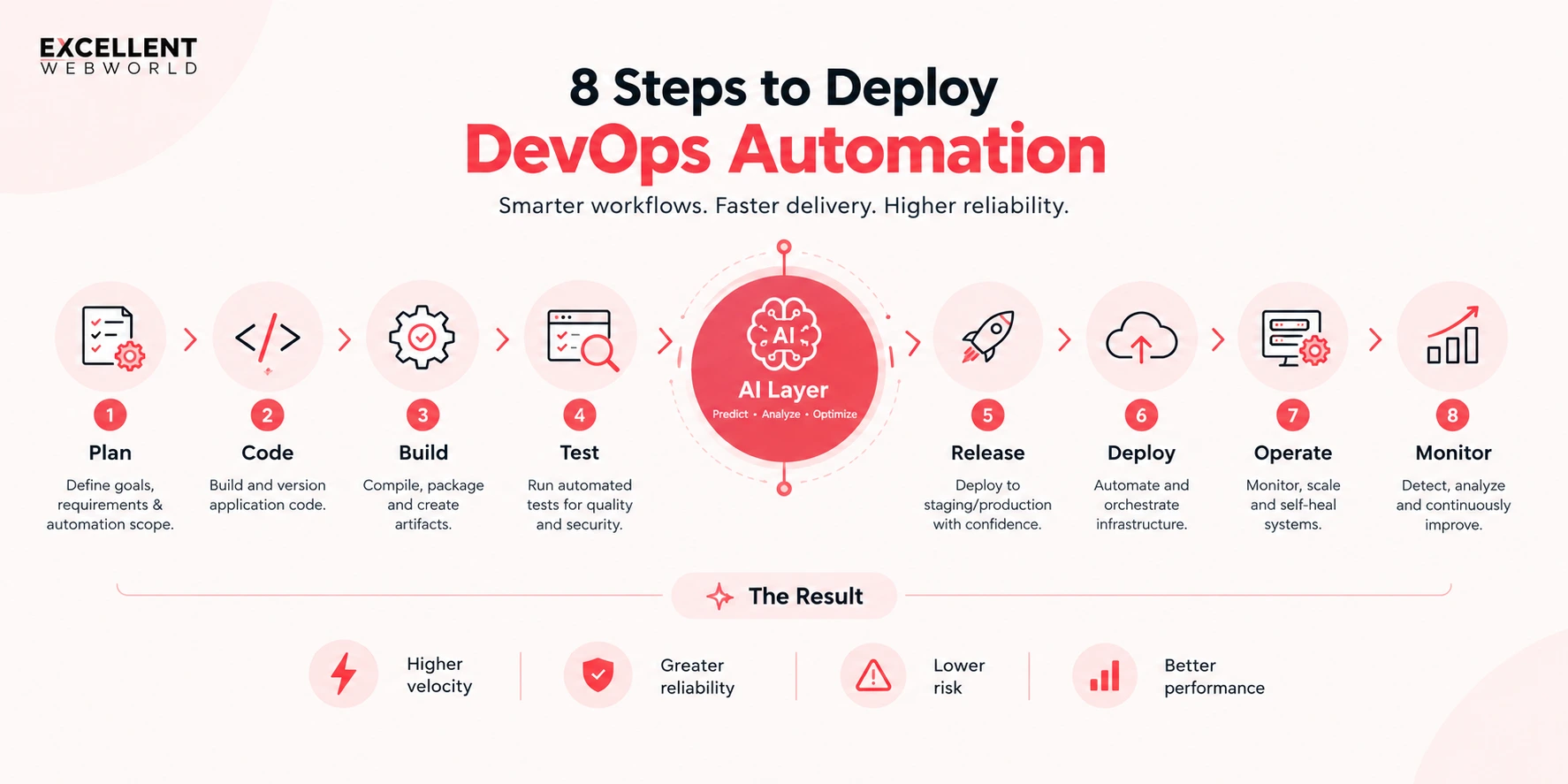
AI in DevOps is creating measurable outputs where it accelerates the delivery process, reduces operational efforts, and improves engineering decisions across the software lifecycle. The following DevOps lifecycle shows where AI is driving automation, intelligence, and efficiency across each stage of software delivery.
AI Pair Programming & Code Suggestions
AI coding assistants are the ones that are widely utilized adopted in real AI in DevOps use cases. The copilot-style tools that are associated help developers to generate, complete, and refine code, thus making an entry point prior to AI integration in the production space.
For teams who are developing agent-driven products, our agentic app development guide can cover systematic orchestration, memory & governance, while our 9 open-source AI agent framework reviews can help teams analyze orchestration options.
Automated Code Review & Reviewer Matching
AI systems can extend the code review beyond a code-generation approach by matching pull requests with relevant reviewers & also summarizing security insights. This helps to reduce context switching and hence accelerates the review process. GitLab’s AI DevOps capabilities determine how these capabilities are integrated into the modern workflow process.
Note: The reviewer matching delivers limited value for smaller teams, particularly those with fewer than approximately 15 engineers, where ambiguity is considerably smaller.
CI/CD Pipeline Intelligence
The CI/CD pipeline becomes more adaptive with an AI approach by predicting aspects like test features, identifying flaky tests, and also prioritizing test execution for faster feedback. These capabilities work better when pipelines are established on a strong cloud native model & API first architecture. Our cloud native application development guide & cloud-based application development cover this architectural foundation, while our cloud native application development services can help establish it well before integrating any AI layer.
AIOps, Monitoring & Incident Response
AIOps seems to be one of the strongest spaces for measurable operational impact. The AI-driven anomaly detection aspect & root cause analysis tends to correlate logs, metrics, and traces to help teams detect issues at the earliest and reduce MTTD & MTTR. Fortune Business Insights & Global Market Insights forecast that the global AIOps market is estimated at roughly $2.2-6.7 billion in 2025 based on their methodology, and its value is expected to grow at 20%+ CAGR throughout the early 2030s.
Infrastructure as Code (IaC) Generation & Drift Detection
The AI agents can produce Terraform and Helm configurations from the natural language requirements and also compare the live infrastructure against its declared state to detect configuration drift prior to any occurrence of incidents. This is actually an emerging Agentic AIDevOps pattern with platforms like the Agentic-DevOps solution on AWS Marketplace, which demonstrates how human approvals are included at the time of approvals for critical scenarios.
ChatOps & Virtual Assistants
The NLP-enabled ChatOps assistants can support first-line incident triage, thus generating runbook steps, and also create postmortem summaries that are directly associated within Slack or Microsoft Teams. Similar escalation & handoff principles apply to the customer-facing AI agent, as explored in our AI voice Agents for eCommerce guide.
Visual Regression Testing
The computer vision system adds another layer to the automated testing process by comparing UI screenshots across builds and also identifies unintended visual changes that are often overlooked by the functional tests. Being a narrower approach than AI in DevOps applications, it provides valuable insights for consumers.
RPA & Hyperautomation as the Foundation Layer
RPA and Hyperautomation remain important for rule-based, DevOps-adjacent workflows like ticket routing processes, approvals, & data transfer systems. Rather than just replacing the foundation, agentic AI builds on that approach with much more adaptive decision-making.
Our RPA in logistics and supply chain & business process automation guides explain this progression. If RPA, hyperautomation & DevSecOps aspects are not mature enough, strengthening them can be a better starting point than adding AI on an immediate basis; that is the type of approach that is reflected in our broader engineering services.
Agentic DevOps-The Layer Above It All
Agentic DevOps takes automation to the next level by allowing AI agents to interpret context, suggest actions, and also execute approved tasks across CI/CD, infrastructure, security, and operations. The key distinction is that agents extend existing systems rather than replacing them, with associated human approvals & guard rails.
The same governance-first pattern approach can be seen in Agentic RAG architectures, Agentic AI in ERP Systems, and AI Agents for Logistics. Our agentic AI development services approach applies these kinds of principles, with approvals and auditability built into the architecture from the start.
Notable Tools Already Powering AI in DevOps
Many of these capabilities are already available off the shelf, but you can use the following tools as a starting reference point.
| Tool | What It Does |
|---|---|
| GitLab CI/CD (Auto DevOps) | Auto-detects language/stack and scaffolds CI/CD pipelines, reducing setup time |
| Harness | Monitors production health and automatically rolls back releases when error rates or performance cross thresholds |
| Jenkins (with AI plugins) | Uses historical failure patterns to flag risky commits before builds run |
| Darktrace | Learns normal network behavior and detects anomalies in real time, primarily for infrastructure security |
| Travis CI | Prioritizes high-impact tests based on the change, shortening feedback loops |
| Bamboo (Atlassian) | Links build/deployment rules to Jira status, ensuring releases proceed only when work is ready. |
Pro Tip: You can evaluate these tools against the specific capability gap that is identified in your maturity assessment, not like any generic feature checklist.
What Does AI in DevOps Cost?
The pricing varies based on the scope and the complexity of the integrations. As a planning benchmark, you can consider the insight below.
| Scope | Typical Range | Coverage |
|---|---|---|
| Tactical / single-workflow | $40K–$100K | One bottleneck, such as flaky-test prediction or basic AIOps alerting |
| Enterprise-wide | $100K–$400K+ | CI/CD, IaC, incident response, custom integrations, and predictive modeling |
The ROI pattern is consistent; enterprises that strengthen data quality & observability prior to scaling AI value faster than those that deploy AI tooling on top of weak data foundations.
What AI Still Can't Do
DORA’s 2025 research found that higher AI adoption is generally associated with greater delivery throughput, but also tends to increase instability in the delivery process that consists of change failures & deployment reworks.
AI can accelerate code generation faster than review & deployment infrastructure can safely absorb it. That is why the rework rate, I would say, was added to DORA’s fifth core metric in the 2025 report.
Human judgment can be essential for;
- Architecture trade-offs- balancing latency, cost, scalability, and team capabilities
- Blameless postmortems- psychological safety and organizational learning
- AI-generated infrastructure changes– hallucinated Terraform can become a production outage
- Compliance and audit trails– accountability for autonomous production changes
A CTO’s Framework for AI Adoption in DevOps
I would say that AI adoption mainly works best as a staged capability journey, but not as a company-wide rollout. And the most resilient team makes this data foundation strong first, then validates one measurable workflow at a time, and also expands only after establishing operational value.
| Stage | What It Looks Like | What to Do |
|---|---|---|
| Reactive | Siloed tools; incident-driven response | Fix observability and data quality first; this is fundamentally data engineering
work. |
| Integrated | Shared data platform | Pilot one measurable workflow, such as test-flakiness prediction. |
| Analytical | Shared insights drive decisions | Expand into AIOps and incident response. |
| Prescriptive | ML recommends actions with human approval | Introduce agentic workflows with human-in-the-loop gates for production. |
My Recommendations at Every Stage
- Start small, prove one workflow before spanning across the SDLC.
- Keep a human in the loop for approvals in the case of production infrastructure and changes in customer data.
- Try to track DORA metrics together, mainly rework rates, change failure rates, and also deployment frequency.
- Prioritize security and early compliance, not after. KPMG’s Q4 2025 AI Pulse Survey found that 75% of the leaders prioritize security, standard compliance & auditability for the agent development process, while 60% restrict sensitive data access without human oversight.
How to Actually Roll This Out
A successful AI rollout is less about deploying more tools and more about sequencing adoption around measurable outcomes & operational stability.
- Baseline your DORA metrics: You should measure deployment frequency, lead time, change failure rate, and also rework rate at first.
- Fix datasets & observability gaps: This helps in addressing foundational blocks before scaling AI systems.
- Select one measurable workflow: You can define success prior to launching the pilot model.
- Set human loop approval boundaries: With this, you can establish standard governance requirements much before selecting tools.
- Choose tooling for the capability gap: Treat the above notable tools list as a reference, not as any blind shortlist.
- Re-run DORA metrics: Validate post-pilot gains if the reworks or change failure rate gets worse despite high throughput prior to scaling the process.
- Scale only after scalability: You should expand only after the pilot proves operational value.
Common Pitfalls CTOs Should Watch For
The biggest AI in DevOps failures rarely come from the models, including weak operational disciplines around deployment, governance & observability.
| Pitfalls | How To Avoid It |
|---|---|
| Alert fatigue- More AIOps noise than useful insight | Tune anomaly thresholds against historical baselines and remove persistently noisy alerts. |
| Tool sprawl- Disconnected point solutions create integration debt | Establish a unified observability/data layer before adding AI capabilities. |
| AI output treated as review-exempt- Faster generation can reduce scrutiny | Keep AI-generated PRs under the same review process and limits as human-written code. |
| No audit trail for autonomous actions- production changes become difficult to explain | Log every agentic action's trigger, reasoning, action, and approval chain before allowing changes beyond staging. |
Where AI in DevOps Is Headed
McKinsey’s research highlights that organizations are shifting from AI-assisted tasks towards end-to-end workflow automation & coordinated agent systems with humans in the loop for decision-making that needs judgement, as highlighted in McKinsey's The AI Revolution in Software Development.
For DevOps, the code suggestions, AIOps & AI-generated IaC are mainly converging towards an agentic delivery layer that is much closer to NoOps, where the infrastructure can self-provision, recover & reroute traffic and also maintain an audit trail with less human intervention. This shift is reflected in headless API first commerce architectures, where API accessibility, scalability & AI readiness play an important role from the initial days.
Building the AI-Ready DevOps Foundation with Excellent Webworld
For CTOs, AI adoption in DevOps is not just a tooling decision, but an architectural & operational model decision. The sustainable value depends on the strength of the underlying data, observability, governance, and automation foundations that enable AI to operate reliably, securely, and at scale.
Excellent Webworld helps engineering organizations build this foundation by integrating AI-driven CI/CD, AIOps, IaC (Infrastructure as Code), cloud-native & agentic automation into the software delivery lifecycle, improving delivery velocity, reliability, and operational controls without any compromise in engineering governance.
- Fix the foundation first: Data quality, observability, and automation readiness are prerequisites for reliable AI in DevOps.
- Prioritize high-value use cases: Focus on AI-assisted coding, predictive operations, AIOps, intelligent CI/CD, and automated remediation.
- Keep humans in the loop: Production changes need appropriate oversight, security, and policy controls.
- Measure engineering outcomes: Track DORA metrics, incident reduction, rework, delivery speed, and engineering efficiency, not AI adoption alone.
- Govern AI as it scales: As DevOps moves toward agentic automation, runtime governance, security, and auditability become critical.
Frequently Asked Questions
Traditional automation follows fixed rules; AI adds pattern recognition and reasoning to predict failures, detect anomalies, and recommend or take action.
Both. AI is strongest in detection and root-cause analysis, while incident reduction depends on code quality and effective review processes.
Not without human approval. AI-generated IaC still requires review, especially for production and state-changing resources.
RPA follows predefined workflows; agentic AI reasons, adapts, and chains actions based on context, with appropriate governance.
Track DORA metrics such as deployment frequency, lead time, change failure rate, and rework, not AI adoption alone.

Article By


Mayur Panchal is the CTO of Excellent Webworld. With his skills and expertise, he stays updated with industry trends and utilizes his technical expertise to address problems faced by entrepreneurs and startup owners.