If you are analyzing agentic app development for an enterprise in 2026, then I wouldn’t start with LLMs or any agentic framework. Rather, I would simply ask one practical question: “Which business process is complex enough to justify autonomous decision-making?”
An Agentic App generally combines AI agents, along with the workflow process and enterprise integrations & memory, to execute multistep business processes rather than answering any other ordinary question.
Basically, it is not a chatbot with better prompts or any RPA system with an LLM attached; rather, its real potential value comes with AI interpretations. It involves focusing on any particular goal, choosing the right tools, managing the exceptions & context, and, at the right time, escalating smarter decision-making when human judgment is specifically required.
In this comprehensive guide blog, you will learn about “what is an agentic app?”, “How it differs from AI agents, RPA & chatbots?”, and also where this agentic workflow automation actually makes right sense. Also, you will have some valuable insights on the technology stacks, costs, and the timeline, and most importantly, how to build an enterprise-ready system without any unreliability & confusion.
What Is an Agentic App?
An agentic app is an AI-powered application that can understand goals, make decisions, use tools, and take actions with limited human intervention. Agentic app development is the process of designing and building these autonomous, goal-driven applications to handle complex workflows and adapt their actions based on context.
How Does an Agentic App Work?
Most enterprise software has some fixed logic. It is like “if this happens, then do that,” just following a basic script that is totally fixed and as per the command. Chatbots generally respond to the given prompts, RPA bots follow some predefined screen sequence orders, and the standalone AI agents are typically able to manage only one bounded task overall.
On the other hand, an Agentic AI App goes much further, extending the capabilities of the AI concept. An LLM-driven agent can basically interpret a goal, which tools to select, data accessibility, and also what future steps should be taken and what comes next. It is very different from any system that entirely relies on pre-coded branches.
What Are the Core Components of an Agentic App?
A Production-Ready Agentic AI development architecture typically combines some important layers that are represented below.
| Layer | Purpose |
|---|---|
| AI Agents | Plan tasks and make runtime decisions |
| Orchestration | Coordinate multi-step workflows |
| Enterprise Integrations | Connect CRMs, ERPs, databases, and APIs |
| Memory & Context | Retain relevant information across runs |
| Human Approvals | Escalate high-risk or ambiguous actions |
| Observability & governance | Track actions, outcomes, permissions, and audit trails |
The key difference from all other apps is quite simple. While a traditional app follows instructions, an AI agent completes a task & agentic AI app overall manages everything, starting from task coordination to access to tools and usage & also making smarter, human-like decisions across all business processes, giving some realistic, valuable outputs.
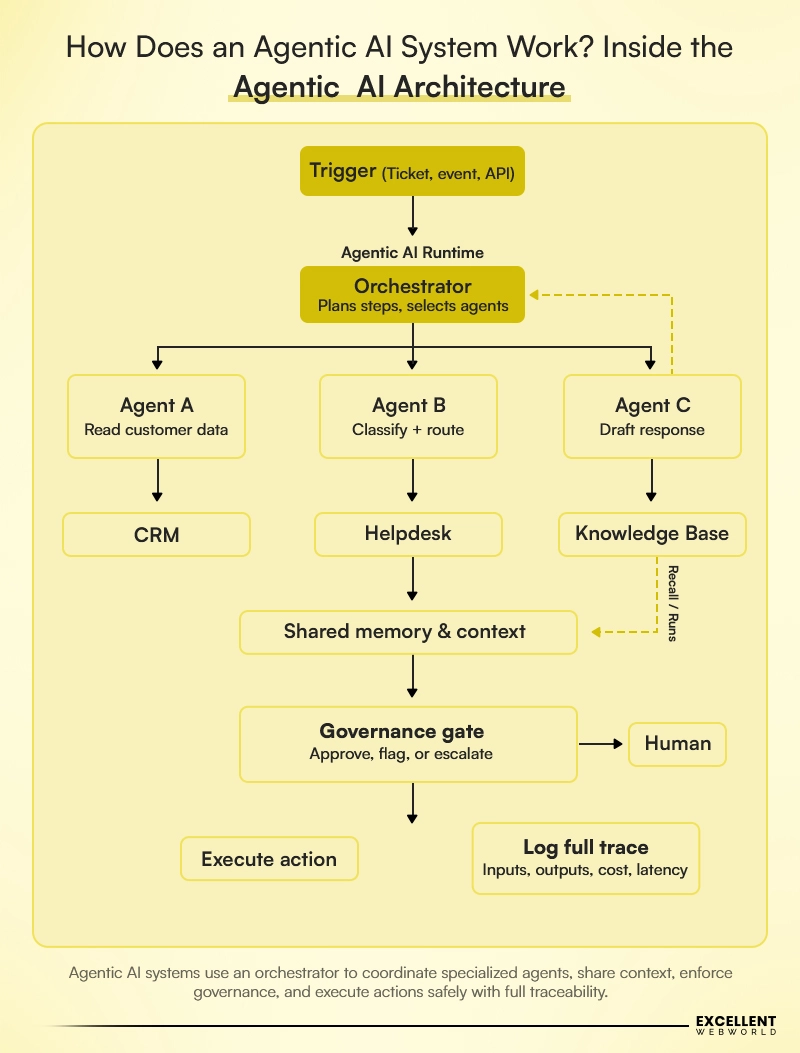
How Does an Agentic AI System Work?
This architecture shows how triggers flow through orchestration, specialized agents, shared context, enterprise tools, and governance to complete tasks with human oversight.
Why Does Controlled Autonomy Matter in Enterprise Apps?
For organizations that are nowadays shifting beyond AI prototypes, our agentic AI development services focus on developing governed AI applications that integrate with existing enterprise systems.
The real opportunity is not about maximum autonomy, but a controlled autonomy that allows the AI system to handle multi-step work while keeping the people & policies in the loop where the judgment matters. These production considerations are also explored in this practical guide to production-grade agentic AI workflows.
An agentic AI app extends AI agent capabilities into end-to-end business processes, thus combining multi-step orchestration, persistent memory, enterprise integrations, human approval aspects, and traceability.
For example, a support-based workflow can read a ticket, check the customer journey and their history, draft a response, identify and flag SLA risks in the workflow process, and also escalate some sensitive cases. All of this is done in a coordinated manner to streamline operations, provide great productivity, and deliver better results aligned with a humanized experience.
| Aspect | Traditional App | AI Agent | Agentic App |
|---|---|---|---|
| Logic | Fixed rules | Task-Level Reasoning | Multi-step reasoning |
| Tools | Predefined | Selects tools | Dynamically selects tools |
| Memory | Database state | Often session-based | Persistent context |
| Scope | One function | One task | End-to-end process |
| Human role | Operates | Reviews/triggers | Approves checkpoints |
| Best for | Stable processes | Bounded tasks | Complex, judgment-heavy workflows |
If you’re adding AI capabilities to an existing application, then this guide to integrating AI into an app covers the integration side.
And when there is some sort of requirement to shift towards autonomous & tool utilization based task execution comes to the play, AI agent development becomes the more relevant architectural approach.
Agentic AI vs Chatbots vs RPI vs AI Agents
The market is full of overlapping labels all around, so I curated this table to make it simpler, with a practical distinction between these four approaches. While chatbots are simple, RPA executes scripts, and AI agents complete bounded tasks, agentic applications coordinate the process.
Gartner forecasts that around 40% of enterprise applications will be able to feature task-focused AI agents by the end of 2026, and from less than 5% in 2025, there is a rapid shift gradually marking significant growth. This also demonstrates a great difference created by moving from simply adding an AI assistant to existing software to a different agentic app development approach.
| Dimension | Chatbot | RPA / iPaaS | AI Agent |
|---|---|---|---|
| Unit of work | Message | Scripted step | Single task |
| Decision logic | Conversational | Fixed rules | LLM reasoning |
| Memory across runs | Limited | Minimal | Optional |
| Human-in-the-loop | Limited | Predefined | Dynamic |
| Auditability | Handoff | Exception queue | Optional |
| Reliability | Chat logs | Run logs | Traces |
| Best Fit | FAQs/support | Stable repetitive work | Bounded tasks |
This does not mean that agentic systems should replace everything. It is generally RPA that remains effective for the predictable, higher-volume processes, while a standalone AI agent system may be just sufficient for managing a bounded task only.
It has been noted in G2’s 2026 Enterprise AI Agents Report that there is vast growing adoption of AI Agents in the enterprise space. And this remains quite relevant for organizations that are still assessing the broader automation landscape and need a specific distinction about these approaches.
I think a stronger enterprise architecture will be like this: rather than relying on AI reasoning alone, enterprises can combine deterministic controls with AI-driven decision-making, system execution, human oversight, and end-to-end traceability. This creates a more controlled and scalable architecture where AI can act autonomously while critical decisions remain governed and auditable.
Deterministic Workflow → AI Reasoning → API/RPA Execution → Human Approval → Audit Trail.
What Are the Core Building Blocks of An Agentic App?
Each production-ready agentic app requires more than just an LLM model. The architecture buildup helps in combining the AI Agents, deterministic work processes, memory, enterprise integrations, standard governance, observability, and failure management at the same time. Production deployments become difficult to control in the case of missing governance and fallback logic systems, which are also considered in terms of functionality.
| Building Blocks | What it does |
|---|---|
| Autonomous Agents | Plan multi-step tasks, select tools, and adapt to results |
| Workflows & Orchestration | Provide the deterministic backbone for sequencing agents and integrations |
| Enterprise Integrations | Connect CRMs, ERPs, EHRs, helpdesks, payment systems, and other business tools |
| Memory & Context | Retain customers, cases, tasks, and organizational context across runs |
| Governance & Approvals | Enforce policies, human sign-offs, PII/PHI controls, and audit trails as part of a broader agentic AI security posture |
| Observability | Track inputs, outputs, cost, latency, decisions, and outcomes |
| Failure handling | Manage wrong tool calls, ambiguity, failed plans, retries, and safe fallbacks. |
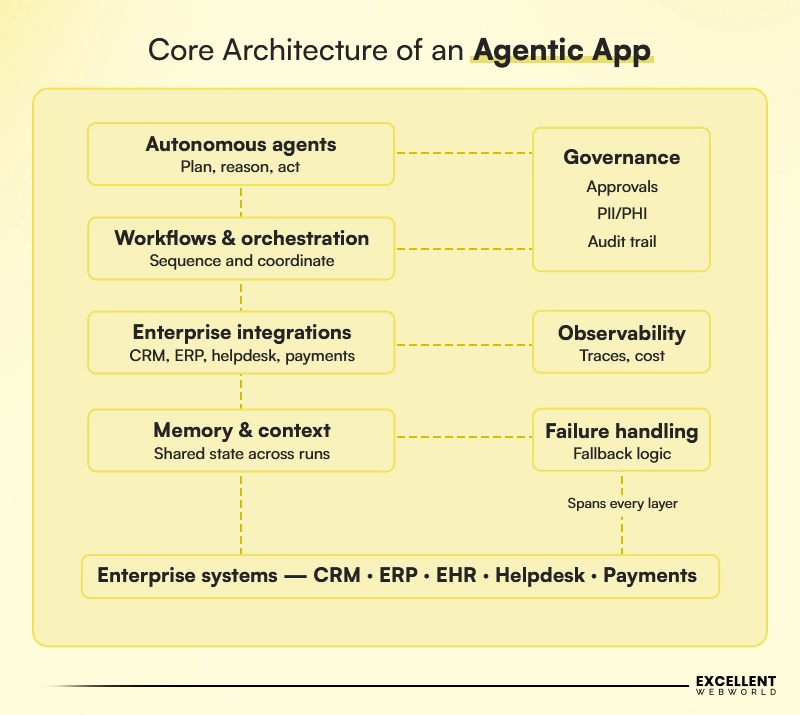
For complex enterprise workflows, agentic AI development services can help you translate business processes into particular governance-based workflows with orchestration, approvals, monitoring, and fallback logic, typically layered on top of your existing ERP rather than bypassing it.
A useful production pattern can be like;
Agent reasoning → Workflow orchestration → Enterprise tools → Human approval → Observability → Fallback
This is what actually separates a production agentic application from a particular LLM demo version, and it acts as an autonomous, governed, observable, & recoverable system when things actually don’t go right.
These layers also need to work together reliably in production, particularly around evaluation, integration, security, and failure recovery- the challenges explored in research on production agentic AI infrastructure.
Who Should Build an Agentic App?
So for this question, I would say that not every department or industry just needs an agentic app. The right approach is always the process, not any technology integration, to drive a seamless, productive process.
You should look for workflows with a certain meaningful volume, step-by-step ambiguity, multiple systems, and also a clear tolerance for the human review aspect. If the process is quite stable, rule-based, and high volume, RPA may be somewhat cheaper and also much more predictable. And for any bounded, specific task, only an AI agent may be suitable, but agentic app development truly changes the game.
The agentic AI development process becomes more sensible at the moment when the work process particularly needs reasoning abilities, coordination, and also smarter decisions across various steps.
Here is the breakdown of the departments and where Agentic AI can fit in to drive highly productive results.
| Department | Use Cases | Why It Fits |
|---|---|---|
| Sales | Pipeline coaching, lead sequencing, forecast integrity | High-volume, judgment-based workflows |
| Support | Ticket triage, knowledge-base deflection, SLA monitoring | Clear escalation paths and measurable outcomes |
| Finance | AR/AP, reconciliation, GL mapping | Rule-heavy workflows with frequent exceptions |
| HR | Onboarding, policy Q&A, document routing | Structured, repeatable processes |
| Legal | Contract review, clause flagging | High-value review with human sign-off |
| Healthcare | Prior authorization, denial recovery, care-gap outreach | Pattern-based workflows requiring strong governance |
| Logistics | Exception resolution, shipment triage | Frequent edge cases beyond fixed rules |
| Marketing | Campaign operations, content routing, performance triage | Multi-system coordination and escalation |
Support is often the fastest win too, since ticket triage and SLA monitoring build directly on conversational AI systems many teams have already deployed.
Sales teams already running structured pipelines are the easiest starting point — most of this coordination sits on top of your existing CRM rather than replacing it.
The use cases become more logical when AI is generally connected to the operational system, rather than just a standalone assistant system. In Finance, this kind of coordinated reasoning is already showing up in production, for example, in AR/AP and AI agent-powered loan approval workflows where agents can verify information, assess risk, and make decisions autonomously.
The same applies to logistics: exception resolution and shipment triage are exactly the kind of edge-case-heavy work that AI in logistics is already reshaping across logistics operations.
Retail brings another side of this into focus, with AI in retail being applied to practical operational needs such as inventory optimization, demand forecasting, and reducing repetitive manual work.
In the case of financial workflows, this requires an additional governance layer, as there is automation interaction between transactions, identity and regulatory controls, fintech app development along with AI/ML, RPA processes, secure authentication, and also compliance-enabled financial systems.
Also, in healthcare, there is a need for stronger governance & compliance that is integrated with the overall architecture. AI can support administrative automation, but systems that make clinical decisions need strict validation, integration, and oversight. AI implementation in healthcare demonstrates how the additional requirements impact the implementation complexity.
Why Build an Agentic App?
I would say that the case of agentic app development is not about the “AI in the future”, but totally about the ability to resolve process-level issues that simple automation cannot.
RPA use cases & iPaaS are generally effective for specific, fixed, and repetitive tasks, while standalone AI agents manage bounded work processes. Agentic AI applications are the ones that are now becoming quite valuable & when employees become the bridge between multiple systems, it becomes more significant.
Some of the aspects are:
- Process-level automation: Coordinates multiple tasks instead of automating one step.
- Exception handling: Reasons through variations that fixed rules cannot.
- Lower coordination overhead: Maintains context across systems and handoffs.
- Built-in auditability: Makes actions, decisions, and approvals traceable.
- Scalable judgment: Handles workflow variation without requiring human intervention at every branch.
Important Consideration: I think Agentic AI works best when the process is properly documented and transparent. Additionally, the automation of a messy workflow can only make the problems much harder and more challenging to manage.
There is a gap already observed in enterprise adoption; around 38% of tech leaders are piloting agentic AI, but only 11% have agents in adoption in actual production, as per Deloitte’s Tech Trends 2026, reported by EMARKETER.
Recent industry reports on agentic AI adoption make this experimentation-to-production step much more seamless, while the production gap, as stated in Forbes, mainly emphasizes the importance of initiating with a clear business problem other than technology itself.
This mirrors a pattern we’ve seen repeatedly: teams that jump into complex builds before validating the process tend to encounter the same mistakes in generative AI development that could have been avoided with proper planning.
How Much Does Agentic App Development Cost in 2026?
Agentic app development cost can range from $20K to $1M+, depending on the number of agents, workflows, integrations, standard governance requirements, and overall platform complexity.
Here is an estimated breakdown of cost by scope and the regional development rates below.
| Build Cost by Scope | ||
|---|---|---|
| Build Tier | Typical Scope | Estimated cost (USD) |
| MVP / Single-agent | One workflow, limited integrations | $20K–$70K |
| Mid-Tier | Multiple agents, several integrations, basic governance | $70K–$250K |
| Enterprise-Grade | Multi-agent orchestration, SSO/RBAC, compliance, audit trails | $250K–$1M+ |
| Full-scale Platform | Cross-department workflows, regulated use cases, custom models | $1M–$1.5M+ |
| Regional Development Rates | |
|---|---|
| Region | Senior Developer Rate (USD/hr) |
| USA | $120–$200 |
| Canada | $80–$130 |
| UK | $75–$150 |
| Germany / Netherlands | $70–$110 |
| France | $65–$100 |
| Australia | $80–$130 |
| Singapore | $70–$120 |
| UAE | $60–$100 |
| Saudi Arabia / Qatar | $55–$95 |
How Long Does Agentic App Development Take?
Building an agentic app needs to have a proper phased process, not just a single-sprint kind. The discovery, governance, and testing often take much more time than generally expected, as the agent behavior is non-deterministic and also needs evaluation across multiple aspects.
| Phase | Duration | Key activities |
|---|---|---|
| Discovery & Process Mapping | 2–4 weeks | Map decisions, exceptions, and handoffs |
| Architecture & Workflow Design | 2–3 weeks | Define agents, models, integrations, and workflows |
| Core Development | 4–8 weeks | Build agent logic, prompts, and orchestration |
| Integrations | 1–3 weeks/system | Connect CRM, ERP, helpdesk, payments, etc. |
| Governance | 2–4 weeks | Add approvals, RBAC, audit trails, and PII/PHI controls |
| Testing | 3–6 weeks | Evaluate consistency, edge cases, and failure modes |
| Pilot & Iteration | 4–8 weeks | Test with real users and refine workflows |
For organizations adding the agents to existing platforms, the legacy software modernization can actually become part of the timeline, as the existing systems, APIs, and technical debt all need preparation prior to the agentic AI workflows being introduced.
For teams building fresh rather than modernizing, starting on a cloud-native architecture avoids inheriting that technical debt in the first place.
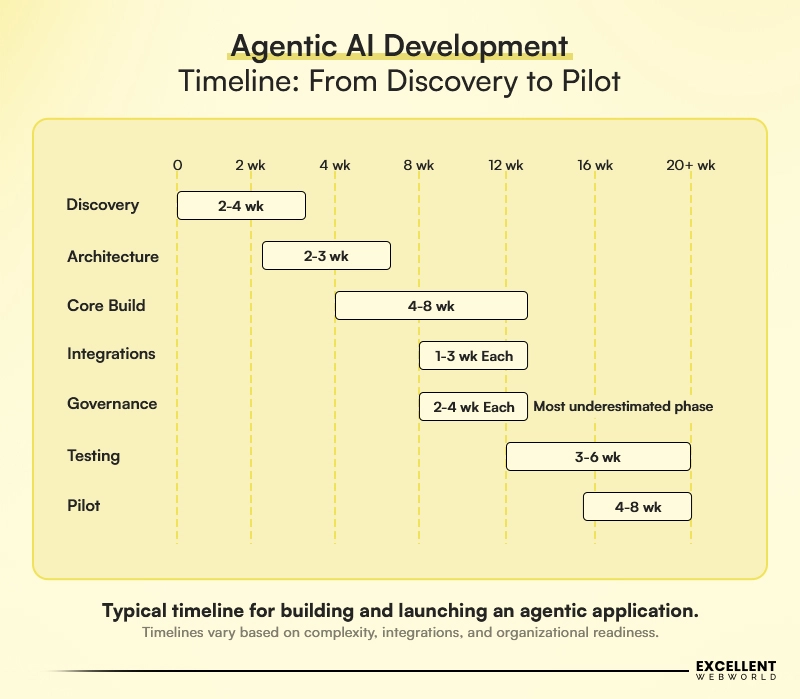
And the typical timeline actually varies like;
- Single Agent tool: 6–10 weeks
- Mid Complexity System: 3–5 months
- Enterprise Multi-Agent Platform: 6–12 months
What Tech Stack Do You Need for Agentic App Development?
There is no single standard tech stack for agentic app development yet. Enterprise systems mainly combine AI Models, orchestration layers, useful integrations, memory management & standard governance while running the development model.
The safest approach, to my knowledge, would be an orchestration modular layer and a swappable model layer that actually helps in reducing vendor lock-in and also in adapting models as they evolve properly.
| Layer | Common Technologies |
|---|---|
| LLM / Model | Claude, GPT-4/5-class, Gemini, Llama, Mistral |
| Orchestration | LangGraph, CrewAI, Temporal, custom state machines |
| Agent Frameworks | LangChain, LlamaIndex, Semantic Kernel, Strands Agents |
| Memory / Vector Store | Pinecone, Weaviate, pgvector, Redis, Qdrant |
| Integration | MCP, REST/GraphQL, Workato, Zapier |
| Observability | LangSmith, Langfuse, OpenTelemetry, Prometheus + Grafana |
| Governance | Policy engines, RBAC, Okta, Azure AD, AWS IAM |
| Infrastructure | AWS Bedrock AgentCore, Google Vertex AI, Azure AI Foundry, containers, serverless |
For the production process, the infrastructure needs to support a secure agent execution approach, a monitoring process, and also requires controlled scaling. Picking between these agent frameworks usually matters less than picking one that’s model-agnostic and matches your integration needs.
AWS Bedrock AgentCore is one of the insightful examples that you can take in terms of an infrastructure approach that is mainly built to transform the agents from the experimental stage to production seamlessly.
Now, as we have discussed almost every essential, or you can say the fundamentals, there is a breakdown of steps to build the agentic app.
Pro Tip: I would recommend selecting a maintainable, model-agnostic architecture that actually fits the workflows, integrations & security needs, rather than just choosing the tools.
How Do You Build an Agentic App Step by Step?
A successful agentic app development begins with the aspect of process engineering, not with any framework selection. You need to define the workflow, automation boundaries, & most importantly, standard governance first for building, testing, and achieving great scalability.
Here is a brief breakdown of the steps you need to do and what needs to be focused on, explained in this tabular representation.
| STEPS (1-10) | WHAT TO DO | KEY FOCUS |
|---|---|---|
| Mapping the Process | Document decisions, exceptions, handoffs, and real workflows | Process mapping |
| Defining the Boundary | Decide what the agent handles and where humans must approve | Human in the loop |
| Architecture Selection | Start with single-agent architecture; add multi-agent only when justified | Scalability & complexity |
| Selecting Models & Tools | Match model capability to task complexity; use RAG before fine-tuning where appropriate | Cost & performance |
| Integrations Buildups | Connect CRM, ERP, helpdesk, payments, and other systems through MCP or APIs | Real-world execution |
| Memory Design | Store persistent context where it belongs; use structured databases where possible | Context management |
| Governance Addition | Implement approval gates, RBAC, PII/PHI controls, and audit logging from day one | Security & compliance |
| Test Behavior | Evaluate multiple runs, edge cases, failure modes, and adversarial inputs | Reliability |
| Piloting Users | Deploy narrowly, monitor results, and refine the workflow using real feedback | Controlled Adoption |
| Scale & Monitoring | Expand only after failures are understood, like tracking cost, latency, errors, quality, and SLAs | Production Operations |
I think the biggest risk is developing an AI agent prior to understanding the process. A production-ready system is one that needs the same disciplined engineering approach across the architecture, integrations & security as an enterprise platform, which helps in scaling and giving productive outputs.
The goal is not about maximum autonomy, but a totally controlled architectural approach which actually helps in delivering a measurable business outcome.
What Is the Future of Agentic AI?
I would say that agentic AI is moving more towards enterprise adoption, but the reliability, governance & costs remain major challenges all over.
What’s consolidating: The orchestration, memory aspects, observability, and governance are shifting towards integrated platforms, thus increasing simplicity & vendor lock-in.
What’s consolidating: The MCP (Model Context Protocol) and Google’s A2A (Agent-to-Agent) are improving the interoperability among the agents, tools & enterprise systems.
What’s changing: Enterprises are shifting from fully autonomous to governed autonomy with many approvals, audit trails, RBAC, and kill switches, reflecting the broader move toward AI governance for enterprise AI as adoption scales.
What’s approaching: AI regulation will increasingly change the deployment process across healthcare, finance, and government.
What’s unsolved: Reliability, cost predictability, evaluation, pilot-to-production scaling, and vendor lock-in remain key barriers.
The future of agentic app development is not a maximum-autonomy process, but a reliable, observable, and standards-governed autonomy that is able to deliver measurable business outcomes with better results.
Why Choose Excellent Webworld for Your Agentic App Development?
Agentic apps are now representing a genuine architectural shift, not simply a rebrand of chatbots or any RPA systems. With evolving technology, there is a need to establish reliability, cost predictability, and evaluation while addressing the remaining key challenges.
The right question, I think,k is not whether you should build an agentic app, but which business processes actually justify the autonomous AI and how they can be governed in a safe manner.
So, if you are evaluating the opportunity, talk to Excellent Webworld about your process, not just about the technology.
- Agentic apps go beyond chatbots and RPA by coordinating AI agents, tools, workflows, memory, and human approvals across complete business processes.
- Start with the process, not the technology. The best opportunities involve multi-step workflows with ambiguity, exceptions, and frequent manual handoffs.
- Autonomy needs governance. Approval gates, audit trails, access controls, and fallback mechanisms are essential for enterprise adoption.
- Architecture matters as much as AI models. Reliable integrations, orchestration, observability, and failure handling determine whether an agentic system works in production.
- Not every process needs an agentic app. Stable, rules-based tasks may still be better suited to RPA, while bounded tasks may only require a standalone AI agent.
- Testing and monitoring are ongoing requirements because agent behavior is non-deterministic and can change with models, tools, and context.
- Cost and scalability should be planned early, including LLM usage, integrations, infrastructure, maintenance, and governance.
- The right implementation partner can make the difference by helping identify viable use cases, design the architecture, and build toward a production-ready system rather than a proof of concept.
Frequently Asked Questions
An agentic app uses AI to reason, make decisions, use tools, and execute multi-step workflows with defined human oversight.
A chatbot primarily responds to queries, while an agentic app can plan actions, use enterprise systems, manage workflows, and escalate decisions.
It is best suited to complex, multi-step processes involving exceptions, multiple systems, and judgment-based decisions.
Costs can range from $20,000 for an MVP to $1M+ for enterprise platforms, depending on scope, integrations, agents, and compliance.
A simple application may take 6–10 weeks, while enterprise-grade implementations can take 6–12 months.
Typical stacks include LLMs, agent frameworks, orchestration, APIs/MCP, vector databases, observability, cloud infrastructure, and governance tools.
Yes. They can connect with CRMs, ERPs, helpdesks, databases, payment systems, and internal APIs through modern integration methods.
Excellent Webworld’s Agentic AI Development Services can support architecture, development, integrations, governance, deployment, and optimization.
No. RPA, conventional automation, AI agents, or agentic apps may each be better depending on process complexity, risk, volume, and decision requirements.

Article By


Mayur Panchal is the CTO of Excellent Webworld. With his skills and expertise, he stays updated with industry trends and utilizes his technical expertise to address problems faced by entrepreneurs and startup owners.