At a glance, IDD (Intellectual and Developmental Disability) software might give the impression of being just another specialized EHR system for healthcare service providers. But I wouldn’t define it with that much simplicity.
Working across our healthcare software services practice, IDD software is one of the more interesting technologies my team and I have gotten pulled into. And let me tell you this, it refuses to stay inside the box that “EHR” puts it in. An IDD platform connects several healthcare engineering domains together, including clinical records, person-centered planning, service delivery tracking, workforce management, and Medicaid billing. And unlike a traditional EHR, all of it is developed around an individual’s ongoing care.
Then there’s the exponentially growing role of AI in healthcare, which is already reshaping how several of these workflows get designed and function.
Boiling all of that down to a “purpose-built EHR for disability service agencies” leaves out a lot of the technology and compliance decisions US-based providers must consider.
I’ve put this guide together to help you understand what IDD software actually encompasses: key features, where AI genuinely fits, the compliance weight it carries, and what to consider if custom IDD software development ends up being the right call for your agency.
What is IDD Software?
IDD software is a specialized healthcare technology platform that helps disability service agencies manage the care, documentation, workforce, billing, and compliance workflows involved in supporting individuals with intellectual and developmental disabilities (IDD).
It brings fragmented workflows across EHRs, spreadsheets, paper documents, and disconnected point solutions into a more unified operating environment. IDD software generally comes in two forms:
- Point solutions address specific challenges such as scheduling, electronic visit verification (EVV), documentation, or billing.
- All-in-one platforms bring multiple care management and operational workflows together.
Sure, you can adapt a general-purpose EHR system for disability services and it might work to an extent. But you’ll most certainly run into limitations as the complexity of your operations increases. That’s because there’s a fundamental mismatch.
Traditional healthcare EHRs are best suited to episodic care encounters while IDD software has to support the long-term care of an individual.
More than that, the scope of an IDD platform is wider than just clinical records. You may have leadership, case managers, nurses, Direct Support Professionals (DSPs), administrators, and billing teams all working with the same individual and the same underlying data.
In the US especially, that scope is closely tied to how services are funded and delivered. As a provider, you may have to manage group homes, day programs, Home and Community-Based Services (HCBS) under Medicaid waivers, Individualized Service Plans (ISPs), service authorizations, DSP schedules, service notes, EVV, and Medicaid claims. You also need to account for differences between state Medicaid programs and HCBS requirements. If you’re operating an IDD agency in New York, for example, your software needs to accommodate workflows and reporting requirements that may differ significantly from those of a provider operating under California’s Medicaid programs.
That’s why I wouldn’t define IDD software as simply an EHR for disability services. It is the operational system connecting the different parts of IDD service delivery.
How Does IDD Software Differ from a Traditional EHR?
I get why you’d question whether you really need another system for your agency if you already have an EHR. Short answer: a conventional EHR system caters to episodic care. In contrast, an IDD provider has to answer a longer list of questions, every day, for every person.
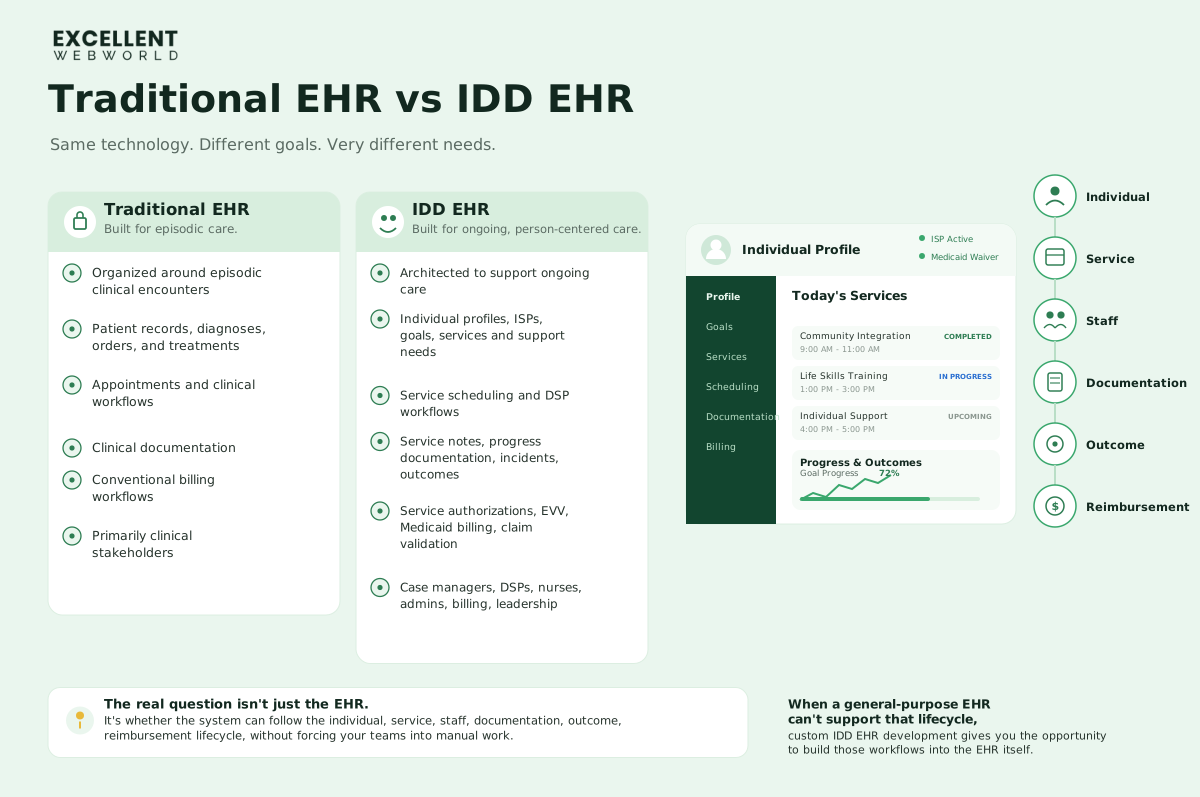
It supports:
- Was the individual’s ISP goal addressed during a particular day’s service?
- Was the DSP authorized and qualified to deliver it?
- Does the documentation actually support what’s about to be billed?
- Were the service code, duration, and location recorded correctly?
- Are required staff certifications still current?
- What was the medication adherence status?
| Traditional EHR | IDD Software |
|---|---|
| Organized around episodic clinical encounters | Architected to support ongoing care |
| Patient records, diagnoses, orders, and treatments | Individual profiles, ISPs, goals, services, and support needs |
| Appointments and clinical workflows | Service scheduling and DSP workflows |
| Clinical documentation | Service notes, progress documentation, incidents, and outcomes |
| Conventional billing workflows | Service authorizations, EVV, Medicaid waiver billing, and claim validation |
| Primarily clinical stakeholders | Case managers, DSPs, nurses, administrators, billing teams, and leadership |
The IDD EHR vs traditional EHR argument especially intensifies in Home and Community-Based Services (HCBS), where HCBS software needs to support person-centered planning around an individual’s preferences, goals, and outcomes while comparing them against the services they receive.
What I’ve Learned
I’ve seen a comparable principle play out in the healthcare platforms my team and I engineer. For an AI-powered virtual health assistant, we had to bring together patient records, appointment scheduling, medication reminders, secure communication, and AI-assisted interactions without treating each as a standalone feature.
That experience reinforces something I’d keep in mind when evaluating IDD software: when different teams depend on the same information, the system needs to keep that information consistent as it moves through each part of the workflow.
So, when you evaluate an EHR for your disability services agency, I would look beyond whether it has a patient record or a billing function. The more important question is whether those components can follow the individual → service → staff → documentation → outcome → reimbursement lifecycle without forcing your teams into manual workloads.
If a general-purpose EHR cannot support that lifecycle, custom IDD EHR development gives you the opportunity to build those workflows into the EHR itself.
The Features That Actually Matter in an IDD Platform
| Feature | What It Covers |
|---|---|
| EHR and client management | A centralized record of medical history, assessments, diagnoses, allergies, behaviors, incidents, appointments, goals, and service documentation gives teams a consistent view of the individual. |
| Person-centered planning | As a type of person-centered planning software, IDD platforms need to connect ISPs and PCPs with individual goals, preferences, interventions, progress, and outcomes, while tying them to the services being delivered. |
| Mobile documentation | Gives DSPs and other frontline staff a practical mHealth app experience to record service notes, goal progress, incidents, signatures, and other information where care actually happens, rather than relying on delayed documentation. |
| eMAR and medication management | Medication schedules, administration records, PRN documentation, missed doses, and medication histories can be kept within the same workflow. Integration with pharmacy software can also help keep medication data synchronized, giving teams a clearer record of medication administration. |
| Scheduling and workforce | Staffing is closely tied to service delivery. The platform needs to account for DSP availability, assignments, open shifts, qualifications, training, time and attendance, and payroll inputs while giving administrators visibility into coverage. |
| Authorization and Medicaid billing | The connection between authorized services and what gets billed matters here because the system must keep track of authorized units, renewal dates, service utilization, claims, and billing requirements while validating that the underlying documentation supports the claim. |
| EVV | EVV adds another layer of verification to service delivery, capturing the individual, staff member, date, time, and location for applicable services. |
| Incident and compliance management | Incident records, follow-up actions, corrective measures, staff certifications, training, audits, and regulatory reporting all need a structured place within the operational workflow. |
| Reporting and analytics | Leadership needs visibility across the operation, not isolated reports. Reporting can bring together outcomes, service delivery, incidents, medication administration, staffing, authorizations, billing, and documentation to help identify operational issues and trends. |
For you as a provider, the most important consideration is workflow continuity.
→ Can your case manager see whether an ISP goal is being addressed?
→ Can a DSP document that service from a mobile device?
→ Can the system connect that documentation to the authorization and EVV record?
→ Can your billing team identify a problem before a claim goes out?
Those connections also determine how much manual reconciliation your teams have to do. A platform may technically offer scheduling, documentation, EVV, and billing while still leaving staff to move information between separate workflows.
I’d advise evaluating IDD software based not only on which features it has, but on how well those features work together around the individual, the services being delivered, and the operational requirements of your agency.
Where AI Actually Fits in IDD Care Technology
AI’s role in IDD software is a lot narrower than most vendor pitches make it sound, and I think it’s worth stating it outright.
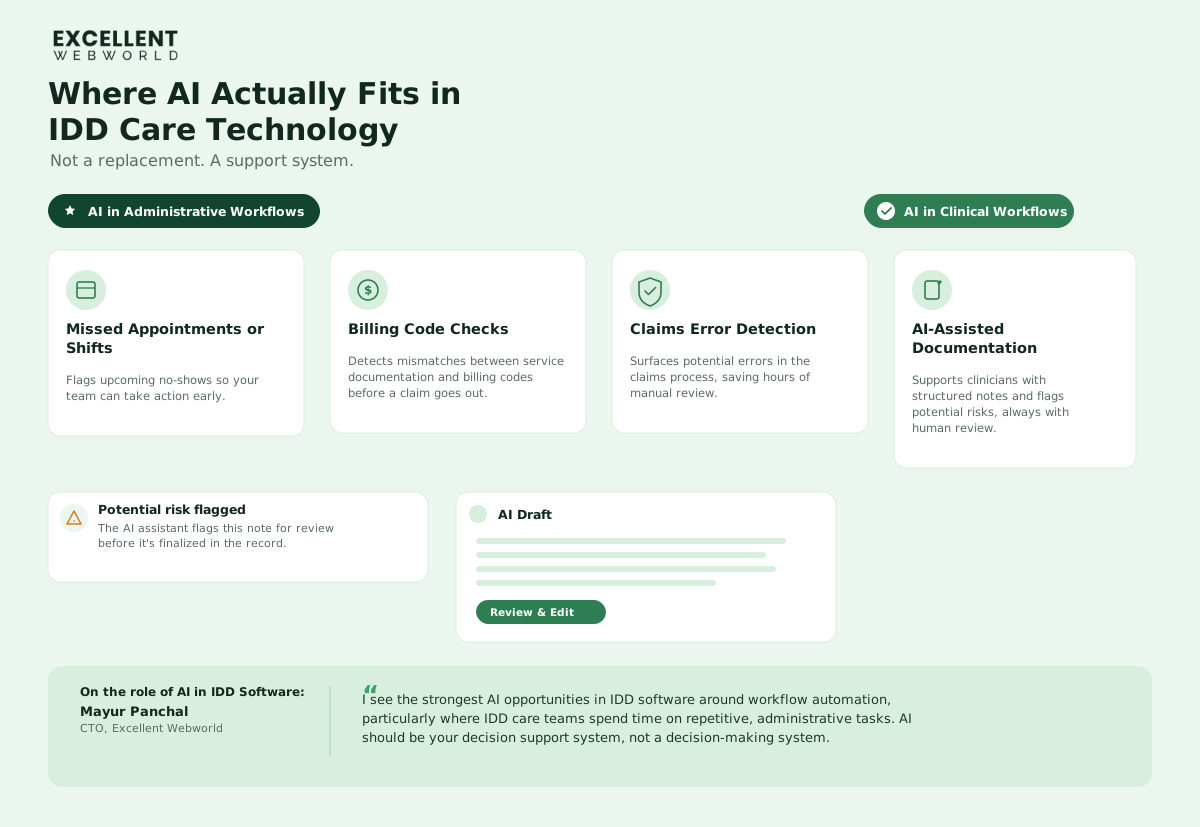
The workflows where AI actually earns its place are administrative, where it can automate repetitive work without taking clinical or care decisions out of human hands. These could be:
- Flagging an appointment or shift that’s about to be missed
- Catching a billing code that doesn’t match the documented service before a claim goes out
- Or surfacing a claims-processing error that would otherwise take your billing team hours to find manually
The goal is to reduce administrative workload without taking control away from the people responsible for an individual’s care.
The same human-in-the-loop principle applies when AI is used within clinical workflows. Our team at Excellent Webworld applied this while engineering Braive, where AI-assisted clinical documentation was designed to support clinicians rather than replace their judgement. The platform uses safety classifiers to flag ambiguous or potentially unsafe outputs before they reach the clinician.
For an IDD provider such as yourself, this can mean less time spent checking records, moving information between workflows, and handling routine administrative tasks.
On the role of AI in IDD Software:
“I see the strongest AI opportunities in IDD software around workflow automation, particularly where IDD care teams spend time on repetitive, administrative tasks. AI should be your decision support system, not a decision-making system.”
 Mayur PanchalCTO, Excellent Webworld
IDD Software Compliance: Federal and State Requirements
IDD software sits on some of the most tightly regulated ground in US healthcare technology, and I always prefer to name the floor precisely rather than wave at it. At minimum, you’re dealing with:
| Requirement | What It Means for the Software |
|---|---|
| HIPAA + Privacy & Security Rule |
|
| HCBS |
|
| Medicaid Waivers: 1915(c) / 1915(i) |
|
| EVV |
|
| 21st Century Cures Act |
|
| State-specific requirements |
|
The state layer is where things get particularly interesting from a software engineering perspective.
A provider working under New York’s OPWDD ecosystem may have different program and reporting requirements from one operating under Texas HHSC or another state’s DDS structure. If these differences are hard-coded into the core application, every regulatory change becomes a development project in itself.
The better approach is a configurable IDD software:
- Your individual records, care plans, scheduling, documentation, and core billing workflows can remain consistent
- State-specific service codes, authorization rules, EVV workflows, reporting formats, and reimbursement logic are configured for each program.
My Practical Test
From the compliance point of view, the question I’d ask when assessing IDD software is simple: “Can the platform adapt to a new state or regulatory change without requiring a rebuild of the core system?”
Why Off-The-Shelf IDD Software May Not Fit Every Provider
Off-the-shelf software has its place in the market. If your programs, workflows, and reporting needs fit the platform’s model, buying can be a smart choice.
But on the flip side, there’s also a chance that your IDD services operation doesn’t fit an existing model as neatly.
Consider a provider operating across several states and program types. You might need various Medicaid waiver billing rules, service authorizations, EVV workflows, and state reporting formats. An off-the-shelf platform may handle each feature individually, but that doesn’t necessarily mean it supports your exact combination of them.
Even internal workflows can be affected, with your DSP scheduling process depending on specific qualification rules or your case managers needing a particular ISP-to-service documentation flow.
At that point, you are usually faced with three choices:
Option A: Change your workflows to fit the software Option B: Maintain manual workarounds for its limitations Option C: Invest in custom IDD software development
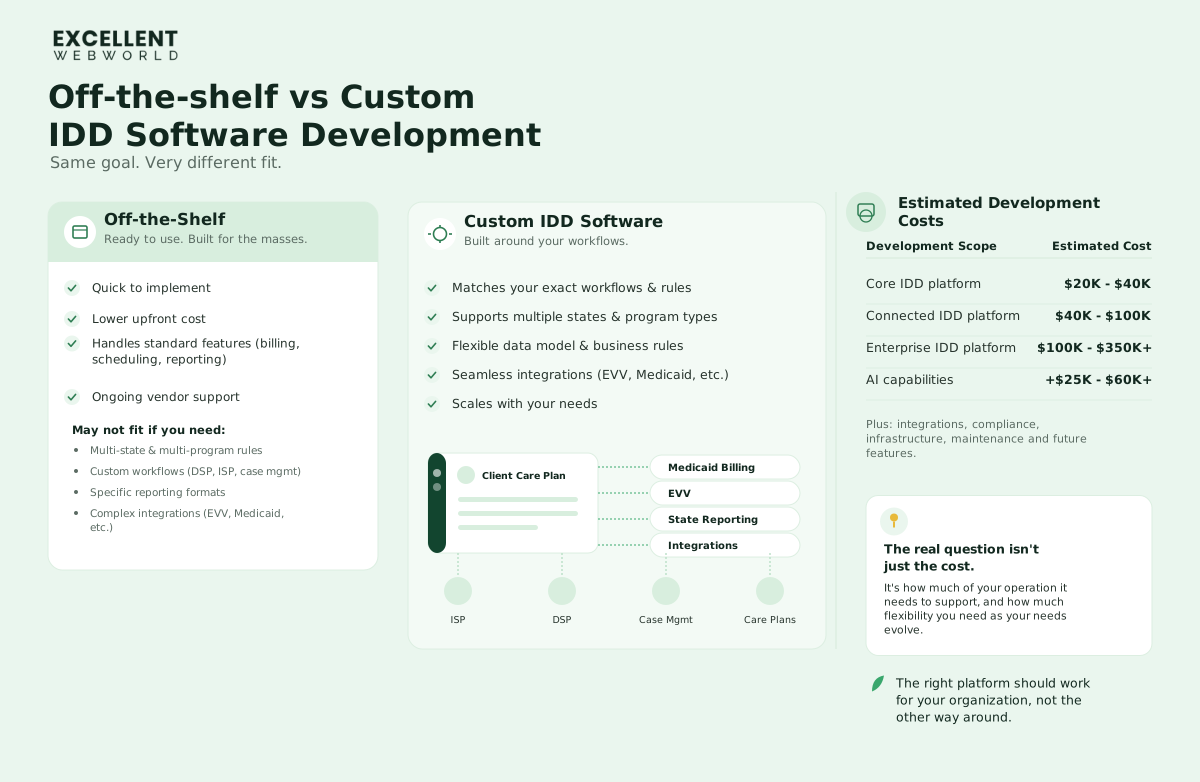
With option C, instead of changing your operations, you can design the data model, business rules, integrations, and workflows to match how your organization works. This is especially useful when Medicaid waiver billing software development needs to accommodate workflows that vary across programs or states.
The key question is whether that flexibility justifies the investment. For providers with simple needs, it may not. For those whose operational complexity is becoming a constraint, it more than likely does.
And that brings us to the next natural question: what does that investment actually cost?
What Custom IDD Software Development Costs
The cost of custom IDD software development depends largely on how much of your service delivery and operational workflow the platform needs to cover. Since IDD software combines several healthcare and administrative functionalities, looking at healthcare app development costs gives us a useful starting point for estimating the investment involved in developing an IDD platform.
Publicly available pricing from existing IDD platforms also gives us some context on the recurring investment involved in using an off-the-shelf system. Giv Healthcare starts at $18 per month per active client, while Statewise starts at $1,000 per month. These healthcare subscription models aren’t directly comparable, since they use different pricing structures, but they illustrate the range of commercial models available in the market.
For custom IDD software development, broader healthcare benchmarks provide a useful reference.
| Development Scope | Healthcare Development Benchmark | What This Could Mean for an IDD Platform |
|---|---|---|
| Core IDD platform | $20K – $40K | Individual management, care planning, documentation, and scheduling |
| Connected IDD platform | $40K – $100K | Multiple user roles, mobile workflows, billing, and third-party integrations |
| Enterprise IDD platform | $100K – $350K+ | Medical billing, EVV, state-specific workflows, extensive integrations, and multi-program operations |
| AI capabilities | (+)$25K – $60K+ | Documentation assistance, workflow automation, claims support, and intelligent data validation |
Where your project lands within these ranges depends on the workflows you need to support. A platform for basic care management and documentation will have a very different development scope from one connecting ISPs, DSP scheduling, EVV, Medicaid billing, state-specific rules, and multiple external systems.
I’d also look at the cost beyond the initial development phase.
Integrations, compliance, infrastructure, maintenance, and future features all add to your long-term investment.
For an enterprise IDD service provider in the US, the right question is therefore not simply what the software costs to develop, but how much of your operation it needs to support and how much flexibility you need to retain as those requirements change.
Why Agencies Building Custom IDD Software Choose Excellent Webworld
An IDD platform can involve everything from person-centered planning and mobile DSP documentation to Medicaid billing, EVV, third-party integrations, and AI-assisted workflows. If you’re evaluating an IDD software development company for a platform like this, I’d look for a team with practical experience developing regulated and often complex technology solutions for the healthcare industry.
At Excellent Webworld, my team and I have worked on healthcare platforms where interoperability, regulated data, multiple user roles, and complex workflows must all work together reliably. Our multidisciplinary engineering teams bring the depth needed to deliver complex healthcare software across the US, UK, Europe, and the GCC. We prioritize compliance, interoperability, scalability, and user experience at every stage of development.
When it comes to IDD software development, I’d rather start by understanding your service models and expansion plans than hand you a predefined feature list.
Let’s have an opening dialogue about what your platform needs to accomplish.
IDD Software Development FAQs
Yes. IDD software can be integrated with an existing EHR through APIs and interoperability standards such as HL7 and FHIR, allowing relevant data to move between systems.
Yes. Custom IDD software development gives you the flexibility to design around your specific service model, business rules, integrations, and reporting requirements. This is particularly useful when your operations span multiple programs or states and a standardized platform would require significant workarounds.
Look for a provider that understands both the technology and operational requirements of IDD service delivery. Beyond development capabilities, evaluate their experience with:
- Healthcare software
- Interoperability
- HIPAA
- Medicaid workflows
- EVV
- Mobile applications
- Complex integrations
I’d also look at whether they can support the platform beyond the initial development phase as your programs and requirements evolve.
Cost depends primarily on the scope and complexity of the platform, while compliance, infrastructure, maintenance, and future development also contribute to the overall investment.
Yes. A custom IDD platform can be configured to accommodate differences between Medicaid waiver programs without changing the core platform. This allows you to adapt the software as program requirements, billing rules, and reporting needs vary across states.

Article By


Paresh Sagar is the CEO of Excellent Webworld. He firmly believes in using technology to solve challenges. His dedication and attention to detail make him an expert in helping startups in different industries digitalize their businesses globally.