If you’ve landed on this article, chances are you’ve decided to build a healthcare app and need to know what it will cost.
Quick answer: Healthcare app development typically costs $20,000 to $350,000+. A simple MVP costs $20,000-$40,000 and takes 2-4 months, a mid-complexity app costs $40,000-$100,000 and takes 4-7 months, and a complex enterprise platform costs $100,000-$350,000+ and takes 7-12 months. Set aside 20-30% of the total budget for compliance and 15-25% of the build cost per year for maintenance. AI-assisted delivery can bring build costs below these averages on well-scoped projects, but compliance, validation, and integration costs do not shrink at the same rate.
Because healthcare app development deals with complex clinical workflows, the cost is higher than for a typical app. Factors like feature complexity, team location, the hiring model (in-house team, dedicated team, or development agency), regulatory compliance such as HIPAA & GDPR, and integrations with EHR & EMR systems all add to the price of a healthcare app.
Moreover, you may have noticed during your research that the question ‘how much does it cost to build a healthcare app?’ gets a vague answer. Most vendors and guides quote a wide ballpark and skip the logic behind it, so instead of clarity, you end up with more confusion.
What most vendors don’t tell you about the healthcare app development cost estimate, and where this guide answers it:
- Which features are actually necessary vs. optional
- Whether the pricing is genuinely justified
- What compliance and certifications your specific app type requires
- Which critical areas are left vague, leading to overpricing and inflated quotes later
- What EHR integration and data interoperability will actually cost you
- Whether your hosting is truly HIPAA-compliant or just marketed that way
- What ongoing compliance audits and post-launch maintenance will add up to
- Who owns the codebase and IP when the project ends
As an experienced, Clutch-rated healthcare app development company with 15+ years of expertise, we’ve delivered 100+ digital health platforms. This guide, created by our experts, will help you understand a clear cost breakdown by app type, complexity, features, and region. You’ll know what’s necessary, what’s optional, and what to ask any agency.
Still shaping the idea? Start with our healthcare app development guide or browse these healthcare business ideas.
Healthcare App Development Cost by App Complexity
The healthcare app development cost, according to the complexity of the application, is as follows:
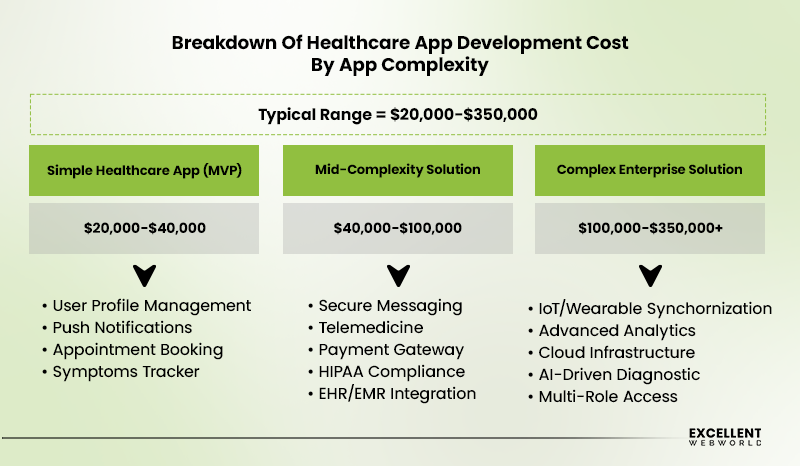
| App Complexity | Average Cost (Standard Delivery) | Best Case With AI-Assisted Delivery | Timeline | Key Features |
|---|---|---|---|---|
| Simple Healthcare MVP | $20,000-$40,000 | $12,000-$25,000 | 2-4 Months | Basic User Profile Management, Push Notifications, Appointment Booking, and Symptoms Tracker |
| Mid-Complexity Solution | $40,000-$100,000 | $25,000-$60,000 | 4-7 Months | Secure Messaging, Telemedicine, Payment Gateway, HIPAA Compliance, and EHR/EMR Integration |
| Complex Enterprise Platform | $100,000-$350,000+ | $60,000-$200,000+ | 7-12 Months | IoT/Wearable Synchronization, Advanced Analytics, Cloud Infrastructure, AI-Assisted Diagnostic Support, and Multi-Role Access |
The “Best Case With AI-Assisted Delivery” column applies to well-scoped projects with reusable components and limited integrations, where AI-assisted coding and testing tools lower build effort. Compliance, clinical validation, and EHR onboarding costs do not shrink at the same rate, so most projects land between the two columns. It does not include the cost of adding AI features to the app itself. See how AI-assisted delivery changes the budget.
Note: Adding AI in healthcare app development to power features like personalized care or a smart symptom checker may cost an additional $25,000 to $60,000. Clinical-grade AI, such as imaging diagnostics or predictive analytics, is priced separately (see the AI section).
Also, set aside 20-30% of the total budget to cover compliance requirements such as HIPAA and GDPR. FDA requirements add cost only if your app qualifies as Software as a Medical Device (SaMD).
Healthcare App Development Cost by App Type
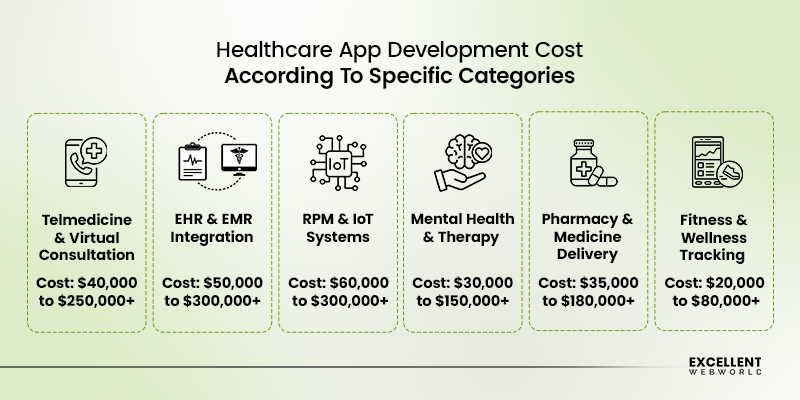
If you’re a healthcare founder or entrepreneur, you should be very clear that no two types of healthcare apps cost the same. Here’s the healthcare app development cost breakdown according to various types or categories:
1. Telemedicine & Virtual Consultation
With a telemedicine application, you can connect patients and doctors via video or chat.
The “telemedicine app development cost” increases with features such as real-time scheduling, multi-specialty support, and EHR integrations. Booking-focused products follow a similar pattern, as covered in our guide to doctor on demand app development, and you can review the full telemedicine app features list before you scope.
Having deployed 50+ telehealth solutions on highly secure cloud infrastructures for various healthcare providers, we understand exactly what it takes to build a reliable and compliant telemedicine platform as a telemedicine app development company.
Average Cost: $35,000-$200,000+
Timeline: 2-9+ Months
2. EHR & EMR System Integration Apps
Many of the top medical apps for doctors rely on EHR/EMR integration, one of the key benefits of EHR/EMR systems, to synchronize patient data in real time.
The only problem with the scenario is that you need a proper HL7/FHIR integration to make it work efficiently. Integration cost depends on how many EHRs you connect (Epic, Oracle Health, and others), whether you need read-only access or write-back, and how long vendor onboarding takes, which can run from weeks to months. Plan for roughly $10,000-$50,000 per integration, plus ongoing fees. Our Epic vs Oracle Health (Cerner) comparison explains how the two vendors differ, and you can add AI for EHR once the integration is stable. If you connect to legacy hospital systems, a healthcare software modernization plan may need to come first.
Average Cost: $50,000-$300,000+
Timeline: 6-12 Months
3. Remote Patient Monitoring (RPM) & IoT Systems
Remote Patient Monitoring (RPM) enables you to track vital health metrics using IoT devices in healthcare and wearables. Our wearable app development services cover the device side of these projects.
It also allows you to send emergency alerts via cloud-based dashboards.
Average Cost: $60,000-$300,000+
Timeline: 6-12+ Months
4. Mental Health & Therapy Apps
Mental health applications can help you conduct therapy sessions, provide support during a crisis, and track patients’ moods at regular intervals.
It’s just that you need a strong alignment with compliance and data privacy rules, even at the MVP stage, because therapy session data is highly sensitive. If you only need a lighter wellness product, see how to create a meditation app like Calm.
Average Cost: $30,000-$150,000+
Timeline: 3-8 Months
5. Pharmacy & Medicine Delivery Apps
With the help of pharmacy and medicine delivery apps, you can handle patient prescriptions, provide door-to-door medicine delivery, and also conduct pharmacy licensing and verification.
The only thing you need to take care of is compliance with state regulations to ensure end-to-end pharmacy app development is carried out efficiently. For the delivery side, read our guide to medicine delivery app development.
Average Cost: $35,000-$180,000+
Timeline: 4-9 Months
6. Fitness & Wellness Tracking Apps
With these apps, you can track fitness activities and goals, and personalize your exercise schedule with wearables and AI-based coaching. Our guide on how to create a fitness app walks through the build in detail.
If you opt for these apps, you don’t have to deal with as much compliance as with core clinical applications. However, if your app shares data with providers, HIPAA can apply, and consumer health apps outside HIPAA may fall under the FTC Health Breach Notification Rule.
Average Cost: $20,000-$80,000+
Timeline: 2-6 Months
Healthcare App Development Cost by Feature
Features are the most controllable part of your budget. The table below shows which features are must-haves for an MVP and which can wait, along with a typical cost for each. Our patient engagement software guide covers the engagement features in more depth.
| Feature | Priority | Estimated Cost | What Drives The Cost |
|---|---|---|---|
| Secure Registration, Login, and Multi-Factor Authentication | Must-Have | $1,500-$4,000 | User roles, MFA method, and single sign-on |
| Patient Profile and Basic Health Records | Must-Have | $2,000-$5,000 | Data fields, consent capture, and encryption |
| Appointment Booking and Scheduling | Must-Have | $2,500-$6,000 | Calendar sync, provider availability, and reminders |
| Push Notifications and Reminders | Must-Have | $1,000-$3,000 | Channels, personalization, and keeping PHI out of notification text |
| Secure In-App Messaging | Must-Have for Care Apps | $3,000-$8,000 | Encryption, attachments, and retention rules |
| Admin Dashboard and Role Management | Must-Have | $4,000-$10,000 | Number of roles, reports, and audit logs |
| Video Consultation (SDK-Based) | Must-Have for Telehealth | $5,000-$15,000 | SDK licensing, group calls, recording, and bandwidth |
| Payments and Insurance Billing | Optional at MVP | $3,000-$10,000 | Payment gateways, insurance eligibility checks, and invoicing |
| E-Prescribing | Advanced | $8,000-$25,000 | Pharmacy networks, controlled-substance rules, and certification |
| EHR/EMR Integration (HL7/FHIR) | Advanced | $10,000-$50,000 | Number of EHRs, read vs. write-back, and vendor onboarding |
| Wearable and IoT Data Sync | Advanced | $8,000-$30,000 | Device types, real-time vs. batch sync, and alerting |
| AI Symptom Checker or Chatbot | Advanced | $10,000-$50,000 | NLP depth, clinical validation, and EHR data access |
| Analytics and Reporting | Optional | $5,000-$20,000 | Data sources, dashboards, and exports |
Note: These ranges assume cross-platform development with a blended hourly rate of roughly $25-$50 (see hourly rates by region). US-based teams typically cost 3-5 times more. Compliance work (HIPAA, GDPR, FDA) is budgeted on top of individual feature costs.
Healthcare App Development Cost by Phase and Platform
Knowing where the money goes helps you challenge a vague quote. These two breakdowns show how a typical budget is split across phases and how your platform choice changes the total.
1. Cost by Development Phase
The shares below describe how the core build budget is typically split. Compliance work runs across every phase. With AI-assisted delivery, the development share typically shrinks and the compliance, validation, and integration share grows (see section 3 below).
| Phase | Share of Budget | What’s Included |
|---|---|---|
| Discovery and Planning | 5-10% | Requirements, compliance classification, architecture, and roadmap. |
| UI/UX Design | 10-15% | User research, wireframes, prototypes, and accessibility (WCAG) checks. |
| Development | 40-50% | Front end, back end, integrations, and the security layer. |
| QA and Security Testing | 15-20% | Functional and performance testing, penetration testing, and user acceptance testing. |
| Deployment and Launch | 5-10% | App store submission, hosting setup, monitoring, and training. |
2. Cost by Platform
| Platform Option | Cost Impact | Best For |
|---|---|---|
| Cross-Platform (Flutter, React Native) | 30-40% lower than two native apps | MVPs and most patient and provider apps. |
| Single Native App (iOS or Android) | Mid-range | Audiences concentrated on one platform. |
| Two Native Apps (iOS and Android) | Highest | Deep device integrations such as HealthKit, Health Connect, or heavy sensor use. |
| Web App or PWA | Lowest | Admin portals and provider dashboards. Push notifications and sensor access are limited. See our healthcare web development services. |
3. How AI-Assisted Delivery Changes the Budget
AI-assisted delivery, which uses AI tools for coding, test generation, and documentation, lowers the cost of some phases far more than others. Here is where it helps and where it does not:
| Phase | Effect of AI-Assisted Delivery | Why |
|---|---|---|
| Discovery and Planning | Small savings | Research and documentation move faster, but stakeholder decisions and compliance classification stay human-led. |
| UI/UX Design | Moderate savings | Concepts and variations arrive faster, but clinical usability testing and accessibility checks still need real users and reviewers. |
| Development | Largest savings | Boilerplate, integration scaffolding, and unit tests are produced faster, but senior engineers still review architecture, security, and PHI handling. |
| QA and Security Testing | Moderate savings | Test generation and regression runs get cheaper, while penetration testing, clinical user acceptance testing, and security review remain human-led. |
| Compliance, Audits, and Clinical Validation | Little to none | Audits, BAAs, documentation sign-offs, and clinical validation take the same effort no matter who writes the code. |
| EHR Onboarding | Little to none | Vendor review and sandbox approval timelines do not shrink with faster coding. |
The net effect is that the development share of the budget shrinks, while compliance, validation, and integration take a larger share. That is why the best-case column in the complexity table is a ceiling on savings, not the typical outcome. Ask any vendor to show exactly where their savings come from.
What Factors Affect Healthcare App Development Cost?
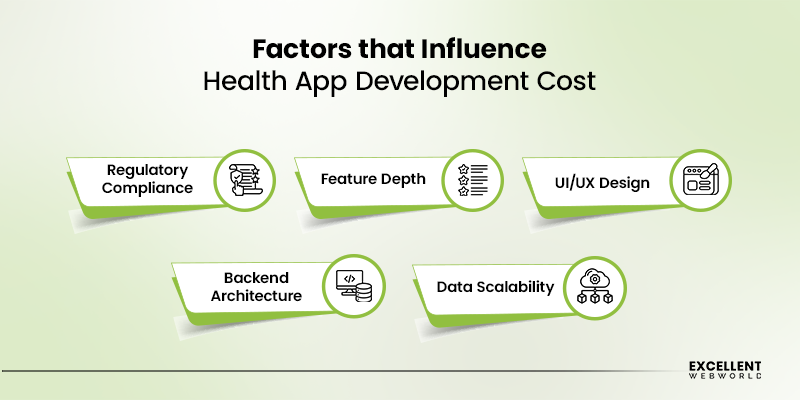
With our experience in developing a healthcare app, we can say that two healthcare founders can build a similar app and pay very different amounts. These are the factors that influence the cost of custom healthcare app development:
1. Regulatory Compliance: HIPAA, GDPR, and FDA Standards
You should give compliance its due importance when considering the cost to build a custom healthcare mobile app, as addressing it later will be expensive.
For example, healthcare app development cost in the USA typically increases by 20-30% when HIPAA compliance is added. GDPR adds further requirements if you operate in the EU. FDA requirements apply only if your app qualifies as medical device software, in which case see our guide to medical device development. The main cost drivers are encrypted storage, audit logs, continuous monitoring, consent flows, and signed Business Associate Agreements (BAAs) with every vendor that touches PHI.
Pro Tip: You should have compliance in your day 1 plan and not after application development finishes, as that would be a costly task.
2. Feature Depth: Core vs. Advanced Functionalities
If you’re developing an enterprise-grade healthcare app, every feature carries a cost, as the feature cost table above shows. You should always start with core features like push notifications, appointment booking, and real-time chat, which are priced affordably.
Once your app is validated in the market, you should choose advanced features such as real-time synchronization with wearables, AI-driven diagnostics, or EHR/EMR integrations. However, if you opt for these features, your custom healthcare app development cost in 2026 will increase significantly.
Pro Tip: Always start with an MVP with 3-4 core features, then add advanced features as your idea is validated in the market.
3. UI/UX Design: Custom vs. Template-Based Interfaces
You can choose either of these two approaches to design your UI/UX for a healthcare application. If you choose template-based interfaces, it may cost less in the initial stages, but it will give you a very generic look and feel that can’t convert users.
On the other hand, if you want a custom UI/UX that follows current healthcare UI/UX design trends, you’ll pay a higher upfront fee, but it will pay off with unique designs that bring users back to your platform again and again.
Pro Tip: Set aside dedicated time for UI/UX research, and always conduct usability tests of your designs before finalizing them to avoid costly rebuilds.
4. Backend Architecture and Data Scalability
If you want to scale your app as your business grows, you need a solid backend architecture. A poor architecture may save you some money initially, but it may fail under heavy load and require a complete rebuild to accommodate user growth and AI-based features.
Many founders have strong ideas, but they fail because they don’t give proper attention to architecture. You should adopt cloud computing in the healthcare industry and build APIs on GCP, Azure, or AWS under a signed BAA. It eases the integration process for your application.
Pro Tip: Whenever you choose a technology partner, ask them how they will handle the 10x growth of your current load to understand their approach to architecture scalability.
Cost of Adding AI to a Healthcare App
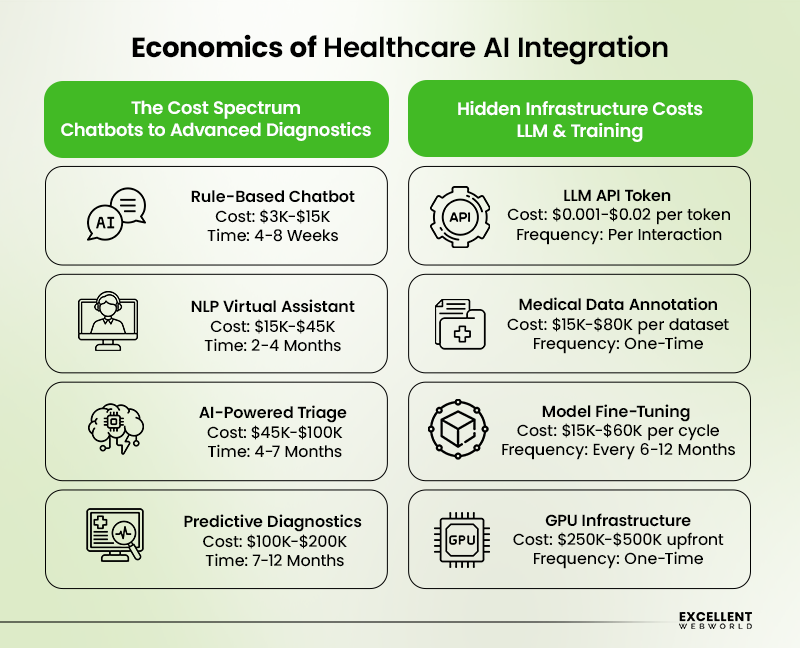
If you add AI to your healthcare application, it pushes the cost calculations to the next level. AI in healthcare statistics indicate that the global market will reach $505.59 billion by 2033. That’s why it’s hard to ignore AI while building healthcare applications nowadays. So, let’s understand how the economics of healthcare AI integration work. For a full budget by use case, read our guide to the cost of implementing AI in healthcare.
1. Basic AI Chatbots vs. Advanced Predictive Diagnostics
Chatbots in the healthcare industry can range from basic FAQ bots that provide quick answers to fully clinical decision engines. The cost of healthcare app development in 2026 varies depending on the level of intelligence and clinical validation of your AI layer. Clinical-grade AI is usually a separate budget line from the base app, and features that influence diagnosis or treatment may fall under FDA oversight. Here’s a cost breakdown by AI use case:
| AI Use Case | Average Cost | Development Time | Key Considerations |
|---|---|---|---|
| Patient Chatbots & Scheduling Automation | $10,000-$50,000 | 4-8 Weeks | Symptom FAQs, Appointment Booking, Intent Recognition, and EHR Data Access for Advanced Bots |
| Clinical Documentation & Workflow Automation | $50,000-$150,000 | 2-4 Months | Speech-to-Text, EHR Write-Back, Clinician Review Workflows, and Accuracy Testing |
| Diagnostic AI (Imaging, Computer Vision) | $100,000-$500,000+ | 4-8 Months | Model Validation, FDA Pathway, Clinical Datasets, and Continuous Monitoring |
| Predictive Analytics & Clinical Decision Support | $200,000-$1 Million+ | 6-12 Months | HIPAA/FDA Compliance, Clinical Validation, Training Data Pipelines, and Real-Time Risk Scoring |
2. Hidden Infrastructure Costs: LLM Token Pricing and Data Training
Many times, founders budget for the AI feature itself but forget the costs of LLM token usage and data training, which are key aspects of AI development.
The cost of custom healthcare development increases with LLM integration, as it comprises recurring costs such as compliant storage, token usage, and model training.
| Infrastructure Component | Estimated Cost | Frequency | What Drives The Cost |
|---|---|---|---|
| LLM API Token Usage | Priced per 1 million tokens; rates differ many times over between small and frontier models, so check current vendor pricing | Monthly, Usage-Based | Daily interactions x tokens per interaction x number of users, and the model tier you choose. |
| Medical Data Annotation | $15,000-$80,000 per dataset | One Time + Updates | The need for clinical data annotators, EHR labeling, and radiology expertise. |
| Model Fine-Tuning & Retraining | $15,000-$60,000 per cycle | Every 6-12 Months | Maintaining tighter alignment with healthcare regulations and keeping diagnoses as accurate as possible. |
| On-Premise GPU Infrastructure | $250,000-$500,000 upfront | One Time | Hospitals that need local data residency and full control of PHI. |
Here’s how to estimate token cost: add the input and output tokens for one interaction, then multiply by interactions per day, 30 days, and the price for your model tier. For example, 10,000 patient interactions a day at 2,000 tokens each is 600 million tokens a month. At an illustrative $5 per million tokens, that is about $3,000 a month, and it grows with every new user. Using the smallest model that meets your accuracy bar, caching repeated prompts, and trimming context are the main ways to keep that bill down. Check current vendor pricing before you budget.
Note: Per-token prices have fallen sharply over the last couple of years, which makes AI integration more affordable. But token usage scales with your traffic, so the monthly bill grows as your application grows. That’s why estimating AI cost before building an AI feature is vital. Our AI development services team can help you model it.
3. Modern AI Features: What They Add to the Budget
Today’s AI features, such as ambient scribes, workflow agents, and clinical knowledge assistants, add budget lines that older estimates leave out. Treat these as separate items in any quote:
| AI Capability or Budget Line | What It Covers | Typical Cost | What Drives The Cost |
|---|---|---|---|
| Ambient Scribes and Workflow Agents | Speech-to-text, note generation, prior authorization, intake, and claims workflows with approval steps. See ambient AI scribe development and AI prior authorization in healthcare. | $50,000-$150,000 | Number of connected systems, payer and clinical rules, exception handling, and clinician review steps. |
| Clinical Knowledge Assistants (Retrieval-Based) | Grounded answers over clinical guidelines or patient documents, with source citations. | Starts within the $10,000-$50,000 chatbot range and rises with EHR access | Data preparation, retrieval quality, and citation requirements. |
| Data Preparation and PHI De-Identification | Cleaning, labeling, and de-identifying data before it reaches a model. | 20-60% of the total AI project budget | Data quality, volume, and the number of source systems. |
| Evaluation, Guardrails, and Human Review | Accuracy and safety test sets, hallucination controls, and clinician-in-the-loop checks. | Budget as a recurring line item, not a one-time task | How often outputs influence care decisions and the risk level of the feature. |
| HIPAA-Eligible Model Hosting | Model access under a signed BAA, zero data retention, and private networking. | Setup cost plus usage-based fees | Vendor, model tier, and data residency needs. |
| EHR Read and Write-Back for AI Features | Letting AI features pull data from the EHR and write notes back into it. See AI for EHR. | $20,000-$100,000+ | Number of EHRs, write-back scope, and vendor onboarding time. |
| Monitoring, Retraining, and Compliance Updates | Drift and accuracy monitoring, audit logs, and model updates. | Retraining $15,000-$60,000 per cycle; compliance updates $20,000-$200,000 annually | Model change frequency and regulatory scope. |
Features that influence diagnosis or treatment decisions may also trigger an FDA pathway, which adds validation cost. For full ranges by use case and total cost of ownership, read our cost of implementing AI in healthcare guide.
Healthcare App Developer Hourly Rates by Region
When building a healthcare app, you can hire a dedicated development team tailored to your project’s needs. This team typically includes developers, designers, QA engineers, and a project manager, everyone needed to take your app from idea to launch. If you prefer a dedicated team, see how to hire dedicated developers.
Many founders go global to optimize the cost of medical app development. And where you hire matters: developers from the US or Europe can cost 3-5 times as much as equally skilled teams from India or Southeast Asia.
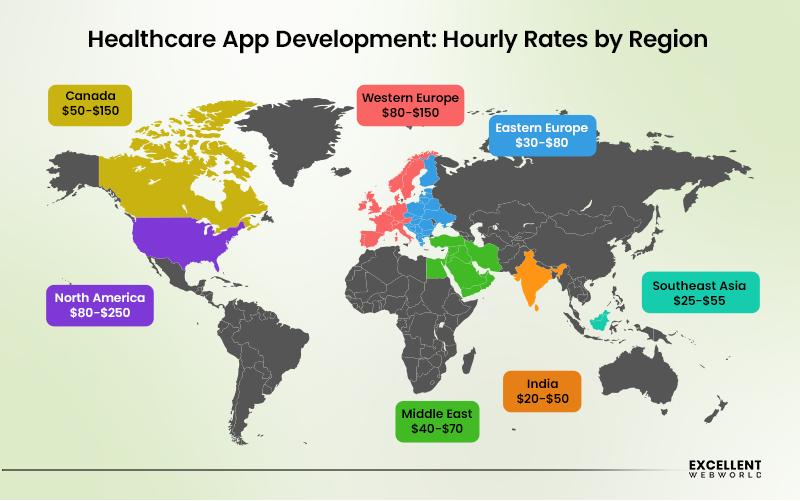
| Region | Hourly Rate | Best For |
|---|---|---|
| United States | $80-$250 | Founders who are looking for partners who understand state compliance rules and have expertise in HIPAA compliance. |
| Canada | $50-$150 | Companies that want to build a high-quality healthcare application at the same quality as the US, but at a lower price. |
| Western Europe | $80-$150 | Organizations that want to target the European audience with their healthcare applications need a GDPR-first architecture. |
| Eastern Europe | $30-$80 | Healthcare entrepreneurs who want a fine balance of cost and quality while developing a world-class health tech app. |
| Middle East | $40-$70 | Founders who are focusing on regional healthcare platforms and want a tighter alignment with local regulations. |
| India | $20-$50 | Healthcare entrepreneurs who are looking to enter the market quickly and want to build an MVP in a budget-friendly manner. |
| Southeast Asia | $25-$55 | Startup founders who want to build a healthcare app affordably, while also needing flexibility in team scaling. |
Note: When selecting a developer, don’t always choose the cheapest option. You should always consider their healthcare experience, HIPAA compliance knowledge, and ability to scale in high-load environments. With AI-assisted delivery, hours alone are a weaker measure of value, so ask for a fixed scope with defined deliverables alongside the hourly rate.
Healthcare App Development Cost by Engagement Model
Knowing the hourly rates is only half the picture. To calculate the complete cost, you also need to understand the engagement model for that particular region. The reason is that the same developers in the same region cost you differently depending on their engagement models.
Here are the types of engagement models for healthcare app development. Figures are annual per-team estimates, vary with team size and seniority, and currency conversions are approximate:
| Engagement Model | USA | Dubai (UAE) | KSA | Kuwait | Qatar | Singapore | Europe | Africa |
|---|---|---|---|---|---|---|---|---|
| In-House Team | $430K-$1.1M/yr | AED 1.1M-2.8M ($300K-$762K)/yr | SAR 1.5M-3.8M ($400K-$1.01M)/yr | KWD 225K-565K ($737K-$1.85M)/yr | QAR 1.75M-4.4M ($481K-$1.2M)/yr | SGD 875K-2.25M ($650K-$1.69M)/yr | €625K-€1.75M ($675K-$1.89M)/yr | $100K-$350K/yr |
| Dedicated offshore team | $100K-$230K/yr | AED 230K-600K ($63K-$163K)/yr | SAR 210K-565K ($56K-$151K)/yr | KWD 15K-43K ($49K-$141K)/yr | QAR 182K-500K ($50K-$137K)/yr | SGD 80K-224K ($60K-$168K)/yr | €75K-€200K ($81K-$216K)/yr | $38K-$113K/yr |
| Onsite dedicated team | $275K-$530K/yr | AED 550K-1.2M ($150K-$327K)/yr | SAR 470K-1.08M ($125K-$288K)/yr | KWD 35K-78K ($115K-$256K)/yr | QAR 455K-1M ($125K-$275K)/yr | SGD 288K-610K ($215K-$457K)/yr | €200K-€450K ($216K-$486K)/yr | $63K-$175K/yr |
| End-to-end outsource | $75K-$260K fixed | AED 185K-695K ($50K-$189K) fixed | SAR 164K-610K ($44K-$163K) fixed | KWD 11.5K-39K ($38K-$128K) fixed | QAR 159K-545K ($44K-$150K) fixed | SGD 80K-288K ($60K-$216K) fixed | €63K-€250K ($68K-$270K) fixed | $25K-$100K fixed |
Hidden and Recurring Healthcare App Costs
Until the development stage, there is a high chance that healthcare founders get the budget spot-on. However, most forget about the hidden, recurring expenses that add up in the budget. Here’s what you should keep in mind:
1. Annual Maintenance and Security Patches
As a healthcare founder or entrepreneur, if you want an accurate health and fitness app development cost, then you need to budget 15-25% of your initial build cost every year for maintenance. You need to constantly update your app to stay relevant in the market, which comprises activities such as bug fixes, performance monitoring, security patches, and OS updates.
| App Type | Annual Maintenance Cost | What’s Covered |
|---|---|---|
| Simple MVP | $4,000-$10,000/year | Basic security patches, OS updates, and bug fixing. |
| Mid-Complexity App | $8,000-$25,000/year | Feature enhancements, compliance updates, and security monitoring. |
| Complex Enterprise App | $20,000-$85,000/year | 24/7 monitoring, regulatory reporting, penetration testing, and infrastructure scaling. |
2. Third-Party API Licensing: EHR, Video, and Payments
Any healthcare application requires custom APIs or third-party integrations for EHR/EMR systems, video consultations, payments, and more, which can cost $10,000 to $50,000 and incur recurring fees.
| API Type | Estimated Cost |
|---|---|
| EHR Integration (Epic, Oracle Health/Cerner) | $10,000-$50,000 one time + ongoing fees |
| Video Consultation (Twilio, Zoom SDK) | $500-$5,000/month |
| Payment Gateway (Stripe, Braintree) | 2.9% + $0.30 per transaction (typical standard US rate; confirm with your provider) |
| IoT in Healthcare & Wearable APIs | $200-$2,000/month |
3. Compliance Audits and Cyber-Security Testing
Compliance is not a one-time exercise, as healthcare regulations continue to change. As a result, you need to update your policies, conduct security audits, and run penetration testing to keep your application compliant with the latest standards.
Secure development frameworks such as OWASP guide how you build, and standards such as HL7, DICOM (for imaging), ICD-10, and CPT matter if your app handles clinical data, imaging, or billing. Here are the compliance costs you need to be aware of:
| Compliance Activity | Estimated Cost | Frequency |
|---|---|---|
| HIPAA Compliance Audit | $5,000-$15,000 | Annually |
| Penetration Testing | $5,000-$20,000 | Twice a Year |
| Security Vulnerability Assessment | $3,000-$10,000 | Quarterly |
| SOC 2 Type II Attestation | $30,000-$100,000 | Annually |
4. HIPAA-Eligible Cloud Hosting and Infrastructure
Hosting is only HIPAA-compliant when your cloud provider has signed a Business Associate Agreement (BAA) with you and the environment is configured correctly. AWS, Azure, and Google Cloud offer HIPAA-eligible services, but eligibility is not compliance, so ask any vendor who signs the BAA and who configures the environment. Explore our cloud services and solutions if you need help with setup.
| App Complexity | Typical Monthly Hosting Cost | What’s Covered |
|---|---|---|
| Simple MVP | $300-$1,000/month | HIPAA-eligible compute and database, encrypted backups, logging, and basic monitoring. |
| Mid-Complexity App | $1,000-$5,000/month | Auto-scaling, web application firewall, redundancy, and video and messaging infrastructure. |
| Complex Enterprise App | $5,000-$25,000+/month | Multi-region setup, advanced monitoring, data residency controls, and dedicated security tooling. |
How to Reduce Healthcare App Development Cost
Reducing healthcare app development cost doesn’t mean you need to cut essential functionality or sacrifice modern-day features. There are five smart ways that you can implement to save your healthcare app development cost:
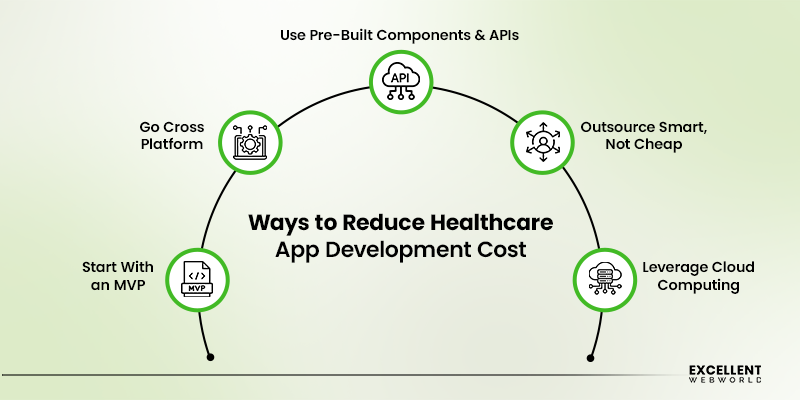
1. Launch Lean: Start With an MVP
You should always focus on what users need, not on what looks good. You should start by building a clean and lean MVP for your healthcare application with minimal features. It will help you to validate your idea in the market, gain traction, and secure funding from investors. See our breakdown of the cost of MVP development or explore our MVP development services.
2. Go Cross-Platform From Day One
If you opt for separate Android and iOS apps, the cost will be much higher than with cross-platform development, which reduces costs by 30-40%. So, you should consider Flutter or React Native to build healthcare apps from day 1. Keep native modules for features that need deep device integration, such as HealthKit or Health Connect.
3. Use Pre-Built Components and Certified APIs
You shouldn’t build everything from scratch, as it takes a lot of time and significantly increases your costs. Instead, you should use pre-built components and APIs from reputable third-party vendors, which help you save weeks of development time and thousands of dollars.
4. Outsource Smart, Not Cheap
The cheapest hiring option is not always the smartest choice for building a healthcare application. You can take advantage of offshore outsourcing, which can reduce overall costs by up to 40-60% compared with US-based teams, depending on scope. However, choose a partner with experience navigating healthcare challenges.
5. Let the Cloud Do the Heavy Lifting
You should always use cloud infrastructure platforms like AWS, GCP, or Azure, under a signed BAA, as they automatically handle scaling issues and save the cost you were previously spending on on-premises servers. For example, if a healthcare app uses an AI virtual health assistant, managing it on cloud infrastructure can help you optimize costs.
Who Owns the Code and IP? What to Ask Before You Sign
Cost is only part of the decision. The contract decides what you actually own when the project ends. Ask every agency these questions before you sign:
- Who owns the source code, designs, and documentation after final payment? (It should be you.)
- Will the code be delivered to a repository you control, and how often?
- Which third-party libraries, SDKs, and licenses are in the build, and who pays the recurring fees?
- Who owns the data, trained models, and datasets?
- Will they sign a BAA and explain how PHI is handled in development and testing environments?
- Which parts of compliance (HIPAA, GDPR, FDA) are in scope, and which stay with you?
- Does hosting run in your cloud account or theirs, and who holds the credentials?
- What does the warranty or bug-fix period cover, and for how long?
- How are change requests priced, and what triggers a re-estimate?
- What does handover look like if you switch vendors, including documentation, knowledge transfer, and access?
Have a lawyer review the agreement. This list is a starting point, not legal advice.
Why Choose Excellent Webworld for Healthcare App Development?
So far, you must have gotten an idea of what drives the cost of healthcare app development. However, the next step is to find a tech partner that understands these things and helps you develop a world-class healthcare application within your desired budget.
That’s where Excellent Webworld, a top-rated healthcare app development company, comes into the picture. Explore our full range of healthcare software development services as well.
Our track record speaks for itself:
- 15+ years of experience in HIPAA-compliant healthcare solutions
- 100+ digital health platforms delivered across telemedicine, RPM, EHR integration, and mental health
- 80+ healthcare clients served globally, from early-stage startups to enterprise health systems
- 50+ telehealth solutions deployed on secure cloud infrastructure
- Recognized by Clutch and business directories like GoodFirms and Top Developers for AI engineering and software development
- Experience with HIPAA and GDPR requirements and HL7/FHIR integrations
Here’s what you will get by partnering with us:
- A fixed-cost MVP package for early-stage founders
- HIPAA and GDPR-compliant healthcare applications
- AI, IoT, and EHR integration expertise
- Post-launch maintenance and compliance support
- A dedicated project manager from the beginning to the launch
So, book a 30-min free consultation call with our experts and get a customized cost estimate before committing a single penny.
FAQs Related To Healthcare App Development Cost
The average cost to develop a healthcare app in 2026 ranges from $20,000 to $350,000+, depending on complexity and features. A simple MVP costs around $20,000 to $40,000, a mid-complexity app around $40,000 to $100,000, and a complex enterprise platform around $100,000 to $350,000+.
HIPAA compliance typically adds 20 to 30% to the development budget, covering encrypted storage, audit logs, consent flows, and signed BAAs with vendors. You also need recurring costs for audits, penetration testing, and monitoring, which are broken down in the compliance cost table above.
Plan for 15 to 25% of the initial build cost per year. That is roughly $4,000 to $10,000 for a simple MVP, $8,000 to $25,000 for a mid-complexity app, and $20,000 to $85,000 for a complex enterprise platform, driven by security patches, compliance updates, and OS updates.
A simple MVP takes 2 to 4 months, a mid-complexity app 4 to 7 months, and a complex enterprise platform 7 to 12 months. Compliance reviews, EHR integrations, and AI validation add time, so confirm your scope before you commit to a launch date.
If you want to save costs, you should definitely opt for cross-platform app development, as it can reduce development costs by 40-60% compared to native apps, making it an ideal choice for MVP development. You can use frameworks like Flutter or React Native for that purpose.
There are multiple ways healthcare apps can generate revenue, including freemium models, subscription plans, in-app advertising, and in-app purchases for personalized health plans.
The biggest factors are data preparation and cleaning, integration with legacy EHR systems, regulatory compliance, high-performance infrastructure, and ongoing maintenance. LLM token usage also grows with traffic, so estimate it before you build any AI feature.

Article By


Mahil Jasani began his career as a developer and progressed to become the COO of Excellent Webworld. He uses his technical experience to tackle any challenge that arises in any department, be it development, management, operations, or finance.