An eCommerce order doesn't end when a customer clicks “Buy.” Multiple processes are activated behind that single action. Payment verification, inventory updates, order confirmation, shipping coordination, invoicing, customer notifications, and returns involve repetitive tasks. These tasks can strain eCommerce operations.
Robotic Process Automation (RPA) uses software bots to streamline repetitive, rule-based digital tasks. In RPA in eCommerce, these capabilities support workflows across orders, inventory, payments, invoicing, returns, and customer service. RPA bots handle predefined tasks automatically, while people manage exceptions, approvals, and decisions that need human judgment.
The statistics support this broader shift. As per GrandViewResearch, the global RPA market is expected to grow from $4.7 billion in 2025 to $35.8 billion by 2033, at a CAGR of 29.0%.
Separately, 77.2% of eCommerce professionals reported using AI and automation to perform various tasks, which is up from 69.3% in 2024. Together, these figures indicate why automation is becoming a non-negotiable part of eCommerce operations.
I have spent 15+ years delivering eCommerce solutions for startups to enterprises worldwide. Many businesses have noticed the benefits of using RPA in eCommerce. These include lighter workloads, more consistent processes, and faster execution.
You can only see these gains when you plan automation early, not bolt it on later. That's why we include RPA during eCommerce app development, not as an afterthought.
In this guide, I’ll outline how to implement RPA in eCommerce. I'll cover everything from finding the right processes to expanding automation across your operations.
What is RPA in eCommerce?
Robotic Process Automation (RPA) in e-commerce is known as the use of software bots to automate, repetitive rule-based, high-volume retail operations.
Instead of requiring deep third-party integrations, RPA bots operate at a basic UI level and mimic human actions such as logging into systems, copying and pasting data, filling out forms, checking refunds, sending customer notifications, triggering cross-platform workflows. Bots follow predefined workflows, while employees deal with exceptions, approvals, and decisions that need human judgment.
The strongest use cases comprise structured data, predefined rules, and high-volume tasks. RPA works well with existing eCommerce platforms, marketplaces, ERP systems, payment gateways, and other business applications without the need to replace any underlying system.
Why RPA Is a 2026 Priority for Ecommerce Leaders
As ecommerce operations grow more complex, RPA gives leaders a practical way to improve efficiency without adding more manual work.
The ROI Case (Cost, Speed, Error Reduction)
The conversation around robotic process automation ROI in eCommerce has moved beyond simple time savings. In eCommerce, many tasks repeat. So, even small inefficiencies can drive operational costs to a new level. RPA takes care of these tasks. It brings clear benefits in cost, speed, accuracy, and operational capacity.
The strongest RPA use cases in eCommerce share several common attributes. These comprise high transaction volumes, predictable rules, and measurable manual effort. Order entry, inventory sync, invoice matching, and returns processing are areas that require greater optimization. The goal isn’t to automate everything. Instead, it’s to automate processes that clearly show financial and operational benefits.
| Metric | What the Data Shows |
|---|---|
| Typical ROI | 100–200% within the first year; some high-volume tasks report up to 10x returns |
| Operational cost reduction | 15-60% on automated, high-volume workflows |
| Payback period | 6–12 months for most eCommerce RPA deployments |
| Error-related cost | A single manual data-entry error can cost $50–$200 to fix, while RPA eliminates errors at the source |
RPA as the Foundation for Agentic Commerce Readiness
Picture an AI shopping assistant. It scans the store at night, checking inventory and prices. Then, it suggests the best products. If the data is outdated or inconsistent, the AI agent skips the product altogether.
Most RPA discussions miss this connection. The same clean, structured data RPA requires is also what AI shopping agents need to process any transaction across an online store. Commerce is shifting to AI platforms across different eCommerce business models. Examples include OpenAI and Stripe’s Agentic Commerce Protocol (ACP) and Google’s Universal Commerce Protocol (UCP).
The protocols let AI agents connect with merchants. They can access product data and help with commerce transactions. For merchants, this creates a new operational need. They must keep product info, pricing, stock, order status, and fulfillment data accurate. This data should also be easy to access across all systems. When merchants fail to maintain information, AI agents struggle to work with their stores.
This is where RPA is beneficial. RPA makes repetitive tasks easier and keeps operations running smoothly. Meanwhile, API, structured data, integrations, and AI are key to agentic commerce architecture.
In other words, adopting RPA isn’t only about decreasing operational costs. RPA, when done right, enhances the automation readiness that merchants need. This is especially important for agentic commerce automation readiness as eCommerce shifts towards AI-driven discovery, decision-making, and transactions.
How to Implement RPA in Ecommerce: Step-by-Step Process
RPA implementation in ecommerce brings a structured approach to introducing automation across business operations.
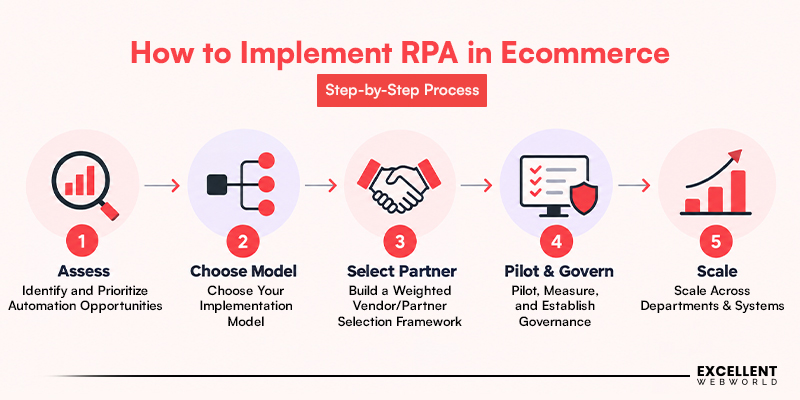
Step 1: Identify and Prioritize Automation Opportunities
Start with an audit to find areas where automation can create a measurable business impact, not where the process looks repetitive. In simple words, avoid the mistake of buying RPA software before identifying the operational problem it needs to solve.
Identify key workflows across your eCommerce operations. Look for repetitive, rule-based tasks that take up a lot of time. Check where these tasks cause more errors, higher exception rates, and increased costs.
High-Value Processes to Automate
Here are the six high-value processes where RPA use cases in eCommerce can deliver measurable results:
- Order Management: Order validation, payment reconciliation, status updates, and other order-to-cash workflows
- Inventory: Cross-channel stock sync across Shopify, Amazon, marketplaces, and POS, and availability checks.
- Returns: Return validation, refund processing, customer notifications
- Invoicing: Invoice matching, purchase order processing, OCR-based document processing, and reconciliation
- Pricing: Process pricing and promotion updates across channels
- Customer Service: Customer notifications, data updates, and routine request handling
These workflows offer simple ways to boost speed, accuracy, and efficiency. You can improve these areas without changing existing business processes.
A strong RPA opportunity follows clear rules. It uses stable inputs and produces predictable outcomes. Also, it has enough transaction volume to make automation worthwhile.
Process Mapping and Feasibility Assessment
Map each shortlisted workflow from start to finish.
- Create a file listing the systems involved, including OMS, ERP, eCommerce systems, and other connected applications.
- Include decision rules.
- Note manual touchpoints.
- Identify data dependencies.
- Outline exception paths.
- Document transfers between teams.
Not every process in the document needs a separate bot.
Next, access each workflow against the following factors to determine its automation feasibility and business value:
| Assessment factor | What to evaluate |
|---|---|
| Transaction volume | How often does the process run, and how much manual effort does it require? |
| Rule consistency | Do simple & straightforward rules handle most transactions? |
| Error rate | How frequently do manual errors affect accuracy, cost, or customer experience? |
| Integration complexity | Can RPA connect well with the needed systems, applications, data, OMS, ERP, and eCommerce platforms? |
| Exception frequency | How often does the workflow need human intervention or special handling? |
| Expected ROI | Can automation deliver measurable savings, productivity gains, or service improvements? |
For 2026 and beyond, intelligent process automation (IPA) in eCommerce operations depends on clean, mapped processes. Defined processes provide AI shopping agents with enough data to execute tasks.
It allows enterprises to build an RPA implementation roadmap for eCommerce that progresses toward AI-based automation.
Step 2: Choose Your Implementation Model
Most guides in RPA for eCommerce skip this step. Yet, it’s crucial. It can determine if the rollout succeeds or stalls within six months. The choice of the right implementation model depends on several factors. These include complexity, integration needs, control requirements, and how much the automation strategy needs to change.
Never consider an RPA model just on the basis of licensing cost. Assess how this approach fits your eCommerce store. Also, check if it adapts to automation as your business expands.
| Factor | Off-the-Shelf Platform | Hybrid/ Extended RPA | Custom-Built Automation |
|---|---|---|---|
| Best for | Platforms such as UiPath, Automation Anywhere, and Microsoft Power Automate work well for standard workflows, and offer connectors for eCommerce platforms, such as Shopify and WooCommerce. | Workflows depend heavily on APIs, custom logic, or AI capabilities | Complex or legacy ERP/CRM integrations, proprietary workflows |
| Time to deploy | Fast for supported processes | Moderate, depending on the third-party integrations | Longer deployment time due to custom development and integration requirements |
| Flexibility | Relies on the platform's pre-built connectors and platform capabilities | Excellent with APIs, scripts, orchestration, and extensions, supporting unattended and attended bot deployments | Highest, with architecture tailored to your systems and rules |
| Long-term cost | Lower initial cost, but licensing cost increases with volume | Moderate, with platform and integration costs | Higher upfront and maintenance cost |
| Where it breaks down | Complex exceptions, unsupported systems, and highly customized workflows | Needs robust integration architecture and technical expertise | Requires specialized expertise in eCommerce, automation, integration, and ongoing maintenance |
For most of the enterprises and businesses, a single approach is not sustainable for every workflow.
Standard processes use an off-the-shelf approach when the workflow is fixed. This means they rarely need exceptions. Depending on the level of human involvement, these workflows can use attended bots for employee-assisted tasks or unattended bots for fully automated, scheduled processes.
Complex workflows that require third-party integrations and high judgment calls need custom development. This approach keeps RPA implementation costs for ecommerce aligned with actual business complexity.
For 2026 and beyond, check if the chosen model supports:
- eCommerce automation with RPA and AI
- Intelligent exception handling
- Agent-based workflows, not just rule-based tasks
RPA implement cost for eCommerce ranges from $10,000 to $150,000 based on the model, workflow complexity, integrations, licensing, and ongoing maintenance. Off-the-shelf tools can reduce the initial development costs, while hybrid and custom approaches need high-amount of investment. The right model should align well with the complexity and scale of the workflows you plan to automate.
Step 3: Build a Weighted Vendor/Partner Selection Framework
A vendor demo showcases what a vendor assists you in achieving in standard conditions, not your technology stack. Therefore, never choose a vendor based on market reputation or by comparing it with a competitor’s tech stack.
A robust RPA vendor selection framework turns a simple evaluation into a measurable decision. Score each candidate based on your needs and preferences. Focus on integration, security, cost, support, experience, and scalability. Don’t base your decision on their pitch deck.
| Criteria | Weight | What to Evaluate |
|---|---|---|
| Technical & Integration Depth | 25% | Does it connect natively with ERP, CRM, eCommerce platform, API, or current automation stack? |
| Security & Compliance | 20% | What steps are taken to protect customer, payment, business, and AI data throughout workflows? |
| Total Cost of Ownership | 20% | What will be the cost of licensing, implementation, infrastructure, maintenance, and support over the next 3 years? |
| Implementation track record | 15% | Does the vendor have expertise in eCommerce deployments instead of just generic case studies? |
| Support & SLA terms | 10% | What response times, escalation paths, tracking, and uptime guarantees are involved? |
| Scalability | 10% | Can a solution manage seasonal peaks, like Black Friday and Cyber Monday? Can it handle higher transaction volumes and new automation tasks? |
Technical and integration fit hold the highest weight for a reason. A platform that struggles to integrate well with your existing CRM or ERP will fail before you streamline even one order. RPA vendor selection framework scoring exists to identify bottlenecks before finalization, not after.
Moreover, I suggest never choosing a partner based on score alone. It’s always better to run a Request for Information (RFI) across a broad range of vendors and then narrow down to a Request for Proposal (RFP) with only 2 to 3 finalists.
If your structure needs high-end integration, check the provider’s eCommerce development services skills. Also, look at their RPA capabilities.
Starting in 2026, vendors will need to be evaluated on how candidates handle AI automation, agentic workflows, data governance, and human oversight. A partner should meet your current RPA needs and scale whenever required.
Step 4: Pilot, Measure, and Establish Governance
A pilot without a governance dashboard is not a test run. It is primarily an unsupervised risk without clear visibility into performance, exceptions, and outcomes.
Choosing a Pilot Workflow
Never launch RPA across an eCommerce organization in the most complex workflows. Choose a closed, high-volume workflow with clear rules. Then, assess baseline performance and keep operational risk in check. Order status updates, invoice matching, and inventory checks are key areas for an RPA pilot program in eCommerce.
Measuring What Actually Changes
Define what you want to achieve before the pilot begins. Compare the automated workflow with the pre-automation.
- Processing time: How much time does the workflow take compared with the current manual average?
- Error rate: How many manual errors, exceptions, and mismatches does automation eliminate compared with the pre-automation baseline?
- Exception Volume: How much human intervention remains necessary?
- Cost per transaction: What is the operational cost per transaction vs. manual labor cost after automation?
- Human effort: What amount of manual work does the workflow remove?
A successful pilot shouldn't limit itself to technical feasibility. It should show if RPA in eCommerce provides clear operational value. Also, it needs to confirm if the workflow is stable enough to scale.
Governance, Compliance, and Exception Handling
Governance is not a phase-two afterthought. Consider governance in the pilot from day one.
- Cross-functional ownership: IT, operations, and business stakeholders make pilot decisions
- Exception handling: Defined set of rules when the bot comes up with an unexpected order, data mismatch, or process exception
- Audit Trail and Access Controls: Keep logs and ensure proper access controls. This is key for compliance, security, and data privacy reviews including PDI CSS requirements for applicable payment-related workflows.
- Post-launch accountability: A designated owner tracks the bot’s performances. They resolve recurring issues and approve any workflow changes after launch.
Step 5: Scale Across Departments and Systems
Once the pilot project shows its worth, we should expand RPA in eCommerce. We should think about dependencies, transaction volume, and business impact. It’s important to look beyond just departmental convenience. Begin with associated workflows where proven automation can support the next stage.
Cross-Functional Rollout Sequencing
A practical sequence for RPA in eCommerce is followed by enterprises worldwide. It starts with order management to inventory, returns, customer service triage, and supplier or vendor workflows. Every stage should revisit the same automation process. Add controls for new systems, data sources, and exceptions as needed.
In our multi vendor super app marketplace project, we ensured live data works in sync across 12+ partner platforms. Microservices kept each partner's data isolated, so one slow response never disrupted another.
Integrating RPA with AI Agents (Hyperautomation)
This is where eCommerce automation meets RPA and AI. The industry calls this hyperautomation in eCommerce operations, where rule-based agents manage predictable, high-volume tasks. In contrast, AI agents spot exceptions like policy-sensitive returns, fraud signals, or mismatched SKUs. They also decide the next action.
The result of this is a hyperautomation model that manages advanced operational complexity. It includes flash sales, supply disruptions, or sudden spikes. These are emerging eCommerce trends that change customer expectations, demand patterns, and fulfillment needs.
Common RPA Rollout Failures and How to Avoid Them
Most RPA in eCommerce failures don’t just happen because of the bot itself, but they occur after a few months because of weak process selection. Other causes include lack of proper ownership, poor vendor choice, and scaling automation before the operational model is ready.
Here are six patterns to ensure your RPA implementation roadmap for eCommerce runs smoothly. This helps keep a successful pilot from becoming a stalled automation program.
| Failure Mode | Root Cause | How to Avoid It |
|---|---|---|
| Pilot succeeds, scale-up becomes hard | Governance & ownership aren’t properly defined during pilot | Set proper ownership, control, rules for scaling, and success criteria before even the pilot begins |
| Bot stops working during peak season | Rigid rules can’t manage exceptions, system changes, or instant volume of transactions | Connect RPA with AI for handling exceptions in edge cases. Test peak workloads, set retry and recovery rules, and maintain human fallback paths |
| Businesses hand automation to IT and walk away | Enterprise owners skip process design, KPI definition, exception handling, and adoption. They aren’t responsible for any outcomes | Assign an enterprise owner to oversee business outcomes. Meanwhile, the IT team will manage technical delivery and platform controls |
| Vendor doesn't fit actual stack | Selection is based on brand reputation or feature lists. It doesn’t focus on integration, security, or workflow needs | Validate the vendor using a weighted framework. Focus on your ERP, CRM, and eCommerce platform. Also, check APIs, security controls, and real RPA use cases in eCommerce |
| ROI is hard to prove to the board | No baseline exists for time, cost, errors, or throughput before rollout begins | Measure baseline metrics such as processing time, error rate, and cost per transaction before starting deployment |
| AI-powered automation creates unreliable decisions | AI is integrated with a set of autonomy lists, validation, tracking, or human escalation | Define boundaries, set AI outputs, track performance, and forward complex or uncertain cases to human reviewers |
For 2026 and beyond, businesses should consider AI as an extension to automation structure instead of just adding AI to existing bots. Governance should include data access, human oversight, tracking, auditability, and escalation as AI handles varied operational tasks.
For teams moving from RPA to AI-based eCommerce, knowing the benefits of AI in eCommerce will allow them to connect automation investments with wider business outcomes.
RPA and Agentic Commerce: Preparing for the Next Phase
The practical difference between RPA and Agentic Commerce lies in how each handles operational tasks. RPA follows defined rules across repeatable processes, such as order management, inventory updates, returns, and reconciliation. Agentic commerce uses AI agents to interpret context, explore products, check options, interact with commerce systems, and complete approved actions within defined boundaries.
These capabilities can work as complementary layers. RPA offers reliable execution for structured, high-value processes, while AI agents deal with tasks that need greater context and decision flexibility. The result is an automation model where deterministic workflows and adaptive AI capabilities can operate within the same eCommerce environment.
For RPA in eCommerce, we shouldn't replace bots with agents. Instead, we should create automation that connects directly to APIs, commerce platforms, and AI systems. This will improve our operating model without discarding proven automation workflows.
For eCommerce businesses and enterprises reviewing varied platforms or exploring AI-powered visual search, it's time to think about automation, data structure, and agent-ready interfaces working in sync rather than as separate technology projects.
Conclusion
RPA in eCommerce should not be considered as a collection of bots added to isolated tasks. The main value comes from engineering connected workflows. They cut effort, boost operational control, and create a strong base for AI-driven automation. In the next few years, eCommerce automation will focus on three key areas: exception handling, connected systems, and emerging agentic commerce.
At Excellent Webworld, we see automation as a key part of our business. It applies to inventory, orders, and returns, not just as a one-time implementation. We combine eCommerce engineering, automation expertise, and AI agent development to engineer systems that scale as operations and business needs evolve.
Frequently Asked Questions
RPA in eCommerce uses software to execute repetitive, rule-based tasks across business systems, such as inventory and order updates. AI agents differ from RPA: they reason, adapt, and handle exceptions to resolve various ambiguous cases that fixed rules can’t resolve.
Implementing RPA in eCommerce business usually takes about 4 to 16 weeks or more. The timeline depends on complexity, integration needs, security reviews, testing, and the total workflows being automated.
The RPA implementation cost for eCommerce companies can range from $10,000 to $150,000. Businesses should consider this alongside their eCommerce app development cost when planning broader digital investments. It varies depending on the scope, platform, integrations, and customization. Apart from this, the cost of licensing, development, infrastructure, maintenance, security, and AI capabilities should be considered
Start with the highest-volume, most rule-based workflows such as order management, inventory reconciliation, returns, invoicing, and data synchronization. Prioritize workflows with measurable manual effort, error rates, and operational costs.
An off-the-shelf platform works well for standard, high-volume workflows on platforms like Shopify. A custom RPA development company becomes more relevant when enterprises need complex integrations, proprietary logic, legacy-system support, or AI-enabled automation.
RPA ROI timelines vary by workflow and implementation scope. Enterprises should define baseline costs, processing times, error rates, and transaction volumes before measuring automation-driven savings and productivity gains.
RPA can strengthen the structured workflows and system integrations that AI-driven commerce depends on. Combined with reliable data, APIs, governance, and human oversight, automation can support future agentic commerce initiatives.
RPA implementations commonly struggle when processes are not properly defined, third-party integrations are overlooked, or governance starts too late. Weak baseline metrics, limited business ownership, inadequate exception handling, and poor scalability affect enterprise adoption.

Article By


Mayur Panchal is the CTO of Excellent Webworld. With his skills and expertise, he stays updated with industry trends and utilizes his technical expertise to address problems faced by entrepreneurs and startup owners.