If your customer support team spends a massive amount of time handling “Where is my order?” and other routine queries, the problem is not whether every customer gets an answer. It is how much human capacity and investment your business needs to keep answering them as your eCommerce operations grow.
As support volume grows, businesses need to find ways to handle routine requests without adding more human agents at the same rate. Streamlining routine tasks can help teams invest their time in complex issues, high-value customers, and conversations that directly influence purchases.
An AI customer service agent is not just a chatbot with better copy, but also an infrastructure that connects customer queries with business data and workflows to provide more contextual support. And it cuts back overhead expenditure as you scale your business.
The numbers indicate this shift. Salesforce reports that service teams estimate AI handles 30% of cases today and expect that share to reach 50% by 2027.
After 15+ years delivering digital transformation products to enterprises globally, I have seen how customer support evolves with complex eCommerce operations. Our experience delivering ecommerce development services points to one lesson: scalable support relies on connecting conversations with the systems behind them.
In this blog, I’ll break down what an AI customer service agent for ecommerce can do, its real ROI, whether to build or buy one, and what founders and CTOs should evaluate before deployment.
How Manual Support Drives Up eCommerce Customer Service Costs?
Manual support becomes expensive when order volumes are higher than available stock. A customer asking for a product size or stock at 11 PM might not wait for the next day. The same is true for routine queries or order updates that keep human agents engaged.
Consumer expectations are increasing year on year. HubSpot’s State of Service research found that 82% of customers expect their issues to be resolved immediately, while 78% expect more personalized interactions. Hence, small to big eCommerce businesses find it hard to deliver fast and personalized support with a human team alone.
A bigger issue is not only response time but also where human attention is spent. WISMO requests, order updates, and return questions consume precious time of human agents.
But in reality, this time should be utilized in ways that could otherwise support complex cases and high-intent buyers. An AI customer service agent can deal with all routine queries, thus freeing time for human agents to spend where it matters most.
Where Manual Support Costs You vs. Where AI Can Change the Equation
| Factor | Manual Support | Business Impact |
|---|---|---|
| Availability | Human teams have limited staffing and fixed hours. | Missed off-hours conversations can lead to lost sales opportunities. |
| Repetitive Queries | WISMO requests, order updates, and routine support questions dominate ticket volume | Skilled agents spend valuable time on low-impact queries, instead of complex cases and high-intent customers. |
| Cost per Resolution | Every manually handled ticket consumes human time and resources regardless of complexity. | Support costs vary by channel and increase with high ticket volume and customer interactions. |
| Pre-purchase Inquiries | Product & stock answers remain unanswered outside business hours. | Delayed answers can weaken purchase intent and result in cart abandonment. |
What an AI Customer Service Agent Actually Does (Beyond Chatbots)?
The distinction between an AI agent vs chatbot for an online store comes down to one thing. A chatbot is built with the intention of answering questions from a predefined script. An AI customer service agent goes further by understanding intent, retrieving relevant customer and order data, reasoning through multi-step requests, and taking approved actions.
The industry now gives importance to agentic AI systems that can decide and execute tasks instead of waiting for a human to take requests and approve steps, a shift that mirrors the broader move from Agentic RAG vs Traditional RAG in how AI systems retrieve and act on information. This shift is also driving demand for AI development services that can support more specialized business workflows.
In ecommerce, the distinction is clear because customers have many questions before and after a purchase. Here are some of the most common AI agent use cases for eCommerce:
- Order status and WISMO (Where Is My Order?) requests by fetching shipment and fulfillment details in real time rather than redirecting customers to the order page.
- Returns and Exchanges by checking eligibility, explaining store policies and approving requests in real-time.
- Refund Status updates such as processed, issued, or pending, fetched instantly from payment records.
- Order Cancellations by verifying the order status and approving cancellations as per predefined rules & regulations.
- Product Questions such as specs, availability, compatibility, or usage, answered from live catalog data.
- Pre-purchase assistance that lets shoppers check sizes, compare products, and make data-backed decisions before buying.
- Personalized responses based on the customer and order context rather than providing generic answers.
- Context-aware Human Escalation When a request is difficult for an AI to resolve, an AI agent passes the conversation history to the human so the customer doesn’t have to explain the issue again.
| Factor | Traditional Chatbot | AI Customer Service Agent |
|---|---|---|
| Conversational context | Limited | Maintains context across interactions |
| Customer/order data | Limited or static access | Retrieves relevant data |
| Multi-step requests | Handles one request at a time | Reasons across multiple requests with several dependent steps |
| Business actions | Delivers information only | Executes approved actions like refunds or cancellations |
| Human escalation | Ends in a dead end or generic form | Escalates with relevant context already attached |
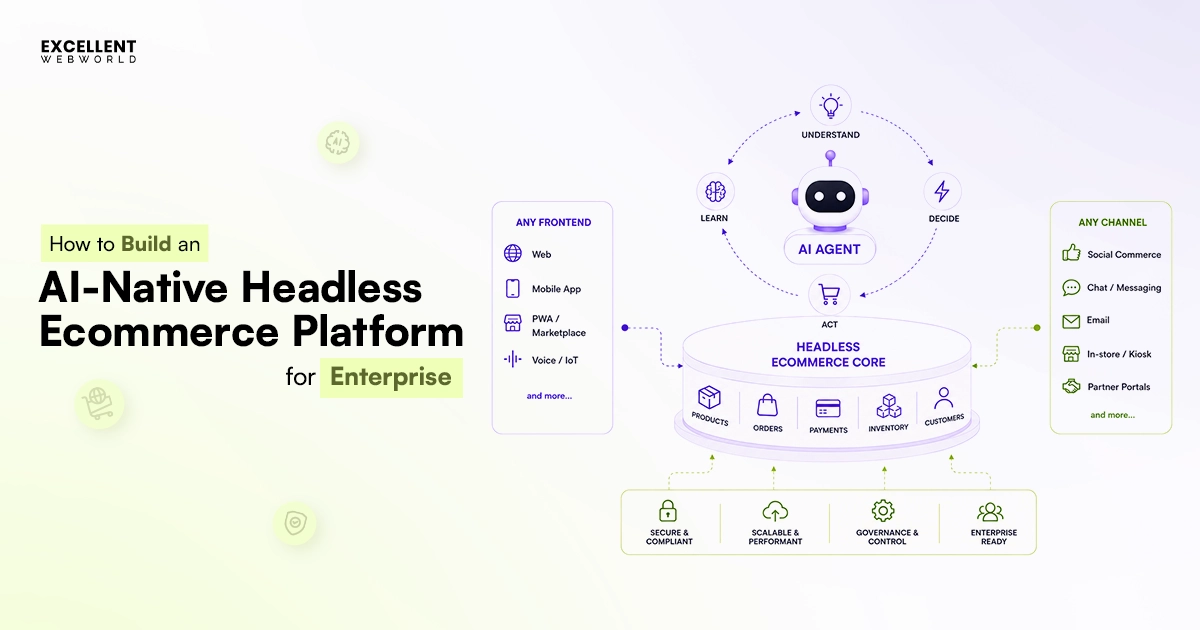
To perform these actions, an AI agent needs complete access to the ecommerce ecosystem. This is where headless ecommerce AI customer support integration matters. It connects with the OMS for order information, CRM for customer context, and inventory systems for real-time product availability, turning conversational requests into controlled workflows.
The ROI Case: Resolution Rates, Cost Savings, and Payback Period
The ROI of an AI customer service agent comes down to more than ticket deflection. In eCommerce, an AI agent’s financial impact includes lower support costs, better agent productivity, increased conversions, and enhanced customer retention.
The metrics mentioned below showcase an effective way to measure AI customer support ROI in ecommerce, comprising support costs and team capacity along with the broader benefits of AI in eCommerce, such as revenue growth, customer retention, and investment recovery.
| ROI Metrics | What to Measure | Business Impact |
|---|---|---|
| Resolution Rate | Share of AI-resolved requests without human intervention | Sets the bar for the total workload AI can handle independently |
| Cost Savings | AI-assisted resolution cost vs. human-handled ticket | Helps to reduce the cost of routine requests in long-term |
| Productivity | Repetitive tickets are removed from human agents | Frees human agents to focus on high-stakes complaints, no new hires needed |
| Conversion | Pre-purchase and after-hours assistance turns potential buyers into leads | Turns opportunities beyond staffed hours into a revenue channel, not just overhead |
| Retention | Customer satisfaction, repeat purchases, and unresolved cases | Build long-term customer loyalty instead of quietly churning the retention rate |
| Payback Period | AI investment vs. support savings and incremental revenue | Shows when the investment turns to net savings |
The exact return on investment varies based on the ticket volume, AI resolution rates, automation potential, integration complexity, and deployment scale. Here, it is recommended to consider the whole financial picture instead of treating deflection rate as one sole metric.
The real measure of AI customer support for eCommerce depends on the equation: cost savings + productivity + conversion + retention.
Build vs. Buy: Where Off-the-Shelf AI Support Tools Hit Their Limits
Off-the-shelf AI support tools are great when businesses need rapid deployment. A team can easily deploy an off-the-shelf AI support tool with pre-built workflows and predictive support use cases without writing a single line of code. They are suitable for enterprises that need to get AI support running quickly without requiring deep customization or system access in the initial stages.
The limitations become visible when enterprises need an agent to work with proprietary systems, implement complex business rules, or execute actions across diverse workflows. At that point, the custom vs. off-the-shelf AI chatbot ecommerce decision becomes a question of control, flexibility, and long-term operating cost.
| Factor | Buy: Off-the-Shelf AI Tool | Build: Custom AI Agent |
|---|---|---|
| Deployment | Faster implementation with pre-built templates | Longer implementation and planning to build workflows |
| Customization | Limited to vendor’s configuration options | Tailors to business rules, workflows, and customer experience requirements |
| Integration Depth | Pre-built connectors and APIs for common platforms | Deep integration with OMS, CRM, and proprietary systems |
| Complex Workflows & Actions | Best for standardized, single-step requests | Best for complex, multi-step, conditional requests |
| Brand Experience | Limited control over AI behavior and experience | Full control over tone, behavior, and customer journey |
| Long-term Flexibility | Dependent on vendor’s roadmap, features, and pricing | Can evolve with business requirements without depending on a vendor roadmap |
| Long-term TCO(Total Cost of Ownership) | Subscription, usage, customization, and vendor costs | Development, infrastructure, AI usage, and maintenance costs |
For enterprises, buying can be more suitable when support requirements are standardized and well-defined. Building an AI agent becomes more relevant when customer service depends heavily on proprietary systems, business rules, and workflows.
The final decision should consider implementation, customization, integration, maintenance, and AI operating costs rather than the subscription price alone.
Agentic Commerce Is Changing What Customer Service Means
AI Shopping agents are turning a simple search-and-checkout journey into a continuous conversation. Tools like ChatGPT, Google, Claude, and emerging shopping agents can discover products, compare options, recommend suitable choices, and support purchase decisions within a single interaction.
That changes the entire role of customer service. The journey can be completed within one thread: question → product discovery → recommendation → purchase → post-purchase support, often without the customer needing to visit the storefront directly. Our experience building AI-powered ecommerce ecosystems, including a multi-vendor marketplace and super app, has shown us how important it is to connect product discovery, personalized experiences, and customer support within a unified shopping journey.
This shift requires eCommerce businesses to establish an architecture that connects product data, pricing, inventory, orders, and customer accounts. Hence, online stores now need headless ecommerce AI customer support integration, structured product data, and protocol readiness that allows third-party AI shopping agents to query and act on store data directly. Standards such as MCP (Model Context Protocol) and emerging UCP frameworks further support more interoperable, AI-powered ecommerce experiences.
It is designing an ecommerce foundation that can participate in agentic AI customer support ecommerce experiences, from product discovery through post-purchase support.
What CTOs and Founders Should Evaluate Before Deployment
An enterprise AI customer service agent should be evaluated beyond its ability to answer customer queries. Before deployment, CTOs and founders should consider key factors to check whether it can operate safely and deliver measurable business value.
Security
Check what customer data the AI can access and whether access follows strict, role-based controls. PII (Personally Identifiable Information) protection should be implemented to keep conversations, connected systems, logs, and AI workflows secure.
Governance
Every agent action should have a defined permission level before launch. Refunds, cancellations, account changes, and other sensitive actions should have clear approval rules.
Accuracy
Evaluate how the agent grounds responses in trusted order and product data and handles uncertainty. Hallucination controls should prevent an AI agent from fabricating product, pricing, or policy details it does not actually have, as an incorrect refund promise can become a business liability.
Human escalation
Set a clear threshold for when AI must stop and hand control to a human. The handoff should transfer conversation history and relevant context without forcing customers to repeat the issue.
Measurement
Deflection alone cannot show the full impact of deployment. Track resolution rate, escalation rate, CSAT, response time, cost per resolution, and conversion or retention impact to measure the broader business value of an AI customer service agent for ecommerce.
How We Builds Custom AI Customer Service Agents
At Excellent Webworld, we approach custom AI customer service agent development based on how a business operates, rather than around a predefined chatbot feature set. We start by mapping customer intent to the data, systems, permissions, and business rules required to resolve each request.
For an AI customer service agent for ecommerce, we build the agent around measurable business workflows, such as order support, returns, product assistance, and pre-purchase queries. Each workflow has defined boundaries for what AI can answer, what actions it can take, and when it should pass a query to a human.
As an AI agent development company with 15+ years of experience building digital products for enterprises, we connect the agent with specific business systems, ground responses in trusted data, test different use cases, and monitor results after deployment. Our goal is not just to automate conversations, but to make customer service operationally useful over the long term.
Frequently Asked Questions
An AI customer service agent for ecommerce is an AI system that understands customer requests, fetches essential business information, and executes approved actions. Compared with a traditional chatbot, AI agents can support workflows such as WISMO, returns, product questions, refunds, and post-purchase queries without following a fixed scripted flow. It escalates to a human when a request exceeds its permissions or capabilities.
A chatbot typically responds to a specific set of questions or conversational prompts through scripted flows. An AI customer service agent can understand context, reason through multiple steps, fetch live customer and order data, and execute permitted actions such as issuing refunds when authorized. The practical difference is that an AI agent can complete a task, rather than simply provide an answer.
An AI customer service agent can significantly reduce support costs, especially when it handles a high volume of repetitive requests such as order status, returns, and product questions. The actual savings depend on support volume, current cost per resolution, automation rate, AI operating costs, and the complexity of customer requests.
An AI support agent can start generating measurable savings within a few months of launch, but the payback period depends on the deployment scope and business case. Key factors include implementation cost, support volume, automation coverage, integration complexity, and incremental revenue generated through faster service. A useful calculation should compare AI customer support ROI in ecommerce against both support savings and revenue impact, instead of measuring ticket deflection alone.
Off-the-shelf tools are ideal for standardized workflows and rapid deployment. Custom AI customer service agent development makes sense when the agent needs deep access to proprietary systems, complex business logic, advanced workflows, or greater control over AI behavior and actions.
The need for integrations depends on what an AI customer service agent is expected to handle. Common connections include the ecommerce platform, OMS for order data, CRM for customer context, inventory systems for real-time product availability, and payment systems where permitted actions require them. Without these integrations, the agent may be limited to resolving basic information requests.
Yes, it can be safe if the governance is designed correctly. Refunds and return requests should have clear authorization rules, access to trusted data sources, auditability, and human escalation where required, so the agent doesn’t approve actions outside its authority.
AI shopping agents like ChatGPT and Google are rapidly shifting customer service from reactive website support toward dynamic conversational engagement. These agents can discover products, compare options, and guide purchase decisions within a single conversation. Customer service can happen within the same thread, which means brands now need to optimize product data and protocol readiness, including MCP, to support these AI-driven customer journeys.
The resolution rate of an AI agent can range anywhere between 20 to 60% in the first year. Mid-market retailers may observe a resolution rate between 40% to 60% on routine queries after sufficient optimization, while enterprise deployments may initially see rates closer to 20%. The achievable rate depends on request complexity, data quality, integrations, workflow design, deployment scale, and escalation rules.
Custom deployments take longer than off-the-shelf setups because they are built around actual workflows and system integrations instead of simple templates. Most custom ecommerce deployments can move from workflow mapping to production within several weeks to a few months, depending on scope, integrations, and testing requirements.

Article By


Mayur Panchal is the CTO of Excellent Webworld. With his skills and expertise, he stays updated with industry trends and utilizes his technical expertise to address problems faced by entrepreneurs and startup owners.