Jev AI fascinates me for a very specific reason: it is designed to make quick and accurate decisions, not to generate paragraphs.
From a statement point of view, it may feel like a very small distinction, but actually it isn’t.
I’ve led engineering teams for the last 15+ years. Over the course of my career, especially in the age of AI, I’ve seen that many teams, while building AI products, use enterprise-level large language model development services for everything – classifying various requests, deciding which tool to call for a particular task, filtering data, checking whether an answer is good enough, routing users, and deciding what an agent should do next.
Any good frontier LLM would be able to do this job. But the question is whether an LLM should always remain engaged in this type of task, or is there a better way out?
That’s where Jev AI has a definitive role to play. It is designed to handle small and repetitive decisions that are required inside any AI workflow. Jev AI provides you with bounded choice, score, or yes/no-style decisions that application code can act on.
Due to this aspect, the strongest Jev use cases are:
- High-volume classification
- Customer and email routing
- AI model routing
- Agent tool selection
- Browser automation
- Safety and policy gates
- Prompt injection detection
- RAG evidence checks
- AI answer evaluation
- Context and memory management
- Lead scoring
- Content moderation
- Real-time decision systems
In terms of the architecture workflow, you can put Jev AI like this in a simple manner:
Context → Jev decision → application logic → action
One thing that you should keep in mind is that Jev doesn’t need to replace Claude, GPT, Gemini, or any other reasoning model. In fact, as per my experience, in most AI systems, Jev makes more sense when it’s sitting underneath the core workflow, handling decision-making for which calling a reasoning model would be unjustifiable.
I Don't Think Every AI Decision Needs a Large LLM
I’ve noticed one particular pattern that, when teams are building any AI product, they tend to overuse their most capable model.
Call GPT.
Need to decide which tool to use?
Call GPT.
Need to determine whether a response should be rejected?
Call GPT.
Need to decide whether a lead is worth sending to sales?
Call GPT.
Need to decide whether an agent should retry?
Technically, there is nothing wrong with this type of approach. However, when I see it from an architectural standpoint, I’m not fully convinced that this is the most viable option.
A typical large language model is very good at reasoning, generating, summarizing, explaining and handling ambiguity. However, a lot of software doesn’t need all of these; it just needs quick decision-making.
For example, this decision-making could be related to:
- Which queue does this belong to?
- Should this be blocked?
- Which tool should run next?
- Is this answer good enough?
- Should this piece of context stay?
- Does this lead deserve a sales call?
This type of decision-making happens thousands or millions of times inside any application, and that’s where Jev has an interesting role to play.
I don’t treat Jev as another AI chatbot or general-purpose LLM; I think it's a decision layer inside an LLM system.
What is Jev AI?
Jev is a decision-focused AI model designed around structured decisions instead of open-ended text generation.
The simplest way I can explain it is that: LLM generates. Jev decides.
Jev is typically designed around three useful decision patterns:
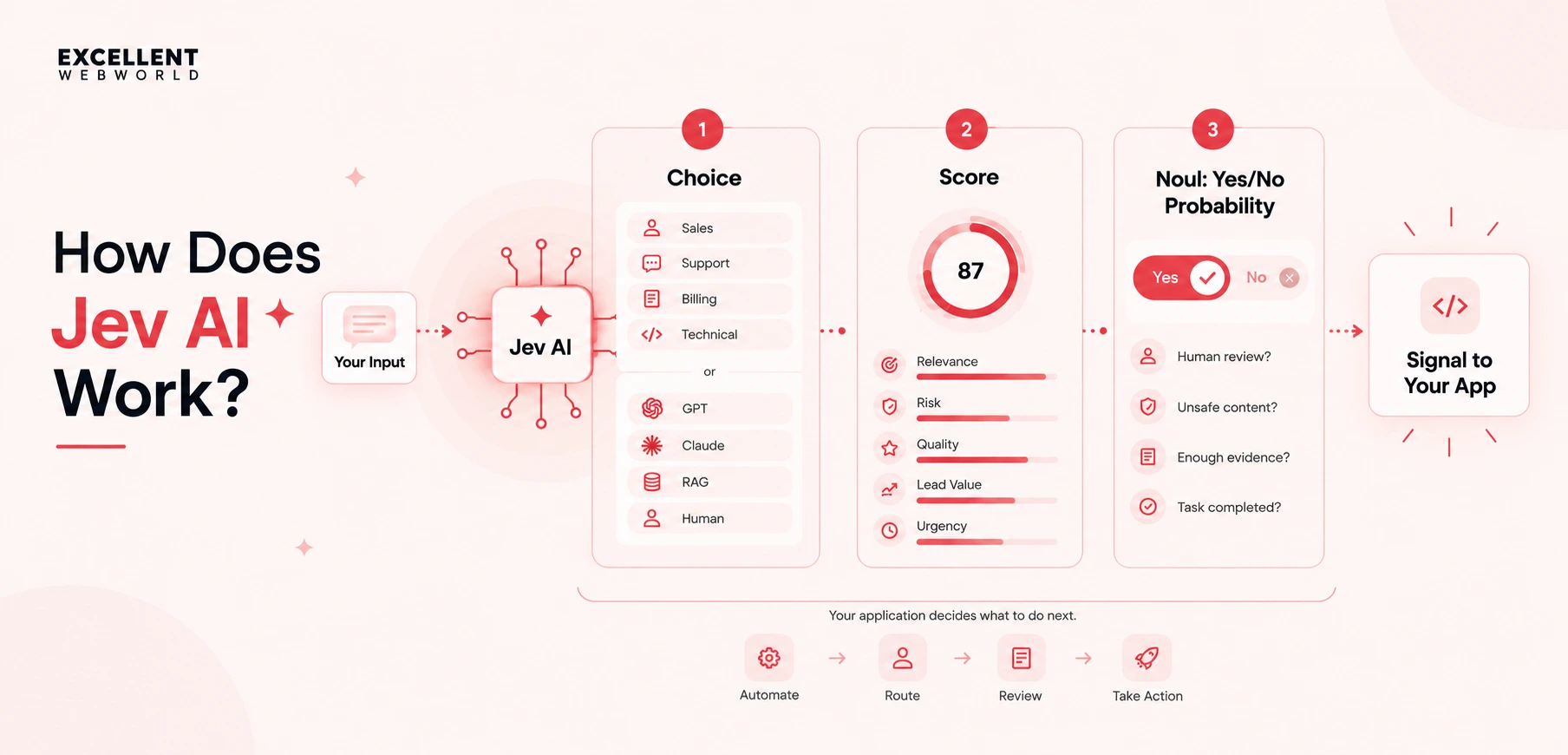
1. Choice
Select one option from a predefined set.
For example:
- Sales
- Support
- Billing
- Technical
Or:
- GPT
- Claude
- RAG
- Human
2. Score
Return a value that represents something like:
- Relevance
- Risk
- Quality
- Lead Value
- Urgency
3. Noul: Yes/No Probability
Determine whether a defined proposition is true.
For example:
- Does this request require human review?
- Is this content unsafe?
- Is there enough evidence to answer?
- Did the agent actually complete the task?
The important part here isn’t the format; it’s what happens after the decision.
Jev provides your software with a signal, and then it’s your application that has to decide what to do with it. That’s the core distinction between a typical LLM and Jev.
The Jev Architecture I Would Actually Use
I wouldn’t put Jev in charge of my application; I’d rather put Jev inside my application.
So, a typical workflow with Jev would look like this: State → Jev → Policy → Action → Feedback
- The application provides Jev with relevant state.
- Jev makes one bounded decision.
- Application logic interprets the decision.
- Lastly, software performs the required action.
For example:
Customer message → Jev → "Technical Support" → Support queue
Or:
Agent state → Jev → "Search Web" → Application executes search
Or:
LLM answer + retrieved documents → Jev → "Insufficient evidence" → Retrieve again
This workflow is pretty important because I don’t want LLMs to decide what they’re authorized to do; I want Jev to handle that decision-making process and LLMs to focus on the execution part based on decisions made.
So, basically, Jev decides. Code enforces. This should be the production mindset.
15 Practical Jev AI Use Cases We Tried & Tested
1. Email Classification and Triage
This is one of the best and easiest places to understand Jev’s value.
Imagine a company is receiving 100,000 emails per month. So, you don’t need an LLM to write 100,000 responses. You just need to have an idea of who these emails are written to.
Is it:
- A sales inquiry?
- A support request?
- An invoice?
- Spam?
- A partnership request?
- An urgent customer issue?
Jev can help you make that classification.
So, the final workflow would be like: Email → Jev → Category + Priority → Workflow
After that, your application will take over in the execution part and:
- Sales emails go to CRM.
- Support emails go to the helpdesk.
- Invoices go to finance.
- Urgent issues get escalated.
I’ve seen teams use much more expensive models for this kind of work. That’s where I would recommend using Jev, as it would reduce your time and cost.
2. Customer Support Routing
Customer support is another decision-heavy workflow. In any customer support ticket, there can be a lot of text, but the business decision is surprisingly simple. That decision-making part is where Jev can play a useful role.
You can ask Jev to classify tickets based on:
- Department
- Severity
- Customer Type
- Product
- SLA Risk
- Escalation Requirement
For example:
The support ticket could be like:
“My payment was deducted, but the subscription still shows inactive.”
The output with the help of Jev would be like: Billing → High Priority → Escalate
This is something customer service agents can immediately act on instead of a paragraph-based ambiguous solution.
3. AI Model Routing
This is one of the Jev AI use cases that I find most interesting strategically.
Not every routing request should go to your most expensive AI model; it can add to your Total Cost of Ownership (TCO) and impact your profitability.
Now, there could be a scenario where you have:
- A cheap model for simple tasks
- A specialist model for coding
- A reasoning model for complex problems
- A computer vision model for images
- A retrieval system for knowledge questions
- A human for sensitive cases
So, the question here is:
Which is the most appropriate model for a particular problem or use case?
That’s where Jev can help you out. It can see the predefined set of rules and then provide your software with the most appropriate model.
For example:
Simple classification → lightweight model
Complex reasoning → frontier model
Company knowledge question → RAG
High-risk request → human review
With this approach, you’ll have a much more deliberate AI architecture.
Instead of:
"Send everything to GPT."
You build:
"Send each request to the capability that makes the most sense."
This is a healthier production architecture.
4. Choosing the Next Action for an AI Agent
AI agents are inherently decision loops:
- They observe something.
- They decide what to do.
- They execute an action.
- They observe the result.
- Then they decide again.
The biggest mistake most companies are making here is that they assume that the same model has to handle every piece of the loop. But that’s not the case in reality.
You can provide Jev with the current agent state and a set of available actions.
For example:
- Search
- Open File
- Call API
- Ask User
- Retry
- Stop
Jev can select the appropriate next set of actions. The application executes that. Then, the agent receives the new state.
So, the final workflow will be:
State → Decision → Action → New State
For many bounded decisions, this can be a much more efficient approach than asking LLMs to make decisions through the entire action space every time.
5. Browser Automation
Browser agents are a particularly interesting use case.
Suppose an agent is looking at a web page and it has five possible actions to choose from. So, it doesn’t need to generate a long explanation about what it wants to do.
It just needs to choose one of the options from these:
- Click
- Search
- Scroll
- Open
- Stop
This is a purely decision problem. So, Jev can sit between the browser state and the deterministic browser automation layer.
Browser state → Jev → action → browser executes
So, basically: Jev decides. The software acts.
This is the pattern I would reuse across many agent architectures.
6. AI Agent Tool Selection
The more tools you give an agent, the harder it is for the agent to decide the right tool.
Imagine an enterprise agent with 40 different tools to choose from:
- CRM
- ERP
- Calendar
- Search
- Database
- Payments
- Analytics
- Customer Records
- Internal Knowledge
- External APIs
An agent doesn’t need all the tools on every request. They need one or a few tools for a particular request. The decision layer here can narrow the possibilities for you.
For example:
User request → Jev → CRM tool → application executes
Or:
User request → Jev → knowledge retrieval → RAG pipeline
Or:
User request → Jev → human escalation
This can become pretty useful in a large agent system scenario where tool selection itself can become a really costly affair.
7. AI Safety and Policy Gates
This is a use case where I would advise you to be extra vigilant and careful.
Suppose an AI agent wants to:
- Delete data
- Send an external email
- Modify an account
- Trigger a payment
- Execute privileged code
- Change a production configuration
So, I don’t want the agent to say that:
"Trust me, this looks safe."
Instead of that, I would need a decision layer that could evaluate the proposed action and ensure agentic AI security.
Jev could come in handy here, as it would help you classify any action as:
- Allow
- Review
- Block
But you need to keep in mind that:
Jev shouldn’t be your authorization system.
Your policy engine and application permission layer should hold the authority. Jev should just provide intelligence that could help in informed decision-making. But it's the code that should be your executor or enforcer. That’s a much safer architecture.
8. Prompt Injection Detection
As AI agents start reading more and more external information, prompt injection can become a serious problem.
Your AI agent might consume:
- Websites
- Emails
- PDFs
- User-Generated Content (UGC)
- Documents
- Tool Responses
Now, the problem arises when some of the content that the AI agent accesses contains instructions that should not be followed.
To ensure safety, you can use Jev as your guardrails, with it doing the job of a classifier.
For example:
Incoming content → Jev → Safe /Suspicious /Injection → Policy
If suspicious:
Block.
Or:
Send to human review.
The value here is not generating another response. It’s about making a quick decision regarding whether something should enter the next stage of the workflow.
9. AI Answer Quality Checks
This is one of the use cases I like the most. You don’t need to automatically trust every answer that your LLM produces, as it can be hallucinated, inaccurate or biased.
So, you can have a workflow like:
LLM → answer
Then:
Answer + criteria → Jev → quality decision
Jev can help you evaluate things such as:
- Relevance
- Completeness
- Grounding
- Instruction Compliance
- Evidence
- Quality Threshold
Based on this evaluation, your application decides: Pass → return answer.
Fail → regenerate.
Uncertain → retrieve more information.
It converts your AI generation mechanism into a controlled, explainable, and auditable pipeline instead of a single model call.
10. RAG Evidence and Grounding Checks
RAG systems have a very simple failure mechanism:
Sometimes, RAG systems don’t have enough information from sources, and the LLM still wants to provide an answer to end users. That’s where the hallucination takes place.
So, to avoid that issue, I will make "I don't have enough evidence" a legitimate state in the architecture.
For example:
Question + retrieved context → Jev
Jev determines:
Sufficient evidence
or
Insufficient evidence
If insufficient:
→ retrieve more documents
or
→ ask the user for clarification
or
→ abstain
This is a much better system than forcing the LLM to answer every question.
11. Context Compaction and AI Memory
This is one of the most interesting Jev applications, as it helps you address an issue that every agent developer eventually faces. That issue is that the context gets huge with time.
An agent might carry:
- Previous Conversations
- Tool Calls
- Search Results
- Files
- API Responses
- Intermediate Reasoning
- Old Observations
However, that is a limit to the context window, so the agent can’t keep anything forever.
So, the question is, which context is the most relevant?
That’s where Jev can help decide:
- Keep This
- Drop This
- Summarize This
- Preserve This
- Retrieve Again Later
This type of workflow is pretty useful for coding agents and long-running workflows.
Jev here is not writing the memory system; it’s just helping the application decide what deserves to remain in memory.
12. Content Moderation
Content moderation is fundamentally a classification problem.
A content moderation platform may need to evaluate:
- Comments
- Reviews
- Posts
- Images or Associated Metadata
- User Submissions
- Messages
That’s where the Jev can help you make decisions, such as:
- Safe/Unsafe
- Spam /Legitimate
- Publish/Review
- Low/Medium/High risk
And remember that when you’re making these types of decisions at massive scale, model economics do matter, and that’s where Jev can be really helpful.
Every time, you don’t necessarily need a frontier model to decide whether something belongs to a particular category.
13. Lead Scoring and Qualification
Sales teams don’t require AI to write any generic paragraph about any lead.
They just need to know:
Is this lead worth our time?
For that purpose, you can use Jev instead of relying on an LLM. You can feed Jev with signals such as:
- Company
- Industry
- Company Size
- Intent
- Engagement
- Budget
- Product Fit
- Buying Stage
Then, you can ask Jev for a score or qualification decision.
For example:
Lead → Jev → 87/100 → Sales-qualified → CRM
The important part is what happens next.
High score?
Sales gets it.
Low score?
Nurture.
Uncertain?
Review.
That's a useful AI decision loop.
14. AI Agent Completion Checks
Here’s a problem that you will definitely face once you deploy AI agents:
The agent says it finished. Did it actually finish the task?
Let’s understand this better with an example. Suppose you asked an agent to update a customer record. It says that it has completed the task.
Now, if you want to verify it, you can use Jev and provide it with:
- Original Task
- Agent Actions
- Final State
- Available Evidence
And then, ask Jev:
Was the task actually completed?
The output can determine:
- Accept
- Retry
- Escalate
It gives you a lightweight verification layer around your autonomous systems. I think this pattern will be incredibly useful as agents move from demos to production environments.
15. Real-Time Decision Systems
This is where things get more experimental.
Jev can potentially fit any system when decisions need to be made quickly and repeatedly.
Some of the most common examples include:
- Real-Time Content Classification
- Dynamic Routing
- Game Agents
- Browser Automation
- Robotics
- Autonomous Systems
- Market or Signal Classification
But this is where I would like you to warn as well.
Fast doesn’t always mean correct and accurate.
A low-latency decision that is consistently wrong is still a bad system.
Therefore, I wouldn’t evaluate Jev's workflow on:
"How fast is it?"
I'd evaluate:
Accuracy + latency + cost + downstream outcome
The downstream outcome part is what most people forget, but it’s the most critical aspect.
When I Would Not Use Jev
Knowing when not to use something is sometimes more important than knowing when to use it.
So, according to my experience, I wouldn’t recommend using Jev when:
- Writing a long article
- Summarizing a meeting
- Explaining a complicated concept
- Brainstorming
- Conducting deep research
- Having an open-ended conversation
- Producing a detailed technical answer
- Working through an extremely ambiguous problem
These are tasks where a general-purpose reasoning or generative model would make more sense.
Jev is most useful when the question is niche and narrower, such as:
- Which one?
- How much?
- Should we?
- Is this safe?
- Is this relevant?
- What happens next?
Jev vs. GPT, Claude and Other LLMs
I wouldn’t frame it as Jev vs. GPT. I would rather frame it as: Jev + GPT.
Here’s how I think about the split:
| Job | Better Fit |
|---|---|
| Long-form writing | GPT/Claude |
| Deep reasoning | GPT/Claude |
| Research | GPT/Claude |
| Summarization | GPT/Claude |
| Classification | Jev |
| Routing | Jev |
| Scoring | Jev |
| Tool Selection | Jev |
| Safety Gating | Jev + Policy Engine |
| Agent Verification | Jev |
| RAG Evidence Check | Jev |
| Complex Final Response | GPT/Claude |
So, in practice, the combination of Jev + LLM could be an ideal architecture:
Jev handles the small decisions.
The larger model handles the expensive reasoning.
For example:
100,000 incoming documents
↓
Jev filters them
↓
4,000 relevant documents
↓
RAG + frontier LLM analyzes them
↓
200 uncertain/high-risk cases
↓
Human review
How I Decide Whether a Workflow Needs Jev
I use a pretty simple framework to evaluate whether a workflow needs Jev AI:
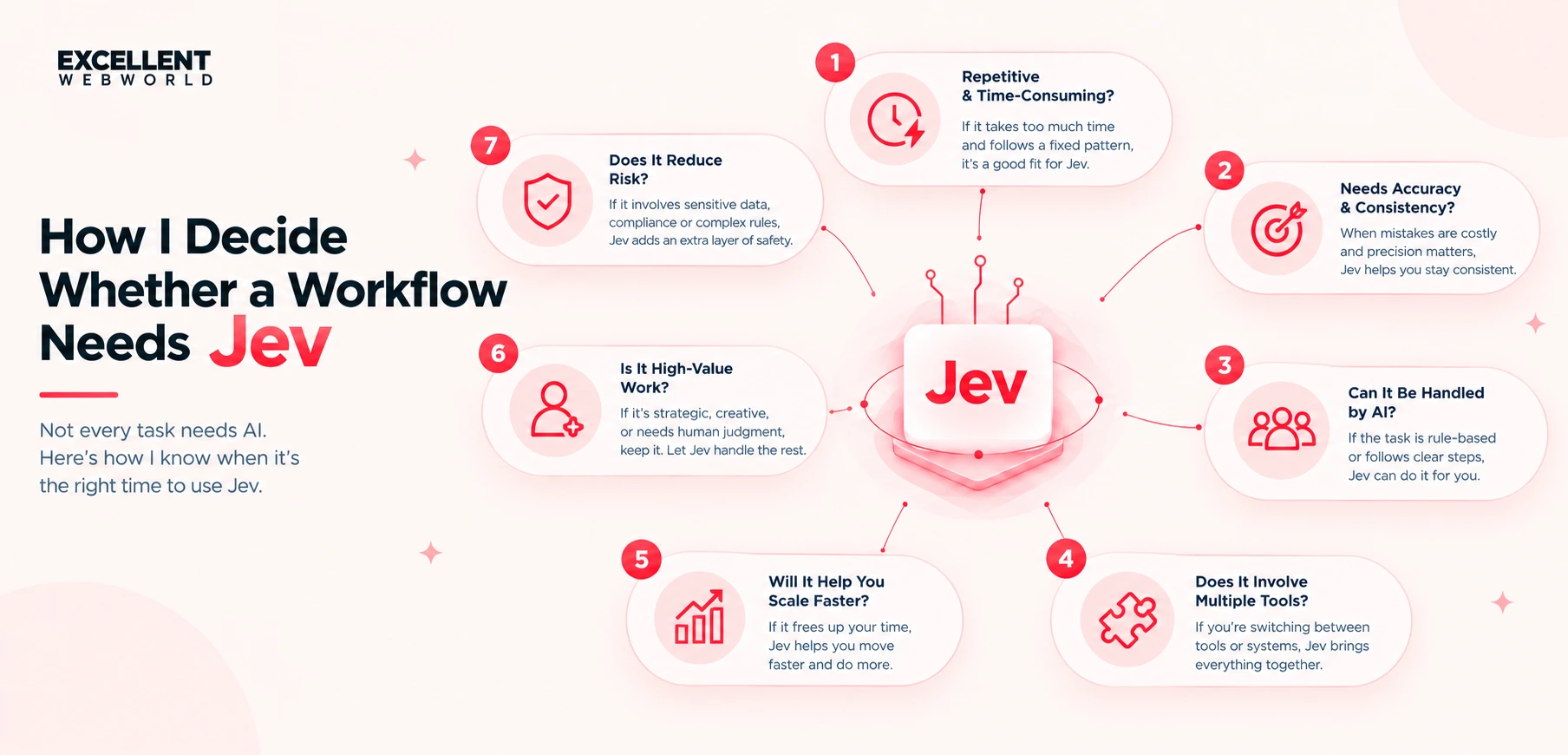
[1.] Is there a defined version?
If you can’t clearly describe what you’re asking your AI models to decide, use Jev.
[2.] Does the decision happen frequently?
If your workflow requires frequent decision-making, then model economics would favor Jev.
[3.] Is a large model currently doing it?
If you’re spending your largest frontier model token budget on YES/NO, then you should think about using Jev.
[4.] Does the answer change what the software does?
If nothing is happening after prediction, then there is no point in using LLMs for that. You should seriously consider Jev.
[5.] Can I define the possible outcomes?
If you can define all the possible outcomes, you should think about using Jev.
[6.] Can I measure correctness?
If you’re not able to measure the correctness and accuracy of your models, then you should incorporate Jev as a decision-making layer.
[7.] Is there a safe fallback?
For important workflows, you need:
uncertain → human
or
uncertain → deterministic fallback
If the answer to most of these is yes, I'd test Jev.
How I'd Build the First Jev Workflow
I wouldn’t start by redesigning an entire AI product.
Instead of that, I would find one expensive decision.
Then, I would follow these steps:
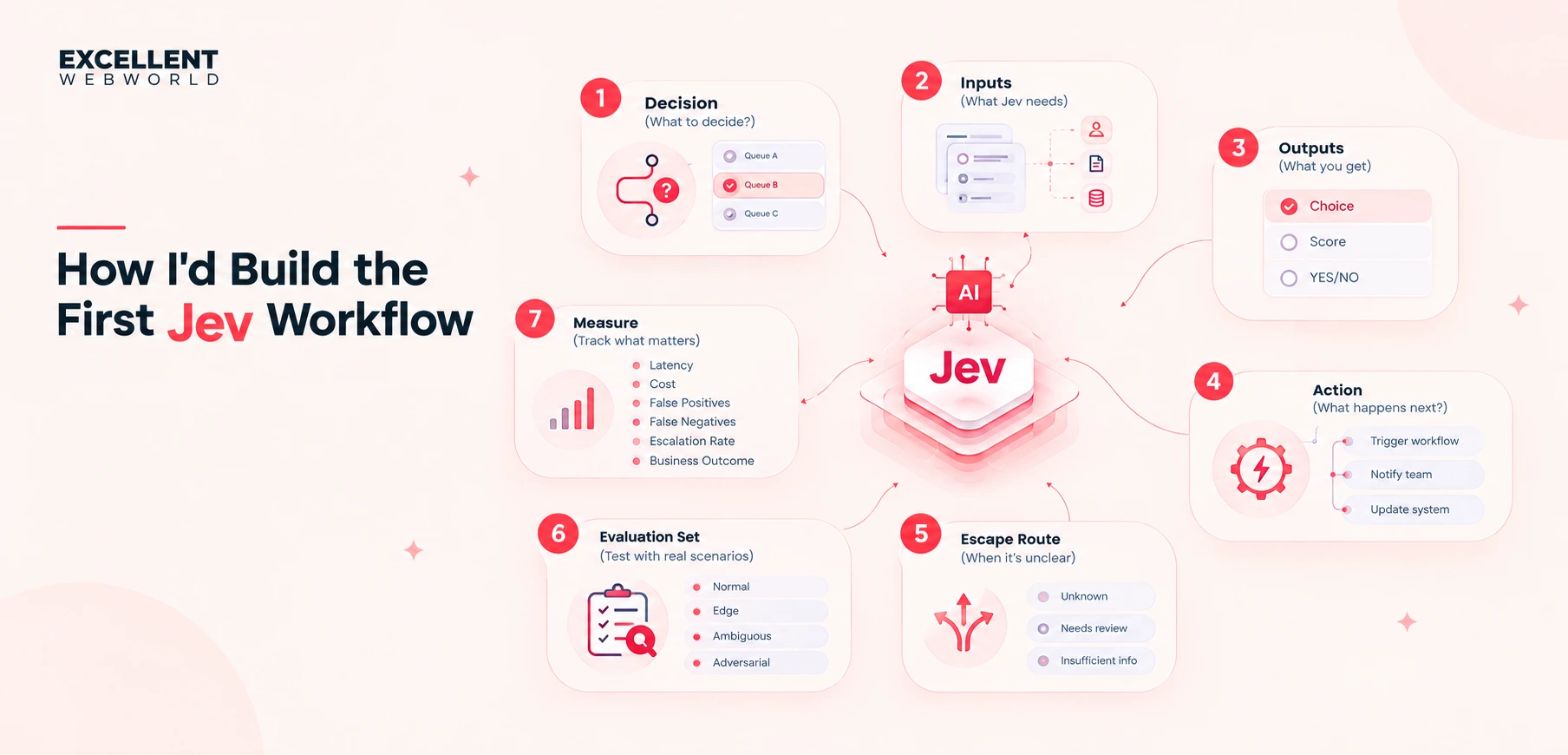
Step 1: Define the Decisions
The decision should not be like: "Understand this customer."
It should be more like:
"Choose the correct support queue."
Step 2: Define the Inputs
Provide Jev with the information it needs to make the right decision.
Step 3: Define the Outputs
You should define the possible outcome, whether it’s a:
- Choice
- Score
- YES/NO Probability
Step 4: Define the Action
You need to define the next steps, i.e., what will happen if a particular output occurs?
Step 5: Add an Escape Route
You don’t need to force every input into a predefined category.
You should also include options like:
- Unknown
- Needs review
- Insufficient information
Step 6: Build an Evaluation Set
Use real examples to build an evaluation set or possible scenarios.
Try to incorporate normal cases, edge cases, ambiguous cases and adversarial cases.
Step 7: Measure the Right Things
Don’t just measure the accuracy of the outputs.
You should also focus on:
- Latency
- Cost
- False Positives
- False Negatives
- Escalation Rate
- Downstream Business Outcome
That’s how I would decide whether Jev belongs in production.
Production Guardrails Matter More Than the Model
There’s one principle I would keep repeating to the team that is looking to use Jev AI in their business workflow:
“Don’t give any model the authority just because it provides a confident answer.”
So, basically, Jev should only provide a decision signal, and it’s your application that should enforce the rules.
This means you should:
- Validate Outputs
- Enforce Permissions in Code
- Set Confidence Thresholds
- Log Decisions
- Version Prompts & Criteria
- Create Human-Review Paths
- Fail Safely
- Monitor Downstream Outcomes
It becomes especially important when Jev is sitting inside your agent workflow.
The more autonomous the system becomes, the more important these guardrails are.
For organizations building sovereign AI platforms, these controls also help enforce data access policies, model usage restrictions, and governance requirements.
The Bigger Opportunity: A Decision Layer for AI Systems
What I think and have understood is that Jev AI isn’t about any individual use case.
It’s more about the architectural pattern.
We're moving from:
LLM → response
to:
AI system → multiple decisions → multiple actions → feedback
An AI agent may make dozens of decisions while executing a single task.
For example:
Which tool?
Which document?
Which model?
Should it continue?
Should it retry?
Is the information sufficient?
Is the action safe?
Is the result good enough?
Should the user be asked?
Should a human take over?
But what I don’t think is that every one of these decisions requires expensive reasoning models.
That’s why I see a role for a dedicated decision layer in the new-age AI systems.
So, according to me, the new architecture would look like:
Generative models
Create, explain and reason.
↓
Decision models
Classify, score, route and evaluate.
↓
Application code
Enforce policy and execute actions.
↓
Human
Handle ambiguity, exceptions and high-risk decisions.
Jev AI Use Cases: Quick Reference
| Use Case | What Jev Decides | What The Application Does |
|---|---|---|
| Email Triage | Category/Urgency | Route |
| Support Routing | Team/Severity | Assign |
| Lead Scoring | Fit/Intent | Prioritize |
| Model Routing | Best Model | Dispatch |
| Tool Selection | Next Tool | Execute |
| Browser Automation | Next Action | Control Browser |
| Safety Gate | Allow/Review/Block | Enforce Policy |
| Prompt Injection | Risk | Block/Review |
| Answer Evaluation | Quality | Return/Retry |
| Agent Verification | Complete/Incomplete | Accept/Retry |
| RAG Grounding | Evidence Sufficient | Answer/Retrieve |
| Context Management | Keep/Drop | Manage Memory |
| Moderation | Safe/Unsafe | Publish/Review |
| Real-Time Filtering | Classification | Filter |
| Autonomous Systems | Next Action | Execute |
How Excellent Webworld Can Help Implement Jev
The hard part with Jev is not about calling an API. The hard part is knowing where a decision model actually belongs inside a production AI system. That’s where our experience and expertise matter a lot.
Our Forward Deployed Engineering approach brings engineers closer to the workflows, data, and existing systems where these decisions need to happen.
We at Excellent Webworld have built AI-native software systems where models, agents, APIs, data pipelines and application logic have to work together as one cohesive system. That doesn’t mean that we’re not looking at Jev as an isolated model.
We actually analyze the various decision points inside the entire AI system.
For example, if we’re building an AI agent, we would identify decisions as:
- Which model should handle the request?
- Which tool should the agent call?
- Is the retrieved information sufficient?
- Should the agent continue or stop?
- Is the proposed action safe?
- Does the final answer meet the required quality threshold?
- Should a human take over?
Some of these decisions are better handled by a general-purpose reasoning model, while others may be a strong candidate for Jev. Differentiating which model is better suited for a particular decision-making task is our main job.
Where We Can Apply Jev
We can evaluate and implement Jev across various workflows such as:
[1.] AI Agent Development
Add a decision layer for tool selection, next course of action, retries, escalation & task completion.
[2.] Agentic RAG
Use Jev as a decision layer for various agentic RAG use cases, like evaluating retrieval relevance, evidence sufficiency, and whether additional retrieval is needed.
[3.] AI Governance
Introduce Jev as a decision gate in AI governance for enterprise AI related to policy compliance, human review, safety, and high-risk actions.
[4.] AI Model Routing
Route requests between frontier models, lightweight models, specialist models, RAG pipelines and human workflows.
[5.] Enterprise AI Workflows
Use scoring and classification layers for support, document processing, operations, sales, and other high-volume workflows.
[6.] AI Quality and Evaluation
Evaluate whether the output generated by AI models aligns with defined quality, grounding or business criteria before it reaches users.
The important part to note here is that we don’t start with: "Where can we put Jev?"
We start with:
"Which decisions in this system are expensive, repetitive, measurable and suitable for a dedicated decision layer?"
That's a much better starting point.
What Gives Excellent Webworld Authority Here?
Our authority doesn’t come from the fact that we know everything about Jev. It comes from the firsthand experience of working in an engineering environment where Jev needs to operate.
We’ve spent 15+ years building software products and have delivered 900+ software, mobile, web and AI projects across multiple industries. Our work now comprises AI-native product engineering, generative AI, agentic AI, RAG development, custom AI systems, cloud infrastructure and production integrations.
This expertise matters because Jev implementation is not just about AI integration in software development.
It touches:
AI models → application architecture → data → APIs → business rules → security → monitoring → production workflows.
And this is what our industry experts are pretty good at.
We also believe that not every problem requires an AI model or an AI-based solution.
- If a deterministic rule is faster, cheaper and more reliable, use the rule.
- If a frontier model is better, use the frontier model.
- If Jev is the right decision layer, use Jev.
The objective shouldn’t be to put more AI into a product. The end goal should be to build the right AI architecture for the job.
That’s the philosophy we bring to Jev implementations.
Final Takeaway
I wouldn’t pitch Jev as: “Another AI model.”
I’d rather pitch Jev as:
Don't ask a frontier LLM to make every decision in your AI system.
- Use the right AI model for the right job.
- Let your large model reason when reasoning is actually required.
- Let Jev make the small, repeated decisions.
- Let application code enforce the rules.
- And let humans handle the decisions where the cost of being wrong is too high.
The reason behind this approach is that as AI systems become more autonomous, the challenge is not going to be getting a model to generate the answer.
The challenge will be to control everything that happens between an answer and an action.
That’s where a decision layer will be invaluable.
FAQs About Jev AI Use Cases
Jev is mainly used for bounded AI decisions such as scoring, routing, classification and filtering, evaluation, and agent control. It offers structured decision signals that softwares can use to determine what should happen next.
The one-word answer is NO. Jev should be viewed as complementary to general-purpose LLMs. GPT, Claude, Gemini, and similar models are better suited for generation and complex reasoning, while Jev can handle smaller, repeated decisions inside AI workflows.
Some of the prominent use cases include AI model routing, agent tool selection, high-volume classification, browser automation, safety gates, RAG evidence checks, prompt injection detection, AI answer evaluation, context management, lead scoring & content moderation.
Oh, YES. Jev can act as a decision layer inside an AI agent workflow, thereby helping determine which tool or action should happen next, whether an agent should continue, whether a task was completed, or whether a human should take over.
Oh, YES. Jev can help assess whether retrieved information is relevant or sufficient before an LLM generates an answer. It can also help you decide whether additional retrieval or human review is needed.
YES. Jev can help you with decision signals for policy and safety workflows, such as allow, review or block. However, you should enforce high-risk permissions through deterministic application logic rather than relying solely on a model decision.
Traditional LLMs are primarily designed for generating answers and reasoning over natural language. Jev primarily focuses on structured decisions like selecting an option, assigning a score or evaluating whether a condition is true.
Don’t simply use Jev because your business workflow comprises AI. If your use case is related to Long-form generation, deep research, summarization, open-ended reasoning and conversational applications, then general-purpose LLMs would give you better results.
Oh, YES. Excellent Webworld can identify suitable decision points, design AI architecture, integrate Jev with existing models & applications, build agentic workflows, implement governance and safety layers, and take the workflow through production deployment.
We don’t simply integrate another AI model. Our industry experts have 15+ years of software engineering experience, have delivered 900+ software, web, mobile and AI projects, and have experience building AI-native systems involving AI agents, generative AI, RAG, cloud infrastructure, APIs and enterprise integrations. It allows us to assess Jev as part of a complete production architecture, rather than treating it as a standalone API.
Oh, YES. We can evaluate and integrate Jev alongside existing LLMs, AI agents, RAG pipelines, APIs, databases, cloud infrastructure and application logic. The architecture will depend on the specific workflow and decision that is being optimized.
Yes. We can help you incorporate Jev into agent architectures for action routing, safety checks, task verification, tool selection, escalation, and other bounded decisions where a dedicated decision layer makes both architectural and economic sense.
You should start by identifying a decision that happens frequently, has a predefined set of possible outcomes, currently consumes significant model resources, affects a downstream workflow and can be evaluated against real examples. If all these conditions are met, then Jev may be worth testing for your AI workflow.
Yes. We don’t recommend a technology because it’s trending. If a deterministic rule, existing model or simpler architecture solves the problem better, that’s what we would recommend. The end goal is building an efficient production architecture, not maximising AI usage.

Article By


Mayur Panchal is the CTO of Excellent Webworld. With his skills and expertise, he stays updated with industry trends and utilizes his technical expertise to address problems faced by entrepreneurs and startup owners.