Retrieval-augmented generation solves a simple but important problem: it lets large language models work with outside data. But retrieval alone does not solve execution. Static RAG pipelines pull the documents and then pause, leaving AI unable to decide what to search next, take action, or check its answers. That’s where Agentic RAG becomes useful.
By combining retrieval with reasoning, it enables AI to plan multi-step tasks, use tools, verify outcomes, and adjust when new information appears. The shift is already clear: OpenAI’s enterprise data report shows agentic AI generates 64% of Codex and ChatGPT tokens, with usage spreading beyond engineering into legal, sales, marketing, and recruiting. To me, this highlights the bigger shift: enterprises are moving from using AI as a productivity layer to using it to manage real work.
The more you evaluate enterprise AI, the clearer the data problem becomes. Knowledge is scattered across CRMs, contracts, policies, ERPs, technical documentation, live APIs, and support tickets. However, answering even a single business question often requires multiple searches across different sources. Teams are often left working with limited context.
Agentic RAG addresses this by deciding what information it needs, searching step by step, and verifying the results before responding. The research on Agentic RAG showed a 5.9* improvement in a single-retrieval test and 92% correctness on FinanceBreach. For high-stakes knowledge tasks, this makes adaptive retrieval particularly useful.
In this article, I explore 12 Agentic RAG use cases across customer support, sales enablement, legal review, financial analysis, healthcare operations, supply chain management, HR, software development, IT service management, research, compliance monitoring, and knowledge management. Rather than treating it as simple theory, I want to focus on real operational problems teams face and how retrieval, reasoning, and action work together to solve them. I show where Agentic RAG can cut down manual work, handle scattered information, and support better decision-making.
Before exploring the use cases, it’s essential to explain what actually makes RAG agentic and how its architecture differs from traditional RAG. Let’s start there.
What is Agentic RAG?
Agentic RAG is a smarter version of Retrieval-Augmented Generation (RAG). Traditional RAG finds the most useful information from your database and uses it to generate an answer. But Agentic RAG goes a step ahead of this. Agentic RAG uses an AI helper that decides what information it needs, where to get it, and what to do next. This is different from the usual RAG vs. fine‑tuning debates, because agentic RAG changes how the system searches for answers instead of changing the model itself
Agentic RAG works like asking a junior analyst to solve a complex problem. It can search across different systems, compare information, use tools, call APIs, and repeat the process if the first search does not give appropriate results. It can work through the task until it reaches the final and appropriate result.
RAG vs. Agentic RAG: The Key Differences
RAG makes AI more reliable by connecting it to your own information. Once it finds the useful information and generates an answer, the process then usually pauses. In this, Agentic RAG keeps going. It can easily plan several steps, check the information it searches, search again when required, and take action rather than leaving it up to human review.
Traditional RAG can help an AI answer questions, while Agentic RAG can help it complete tasks. The table below shows key differences between traditional RAG and Agentic RAG.
| Dimension | Traditional RAG | Agentic RAG |
|---|---|---|
| Core behavior | Looks up once and generates the final answer | Thinks, searches, checks, and acts; keeps going continuously |
| Decsion-making | Follows the fixed path | Agent makes judgment about what to search, where, and when it’s enough |
| Number of steps | One-time process | Repeat or change based on the actual results |
| Data sources | One database | Use many tools, databases, servers, and apps together |
| Handling bad outcomes | Gives whatever it finds, even if it’s not good | Knows if information is poor and tries repeatedly |
| Action | Answering a question only | Do the tasks for you. Update records, trigger actions, and even call apps |
| Best fit | Simple bots, FAQs, basic lookups | Complex tasks, multi‑system work, decisions needing judgment |
| Human role | Human still requires the next step | Agent frequently completes the next step itself |
| Analogy | Librarian handing you a book | A research assistant who reads, checks more sources, and writes the memo |
Why is Agentic RAG Important?
Here are some key reasons why Agentic RAG is important:
- Improved accuracy: Agentic RAG can enhance response accuracy by getting more appropriate context and minimizing the risk of unsupported hallucinated answers.
- Context-aware reasoning: Agents can easily plan the retrieval steps and merge information from several sources to create a smarter response for the user.
- Explainability: A retrieval process can be traced to show what insight was gained, why it was chosen, and how it contributed to the final results. Overall, this makes the system easier to understand and audit with human engagement.
- Adaptability: Instead of following a fixed retrieval path, agents can dynamically adjust their retrieval strategy based on the complexity and requirements of each query or question.
- Continuous improvement: Feedback loops could be used to evaluate the previous results and refine retrieval, planning, and response strategies over time.
- Smarter routing: Agents can describe which knowledge sources, databases, APIs, or external tools are most relevant to a specific task. This helps to reduce irrelevant information and unnecessary tool calls.
Overall, all these features make Agentic RAG specifically valuable for complicated and knowledge-intensive applications where simple retrieval and generation are not enough.
Top 12 Agentic RAG Use Cases and Examples
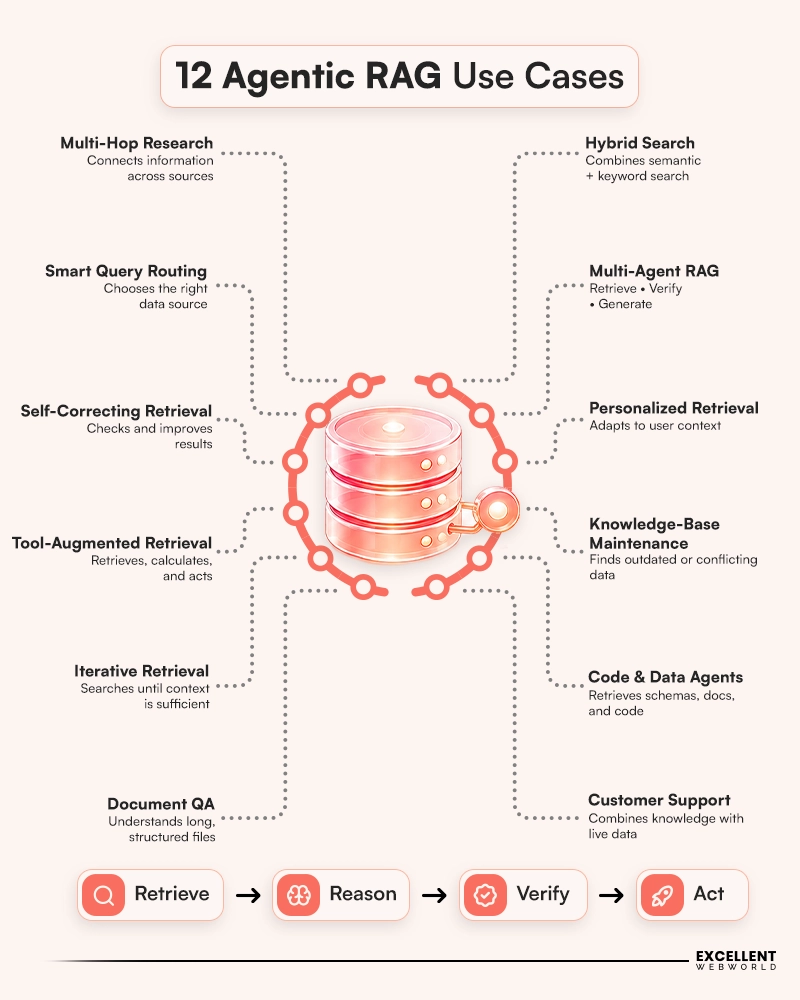
1 Multi-Hop Research and Question Answering
Some questions need connecting information from several sources instead of only being dependent on a single document. Agentic RAG handles these multi-step queries by breaking them into smaller retrieval tasks and combining the findings into a meaningful answer.
Benefits: Helps AI platforms handle complicated questions with ease by connecting the relevant information and reducing the chances of missing significant context.
Example: LinkedIn developed a customer service question-answering system that combines RAG with a knowledge graph. It helps to preserve relationships in the system and between the historical issue-tracking tickets, and retrieves the relevant subgraphs to enhance retrieval and answer quality. After deployment within LinkedIn’s customer-service team, the system reportedly reduced median issue-resolution time by 28.6%.
2 Query Routing Across Heterogeneous Data Sources
Agentic RAG can easily identify which data source retrieval technique is most relevant for the query. A routing agent can easily classify users’ intent and direct different parts of a query to the right sources, like an SQL database, vector store, document repository, or API.
Benefit: This will lessen irrelevant retrieval, improve retrieval precision, and support AI systems in handling multi-intent queries that need information from several sources within a single conversation.
Example: Microsoft’s Agentic RAG architecture evaluates the scenario where an agent is required to recognize product SKUs with open recalls. Instead of finding a single source for all, the agent initially retrieves the relevant SKUs from the internal product catalog and then searches regulatory databases for recall information. Finally, it merges all the results that are generated by different agents to provide a single grounded answer.
3 Self-Correcting and Reflective Retrieval
Agentic RAG can examine whether the retrieved data is relevant and sufficient before generating an answer. If the context is weak, the system can refine the query, retrieve extra information, or use another source rather than immediately generating a response.
Benefit: The reflective loop helps to reduce irrelevant context and unsupported answers while enhancing factual checks of the outcomes.
Example: Reflective RAG, presented at ACL 2026, represents a self-evaluation step where the system assesses the relevance of retrieved information prior to continuing with its final response. If, in any case, retrieved evidence is not enough, the system adjusts its retrieval strategy instead of only relying on weak context.
4 Tool-Augmented Retrieval (RAG + Function Calling)
Agentic RAG can go beyond retrieving insights from knowledge by leveraging retrieval as one tool within a larger set of functions. Through function calling, an agent can decide whether it needs to search the document repository, query a database, call an external API, perform a calculation, or use another specialized tool to finish tasks.
Benefit: This allows the AI system to merge the retrieved knowledge with real-time data and complex tools. The RAG agent can get context, call the perfect function, process the desired result, and merge several tools’ results to finish multi-step tasks.
Example: LangChain shares an actual code setup for LangGraph Agentic RAG. In this, an AI assistant automatically selects the right tool, deciding whether to search for a text document, look up a database, or call an external tool. This is all done before giving the user a final answer.
It becomes very useful for AI applications that need to work across unstructured data, structured databases, APIs, and RPA systems instead of one retrieval source.
5 Iterative/looping retrieval until sufficiency
Agentic RAG can get the information repeatedly instead of pausing after a single search. After each retrieval, the system checks whether it has enough data to answer the query, whether important information has disappeared, and then generates a more targeted search and continues with the retrieval cycle.
Benefit: This is most valuable for difficult research and enterprise questions where the relevant information is spread across multiple sources. By checking for missing context prior to producing the final decision, the system can generate better-read and clearer responses.
Example: Google Search and Google Cloud introduced an Agentic RAG framework for Gemini Enterprise. The Agent Platform uses a multi-agent workflow to decompose complicated enterprise queries and iteratively search for more context. For example, if an initial search identifies the server ID that is related to the project but not its specifications, the system can use that insight to perform a second search in another data source before answering the hard queries for the enterprise.
6 Agentic document QA over long/structured files
Long and structured documents like contracts, tenders, RFPs, and terms of reference can be complex to query with the core chunk-and-retrieve technique. This important information may rely on the document’s hierarchy and surrounding context. The agentic RAG can move ahead with this structure, moving from the table of contents or section indexing to the relevant section and then to a particular clause.
Benefit: A hierarchical approach aids in preserving document context and finding the precise information without retrieving huge amounts of unrelated text. It is specifically useful for legal, compliance, procurement, and contract-review workflows.
Example: LlamaIndex explains this technique in their Hierarchical Node Parser Guide. Rather than only suggesting, the AI scans the top-level section headers first (like a Table of Contents), opens the correct chapter (Financial performance) and then pulls the same sub-clause with complete context.
7 Hybrid Search and Structured Retrieval
Not every retrieval query can be effectively answered using semantic similarity alone. Some questions need the exact phrase, metadata filters, or structured conditions, while others rely on understanding the content’s meaning. The Agentic RAG can merge multiple vector retrievals with sparse keyword search, like BM25, and structured filters to opt for the most appropriate retrieval strategy.
Benefit: Combining all these retrieval methods can enhance the search coverage and handle several query types. It enables an agent to manage both semantic questions and precise conditions, including dates, numbers, document types, and other metadata.
Example: Microsoft Azure AI Search shows retrieval that mixes vector and full-text search in one request. In a contract‑management workflow, a human agent can filter contracts that have renewal dates before March 2025 and an ARR above $200,000. While using search, the agent finds documents that talk about usage‑based pricing.
8 Multi-agent RAG (retriever + verifier + generator roles)
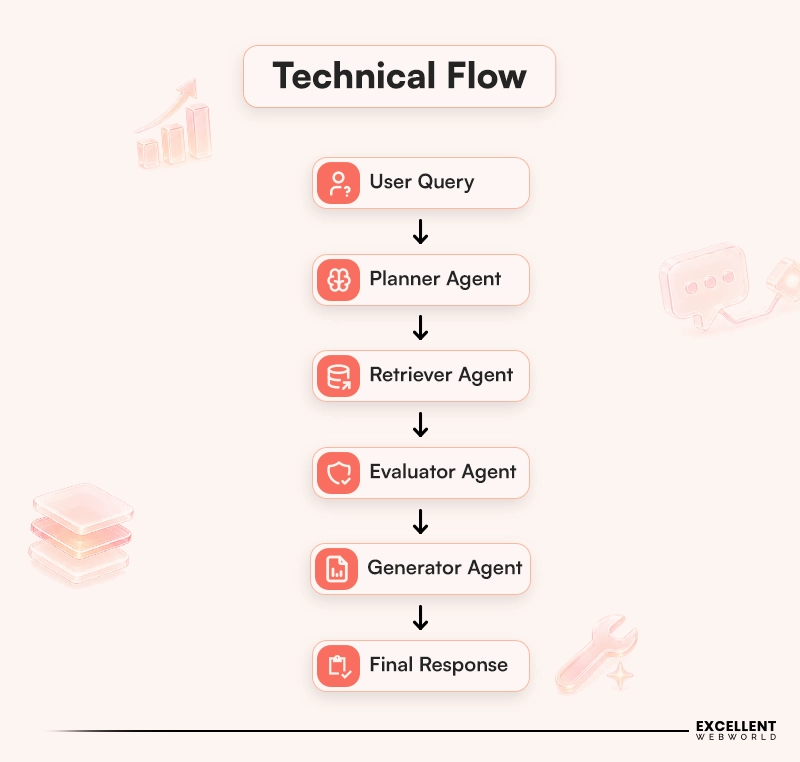
Agentic RAG can divide the retrieval and generation workflow among several agents, with each agent responsible for certain tasks; the same multi-agent vs. single-agent trade-off that applies to agent architecture generally. A planner can easily break down the question and determine the retrieval strategy and get appropriate information; the verifier can analyze evidence; and the generator can produce the final response.
Benefit: A role-based architecture makes the complicated RAG workflows more modular and offers important tasks like retrieval and verification with their own dedicated agents. It permits several components to be enhanced independently without redesigning the complete workflow.
Example: Google Cloud’s Agentic RAG codelab shows how you can make different agents work as a team in an Agentic RAG application. You can have one agent that plans out the task. You can have another agent that finds information from a search service. Then you can have an agent that uses that information to write a real answer. This way of building things is great for compliance workflows. These compliance workflows need a plan, good retrieval, quick verification and clear response generation.
9 Personalized/contextual retrieval with memory
Agentic RAG can consist of user permissions, departmental context, earlier interactions, and the historical activity while determining which data is relevant. This enables the retrieval to adapt to an individual’s role, accessibility level, and functional requirements instead of treating every user query the same.
Benefit: This makes the enterprise AI responses more relevant while ensuring that the retrieved data aligns with users’ authorized access and business context.
Example: A research publication on Permission-Aware RAG proposes validating user permissions against identity and access-management systems during retrieval. For example, when a finance employee requests the latest regional revenue forecast, the agent can verify the employee’s role and authorized region before retrieving the relevant reports.
10 Autonomous knowledge-base maintenance
Agentic RAG is moving beyond simply retrieving information and helping to track the quality of the knowledge base itself. AI agents can evaluate the retrieved content, recognize outdated, missing, or conflicting information, and decide whether more retrieval data, re-indexing, or human review is needed.
Benefit: Helps institutions maintain a more reliable and up-to-date knowledge base, reducing the risk of agents repeatedly retrieving outdated or contradictory information. It’s an reliable concern that typically requires forward-deployed engineers embedded in enterprise AI rollouts to catch early.
Example: An agent encounters conflicting information across two internal policy documents while answering a compliance question. Instead of selecting one source and confidently generating an answer, it can identify the inconsistency, flag the affected documents, and trigger an update or human-review workflow.
11 Retrieval-augmented code/data agents
Agentic RAG can easily retrieve code snippets, database schemas, API documentation, technical specifications, or previous support tickets before generating the code or SQL. This gives the agent access to recent technical context instead of depending on information learned during model training.
Benefit: This strategy will help eliminate the problems arising from the use of outdated assumptions, database structure changes, or lack of technical information. It is especially applicable for developers working in large code and data environments that undergo changes often.
Example: The Microsoft Agentic Retrieval-Augmented Generation (RAG) architecture outlines how an agent retrieves current information via retrieval and external tool functions prior to accomplishing a given task. In the developer workflow, the agent is able to retrieve the current database schema and documentation and confirm which columns are available, and from there, generate the SQL; the same retrieval-then-reason pattern covered in how to build an AI agent.
12 Agentic RAG for Customer Supportvcode generation,
Agentic RAG can assist customer support systems in retrieving information from the documentation of the product, order details, troubleshooting documents, previous support cases, and company policies before generating a response. The agent can determine the relevance of different information sources, retrieve further information as required, and use the information to provide a more accurate response.
Benefit: This can reduce repetitive work for support teams while helping customers receive context-aware responses. This will also help the agents in responding to queries that need to be answered based on multiple systems.
Example: The customer queries, “I haven’t received my replacement yet and would like to know if I can get a refund.” The agent can retrieve the order details and its status from the live system and the refund policy from the knowledge base to respond.
The Future of AI With Agentic RAG
After exploring all these 12 Agentic RAG use cases, it is obvious that AI is moving beyond simple retrieval towards systems that can easily plan, reason, retrieve, verify, and act autonomously. Moreover, turning these capabilities into a reliable business solution needs the right architecture, data strategy, security, and agent orchestration.
That’s where Agentic AI development services can help. Our team engineers custom Agentic AI apps and solutions around real business workflows, implementing intelligent retrieval, AI agents, automation, and enterprise data sources. We help businesses move from experimentation to scalable integration.
Are you ready to explore what Agentic RAG can do for your business? Connect with our AI experts to identify the right use case and create a solution tailored to your objective.
FAQs
The agentic RAG model adds the ability to plan retrieval, select sources of information, use external tools, verify and evaluate results, and execute multiple rounds of retrieval before generating the final output, compared to the traditional RAG process.
Agentic RAG applies to multi-hop research, complex document question answering, hybrid search, iterative retrieval, personalized retrieval, maintenance of the knowledge base, code generation, customer service, and many other workflows that require multiple reasoning or retrieval steps.
The agentic RAG model has the capability to lower the number of unsupported statements, as it will be possible to retrieve information, verify it, and retrieve additional data if the existing context is not sufficient.

Article By


Paresh Sagar is the CEO of Excellent Webworld. He firmly believes in using technology to solve challenges. His dedication and attention to detail make him an expert in helping startups in different industries digitalize their businesses globally.