An agentic AI modernization framework gives engineering teams a structured way to update legacy applications with AI agents. Adding agents to existing development workflows is not enough. Teams need to understand their current systems, define what each agent is allowed to do, and set controls before agents touch any modernization task.
The framework runs in five phases: assess the application, design the target architecture, build the agent team, validate the approach through a pilot, and scale proven workflows across the organization. Each phase ends with documented outputs, so teams move from assessment to controlled agent adoption in clear steps.
The real measure of success is whether agents can modernize without compromising code quality, security, system reliability, or developer control. This requires measurable pilot results, defined agent responsibilities, human approval points, and documented workflows that teams can maintain as adoption grows.
Agentic AI application modernization is moving from an experimental concept to a practical enterprise engineering model. But deploying an AI coding assistant during a migration is not the same as building an agentic modernization capability.
A working agentic AI modernization framework connects AI agents to every major stage of transformation: application assessment, architecture design, implementation, testing, security review, deployment, and organizational adoption.
That distinction matters because modernization projects fail for reasons that have little to do with how quickly code can be generated. Enterprises must first understand what a legacy application does, determine what should change, establish controls around AI-generated changes, validate the result, and then make the operating model repeatable across teams.
A practical way to manage this complexity is a five-phase framework:
- Assess
- Architect
- Build the Agent Team
- Pilot
- Scale
This agentic AI modernization framework gives you a path from the first analysis of a legacy application to organization-wide adoption.
What is the Agentic AI Modernization Framework?
An agentic AI modernization framework is a structured approach to using specialized AI agents across application assessment, architecture planning, implementation, validation, and organizational adoption. Each phase defines the activities, agent responsibilities, expected outputs, and approval requirements before the modernization process moves forward.
For example, when modernizing an insurance claims application, discovery agents can identify legacy dependencies, architecture agents can recommend a target design, and development and testing agents can support implementation and validation. Human engineers review the results before the organization expands the approach to other applications.
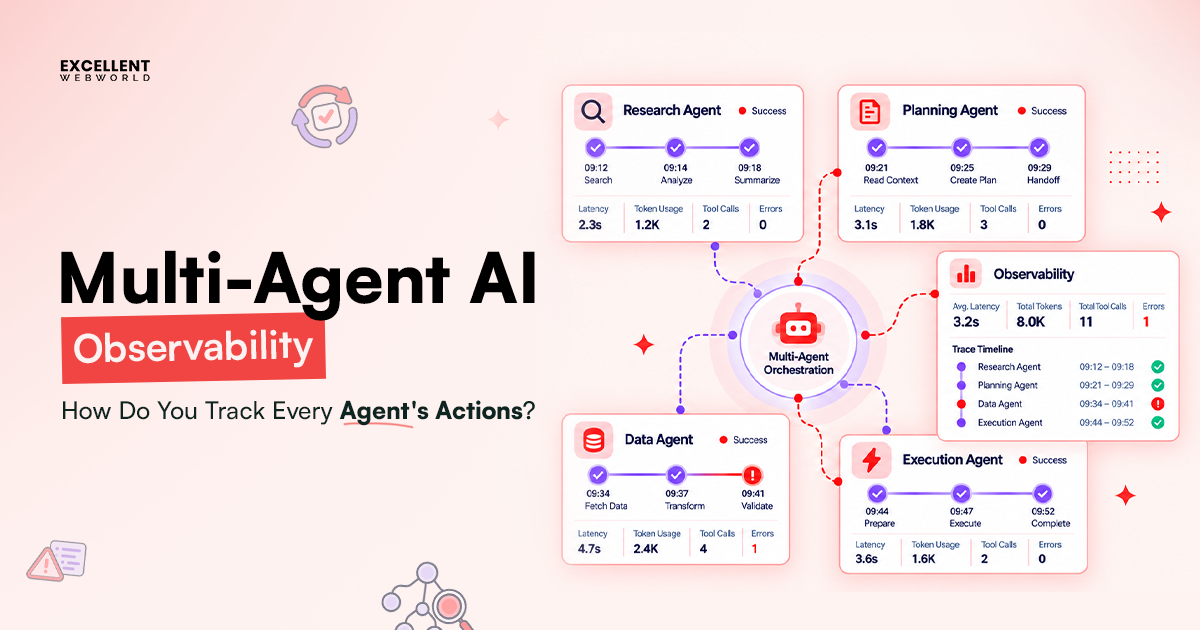
In an agentic modernization model, multiple AI agents perform specialized tasks within an orchestrated workflow. This approach to agentic AI development allows an architecture agent to analyze application dependencies and propose a target design. A development agent can implement approved changes, while testing agents validate the implementation. Review agents evaluate code quality, and security agents check for vulnerabilities and policy violations.
The human engineering team governs the workflow, approves high-risk decisions, and resolves situations where agents produce conflicting recommendations. This creates a structured modernization process:
- Application understanding
- modernization planning
- transformation
- validation
- deployment
- continuous improvement
Deployment and continuous improvement follow as part of the implementation and adoption activities. The objective is controlled autonomy that increases engineering capacity while keeping technical debt, security exposure, and operational risks under control.
The Five-Phase Framework for Agentic Application Modernization
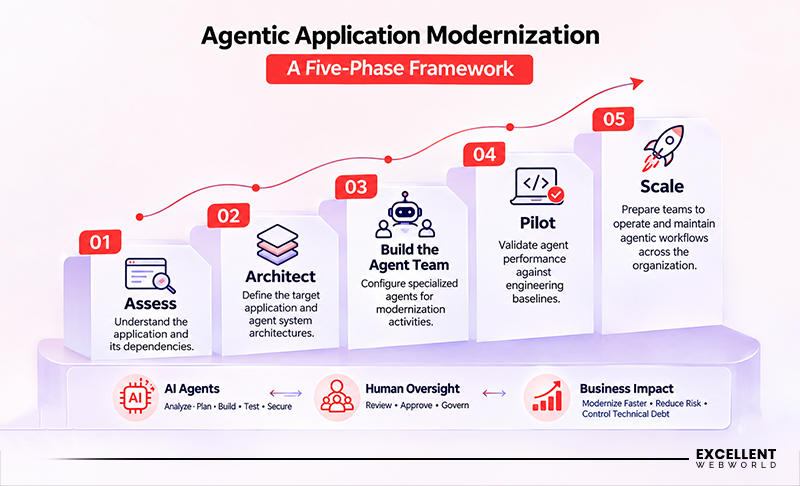
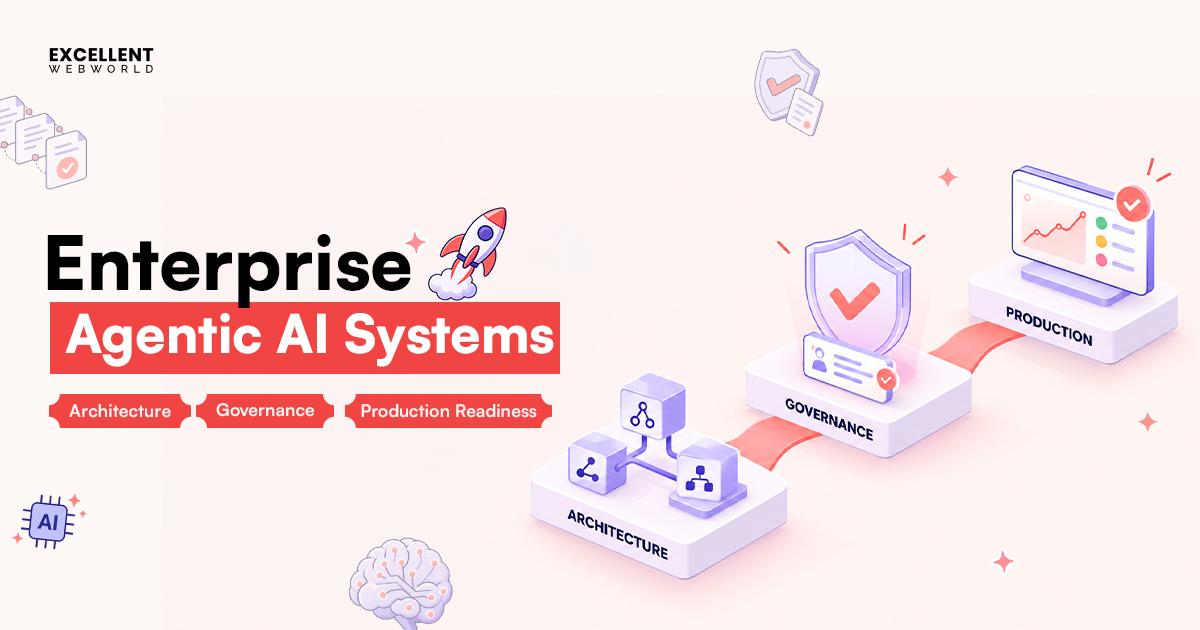
The agentic AI modernization framework divides legacy application modernization into five connected phases. Each phase has a specific objective, requires different agent capabilities, and produces outputs that guide the next stage.
| Phase | Primary Goal | Main Agents Involved | Key Deliverable | Indicative Duration |
|---|---|---|---|---|
| Phase 1: Assess | Understand the existing application and its dependencies. | Discovery and architecture agents | Application assessment report and dependency map | 1 – 3 weeks |
| Phase 2: Architect | Define the target application and agent system architectures. | Architecture and business analyst agents | Target architecture and migration strategy | 1 – 3 weeks |
| Phase 3: Build the Agent Team | Configure specialized agents for modernization activities. | Development, cloud, DevOps, review, testing, and security agents | Configured agent workflows and responsibility matrix | 2 – 4 weeks |
| Phase 4: Pilot | Validate agent performance against engineering baselines. | All relevant agents under human supervision | Pilot evaluation report | 3 – 8 weeks |
| Phase 5: Scale | Prepare teams to operate and maintain agentic workflows. | Agent team and human engineering teams | Adoption plan and operational handover | 4 – 12+ weeks |
The phases can overlap depending on application complexity, team availability, and the maturity of existing engineering processes. However, each phase should produce documented outputs before the organization increases the scope of agent involvement.
Phase 1. Assess the Application Before Changing It
The first phase establishes the current state of the application. Legacy systems often contain undocumented business rules, interconnected databases, third-party integrations, and infrastructure dependencies. Before deciding whether to refactor, replatform, or rebuild, engineering teams need to understand how these components interact.
What to Assess in Your Application
Here is what an application assessment must examine:
- Current architecture
- Programming languages and frameworks
- Application dependencies
- Database architecture
- APIs and integrations
- Infrastructure dependencies & application usage
- Performance characteristics
- Security exposure and Testing coverage
- Deployment processes
- Operational dependencies
- Technical debt and business criticality
What’s the objective? It’s to answer the question: What are we actually changing?
How Agents Contribute
A discovery or architecture agent can analyze source repositories, configuration, documentation, dependency files, API definitions, schemas, and other available technical artifacts. Here are the patterns that can be identified by the AI agent:
- Tightly coupled components
- Duplicate functionality
- Obsolete frameworks
- High-risk modules
- Unused dependencies
- Potential architectural bottlenecks
- Missing documentation
- Low-test-coverage areas
AI should accelerate discovery, not replace validation. The resulting analysis should be reviewed by engineers who understand the application's operational and business context.
Deliverables You Need to Check in Phase 1
Here is what a structured assessment must produce:
| Deliverable | What It Contains |
|---|---|
| Application assessment report | Current architecture, technologies, and application condition. |
| Dependency map | Relationships between application components, databases, and integrations. |
| Technical debt inventory | Outdated frameworks, duplicated code, and maintainability issues. |
| Risk assessment | Security, operational, and migration risks. |
| Modernization prioritization matrix | Applications ranked according to business value, technical complexity, and risk. |
| Modernization roadmap | Recommended transformation sequence and initial milestones. |
A technically difficult application may not be the first to modernize if it has low business value. A business-critical application can still earn a top spot even when its technical complexity is higher.
I have seen the importance of assessing operational workflows before transformation. For HJM Logistics, an international freight forwarding and supply chain company, we mapped existing freight processes before building a connected platform with AI-powered quoting, document processing, and shipment intelligence. This AI freight forwarding project illustrates why modernization decisions should begin with business requirements rather than technology selection alone.
Phase 2. Design the Target Architecture
Once the existing application is understood, the next question is:
What should the modernized application become?
There is no single architecture that is correct for every modernization project. For some enterprise applications, cloud-native application development supports scalability, modular services, and automated deployment. Others may benefit from a simpler architecture that reduces operational complexity. Depending on the application's characteristics, the target architecture may use:
- Cloud-native services
- Microservices
- Modular monoliths
- Event-driven architecture
- Serverless components
- Managed databases
- API-driven integration
- Containerized workloads
The choice should be driven by business requirements, scalability needs, operational constraints, security, cost, and maintainability, not by a particular architectural pattern's popularity.
Choose the Right Migration Strategy for Application Modernization
Agentic AI can automate parts of the transformation process, but the underlying application modernization strategy still depends on the existing system's architecture, technical debt, business requirements, and migration risks. An agentic application modernization strategy can include several approaches.
| Migration strategy | What It Involves | Best suited to |
|---|---|---|
| Rehost | Move the application to a new infrastructure environment with minimal code changes. | Organizations seeking infrastructure modernization with limited application transformation. |
| Replatform | Move the application to a modern platform while making targeted changes. | Applications that can benefit from modern infrastructure without extensive restructuring. |
| Refactor | Change the internal implementation while preserving the application's fundamental behavior. | Systems where the existing functionality remains valuable but the codebase has become difficult to maintain. |
| Rebuild or Rearchitect | Redesign major application components and architectural patterns. | Systems where the existing architecture creates fundamental scalability, maintainability, or integration limitations. |
For example, replatforming may involve migrating to the cloud and moving to managed infrastructure while retaining much of the existing application functionality. Refactoring may require changes to internal components without replacing the entire application.
These transformations require application modernization services to restructure legacy components, improve system integrations, and prepare the application for AI-driven workflows. Make these choices before agents begin large-scale transformations.
Define the Agent Architecture at the Same Time
An agentic modernization program requires two architectures to be planned together.
1. Modernized Application Architecture
This defines how the transformed application will operate. It covers:
- Application components and services
- Database architecture
- APIs and integrations
- Infrastructure requirements
- Deployment model
- Scalability and maintainability requirements
2. AI Agent System Architecture
This defines how specialized agents will participate in modernization activities. It covers:
- Agent responsibilities
- Available tools and permissions
- Data and context access
- Communication mechanisms
- Human approval requirements
- Escalation procedures
- Evaluation criteria
- Audit requirements
Planning these architectures together helps prevent agents from operating outside the application's technical and security constraints.
Phase 3. Build the Agent Team for Application Modernization
The third phase introduces specialized agents into the modernization workflow. A practical enterprise model can begin with six core roles.
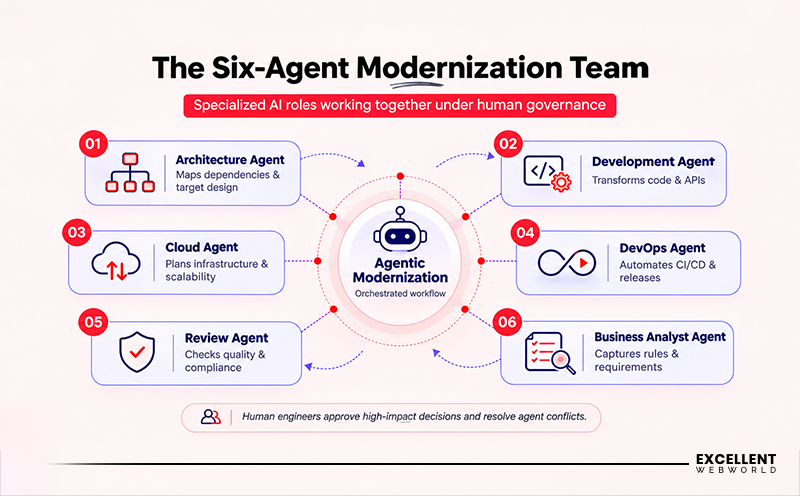
1. Architecture Agent
The architecture agent focuses on system structure. Here is what it carries out:
- Analyze legacy architecture
- Identify architectural debt and map dependencies
- Recommend refactoring opportunities
- Generate architecture documentation
- Evaluate proposed changes against architectural standards
Treat its output as a recommendation rather than an automatic architectural decision.
2. Development Agent
The development agent handles implementation tasks defined within the approved modernization plan. Dev Agent is there to assist you with:
- Code transformation
- Framework migration & refactoring
- API implementation
- New feature development
- Documentation & configuration updates
The development agent should work within repository-level instructions, coding standards, architecture constraints, and testing requirements.
3. Cloud Agent
The cloud agent focuses on the infrastructure required by the modernized application. Its responsibilities can include:
- Infrastructure definitions & cloud resource configuration
- Scalability recommendations & resilience design
- Observability requirements
- Infrastructure validation & cost optimization analysis
The cloud agent should not have unrestricted production access simply because it can generate infrastructure code.
4. DevOps Agent
The DevOps agent supports software delivery. Along with that, the DevOps agent can work on:
- CI/CD pipelines
- Build configuration
- Deployment workflows
- Environment configuration
- Release automation
- Deployment diagnostics
- Infrastructure automation
Its role is to make the path from approved code to validated deployment more repeatable. The DevOps agent supports software delivery by automating tasks across CI/CD pipelines, infrastructure management, and release workflows. All the key areas of DevOps services and solutions, where agents can reduce manual effort and improve deployment consistency.
5. Review Agent
The review agent provides an independent quality checkpoint. Review agents are the ones who evaluate:
- Code quality & maintainability
- Architectural compliance
- Coding standards and potential defects
- Test adequacy and dependency risks
An important design principle is separation of responsibilities. The agent that generates a change should not necessarily be the only agent responsible for validating that change.
6. Business Analyst Agent
The business analyst agent connects technical implementation with business requirements. Having a business analyst agent helps you analyze:
- Requirements & user stories
- Business rules
- Acceptance criteria
- Functional dependencies
- Process documentation
This role is particularly important for legacy modernization because undocumented business logic can be embedded directly inside old code.
For example, in our sports governance intelligence platform, we implemented an agentic workflow that validates sports sabbatical requests against eligibility rules, minimum notice periods, and policy requirements. It demonstrates why agents need an accurate understanding of business rules before taking action.
What Happens When Agents Disagree?
This is one of the most important design questions in an agentic modernization system. Suppose:
- The architecture agent recommends extracting a service.
- The cloud agent recommends keeping the component together for operational simplicity.
- The development agent identifies significant implementation complexity.
- The business analyst agent determines that the module contains tightly coupled business rules.
The system should not allow one agent to arbitrarily override the others. This is where AI governance becomes important. Each recommendation needs an accountable decision-maker, clear approval boundaries, and a record of how conflicting outputs were resolved. Instead, disagreements should trigger a resolution protocol.
A practical protocol is:
Agent recommendations → evidence comparison → risk classification → human review → decision recorded → workflow continues
For high-impact architectural decisions, the human engineering team becomes the final authority. This creates a useful rule: Agents can disagree; the system must never be ambiguous about who resolves the disagreement.
Phase 4. Validate the Agentic Model Through a Pilot
Before introducing agentic modernization across an enterprise application portfolio, validate the workflow through a controlled pilot. The pilot should use a defined application, a measurable modernization objective, and engineering tasks that can be evaluated against existing performance baselines.
Select a Suitable Application for the Pilot
A suitable pilot application should have:
- A clearly defined modernization objective
- Documented application requirements
- Manageable technical complexity
- Accessible source code and documentation
- Measurable engineering baselines
- Limited production risk
- An engineering team available to review agent-generated work
Avoid starting with the most complex business-critical application. A contained project gives teams an opportunity to evaluate agent performance before expanding the workflow.
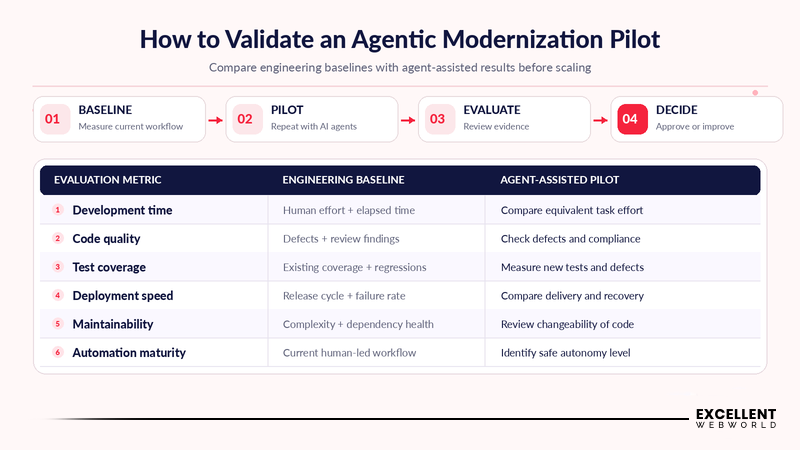
| Measurement Area | What to Evaluate | Key Metrics |
|---|---|---|
| Development Time | Engineering effort with and without AI assistance |
|
| Code Quality | Code quality and architectural compliance |
|
| Test Coverage | Test coverage before and after modernization |
|
| Deployment Speed | Changes in software delivery speed and reliability |
|
| Maintainability | Ease of maintaining and modifying the application |
|
| Automation Maturity | Level of autonomy across modernization tasks |
|
These metrics become more meaningful when the agent workflow is evaluated alongside CI/CD for AI, where testing must account for traditional software behavior and the variability of AI-generated outputs.
The objective of automation maturity is not to reach controlled autonomy everywhere. It is to determine the appropriate autonomy level for each modernization task.
Phase 5. Move From Pilot to Organization-Wide Adoption
A successful pilot does not create organizational capability by itself. Teams need the skills, processes, governance, and operating model required to work effectively with agents.
Prompt Engineering
Developers need to understand how to provide agents with:
- Context
- Constraints
- Examples
- Acceptance criteria
- Expected outputs
- Validation requirements
However, enterprise agentic development should not depend entirely on individual prompt-writing skill. Prompts should increasingly become reusable instructions, repository policies, specifications, and workflow definitions.
Spec-Driven Development
Spec-Driven Development provides agents with explicit requirements before implementation begins. A modernization specification can include:
- Business objective
- Functional requirements
- Technical constraints
- Security requirements
- Performance expectations
- Acceptance criteria
- Testing requirements
- Architectural constraints
This creates a stronger workflow:
- Specification
- Plan
- Implementation
- Test
- Review
- Approval
It also improves traceability when multiple agents participate in the same task.
Knowledge Transfer
Organizational adoption requires more than showing developers how to use an AI interface. Teams also need to understand how AI in DevOps changes software delivery, incident response, infrastructure management, and the balance between automation and human oversight. When it comes to knowledge transfer, make sure it covers:
- Agent capabilities
- Agent limitations
- Workflow design
- Review practices
- Security controls
- Evaluation methods
- Escalation procedures
- Prompt and specification patterns
Teams should leave the program able to operate and improve the agentic workflow themselves.
Handover Plans
A proper handover should document:
- Agent roles
- Tool permissions
- Workflow definitions
- Repository instructions
- Evaluation criteria
- Approval gates
- Known failure modes
- Monitoring procedures
- Ownership responsibilities
The goal is to prevent the organization from becoming dependent on an external team that understands the agent system better than its own developers.
Build vs. Buy: Custom Agent Team or Platform?
You can run the agentic AI modernization framework with a custom agent team or with an enterprise modernization platform. The right choice depends on your customization, integration, and governance requirements.
| Criteria | Custom Agent Team | Modernization Platform |
|---|---|---|
| Customization | Tailored agent roles, tools, and workflows | Limited to platform capabilities |
| Architectural Control | Control over models and orchestration | Platform-dependent |
| Implementation | Higher engineering effort | Faster initial setup |
| Integrations | Supports proprietary enterprise systems | Depends on available integrations |
| Security | Custom-defined controls and evaluation | Platform-provided controls |
| Maintenance | Managed internally | Partly managed by provider |
| Best For | Complex, specialized workflows | Standardized modernization |
Custom AI agent development makes the most sense when modernization workflows are strategically important or highly specialized.
For organizations considering platforms, AWS Transform supports agentic application modernization, while Indium's LIFTR.ai focuses on legacy application transformation.
The choice comes down to speed of adoption versus control and customization. A hybrid approach can also combine platform capabilities with custom-built agents. This version retains the original section's key information, preserves your internal link, and removes the lengthy advantages and trade-offs lists.
Tools and Technology Stack for the Agentic AI Modernization Framework
An agentic modernization system generally requires several technical layers.
Foundation Models
The reasoning and code-generation capabilities are provided by one or more foundation models. The right choice depends on:
- Coding performance
- Context-window requirements
- Cost
- Latency
- Enterprise data controls
- Deployment requirements
Agent Orchestration
An orchestration layer determines:
- Which agent receives a task
- Which tools it can use
- What context it receives
- When another agent should be invoked
- When human approval is required
- How failures are handled
Choosing among open-source AI agent frameworks requires evaluating the organization's preferred cloud, model providers, programming environment, workflow complexity, and need for multi-agent coordination.
Model Context Protocol
Model Context Protocol (MCP) can provide a standardized way for AI systems to connect with external tools and data sources. In an enterprise modernization environment, MCP-style integrations can expose controlled access to resources such as:
- Code repositories
- Documentation
- Issue trackers
- Databases
- CI/CD systems
- Cloud environments
- Monitoring platforms
The important consideration is not simply whether MCP is available. It is what each agent is allowed to access through those connections. Without proper agentic AI security, tool integrations can introduce risks such as excessive permissions, unauthorized actions, and exposure of sensitive information. So, control what each agent can access and execute through MCP integrations.
Developer Tooling
The agent layer sits alongside conventional engineering tools:
- Git repositories
- IDEs
- Static-analysis tools
- Testing frameworks
- Container platforms
- CI/CD systems
- Infrastructure-as-code
- Observability platforms
- Security scanners
Agentic AI does not replace this engineering toolchain. It orchestrates and extends it.
How Long Does Each Phase of Agentic Application Modernization Take?
The agentic AI modernization framework does not give every application the same schedule. A contained pilot may take a few months, while a complex enterprise application can need substantially more time. The table below shows indicative durations for each phase.
| Phase | Indicative Duration |
|---|---|
| Application Assessment | 1 – 3 weeks |
| Target Architecture Design | 1 – 3 weeks |
| Agent Team Setup | 2 – 4 weeks |
| Pilot Validation | 3 – 8 weeks |
| Organization-Wide Adoption | 4 – 12+ weeks |
These phases can overlap depending on the project. For example, agent configuration can begin while the architecture is being finalized, provided the responsibilities and technical constraints are sufficiently clear. Actual timelines depend on several factors:
- Number of applications being modernized
- Codebase size and complexity
- Dependency relationships
- Business criticality
- Existing test coverage
- Number of integrations
- Regulatory requirements
- Data migration requirements
- Target architecture
- Production risk tolerance
Application complexity generally has a greater influence on the schedule than the AI model itself. A well-documented application with limited dependencies may move through the framework faster than a legacy system with interconnected modules and undocumented business rules.
Where Each Phase of Agentic Modernization Can Go Wrong
Every phase introduces different risks. Identifying them early helps engineering teams establish the right controls before expanding agent responsibilities.
Phase 1 Concern: Assess
An agent identifies code as redundant because it misses an undocumented business dependency.
How to Prevent It
Combine code analysis with runtime evidence, dependency discovery, and human validation.
Phase 2 Concern: Architect
The team selects an architecture because it is popular rather than suitable for the application.
How to Prevent It
Evaluate options against business requirements, security, cost, and maintainability.
Phase 3 Concern: Build the Agent Team
Agents produce conflicting recommendations without a clearly assigned decision-maker.
How to Prevent It
Define agent responsibilities, decision ownership, and escalation procedures before implementation.
Phase 4 Concern: Pilot
The team measures development speed but overlooks defects, test coverage, and remediation effort.
How to Prevent It
Evaluate delivery speed alongside code quality, testing, and remediation metrics.
Phase 5: Scale
Developers lose familiarity with underlying systems, or the organization becomes dependent on one agent provider.
How to Prevent It
Retain human engineering ownership and separate agent instructions from provider-specific implementations.
Security risks also need to be considered as agent responsibilities expand. Testing agents against adversarial inputs and unauthorized tool requests can help identify unsafe behavior before production deployment.
Prepare Your Enterprise Applications for Agentic AI Modernization
Modernizing enterprise applications with agentic AI requires more than assigning coding tasks to autonomous agents. It needs a structured process that connects application assessment, architecture planning, agent development, validation, and organizational adoption. The agentic AI modernization framework helps engineering teams manage these activities while keeping human oversight and technical quality intact.
We, at Excellent Webworld, help businesses plan and implement agentic modernization strategies. Our team brings expertise in:
- Legacy Application Assessment: Identifying application dependencies, technical debt, and modernization risks.
- Agent Architecture Design: Defining specialized agent roles, orchestration patterns, and human approval points.
- Custom AI Agent Development: Building agents for architecture analysis, code transformation, testing, and documentation.
- Enterprise Integration: Connecting agents with existing repositories, databases, cloud environments, and CI/CD systems.
- Security and Governance: Establishing access controls, validation processes, and human oversight.
- Performance Evaluation: Measuring engineering effort, code quality, test coverage, and automation maturity.
The goal is to make every modernization cycle more predictable and manageable while leaving applications easier to maintain and extend. Planning to apply an agentic AI modernization framework to your legacy applications? Talk to our Agentic AI experts about running the 5-phase process on your first pilot application.
Key Takeaways
- An agentic AI modernization framework starts with what the legacy application actually does, which can differ significantly from its documentation. Undocumented integrations, runtime dependencies, and business rules can change the scope of modernization.
- Two architectural views matter: one for the application being modernized and another for the AI agents working on it. Both need to be mapped before implementation begins.
- Giving every agent access to the same tools and permissions can create conflicting actions. Access should reflect each agent's assigned responsibilities.
- Agent disagreement is an expected part of multi-agent workflows. The process needs a clear record of competing recommendations, supporting evidence, risk levels, and human-approved decisions.
- A pilot may show faster code generation while exposing problems in testing, maintainability, or deployment. Development speed alone cannot establish whether an agentic approach is working.
- Who owns the workflow when the AI provider changes? Engineering teams should retain agent instructions, workflow specifications, architecture records, and approval rules so the implementation does not depend entirely on one provider.
Frequently Asked Questions
The five phases are application assessment, target architecture design, agent team development, pilot validation, and organization-wide adoption. Each phase addresses a different part of modernization, from understanding existing systems to scaling validated agentic workflows.
If you opt for a full engagement under the agentic AI modernization framework, it would take about 11 to 30+ weeks, and a contained pilot (phases 1 to 4) is usually ready in 7 to 18 weeks. The exact timeline depends on application complexity, existing dependencies, and the scope of modernization.
- Application Assessment (1–3 weeks)
- Target Architecture Design (1–3 weeks)
- Agent Team Development (2–4 weeks)
- Pilot validation (3–8 weeks)
- Organization-wide adoption (4–12+ weeks)
Yes. AI agents can analyze COBOL programs, summarize business logic, map copybooks and job dependencies, and draft equivalent code in languages such as Java or C#. Legacy business rules and batch-processing behavior still require careful validation. Running identical transactions through both systems and comparing their outputs can help identify discrepancies before deployment.
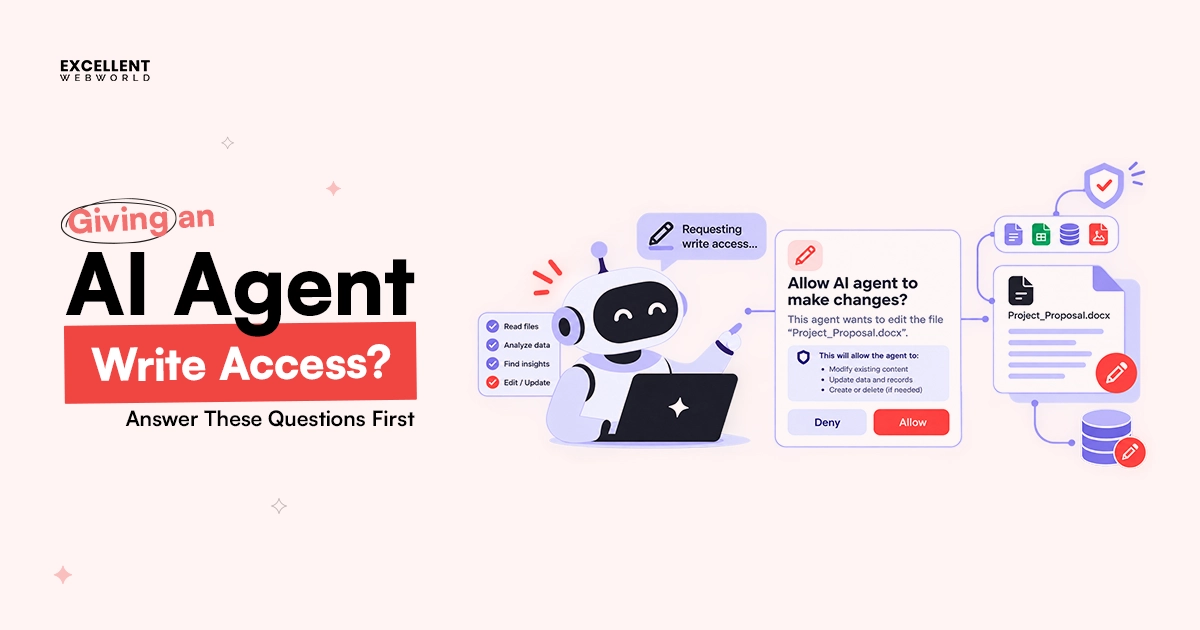
Yes, when access is controlled. Start with read-only permissions and add write access only after the agent’s work has been reviewed. Before granting access, check these points:
- Model Hosting: Whether the model runs through a vendor-hosted service, private cloud, or self-hosted environment.
- Data Handling: Whether source code and prompts are stored or used for model training.
- Permissions: Whether agents have read-only or write access.
- Credential Security: Whether API keys, passwords, and customer data are protected.
- Activity Logs: Whether agent actions and tool calls are recorded.
Evaluate the pilot using both delivery and engineering quality metrics. Track development time, code quality, test coverage, defect rates, deployment performance, and maintainability. Compare these results against the existing development process to determine whether agents are producing measurable improvements without introducing additional engineering risks.
Yes. Agents can assist with schema conversion, stored procedure translation, data mapping, and validation queries. Engineers should retain ownership of data cleansing, cutover planning, rollback procedures, and performance tuning. Data that works under the old schema may also violate constraints in the new database, so validation is necessary before migration.
Scale when the pilot consistently meets its predefined performance, quality, security, and reliability targets. Teams should also have documented workflows, clear agent permissions, human approval processes, and sufficient monitoring in place. If the pilot still produces frequent errors or requires extensive manual correction, the workflow needs further refinement.
Documentation should stay connected to the application code and development process. Teams can generate architecture and API documentation from the updated codebase, refresh it through CI/CD pipelines, and have engineers review changes to business rules. Storing documentation alongside the code also makes it easier to maintain across releases.

Article By


Mahil Jasani began his career as a developer and progressed to become the COO of Excellent Webworld. He uses his technical experience to tackle any challenge that arises in any department, be it development, management, operations, or finance.