What matters when building NDIS software:
- NDIS software must balance participant operations, provider workflows, claims, rostering, billing, and compliance in one reliable platform.
- PRODA and PACE serve different purposes, so integration requirements should be defined early when building scalable NDIS software.
- SCHADS compliance should be built into rostering and payroll workflows to calculate rates, allowances, and overtime accurately.
- Custom NDIS software development can make more financial sense long-term for larger providers that need greater control, integration, and data ownership.
- Strong audit trails, accurate claims, incident records, and access controls are essential as NDIS regulatory and safeguarding requirements evolve.
- AI-powered NDIS software is generally more practical than AI-native architecture, using AI for targeted administrative workflows while keeping core compliance logic deterministic.
- The right NDIS technology strategy starts with operational and compliance requirements, then adds automation and AI where they deliver measurable value.
If you are analyzing AI-powered NDIS software development options in Australia in 2026, then I wouldn’t start with a feature section on which ones need to be included. I would rather start with these 3 basic questions: “What needs to be compliant? What actually needs to be automated, & which NDIS setup does the platform need for connecting?”
At Excellent Webworld, we have spent 15 years building heavy compliance-based, government-facing software, a lot of which is done for Australia. On the basis of that experience, I can state that often NDIS-related projects are unnecessarily expensive.
Teams often start with screens & features, then explore the rostering process. It includes SCHADS rules, claims based on government systems & critical workflows that actually need defensible records. That is where a record of experienced custom software development becomes very important: not simply building more features, but getting the underlying architecture right.
My recommendation is quite simple when it comes to building AI-powered NDIS software. You need to develop the operational core deterministically, making standard compliance a part of the architecture from day one, and then use AI to eliminate manual administrative work and save time.
My 2026 view: The best NDIS platform isn’t one with the most AI; it is actually the one where AI makes the right workflow faster without compromising participant safety, auditability, or human accountability.
Here’s what I’d tell you if you sat down with me to scope one.
What Is the NDIS, Quickly?
Mostly, people reading this must already know what NDIS actually means, so I won’t spend much time on the basics. Understanding the scale of the system for which you are building the software is much more significant.
The National Disability Insurance Scheme (NDIS) is Australia’s national scheme for funding sports & services for individuals with disabilities. From this standard scheme, participants actually receive customized plans & funding, which is mainly utilized by registered providers. This helps plan managers or self-management for services like personal care, therapies, equipment & community access controls.
Managed by the National Disability Insurance Agency (NDIA), which is a government-backed agency, there is proper administration of schemes and NDIS operations, providing better compliance. Along with that, the NDIS Quality & Safeguards Commission coordinates the registration process, manages complaints & also oversees quality protection information.
This standard scheme of Australia supports over 774,000 participants & moves 10 billion dollars yearly through a provider marketplace of about 20,000+ registered providers. It includes everything from individual support workers & small organizations to larger service providers.
That scale totally changes the software equation. A claims error is not just a technical error, but it can hamper and delay revenue too. Missed worker compliance requirements and a poor audit trail approach also create bigger problems when a provider conducts demonstrations. This generally raises many questions about accessibility & what actions need to be taken.
That’s why I look at NDIS software as a core operational & compliance platform first, rather than understanding it as a simple CRM, rostering app, or any billing system. Generally, in terms of practice, every part of the platform, starting from participant datasets, rostering, claims, incidents & integrations, all needs a unified, accountable setup.
What Does AI-Powered NDIS Software Development Contain?
I would separate this market space into 3 practical categories.
| Platform | What It Actually Is | Where AI Sits |
|---|---|---|
| Legacy SaaS | There are off-the-shelf tools like ShiftCare, Brevity-style, and others developed for generic rostering & billing processes in this platform. | For this, AI is often absent and also limited to standalone features like chatbots, with little integration into underlying operational work processes. |
| AI-Powered | This platform includes a purpose-based operational platform covering rostering processes, claims & compliance records, with AI integrations, thus delivering operational value. | Here, AI assists with defined tasks like progress note drafting, claims validation, document extraction, risk-flagging approach & worker matching with human-reviewed decisions. |
| AI Native | This is a particular platform that is built around AI models as the most significant part of its architecture from the initial phase, with AI deeply integrated into how information is translated & interpreted in a proper orchestration. | AI becomes the main decision-maker and forms the orchestration layer that continuously interprets datasets, thus generating recommendations & driving workflows, rather than just functioning as an add-on feature. |
Mainly for most of the NDIS providers, I would suggest an AI-enabled, not AI-native, setup. The NDIS software is closer to the government claims, participant safety & audit trails, so that the core rostering process, billing and standard compliance logic are quite deterministic, auditable & also testable.
As per the recent scenarios, AI should earn its place by reducing measurable administrative manual work processes involving shift note drafts, detecting unvalidated failed claims or in terms of surfacing patterns that need human attention. This is where AI development services can add value without turning AI into the decision-maker.
That is the approach to AI-powered NDIS software development that I recommend: engineering discipline first, AI integrated precisely where it delivers measurable operational value, while keeping consequential decisions under appropriate human oversight.
Why Do Providers Choose to Get AI-powered NDIS Software Custom Developed Instead of Buying It?
I generally see these four factors as ones that drive smarter decisions for mid-size & larger providers.
| Factors | What I’m seeing in Practice | What It Means for the Build Decision |
|---|---|---|
| Subscription Costs | The pricing that actually works for 20 staff is quite difficult to justify at 100. There could be spending of about $20,000–$25,000 AUD annually on a mid-tier plan for a provider with 100 staff & 200 participants prior to SMS credits or premium modules. | At that scale, it is quite worth comparing the 5-year cost of SaaS against any custom ownership. |
| Workflow Fit | Supported Independent Living (SIL), Specialist Disability Accommodation (SDA), & complex community needs require more flexible rostering than any generic approach that platforms provide. Gaps can be filled with spreadsheets & manual workarounds, but require additional compliance. | The custom software implementation becomes much more compelling when your service model no longer fits the standard workflows. |
| Data Ownership | Transferring years of records of participants, incident reports & progress notes from a subscription platform can be more complicated than expected. | For this, I would rather treat data portability & long-term accessibility as part of the software decisions, not as an afterthought. |
| Regulatory Pressure | The NDIS Commission’s 2026 regulations strengthen regulatory oversight, thus involving stronger data gathering & increased penalties for misconduct. From July 1, 2026, SIL & NDIS platform providers must also register with the NDIS Quality & Safeguards Commission. | In the case of building decision matters, it raises the bar for the audit trails, claims documentation, access controls & compliance workflows that need to be defensible by design and not reconstructed when there is a Commission review. |
What Compliance Does the AI-Powered NDIS Software Need to Satisfy?
This is the particular aspect where I would spend more time than most of the team actually expects. With the NDIS Practical Standard, this helps in determining the quality and safety outcomes, but not a software specification.
For developing NDIS software, I need to incorporate these standards into practical product controls that help in driving seamless operations.
| Requirements | Software Controls |
|---|---|
| Participant Privacy Aspects | Role-based access and least privilege |
| Auditability | Detailed activity and change logs |
| Incident Management | Structured capture and escalation |
| Worker Compliance | Screening and credential tracking |
| Governance | Approval and evidence workflows |
| Data Security | Encryption, backups and monitoring |
| Record Management | Versioning, retention and controlled access |
There is a need for careful planning in the case of identities and claims. The Provider Digital Access (PRODA) helps in managing the authentication process. Additionally, the PACE, a NDIA’s new provider computer system, supports NDIA participants & provider’s workflow.
The providers are able to use myplace bulk uploads, while already approved partners can pursue API access controls through NDIA Digital Partnership Program. In the case of rostering, there is a requirement of built in compliance.
The SCHADS Award rates, allowances, and overtime should be calculated based on what shifts are mainly created, while the NDIS Worker Screening Checks should be tracked with expiry alerts & assignment controls.
And the privacy & security go beyond the hosting location. The Privacy Act 1988 Cth, the Australian Privacy Principles, Australian region hosting & ACSC Essential Eight should inform the architecture. ISO 27001 is also quite significant in terms of enterprise procurement.
The 2026 reforms raise the expectations quite a bit higher in compliance. NDIS Quality & Safeguards Commission has strengthened information security and enforcement, with some strict contraventions thus imposing penalties up to 10,000 penalty units, around $3.3 million AUD.
It has been observed that from July 1, 2026, there is a mandatory registration process applicable to all NDIS platform providers & SIL operators. For the software team, the practical implications are very transparent, involving audit trails & claims documentation that needs to be defensible under the Commission’s close scrutiny, and also not require any kind of rebuilding or reconstruction when errors occur.
My Practical Test: Can you reconstruct what actually happened, who did it, when it happened, what changed, & also who approved it?
If not, the platform has an auditability problem.
Our Amazon Ring production testing system shows our expertise in how real-time logging and serial-number-based records can make traceability part of the system, rather than an afterthought. We could do the same for you when it comes to AI-powered NDIS software development in Australia.
Where Does AI Actually Fit Into an NDIS Platform?
This is the part where I would generally push back and say much about AI marketing. AI in NDIS software should remove the manual administrative work while keeping human oversight around the patient’s safety, claims & compliance. It’s the same principle that we, at Excellent Webworld, apply across our agentic AI development and AI agent development services, where AI agents assist but don’t make decisions on their owns unless we program them to do so upon project requirements.
Ambient Progress Notes
AI system can change a worker’s dictated shift debrief to a more structured & goal-focused fit plan. The workers are able to review it prior to entering the participant’s datasets, thus reducing manual documentation efforts.
Pre-Claim Validation
With this, an incorrect support item code or any budget issue can delay a claim generally. I would implement AI to detect anomalies prior to any submissions, while keeping the billing process quite deterministic and also aligned with the NDIS pricing schedule & support catalog.
Predictive Risk Flagging
AI can identify patterns across all progress notes, such as repeated wellbeing issues or behavioral changes, and also flag them for standard authorization. Additionally, it should surface a pattern, not make any care decisions, thus making this approach tailored to the NDIS’s growing emphasis on safeguarding participants’ data. Pattern detection that’s actually reliable at this scale is highly dependent on clean, structured data pipelines, something which we ensure via our data science services. So that it doesn’t become a problem later.
Smart Rostering
AI-enabled matching system helps in ranking the workers utilizing availability, qualifications, location, participant preferences & screening status. And the goal is pretty simple: it helps to reduce the unfilled shifts and the administrative efforts, thus making the eligibility controls quite deterministic.
Incident-Report Drafting
While under pressure, staff often miss details or struggle to manage the windows on critical incidents; a guided workflow can structure the incident information and relevant aspects like falls or injuries and also prepare documentation for an authorized review system. In the case of incidents falling within SIRS requirements, the system should support the correct reporting workflows, rather than making the reporting decision by itself.
My recommendation: AI can prepare, classify, detect & recommend, but humans remain accountable for the consequential decisions.
For NDIS software development, that is not an AI limitation, but an architecture that I would recommend when participant safety, claims accuracy & auditability are involved. We have observed a similar pattern play out in related regulated care settings. Checkout real AI-in-healthcare examples piece if you want to understand what enabling AI in healthcare looks like in practice elsewhere.
What Are the Core Modules of NDIS Software?
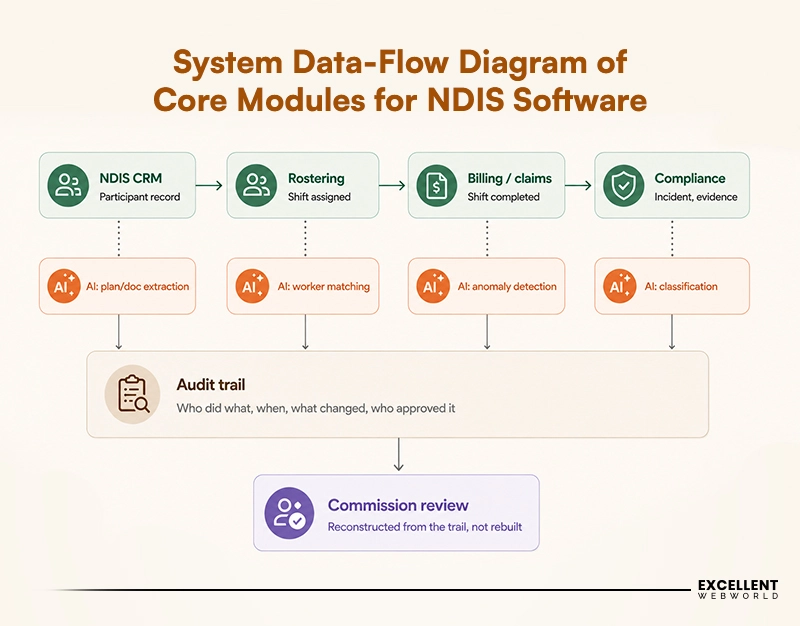
A strict NDIS management software development project must connect with the operational workflow setup rather than creating any isolated tools. I would structure the platform around these 5 core modules.
| Core Module | What it Should Handle | Where AI Assists |
|---|---|---|
| NDIS CRM software | Includes participant profiles, care plans, funding, goals, documents, and stakeholder access, supported by CRM development that connects these workflows in one system. | Plan/document extraction |
| NDIS rostering software | Need to manage shifts, availability, SCHADS checks, qualifications, and screening. | Intelligent worker matching |
| NDIS billing software development | Involves claims invoices, budget tracking & validation. | Anomaly and pre-claim detection |
| Compliance & incidents | This consists of incident workflows, evidence, corrective actions & audit records. | Classification and report drafting |
| NDIS app development | Includes shift acceptance, check-in/out, notes, signatures & offline capture | Voice-to-note conversion |
Care plans and participant profiles sit right at the center of this, just as patient records do when it comes to healthcare app development. The same discipline of highly structured and clean, auditable records is applicable to both.
The most important part is how these core modules actually work together as one operational system. A participant record dataset should inform the rostering process; completed shifts should flow into claims; incidents also need to have standard compliance workflows, along with the staff activities that need to create an evidence trail that is needed for review. Getting claims, rostering, and participant data to flow cleanly between various modules is fundamentally a concern of data engineering before it’s an AI concern.
For the NDIS app development, I would also say that offline capability is one such core aspect to be added, in addition to any other features. Whether SIL or regional teams face unreliability in connectivity, the workers need to capture the shifts in offline mode & synchronize reliably while the connectivity is restored.
We’ve applied a similar approach in FerMD, connecting mobile apps, doctor web panels, patient workflows, and hospital administration into one digital healthcare ecosystem.
FerMD
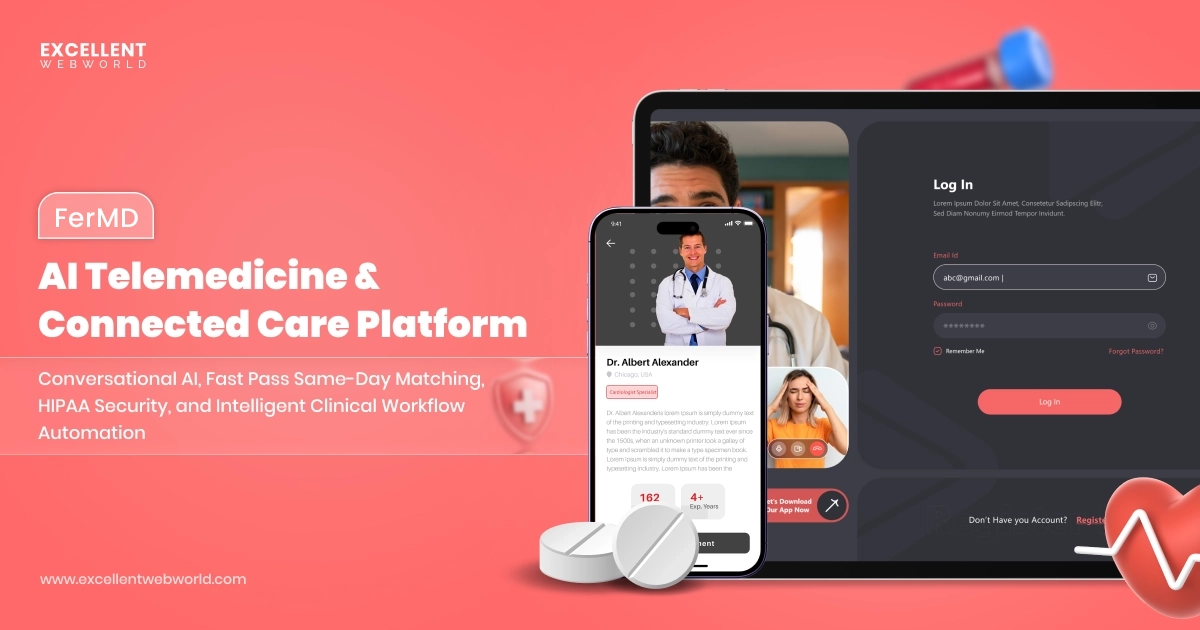
A HIPAA-conscious telemedicine app. Secure video consults, e-prescriptions, and scheduling expand patient access and streamline clinical workflows.
What Tech Stack Should You Choose for NDIS Software Development?
I would recommend a proven, maintainable tech stack over anything just selected for novelty for NDIS software development. The priority is always to make a secure, auditable & maintainable platform as per the operational & standard compliance requirements. This is also where experienced software development services can help translate those requirements into a scalable technical foundation. Our cloud services and solutions can help translate your needs, including Google, Azure, and AWS Australia’s regional hosting for sovereign data, into a technical foundation that’s scalable.
| Layer | Recommended Technology | Why It Fits |
|---|---|---|
| Admin web console | React | Mature and maintainable for enterprise interfaces |
| Staff mobile app | Flutter | One codebase for iOS and Android |
| Backend | Node.js or Laravel | Flexible for APIs, workflows, and integrations |
| Database | PostgreSQL | Reliable foundation for structured operational datasets |
| Hosting | AWS-Sydney region | Supports Australian data-sovereignty requirements |
| Finance integration | Xero or MYOB | Keeps financial data synchronized automatically |
| Notifications | Twilio | Supports SMS alerts and shift reminders |
How to Build NDIS-compliant Software?
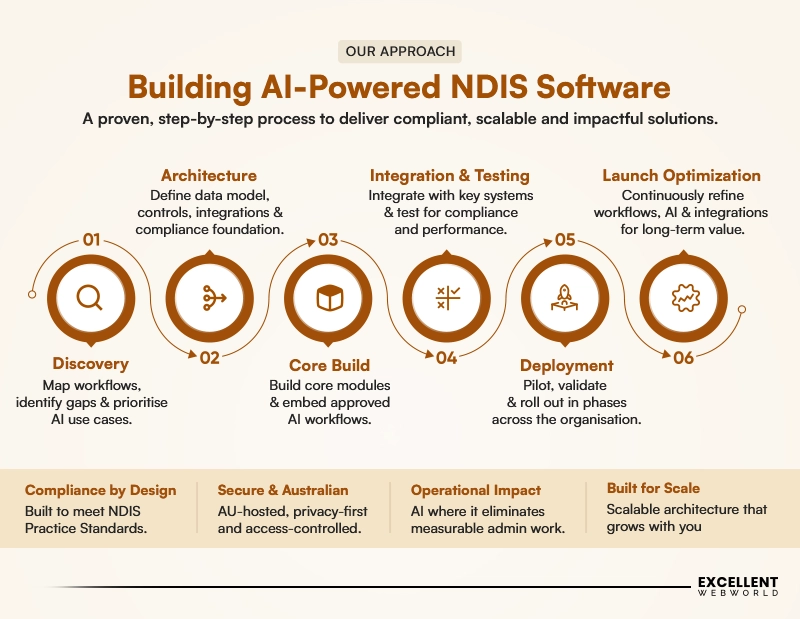
This is the sequence I would hold any NDIS software developer to when considering how to build NDIS-compliant software. While compressing these phases may shorten a proposal, it increases the rework risks, compliance gaps & also the budget overruns.
The NDIS Practice Standards are outcome and quality-focused, so the building process needs to translate those requirements to practical controls from the architecture stage onwards.
| Stage | What Happens | Main Outcome |
|---|---|---|
| Discovery (Week 1-2) | In this phase, it involves mapping the rostering, claims & compliance workflows involving spreadsheets, exceptions & also manual workarounds. Along with that, there is prioritization of AI use cases for the first release. | Clear Scope |
| Architecture (Week 3-4) | Involves establishing dataset model, AU region-based hosting, access controls, audit logging, & PRODA integration points. For direct NDIA APIs, needs to start the Digital Partnership earlier. | Compliance-ready foundation |
| Core Build Setup (Week 5-10) | For this phase, there is building of participant CRM system, NDIS rostering software, claims & billing architecture. Then, integrate approved AI-based workflows like ambient notes or pre-claims validations into those processes. | Operational Platform |
| Integration & Testing (Week 11- 13) | Connect PRODA, myplace claims, SCHADS Award logic & Xero/MYOB, & then conduct tests for both normal & failure scenarios against the NDIS Practice Standards. | Production readiness |
| Staged Deployment (Week 14-16) | For this step, pilot one site or team prior to expansion across the organization to isolate issues without disruption in service delivery. | Controlled rollout |
| Launch Optimization (Ongoing) | It involves refining the workflow, AI & other integrations using real operational datasets while adapting to changes as per the NDIS standards. | Long-term value |
For the building steps, I would not compress the discovery just to make the timeline look attractive. Rather, spend time understanding how the staff actually work in the first two weeks of the timeline, so that it helps in preventing months of rebuilding a wrong custom NDIS software.
normal/failure-scenario testing testing and reliable staged rollouts at this stage depend heavily on solid release pipelines ensured by DevOps that support this sort of environment and CI/CD discipline for platforms that are compliance-sensitive.
Actually, the same principles also apply post-deployment too, for the AI rostering logic & compliance workflows, which need continuous refinement. So, optimization should be treated as part of the platform lifecycle, not as an optional part of the platform lifecycle without incurring much expense.
For a look at how this plays out in practice, see how we apply Australia’s Privacy Act, ACSC Essential Eight, and sector-specific rules to AI-powered NDIS software development for disability service providers. It might interest you to see how we apply compliance-first architecture across regulated markets and how we address data security and privacy compliance across various jurisdictions.
What Does NDIS Software Development Cost in Australia, and How Long Does It Take to Launch?
For NDIS software development cost Australia, I prefer giving this planned range rather than pretending that there is one universal price.
| Component | Estimated AUD cost |
|---|---|
| UI/UX design | $8,000 – $15,000 |
| Staff mobile app (iOS + Android) | $15,000 – $25,000 |
| Admin Web Platform | $18,000 – $35,000 |
| PRODA/myplace claims integration (add ~$5,000–$10,000 if pursuing Digital Partnership API access) | $8,000 – $18,000 |
| SCHADS payroll engine | $6,000 – $12,000 |
| QA and compliance testing | $6,000 – $12,000 |
| Total | $61,000 – $117,000 |
If you’re comparing this range against the cost of adding AI in other regulated sectors, this article on the cost of implementing AI in healthcare does a good job of breaking down a similar budgeting exercise for you to understand better.
Timeline
An MVP version covering rostering, participation management & basic claims generation actually takes 12- 14 weeks to complete. In the case of a broader platform with SCHADS system payroll, deeper myplace claims automation, and compliance modules, it generally takes about 16–20 weeks. However, enterprise, multi-side builds with deeper AI functionalities & standard custom compliance engines actually take longer.
I would be very cautious of any proposal promising a full enterprise platform in just under 12 weeks.
What Do Most Providers Get Wrong When Developing an AI-Powered NDIS Software for Australia?
Almost every cost overrun or standard compliance finding that I have observed in this particular category traces back to the conditions mentioned below.
- Treating SCHADS logic as an afterthought
- Keeping the worker screening on spreadsheets
- Skipping offline mobile functionality
- Building AI before fixing data quality
- Underestimating API failure & reconciliation
- Treating Audit trails as a final-stage feature
- Allowing AI to make consequential decisions without human oversight
- Deploying without realistic compliance testing
The biggest lesson that I have learned is this: if the underlying workflow is broken, AI won’t fix it. But it will simply automate the inconsistency.
Why Is Excellent Webworld the Right Partner for Your NDIS Software Build?
If you have under 50 staff and are still figuring out your service model, a subscription platform is usually the smarter choice. You don’t need to over-engineer anything before understanding the workflows and what defines the requirements.
If you are past 100 staff, then running SIL/SDA along with standard support and planning to operate for 5+ years, custom software becomes the ideal solution for both economies and the controls. That’s not a sales pitch; it’s the same build vs buy calculation that I would generally apply for any operations-heavy platform.
At Excellent Webworld, we are not an AI lab that sells a particular model for your business. We are an engineering team with more than 15 years of experience building compliance-based, government-facing software, with AI implemented where it actually removes the real administrative work burdens, & nothing shipped that can’t stand up to strict compliance security.
Browse our work, which comprises the compliance-heavy platforms we’ve built across healthcare, public sector, government, and other heavily regulated industries.
If you’re scoping a build, I’d rather discuss your actual numbers, workflows, and requirements than sell you a feature list. Schedule a call with my team of AI-powered NDIS software experts if you’re looking forward to it.
FAQs
Yes. PRODA handles authentication, while PACE manages participant, provider, plan, and budget data. They serve different roles in NDIS software integration.
It means calculating penalty rates, allowances, and overtime correctly at roster creation, helping prevent payroll errors and compliance issues.
Usually, subscriptions suit shorter horizons, while custom NDIS software development can offer better long-term economics, control, and data ownership for larger providers.
Yes. Stronger regulatory powers and penalties make detailed audit trails, incident records and accurate claims increasingly important in NDIS software development.
AI-powered NDIS software embeds AI into specific workflows while keeping core logic deterministic and auditable. For most providers, this is more practical than an AI-native architecture.

Article By


Mahil Jasani began his career as a developer and progressed to become the COO of Excellent Webworld. He uses his technical experience to tackle any challenge that arises in any department, be it development, management, operations, or finance.