Prior authorization in healthcare is a high-volume, costly, highly manual, and frustrating administrative process. It requires healthcare providers to obtain approval from a patient’s health plan before initiating certain treatments, procedures, services, or prescription drugs.
It’s done through understanding and considering authorization requirements, gathering clinical documentation, submitting requests, responding to payer requirements, and tracking decisions. It’s a complex process full of administrative burden for providers and potential delays for patients.
The process of prior authorization was initially implemented to check medical necessity and control unnecessary hospitalization or treatment, causing insurers unwanted costs, but over time, it ballooned into a major friction point.
Hence, AI prior authorization in healthcare can be a game changer.
Some facts supporting this solution include:
- If we check the latest data as reported by the American Medical Association Survey, then on average, a prior authorization takes 13 hours a week to process. Hence, providers can process only 40 prior authorizations per week.
- The thing is that mostly 90% of requests get approved. But most of the time of clinicians is spent on manual EHR data gathering, payer-specific portals, faxes, phone calls, and documentation assembly, which could have been utilized for better patient care.
- The latest AMA survey stats show that 94% of clinicians report that a manual prior authorization process leads to burnout.
- One of the major points not to miss is that AI prior authorization software is the biggest market opportunity, with the market addressing $98 billion in healthcare administrative spending, of which only 3% is addressed by software.
So, let’s have a look at what AI in prior authorization looks like in practice, some of the regulatory and market catalysts promoting it, and limitations you can expect to address when exploring it as a part of your healthcare IT solution initiative.
What AI-Powered Prior Authorization Looks Like In Practice
AI-powered prior authorization in healthcare replaces most manual, time-consuming processes with intelligent automation while keeping clinicians in the loop for complex or borderline cases.
Here’s how you can expect AI for faster prior authorization in healthcare:
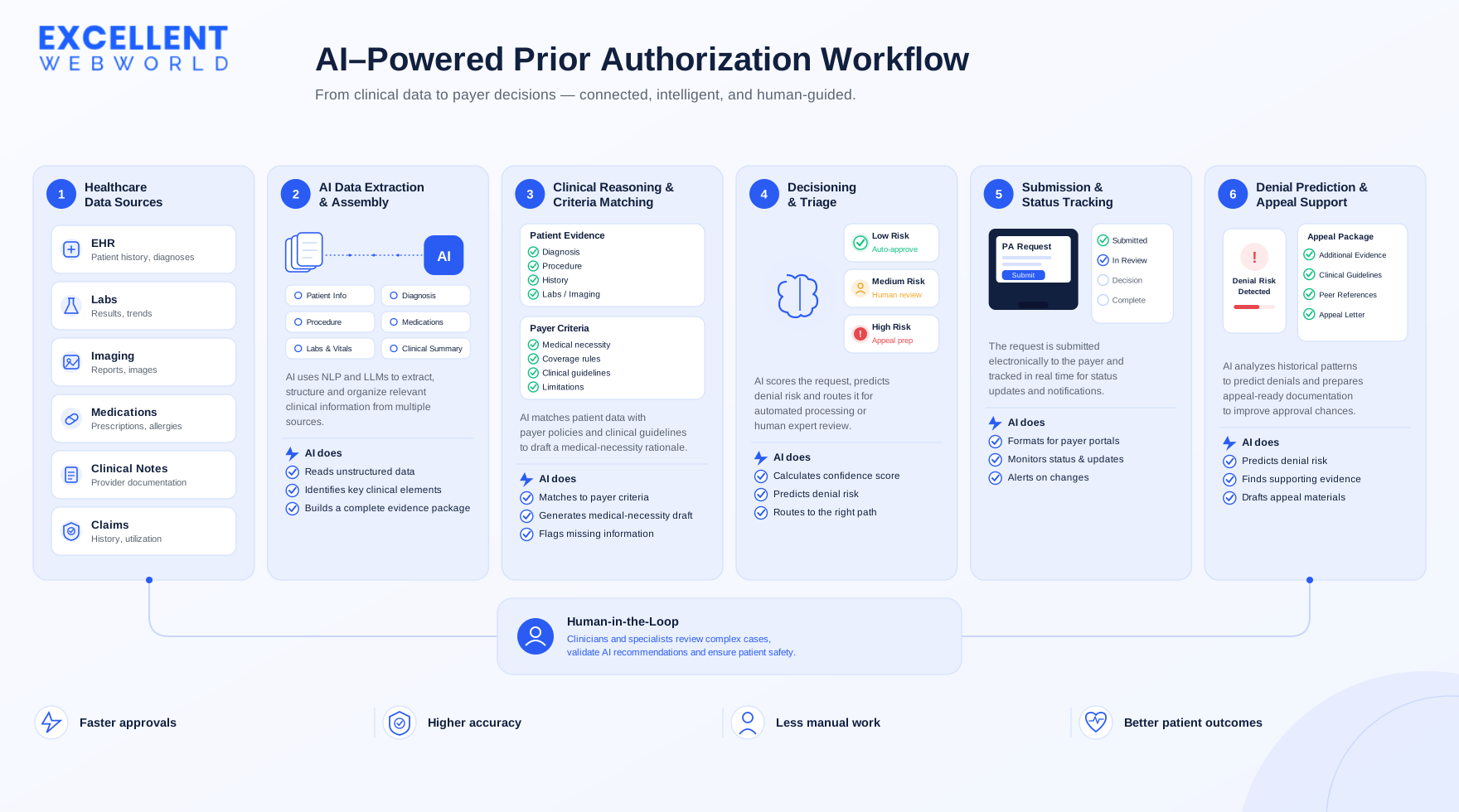
Intelligent Data Extraction and Assembly
AI systems connected to healthcare software solutions, like EHRs, telemedicine apps, etc., pull relevant clinical information, such as progress notes, lab results, imaging reports, medication history, and diagnosis codes. AI also helps to structure unstructured clinical notes and extract specific data points that payers require to match with medical-necessity criteria. Through this, AI helps to cut down 15-30 minutes of manual extraction, documentation, and analysis work by reducing it to seconds.
Real-Time Criteria Matching and Medical-Necessity Drafting
AI-powered prior authorization systems compare patients’ medical files and health information against the payer’s guidelines. Based on that comparison, it drafts a clear, structured medical-necessity justification in a way that meets the payer’s expectations, increasing the chances of approval.
Smart Triage and Automated Decisioning
AI analyzes incoming prior authorization requests against patient information, clinical documentation, payer policies, and authorization criteria. This way, it determines how each prior authorization request should be handled.
Some of the straightforward and high-confidence clinical cases, meeting clear criteria, can receive near-instant approval. When said instant, it can mean within minutes and sometimes even in seconds if integrated with payer APIs.
For borderline or complex cases, AI can flag them or trigger the human-in-the-loop workflow, routing that request to clinical staff with suggested supporting language and a summary of the key decision factors. This prioritization alone can result in frequent time savings of 50-70%.
Explore our AI agent development services to see how we can help you enable smart triage and automated decisioning.
Seamless Submission and Status Tracking
You can make AI work with FHIR APIs, payer APIs, and workflow automation tools for the process and check what comes next after the submission of prior authorization requests.
Before submission, you can have AI check clinical notes and supporting documentation to find out if any information is missing or not. After submitting the prior authorization requests online, AI can monitor payer responses, interpret status updates, and identify if there are any requests for additional documentation.
During the process, if AI determines the need for human expert involvement, it routes such cases to the right staff member with action-needed triggers. This way, in prior authorization submission, AI helps to reduce the need for repeated portal checks, phone calls, and manual follow-ups.
Denial Prediction and Appeal Support
Prior authorization AI systems trained on historical data of previous requests with higher denial rates can flag the request the moment you try to submit a request similar to that. It not only flags such requests but can also recommend stronger documentation to avoid denial.
Even after that, if requests get denied, then the implemented generative AI solution takes the lead and immediately drafts appeal letters, referencing relevant clinical evidence and payer policy language. This way, AI can help significantly in reducing the time and expertise required to contest decisions.
Regulatory and Market Catalysts for AI Prior Authorization You Should Not Ignore
The CMS interoperability & prior authorization final rule (CMS-0057-F), state-level legislation & “gold carding,” severe administrative labor shortages, exploding cost of denials & friction, and value-based care alignment are the top-most regulatory and market-driven catalysts promoting adoption for prior authorization AI.
Let’s see how they’ve become catalysts:
The CMS Interoperability & Prior Authorization Final Rule (CMS-0057-F)
The Centers for Medicare & Medicaid Services (CMS) enforced standards that have fundamentally restructured how payers operate:
- Mandated Response Timelines: It says that, after receiving the prior authorization requests, payers must respond within 7 calendar days and expedited requests within 72 hours rather than 14 days, which was followed previously. This can become difficult for human staff at scale unless they use AI pre-screening and automated data assembly.
- Mandated Decision Explanations: It says that, before denying any prior authorization requests, payers must provide specific, clear reasons. If payers use generative AI and NLP-powered tools, they can automate the generation part of detailed clinical rationale mapping referred to against policy documentation.
- Standardized FHIR API Implementation: CMS asks healthcare decision-makers to implement standardized HL7 and FHIR-based prior authorization APIs, along with provider access and patient access APIs. The intention behind it is to give AI models seamless access to analyze and query EHRs and ingest data without portal logins or manual faxing.
State-Level Legislation & “Gold Carding”
The above-mentioned federal rules for prior authorization are worth considering. But we should also not overlook that, at a granular level, a growing number of states are imposing even tighter requirements on prior authorization timelines and making it harder for clinicians to bypass that process. Let’s have a look below at how:
- State Timelines: States like Indiana (24-hour timeline to make decisions for urgent requests and 48 hours for non-urgent requests), Nebraska, and Colorado (relatively short turnaround times and deem requests to be approved if payers fail to address the prior authorization requests on time). Many other states also have established stricter 24-to-48-hour standard timelines to address prior authorization requests (for both urgent and clean electronic submissions).
- Gold Carding Requirements: States like Texas, Louisiana, and Michigan have the enforcement to exempt clinicians from the prior authorization process. Clinicians who benefit from this rule are those with an 80-90% positive score for the approval of prior authorization requests. For this, many decision-makers in this industry are using AI tools to continuously track physician approval rates, automate eligibility determination, and more. Hence, it helps both payers and providers manage gold-card status and compliance.
Anti-“Algorithmic Bias” & Oversight Regulations
Regulators from state departments of insurance and the U.S. Department of Health and Human Services Office for Civil Rights (HHS/OCR) have moved to restrict fully automated “black box” denials. These regulations don’t directly restrict using AI for workflows but mandate “Human-in-the-Loop” governance, where AI can approve compliant requests, but for denials it must ask for review from a human medical director. Hence, it forces payers to opt for explainable AI platforms rather than explicit automated denial scripts.
Severe Administrative Labor Shortages
According to the World Health Organization‘s survey, the global healthcare workforce can face a shortfall of 11 million workers by 2030. If considering nurses in clinical staff specifically, then the numbers can fall to 4.1 million by 2030.
Healthcare organizations still using manual prior auth processing, then they would require nurses to spend up to 35% of their working hours searching EHR notes and filling out forms. However, they can cut this time significantly by using AI to auto-extract unstructured clinical evidence.
Also check out the latest AI in healthcare statistics to find out its impact.
Exploding Cost of Denials & Friction
- Provider Margin Pressure: Prior authorization in the first place costs providers around $30-$100+ per transaction due to administrative overhead. If prior authorization requests get denied, it can result in lengthier appeal cycles, leading to more cost. Hence, it becomes important to have AI “pre-submission checking” to ensure zero documentation gaps before a claim hits the payer.
- Payer Administrative Ratios: Medical Loss Ratio (MLR) rules mention that healthcare insurers can only spend a limited amount of money on administration. When they have a large team for managing prior authorization manually, it eats up that cost. Hence, many payers are moving forward with adopting AI tools for prior authorization.
Value-Based Care Alignment
Healthcare follows the value-based care model because a delayed prior authorization directly damages performance metrics, leading to delayed care and thus increased ER visits, avoidable inpatient admissions, and poor disease management.
AI eliminates that friction at scale by automating documentation and data-fetching processes, introducing advanced imaging solutions, and automating prior authorization applications that can be approved quickly to keep patients out of high-cost acute settings.
Like we helped our client build an AI-powered virtual health assistant, enabling doctors and staff to collect patient data faster with 90% accuracy in EHR data standardization. This indirectly led them to speed up prior authorization requests.
Some of the Limitations of AI in Healthcare Prior Authorization You Should Consider and How to Deal With Them
AI in healthcare prior authorization can offer multiple benefits, but at the same time, it has limitations in addressing the core friction of healthcare utilization management.
To deploy AI responsibly for prior authorization in healthcare, you must navigate technical, ethical, and structural limitations with clear, targeted safeguards.
Let’s have a look at AI limitations:
Algorithmic Bias and “Black Box” Automated Denials
When using historical data to train AI, it can cause structural health disparities or penalize rare conditions. If healthcare organizations use “black box” algorithms for mass automated denials, many have already faced significant regulatory enforcement and class-action litigation.
How to Deal With It: Implement a mandatory Human-in-the-Loop (HITL) workforce, as AI systems should not be authorized to issue automated approvals or denials for critical cases. This means any determination, such as a denial or partial denial, must be routed to a licensed medical director for manual review, as mandated by CMS and state insurance laws.
Opt for our AI consultation services to get a solution and development plan to avoid such AI limitations and build ethical AI.
EHR Interoperability and Generative “Hallucinations”
When interpreting ambiguous physician charts, chances for hallucinations are there for LLMs, generating confident information but with factually incorrect assertions.
How to Deal With It:
- Use Retrieval-Augmented Generation (RAG) to ensure AI pulls information from trusted clinical guidelines, such as MCG and InterQual, and the patient’s medical records.
- Integrate AI with healthcare EHR through HL7® FHIR® APIs, aligned with CMS-9957-F, for direct access to patient data rather than relying only on OCR or free-text summaries.
Risk of Oversubmission & Audit Triggers
When providers’ side systems use AI for prior authorization, it makes it easy for staff to generate documentation and over-submit templated justification letters to the payer. When payers see the templated letters, they actively flag generic, repetitive submissions, which triggers utilization review audits, slowing down the reimbursement process.
How to Deal With It:
- Configure AI tools to extract case-wise clinical evidence by referring to physician notes rather than generating standardized, boilerplate narrative text.
- Audit every AI-generated packet before submission to ensure it has patient-specific data points.
Data Privacy and HIPAA Security
When using third-party AI APIs without tight controls to process Protected Health Information (PHI), it creates the risk of severe HIPAA non-compliance and data leaks.
How to Deal With It:
Partner with vendors that offer zero-data-retention BAAs for AI automation prior authorization healthcare solutions. This ensures that patient information remains encrypted end-to-end, hosted in a private single-tenant environment, and never used to train public foundational models.
How Excellent Webworld Comes Into the Picture
The regulatory and operational pressures mentioned above around healthcare and its prior authorization processes are real.
At Excellent Webworld, our AI and healthcare technology teams work directly with providers and payers who face these exact challenges. Our focus is practical: reduce the time and frustration clinicians and staff spend on administrative work while helping organizations stay compliant with the latest requirements.
By providing a prior authorization in healthcare AI solution, we help teams:
- Spend far less time digging through records and filling out forms.
- Get clearer, faster answers on requests so care is not delayed.
- Track approval patterns so high-performing clinicians can qualify for gold-card exemptions.
- Keep qualified people involved in every denial decision, meeting both regulatory and ethical expectations.
- Create processes that feel fairer and more predictable for everyone involved.
For Braive, we created one AI-powered mental healthcare platform with an AI-assisted documentation feature, helping providers to save 15 min per clinical session.
As an AI development company, we want clinicians to get back to caring for patients, staff to stop drowning in paperwork, and organizations to be efficient and good at patient care.
Frequently Asked Questions
AI prior authorization uses artificial intelligence, such as large language models and machine learning, to automate the insurance approval process for medical treatments, procedures, and medications.
Prior authorization is a major problem in healthcare because it eats 13-14 hours every week of hospital staff time; a delay in its approval can cause dangerous delays in patient care; and it restricts access to necessary medical treatments.
AI can help with prior authorization by automating processes like data extracts, rule matching, form submissions, appeals, and tracking, resulting in speed, meeting new regulatory mandates, and enabling providers and payers to achieve real-time adjudication.
The new CMS interoperability and Prior Authorization Final Rule (CMS-0057-F) mandates:
- Faster decision deadlines, requiring payers to react on standards requests within 7 calendar days and urgent ones within 72 hours.
- Digital APIs by 2027 for payers like Medicare Advantage, Medicaid CHIP, and federal marketplace plans to complete the launch of HL7 FHIR-based APIs by January 1, 2027, for data exchange automation.
- Payers must provide a valid, actionable reason when denying prior authorization requests.
- Payers must publicly publish annual metrics for prior authorization performance and approval rates.
- Digital systems for payers to approve patients’ prescription medicines.
No, AI cannot fully automate prior authorization denials, as it requires a human-in-the-loop, where critical requests must be redirected to a licensed medical officer to review and sign off on any final adverse coverage decision.
Yes, many state laws require faster prior authorization decisions than the federal baseline. On average, majority requires certain requests to be approved within 24-48 hours, and some mandate automatic approval if the payer misses the deadline.
From prior authorization modernization, healthcare organizations expect benefits like reduced administrative costs, faster decision turnarounds, lower claim denial rates, improved patient experience, and regulatory compliance.
You can expect the cost to implement an AI in healthcare solutions like prior authorization to be in the range of $25,000 to $500,000 or more. It can vary depending on factors like EHR integration complexity, payer network and submission methods, data sources and processing needs, and security and compliance requirements.

Article By


Paresh Sagar is the CEO of Excellent Webworld. He firmly believes in using technology to solve challenges. His dedication and attention to detail make him an expert in helping startups in different industries digitalize their businesses globally.