What Founders Need to Know Before Launching an AI-Built MVP
Building an MVP with AI tools helps founders validate ideas faster, but production readiness requires more than a working prototype.
- AI app builders accelerate prototyping, while generated code still needs technical review.
- A focused MVP prioritizes essential features that validate real user demand.
- Authentication, data permissions, payments, and deployment must be tested before launch.
- A technical audit and scoped production sprint can address engineering gaps without hiring a full team.
- Source code, repositories, domains, and service accounts should remain under the founder’s control.
- The right approach combines rapid validation, security checks, and reliable production engineering.
Building an MVP version with AI tools allows the founders to translate their product ideas into working prototypes without hiring a full engineering team up front. Tools like Lovable, Bolt, Replit, Cursor, and Claude Code can accelerate the development process, but a working prototype is not necessarily ready for real users, payments or sensitive data.
The challenges lie in moving from AI-generated code to a secure, reliable, and maintainable product. A 2025 Veracode GenAI Code Security Report found that security vulnerabilities were present in 45% of AI-generated code tasks it tested, which highlights why human review & security testing are very important.
The practical approach is mainly to validate the demand, develop only the essential features & verify production readiness before launch. So, if you already have an AI-built prototype, vibe to production engineering can help identify gaps between your current build & a production-ready application.
In this comprehensive guide, you will learn how to build an MVP with AI tools, estimate development costs, assess production readiness & decide when short-term engineering support tends to make more sense than hiring a whole team.
What Does Building an MVP With AI Tools Actually Mean?
Building an MVP with AI tools means using AI app builders or coding agents to accelerate the development of a Minimum Viable Product (MVP), i.e., the smallest version of a product that allows you to test the core value with real users.
This approach is called vibe coding. It is simply like this: you describe what you want in plain language & AI tool generates it or modifies the code accordingly. Then, you opt to review the output, test workflows & also refine the applications.
There are tools like Lovable, Bolt, Replit, Cursor, and Claude Code that actually support different types of work processes; some generate full-stack applications from just prompts, while others help developers work in association with the existing codebase.
However, a prototype, an MVP, and a production-ready product are not the same.
| Stage | What It Means | Who It Serves |
|---|---|---|
| Prototype | Demonstrates screens and basic interactions, sometimes using mock data. | The idea and user experience can be explored. |
| MVP | Delivers the smallest useful feature set to real early users. | The product can test demand and user behavior. |
| Production-Ready Product | Includes validated access controls, reliable data handling, tested workflows, deployment processes, and monitoring. | The application can be operated and maintained responsibly. |
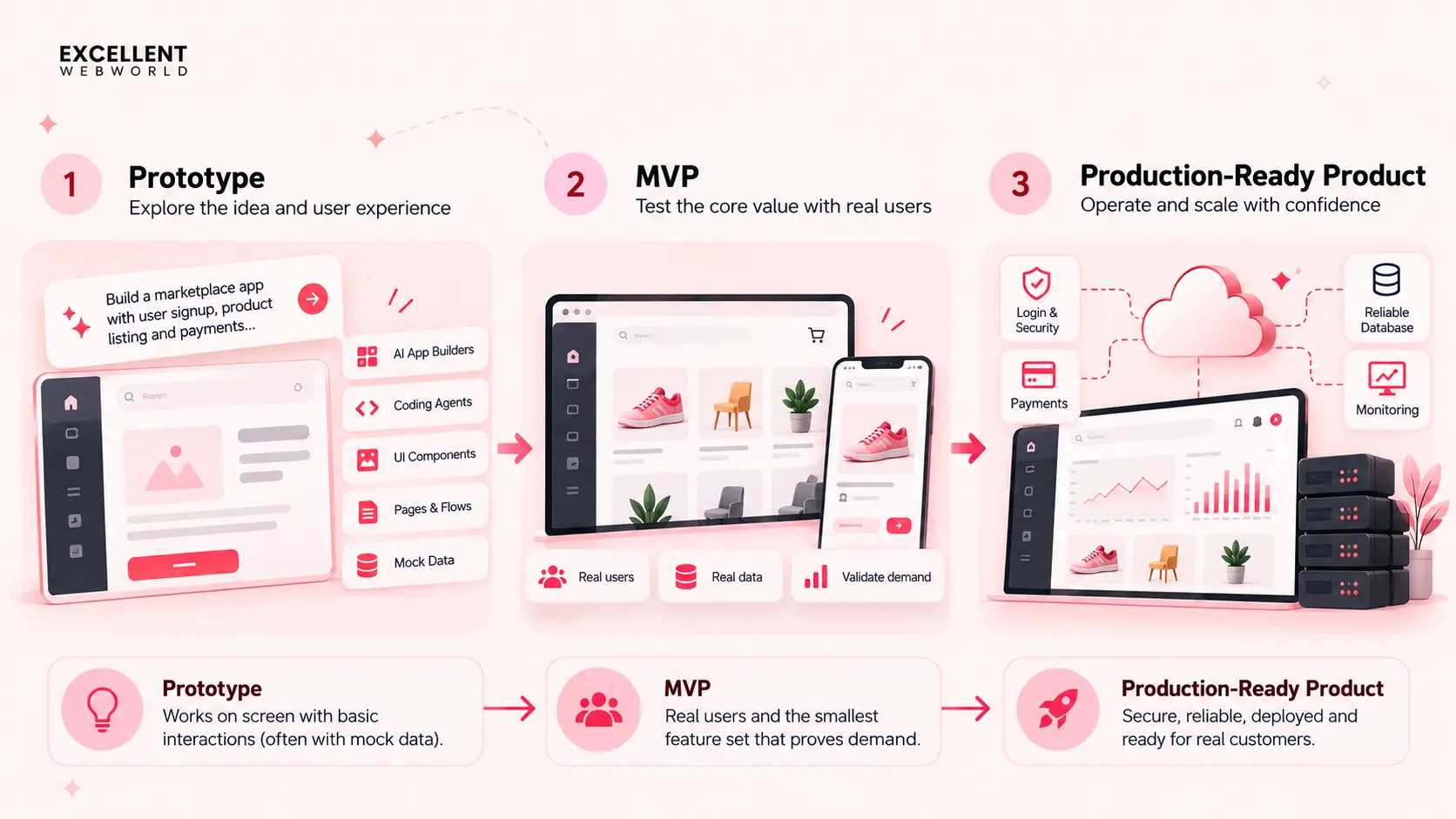
Most of the weekend build stories tend to determine the prototype stage. But more demanding work appears when real user accounts, private data, payments & customer expectations enter into the picture.
How Do You Build an MVP With AI Tools Step by Step?
You can follow these 8 steps to validate your idea, build a focused MVP version & prepare it for production without hiring a full engineering team.
| Steps | What to Do | Key Actions |
|---|---|---|
| 01. Define the Scope | Create a one-page product spec. | Define your target user, core problem, 3–5 essential features, required data, and critical risks such as cross-customer data exposure. |
| 02. Validate Demand | Test the idea before development. | Create a landing page, interview ten potential customers, and assess their willingness to pay or switch. |
| 03. Generate a Prototype | Select suitable AI tools. | Use Lovable, Bolt, Replit, or v0 for prompt-based app generation, or Cursor and Claude Code for codebase-level control. |
| 04. Use Managed Services | Avoid building infrastructure from scratch. | Use Supabase for databases, Stripe for payments, and Vercel for hosting, alongside established authentication and access-control solutions. |
| 05. Secure Code Ownership | Keep control of your product assets. | Maintain your own code repository and retain ownership of your domain, hosting, and service accounts from day one. |
| 06. Test With Real Users | Validate essential workflows. | Observe users completing core tasks, identify friction, and refine features using test data rather than sensitive production data. |
| 07. Assess Production Readiness | Identify technical and security gaps. | Review authentication, data permissions, payment flows, code quality, backups, and reliability before launch. Software development services can help address engineering gaps before your MVP reaches production. |
| 08. Deploy and Monitor | Prepare for ongoing operation. | Deploy to production hosting, configure backups and error alerts, and establish repeatable testing and release processes. DevOps services can support reliable deployments, monitoring, and ongoing release management. |
Where do AI-built MVPs break?
AI-built MVPs often break at the time of security, permissions, payments & deployments, not any kind of feature development. The AI tools can actually build what you ask for, but they may miss some of the safeguards you never explicitly requested.
The evidence/research reports below highlight why production readiness matters.
1. ACM research (2025) study: This peer-reviewed research study published in ACM Transactions on Software Engineering & Methodology assessed AI-generated code from GitHub projects & found security weaknesses in code produced by AI coding assistants. The findings support the need to review & test AI-generated code prior to deployment.
2. CIO Dive (2025) report: This reports Gartner prediction that by 2028, 40% of new enterprise production software will be creating utilized vibe coding techniques & tools, thus highlighting rapid adoption of AI-assisted development & the need to address enterprise risks prior to deployment.
3. Symbiotic Security Labs (2026): As per this report, it has been noted that a security scan of 1,072 AI-built applications utilizing Supabase found that 98% had atleast one detected vulnerability, while 29% had high- or critical-level severity findings. This indicates the relevance of verifying database security & permissions, along with access controls, prior to the launch stage.
4. DORA (Google Cloud, 2025): Its State of AI-assisted Software Development analysis found that AI tends to amplify existing organizational strengths & weaknesses, and the research study clearly links AI adoption with increased software delivery instability, thus supporting the testing process, reviews & release practices.
And some of the common failure points, in the order they tend to hurt, are;
- Permissions: Users can view or modify data that belongs to others.
- Authentication: Weak sessions, missing password-reset functionality, or secrets exposed in front-end code.
- Payments: Unverified webhooks or failed payments that are not handled correctly.
- Database: Missing backups, untested restores, or slow queries as data grows.
- Deployment: No separate staging environment, with changes pushed directly to live users.
- Monitoring: No alerts for outages or rising error rates, leaving customers to report problems.
The AI tools are rapidly growing, so you should treat these findings as a checklist for your verification, not as a just reason to avoid the AI-assisted development process.
The importance of production-ready engineering extends beyond MVPs. The HJM Logistics AI freight forwarding platform demonstrates how AI capabilities such as document intelligence, predictive ETAs, and automated freight quoting can support real-world business operations.
A working prototype still requires a security testing process, engineering review & reliable deployment practices prior to being ready for real users.
What is a Production-Readiness Scorecard for an AI-Built MVP?
With a production readiness scorecard, you can determine whether an AI-built MVP is actually ready for real users. You can award one point for each item that you verified through the process of testing or evidence.
MVP Production-Readiness Checklist & Scorecard
| No. | Checklist Item | What to Verify |
|---|---|---|
| 1 | Data isolation | Two test accounts cannot access each other’s data. |
| 2 | Authentication | Sign-up, login, password reset, and logout work; passwords and secret keys are not exposed in front-end code. |
| 3 | Payments | A payment provider handles card data; webhooks are verified, and failed payments and refunds are tested. |
| 4 | Server-side validation | Permissions and business rules are enforced on the server, not just in the interface. |
| 5 | Secrets management | API keys are stored in environment settings, and previously exposed keys are rotated. |
| 6 | Backups | Automated backups run, and at least one backup has been successfully restored. |
| 7 | Monitoring | Alerts notify you about outages and spikes in errors. |
| 8 | Environments | A separate staging environment and a repeatable release process are in place. |
| 9 | Automated tests | Tests cover sign-up, payments, and core user workflows. |
| 10 | Ownership | You can control the code repository, domain, hosting, and third-party service accounts. |
How To Interpret Your Score
| Score | Recommended action |
|---|---|
| 8–10 | Run a limited beta and monitor closely. |
| 5–7 | Arrange a focused technical audit before launch. |
| 0–4 | Address critical gaps before handling real users or payments. |
[Note: These thresholds are practical guidelines, not a formal security certification. Critical security failures must be fixed regardless of the total score.]
Should You Hire a Full Team, a Freelancer, or Short-Term AI Engineers?
For founders with an existing prototype, a short-term, fixed-scope engineering engagement can balance & manages the cost, speed & safety. A full in-house team makes more sense once the product & revenue tend to justify the hiring process.
| Approach | Indicative published cost | Best for | Watch out for |
|---|---|---|---|
| DIY with AI tools | $10 – $50/month for tools; ongoing costs vary. | Validating an idea with test data | Security gaps and repeated rework |
| AI builder + contract engineer | $5,000 – $15,000 | Simple products needing engineering support | Finding a reliable freelancer |
| Audit + fixed-scope hardening | Audits: $1,500 – $5,000, Remediation varies by scope | Founders with an existing prototype | Audit depth and quality vary |
| Short-term AI-native engineering sprint | Average MVP cost: $6,000 – $12,000 | A defined scope and launch goal | Scope creep/uncontrolled & unplanned expansion |
| Traditional agency MVP | $5,000–$25,000 for a simple validation MVP; more complex builds can cost substantially more. | Complex products or those requiring broader delivery support | Higher cost and longer timelines |
| Full in-house team | Depends on team size, location, & seniority; salary alone excludes recruitment and management | Proven products with revenue | Hiring costs and delays |
What else impacts the cost?
- Pricing Models: Fixed-price contracts provide budget certainty for AI-powered MVP development, but they may include a premium to account for project scope, technical complexity, and delivery risks.
- AI-Assisted Development: The World Bank report on AI & software engineering cites an estimated 15-20% net productivity gains from AI in software development in spite of increased rework.
Actual MVP cost savings depend on complexity, testing & security requirements.
What Do Other Providers Promise on Speed, and How Should You Evaluate Their Claims?
The published delivery claims range from under 2-8 weeks. However, the timelines depend on project scope, codebase condition & also production readiness requirements.
Independent research highlights how AI influences software delivery speed & why productivity gains must be supported by strong engineering practices.
- McKinsey 2025 Report: Reports productivity & time-to-market improvements of about 16-30% among high-performing organizations utilizing AI-enabled software development practices.
- METR 2026 Research:This research study finds that wider AI adoption tends to make developer productivity harder to measure, as developers increasingly avoid tasks they cannot utilize AI for & select tasks where AI is more useful.
These findings provide useful context, but actual delivery timelines still depend on the application’s scope, existing code quality & production readiness requirements.
How To Evaluate These Claims:
- Review the starting point: A timeline quoted for reviewing your estimated code is only an estimate.
- Define production-ready: Here, it can confirm which security test checks, tests, deployment environments & monitoring requirements are included.
- Check accountability: You should look for fixed scope, written acceptance criteria, clear remedies like refunds or free fixes for a set period.
- Question Blanket Promises: You should be cautious of guaranteed launch dates that don’t account for your application’s current state.
Our position: We set delivery timelines only once after reviewing your codebase & upon agreeing on measurable acceptance criteria. Speed comes from a clearly defined scope, not from any kind of advanced, made promise.
How Does Excellent WebWorld Help Founders Turn AI Prototypes Into Production-Ready Products?
Excellent Webworld helps founders move from an AI-built prototype or product specification to a secure, production-ready product through a focused, fixed-scope engineering engagement.
Established in 2011, Excellent Webworld brings 15+ years of software engineering experience, backed by a team of 300+ engineers, designers & AI specialists serving businesses in 40+ countries.
Our engagement follows these 3 steps;
1. Readiness Audit: We analyze your codebase, data model, security & deployment setup for identifying launch blockers, priority fixes & areas for later improvement.
2. Production Sprint: With this, we address the technical gaps, including authentication, permissions, payments, database reliability, backups, deployment environments & also monitoring. Additionally, scope, pricing & timelines are defined post-audit process.
3. Handover: You receive the code, documentation, hosting & accounts under your ownership, with flexibility to continue with us, bring in your own team or manage the product independently.
And this engagement is ideal if you;
- Already have a prototype built with Lovable, Bolt, Replit, Cursor, or Claude Code, or a clear product specification.
- Want to prepare for your first paying customers or an investor demonstration.
- Need focused engineering support without hiring a permanent team.
It may not be an ideal fit if you have not validated market demand or need a large, compliance-heavy platform started from scratch. Those require a broader engagement.
Have an AI-built prototype that needs to be production-ready? – Explore our AI development services to turn your prototype into a secure, scalable product.
Key Takeaways
- AI tools can accelerate MVP development, but a working prototype is not automatically production-ready.
- Validate market demand and prioritize essential features before building.
- Test authentication, data isolation, payments, and server-side permissions before onboarding real users.
- Use the MVP Production-Readiness Scorecard to identify technical gaps before launch.
- Choose engineering support based on your product's complexity, timeline, and production requirements.
- Treat AI as a development accelerator, not a replacement for engineering review, testing, and deployment discipline.
- Expand your MVP gradually, addressing critical risks before scaling to more users and features.
Frequently Asked Questions
Yes, you can build a working prototype using AI app builders. However, before launching to real users or handling payments, have an engineer review its security, payment flows, and deployment.
AI tool subscriptions typically cost 10–50 per month. Building and preparing an AI-assisted MVP for real users can cost around $2,500-$15,000, while traditional agency-built MVPs may range from $30,000 to $150,000. Actual costs depend on product complexity, features, integrations, and production-readiness requirements.
Not automatically. A 2026 study published in Empirical Software Engineering identified 56 security vulnerabilities across 2,315 AI-generated code snippets analysed. Before launch, conduct security reviews, scan the code, and test critical workflows, following the study’s findings on security vulnerabilities in AI-generated code.
Published provider claims range from one to eight weeks, depending on scope and the prototype’s condition. Treat timelines quoted before a code review as estimates.
Not necessarily a full-time CTO. A short-term engineering team or fractional technical lead can help with architecture, security reviews, and deployment until the product gains traction.
You should retain ownership. Confirm this in writing and keep the code repository, domain, and hosting accounts under your control from the start.
Avoid repeated prompting. Review the production-readiness scorecard to pinpoint technical gaps, then get an engineering audit to assess the fixes needed before launch. This helps address issues early and reduce costly rework later.
Hire when you have validated demand, recurring revenue, and a roadmap requiring continuous development. Until then, short, fixed-scope engineering engagements can offer a more flexible alternative.

Article By


Mahil Jasani began his career as a developer and progressed to become the COO of Excellent Webworld. He uses his technical experience to tackle any challenge that arises in any department, be it development, management, operations, or finance.


