What if a retailer could analyze why a shopper browses different products and leaves without purchasing with the same level of visibility available across digital channels? I believe that is possible once you treat computer vision in retail as an operational tool, not just surveillance.
Computer vision allows retailers to interpret what cameras capture and turn it into actionable business insight. Visual data helps with shelf availability, customer movement, checkout activity, and loss prevention. These areas were hard to measure earlier.
The market reflects that shift. According to Research and Markets, the computer vision for retail market is projected to grow from $5.24 billion in 2026 to $12.19 billion in 2030. To me, that shows computer vision is moving from a new tech to real retail use.
I have more than 15 years of experience helping businesses adapt technology to their needs. Over that time, I’ve come to understand the difference between simply deploying technology and truly integrating it into a business.
I have also built vision-driven systems for retail and eCommerce brands, including visual search and try-on tools. We build these into our eCommerce development services. This way, store-level intelligence and the online storefront are designed together, not added later.
In this blog, I will explain the basics of computer vision in retail and its use cases. Then, I will walk you through a successful implementation of computer vision.
What Is Computer Vision in Retail and How Does It Work?
Computer vision in retail is a branch of AI. It interprets images and videos from cameras or sensors inside stores. This technology turns visual data into useful business intelligence. Retail computer vision is better than conventional surveillance. It can see what’s happening, understand the context, and respond appropriately.
The difference is more visible when visual intelligence connects with retail systems. Computer vision in retail can spot objects and track movement. It turns camera feeds into structured data. This helps stores make quick decisions. However, broader AI in retail strategies determine how these insights contribute to customer experience and business operations.
From Surveillance Footage to Real-Time Retail Intelligence
Traditional store cameras are primarily used for security purposes. Footage is usually checked after a loss or incident. This makes video a passive record instead of an active signal. Traditional surveillance follows a simple path:
- Camera
- Footage
- Human Signal
Modern computer vision adds an intelligence layer that detects and interprets events as they happen. A computer vision model can detect an empty shelf, a growing queue, unusual product movement, damaged product packaging, or checkout behavior. It can turn the video and visual data into useful insights using retail visual and video analytics. These insights can then feed into operational workflows.
The modern computer vision process is as follows:
- Camera/Sensor
- Computer Vision
- Business Action
For example, shelf monitoring can identify empty product positions and notify store staff. Queue detection alerts managers when more checkout lanes are needed. Product recognition helps ensure items are in the right spots on shelves.
Core Technologies Behind Computer Vision Technology in Retail
The capabilities of computer vision technology in retail depend on several visual AI capabilities working together, rather than a single algorithm. Each capability addresses a specific part of the visual analysis process:
- Object Detection: Identifies people, products, packages, and diverse objects within a frame.
- Product Recognition: Identifies specific products from their packaging, shape, or barcode, and matches them against the retail product catalog.
- Image Classification: Sorts the image or detected object into categories, such as product type or visual condition.
- Optical Character Recognition: Reads and extracts text from price tags, labels, receipts, packaging, and visual content.
- Object Tracking: Follows objects across video frames and multiple-camera angles, and helps maintain visibility of their movement across various store areas.
- Visual Embeddings: Turn visual characteristics into illustrations that enable systems to compare products or objects by visual similarity.
These capabilities run through cloud computer vision or edge devices via computer vision APIs, depending on latency, connectivity, privacy, and processing needs. For instance, edge deployments can process camera feeds closer to the store, while cloud platforms offer scalable model and API infrastructure.
How Does Computer Vision Become a Retail Intelligence Layer?
Computer vision retail solutions create the most business value when visual insights connect with the systems that retailers already use, rather than remain inside standalone dashboards.
- Camera/Sensor
- Computer Vision Model
- Retail Systems
- Business Workflow
A retail computer vision software layer can send detected events and insights to POS, ERP, OMS, WMS, PIM, CRM, and eCommerce platforms. For instance, a vision system can detect a stockout, send the event to an inventory system, and trigger a replenishment workflow instead of leaving the information inside a camera feed.
In simple terms, a single camera-detected event can inform inventory, staffing, and merchandising decisions across the business.
This architecture turns visual data into an operational input.
NVIDIA’s retail AI workflows show how computer vision helps with:
- Inventory monitoring
- Store analytics
- Loss prevention
- Self-checkout workflows
This technology makes retail operations smoother and more efficient.
What Are Retailers Investing in Computer Vision Now?
Retailers are investing heavily in computer vision in retail as the technology has moved beyond pilot programs to deliver measurable operational returns. The technology now addresses multiple issues at the same time, including loss prevention, labor visibility, inventory visibility, and customer experience. AI is also making visual systems more accurate and useful within connected store operations.
What Do Market and Adoption Benchmarks Tell Us?
The progressive adoption of AI and computer vision indicates that retailers are shifting more towards intelligent store operations. The benchmarks given below highlight the market momentum and the business pressures influencing this shift.
| Market/ Adoption Indicator | Evidence | Business Implication |
|---|---|---|
| Computer Vision Market | 86% of retail and consumer products executives say AI delivers a clear and measurable competitive advantage. (IBM) | Retailers have a stronger business case for applying AI to operational workflows. |
| Retail AI Adoption | 58% of retailers now actively adopt AI, which is far better than 42% a year ago (NVIDIA) | Computer vision is suitable for a broader AI operating model instead of just a standalone camera system |
| Shoplifting Pressure | Shoplifting incidents declined 12.4% in 2025, while other forms of external theft, fraud, and scams continued to evolve. (National Retail Federation) | Visual intelligence can improve detection, tracking, and loss-prevention workflows. |
| Frontline labor capacity | AI could free up to 44% of frontline retail work capacity when organizations redesign the work around it. (Deloitte) | Automation can reduce repetitive tracking and redirect staff toward activities that matter most. |
What Business Pressures Are Driving Adoption?
The investment in computer vision in retail technology is worthwhile when it directly addresses the pressures that affect cost, accuracy, and customer experience:
Shrink and Theft: Visual intelligence helps teams detect suspicious activity in real time and provides loss-prevention teams with faster, more contextual insights.
Labor Costs: Automated shelf checks, queue tracking, and visual audits can reduce repetitive tasks and allow teams to spend more time on high-value store activities.
Inventory Inaccuracies: Shelf-level product detection helps identify stock conditions that might not match existing records, thus assisting retailers in improving inventory accuracy.
Returns: Visual inspection can help evaluate product condition and streamline parts of return workflows, especially for categories where physical condition or fit affects resale value.
Customer Experience: Shoppers now expect the same level of visibility across both physical and online stores. Computer vision can help identify queues, empty shelves, and other friction points so retailers can respond quickly and improve the customer experience in real time.
Competitive Pressure: Retailers are first connecting AI with day-to-day store operations. Then, they use computer vision technology to make data-driven decisions and set a new performance baseline for their specific retail category.
Omnichannel Expectations: Accurate store inventory is key for all channels. This includes physical stores, websites, and mobile commerce. It’s because retailers expect products to be available everywhere.
Computer Vision Use Cases in Retail by Business Outcome
In-store operations are key for computer vision in retail. It lets cameras monitor every shelf, queue, and checkout lane at the same time. AI-based object detection and product recognition can reduce manual checks. This helps teams make faster decisions.
| Use Case | What Computer Vision Does | Business Outcome |
|---|---|---|
| Shelf monitoring | Detects empty, misplaced, or incorrectly positioned products | Faster replenishment |
| Inventory tracking | Tracks product movement and availability | Better inventory accuracy |
| Automated checkout | Uses product recognition to identify products and shopper activity | Faster checkout |
| Loss prevention | Detects suspicious patterns and checkout anomalies | Reduced shrink |
| Queue management | Measures queue length and waiting time | Better staffing |
| Planogram compliance | Detects placement deviations | Consistent merchandising |
These applications allow retailers to enhance inventory accuracy, reduce operational effort, and enhance customer experience.
Ecommerce and Digital Storefront Applications
Computer vision applications in retail connect the product with digital discovery and merchandising. The latest AI models can evaluate product images and other features to ensure that online shopping is relevant for the target audience.
Visual Search: Shoppers upload or share a screenshot, and the technology first identifies the color, shape, texture, and other crucial features in uploaded images, then matches them with similar products in the catalog. Here, the product recognition capability identifies products inside images or videos and connects shoppers to relevant product results through AI visual search in eCommerce. Ultimately, it reduces the discovery time for shoppers.
Virtual Try-On and AR: Enables shoppers to visualize products across different categories, such as fashion, eyewear, beauty, and furniture before purchase. Integrating this capability helps reduce size and fit uncertainty, which is one of the most common reasons for product returns. We have also built a pre-owned furniture marketplace that demonstrates how visually rich product catalogs can support digital shopping experiences.
Automated Product Tagging: Uses visual attributes such as color, style, material, and category to create or enrich product catalogs at scale. This data is highly beneficial for AI shopping agents to evaluate and recommend products for shoppers.
Defect Detection: Identifies visible damage, product mismatches, packaging issues, or product abnormalities during fulfillment, quality inspection, and returns processing rather than after a customer gets a damaged or mismatched product and lodges a complaint.
Customer Analytics and Merchandising
Retail visual analytics and retail video analytics convert foot traffic into merchandising decisions, not just security footage. This runs at an aggregate level, where retailers understand customer behavior patterns instead of requiring individual identification. Computer vision here can analyze:
Heat maps and customer movement: Identify high-traffic routes, ignored areas, and movement patterns in diverse store zones.
Dwell time and product interaction: Show where shoppers give the most attention and which products or displays they pick up, not just walk past.
Display performance: Measure engagement with promotional displays and advertisements.
Store layout optimization: Identify traffic patterns that support better product placement and store design.
Promotional placement: Compare customer engagement across promotional locations to improve merchandising decisions.
These insights enable retailers to take physical stores to a new level and enhance customer experience without making individual identification a prerequisite.
Warehouse and Fulfillment Operations
Computer vision for retail is now used in warehouses, fulfillment centers, and returns. The technology is meant to change the trajectory of inventory tracking and product recognition. New-age AI systems can check products at different stages of the physical order lifecycle.
Computer vision solution applications comprise package inspection before shipping, picking accuracy, returns inspection, inventory tracking, and OCR and barcode recognition. These capabilities help reduce fulfillment errors, enhance inventory accuracy, and ensure that the physical product aligns with the digital order and inventory record.
Computer Vision and Agentic Commerce: The Next Retail Shift
Computer vision in retail is becoming part of the product data layer required for agentic commerce. AI shopping agents need structured and reliable product information before they can evaluate products and make purchase decisions.
Why AI Shopping Agents Need Better Product Data
Traditional commerce works on a simple path. A customer searches, opens a product page, then checks out. Agentic commerce changes this completely. An AI agent handles product discovery and evaluation before the purchase.
- Customer
- Search
- Product Page
- Checkout
- Customer Intent
- AI Agent
- Product Discovery
- Evaluation
- Purchase
An AI agent cannot evaluate a product from an image alone. It needs product identity, attributes, variants, pricing, availability, compatibility, images, and fulfillment information, all in an organized format.
Visual search is particularly valuable as ecommerce moves toward more personalized and visually driven shopping experiences. These capabilities align with broader ecommerce trends around AI, personalization, and visual commerce.
Preparing Visual Data for Agentic Commerce
Preparing for visual data means retailers need to consider product data as infrastructure for AI systems to identify, compare, and suggest relevant products accurately.
- Structured Attributes: Standardize the color, material, dimensions, style, and other product attributes uniformly across every channel.
- Consistent Identifiers: Maintain reliable product IDs across catalogs and channels.
- Visual Metadata: Pair premium-quality images with accurate image metadata and product relationships.
- Inventory and Pricing: Ensure that stock, price, availability, and fulfillment data are updated in real time.
- Fulfillment Data: Provide delivery, pickup, and availability information.
Some evolving approaches, such as ACP (Agentic Commerce Protocol) and UCP (Universal Commerce Protocol), are being implemented to standardize the way agents integrate with eCommerce systems. UCP now supports product discovery, cart, checkout, and other workflows.
Ensuring these things are implemented well is similar to a large-scale data engineering task, which is why AI agent development expertise is as important as computer vision skills.
From Product Recognition to Agent-Ready Product Intelligence
Computer vision is responsible for converting visual data into structured signals that AI systems can consume at scale. Product recognition extracts these features automatically, then structures them for AI systems to read and act on.
- Image
- Product Recognition
- Visual Attributes
- Structured Product Data
- AI Understanding
- Agent Decision
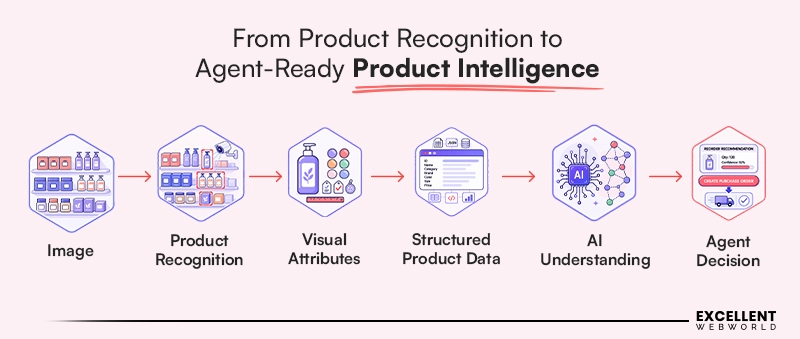
This approach builds a solid bridge between visual content and machine-readable commerce, which helps AI agents understand products in depth, not just their text descriptions.
What Does the ROI for Computer Vision in Retail Actually Look Like?
ROI from computer vision in retail should be measured based on operational and commercial metrics.
These metrics show up in four places: shrink, returns, conversion, and labor. Each of the metrics has real numbers behind it, not vague promises. Hence, retailers should define an upper limit before deployment, then compare the same metrics after implementation.
Loss Prevention and Shrink Reduction
Usage of AI and computer vision can help to detect theft patterns, suspicious activities, and shoplifting activities. Retailers can use this to track shrink rate, theft incidents, fraud detection, inventory discrepancies, and recovered inventory value. Especially the metrics recovered inventory value and faster fraud investigation work on the same logic: fewer blind spots, fewer responses.
Return Rate Reduction
Visual search and virtual try-on are two essential features that help reduce uncertainty around wrong expectations and wrong fit. When shoppers view the right product details and a realistic preview of the product before purchase, the guesswork results in a drop in return and exchange rates.
Initially, the return rate drops, followed by the exchange rate and conversion rate as customers trust more and buy with confidence. For example, Garcia, a retail brand, conducted A/B testing and reported a 7.06% higher conversion rate and 5.54% lower returns with virtual try-on. The test included more than 5,000 orders in each group.
Conversion and AOV Impact
Improved product visibility reduces the gap between shopper intent and purchase, thereby increasing the conversion rate and search-to-purchase rate. Product engagement reaches a new level when shoppers interact with the product physically rather than just reading the descriptions online. The engagement rate has a direct impact on the basket size and average order value.
Operational Efficiency and Labor Savings
AI-based retail computer vision streamlines repetitive shelf audits and inspections, which further enables employees to focus on replenishment, customer service, and exception handling. Retailers should establish a baseline and track the same metrics after deployment to measure actual gains.
| Business Metric | What to Measure |
|---|---|
| Shelf audit time | Hours repaired per audit |
| Manual inspection | Labor hours |
| Checkout throughout | Transactions per hour |
| Inventory accuracy | Accuracy percentage |
| Fulfillment accuracy | Error rate |
How to Implement Computer Vision in Retail?
Successful computer vision implementation in retail begins with phased rollout, not a single full-fledged launch. Here are the four simple steps to move from initial deployment to full-scale operation.
Step 1: Define Success Metrics Before Piloting
Begin with a burning business problem, not the technology. Define what your outcome looks like before choosing an AI partner and the devices & workflows required to achieve it. Choose measurable goals, such as reducing shrink, enhancing inventory accuracy, decreasing queue time, reducing returns, increasing conversion, or reducing manual inspection hours. These metrics become the baseline for evaluating the pilot.
Step 2: Run a Controlled, Measurable Pilot
Begin the pilot project with one store, product category, workflow, or channel. State the baseline performance, run the pilot, evaluate results, and fine-tune well before expanding.
- Baseline
- Pilot
- Measure
- Optimize
Make some technical decisions, such as choosing a computer vision model, checking object detection accuracy thresholds, defining computer vision datasets for training, and also AI model training requirements. In addition, evaluate whether edge AI or cloud computer vision is highly valuable, and whether existing computer APIs help to accelerate the deployment.
Step 3: Plan for Data Privacy and Compliance
Ensure you maintain privacy in the computer vision implementation from the beginning. Address some of the burning issues, such as the following.
- Data minimization and anonymization
- Consent where required
- Data retention and access controls
- Biometric data considerations
- Vendor data handling
Retailers who are operating in different regions of the world should comply with the GDPR, CCPA/CPRA, applicable local privacy laws, and emerging EU AI Act considerations. For a broader view of common deployment obstacles, see AI implementation challenges.
Step 4: Scale Across Stores and Channels
As soon as the pilot project demonstrates measurable value, integrate computer vision retail with several core enterprise systems. These comprise POS, ERP, OMS, WMS, PIM, and CRM systems, along with ecommerce platforms. Then continuously monitor:
- Model accuracy and drift
- Cloud/edge infrastructure performance
- ROI and business KPIs
This broader approach to AI in retail helps retailers connect computer vision with other retail workflows based on proven outcomes rather than just technical readiness.
Key Considerations for Deploying Computer Vision in Retail
Scaling computer vision in retail isn’t limited to technical readiness; retailers also need to address privacy, accuracy, and fraud risks.
Privacy and Biometric Data Regulations
Privacy is crucial when computer vision in retail involves customer or biometric data. Retailers should determine the regulations that apply to the specific use case and become familiar with the compliance requirements. In general, biometric data has stricter regulations than standard visual analytics.
According to the EU AI Act, requirements should be determined by the application and risk level, not by the use of computer vision technology in retail. Retailers should treat compliance as an ongoing process, not a one-time assessment, as regulations and use cases can change over time.
Model Accuracy, Bias, and Vendor Accountability
Enterprise buyers should assess the computer vision model before deployment. Here are several essential questions they should ask the vendor:
- How accurate is the model, and what is its false-positive rate?
- Which computer vision datasets does the model support?
- How is bias tested and monitored?
- How is model drift monitored?
- How often is AI model training updated?
- Who owns the data and derived insights?
- Who is accountable when the model fails?
Fraud Risk in Agent-Driven Commerce
Agentic commerce introduces new fraud risks for computer vision applications in retail. These include manipulated product data, fake images, and fraudulent listings. Compromised APIs can also create payment and identity risks. Therefore, retailers should use trusted product data and secure workflows to manage payment, identity, and purchasing risks.
How to Choose a Computer Vision Development Partner
A computer vision project in retail succeeds when a partner meets three key criteria. First, the partner must deliver accurate detection, recognition, and real-time analysis. Second, the partner must integrate your project smoothly with current retail systems, such as POS, ERP, and eCommerce systems. Third, align with clear business goals. This includes improving inventory accuracy, preventing losses, and enhancing customer experience. A working model alone is not enough.
At Excellent Webworld, we combine retail computer vision systems with scalable, AI-ready architecture. As an AI development company, we develop custom computer vision solutions for retail. Our team links visual intelligence to enterprise systems, structured product data, and business workflows. Our approach helps retailers improve operations, inventory accuracy, and customer experience.
Frequently Asked Questions
Computer vision in retail evaluates images and video to detect products, people, and activities. Common applications include shelf monitoring, inventory tracking, checkout automation, loss prevention, and footfall analysis. In short, it converts camera feeds into actionable operational data.
Cameras or sensors capture visual data, while a computer vision model analyzes it using techniques such as object detection and product recognition. The resulting insights can trigger alerts, analytics, or automated actions based on what it detects.
The key benefits of computer vision in retail include enhanced inventory accuracy, reduced shrink, faster operations, and better customer experiences. Computer vision technology in retail also supports automation across stores, warehouses, and digital commerce.
Traditional CCTV primarily records footage for human review. Computer vision actively analyzes video in real time, which helps identify objects, behaviors, and anomalies without manual monitoring.
Key computer vision applications in retail ecommerce include visual search, automated product tagging, image-based recommendations, virtual try-on, and visual quality checks. These applications improve product discovery and search relevance.
Computer vision can potentially reduce returns by enhancing product discovery and customer confidence. Visual search and virtual try-on allow customers to better understand products before purchasing; however, results vary by category and implementation.
No, computer vision is not limited to enterprises. Cloud-based computer vision APIs and SaaS platforms have made the technology more accessible to small and medium-sized businesses.
ROI depends on the use case, baseline performance, deployment scale, and measurable business impact. Retailers should define KPIs prior to computer vision implementation and measure results through a controlled pilot.
Computer vision can turn visual product information into structured attributes and product signals. AI shopping agents can use this data for product discovery, comparison, and purchasing decisions.
Retailers should assess personal and biometric data requirements, applicable privacy laws, facial recognition rules where relevant, and data storage practices. Requirements vary based on the use case and jurisdiction, so compliance should be assessed before deployment.
The decision depends on business requirements, integration needs, deployment scale, and available capabilities. Off-the-shelf platforms work well for standard use cases, while custom computer vision retail solutions provide greater control and adaptability.
Retailers should assess expertise in object detection, product recognition, AI engineering, integrations, and real-time processing. They should also evaluate computer vision datasets, AI model training, security, scalability, and the partner’s ability to connect technology with measurable business outcomes.

Article By


Paresh Sagar is the CEO of Excellent Webworld. He firmly believes in using technology to solve challenges. His dedication and attention to detail make him an expert in helping startups in different industries digitalize their businesses globally.