Yes, you can deploy a basic voice AI agent in under two minutes. But you can’t make a production-ready voice AI agent in that time that users can trust.
That’s the actual difference that is missed while watching voice AI demos on YouTube or LinkedIn. A person simply opens a laptop, taps a few buttons, and then within seconds, an AI receptionist answers a live call, ending with “Your AI voice receptionist is ready.”
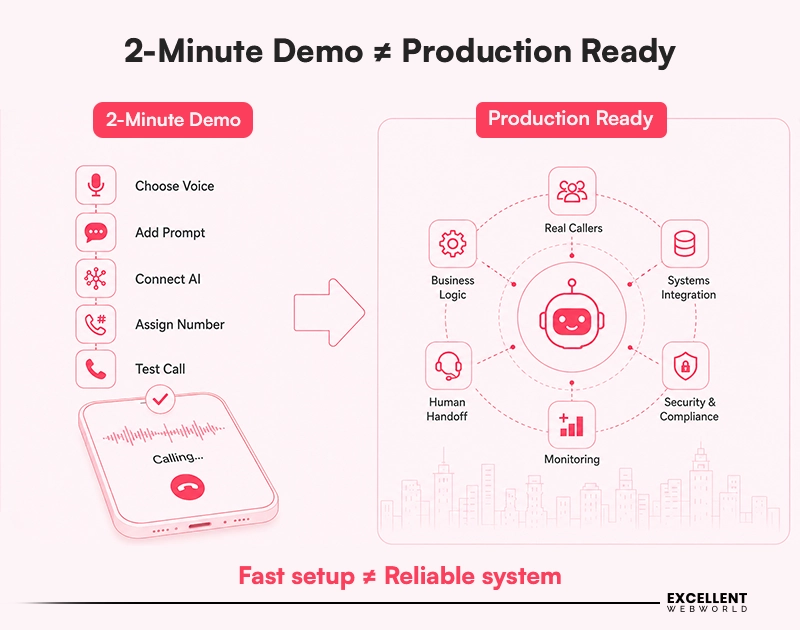
In this, the well-known platforms like x.AI, Vapi, Retell AI, Bland AI, and Vocode let you set up quickly within minutes. You need to pick a voice AI agent, set a prompt, link speech and LLM models, assign a number, and finally run a test call. This is worth it for testing ideas about how your business operates by integrating voice AI agents. A working test can only prove that the voice AI pipeline works, but it does not prove that these AI agents are safer for real-time customers and their queries.
Real calls are chaotic. Customers speak from noisy places, switch their queries, or, if they do not get a satisfactory answer, then they will ask to connect with real-time customer support. In this situation, when the AI does not respond, customers quickly become frustrated, and it will harm trust in your products or services.
Engineer Pramod Chandrayan documented this operational risk in his notes, “30 Days, 7 Failures, 1 Note.” Over one month in production, his agent has met with the seven hidden system failures, including stale documentation, input overflows, context drift, silent cost increases, and prompt injection attacks. Pramod also says: “Your test suite checks the problems you expect. Real production shows the problems that actually happen.”
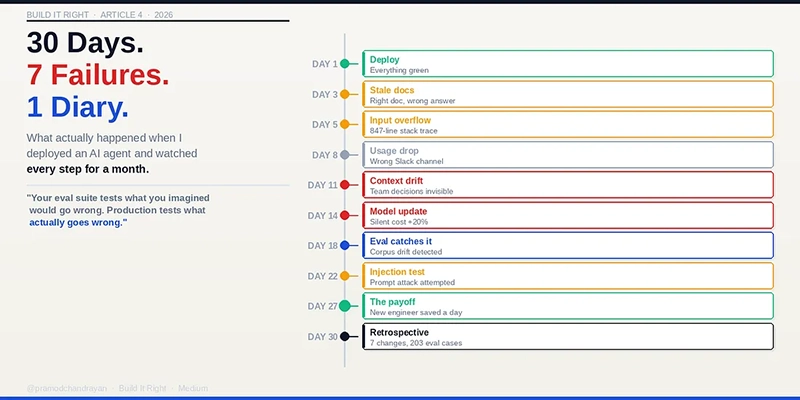
The lesson is that deployment speed and production readiness are completely different from each other.
So the real question is not: “Can I deploy a voice AI agent in 2 minutes?”
It is: “Can that two-minute agent reliably handle your customers, integrations, and failure scenarios when real money is on the line?”
What Truly Occurs After the Initial Successful Call?
- Picture your first test call.
- You ask an agent a simple and easy question.
- After that, a voice AI agent understands you, responds naturally, and, at last, it makes you feel like a human is having a conversation.
At this point, it is easy to assume the difficult part is over.
Isn’t it?
The first successful call only confirms that a core voice pipeline is operating. It tells you that speech can be captured, processed, interpreted, and converted back into a response. It doesn’t tell you how the agent will behave when the conversation becomes unpredictable.
A caller may communicate while background traffic is passing by. The other customer might have a robust regional accent. Someone may interrupt an agent in between when they are answering your queries. Another call might stay silent for some seconds before responding.
Someone may suddenly ask: “Can you direct my call or query to a human?”
This is where the system has to do more than generate a convincing voice. It has to learn about intent, maintain context, recover from bugs, access the right information, and decide what to do when it can’t securely continue.
Analysis of production voice AI failures points to complexities such as latency, interruptions, real-time user behavior, and failure handling as the reasons demos collapse once real calls start coming in.
That is the point where a successful demonstration starts becoming a production engineering problem.
Real Voice AI Stack is Larger Than the Demo
A quick demo might make building a voice AI agent look simple, but in reality, it relies on several interconnected components working seamlessly together. These include telephony and call routing, speech‑to‑text (STT), AI reasoning, text‑to‑speech (TTS), conversation orchestration, business tools and API calls, and knowledge retrieval. Each part plays a role in ensuring the agent can understand, respond, and act effectively during a live conversation.
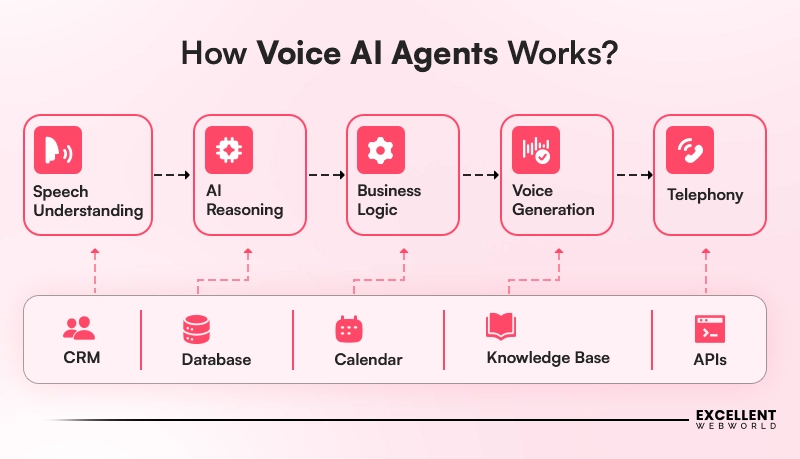
But a production system adds one more layer that’s across the pipeline. The agent may need access to the CRM system to retrieve all customer data. It needs a calendar to book appointments and a knowledge base to answer the company-specific questions. It might require authentication before accessing the confidential and sensitive records.
And when something goes wrong, the system needs a defined fallback instead of leaving the customer stuck in the conversation. This is why a voice AI platform should be viewed as the foundation for building a voice agent system — not the complete business solution. The platform provides the voice infrastructure, but your business still needs to provide the data, integrations, business rules, security controls, and safeguards around it.
The Tools That Deploy Fast Voice AI Agents
| Platform | Best For | Set Up Speed | Main Limitation |
|---|---|---|---|
| Vapi | Developers building custom voice applications | Very fast | Production implementations often require additional coding |
| Retell AI | Sales and support teams | Fast | Limited out-of-the-box CRM depth |
| Bland AI | High-volume inbound and outbound calls | Very fast | Performance depends heavily on configuration and prompts |
| Vocode | Technical teams wanting greater control | Moderate | Requires engineering resources to maintain |
The key point is that these platforms help businesses start using voice AI quickly. But they do not automatically know how your business works.
A platform gives you the voice setup, but your business must add the intelligence, data, integrations, rules, and safety checks around it.
The faster you launch, the more important it is to check what the platform actually does for you — and what still needs engineering from your team.
Where Does Voice AI Agent Stop Impressing?
The most important test is not whether the AI can answer a question. It is what happens when the conversation doesn’t go as expected.
Suppose a customer is calling a service business. They begin with a simple request, and the AI answers correctly. Then, a customer changes the subject, asks about pricing, wants to reschedule an appointment, and finally requests a human representative.
A core demo will handle the initial question perfectly and without any interruption. A production system has to manage the whole conversation flow the way conversational AI is meant to work. This means preserving context while the conversation changes. After that, it needs to retrieve the correct business insights. It will perform actions instead of simply providing answers.
If it reaches those limits, then it can be handled safely and needs to transfer the conversation without creating another problem for the customer. This is the stage where production engineering becomes crucial. The goal is to make failures controlled, recoverable, and visible, and not to ignore the failure that makes your business slow down.
What Does a Production-Ready Voice Agent Actually Need?
Once an agent is getting customer-related queries, there are several requirements that become too complicated to be ignored by business owners.
Business System Integration
A voice agent is worth it when it can do something with the insights it gets. Suppose it may need to:
- Retrieve customer records
- Schedule an appointment
- Check for order status
- CRM updation
- Create a support ticket
- Retrieve information from an internal database
With this, AI sounds more intelligent than a human, but is still unable to understand and complete the customer’s request. Agentic AI development is designed to solve complex problems so agents can make real-time decisions, not just give a brief explanation.
Reliable Conversation Handling
Customers rarely begin conversations perfectly with structured sentences. A system is required to deal with interruptions, stops, corrections, changing topics, background sounds, and unexpected queries without losing the major context of the chat.
Human Escalation
Not every conversation should finish with AI. Some requests require a person. A production system should know when to stop trying to resolve the issue itself and move up the conversation to the appropriate team.
Monitoring and Quality Assurance
Launching a voice AI agent isn’t the finish line—it’s the start of ongoing refinement. Businesses need a clear view of how the agent is performing. The same DevOps automation tools used to monitor software pipelines are also applied to track call results, failed interactions, speed (latency), customer complaints, and escalation rates. Real conversations become a continuous feedback loop, helping teams spot weaknesses and improve the system over time.
Security and Compliance
The stakes rise when an agent handles sensitive information—whether personal, financial, or healthcare data. Before going live, businesses must address call recording, data storage, access control, AI disclosure, and industry‑specific regulations.
Microsoft’s responsible AI guidance also underscores four pillars every production system should uphold: reliability and safety, privacy and security, transparency, and accountability.
An Actual Timeline: Demo vs Production
This is the stage where the “two-minute deployment” claims need some context. Nothing is wrong with a fast prototype. In fact, it saves a lot of time and money for businesses. Assuming that prototype speed is equal to production speed is where the misunderstanding begins.
Usually, a journey of production will look like this:
| Stage | What Happens | Typical Timeline |
|---|---|---|
| Initial prototype | Select platform, configure voice, create prompt, and test calls | Minutes to hours |
| Conversation design | Study real conversations and identify important scenarios | 3–7 days |
| Integration | Connect CRM, calendar, databases, APIs, and business workflow | 1–2 weeks |
| Testing & QA | Test edge cases, accuracy, interruptions, escalation, and performance | About 1 week |
| Compliance & security | Review data handling, recording, access, and applicable requirements | Varies by use case |
| Production monitoring | Track calls, failures, user feedback, and system performance | Ongoing |
The timeline will vary feature by feature. A simple appointment reminder system may need minimal customization.
A voice AI agent handling financial accounts or healthcare information is a completely different project. That is why it is more useful to measure development only by its requirements instead of promising an arbitrary number of weeks.
Why These Fast Voice AI Tools Are Still Being Used More
It would be completely unfair to treat rapid development as nothing. For many businesses, it is genuinely useful, as it helps them in many ways.
Suppose you want to find out whether customers will actually use an AI receptionist. Then you do not necessarily need a six-month development project to answer that question.
A quick prototype can help you with:
- Validate business ideas
- Test customer reactions
- Compare several voices and prompts
- Estimate possible call-handling volume
- Recognize common customer questions
- Demonstrate a concept to stakeholders
- Decide whether deeper development is justified
For narrow and low-risk workflows, this approach can be extremely practical. The example includes appointment reminders, basic FAQs, and order-status requests. In ecommerce voice AI agent is most useful for quick order and delivery updates. In any scenario, if the system only requires managing a small set of predictable tasks, then a fast-deployment platform might be all you need.
Startups, mid-sized businesses, and early pilots can then use a well-tuned Retell or Vapi agent as a sensible beginning point. So there is no cause to over-engineer a problem prior to proving that solution has value.
When Is a Quick Voice Agent No Longer Enough?
The decision changes when the consequences of failure become more serious. A purpose-built voice agent becomes more appropriate when the system needs to work with live business data, handle sensitive communication, or manage a high volume of customer interactions. Here are some important things to add, like:
- The agent needs to access or update CRM or ERP data, or else they can embed the ERP systems for orders, inventory, or financial records
- Customers discuss payments, accounts, or personal information
- Business functioning in areas like healthcare, finance, etc
- AI represents a significant customer-facing brand only
- Call volumes are high enough that even small bug rates make a huge business impact
- The organization requires detailed logging, auditing, reporting, or QA
- The agent requires complex business logic instead of only simple question answering
- You are now no longer only configuring the voice platform; you are developing the complete software
Using open‑source AI agent frameworks requires integrating architecture, authentication, data handling, API security, monitoring, fallback workflows, and compliance into the process.
How Do You Know Which Approach Is Right?
One of the easiest ways to clear up your confusion is to begin with the risk and complexity of the conversation, and not the popularity of the platform.
Fast Platform is Worth It When:
- Workflow is narrow
- The information involved is low-risk
- Integration number is restricted
- Still at the validating the idea stage
- Occasional failures are acceptable and manageable
- The team can monitor and adjust the agent
Purpose-Built System Makes More Sense When:
- Agent needs to access live business data
- Confidential customer data is stored
- Workflow has several decision paths
- Regulatory requirements apply
- Human escalation and detailed monitoring are important
Hence, the technology should follow these requirements and not revolve around them.
Questions to Ask Before Choosing a Voice AI Vendor
Before opting for a platform or custom AI development partner, you need to ask questions that reveal what happens beyond the demo.
- What happens when the AI doesn’t know the answer?
- Can it transfer a caller to a human without losing the conversation context?
- How is customer data stored and secured?
- Could it safely connect to our CRM, ERP, database, or calendar?
- How is the system tested using real customer scenarios?
- What situations arise when an integration fails?
- How are calls monitored after deployment?
- Can the system support our brand voice?
- How are call recording and AI disclosure requirements handled?
- What security and compliance are available?
- Can the system support requirements such as SOC 2, ISO 27001, or HIPAA compliance and a BAA where applicable?
- Who is responsible for fixing problems after launch?
In this, the FTC’s telemarketing sales rule guidance can also be more important when reviewing telemarketing and consumer-protection considerations. If a vendor is not able to give clear answers to all of these questions, then the impressive demo does not make sense.
Why 95% of GenAI Pilots Don’t Deliver ROI?
Yes, you can deploy a voice AI agent in under two minutes. What you can’t do in that period is create a production-ready business solution. Deploying the technology is about configuring the tool. When you are delivering reliable business value, it means you’re engineering a system that is operating around your workflows.
A two‑minute rollout is valuable because it lets you test an idea fast. Use that speed to validate whether the concept solves a real problem. The work that follows determines whether the experiment scales into something dependable: preserving context across turns, integrating with business data, executing actions, and handling handoffs without creating new customer friction.
Research from MIT NANDA found that 95% of organizations in its study were not yet seeing measurable returns from their GenAI investments. That is not due to technology failure. Instead, it highlights the difference between experimentation and production. So, treat the quick demos as the beginning of a learning loop, not the finished product.
A Quick Takeaway:
- Start quickly to validate the idea and collect real conversation data.
- Test realistically to understand how customers actually interact with the agent.
- Develop carefully when the use case involves sensitive data, complicated workflows, high call volumes, or significant business risk.
A fast demo gets you started. Production engineering makes the system trustworthy.
Ready to Move Beyond the Demo?
If you are exploring voice AI for customer service, sales, appointment booking, customer support, or another business workflow, the right approach depends on what the agent actually needs to do.
At Excellent WebWorld, our AI & Agentic Systems practice builds voice AI solutions that go beyond demos by integrating agents with core business systems and testing them in real‑world scenarios. We implement appropriate safeguards and full production‑readiness processes so solutions are secure, reliable, and ready to deliver measurable business value. The goal is to make it more useful when a real-time customer is looking for an actual response.
Ready to move from a two-minute demo to a production-ready voice AI solution? Talk to our AI & Agentic Systems experts and schedule a free 30-minute consultation.

Article By


Paresh Sagar is the CEO of Excellent Webworld. He firmly believes in using technology to solve challenges. His dedication and attention to detail make him an expert in helping startups in different industries digitalize their businesses globally.