Web and mobile application development has changed a lot over the last few years. In 2026, the full-stack development process adapted cloud infrastructure, real-time APIs, AI integrations, and multi-platform frontends. All these make your product scalable and reliable for long-term growth.
As a startup or an enterprise owner, you might have lots of questions regarding full-stack development:
- What is the development process?
- Who is a full-stack developer?
- What are the roles and responsibilities of a full-stack developer?
- What to cover and what to skip in full-stack development?
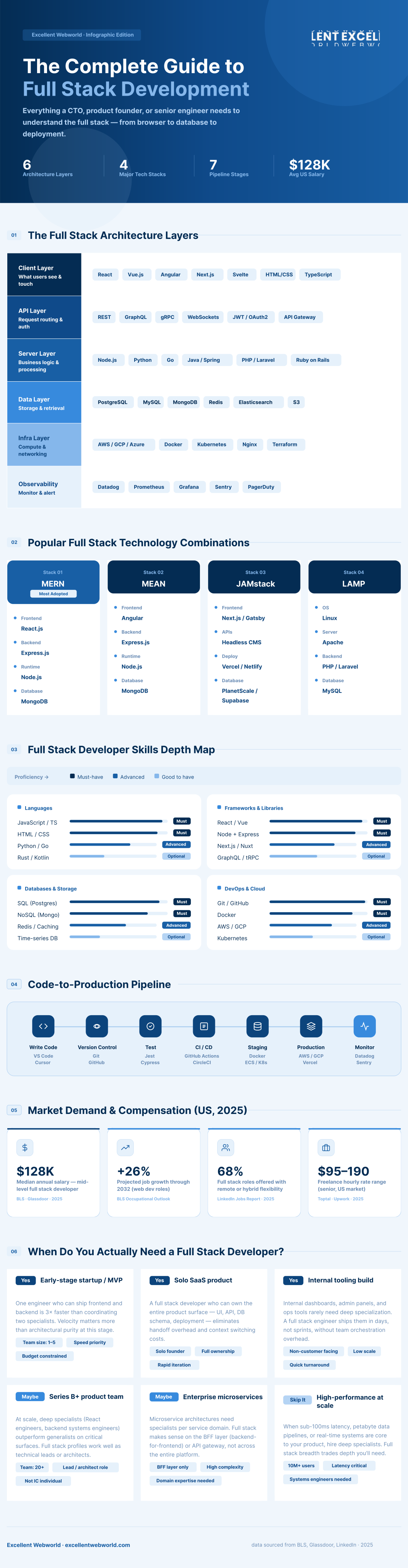
We’ve answered these questions in detail in our blog, “The What is full-stack development?” You can check it for more information. Here, we have sorted things for you with the best infographics. Scroll down to discover top visuals that explain the architecture layer, popular tech combinations, developer skills map, code to production pipeline, market demand, and more regarding full-stack development.
Conclusion
Undoubtedly, full-stack development remains the most versatile and commercially valuable skillset a developer can bring to a project. It brings the power of frontend and backend technologies to create complete, scalable, and user-focused digital product development. Adapting full-stack development from a single tech partner or a team of developers is like enabling an end-to-end solution from one source. The intentions of these infographics are to simplify the journey by breaking down complex concepts into clear, visual insights.
If you’re looking to turn these insights into real-world applications, Excellent WebWorld stands out as a trusted partner. Hire full-stack developers with us to leverage expertise across the full stack. Our team helps you transform ideas into high-performing digital products efficiently, creatively, and reliably.
Get in touch with us to share your requirements.
FAQs About Full-Stack Development in 2026
The skill sets required are frontend and backend technologies. In the frontend, skills like CSS3, HTML5, and JavaScript are needed. While in the case of backend tech, there is a need for a server-side language. SQL and NoSQL are the preferred ones for databases, and Git Workflow is related to version control.
It takes around six to nine months in 2026 to learn full-stack development.
React.js is used for interfaces, and is quite flexible in terms of MERN, while MEAN has Angular as a tech stack, which makes it quite rigid & ideal for enterprise applications.
Startups need to hire a full-stack development company to maximise efficiency and also reduce overhead costs. Some of the advantages of hiring are: cost efficiency, faster MVP launch, seamless integration, and higher scalability.
Selecting the right tech actually depends on the scalability of the project, speed, and budget requirements. While the MERN stack is right for real-time applications, Python Django is considered for heavy data projects. To make sure that the most technical & cost-effective choice, it is also necessary to consult with a top-tier successful company like Excellent Webworld that helps in assessing the needs of the business and suggests a future-proof strategic roadmap.

Article By


Mahil Jasani began his career as a developer and progressed to become the COO of Excellent Webworld. He uses his technical experience to tackle any challenge that arises in any department, be it development, management, operations, or finance.