Health systems have relied on Electronic Health Records (EHR) for decades to organize and manage patient data. That foundation still matters, but expectations from these systems have changed.
Traditional EHRs do the job of digitally storing patient information very well. But modern healthcare demands faster documentation, clearer insights, and workflows that align with how healthcare app development is evolving today.
AI in EHR systems is already starting to close that gap by improving documentation, supporting coding, and surfacing relevant patient data in real time. As leadership teams across healthcare organizations look to integrate AI into their EHR systems, the focus shifts to a few particular questions:
- Where does AI fit in existing EHR systems?
- What actually changes in day-to-day workflows?
- How do you introduce AI without disrupting an already functional system?
This blog breaks down how AI is used to improve EHR systems, where it creates measurable impact, and what you should evaluate before moving forward.
Key Takeaways:
- AI in EHR uses technologies like natural language processing, predictive analytics, and machine learning within electronic health records to improve how data is captured, processed, and used.
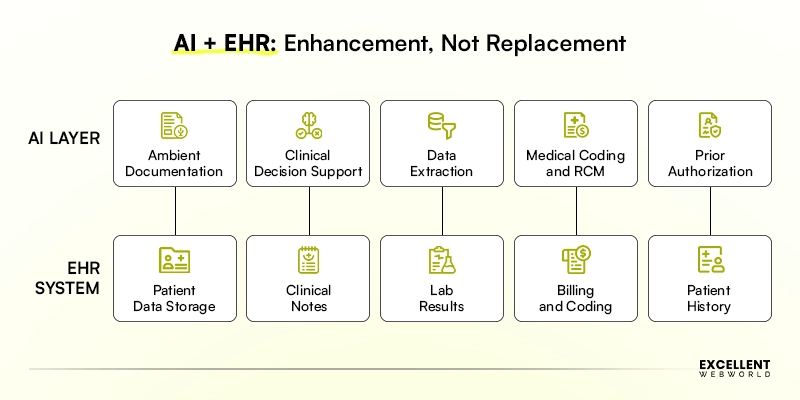
- Most implementations focus on improving existing systems, not replacing them, across documentation, coding, and clinical workflows.
- The shift is happening because traditional EHRs store large volumes of data but still rely heavily on manual effort to turn that data into decisions.
- Current AI in healthcare statistics show healthcare systems are seeing impact in the form of reduced documentation time, improved coding accuracy, earlier risk detection, and smoother revenue cycles.
- AI is typically introduced as a layer on top of existing EHR systems through integrations, rather than through full system replacement.
- Key challenges include workflow fit, output reliability, and data access, including PHI protection and compliance.
- For leadership teams, the decision comes down to identifying the right use case to start with, validating ROI early, and scaling based on measurable outcomes.
What Artificial Intelligence in EHR Actually Means
AI in EHR uses technologies like natural language processing (NLP), predictive analytics, and machine learning within EHR software and EMR integration environments to improve how data is captured, processed, and used across clinical and administrative workflows.
It is built into existing platforms like Epic Systems, Oracle Health, or athenahealth through APIs and integration layers rather than introduced as a separate system.
In practice, this means using AI to support EHR optimization without replacing the systems already in place.
You’ll usually see this applied in areas where teams spend the most time today.
| Area | What Changes | Example |
|---|---|---|
| Documentation | Reduces manual note-taking and summarizes clinical information | AI scribe tools like Nuance DAX or Suki AI convert conversations into structured notes and reduce documentation burden |
| Clinical Decision Support (CDSS) | Surfaces risks and supports real-time decisions | Predictive analytics helps identify readmission risk and supports evidence-based recommendations |
| Administrative Workflows | Automates coding and billing tasks | AI assists with ICD-10 coding and improves revenue cycle management (RCM) accuracy |
| Data & Interoperability | Makes data easier to use across systems | FHIR APIs and HL7 standards structure and share data across systems |
Why AI-Powered EHR Optimization Has Become a Priority
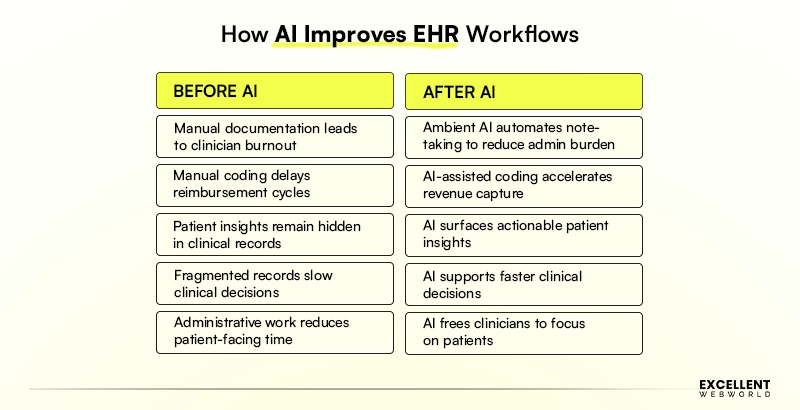
Electronic Health Records still sit at the center of clinical and administrative workflows. But they struggle to meet current expectations. All the patient data is there, available across the system for faster and more efficient care. But the friction comes from how much manual effort it still takes to turn that data into usable output.
Documentation Still Takes More Time Than It Should
- Notes are written after consultations and repeated across encounters
- A large portion of clinician time goes into maintaining records
- Work often extends into after-hours EHR usage (“pajama time”)
- Studies show 20% reduction in note-taking time and 30% less after-hours work with ambient documentation tools, highlighting how much effort is currently spent on non-clinical tasks
Coding & Billing Workflows Are Still Heavier Than They Look On Paper
- Clinical notes need interpretation before mapping to ICD-10 codes
- Claims often need rework before successful submission
- Teams spend time correcting, validating, and resubmitting patient data
- Delays and denials directly impact revenue cycle management
Data Exists In The System, But Is Difficult To Act On
- Patient histories, lab results, and notes exist across multiple formats
- Key information is often buried in unstructured clinical text
- Extracting insights still depends on manual review
- Systems rarely surface the right signals during real-time decision-making
The Functional Roles AI Plays Inside the EHR
AI in EHR systems typically operates across a few functional roles, each addressing a specific layer of work rather than changing everything at once.
| Role | Description |
|---|---|
| Documentation | AI captures clinical conversations and converts them into structured notes using clinical NLP, voice-to-text, and ambient documentation. This reduces manual entry, reduces after-hours work, and frees up clinician time. |
| Clinical Support | AI strengthens clinical decision support (CDSS) by analyzing patient data in real time, flagging risks, and surfacing evidence-based recommendations. This supports faster, more consistent clinical decisions. |
| Data Extraction | AI extracts structured data from unstructured clinical notes, lab reports, and patient histories, making it easier to access and use across systems. This improves interoperability through standards like FHIR APIs and HL7. |
| Administrative | AI supports medical coding (ICD-10), prior authorization, and revenue cycle management by reducing manual review. This improves accuracy and speeds up processing, leading to fewer errors and more predictable revenue cycles. |
In most cases, you don’t need to implement all these at once. What we usually see is teams starting with one area, validating the impact, and then expanding from there.
The same pattern is increasingly visible in AI in healthcare app development, where organizations typically begin with a focused implementation, measure its impact, and then expand AI capabilities across broader healthcare workflows.
What are the Most Impactful Use Cases of AI in EHR Systems?
AI in EHR is already being used across specific workflows where time, accuracy, and coordination matter the most. These use cases show how teams are using it to move beyond static records and actually work with patient data in real time.
1. Ambient Documentation and AI Scribes Reduce Physician Charting Time
Many teams start here because it’s one of the first areas to deliver immediate impact. Ambient AI tools capture conversations during visits and convert them into structured clinical notes inside the EHR.
This reduces after-hours charting and frees up clinician time during the day.
- At Rush University Medical Center, physicians reported a 74% reduction in burnout levels after adopting AI-supported documentation tools.
- At The Permanente Medical Group in Northern California, physicians saved nearly 16,000 hours in documentation time over a one-year rollout.
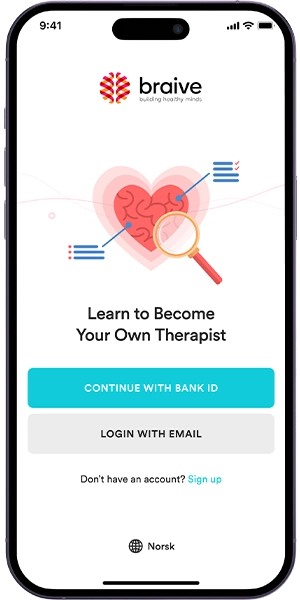
Ambient AI Reduces Clinical Workload Beyond EHR Settings
When we developed Braive, an AI-powered mental healthcare platform deployed across Scandinavia and Europe, the same documentation principle applied outside of EHR workflows entirely. Its AI-native clinical documentation engine, Braive Note, generates session notes post-therapy with 99.8% accuracy and saves clinicians 15 minutes per client call on average.
- EU MDR-certified, deployed across Scandinavia & Europe
- Combines iCBT pathways with AI clinical documentation
- Braive Note hits 99.8% accuracy on session notes
- Saves clinicians 15 minutes per client call
2. AI Surfaces Real-Time Clinical Decision Support at the Point of Care
Once documentation becomes less of a burden, the attention then usually shifts to how quickly and accurately decisions can be made during the consultation.
AI works alongside patient data in real time. Instead of going through records manually, clinicians get relevant signals in context such as risk flags, missing information, or recommendations based on similar cases. That reduces interpretation time and enables earlier action.
Platforms like Epic Systems are already integrating generative AI capabilities through Microsoft Azure OpenAI to provide draft clinical summaries and in-workflow insights. This is one of the early examples of generative AI in EHR being used within clinical workflows.
Clinical decisions no longer depend on manually stitching together information across multiple parts of the EHR.
3. Predictive Analytics in EHR Identifies High-Risk Patients Before Complications Occur
Healthcare teams often have the data needed to anticipate risk, but identifying it early depends on recognizing patient history, lab results, and ongoing treatment.
Predictive models built into EHR systems surface those signals earlier. Instead of waiting for a condition to escalate, clinicians can identify patients at higher risk of readmission or complications and intervene sooner. This improves how care is prioritized and reduces avoidable hospital events over time.
- At Kaiser Permanente, predictive analytics models built on EHR data identified high-risk patients and supported them through a 30-day follow-up program, reducing hospital readmissions risk by 10% without increasing patient mortality.
Clinical teams no longer have to wait for risk to become visible through outcomes. The system helps flag it early enough to act on time and even ahead of time.
4. AI-Driven Medical Coding Improves ICD-10 Accuracy and Reduces Rework
Coding accuracy directly affects how quickly claims move through the system and how often they come back for correction.
AI-driven coding tools analyze clinical notes, suggest ICD-10 codes, and support coders within their existing workflow, reducing the manual interpretation.
A controlled study conducted across hospitals in Sweden and Norway evaluated the use of AI-assisted coding (Easy-ICD) in real clinical settings with professional coders. The results highlight how AI improves both speed and accuracy in real-world coding workflows.
| Metric | Result |
|---|---|
| Coding Time (long notes, around 300 words) | 46% reduction (123 seconds faster) |
| Coding Accuracy (long notes) | 62% → 67% (improved) |
| Coding Accuracy (short notes) | 60% → 70% (improved) |
The study found that AI assistance significantly reduced the time required to code complex clinical notes while improving overall data quality. This level of improvement directly reduces manual effort and helps coding teams keep pace without increasing workload.
5. Agentic AI Automates Prior Authorization Drafting, Submission, and Denial Appeals
Prior authorization is one of the few workflows where delays are almost expected. Requests move back and forth between providers and payers, documentation gets pulled manually, and even small gaps can lead to denials or resubmissions.
Agentic AI integration in EHR systems changes this by handling multiple steps in sequence. It pulls clinical data, applies payer rules, generates submission-ready requests, and tracks responses within the same workflow.
Solutions like Humata Health show how agentic systems can handle multiple steps across the prior authorization workflow. Instead of stopping at data extraction, these systems pull clinical context from the EHR, generate submission-ready requests, and continue to track payer responses and next actions within the same flow. This works because the system connects these actions across the workflow.
Prior authorization depends on how clinical data is structured, how rules are applied, and how responses feed back into the system.
6. AI Breaks Down Data Silos with FHIR-Based Integration
AI improves how patient data moves across systems by working with standards like FHIR APIs and HL7. It structures and connects data so it can be accessed where needed.
This is especially important when patient data spans multiple care settings. AI bridges that gap by extracting relevant data, aligning it to standard formats, and making it available across workflows.
Platforms like Oracle Health are already expanding interoperability through FHIR-based APIs to support data exchange across healthcare systems.
The impact depends on how well this layer fits into your existing EHR environment because interoperability goes beyond APIs, and involves data mapping, governance, and information exchange across workflows.
7. AI in Revenue Cycle Management Reduces Claim Errors and Improves Processing Speed
Many revenue cycle delays start with small issues in documentation or coding that lead to denials and rework.
AI improves this by adding a validation layer across the claims workflow. It checks clinical data, coding, and documentation against payer rules before submission, helping teams catch issues early. At the same time, machine learning models can analyze historical claims data to identify patterns in denials and predict which cases are likely to be rejected or overturned on appeal.
Research indexed on PubMed Central shows that machine learning models can predict which claims are likely to be overturned, helping teams focus on recoverable revenue and reduce manual review.
When validation happens earlier and denial handling becomes more targeted, the entire workflow becomes more efficient, speeding up reimbursement cycles and reducing repetitive administrative work.
Benefits of Using AI to Improve Electronic Health Records (EHRs)
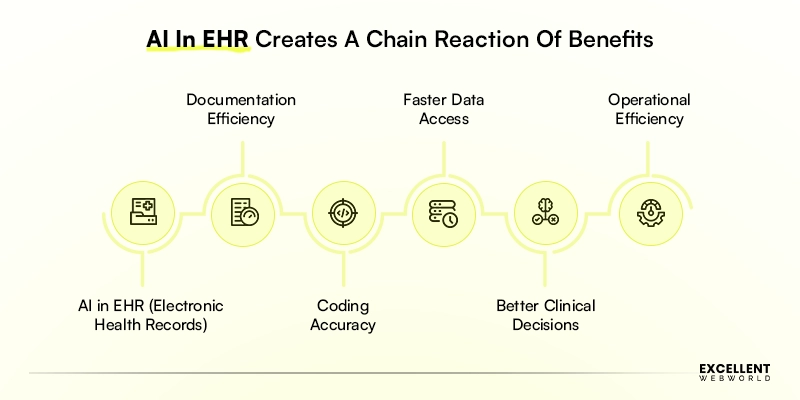
At this stage, the value of AI in EHR systems becomes visible in how improvements across workflows build on each other.
When documentation improves, coding becomes more efficient. When data becomes easier to use, decisions become faster. Together, these changes affect both clinical and operational outcomes.
If you look at systems where AI has been integrated properly, these are the kinds of shifts that tend to follow.
1. Physicians Spend More Hours on Patient Care Than on Screens
When documentation shifts to ambient capture, time spent inside the EHR drops. You’re not constantly going back to complete notes or carrying unfinished work into the evening.
This shift is already visible in systems like The Permanente Medical Group, where AI-supported documentation has meaningfully reduced after-hours charting.
Over time, this shifts how clinical hours are used, with more focus on patient care and less on repetitive screen work.
More meaningful patient interactions also create opportunities for organizations to strengthen engagement strategies through digital tools and patient engagement software.
2. AI in the EHR Measurably Reduces Physician Burnout
Burnout is closely tied to after-hours work. When documentation, summarization, and data retrieval become faster, that pressure starts to ease off.
As “pajama time” drops, workloads become more sustainable without reducing patient volume.
3. Diagnostic Errors Drop When EHR Flags Anomalies in Real Time
Real-time clinical decision support adds a layer of safety by flagging inconsistencies in patient history, lab results, or expected patterns.
This reduces the need to manually piece together information across systems and helps clinicians act with more clarity during care. For you, that means fewer missed details in complex cases where multiple data points need to be considered together.
Platforms like Epic Systems are already building this into workflows, where AI surfaces insights directly during patient interactions.
4. ROI Compounds Across Documentation, Coding, and Interoperability
The impact of AI doesn’t stay limited to one workflow. Improvements in documentation make coding more accurate. Better data structure improves interoperability. Faster data access improves decision-making.
If you’re evaluating ROI, this is where it becomes visible. Instead of isolated gains, returns start compounding across multiple parts of the system.
5. Mid-Market Health Systems Avoid Full EHR Rebuilds by Layering AI on Existing Infrastructure
Replacing an EHR system is expensive and disruptive. AI allows teams to build on existing systems instead.
This allows you to modernize workflows without going through a full rebuild, while reducing both cost and implementation risk.
6. A Single AI Layer Connects Clinical and Administrative Workflows Without New Infrastructure
Clinical and administrative workflows often operate separately despite relying on the same data. AI connects these processes across documentation, coding, and claims, allowing teams to work with consistent information without switching systems.
In practice, your teams can work with the same information without constantly switching systems or reconciling data manually.
7. Early Adopters Build a Compounding Data Advantage That Late Movers Cannot Buy Back
The earlier AI is integrated into EHR workflows, the more data it learns from over time, improving accuracy and automation quality.
If you start earlier, the system improves with your data. Late adopters can implement similar tools, but they lack the same system-specific learning, which creates long-term performance differences.
These outcomes show how AI is already changing how EHR systems operate in practice.
3 Questions Every C-Suite Asks Before Implementing AI in EHR
By the time leadership teams get serious about AI in EHR, the conversation has already moved past what the technology can do. The real questions are about how it fits into your system, whether your teams will actually use it, and how quickly it starts delivering value.
At that point, decisions slow down because the trade-offs are clear and affect multiple stakeholders.
These are the three questions that usually determine what happens next.
1. Does AI in EHR Require Replacing Epic Systems, Oracle Health or MEDITECH?
In most cases, AI is introduced on top of the existing EHR. Systems like Epic Systems and Oracle Health already support integration through FHIR APIs, HL7, and vendor connectors, allowing new capabilities to plug into existing workflows.
What matters is how the AI integration layer is introduced. Clinical data needs to be mapped correctly, workflows must remain intact, and compliance requirements still apply across every layer. This is where most of the effort sits, and where things tend to go wrong if not planned carefully.
As a CIO, the decision comes down to how you introduce AI into your architecture without disrupting the systems your teams rely on every day.
2. Will Physicians Actually Use It and Will It Improve Care?
Adoption depends on how the tool behaves inside the workflow. If it adds steps, it gets ignored. If it removes effort, usage builds quickly.
At The Permanente Medical Group, physicians using AI-supported documentation tools collectively saved the equivalent of 1,794 working days over a year.
That time translates into practical changes:
- Less time finishing notes after clinic hours
- Fewer interruptions during consultations
- More consistent pace across the day
From what we’ve seen, adoption improves when the system fits naturally into how clinicians already work, and when rollout is supported by structured change management.
As a CMO, the question is whether this improves care delivery in a way your teams actually experience day to day.
3. What Does AI in EHR Cost and When Does It Pay Back?
Costs vary depending on the use case and integration depth, but some patterns are consistent. In most implementations we’ve worked on or evaluated, ambient documentation tools fall in the range of $150 to $600 per provider per month.
These ranges align with what providers like The Permanente Medical Group have reported in early deployments.
Returns usually become visible within the first year itself through time saved in documentation, fewer coding corrections, and faster claim processing.
Over time, systems that adopt earlier build structured data that improves model performance, creating an advantage that becomes harder to replicate later.
As a CFO, you’re looking at whether this translates into measurable financial impact without adding operational complexity.
How These Decisions Break Down in Practice
| C-Suite Role | The Question You’re Asking | What This Comes Down To |
|---|---|---|
| CIO | Do we need to replace our EHR to make this work? | Clean integration without disrupting workflows or system stability |
| CMO | Will clinicians use this, and does it improve care? | Adoption, workflow fit, and impact on day-to-day clinical decisions |
| CFO | What does this cost, and how soon does it return value? | Measurable returns across documentation, coding, and revenue cycles without added overhead. |
Once you have clear answers to these, the next step is figuring out how to implement AI in your existing EHR system.
How to Implement AI in Your EHR System
Once you decide to move forward, the challenge is where to start and how to avoid disrupting what already works. For most teams, the technology itself isn’t the main challenge. They struggle with sequencing, integration, and making sure early decisions don’t create problems later.
Implementing AI in EHR systems usually happens in phases rather than all at once.
- Audit your current EHR stack and identify where friction exists: Look at where your teams lose time, typically in documentation delays, coding backlogs, or difficulty accessing usable data. Trying to fix everything at once slows progress.
- Decide whether you’re introducing a point solution or an orchestration layer: Some use cases work with standalone tools, while others require coordination across workflows. Your choice here determines the integration effort you take on and how scalable the system becomes over time.
- Evaluate vendor compliance before capability: Review BAA terms, data residency, and model training policies early. This includes alignment with regulations like HIPAA and clarity on how patient data is handled, including PHI protection and ePHI encryption. In healthcare environments, addressing compliance early is far easier than fixing gaps later.
- Run a phased pilot instead of a full rollout: Start with one department and measure how EHR time and workflows change. Use that data to guide your next phase. Early validation reduces risk and supports internal buy-in.
- Design your data integration approach early: Plan how you’ll use FHIR APIs, legacy connectors, and event-driven data flows. This determines whether your system remains scalable or becomes harder to manage over time.
- Put a governance layer in place from the start: Set up audit trails, anomaly detection, and clinician override protocols early. These controls help your teams trust the system and rely on it in day-to-day use.
What Are the Challenges of Implementing AI in the EHR?
AI in EHR can deliver measurable improvements, but challenges become visible once systems interact with real data and workflows.
- AI outputs depend on how clinical context is retrieved and structured: If data is incomplete or poorly structured, outputs miss key details and fail to reflect the full patient picture.
- Balancing data access with control becomes a constraint: AI needs enough access to be useful, but not so much that it creates compliance or security risks. Defining what the system can read, write, or trigger across workflows requires careful scoping early on.
- Compliance requirements shape how AI can be implemented: Regulations like HIPAA influence how data is accessed, processed, and stored. BAA terms, data residency, and model training policies define how data can be used. Structured approaches to HIPAA-compliant development help ensure systems operate safely within these constraints.
- Complex workflows require multiple approaches: Clinical workflows involve extraction, validation, decision logic, and summarization. Treating this as a single AI task leads to unreliable results.
- Lack of traceability reduces trust: If teams can’t see what data was used or how outputs were generated, confidence drops quickly. Clear audit trails and visibility into system behavior become essential.
- Early rollout can introduce friction before it removes it: Even when the long-term goal is efficiency, initial adoption can slow teams down. Systems need to fit into existing workflows without forcing major behavioural changes.
- Scaling beyond the first use case requires rework: What works in one department doesn’t automatically extend across the system. Expanding AI across workflows often requires revisiting integration, data handling, and governance decisions.
These challenges don’t block adoption, but they shape how teams move forward. AI integration in EHR systems depends on how well the new layer fits into existing workflows and data structures. When addressed early, these become manageable constraints rather than ongoing issues.
How We Help Health Systems Add AI to Their EHR Without Rebuilding It
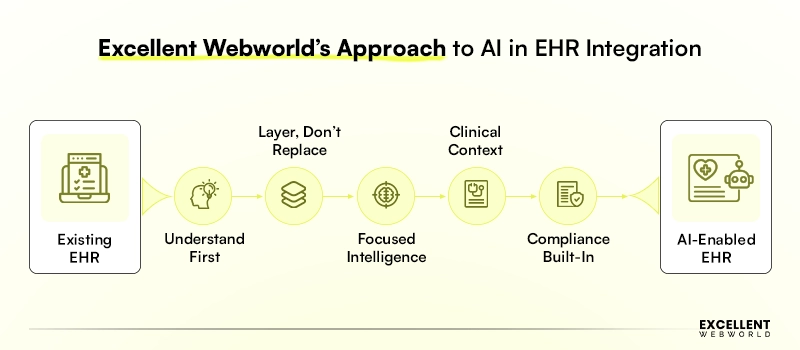
In most health systems, teams already understand what AI can do. The challenge is fitting those capabilities into your workflows that are already in place and closely tied to how care is delivered.
That’s where the approach starts to matter. Early decisions shape how well the system holds together once AI is introduced.
“We don’t start with AI but with how your system behaves today.”
Before introducing any new layer, the focus is on how information moves through your EHR, where delays occur, and how decisions are currently made. That context determines what AI should actually do instead of forcing a predefined solution into your workflows.
“We treat AI as a layer, not a replacement.”
Your EHR already does what it was designed to do. AI extends that system without rebuilding it, working within your existing architecture and introducing capabilities that fit into how your teams operate. This approach aligns with how most healthcare development efforts are structured today, where systems evolve through integration rather than full replacement.
“We prioritize control over coverage.”
Solving everything at once usually leads to fragmented systems. Instead, AI is introduced in areas where it can operate reliably and deliver consistent outcomes. That control makes it easier to expand later without reworking the foundation.
“We design for how decisions are actually made.”
Clinical and operational workflows rarely follow clean system boundaries. AI needs to reflect how teams work across those boundaries, not just how data is stored.
“We build with compliance and accountability from the start.”
Working within healthcare systems requires alignment with regulations like HIPAA and ensuring outputs can be traced, validated, and trusted. These considerations shape how the system is designed from the beginning.
When this approach is followed, AI becomes part of how your EHR operates rather than something your teams have to work around. This allows you to introduce new capabilities without disrupting what already works.
What the Next 24 Months Look Like for AI in EHR Systems
With the current pace of adoption, the next 12 to 24 months won’t be about whether AI is used in EHR systems. The future of AI in EHR will depend on how these systems evolve over time.
One of the first decisions you’ll face is whether your EHR continues as a system with AI layered on top, or moves toward becoming an AI-native platform. In that model, documentation, decision support, operational workflows no longer run separately. They start working as a single layer.
Agentic AI is already pushing things in that direction, and health systems are increasingly turning to Agentic app development to build these capabilities. Instead of waiting for input, systems begin handling sequences of work on their own, whether that’s preparing prior authorizations, reconciling medications, or identifying coding gaps as data is generated.
As this becomes more common, governance stops being a background concern. You’re no longer just deciding how AI is used, but how it is monitored and controlled. With sensitive patient data involved, alignment with regulations like HIPAA becomes non-negotiable. This is where AI governance platforms come in, handling compliance checks, audit trails, and policy enforcement so that these systems can operate safely at scale.
The bigger opportunity, and the bigger decision, sits with federated learning. By mid to late 2026, your AI models will be able to learn from multiple health systems without any patient data leaving your environment. This works through approaches like homomorphic encryption, where models learn from encrypted data without exposing raw patient information.
If you put the right governance and data structures in place now, your systems improve continuously using patterns beyond your own organization. If you wait, you can still adopt similar tools later, but the learning happens outside your system. In that case, vendors control the models, the insights, and how quickly they improve, while you rely on outputs instead of building your own advantage.
Over the next couple of years, how you approach these shifts will shape how your EHR system evolves and what you get out of it. The impact builds gradually, but over time, the gap becomes difficult to ignore.
AI in EHR Systems Is Already Shaping How Modern Healthcare Operates
The decision to implement Artificial Intelligence in EHR systems is no longer something teams evaluate in isolation. It is already influencing how documentation is handled, how decisions are made, and how workflows connect across clinical and administrative functions as part of broader digital health transformation efforts.
What determines the outcome isn’t the presence of AI, but how it’s introduced into the system. The way it fits into existing workflows, how data is structured, and how decisions are supported over time all determine whether it delivers consistent value or adds complexity. The goal is not simply to add new features, but to create an AI-powered EHR that improves how information flows across the organization.
If you’re evaluating where to start, it helps to cut through what sounds good and focus instead on what actually works for your particular healthcare environment.
You can talk to our AI healthcare team specializing in healthcare development to decide what’s worth implementing in your system and what isn’t.
Frequently Asked Questions
AI in modern EHR software is used to reduce manual work and support decision-making. Common applications include ambient documentation (AI scribes), clinical decision support, predictive analytics, automated coding, and prior authorization workflows. More advanced systems are beginning to use agentic AI to handle multi-step processes across documentation, billing, and care coordination without constant manual input.
Several major EHR platforms are integrating AI scribes directly into their systems. Epic Systems offers ambient documentation through partnerships with Microsoft, while Oracle Health is building similar capabilities into its platform. Some health systems also use third-party AI scribe tools that integrate into existing EHR workflows without requiring system replacement.
For physicians, AI in EHR reduces time spent on documentation, improves access to relevant patient data, and supports faster clinical decisions. This leads to fewer after-hours tasks, less repetitive work, and more time focused on patient care. Over time, these changes contribute to reduced burnout and a more manageable daily workload.
AI in EHR systems must comply with strict data privacy regulations like HIPAA. This is handled through encryption, access controls, audit trails, and Business Associate Agreements (BAAs). Many systems also include governance layers that monitor how patient data is accessed, processed, and stored to ensure ongoing compliance across workflows.
Costs vary based on scope and integration depth. Based on typical implementations across health systems, adding a custom AI layer to an existing EHR usually falls in the range of $150K to $800K. A full AI-native EHR rebuild can run into $2 million to $6 million over 18 to 36 months. Most mid-market systems see faster ROI by layering AI onto their current EHR rather than replacing it entirely.
AI in EHR refers to adding AI capabilities to an existing system, such as documentation, coding, or decision support tools. An AI-native EHR is built from the ground up with AI at its core, where workflows and data structures are designed around AI from the start. For most organizations, enhancing an existing EHR is more practical and cost-effective than rebuilding the system entirely.

Article By


Mayur Panchal is the CTO of Excellent Webworld. With his skills and expertise, he stays updated with industry trends and utilizes his technical expertise to address problems faced by entrepreneurs and startup owners.