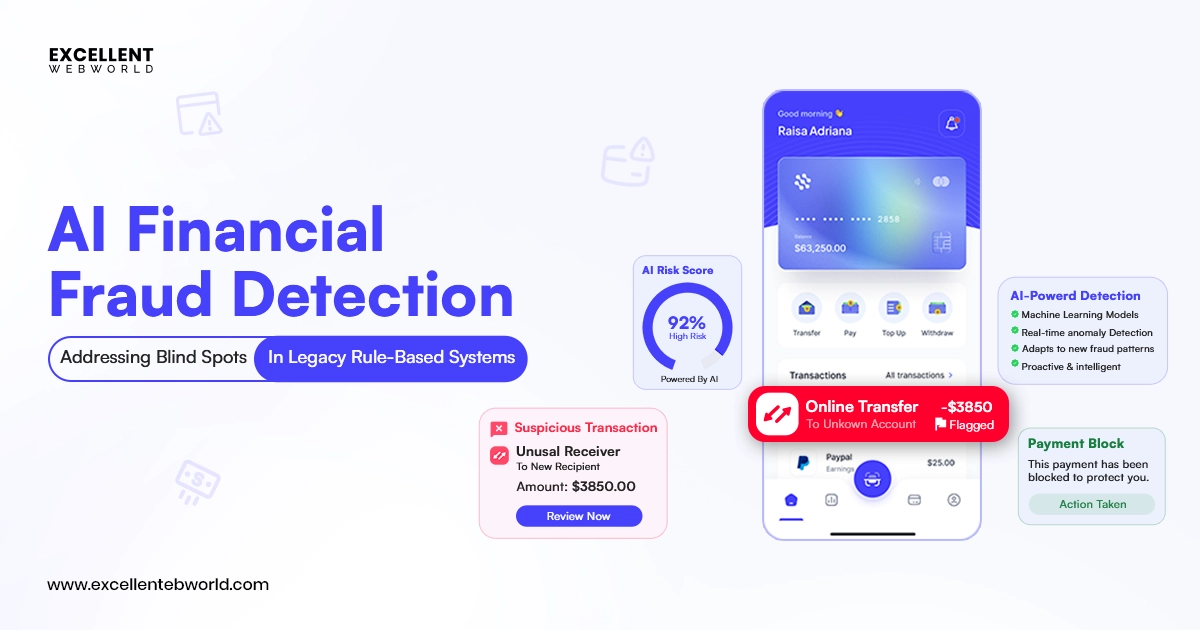
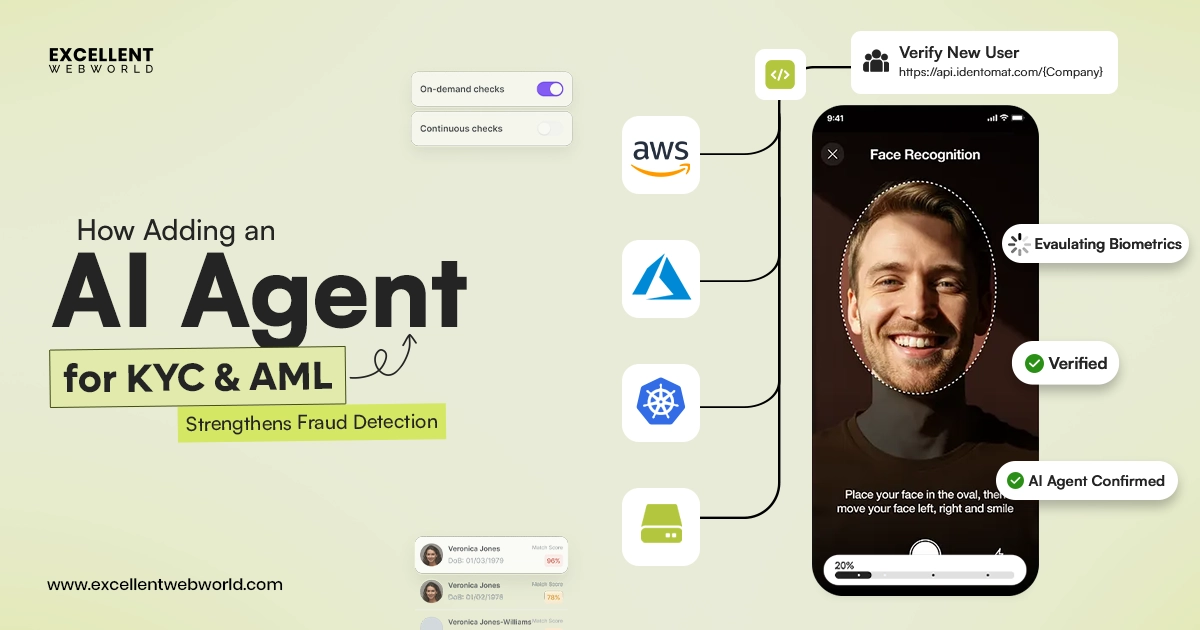
- The insurance platform market is projected to reach $207.52 billion by 2030, and most of that spending is going toward AI and mobile experiences.
- AI-driven claims processing cuts assessment time by 23 days and reduces customer complaints by 65%.
- Different insurance lines need their own apps. Health, auto, home, and travel insurance each call for different features, so a generic app rarely works well.
- Costs range from $80,000 for a basic MVP to $450,000+ for an AI-native, enterprise platform, depending on features, integrations & compliance.
- Compliance goes beyond data privacy. Along with HIPAA and PCI DSS, insurers also need to cover AI model governance, explainability & bias testing.
- The right development partner makes or breaks this whole plan. Choosing one with real fintech and regulatory experience gets a project across the finish line.
I’ve conducted meetings with insurance company C-level executives to learn what keeps them awake at night: “Is our insurance mobile app built to support today’s customer behavior, or is it just an old workflow with new screens on the top?” This question has become more relevant today because customers don’t have patience for clunky insurance apps, and that impatience is pushing markets to move at a rapid pace.
MarketsandMarkets survey report confirms this shift, with the insurance platform market projected to reach $207.52 billion by 2030. Insurers modernizing legacy insurance systems to align with new-age customer expectations are driving that growth. So, most of the spending is going toward building a robust AI and automation layer to support new-age features.
Deloitte’s Financial Services Outlook report confirms that this spending is generating measurable returns, with AI-driven fraud detection expected to save property and casualty insurers up to $160 billion by 2032, one of several AI use cases already proving out. Insurers acting quickly on these findings will have a significant advantage over those still waiting.
That’s the gap I advise clients to address for insurance mobile app development. Knowing you need to act is one thing; knowing how is another, and that’s what this guide is built to answer, drawn from 15+ years of experience building custom fintech solutions and delivering 100+ fintech projects in 40+ countries. After reading this guide, you’ll get a detailed roadmap of how to develop an insurance app, realistic costs, which features are worth your budget, and how to choose the right fintech app development company for the job.
Insurance Mobile App Market Overview
According to Gartner’s Survey Report, global insurance industry IT spending is expected to reach approximately $256.8 billion by 2026 and grow at an 8.4% CAGR through 2029. Most of this budget is allocated to mobile apps and customer-experience projects rather than back-office work.
This shift clearly tells us that the debate in the insurance industry isn’t about whether to modernize; it’s about how quickly they can modernize so they don’t lose out to competitors.
The InsurTech Speed Advantage Legacy Carriers Can’t Match
Given the urgency in the insurance market, InsurTechs are outpacing decade-old legacy systems. The reason is that InsurTechs are built on a mobile-first approach from day one, while legacy systems are trying to retrofit to stay relevant in the market.
According to Grand View Research, the U.S. InsurTech market is projected to grow to $42.15 billion by 2030. I’ve seen this difference firsthand: InsurTech teams ship projects in weeks, while legacy systems take quarters to get approved.
AI Is Now Core Infrastructure, Not a Side Project
The same urgency that InsurTech is built upon is also driving digital transformation in the insurance industry. AI has now become a major player and a core part of the infrastructure for insurance platforms, rather than just an integration you can add later. As per Grand View Research, the digital insurance platform market is expected to grow to $1,546.1 billion by 2033.
This growth is driven by AI-led insurance platforms, which are already reaping rewards, according to McKinsey’s Future of AI in the Insurance Industry report. According to that report, AI can reduce assessment time by 23 days & customer complaints by 65%, and improve customer satisfaction ratio by 36% and conversion rates by 11%.
Your Real Competitor Isn’t Another Insurer
The same AI-driven customer experiences are raising the bar for new-age policyholders, as they will now compare your insurance platform with Amazon or Chase (pro at providing next-level, immersive customer experiences) rather than other insurance companies. So, if you’re planning your insurance app development process in line with the latest fintech trends, you need to keep it customer-first; otherwise, it will be difficult to retain customers.
Where the Next Wave of Growth Is Hiding
The next wave of growth for insurance platforms lies in integrating embedded insurance, agentic AI, and frictionless payments from the beginning. So, if you’re planning to build a fintech app related to insurance, then you need to get your online payment API strategy right from the beginning. I’ve seen that many insurance app projects waste months retrofitting payment gateway integration rather than designing it up front.
What is AI-Native Insurance Mobile App Development?
Insurance mobile app development is the process of building an application that allows policyholders to purchase insurance, file claims, and check claim status on their smartphones, rather than making phone calls or using paper forms.
However, in the age of agentic AI, this definition feels incomplete. Today, an app is not just a portal; it’s a full ecosystem that can act on the policyholder’s behalf, automatically file a claim when an event occurs, or flag a missing document before the customer notices.
How AI-Native Insurance Apps Actually Work?
A well-built insurance application generally comprises three connected systems: policy administration, claim management, and CRM. The application doesn’t store this data; it pulls and pushes information between these systems in real time so that a claim filed in the application instantly updates the adjuster’s dashboard on the backend.
AI agents sit in this pipeline that verifies uploaded documents, routes claims to the right team, and flags fraud-detection patterns before a customer opens their insurance claim file. This backend-to-frontend connection is where most insurance application development projects fail or succeed. So, you need to give due importance to developing a robust data pipeline, and that’s where an experienced data engineering services provider can help you out.
Why Businesses Are Investing in AI-Native Insurance Apps Now
The primary reason businesses invest in modern-day insurance apps is to deliver a next-level customer experience. In my firsthand experience, half of complaints at the claims stage stem from manual paperwork and clunky interactions.
So, insurers are losing customers’ trust over broken forms, not technical underwriting mistakes, and this problem can be fixed with a technology-driven solution. That is precisely why insurance software development has become a mainstream topic in board-level meetings at insurance organizations.
The Role of Mobile Technology in Insurance Today
Mobile is the layer where customers can look and feel the experience of your insurance platform. In fact, it’s the only touchpoint that policyholders have to communicate with their insurers between renewals. In addition, mobile is the layer where AI in fintech actually reaches end-users, converting back-end automation into something a customer can tap, upload, or approve on their screen.
Whether you’re planning to start a fintech company related to insurance or collaborating with a mobile app development company to modernize your existing platform, mobile will always be your foundational layer on which features, budget, and compliance workflows are built.
Why Invest in AI-Native Insurance Mobile App Development?
Insurance companies are under pressure from two directions: policyholders expect instant, mobile-first service, and InsurTech competitors are already delivering that aspect.
Here are some of the key reasons why you should invest in AI-native insurance mobile application development:
| Benefit | Why It Matters |
|---|---|
| Improved Customer Experience | Policyholders are looking for a platform that enables them to buy coverage, upload documents, and check claim status without any human intervention. A well-built mobile insurance app does exactly that. |
| Faster Claim Processing | With digital insurance solutions, claims that used to take a few days for manual review are now checked and automatically routed to the relevant teams within minutes. |
| Reduced Operational Costs | If you opt for insurance app development services, it will free your team to focus on complex use cases that require human intervention, since routine claims processing will be handled automatically by your digital insurance platform. |
| Personalized Insurance Services | Applying the same price band to each customer ignores the real risk a particular individual faces. If you opt for an InsurTech platform, they use AI development services to help you personalize insurance prices according to each user’s preferences, which will also increase the chance of customer retention. |
| Increased Customer Retention | Customers generally leave the insurance platform when they find the renewal or claims process difficult. An insurance mobile app can solve this issue by delivering a world-class customer experience and easy navigation, keeping customers in your ecosystem for longer. |
| Better Fraud Prevention | Manual review can catch common fraud but misses patterns spread across thousands of claims. But with a new-age insurance app, you have an AI-driven fraud detection system, which is a popular fintech API use case. With that, you can detect fraud in real time and prevent customers from incurring any loss. |
| Higher Business Efficiency | With the help of new-age InsurTech platforms, departments can share claim data instantly instead of waiting for manual approval, which increases business efficiency, the same principle as neobank app development brought to banking years ago. |
| Competitive Advantage | When it comes to digital adoption, insurance is still behind banking. Insurers who study the latest mobile banking trends and apply them to policy and claims workflows are surging ahead of their competitors through their mobile apps. |
What are the Different Types of Insurance Mobile Apps?
The biggest mistake insurance companies make when scoping an insurance app project is trying to build a single app that covers everything instead of focusing on specific use cases. The apps that actually succeed are the ones built around specific use cases, since a health insurance claim workflow differs from a car accident insurance claim.
Here are the different types of insurance apps that you should be aware of:
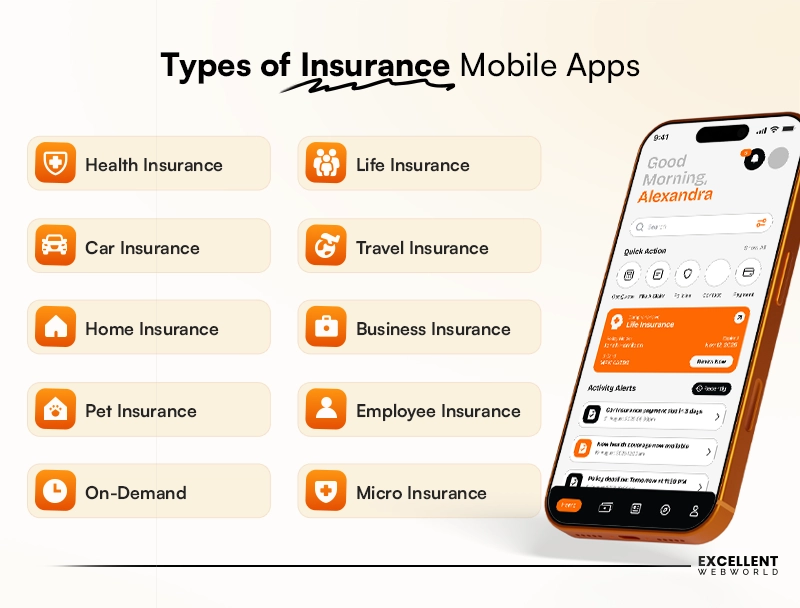
| App Type | Core Use Case | Must-Have Feature | Business Impact | Role of AI | Examples |
|---|---|---|---|---|---|
| Health Insurance App | Users can book their care, submit claims, and check coverage without connecting with the support team. | Real-time eligibility check and claim status | Reduces delays in eligibility checks and claim processing, which are the biggest customer complaints. | For health insurance app development projects, AI predicts the chances of a claim approval and flags coverage gaps. | Oscar Health, UnitedHealthcare |
| Life Insurance App | Policyholders manage beneficiaries, track cash volume, and initiate a claim after a loss. | Digital beneficiary management | Cuts down disputes at claim time, helping families that are already under pressure and not equipped to handle too much paperwork. | AI can help you automate underwriting by analyzing risk data instead of relying on a manual process that takes several weeks. | Ethos, Ladder |
| Car Insurance App | Drivers can file accident claims, upload photos, and get instant repair estimates. | AI-powered damage assessment | Faster payouts and claim settlement, which enhances the user experience and customer retention. | For car insurance app development projects, AI assesses the damage from uploaded photos and estimates repair costs without any human intervention. | Root, Metromile |
| Travel Insurance App | Travelers buy short-term coverage and file claims for lost bags or delays. | Instant, on-the-go policy purchase | Helps you convert impulsive buyers at the airport gate. | AI can automatically detect flight delays and trigger payouts before customers even file a claim. | Allianz Travel, SafetyWing |
| Home Insurance App | Homeowners document property, file claims, and receive payouts. | Photo-based claim plus instant payout | Reduce settlement time from weeks to days. | AI scans property photos to gauge damage and auto-approve low-risk claims, often paired with the best NFC payment apps for instant payout. | Hippo, Lemonade |
| Business Insurance App | Commercial clients manage multiple policies, certificates & renewals in one place. | Multi-policy dashboard | Managing several policies and renewal dates can be complicated, especially for commercial clients switching between multiple insurance partners. | AI finds coverage gaps and renewal dates automatically.However, the workflow is complex, and you need an experienced software development services partner to integrate this into your ecosystem. | Next Insurance, Thimble |
| Pet Insurance App | Pet owners submit vet bills and track reimbursement status. | Direct vet-to-app claim submission | Faster reimbursement consistency is the biggest renewal driver in this category. | AI reads vet invoices automatically to speed up the reimbursement process without any manual data entry. | Trupanion, Healthy Paws |
| Employee Insurance App | Employees enroll and manage group benefits without HR intervention. | Self-service benefits enrollment | Reduces HR support tickets during open enrollment sessions. | AI recommends benefit plans based on individual employee needs instead of generic tiers. | Gusto, Zenefits |
| On-Demand Insurance App | Customers toggle the coverage on and off for specific activities ot time periods. | Usage-based, pay-per-activation coverage | Customers now expect to switch between coverage instantly. | AI calculates dynamic, activity-based pricing the moment coverage is switched on, similar to how projects related to mobile banking app development enable instant balance checks. | Slice, Trov |
| Micro Insurance App | Customers buy short, affordable coverage for single itemes or a short period. | Micro-premium, installment-style pricing | Tries to cover price-sensitive buyers who would otherwise skip the insurance. | AI segments risk at a micro-level to devise small and short-term profitable policies, borrowing the same price logic that is used by BNPL app development projects. | Cover Genius, Bindable |
What are the Essential Features of an AI-Native Insurance Mobile App?
In the past days, a feature list was just a checkbox exercise. However, in modern times, they can be the difference between an app getting used constantly and one that gets uninstalled immediately. The right AI-native insurance mobile app features span across three different panels: customers, agents, and admins, each trying to resolve a different pain point.
Customer Panel Features
These are the features with which the policyholders are directly connected, and therefore, they have to work like applications they use on a daily basis and not like a lengthy government form. Getting these insurance app features spot-on determines whether a customer will complete a claim process or leave it halfway through.
| Feature | Description |
|---|---|
| User Registration & Login | Through Single Sign-On (SSO) or biometric authentication, the customer can reach their account details in a few seconds, without having to remember passwords. |
| Profile Management | Allows customers to update personal details, contact information, and coverage preferences on their own, without asking for help from a support representative. |
| Policy Purchase | An in-app workflow that allows customers to move from browsing to bound coverage in one session, thereby increasing chances of conversions. |
| Premium Calculator | Provides you with instant, transparent pricing before the final purchase, creating transparency that customers rarely get from a scripted quotation call. |
| Policy Renewal | One-tap renewal process that eliminates the friction that causes lapses in coverage. |
| Claims Submission | Replaces paper forms and multi-step processes with guided, mobile-first forms, thereby reducing abandonment that happens mid-claim. |
| Claims Tracking | Real-time updates are what differentiate a modern-day insurance mobile app from a glorified contact form that confuses users. |
| Document Upload | Camera-based upload for receipts, ID, and damage photos speeds up the verification process without having to visit a physical office. |
| Digital Insurance Card | Provides customers with always-on proof of coverage they can fetch instantly in case of a stop or emergency, without needing a physical wallet. |
| Online Payments | Secure, one-tap premium payments, with the same speed and simplicity that are now standard across money transfer app development projects. |
| Push Notifications | Sends timely alerts to customers for claim updates, renewals, and due payments, thereby reducing missed deadlines that impact retention ratio. |
| AI Chatbot | Handles routine questions round-the-clock, thereby allowing human agents to focus on complex, high-value cases. |
| Policy Comparison | Allows customers to compare various policies side-by-side so they can choose coverage with greater confidence. |
| Emergency Assistance | One-tap medical or roadside help for customers in case of an emergency. |
Agent Panel Features
Agents close the deal and manage renewals; therefore, their panel also needs to move as fast as customers. This is also the place where many custom insurance app development projects lose momentum if agent workflow is not built well.
| Feature | Description |
|---|---|
| Customer Management | Provides a centralized view of every customer’s policies, history, and unresolved issues even before they pick up their phone. |
| Lead Management | Track prospects through every stage of the pipeline, so follow-ups happen on time instead of missing potential leads. |
| Claims Management | Routes and prioritizes claims automatically based on urgency and complexity, using the same logic that is powering AI agents for the loan approval process. |
| Premium Calculator | Provides you with instant, transparent pricing before the final purchase, creating transparency that customers rarely get from a scripted quotation call. |
| Policy Renewal | One-tap renewal process that eliminates the friction that causes lapses in coverage. |
| Claims Submission | Replaces paper forms and multi-step processes with guided, mobile-first forms, thereby reducing abandonment that happens mid-claim. |
| Claims Tracking | Real-time updates are what differentiate a modern-day insurance mobile app from a glorified contact form that confuses users. |
| Document Upload | Camera-based upload for receipts, ID, and damage photos speeds up the verification process without having to visit a physical office. |
| Digital Insurance Card | Provides customers with always-on proof of coverage they can fetch instantly in case of a stop or emergency, without needing a physical wallet. |
| Online Payments | Secure, one-tap premium payments, with the same speed and simplicity that are now standard across money transfer app development projects. |
| Policy Management | Allows agents to update, renew, or modify policies directly, without switching between three different back-office systems. |
| AI Chatbot | Handles routine questions round-the-clock, thereby allowing human agents to focus on complex, high-value cases. |
| Commission Dashboard | Provides real-time visibility into earnings and pending payouts, thereby reducing commission disputes that damage sales team trust. |
| Notifications | Alert agents about upcoming renewals, expiring leads, and claim escalations. |
Admin Panel Features
Admin takes care of compliance and human oversight; therefore, this panel requires more depth compared to the previous two panels. A weak admin panel leads to security incidents and audit failures.
| Feature | Description |
|---|---|
| User Management | Control access across agents, customers, and internal staff from a single console. |
| Policy Management | Oversees policy creation, pricing logic, and underwriting rules across every product line. |
| Claims Management | Provides visibility into claim status, processing bottlenecks, and adjuster workload before small delays convert into customer complaints. |
| Reports & Analytics | Provides performance dashboards the same way wealth management software development projects provide portfolio details for financial advisors. |
| CMS | Allows teams to update policy documents, in-app content, and terms without disturbing a developer. |
| Fraud Detection | Flags suspicious claims with the logic that compliance teams use while developing AI agents for KYC and AML in banking ecosystems. |
| Payment Management | Reconciles premiums and payouts with the same logic that money lending app development projects apply for loan disbursement and repayment tracking. |
| Role-Based Access | Restricts sensitive data to the teams that require it, thereby closing one of the most common compliance gaps that auditors often flag. |
How to Develop an AI-Native Insurance Mobile App: Step-by-Step Development Process
I’ve seen that many insurance teams underestimate how many components work together to develop an AI-native insurance application. They get caught off guard by delays or budget overruns somewhere in the middle because the process looks the same until AI gets into the scene. Here’s a complete AI-native insurance app development process that will help you keep your project on schedule instead of getting into endless rework:
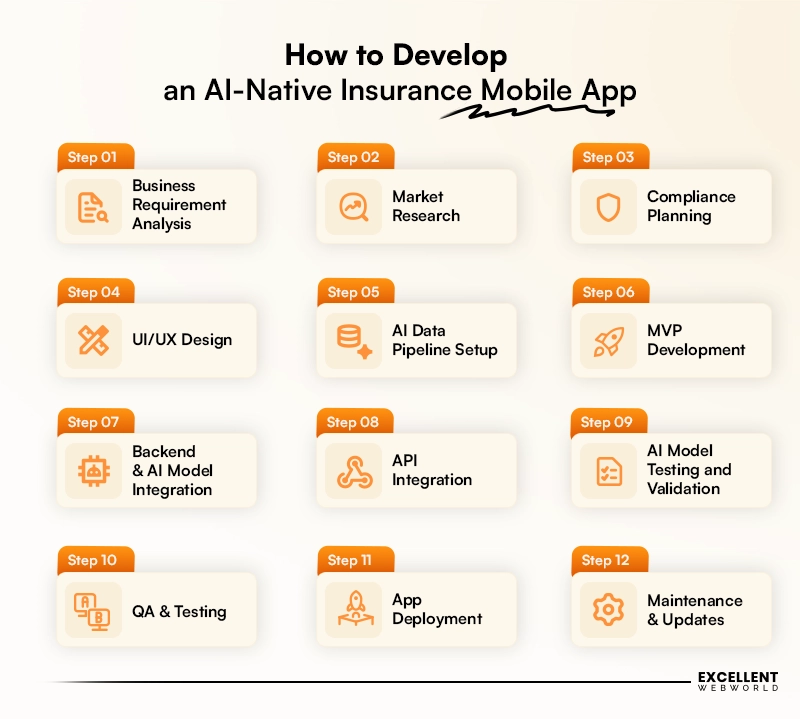
| Step | Description | Why It Matters |
|---|---|---|
| Step 1: Business Requirement Analysis | Defines the purpose of the app, which insurance line and users it is targeting, and what tasks should AI handle versus what tasks will still require manual intervention. | Skipping this part can cause a budget overrun for the project scope, and AI ambitions keep changing mid-project. |
| Step 2: Market Research | Look at the competitors, customer complaints, where policyholders drop off during purchase or claims, and where they’re using AI to close those gaps. | Shows what’s actually worth building, instead of just adding AI features. |
| Step 3: Compliance Planning | Map state insurance rules, HIPAA for health plans, data privacy needs, and how AI-driven decisions will be documented for regulatory bodies. | Regulatory bodies are analyzing AI-driven claims decisions minutely, and fixing this post-launch costs you way more than planning for it upfront. |
| Step 4: UI/UX Design | Sketches and test agents, customer, and admin screens, including how AI-generated suggestions or chat responses actually appear to the end-users. | Anyone thinking about how to build an insurance app should emphasize UI/UX, as it decides whether the end-user will remain or leave your app. |
| Step 5: AI Data Pipeline Setup | Builds the pipeline that feeds policy, CRM, and claims into AI models, then clean/structure the data so models can learn something that’s reliable. | Poor data quality is the biggest reason why AI models don’t perform reliably, which means AI-driven features underperform after launch. |
| Step 6: MVP Development | Develop must-have features first, such as payments, claim submission, and policy purchase, alongside first versions of core AI capabilities. | Puts an AI-assisted app in front of users, so that the feedback received can shape the final product and AI models. |
| Step 7: Backend & AI Model Integration | Connects claims, policy admin, and CRM systems on the backend, hosted on scalable cloud services & solutions, while integrating AI agents for tasks like fraud detection and document parsing. | This is the step where AI stops being an add-on and becomes part of your core workflow related to claims data and real policy. |
| Step 8: API Integration | Connect third-party tools like payment gateways, KYC checks, and telematics for collecting premium in a secure manner. | A broken connection here causes failed payments and dropped claims. |
| Step 9: AI Model Testing & Validation | Test AI outputs separately from regular testing, thereby validating accuracy, bias, hallucination, and confirming if AI hands over complex tasks to the support team. | This is what prevents an AI feature from denying a legitimate claim or providing customers with wrong information. |
| Step 10: Quality Assurance & Testing | Checks overall functionality, performance, and security across devices using the same rigour that you associate with stock trading app development, where each bug can prove really costly. | Catches problems early before they convert into negative reviews post-launch. |
| Step 11: App Deployment | Publishes the app on the App Store and Google Play Store, and sets up analytics, crash monitoring, and AI-driven performance monitoring from day one. | A smooth launch avoids approval delays, and AI-driven monitoring catches performance issues before customers notice. |
| Step 12: Ongoing Maintenance, Updates & Model Retraining | Covers bug fixes, OS updates, new features, and periodic retraining of AI models as fraud patterns and customer behavior shift. | Apps that skip model retraining will see the accuracy of their AI model decline over time. |
Technology Stack for AI-Native Insurance Mobile App Development
Selecting the right AI-native insurance app technology stack shapes everything from compliance readiness to claim speed. The wrong tech stack can cause scaling and security issues after one or two years post-launch, which is painful. Here’s what you should include as part of your modern insurance software technologies in 2026 and beyond:
| Layer | Technologies |
|---|---|
| Frontend | Flutter, React Native, Swift, Kotlin |
| Backend | Node.js, .NET, Java, Python |
| Database | PostgreSQL, MongoDB |
| Cloud | AWS, Microsoft Azure, Google Cloud |
| AI & Automation | OpenAI, OCR, Machine Learning, Predictive Analytics |
| Security & Compliance | Okta, AWS Cognito, Twilio Verify, Vault |
| Payments | Stripe, Plaid, PayPal |
Third-Party Integrations for AI-Native Insurance Apps
An insurance app can’t work in a standalone manner. Behind the scenes, it talks with ID verification services, hospital networks, payment processors, and internal CRM systems for day-to-day functioning. Here are the insurance app integrations that matter the most:
| Integration | Description |
|---|---|
| Payment Gateway Integration | Premium collection and claim payout depend on this integration, the same infrastructure used by some of the best mobile payment apps. |
| eKYC Verification | Manual paperwork is the biggest bottleneck to signups. Digital verification removes that friction, moving customers from download to active policy dashboard in a few minutes. |
| OCR Integration | Manual data entry is the biggest barrier in the claims process. OCR extracts data from documents and uploaded IDs automatically, thereby removing the manual process. |
| CRM Integration | Agents and customers often see different views of the same account. CRM integration creates real-time synchronization between these systems. |
| ERP Integration | Manual reconciliation processes can cause billing errors. ERP integration connects finance and operations systems to provide accurate data. |
| Hospital APIs | Health claims can go through a longer process when records are requested manually. Hospital data fetches data directly, thereby reducing settlement time. |
| GPS & Maps | Modern-day insurtech app development projects have telematics-based pricing and repair shop suggestion functionality, powered by location services. |
| SMS & Email | Not all customers have time to open your app daily. Through SMS and email communication, you can stay connected with your customers. |
| Push Notifications | Customer engagement can drop between renewals. Push notifications for claim milestones keep the relationship active. |
| AI Chatbot Integration | One of the most used insurance software integrations that helps in answering customer queries at anytime and from anywhere. |
| Cloud Storage | Every claim and document requires you to be stored in a secure place, and that’s where cloud services can help you out. |
Compliance & Security Considerations for AI-Native Insurance App Development
AI completely changes what it means to be “compliant.” It’s not only about encrypting the data; it’s more about how you can explain to regulators how your AI model reached a particular decision while denying a claim or setting up a premium. AI-native insurance app security has to cover both traditional data risk and the considerations associated with AI models.
| Compliance & Security Considerations | Description |
|---|---|
| GDPR Compliance | Applies if your app is handling EU customers, and now, with AI-driven decision-making, GDPR applies to AI models as it gives individuals the right to know how a particular decision was reached. GDPR violations carry fines that can overwhelm your budget. |
| HIPAA Compliance | Mandatory for any insurance app handling health records, and especially important when AI models are processing that data based on which claim settlement or risk scoring takes place. |
| PCI DSS | Required when the insurance app is processing premium payouts, especially for AI-driven fraud detection systems that use cardholder data for transaction review. |
| SOC2 | Sends a signal to your enterprise partner that your system, including the AI infrastructure, meets globally recognized security and availability standards. |
| ISO 27001 | Widely recognized information security framework that also covers how your AI models and training data are secured. |
| AI Model Governance & Explainability | State regulatory bodies require insurance companies to document how AI models make underwriting or claim decisions, and they need to explain any single output, if required. |
| Bias & Fairness Testing | Regular fairness audits have become a compliance requirement as AI models trained on past data can replicate past biases related to pricing or claim approval. |
| End-to-End Encryption | Protects policyholder data in transit and at rest related to coverage and premium details. |
| Multi-Factor Authentication | Adds a second verification layer beyond passwords, thereby closing the most common entry point for account takeover attempts. |
| Secure APIs | Every third-party API and AI model connection is a potential entry point for attackers; therefore, encryption and authentication at the API level are non-negotiable. |
| Data Backup & Recovery | Ensures that policy, claim, and AI training data survive outages or attacks, keeping the business operational when systems fail. |
| Audit Logs | Tracks every action taken by AI systems and users, essential for ensuring accountability in an insurance policy management app and passing insurance compliance review without any gaps. |
The Role of AI in Insurance Mobile App Development
AI in insurance has moved past the pilot stage to become the difference between the app that feels like digital paperwork and one that actually resolves a customer’s issue in real time. Here are the capabilities that separate a modern-day AI insurance app from a traditional one:
| AI Capability | Description |
|---|---|
| AI Chatbots | Handles routine queries instantly, thereby allowing human agents to focus on high-stakes tasks where a judgment call is invaluable. |
| AI Underwriting | AI insurance software analyzes applicants’ data in minutes instead of days and approves low-risk policies that don’t require manual review. |
| Fraud Detection | Flags any suspicious activities by spotting patterns across thousands of cases that a manual process won’t be able to catch. |
| Claims Automation | Routes, verifies, and settles simple claims without human intervention, reducing the waiting time that most customers complain about. |
| Risk Assessment | AI in insurance apps scores individual risk using real-time data instead of a broad demographic dashboard. |
| Personalized Recommendations | Suggests coverages according to the customer’s actual situation, thereby improving conversion rate at the entry point. |
| Predictive Analytics | Forecasts the chances of claims and customer churn in advance, thereby giving carriers the time to act. |
| Document Verification | AI in custom insurance software development projects helps you confirm IDs, claim photos, and receipts automatically. |
Latest Trends in Insurance Mobile App Development
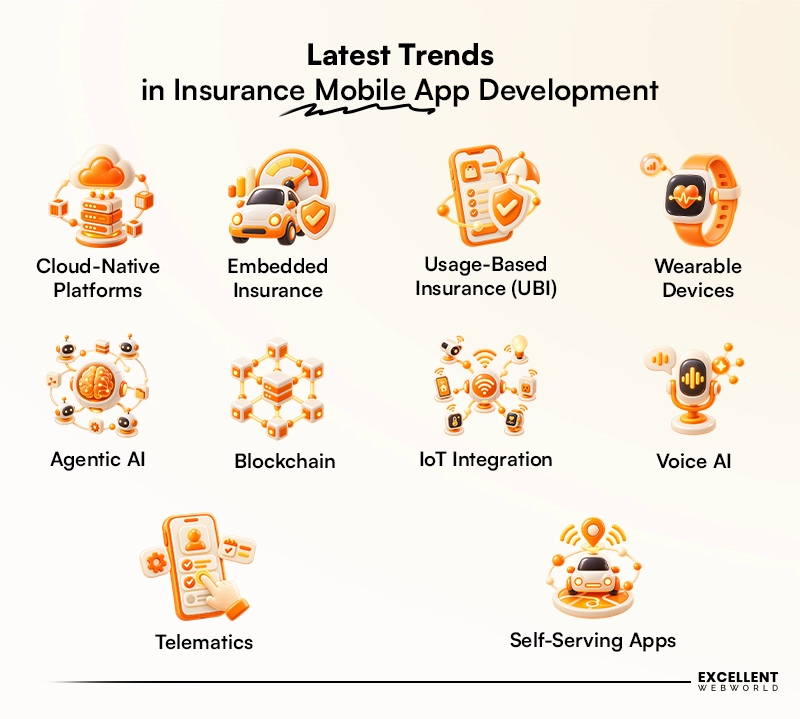
Building for what’s popular today means launching outdated products for tomorrow. Here are insurance app trends for 2026 that are reshaping the insurtech landscape:
| Trend | Description |
|---|---|
| Agentic AI | AI systems that don’t just provide suggestions but act on them, i.e., filing a claim or approving a policy without human intervention. |
| Embedded Insurance | Coverage sold directly inside another app or checkout workflow, so customers can buy insurance the moment they need it. |
| Blockchain | One of the most overlooked insurtech trends that helps in fraud-heavy claim categories by enabling transparent, tamper-proof claims records. |
| IoT Integration | Connected devices feed real-time data into pricing and risk models, removing static, once-a-year policy assumptions. |
| Wearable Devices | Health and fitness data from wearables provide information to life and health insurance companies. |
| Usage-Based Insurance (UBI) | A premium that is associated with actual usage instead of a flat estimate, a trend that is most relevant for auto insurers nowadays. |
| Telematics | Tracks real-time driving behavior to provide pricing for auto policies fairly, thereby rewarding people for safe driving. |
| Cloud-Native Platforms | Allows insurance platforms to scale instantly during claim surges, thereby eliminating the chances of outages that happen to apps still running on legacy infrastructure. |
| Voice AI | Allows customers to file claims or ask questions in a hands-free manner, which is what the future of insurance apps looks like. |
| Self-Serving Apps | Puts policy changes, claims, and renewals in customers’ hands, one of the insurance app trends you will hear a lot in the near future. |
How Much Does It Cost To Build An AI-Native Insurance Mobile App?
There can’t be a single number here. However, the cost to build an AI-native insurance mobile app lands somewhere between $80,000 and $450,000+, depending on platform choice, location of developers, features, complexity, integrations, and more.
The range will only make sense when you understand what separates a basic build from an enterprise-grade one, which is exactly what the following table aims to do:
| App Tier | Cost Range | What’s Included |
|---|---|---|
| MVP/Basic | $80,000-$150,000 | Core policy purchase, claims submission, and a basic AI chatbot. |
| Mid-Complexity | $150,000-$300,000 | Cross-platform build, AI-powered claims automation, third-party integrations, and compliance groundwork. |
| Enterprise/AI-Native | $300,000–$450,000+ | Full AI stack, fraud detection, predictive analytics, multi-panel architecture, and enterprise-grade compliance. |
Knowing the cost range is only half the picture, as the insurance app development cost for the same “tier” can shift based on the various choices made within it. Here are the factors affecting those cost calculations:
- Features & Functionality: Every module that you add, from digital wallet to telematics, adds development and testing time, which then contributes to overall cost.
- Platform (Android/iOS/Cross-Platform): If you opt for a native build, it will cost you more compared to a single cross-platform codebase, which works across both iOS and Android.
- UI/UX Complexity: Customized animations and multi-panel dashboards take a little longer compared to templatized designs.
- Third-Party Integrations: KYC providers, hospital APIs, and payment gateways add scope and testing overhead, which affects your overall budget for the insurance app.
- AI Features: Features like claims automation, predictive models, fraud detection, risk assessment, etc. require strong data pipelines, which increases your overall budget.
- Compliance Requirements: PCI DSS, HIPAA, GDPR, SOC2, and other state insurance regulations require dedicated development and audit work.
- Development Team Location: Location of the developers plays a massive role in determining the cost of your insurance mobile app, as nearshore and offshore teams are priced very differently.
- Maintenance & Support: Bug fixes, software upgrades, performance enhancements, and model retraining typically account for 15-20% of your total cost.
Common Challenges in AI-Native Insurance App Development
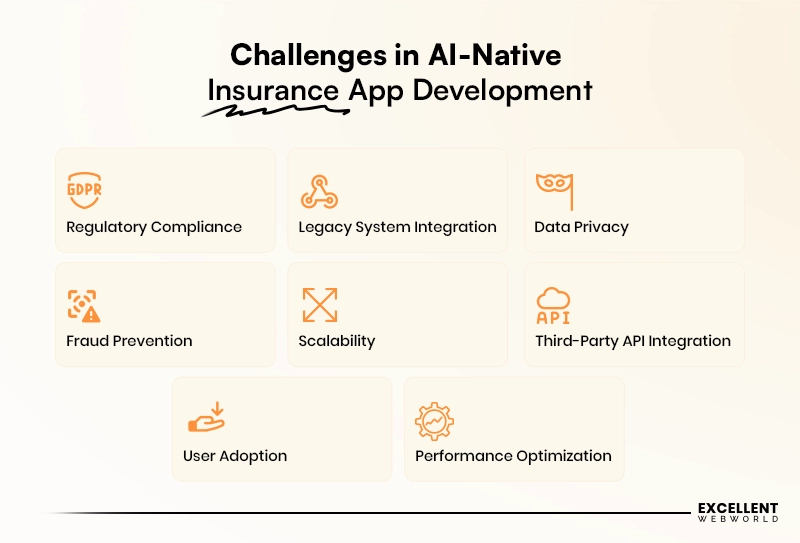
Most insurance organizations think about features and timelines, but don’t give that much importance to problems that can derail the projects midway through. Here are some of the most common AI-native insurance app development challenges that you should be aware of:
| Challenge | Description | Possible Solution |
|---|---|---|
| Regulatory Compliance | State insurance regulations, HIPAA, and new AI governance regulations vary from state to state. | Bring compliance experts from the planning phase and document AI decision logic from day one. |
| Legacy System Integration | Decades-old claims systems and policy admins weren’t built to connect with modern-day mobile apps or AI models. | Use middleware or API layers to bridge the gap between old and new systems. |
| Data Privacy | Once the systems are connected, data flowing between those systems can be a point of exposure, especially health and customer data that AI models process. | Encrypt data end-to-end and limit AI model access to what each task actually requires. |
| Fraud Prevention | Fraudsters are coming up with new tricks every day that static, rule-based systems can hardly catch. | Deploy AI models trained on evolving fraud patterns and retrain them at regular intervals. |
| Scalability | Fraud detection running well under normal load doesn’t guarantee that it will hold under pressure, and claim volume spikes during seasonal events can crash apps. | Build on cloud-native infrastructure that scales automatically. |
| Third-Party API Integration | Each API introduces their failure points and version changes, which are not in your control. | Create resilient API layers with fallback logic so an outage from one vendor doesn’t affect the entire ecosystem. |
| User Adoption | Even with utmost technical proficiency, the app can fail if users can’t trust the app. | Design onboarding flow around real customer behavior; prove reliability through visible wins like instant claims. |
| Performance Optimization | Trust erodes the moment the app feels slow, since laggy AI responses and long waiting times can frustrate users. | Optimize AI inference speed and app architecture together as a single workflow. |
Monetization Models for Insurance Apps
Building the app is only half the job done; knowing how it can actually generate revenue for your business is the most important thing.
Every solid insurance app business model blends a combination of multiple insurance app monetization models instead of relying on a single revenue stream.
| Model | How It Works | Best For | Revenue Potential |
|---|---|---|---|
| Commission-Based Revenue | Earn a fixed percentage on every policy sold through the app. | Brokers, MGAs, agencies | High volume, steady |
| Premium Subscription Plans | Charges users for advanced features like extra coverage tools or priority claims. | InsurTech startups | Recurring, predictable |
| Featured Listings | Insurers pay more to appear higher than competitors. | Multi-carrier platforms | Strong margin, scalable |
| Cross-Selling Financial Products | Bundle related products like loans or investments into the app. | Enterprise carriers | High |
| Referral Programs | Reward users or insurers for bringing new policyholders. | Growth-stage startups | Low cost, high ROI |
| Value-Added Services | Sells add-on services, roadside services or telehealth access. | All carrier types | Incremental, sticky |
Why Choose Excellent Webworld for AI-Native Insurance Mobile App Development?
Insurance apps in 2026 aren’t digital paperwork; they’re AI-native systems that verify documents, catch fraud & price coverage in real-time, and settle claims in a few minutes. Insurance companies that are treating this as core infrastructure are surging ahead of others.
However, this project requires expertise in compliance, security, and AI models. Therefore, you need a partner that has the knowledge and experience of developing such a solution for a high-stakes, regulated industry, where a single mistake has fatal financial consequences.
That’s where Excellent Webworld, a leading AI agent development company, comes into the picture. Here’s what you will get by partnering with us:
- 15+ Years of Experience building compliance-heavy insurance platforms.
- Custom Insurance Solutions built around your specific business requirements.
- Agile Development Process with clear, iterative milestones.
- UI/UX Expertise shaped by how policyholders and agents actually behave.
- AI Integration Capabilities, part of 300+ financial workflows we’ve automated.
- Secure & Scalable Architecture built on PCI DSS, SOC 2, and ISO 27001 from the start.
- Dedicated Development Team that has delivered 100+ platforms across 40+ countries.
- Post-Launch Support & Maintenance covering updates, monitoring, and AI model retraining over time.
- End-to-End Development Services, including 120+ payment and banking APIs integrated to date.
Maridady Motors, an automotive finance platform, is an amazing example of this expertise. We built a lending platform that automated credit checks and risk scoring, the same logic that an insurer applies for policy approval or claim processing. It helped the client reduce approval time by 50% and increase the approval rate by 38%, while keeping every decision auditable.
So, want to bring AI-native underwriting, claims, and fraud detection into your insurance app? Connect with our industry experts and get a roadmap of where AI can make the biggest impact for your business.
Frequently Asked Questions
A basic MVP takes around 3-4 months, while a mid-complexity app with AI features and integration takes around 5-7 months. On the other hand, a full enterprise-grade, AI-native platform takes around 9-12 months, depending on compliance scope, number of insurance types, and third-party integrations involved.
YES, insurance agencies do need a mobile application because a responsive website is good enough for basic browsing. Still, it can’t offer functionalities like push notifications, offline access, camera-based claims, and biometric login, which enhance the user experience.
Oh, YES, most insurers and startups opt for the outsourcing option. Partnering with an experienced fintech app development company provides you with access to compliance, AI, and mobile expertise without the cost of hiring a full internal team. But always look for a partner with proven experience in regulated industries, not generic app development.
You should track metrics beyond just downloads, i.e., app store rating trends, renewal rate through the app, customer support ticket volume, claim submission completion rate, and average claim resolution time. A drop in support tickets alongside faster claims usually signals that the application is solving customer problems with pinpoint accuracy.
Common reasons include missing terms for financial transactions, broken payment flows during review, insufficient explanation of AI-driven features like automated claim decisions, and unclear data privacy disclosures. So, review the financial app guidelines for both platforms before submission and test thoroughly to avoid launch delays.
It depends on your contract; therefore, you need to clarify it before signing. Any experienced development partner transfers full source code ownership and data rights to you after the project is completed or as the milestone payment is made. Always take this confirmation in writing, along with what happens to your data if you switch vendors later.

Article By


Paresh Sagar is the CEO of Excellent Webworld. He firmly believes in using technology to solve challenges. His dedication and attention to detail make him an expert in helping startups in different industries digitalize their businesses globally.