- Computer vision in logistics uses cameras and AI to identify, inspect, count, track, and verify physical operations.
- Key use cases of computer vision for logistics include inventory tracking, damage detection, shipment verification, safety monitoring, dimensioning, and automated inspection.
- Computer vision connects physical logistics operations with WMS, TMS, ERP, robotics, and IoT systems.
- Business benefits of implementing computer vision in logistics operations include higher accuracy, faster throughput, lower manual effort, improved safety, and earlier exception detection.
- Implementation steps for this solution typically involve use-case selection, KPI baselining, infrastructure assessment, model development, system integration, pilot deployment, and ROI validation.
- To scale computer vision capabilities across logistics sites, it requires standardized deployment, MLOps, monitoring, model versioning, and site-specific adaptation.
A massive explosion in global e-commerce volume, chronic labor shortages, and razor-thin margins have created serious pressure on logisticians to move more goods with greater accuracy, speed, visibility, and control. In such high-volume operations, even minor manual human error like miscounting inventory, mislabeling a package, loading the wrong shipment, or overlooking product damage can lead to significant financial losses.
Many industry leaders, like DHL, Amazon, FedEx, and UPS, and the other 70%, have invested in AI-powered logistics machine vision systems to deal with such challenges through automation.
Gartner predicts that by 2027, nearly 50% of global companies with warehouse operations will have AI-enabled vision systems in place.
Computer vision solutions address a specific gap in logistics operations by giving them a digital perception layer that connects what is physically happening on the warehouse floor, dock, yard, or delivery route with the enterprise systems responsible for acting on it.
But this isn’t convincing for enterprise logistics businesses to invest in computer vision. They want to know where computer vision in logistics operations delivers measurable ROI, how it fits into existing WMS, TMS, ERP, cameras, and robotics, what implementation will cost, and how to scale it across facilities.
This blog answers all those questions logisticians wanting to invest in computer vision want to know.
Why Are Logistics Companies Investing in Computer Vision?
The economics of logistics leave little room for mistakes. As order volumes grow, warehouses need to handle more inventory, orders, and shipments without adding warehouse space or slowing operations.
This is pushing logistics businesses to adopt technologies that reduce operational variability.
Below are the key reasons why logisticians are adopting computer vision:
- Rising throughput is exposing the limits of manual inspection.
- Inventory accuracy has become a critical warehouse KPI.
- Logistics operators need earlier exception detection.
- Labor shortages are increasing pressure to automate repetitive tasks.
- Existing surveillance infrastructure represents an underused source of operational data.
- Safety and compliance requirements increase the need for continuous operational visibility.
How Does Computer Vision Work in Logistics?
Computer vision in logistics works by following a technical sequence. For example, the camera detects a damaged carton; then the CV model classifies the damage type; then the system creates an exception, which is recorded by the warehouse management system (WMS); then the operator receives an alert; and finally, the image becomes evidence for the claim.
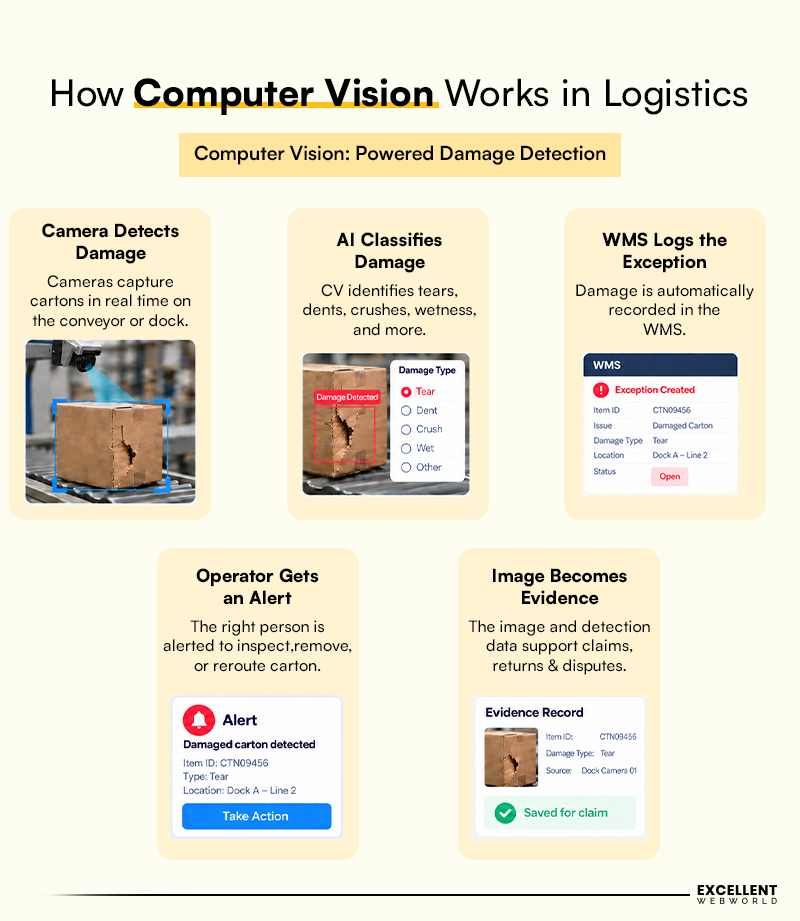
Let’s have a look at detailed workflow of machine vision in logistics operations:
Step 1: Capture
Cameras installed across warehouses, docks, yards, conveyors, and vehicles monitor and capture every activity within their field of view (FOV).
Step 2: Process
Then come the edge devices or cloud infrastructure connected to those surveillance cameras, which process the visual data they capture and prepare it for AI analysis.
Step 3: Analyze
All the prepared data are sent to computer vision models to detect, classify, count, track, inspect, or recognize objects and events.
Step 4: Interpret
After object recognition, business rules implemented with computer vision models flag those detections as meaningful events, for example, wrong pallets, damaged packages, or restricted-zone entry.
Step 5: Integrate
Then the resulting/flagged detections are sent to WMS, TMS, ERP, Warehouse Control System (WCS), robotics, or other enterprise systems through APIs or event streams.
Step 6: Act
Finally, the connected logistics solutions trigger the required action, whether to alert, hold, reroute, verify, record, or escalate.
In simple terms: Computer vision observes what is physically happening, AI interprets it, and enterprise systems turn that insight into an operational action.
Where Computer Vision in Logistics Operations Generates Value: Top Use Cases
In logistics operations, logisticians can utilize computer vision to continuously observe physical operations, verify high-volume transactions, detect exceptions, and in many other areas where conventional systems cannot see.
Below are the key computer vision use cases in logistics and the operational value they can deliver:
1. Automated Inventory Counting and Verification
Warehouse cameras powered by computer vision software can help count stock, verify storage locations, identify misplaced inventory, and reconcile physical inventory with WMS records.
Value this use case brings: Higher inventory accuracy, fewer manual cycle counts, and lower labor requirements.
2. Package and Parcel Damage Detection
Logistics machine vision systems can also detect crushed cartons, tears, punctures, leaks, and other visible damage during receiving, sorting, packing, or dispatching time.
Value this use case brings: Earlier intervention, fewer claims, and better quality control.
3. Barcode, Label, and Shipment Verification
Industrial machine vision cameras and AI-augmented CCTV networks with global shutter technology, liquid lenses & autofocus capabilities, and strobe & polarized lighting can make it possible to read and validate barcodes, shipping labels, SKU identifications, and package information against expected shipment data. These camera systems enable high-precision operations and ambient analytics.
Value this use case brings: Fewer mis-picks, misroutes, and shipping errors.
4. Pallet and Load Verification
Machine vision in logistics enables verification of pallet contents, pallet condition, load configuration, and validation of shipments in real time through strategically placed cameras, deep learning models, and optical character recognition (OCR). This system cross-checks visual references of physical cargo against digital logistics data.
Value this use case brings: Reduced loading errors, rework, delays, and disputes.
5. Automated Dimensioning and Volume Measurement
3D time-of-flight (ToF), structured light, 2D image processing, edge computing, AI algorithms, and dynamic (in-motion) sensing make machine vision in logistics operations measure package dimensions (exact length, width, height) and estimate the volume without manual measurement.
Value this use case brings: More accurate freight calculations, better space utilization, and reduced dimensional-weight discrepancies.
6. Warehouse Safety Monitoring
Computer vision automates warehouse safety by turning industrial CCTV camera feeds into a continuous safety monitoring system. It uses deep learning algorithms and live camera feeds to automatically analyze footage to track forklift telemetry, monitor pedestrian zones, and verify total PPE compliance in real time.
In extreme cases, the system also triggers localized floor alarms and alerts supervisors to take immediate corrective action.
Value this use case brings: Can help reduce safety incidents, improve PPE compliance, and provide earlier intervention when unsafe conditions are detected.
7. Dock, Yard, and Vehicle Monitoring
The active monitoring of docks, yards, and vehicles is one of the big logistics bottlenecks that computer vision optimizes through advanced object recognition and automatic number plate recognition (ANPR) capabilities. This way, it identifies arriving trailers, tracks vehicle transit across the yard, and logs precise dock occupancy timestamps.
Value this use case brings: Can reduce manual yard audits, improve dock utilization, reduce vehicle dwell time, and provide more accurate operational records.
8. Pick and Pack Verification
Manual verification can become difficult to scale when packing operations involve high order volumes and repetitive checks. Computer vision can provide an automated verification layer at packing stations.
As items pass under the camera, deep learning models used within the computer vision system automatically read product dimensions, match the outer packaging against master images, and cross-reference barcodes directly with the WMS. In case cameras detect workers grabbing an incorrect SKU, packing an extra item, or selecting the wrong box size, the system integrated with smart warehouse conveyors can flag the error or trigger a predefined workflow before the package is sealed.
Value this use case brings: Higher order accuracy, prevention of expensive re-shipment loops, and a cut down on customer returns.
9. Returns Inspection and Classification
Reverse logistics, meaning bringing returned items back to warehouse stock, often acts as an unpredictable bottleneck, where manual evaluation of returned goods drains labor and may sometimes lead to highly inconsistent grading.
The warehouse’s surveillance systems integrated with a computer vision system instantly analyze returns the moment a box is opened. With the use of deep learning models, the system instantly cross-references items against their original SKU profiles to inspect for missing components, assess the structural integrity of the retail packaging, and classify visible cosmetic or structural damage according to predefined grading criteria.
This way, computer vision in warehouse operations can support disposition decisions, such as restocking, refurbishment, liquidation, or further inspection.
Value this use case brings: Can reduce inspection backlogs, compress the return-to-shelf window by days, and unlock immediate cash recovery from idle inventory.
10. Conveyor and Sortation Monitoring
Automated sortation systems are proof that you are running a modern fulfillment hub. However, if you send a single crumpled label or misaligned box to the conveyor, it can trigger a cascading conveyor jam that puts the entire warehouse operations facility on pause.
Computer vision logistics systems with modern material-handling networks can reduce that by wrapping critical conveyor nodes and sortation lines in a continuous automated vision layer. Deep learning models used in the system actively track the parcel flow and identify package accumulation, torn barcodes, or cross-belt drifting before they happen. In the case of erratic package movement or a high-density bottleneck forming, it automatically flags the exact location for the maintenance teams or dynamic adjustment to conveyor speed.
Value this use case brings: Earlier detection of flow disruptions, reduced manual monitoring, and improved conveyor utilization.
11. Proof of Delivery and Delivery Verification
In the domain of last-mile delivery, missing tracking data and vague driver confirmation on goods delivered can leave brands exposed to expensive “lost package” claims and customer friction. Such logistics and supply chain bottlenecks or challenges can be dealt with by implementing intelligent, automated analysis of photos and videos captured at the doorstep.
This functionality can be implemented within the last-mile delivery app, where deep learning algorithms parse the drop-off imagery to confirm accurate package placement, verify the structural integrity of the box, and detect risks like exposure to rain or high-theft pathways.
Value this use case brings: Stronger delivery evidence, fewer disputes, and better last-mile visibility.
| Use case | Operational KPI | Potential business impact |
|---|---|---|
| Inventory counting | Inventory accuracy, cycle-count hours | Lower labor effort, fewer discrepancies |
| Damage detection | Damage rate, claims | Lower claims and rework |
| Shipment verification | Misshipment rate | Fewer returns and reshipments |
| Dimensioning | Measurement accuracy | Better freight billing |
| Dock monitoring | Dock dwell time | Higher dock utilization |
| Safety monitoring | Near misses, PPE compliance | Lower safety risk |
| Pick/pack verification | Order accuracy | Lower return/reshipment costs |
| Conveyor monitoring | Downtime, throughput | Higher equipment utilization |
| Returns inspection | Inspection time, return-to-stock time | Faster disposition and inventory recovery |
| Yard monitoring | Vehicle dwell time, dock utilization | Better asset utilization and lower detention exposure |
Business Benefits of Computer Vision in Logistics
The value of computer vision in logistics is not only limited to automating surveillance-related operations but also to integrating intelligence across warehouse, transportation, and enterprise logistics systems.
As a result, it can reduce process variability, improve operational accuracy, detect exceptions, and deliver measurable data around physical activities. Eventually, logisticians start to notice reduced operating costs, higher throughput, better service levels, and more informed decision-making.
Let’s check the considerable benefits logistics businesses notice after implementing computer vision for their operations:
- Reduced manual inspection and labor costs
- Improved inventory and order accuracy
- Early detection of exceptions
- Increased warehouse throughput
- Reduced damage, claims, and operational losses
- Improved safety visibility
- Data-driven operations
- Capability to scale operational standards across facilities
How to Implement Computer Vision in a Logistics Operation
A successful logistics computer vision implementation should start with an operational problem, not the technology itself. Identify the business case, establish baseline KPIs, assess the infrastructure, integrate vision outputs with existing systems, validate ROI, and then scale.
Let’s have a detailed look at the steps to implement computer vision in logistics operations:
Step 1: Identify High-Value Use Case
Start your business analysis by focusing on processes that are repetitive, have high volume, can be verified visually, or are tied to a measurable business challenge. Specific to your logistics business, you can prioritize use cases with clear operational baselines and measurable financial impact, such as damage detection, shipment verification, warehouse safety monitoring, or inventory counting.
Step 2: Establish Baseline KPIs
Before you start implementing AI for logistics operations, first define how you want to measure its impact by mentioning KPIs such as inspection time, inventory accuracy, labor hours, error rate, throughput, claims, or cost per shipment.
Step 3: Assess Camera and IT Infrastructure
Your facility may already have cameras, but existing surveillance infrastructure is not automatically suitable for every computer vision use case. Evaluate camera position, resolution, lighting, field of view, frame rate, connectivity, edge compute, and storage requirements before deciding whether additional hardware is needed.
Step 4: Collect and Prepare Data
To train the computer vision model to identify scenarios, you need to capture representative images and videos from real operating conditions. Once the capture phase is done, prepare the data by labeling relevant objects, events, and exceptions that the system can account for under conditions such as lighting, packaging, camera angles, SKUs, and operating environments.
Step 5: Develop and Validate the Vision Model
Engineer a custom or select an optimal computer vision architecture and execute training pipelines on domain-specific datasets while adjusting hyperparameters for accurate and reliable outputs. Then validate the model using real operational data and metrics such as precision, recall, F1-score, false-positive rate, false-negative rate, latency, and inference performance.
Step 6: Integrate with WMS/TMS
Integrate the computer vision system with the existing logistics systems like WMS, TMS, ERP, WCS, robotics, or other platforms through APIs, middleware, or event streams. Then the computer vision layer should convert visual detections into structured events, such as “damaged package,” “wrong SKU,” or “vehicle arrived,” and send those events to the connected platforms. While integrating, do ensure you define what action each detected event should trigger.
Step 7: Run a Controlled Pilot
Once the development work is done, deploy the computer vision-powered logistics solution in a controlled environment to test its functionality and reliability under actual operating conditions. For this, you can deploy it to work specifically for one warehouse zone, dock, conveyor, or specific workflow. If you come across the result that it works fine for that area, then you can think about scaling its scope.
Step 8: Measure ROI
Based on the model’s performance in a limited zone, you can compare its results with baseline KPIs. To evaluate it better, define how much labor savings, error reduction, throughput gains, claims avoidance, and other financial benefits it has offered in comparison to the investment you have made.
Step 9: Deploy Model to Production
After validating the performance of logistics machine vision and ROI, you can finally move the solution into production by enforcing appropriate monitoring, security, access controls, model versioning, alerting, and operational support.
Step 10: Scale Across Facilities
After the success of a computer vision model in an existing logistics setup, you can scale it across sites. For that, you have to standardize the validated computer vision architecture and deployment process for where you want to implement it next while making the model adapt to new layouts, lighting, camera configurations, workflows, and operating conditions. Once scaled, you can continuously monitor the model’s performance and retrain when conditions change.
Real-World Examples of Computer Vision in Logistics
Several major logistics, retail, and technology companies like DHL, Amazon, Walmart, and many others have implemented computer vision to automate warehouse and supply chain operations to deal with labor shortages, the need for faster shipments, etc.
Let’s have a look at real-world case studies of top companies that have implemented computer vision for logistics and supply chain operations:
1. DHL
DHL is the world’s leading logistics company headquartered in Bonn, Germany, known for its courier, package delivery, and express mail services. To deal with massive shipment requests from across the globe, it integrated computer vision across its logistics network to streamline warehouses and clear workflows.
Key areas where it is reaping the benefits of computer vision capabilities include:
- Navigating warehouse aisles hands-free to reduce pick times with Locus AMRs
- Automated parcel dimensioning for high-speed conveyor systems
- AI item identification for customs via image recognition and OCR to reduce border delays while meeting customs compliance.
2. Amazon
Amazon Shopping, an e-commerce pioneer, relies heavily on computer vision models to power its automated fulfillment centers at hyperscale.
Its top applications of computer vision for logistics include:
- Robotic pick-and-pack systems (Sparrow and Cardinal) that leverage multi-camera computer vision and deep learning backbones for inventory management and product safety.
- Amazon’s Project P.I. offers automated quality assurance for goods in terms of damage or mislabeling before they reach packaging.
- Proteus – Amazon’s vision-guided autonomous mobile robots navigate dense warehouse floors to transport inventory safely around human associates.
3. Walmart
Walmart is an American multinational retail corporation, known for operating a massive chain of hypermarkets, discount department stores, and grocery stores. To cope with the retail chains running at a faster pace and optimize modern distribution centers, Walmart implemented computer vision and machine learning solutions across its massive supply chain footprint.
Some of the key use cases of machine vision in logistics operations that Walmart utilizes are:
- Next-generation automated distribution powered by optical recognition technology to route goods on the conveyor belts through the high-speed sorting pathways.
- Intelligent warehouse orchestration, preventing warehouse operations’ bottlenecks and line stoppages.
- Self-healing inventory synchronization powered by vision-driven data pipelines and agentic AI development services to automate stock balancing between regional fulfillment centers and local store delivery hubs.
What Will Be The Future of Computer Vision in the Logistics Industry
The next era of machine vision in logistics will be more focused on fully autonomous, spatially aware operations. Its applications will be powered by 3D reconstruction, depth perception, and real-world cognitive sight to manage entire supply chains dynamically.
Some of the future trends of computer vision for logistics operations include:
- Advanced depth perception & 3D reconstruction handle even complex unstructured environments without human help.
- Autonomous warehouses & robotics performing high-speed inventory audits and reacting instantly to shifting physical layouts.
- Digital twin-enabled logistics machine vision systems, enabling logisticians to simulate scenarios and test strategies to optimize logistics operations without physical investments. It’s like see it before it happens.
- Edge-computed vision continuously detects and flags anomalies that can become a bottleneck to logistics operations.
- Vision-language-action models could enable more capable autonomous picking, packing, mobile manipulation, and real-time error recovery.
Also check out: Top AI Agents use cases for Logistics
Implement Computer Vision for Logistics With Excellent WebWorld
So far, you have understood that, if implemented strategically, computer vision for logistics operations can deliver considerable benefits. But for that, you need to hire AI developers, computer vision experts, and ML and deep learning experts who can translate technology into a solution, solving your business challenges. Excellent WebWorld, as a logistics software development company, is a reliable partner trusted by brands like HJM from the Netherlands, Camtrack from the UK, ConnectKargo from Angola, and many others.
Top reasons why logistics enterprises trust Excellent WebWorld for AI-powered software development services:
- 15+ years of experience serving this industry with on-demand solutions and custom AI-powered software solutions.
- 100+ logistics solutions delivered so far to 80+ enterprise clients
- #1 Clutch global ranking for telematics solutions.
- Awarded titles like top Clutch computer vision company Dubai 2026, top Clutch IT services company supply chain and logistics and transport in Dubai, top AI development company (United States 2024) by GoodFirms, and many others.
- Strong adherence to industry and regional regulatory standards like GDPORM, IATAM, TMSA, SOC 2 Type II, and more.
- ISO 27001-certified logistics software development company.
Apart from that, Excellent WebWorld has every capability needed to help logistics and supply chain enterprises turn high-value computer vision use cases – be it powered by AI, computer vision, or IoT – into value-driven investments.
FAQs About Computer Vision in Logistics
Computer vision in logistics is the use of cameras, sensors, and AI models to identify, inspect, count, track, and verify physical objects and activities across warehouses, distribution centers, yards, docks, and transportation operations.
Yes. Computer vision can be scaled across multiple warehouses by standardizing the model, deployment architecture, monitoring, and integration layer while adapting each site to its camera configuration, lighting, layout, and operational conditions.
There is no fixed cost for a logistics computer vision system. A small proof of concept may start around $10,000-$35,000, while production-grade solutions can range from $35,000 to $500,000 or more, depending on camera infrastructure, model complexity, integrations, edge hardware, data requirements, and deployment scale.
Some of the key applications of computer vision for logistics businesses include automated package sorting and scanning, inventory and dimension management, quality control & damage detection, loading automation, and warehouse safety management.
During the implementation of computer vision logistics operations, you can expect to face challenges like inconsistent lighting, camera positioning, object occlusion, changing packaging and SKUs, model drift, integration with legacy logistics systems, and scaling across different facilities.
You can integrate computer vision with an enterprise logistics stack by following two integration approaches: one is using API & webhooks, and the second is PLC handshakes via OPC UA or Modbus. Simply put, you can do this integration by converting visual detection into structured events and connecting them to existing logistics systems through APIs, webhooks, event streaming, or integration middleware.
Computer vision tracks inventory by using cameras and AI models. The process works as follows: Cameras capture inventory and send it to the AI model to identify and count it using object detection, classification, tracking, barcode recognition, OCR, or other vision techniques depending on the inventory type and identification requirements; then detected inventory events are sent to the WMS or inventory management system for database synchronization.
To detect damaged packages, AI uses camera images and video with computer vision models trained to recognize defects such as tears, dents, crushed corners, punctures, and deformation. It first detects the defect and assigns a confidence score. If the result exceeds a predefined threshold, the system flags the package and can trigger an alert, diversion, inspection, or repackaging workflow.
Yes, existing CCTV cameras may be usable if they provide sufficient resolution, frame rate, field of view, image quality, and network or digitized video access for the target use case. Analog cameras may require encoders or other video interfaces.
Well, it depends on the computer vision use case for logistics operations you are planning to implement. For inventory management, RGB/IP cameras work best; for barcode inspection use high-resolution industrial/global-shutter cameras; for dimensioning use 3D/depth cameras; for conveyor inspection use high-FPS industrial cameras; for warehouse safety monitoring use wide-angle RGB/IP cameras; and for yard monitoring use PTZ/IP cameras + ANPR.
Computer vision in logistics can fail due to environmental variability, occlusion, changing SKUs/packaging, camera limitations, insufficient training data, model drift, false positives/negatives, integration/latency, and inability to meet ongoing monitoring requirements.
The ROI of computer vision in logistics depends on the use case and baseline operational costs. Businesses can measure ROI through metrics such as labor hours saved, inventory accuracy, error reduction, throughput, claims avoided, downtime reduction, inspection time, and cost per shipment. A controlled pilot can establish these improvements before wider deployment.

Article By


Paresh Sagar is the CEO of Excellent Webworld. He firmly believes in using technology to solve challenges. His dedication and attention to detail make him an expert in helping startups in different industries digitalize their businesses globally.