Hiring at scale can create problems that conventional recruiting systems were never designed to solve; the volume of recruiting decisions grows at exponential rates, beyond the team’s capacity to process them.
Recruiters may have an ATS, sourcing platforms, automation tools, & communications systems, yet sometimes significant time is spent on resume reviews, screening qualified candidates, sending follow-ups, updating records, or even informing hiring managers. With 92% of companies planning to increase their AI investments, only 1% consider themselves AI mature; a McKinsey report highlights the gap between AI adoption & real workflow transformation.
This is where AI recruiting agents change the model.
Unlike basic rule-based automation, an AI recruiting agent can actually interpret a recruiting objective, work across connected business systems, determine the next permitted action outputs & execute workflow within defined boundaries. With AI recruiting agents' development, businesses can connect sourcing, screening, communication, scheduling, and follow-up into one streamlined workflow.
The goal is not simply to replace recruiters with AI, but to give them an intelligent execution layer that is able to manage repetitive operational work while keeping the human judgment on point when it matters most. For the organization exploring AI development services, the strategic question is how much of the recruiting workflow can be safely automated & translates into measurable hiring outcomes.
Where Recruiting Operations Start to Break
Hiring rarely breaks down because recruiters cannot find the candidates. It simply breaks as the volume of decisions & administrative work grows much faster than the recruiting team’s capability.
One open position can attract hundreds of applications. And when this volume is multiplied across dozens or hundreds of active roles, recruiters spend an increasing amount of time on repetitive operational work, which generally takes away from high-value recruiting decisions like;
- Reviewing resumes
- Searching candidate databases
- Sending initial outreach
- Answering repetitive candidate questions
- Coordinating interviews
- Following up with hiring managers
- Updating the ATS
- Moving candidates between stages
- Preparing interview information
- Generating recruiting reports
The results seem to be an expensive operational bottleneck, where recruiters spend less time on evaluation but more time on keeping the process moving. This is where Agentic AI development becomes relevant, not as another layer of automation, but as a way to coordinate repetitive tasks, workflow decisions, system actions, and human escalation across the recruiting lifecycle.
Where Recruiting Costs Leak
The recruiting costs often get accumulated across disconnected & repetitive workflows rather than any single recruiting task. Starting from candidate sourcing & screening to communication, scheduling, & ATS administration, each manual handoff adds time & operational overhead.
| Cost leak | Common cause | Business impact |
|---|---|---|
| Resume screening | Manual review of large candidate pools | Higher recruiter workload |
| Candidate sourcing | Searching across multiple talent channels | Slower pipeline creation |
| Candidate communication | Repetitive emails, messages, and follow-ups | Less time for high-value work |
| Interview scheduling | Back-and-forth coordination | Longer hiring cycles |
| ATS administration | Manual candidate status updates | Delayed or incomplete data |
| Candidate follow-up | Inconsistent reminders and outreach | Higher candidate drop-off |
| Hiring-manager coordination | Manual requests, updates, and handoffs | Slower hiring decisions |
| Recruiting analytics | Data spread across disconnected systems | Limited workflow visibility |
So, the business problem is therefore much bigger than we simply say as “we need an AI resume screener”. I think the real opportunity is to utilize AI recruiting agents to automate & coordinate the recruiting workflow around the sourcing process, screening, communication, scheduling, follow-up & reporting.
But coordinating these workflows requires more than an AI agent operating in isolation. ATS, HRIS, CRM, email, calendar, assessment, and communication platforms need to exchange data reliably, which makes AI integration services an important part of the underlying architecture.
Expert Takeaway: The highest-value recruiting automation doesn’t simply automate one single task. It helps connect multiple recruiting workflows & have AI agents execute repetitive actions with autonomy, keeping recruiters in control of critical decisions.
What AI Recruiting Agents Change: ATS vs. Automation Tools vs. Agents
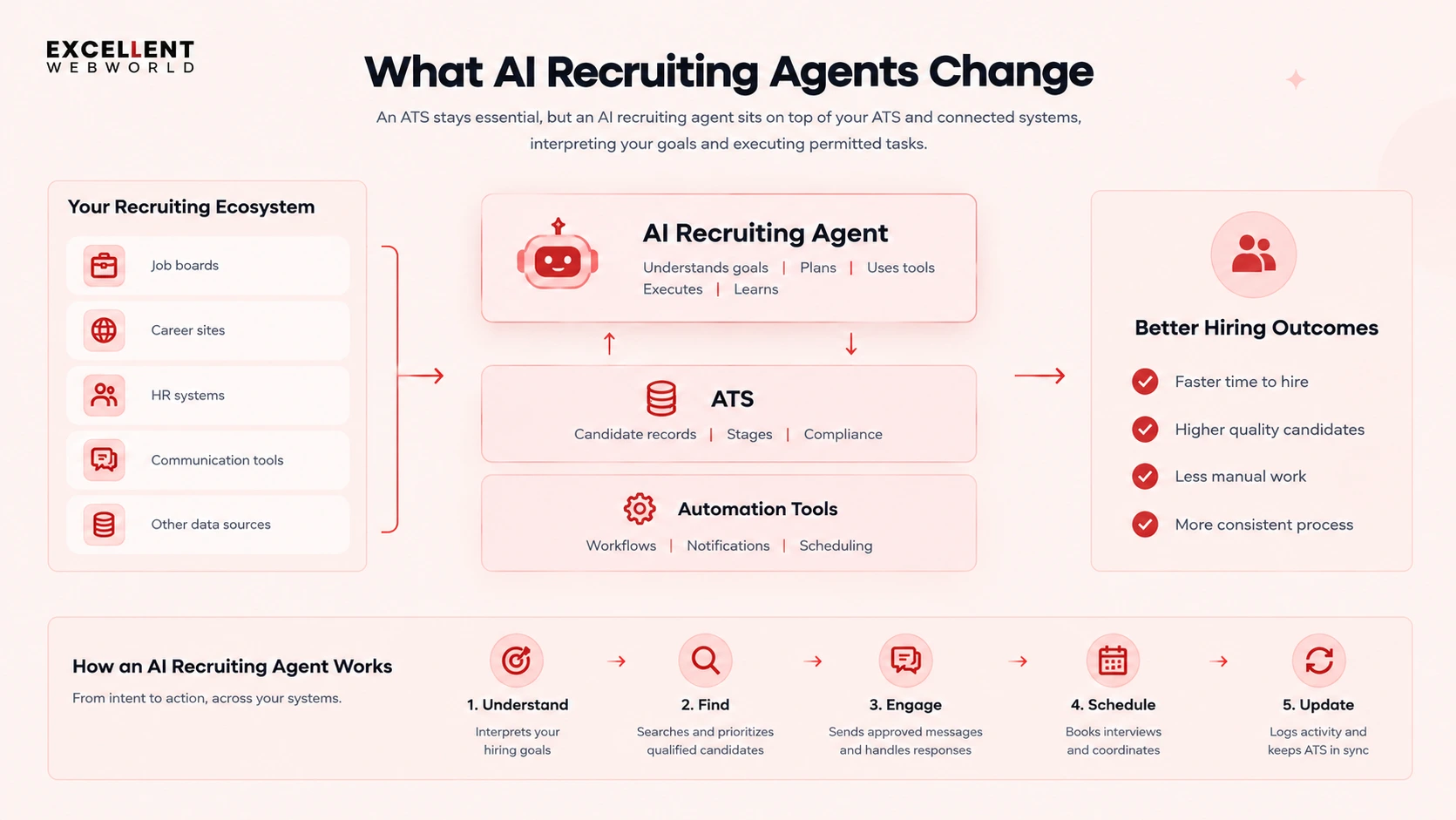
An ATS remains essential, but an AI recruiting agent doesn’t replace it at all. Instead, I would say that it can sit on top of the ATS & connected recruiting systems, thus interpreting recruiting objectives & executing permitted tasks.
| Capability | ATS | Automation Tools | AI Recruiting Agents |
|---|---|---|---|
| Store candidate records | ✓ | Usually No | ✓ |
| Track recruiting stages | ✓ | Limited | ✓ |
| Execute fixed workflows | Limited | ✓ | ✓ |
| Understand natural-language instructions | Limited | Limited | ✓ |
| Handle variable situations | Limited | Low | ✓ |
| Reason across multiple data sources | Limited | Limited | ✓ |
| Decide the next permitted action | Usually No | Rule-Based | ✓ |
| Communicate with candidates | Limited | ✓ | ✓ |
| Work across business systems | Through integrations | ✓ | ✓ |
| Operate with defined autonomy | Low | Medium | High |
| Maintain human approval points | ✓ | ✓ | ✓ |
So, the distinction actually matters.
A traditional automation rule might say:
“If candidate status = interview, send email A.”
But an AI recruiting agent can operate at a much higher level, like;
“Find the qualified candidates for this role, prioritize those meeting standard criteria, send the approved message, identify the available time slots, schedule candidates who actually respond positively, & also update the ATS system.”
Here, the second workflow can be said to involve interpretation, proper planning, tool usage, & execution. AI chatbot development can support candidate conversations, while AI recruiting agents can take those interactions further by executing the required workflows.
Pro Tip: You must keep the ATS as the system of record & utilize an AI recruiting agent as an intelligence & execution layer around it, rather than creating another disconnected candidate database.
What Are the Business Benefits of AI Recruiting Agents?
I would tell you that the business case for AI recruiting agents should be evaluated by financial & operational outcomes, not by any number of AI features. AI consulting services can help organizations identify the right use cases, prioritize high-value workflows, and define measurable outcomes before investing in an agent-led recruiting system.
The key metrics include;
- Time-to-screen, shortlist, interview, and hire
- Recruiter hours per requisition
- Cost per hire
- Candidate response rate
- Interview scheduling time
- Recruiter workload per open position
- Hiring-manager turnaround time
Manual Recruiting vs. Agent-Led Recruiting
| Metric | Manual-heavy process | Agent-led process |
|---|---|---|
| Candidate sourcing | Recruiter-driven | Agent-assisted or automated |
| Initial screening | Manual review | AI-assisted screening |
| Candidate communication | Individual outreach | Approved agent communication |
| Scheduling | Back-and-forth coordination | Calendar-aware scheduling |
| ATS updates | Manual | Automated |
| Follow-ups | Recruiter-dependent | Workflow-driven |
| Reporting | Periodic/manual | Continuous |
| Recruiter focus | Administration + recruiting | Judgment, relationships, and hiring strategy |
A Simple Capacity Equation
“Recruiter Capacity Recovered = Repetitive Recruiting Hours Automated x Hiring Volume”
“Recruiting automation ROI = (Annual Labor Capacity Value + Avoided Hiring/Process Costs − Annual AI Operating Cost) ÷ Total AI Investment”
These calculations are more meaningful than claiming AI will just automatically “cut hiring costs by X%”.
Expert Takeaway: You should start with measurable recruiting hours, workflow delays, & also process costs. Then, you must determine what an AI recruiting agent must automate to create a measurable, positive business case.
Where to Deploy AI Recruiting Agents First: Use Cases by Hiring Type
Not every recruiting workflow requires the same level of AI autonomy. High-volume hiring can support greater automation for sourcing, candidate communication & scheduling, while the executive hiring process typically needs stronger human oversight.
AI Recruiting Agent Use Cases
| Hiring Environment | Agent Role | Autonomy | Potential Outcome |
|---|---|---|---|
| High-volume hiring | Sourcing, pre-screening, communication | High | Higher recruiting throughput |
| Technical hiring | Match candidate evidence to requirements | Medium | Faster shortlisting |
| Campus recruitment | Qualification and scheduling | High | Lower administrative workload |
| Sales hiring | Sourcing, outreach, follow-up | Medium–High | Larger active pipeline |
| Healthcare hiring | Qualification, document collection, scheduling | Medium | Faster workflow execution |
| Executive hiring | Research and candidate intelligence | Low–Medium | Human-led decision-making |
| Internal mobility | Match employees to open roles | Medium | Faster internal candidate discovery |
| Contingent workforce | Candidate matching and coordination | High | Faster fulfillment |
So, the best starting point is rarely the one that has the most complex workflow. You should prioritize processes where;
- Hiring volume is high.
- Tasks are repetitive & rules are clear.
- Required data is already available.
- Process Delays have measurable costs.
- Human review can remain in the loop.
Recommendation: You should start with candidate sourcing, initial qualification, communication, & scheduling. These AI recruiting agent use cases typically provide clear automation opportunities without removing human oversight in terms of critical hiring decisions.
What Is an Enterprise AI Recruiting Agent Architecture?
I would say that an enterprise AI recruiting agent is more than just an LLM model connected to an ATS system. It can be said that a production-ready AI recruiting agent architecture actually combines orchestration, knowledge/RAG, integrations, intelligence, AI governance & analytics to execute recruiting work processes much safer & easier.
AI Recruiting Agent Architecture
| Layer | Function | Key Consideration |
|---|---|---|
| Experience | Recruiter, candidate, and hiring-manager interfaces | Usability |
| Orchestration | Plans tasks and workflow sequences | Agent reliability |
| Knowledge / RAG | Retrieves job descriptions, policies, playbooks, and approved information | Accuracy and context |
| Integration | Connects ATS, CRM, HRIS, calendar, email, and communication systems | Time-to-value |
| Intelligence | LLMs, classifiers, ranking, and matching models | Cost and accuracy |
| Governance | Permissions, approvals, policies, logging, and controls | Compliance and risk |
| Analytics | Tracks outcomes, errors, workload, and ROI | Business measurement |
The Knowledge/RAG layer helps agents retrieve relevant recruiting context, while Agentic RAG use cases extend retrieval into reasoning and action. These capabilities can be complemented by generative AI development for adaptive candidate communication and content generation.
Why Integrations Matter
The ATS integration & connected systems are the core to AI recruiting agents' development. And the agent should work across;
- ATS and HRIS
- Recruiting CRM
- Email and calendar
- Job boards
- Assessment platforms
- Identity systems
- Communication platforms
Without reliable system accessibility, an agent can create another workflow that seems to overlap or create errors, instead of removing one.
Governance Controls Agentic Recruiting
The enterprise agents need explicit permission for what they can do. AI governance for enterprise AI helps define these controls across the agent lifecycle:
- Read
- Recommend
- Write
- Send
- Approve
- Decide
The permissions should vary by workflow. For example, a scheduling agent can access candidate availability & calendars, create interview events, & send approved messages, but should not access compensation data or modify screening ones.
This applies the least privilege principle to agentic recruiting, giving each agent only the access required for its assigned workflow.
Expert Takeaway: In AI recruiting agents development, integrations drive time to value, while governance tends to enable safe, scalable recruiting automation.
AI Recruiting Agents Development: Build vs. Buy vs.Custom
There is no single right approach to AI recruiting agents development. The choice actually depends upon workflow complexity, integration requirements, compliance needs, cost, and the level of control needed.
Build vs Buy vs Configure
| Approach | Cost | Time-to-value | Control | Compliance fit |
|---|---|---|---|---|
| Off-the-shelf | Lower initial investment | Fast | Low | Vendor-dependent |
| Configured platform | Moderate | Fast–Medium | Medium | Architecture-dependent |
| Custom-built agent | Higher initial investment | Medium–Long | High | Highest ability to tailor controls |
- Off-the-shelf: This is best for standardized recruiting work processes and faster deployment, but the organization may need to adapt its processes to the software.
- Configured platform: This helps in providing an existing agent framework with set-up configurable workflows, integrations, knowledge sources, & permissions.
- Custom built: Said to be best when the organization requires proprietary workflows, complete ATS/HRIS integrations, multiple AI agents, custom candidate matching logic, enterprise identity, access controls, specialized compliance requirements, internal data integration, custom analytics, or fine-grained autonomy through custom software development.
Our Maridady Motors case study is one example of how a custom operational platform can connect business processes, workflows, and system integrations.
Automotive Financing & Credit Intelligence Platform
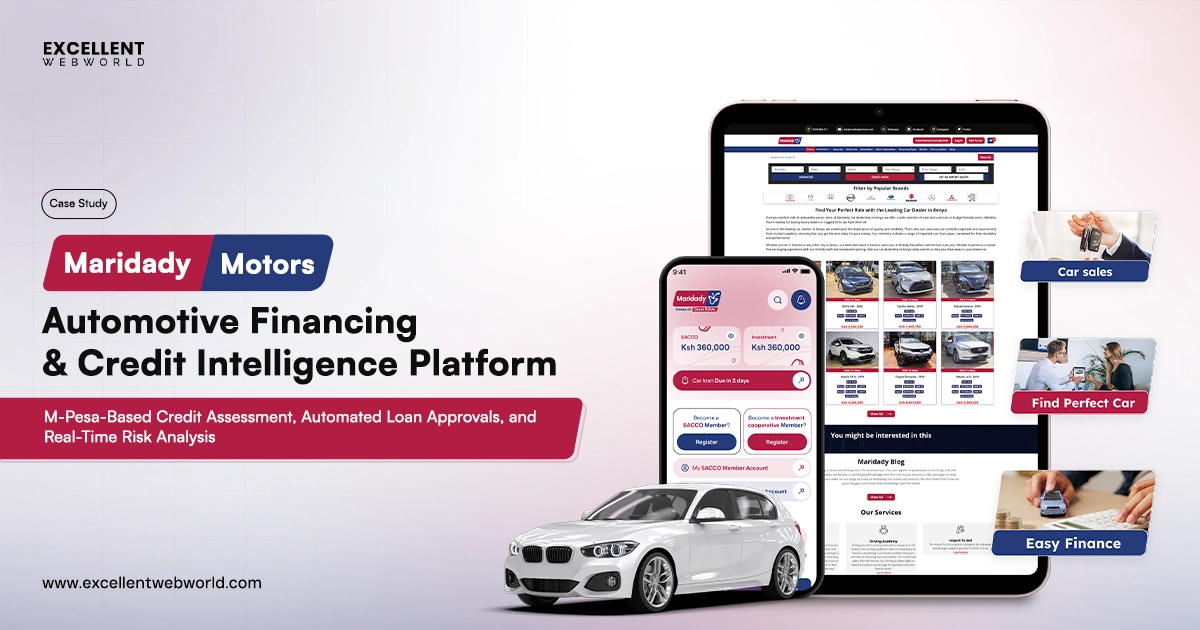
A digital automotive finance platform connecting borrowers and investors. Streamlines lending, KYC, and portfolio management to scale approvals.
Recommendation: Buy commodity capabilities, configure standardized workflows & custom build the orchestration, integrations, & intelligence where they create measurable business differentiation.
Governance: Protecting the Investment
Because AI recruiting agents can influence employment decisions, AI governance solutions must be built into the architecture from the start.
In the US, EEOC guidance tends to confirm that Title VII applies when automated systems influence the employment decision-making process, including potential disparate impact. The DOJ & EEOC have also highlighted disability-discrimination risks in AI hiring technologies.
New York City Local Law 144 requires certain automated employment decision tools that help in undergoing bias audits, offer audit information publicly, & issue specific notices. These requirements translate into engineering controls, human oversight, monitoring & auditability.
AI Recruiting Agent Autonomy Tiers
| Autonomy | Agent can | Required control |
|---|---|---|
| Autonomous | Source, send approved messages, schedule interviews | Permissions + monitoring |
| Approval-required | Recommend shortlists, draft outreach, suggest actions | Human approval |
| Human-only | Make hiring, compensation, or sensitive employment decisions | Mandatory human decision |
The autonomy boundaries should be aligned with the organization’s legal, HR, compliance & risk requirements.
Expert Takeaway: Effective AI recruiting agent development means controlled autonomy, i.e., automating the workflow while preserving human oversight, governance, and auditabiliy, which is needed for responsible hiring.
Five Controls Every Enterprise Deployment Should Consider
1. Access Limits
You should apply least privilege, so that each AI recruiting agent only accesses the datasets, tools, and systems that are needed for its workflow.
2. Explainable Outputs
Make recommendations & candidate screening outcomes traceable to the data & criteria utilized.
3. Bias & Accuracy Testing
You need to test ranking, screening, & matching prior to production & monitor them continuously. Understanding AI implementation challenges is also important because the EEOC notes that meeting the four-fifths rule alone does not guarantee that a selection process is actually free from unlawful disparate impact.
4. Candidate Consent & Human Review
This helps to provide required notices, accessibility, accommodation mechanisms, & clear human review paths where applicable.
5. Audit Logs
This records data accessed by the agents, outputs generated, actions taken, governing policies, & human approvals.
Pre-Launch Checklist
So, before deploying AI recruiting agents, verify;
- Defined business purpose and tool permissions
- Restricted candidate-data access
- Tested screening and ranking logic
- Documented human approval points
- Reviewable candidate communications
- Accessibility and accommodation paths
- Retained audit logs
- Failure and escalation paths
- Applicable jurisdiction-specific requirements
Expert Takeaway: Effective AI recruiting agent development establishes governance into the architecture from day one, enabling controlled recruiting automation with access controls, testing, human oversight & auditability.
Implementation in 6 Steps: From Pilot to Scale
You should start AI recruiting agents with one measurable workflow, then scale based on proven results.
| Steps (1-6) | What to Do | What to Establish |
|---|---|---|
| Pick a Workflow | Select one recruiting workflow to automate. | Clear workflow scope |
| Baseline Metrics | Measure current time, effort, speed, and cost. | Performance benchmark |
| Set Autonomy | Define what the agent can recommend, execute, or escalate. | Autonomy and human oversight |
| Integrate ATS | Integrate with ATS, communication, calendar, and data systems. | Seamless workflow integration |
| Pilot | Test agent actions with recruiter oversight. | Accuracy, efficiency, and escalation data |
| Scale | Extend proven workflows gradually. | Scalable agent ecosystem |
Moving from a successful pilot to production requires engineering that understands the realities of recruiting workflows. Forward Deployed Engineering helps turn that alignment into production-ready execution.
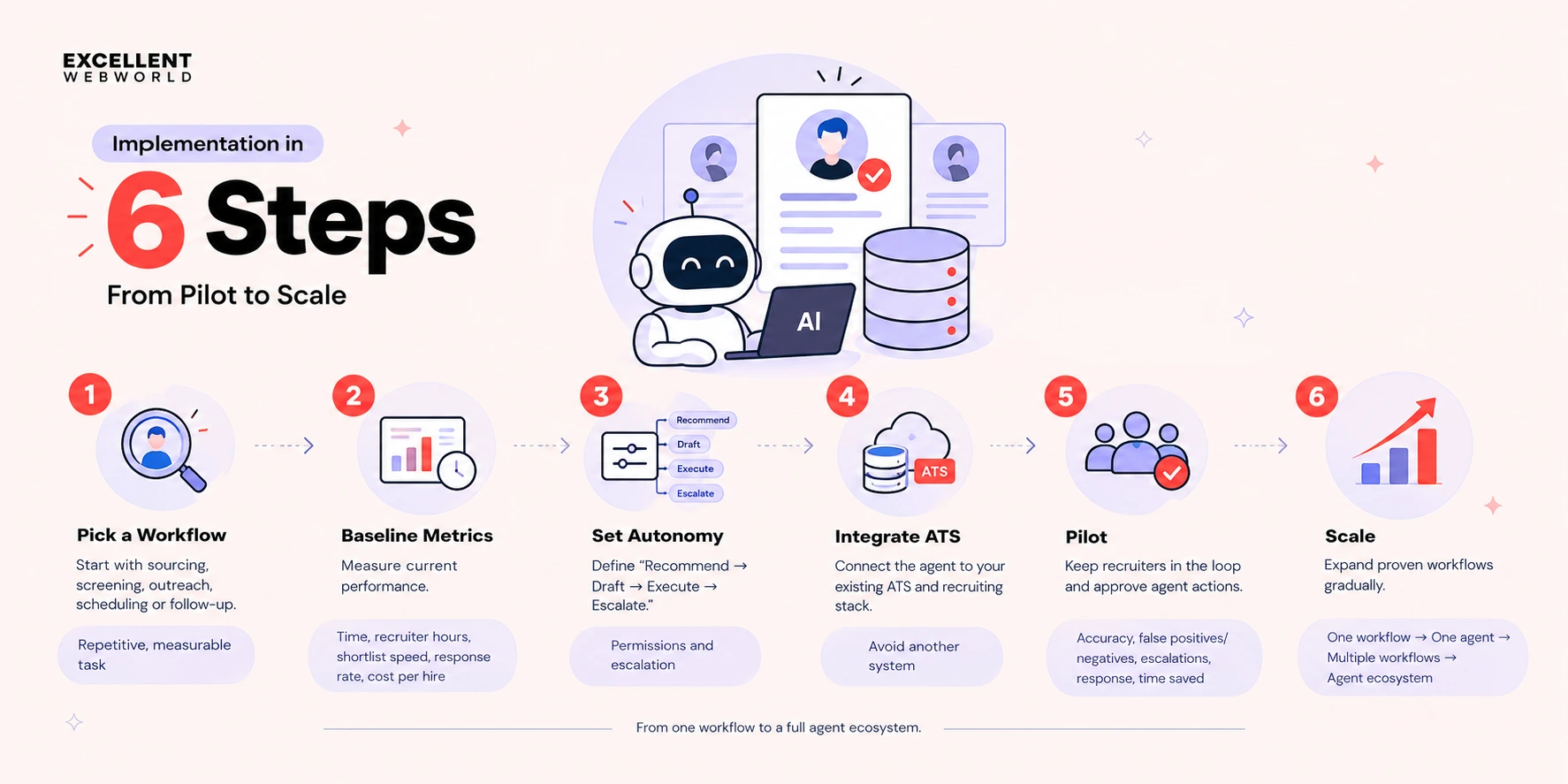
Pro Tip: Scale AI recruiting agent development that is based on measured performance & business value, not any AI capability count.
Cost and ROI: What to Budget and Expect
The cost of AI recruiting agents development actually depends on whether you configure an existing workflow or build a custom multi-agent workflow. AI consulting services can help determine the right approach by assessing the workflows, technical requirements, expected ROI, and implementation complexity before development begins.
AI Recruiting Agents Development Cost Components
| Cost Components | What It Includes |
|---|---|
| Discovery | Workflow mapping, requirements, ROI baseline |
| AI Engineering | Agent logic, prompts, models, evaluation |
| Integration | ATS, HRIS, CRM, email, calendar, APIs |
| Knowledge Layer | RAG, policies, job data, recruiting documentation |
| Frontend | Recruiter and hiring-manager interfaces |
| Governance | Permissions, approvals, logging, controls |
| Testing | Accuracy, security, bias, workflow testing |
| Infrastructure | Cloud, model usage, storage, monitoring |
| Maintenance | Model updates, integrations, optimization |
A Simple ROI Model
For 12,000 candidates/year, within 20 minutes of administrative work per candidate;
4,000 hours x 60% x $50 = $120,000 is the potential annual capacity value.
And, if annual AI operating & maintenance costs are around $80,000, then;
Net benefit: $120,000 − $80,000 = $40,000
ROI = 50%
I would say that a real business use case should include time to hire, agency spend, recruiter overtime, capacity, scheduling effort, candidate conversion, model, infrastructure, integration, & maintenance costs.
Expert Takeaway: Measure capacity unlocked per recruiter, rather than simply headcount reduction. A strong AI recruiting business case shows where the value comes from.
Risks That Erode the Business Case and How to Fix Them
Most of the implementation failures are operational as much as technological.
| Risk | Impact | Fix |
|---|---|---|
| Poor candidate data | Weak recommendations | Clean and standardize data |
| Broken workflow | Faster execution of flawed processes | Redesign before automation |
| Weak ATS integration | Continued manual work | Integrate the system of record |
| Over-scoped pilot | Higher cost and slower deployment | Start with one measurable workflow |
| Unclear permissions | Security and compliance exposure | Apply least-privilege access |
| Poor evaluation | Hidden errors | Use measurable test sets |
| Excessive autonomy | Incorrect actions at scale | Add approval gates |
| No monitoring | Undetected performance degradation | Monitor agent outcomes continuously |
| Poor adoption | Low utilization | Design with recruiters |
It is like;
Governance:Should the agent be allowed to perform this action?
Execution:Can the agent perform it reliably in the real workflow?
An effective AI recruiting agent’s development needs both controlled autonomy & reliable execution.
Scale AI Recruiting With Excellent WebWorld
The value of AI recruiting agents is not just about adding AI to an ATS system. It is connecting
- sourcing
- qualification
- outreach
- scheduling
- ATS updates
- escalation
- analytics
into a coordinated workflow that improves recruiter capacity, hiring speed, and operational efficiency.
The foundation matters: ATS/HRIS integrations, controlled autonomy, least-privilege access, human oversight, governance, and measurable ROI must work together.
For businesses that are exploring AI recruiting agent development, start with a measurable workflow, establish a baseline, automate what can be safely automated, run a controlled pilot, and scale what proves its value.
Excellent Webworld can help you design & deploy AI recruiting agents across workflow assessment, architecture, ATS/HRIS integrations, agent development, governance, and production deployment, turning repetitive recruiting operations into a scalable, measurable, & human-led system.
- Prioritize business-critical workflows: Start where recruiting volume, manual effort, and delays create measurable costs.
- Integrate the existing stack: Connect agents across ATS, HRIS, CRM, communication, scheduling, and assessment systems.
- Define controlled autonomy: Establish clear boundaries for what agents can recommend, execute, and escalate.
- Engineer governance into the architecture: Apply permissions, human oversight, bias testing, consent, and audit trails from day one.
- Measure operational impact: Track recruiter capacity, time-to-hire, cost per hire, accuracy, response rates, and workflow efficiency.
- Scale from proven workflows: Validate one use case in production before expanding across recruiting operations.
- Choose the right delivery model: Buy, configure, or custom-build based on integration complexity, control, governance, and strategic differentiation.
Frequently Asked Questions
AI recruiting agents execute recruiting tasks with defined autonomy, including sourcing, screening, communication, scheduling, system updates, and escalation. Unlike traditional automation, they can interpret goals, choose next actions, and use connected tools.
There is no fixed price. Cost depends on workflows, integrations, AI models, interfaces, governance, and customization. Configured agents generally cost less than custom enterprise platforms.
Not always. Buying suits standardized needs, while AI recruiting agent development is better for proprietary workflows, complex integrations, specialized governance, or differentiated candidate intelligence.
They can automate repetitive tasks such as sourcing, communication, scheduling, and workflow administration. Recruiters remain essential for relationship building, nuanced assessment, stakeholder management, and final hiring decisions.
They can create legal and compliance risks when influencing employment decisions without proper controls. Businesses should assess applicable discrimination, disability, bias-audit, notice, and other jurisdiction-specific requirements.
Governance defines agent access, permitted actions, human approvals, and audit logging. Agents can source candidates, schedule interviews, and recommend shortlists, while humans approve final hiring decisions.

Article By


Mahil Jasani began his career as a developer and progressed to become the COO of Excellent Webworld. He uses his technical experience to tackle any challenge that arises in any department, be it development, management, operations, or finance.