If I were signing off on the architecture for an NDIS-ready support worker app in Australia, then my first concern would not be any feature list. It would be the system that actually works behind it.
A care marketplace has to make several things work simultaneously: participants need relevant support, workers need qualified opportunities, bookings need to be reliable, services need to be documented, payments need to reconcile & sensitive actions need to remain traceable.
That is the reason why I would study the NDIS-ready support worker app, like Mable of Australia, as an operating model, not as a UI to reproduce. Its app experience sits on top of a broader disability support services workplace that involves a worker profile base, verification modes, scheduling, communication, service delivery & also the payments. This is where principles from healthcare app development also become relevant, particularly around secure data, user roles, integrations, and sensitive workflows.
For support worker app development, the harder CTO decisions often come earlier, like: “What belongs in deterministic rules?” “Where can AI assist?” “How should NDIS-associated costs & eligibility evolve?” “What data must be auditable?” “Which services should the MVP actually support?, & lastly, “How do we prevent today’s architecture from becoming future constraints?”
At Excellent Webworld, our approach to NDIS Ready support worker app development starts with those decisions prior to the development process initiation. In this guide, I will walk you through the architecture, technology choices, AI boundaries, and compliance considerations, & scaling decisions behind a production-ready care marketplace.
What is a Support Worker App?
A support worker app is a digital marketplace that helps connect people who need support with independent workers.
Simply, you can think of it like;
- Client
- Marketplace
- Support Worker
Below that, there is a required production-ready platform that must coordinate along a pathway like;
- Discovery
- Verification
- Matching
- Communication
- Booking
- Service Delivery
- Documentation
- Payment
- Safety
- Compliance
That is why building a support marketplace is more complicated than building a conventional booking app, particularly when healthcare software architecture must account for sensitive data, workflows, and multiple user roles.
Participants need confidence in worker suitability & safety standards; workers need reliable booking & payments. Additionally, the platform must manage identity, availability, pricing, communication, documentation, disputes & auditability.
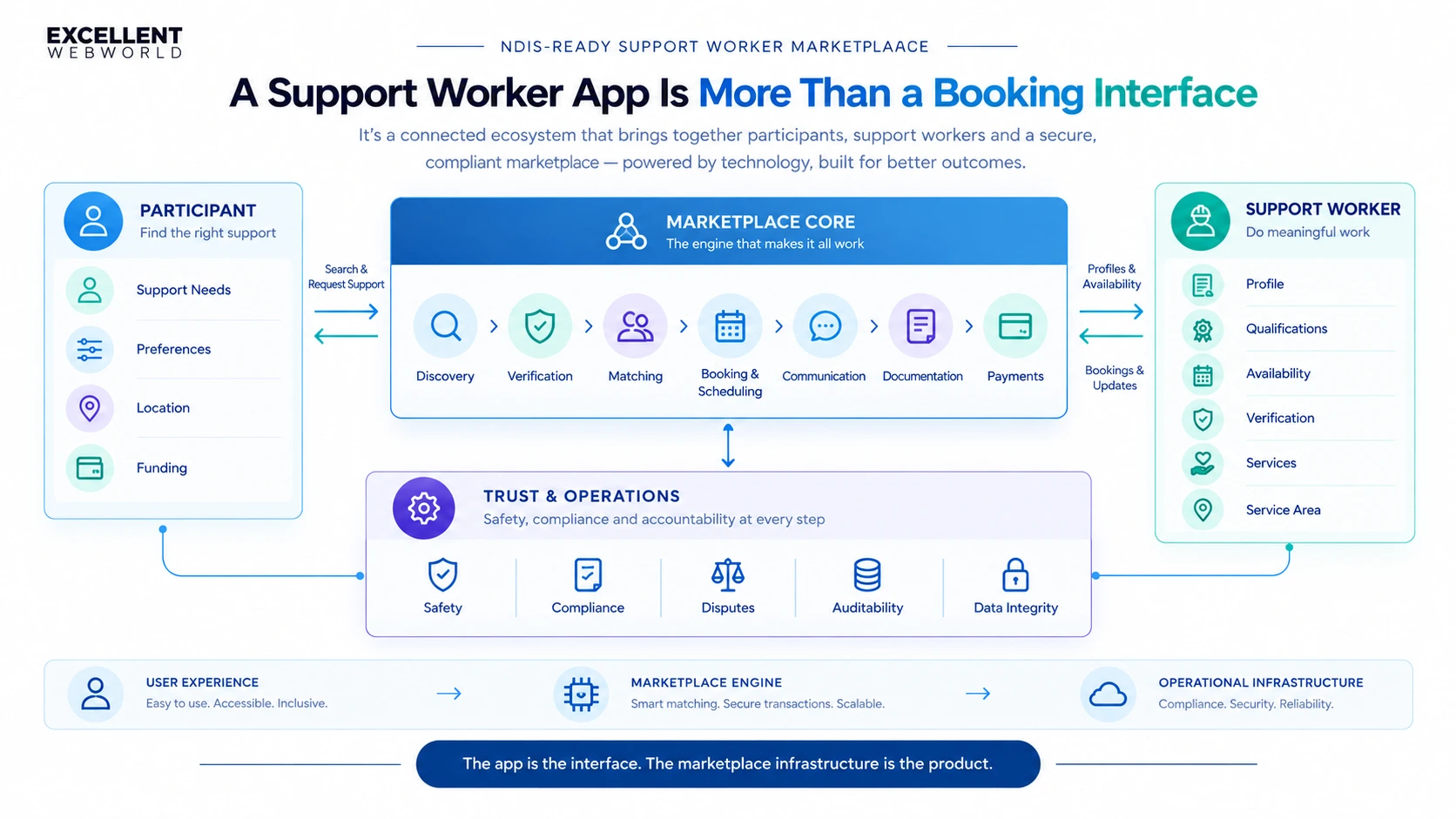
From a CTO perspective, the real product is actually the infrastructure that connects these workflows. This helps to align our approach to healthcare app development, in which secure data handling, integrations, scalable architecture & the user experience must operate in a single unified system.
Mable provides a useful reference that combines worker discovery, profiles, qualifications, communication, scheduling, bookings & appointments within the marketplace. For support worker platform development, the objective is to engineer the complete service, not simply provide another platform’s features. The user experience can remain consistent, but the underlying rules should stay configurable, so that the platform can adapt as funding models, regulations & service offerings change.
Why Build an NDIS-Ready Support Worker App in Australia?
Australia presents a unique opportunity for NDIS-ready support worker app development as it is offered through various funding & services, not with any single pathway. And, based on the product strategy, the platform may need to support;
- NDIS participants
- Older Australians receiving aged-care support
- Private-pay clients
- Families arranging care for someone else
- People needing temporary in-home assistance
- Disability support organizations
- Independent support workers
- Personal care professionals
The platform may need to support these aspects, making aged-care compliance an important part of the product architecture. From a CTO perspective, I would say that the marketplace should not be designed around one generic care client only.
Instead, your platform needs to have different funding models, eligibility, services, and also some standard compliance requirements from the starting phase.
Mable’s current marketplace supports this flexibility by supporting disability, aged care & also self-funded services within a unified ecosystem, rather than separate products.
This, you can say, is the real architectural takeaway. I would say that the user experience must remain consistent across all customer segments, but the underlying rules stay configurable, thus allowing the platform to adapt as funding models, regulations & service offerings evolve without having any technical debt.
How Does a Mable-Like Support Worker Marketplace Work?
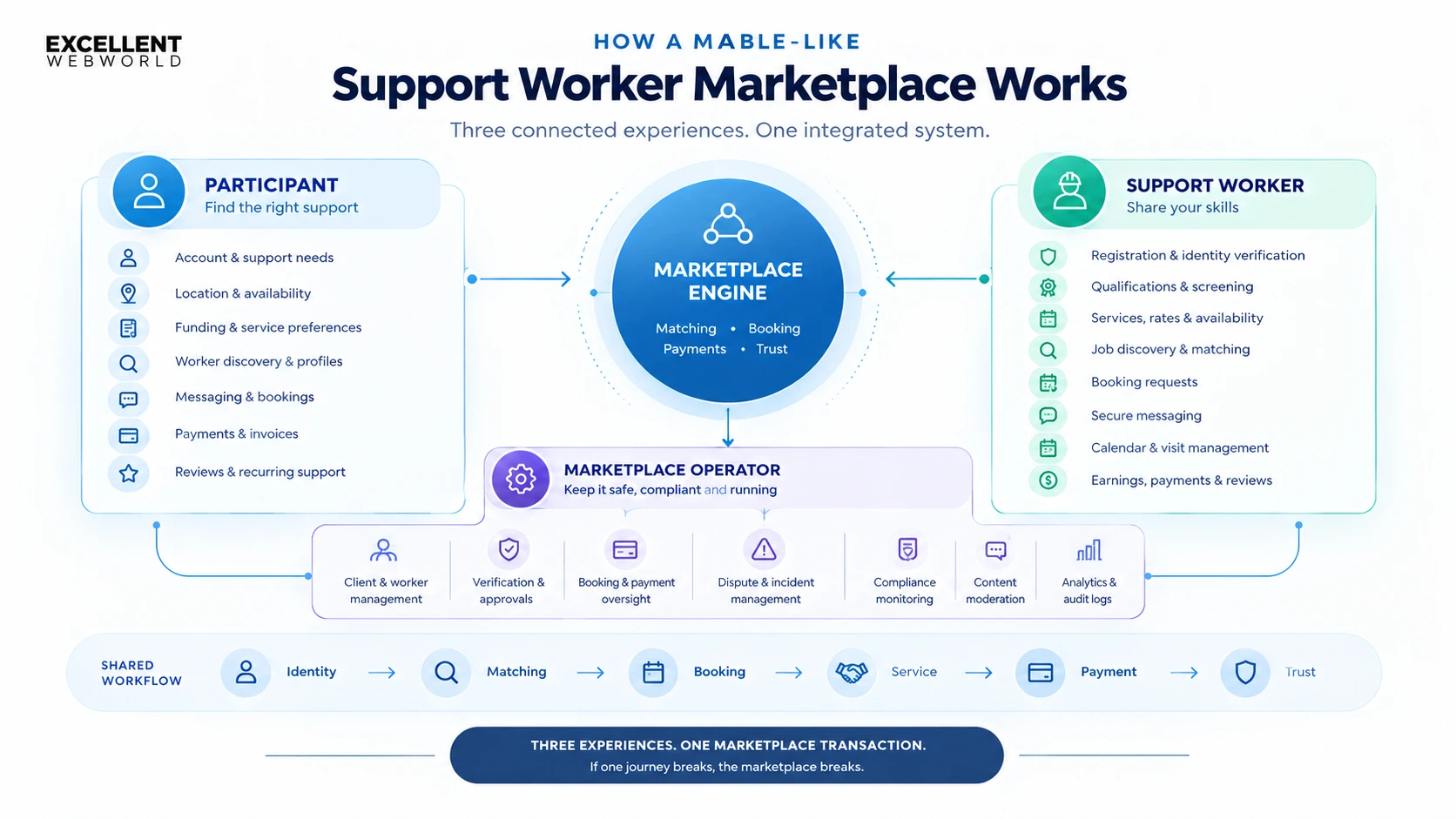
From a CTO perspective, I would say that a support worker app is not just one single application, but associated with three connected experiences that operate as one system.
Participants, support workers, & the marketplace actually share one common transaction, so if one journey breaks, the whole marketplace breaks along with it.
That is why support worker app development should be engineered as an integrated marketplace rather than a collection of disconnected interfaces, with the underlying platform treated as a unified software development system.
Here are the three marketplace experiences in the table below.
| Experiences | Core Capabilities |
|---|---|
| Client |
|
| Support Worker |
|
| Marketplace Operator |
|
Why Structured Onboarding Matters
Mable’s onboarding process shows how the structured data models support an accurate matching process & also the operations. The clients provide location, support type, funding, service requirements, timings & hours; workers provide work history, qualifications, references & an NDIS Worker Screening Check.
The CTO goal is to capture the right dataset without adding unnecessary onboarding friction, similar to the challenges involved in healthcare software modernization where existing data and workflows need to evolve without disrupting operations.
The Most Overlooked Product is the Admin Platform
The admin platform acts as the marketplace’s operational control layer, making a dedicated web portal important for verification, bookings, payments, disputes, compliance, and auditability
With our marketplace approach, it helps guide our support worker platform development that connects the participant, worker, and administration workflows. It also informs our healthcare app development & on-demand marketplace architecture, where secure workflows, integrations, & scalable infrastructure all operate as one single system.
6 Essential Features in Support Worker App Development
Instead of building every feature at once, a scalable support worker app should begin with a focused MVP around the six core capabilities that prove the marketplace model.
| Capability | Core Features |
|---|---|
| 1. Client & Participant Profiles |
|
| 2. Worker Profiles |
|
| 3. Search & Discovery |
|
| 4. Booking & Scheduling |
|
| 5. Secure Messaging |
|
| 6. Payments |
|
How I Would Build the Support Worker App Layer
The real competitive advantage, I think, is not the profile screen, but the matching engine.
Suppose a participant needs;
- Personal Care
- Tuesday and Thursday afternoons
- A worker within 10 km
- Mobility-support experience
- A specific language
- A defined rate range
A basic marketplace able to perform a database query. While a modern support worker app can combine deterministic eligibility rules with machine learning and AI-powered ranking, making matching more relevant without compromising mandatory compliance rules.
Hard Constraints
The eligibility should remain deterministic & rule-based;
- Required qualifications & verification
- Service eligibility
- Location Limits
- Availability
- Platform & Compliance Rules
AI Ranking Signals
Once the eligibility criteria are confirmed, AI can rank candidates based on;
- Experience and service fit
- Participant preferences
- Worker continuity
- Ratings and response history
- Distance and availability
I would say that this principle is quite simple, i.e., AI ranks eligible candidates, but it does not override mandatory eligibility rules.
This particular architecture actually creates a reliable, strong foundation for support worker app development, thus allowing an intelligent matching approach that improves discovery while keeping the eligibility decisions quite deterministic.
Building a Support Worker App Like Mable With AI
If we were building a Mable-like marketplace today, I would not totally rely on the conventional manual development process. Modern tools can increase the pace of support worker app development, from the discovery phase to prototyping to implementation, when used selectively & under engineering oversight.
AI-Assisted Product Discovery
Before any production code, tools like Claude, ChatGPT, & enterprise AI systems can help teams;
- Analyze publicly available competitor workflows
- Compare marketplace models
- Structure requirements and user journeys
- Identify edge cases and challenge assumptions
- Create PRDs and initial information architecture
AI can accelerate the research process, particularly when evaluating opportunities within healthcare digital transformation, but understanding the challenges of AI implementation and applying the CTO & Product Team's judgment remain essential for validating requirements & shaping the product strategy.
AI-Assisted Prototyping
The AI-enabled development process can quickly translate the requirements into;
- Clickable interfaces and mobile UI concepts
- Dashboard prototypes
- Database schemas and API contracts
- User flows and interaction models
These capabilities can complement broader AI development services, but AI coding agents should not have unrestricted control over a production repository, particularly when the application handles sensitive health information and requires HIPAA-compliant application development practices.
This allows the client and engineering team to validate participant and worker journeys before larger engineering sprints and identify where AI integration can add measurable value.
AI-Assisted Development
Once the architecture is fully established, tools like Claude Code, Codex, & other agentic coding environments can accelerate;
- Boilerplate and API implementation
- UI components and database migrations
- Unit and test generation
- Documentation and refactoring
These capabilities can complement broader AI development services, but AI coding agents should not have unrestricted control over a production repository. The clear engineering controls should include:
- Architecture and repository conventions
- Security and coding requirements
- Testing standards
- Pull-request review
- Human approval gates
The objective is simply AI-accelerated engineering, not any AI-supervised engineering process.
AI Features I Would Prioritize
I would not start with an AI chatbot simply because modern apps have one. For a support worker app, I would mainly prioritize the AI capabilities that help improve matching, discovery, scheduling, operations, and also the service delivery process.
| AI Capability | Core Functionality |
|---|---|
| AI Worker Matching | There are applied AI systems that match workers to the right opportunities utilizing experience, availability, preferences, location & business rules. |
| Natural-Language Search | This helps in establishing RAG-powered search experiences that translate natural language requests to relevant, context-aware results across your business datasets. |
| AI Profile Summarization | This uses generative AI to translate complex profile records & documents into concise, decision-ready summaries without losing accessibility to underlying information. |
| AI Scheduling | Helps to build AI agents that coordinate people, services, availability, locations, & business rules to automate complex scheduling work processes. |
| AI Documentation | Convert dictated service notes from the mobile app into structured drafts for worker review, an AI in healthcare use case that reduces documentation overhead while retaining human review. |
| AI Compliance Assistant | Implement AI governance solutions that continuously identify missing documentation, compliance gaps, credential issues, and operational risks. |
| AI Customer Support | This builds conversational AI systems that mainly manage routine customer interactions while routing sensitive, complex, or high-risk cases to human teams. |
For the support worker platform development, this shifts beyond a database & mobile interface system. AI becomes an intelligent operating layer across the marketplace, while deterministic rules & oversight remain in control of decision-making.
How We Would Make the Platform NDIS-Ready
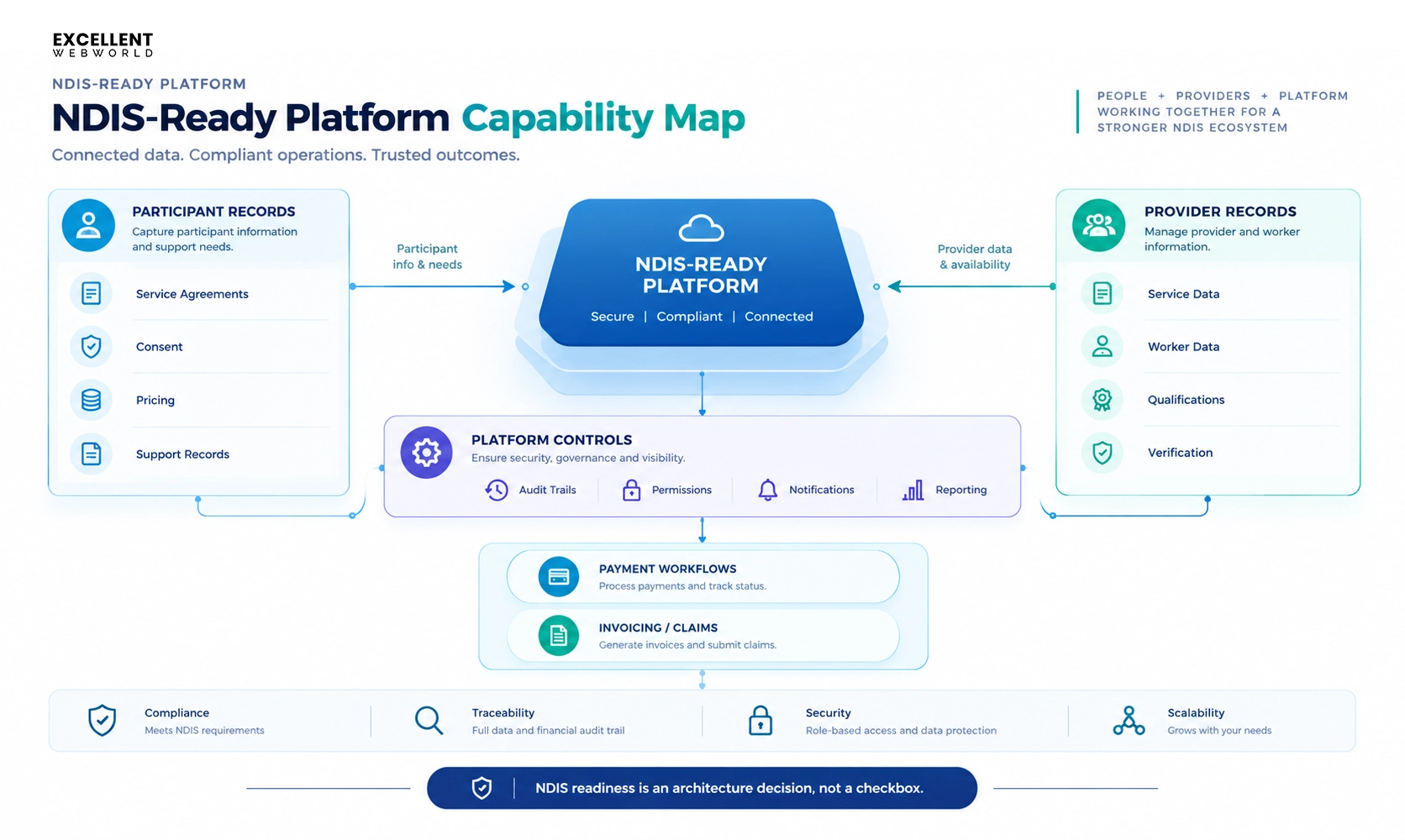
For an NDIS-focused support worker app, the compliance should be designed into the architecture, not added after any deployment process. The current provider responsibilities include charging within applicable pricing arrangements & price limits, disclosing the price list prior to delivering supports, maintaining accurate records, generating invoices post-delivery, & submitting payment requests within the applicable requirements. These requirements also create opportunities for AI-powered NDIS software development to support intelligent workflows while keeping critical compliance decisions governed by defined rules.
Basically, this translates directly into the platform capabilities;
- Participant management — profiles, funding and support details
- Service agreements — agreed services, pricing and terms
- Support records — service delivery and historical records
- Pricing engine — configurable pricing arrangements and limits
- Booking & scheduling — approved support delivery workflows
- Invoicing & claims — invoices, payment and claims-related workflows
- Consent management — permissions and consent records
- Provider records — worker and provider information
- Audit trails — traceable changes, actions and transactions
The architecture should also separate regulatory rules from the application logic, while applying appropriate cybersecurity controls to sensitive participant and worker data.
NDIS requirements and pricing arrangements change over time, so hard-coding rules across the application creates technical debt. A centralized, versioned rules layer makes regulatory updates easier to maintain and test, while a robusthealthcare technology infrastructure can support the secure data, integrations, and operational workflows required as the platform evolves.
Disability Support Services Marketplace Development Is a Trust Problem
In disability support services marketplace development, trust and safety are core product capabilities, not secondary features, as demonstrated by our work on an AI-powered mental healthcare platform involving sensitive healthcare workflows. Participants require confidence that the workers are verified, appropriately qualified & suitable for their support needs.
Braive
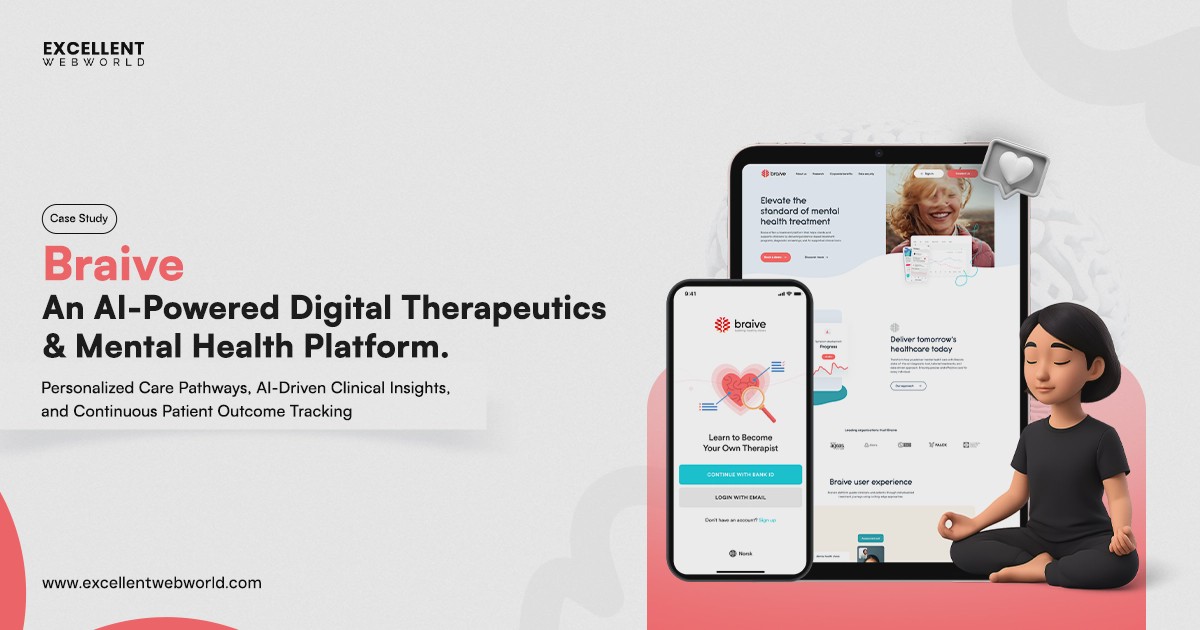
A digital mental health platform with guided programs, clinician tools, and progress tracking. Expands access to care and improves patient...
- Identity verification
- Worker screening
- Qualification and certification verification
- Reference checks
- Reviews and ratings
- Incident reporting
- Dispute management
- Secure communication
- Audit trails
The verification requirements need to be configurable based upon services, worker roles, & jurisdictions that the platform supports. For example, in terms of Mable, it requires independent support workers to provide an ABN & NDIS worker screening check, alongside other verification requirements like references & profile information.
The right approach for a new platform is not to copy Mable’s verification model blindly, but to translate its own business model, service scope & legal obligations into enforceable platform rules.
Personal Care Workers Marketplace Development Requires Stronger Controls
So, in terms of personal care, it requires more than basic marketplace matching aspects. The services for personal care include
- Showering
- Toileting
- Mobility assistance
- Transfers
- Medication-related support
- Other intimate or sensitive activities
Therefore, personal care workers marketplace development needs stronger profile data, eligibility checks, consent controls, service definitions, and incident workflows, similar to the structured healthcare interactions addressed in our AI virtual health assistant project.
And the platform must determine what each worker is qualified & also authorized to provide such services.
I would tell you that eligibility comes first; then it comes to optimization for such significant solutions & services.
Building for Disability & Aged Care Support Platforms
If the commercial strategy includes aged care, the architecture should support multiple segments without hard-coding the product around one category. The disability & aged care support platforms may support;
- Disability support and personal care
- Domestic and social assistance
- Transport and post-hospital support
- Nursing and allied health
- Aged-care services
These aspects are similar to the multi-sided healthcare ecosystem represented by our AI telemedicine marketplace platform.
FerMD
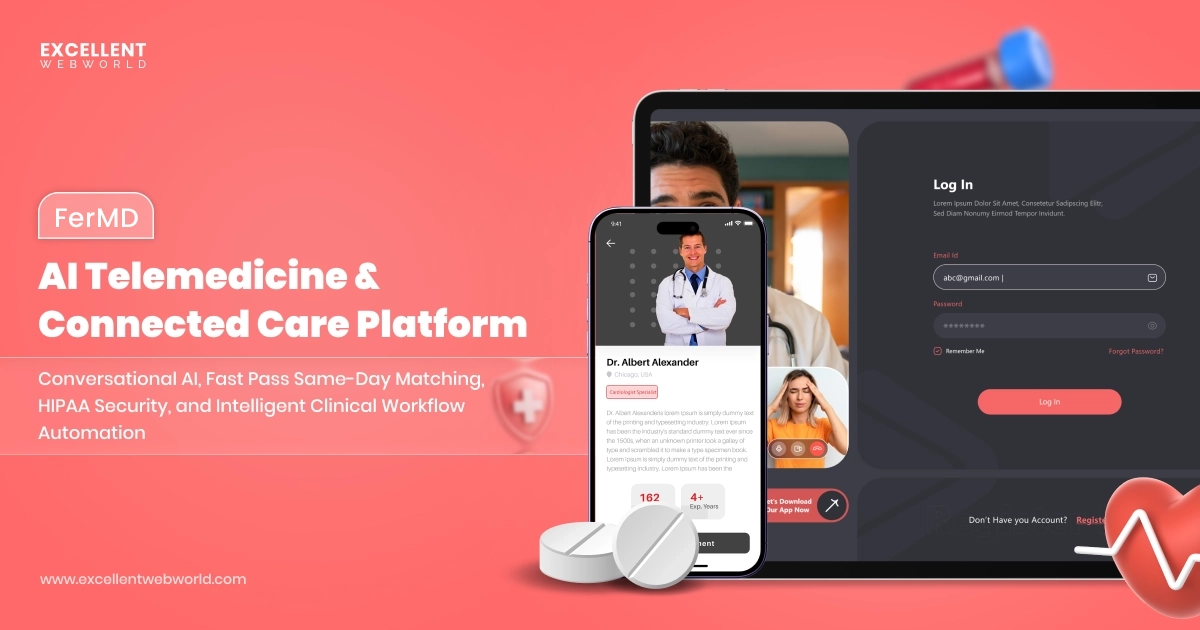
A HIPAA-conscious telemedicine app. Secure video consults, e-prescriptions, and scheduling expand patient access and streamline clinical workflows.
The Technology Architecture I Would Use
For a scalable support worker app, I would design in layers, so that each capability can evolve independently with the marketplace growth.
| Architecture Layer | Core Components |
|---|---|
| Experience Layer | Client web/mobile app, worker mobile app, admin portal |
| Core Platform | Identity, profiles, search, matching, booking, scheduling, messaging, payments, reviews, compliance |
| Intelligence Layer | Recommendation engine, AI search, LLM services, RAG, AI agents, analytics |
| Integration Layer | Payment providers, identity verification, notifications, accounting, payroll, relevant government and enterprise APIs |
| Data Layer | Transactional database, search index, document storage, analytics warehouse, audit logs |
This modular architecture creates a stronger foundation for support worker platform development, particularly when the underlying infrastructure is designed for cloud application development and independent scaling.
The matching engine can evolve into an AI recommendation system similar to an AI-enhanced service marketplace; worker profiles can power up the automated eligibility & compliance checks, while AI Agents can coordinate scheduling and workforce workflows without requiring a complete platform rebuild.
How We Approach Support Worker Platform Development
Our approach moves beyond the traditional requirements → months of coding → launch model, through forward-deployed engineering, keeping engineering closely aligned with the product and operating environment.
Here are the steps and their focus in the support worker platform development process.
| Steps | Focus |
|---|---|
| 01. Product Discovery | Define the marketplace model, target users, geography, services, revenue model, funding pathways, regulatory requirements, and competitive differentiation using AI-assisted research. |
| 02. AI-Assisted Prototyping | Validate client onboarding, worker onboarding, discovery, matching, booking, payments, and admin journeys before full engineering. |
| 03. Architecture | Design the data model, APIs, authentication, permissions, marketplace services, AI integration services, AI architecture, integrations, and infrastructure. |
| 04. MVP Development | Build the smallest product that proves marketplace liquidity: Client + Worker + Admin + Matching + Booking + Payment, before expanding features. |
| 05. AI Integration | Introduce AI only where it delivers measurable value across production workflows. |
| 06. Security & Compliance | Validate access controls, sensitive-data handling, payment security, worker verification, auditability, and AI behavior. |
| 07. Pilot Launch | Launch within a controlled geography or user group and measure real marketplace behavior. |
| 08. Scale | Expand functionality, geography, and automation only after achieving product-market fit. |
This particular step-wise approach keeps the support worker platform development aligned with product validation, scalable architecture & production-ready engineering, rather than building any unnecessary complexity too early.
How Much Does Support Worker App Development Cost in Australia?
There is no such honest single price for support worker app development in Australia. The investment generally depends on whether you are developing an MVP marketplace or a production-scale care platform.
| Platform Stage | What It Typically Includes |
|---|---|
| MVP marketplace | Client app, worker app, admin dashboard, profiles, search, matching, booking, messaging, and payments. |
| Advanced marketplace | Advanced matching, worker verification, reviews, scheduling, compliance, analytics, AI capabilities, and multiple integrations. |
| Enterprise Platform | Multi-tenancy, NDIS workflows, aged-care workflows, advanced AI agents, enterprise security, complex payment architecture, advanced analytics, and large-scale infrastructure. |
The biggest cost mistake is building enterprise complexity prior to validating the marketplace. I would rather launch a focused product, measure real demand & invest in engineering capacity where the data proves that it matters.
What Is the Biggest Mistake When Building a Mable-Like App?
The biggest mistake is recreating Mable’s visible features without understanding the marketplace system underneath.
A successful marketplace basically depends on liquidity, trust, matching, worker supply, participant demand, retention, payments, safety, and operational support. This is actually a simple interface connecting these systems.
For example, 70 search filters mean little if only three suitable workers are available in a region. That is why a supply-demand model should shape the product strategy from day one. The key questions can be:
- Where will workers come from?
- How will participants be acquired?
- Which geography should launch first?
- How quickly can participants find suitable workers?
- How will high-quality workers be retained?
Once these marketplace fundamentals are clear, the next step is deciding which product capabilities to build first and where AI can create measurable value.
What Would We Build First?
If we were building this support worker app at Excellent Webworld today, we would definitely start with one focused marketplace journey;
- Find
- Match
- Message
- Book
- Deliver
- Pay
- Review
Then, we would explore and introduce AI to improve each step, starting with focused workflows rather than attempting to build an AI app around every marketplace function from day one.
| Steps | AI Capability |
|---|---|
| Find | Natural-language search |
| Match | AI-assisted support |
| Message | AI-assisted support |
| Book | Intelligent scheduling |
| Deliver | Voice-to-structured documentation |
| Pay | Reconciliation and exception detection |
| Review | Sentiment and quality analysis |
This keeps support worker platform development mainly focused on the measurable marketplace outcomes, not adding any AI just for its own sake. The goal is pretty simple: it is to have a focused product that proves demand first & then expands where data shows engineering investment tends to create potential value.
The Future of Support Worker Marketplaces in Australia
So, for the future outlook, I expect the next generation of care marketplaces to move beyond “Which workers are available?”to “Which verified, eligible workers best fit this participant’s needs, preferences, schedule, and location?”
From a CTO perspective, I would design the platform around one continuous marketplace loop;
- Discover
- Match
- Connect
- Book
- Deliver
- Pay
- Review
- Improve
Each of the interactions generates data that helps to improve matching, scheduling, service quality, & the marketplace operations over time.
The platform should connect;
- Participant preferences with worker capabilities
- Availability, service history, and scheduling patterns
- Geographic constraints with marketplace demand
- Trust, compliance, and operational risks
I also see that the AI agents coordinate most of the workflows, while the deterministic rules and human oversight remain responsible for high-impact decisions.
This evolution aligns with the broader capabilities across AI development and intelligent software solutions, moving Disability Support Platform development beyond static directories toward intelligent care infrastructure designed around Australian requirements from the start.
Build Your NDIS Support Platform With Excellent Webworld
At Excellent Webworld, we approach support worker app development as marketplace engineering, not feature replication. We combine AI-assisted research, rapid prototyping, scalable architecture, and AI-assisted development around Australian operating requirements.
From onboarding and intelligent matching to compliance, bookings, payments, and operational workflows, we build the technology foundation for scalable, NDIS-ready marketplaces.
If you’re planning an NDIS-ready support platform in Australia, the next step is to align the marketplace model, technical architecture, and product capabilities with your business goals.
Key Takeaways
- Build a marketplace, not just an app: Connect participant, worker, and admin workflows.
- Design for marketplace liquidity: Balance worker supply, participant demand, and matching quality.
- Keep critical rules deterministic: Validate eligibility, pricing and safety before AI ranking.
- Structure data for scale: Use profiles, availability, and service data to power matching and operations.
- Embed NDIS requirements: Build pricing, records, consent, invoicing, payments, and audit trails into the architecture.
- Apply AI with clear boundaries: Use it to improve matching, search, scheduling, and operations without overriding critical rules.
- Keep engineering oversight: Combine AI-assisted development with security, testing, code review, and human approval.
- Prove the core marketplace loop: Find → Match → Message → Book → Deliver → Pay → Review.
- Design for evolution: Use modular architecture and configurable rules to support new services and care segments.
Support Worker App Development FAQs
A digital marketplace connecting people needing disability, aged-care, or personal support with independent workers. It typically manages profiles, discovery, verification, matching, communication, bookings, payments, and trust.
Define the marketplace model, target users, services, funding pathways and Australian requirements first. Then design client, worker and admin experiences before building matching, booking, payment and operational infrastructure.
Build a two-sided marketplace with worker profiles, verification, search, matching, messaging, bookings, payments, reviews, safety controls and admin tools. Use Mable as a product reference, not as an implementation or business-model template.
Matching is critical, but marketplace success depends on the complete discovery-to-booking journey. Strong matching cannot compensate for limited worker supply or weak participant demand.
Yes. AI can rank eligible workers using skills, experience, location, availability, and preferences. Mandatory eligibility and safety rules should remain deterministic and run before AI ranking.
Yes. The platform should account for applicable NDIS requirements covering participants, providers, pricing, records, invoicing, and payments, with these requirements built into the product architecture.
Cost depends on scope, from an MVP to a production marketplace or enterprise platform with NDIS/aged-care workflows, advanced AI, integrations, and compliance capabilities.
A focused MVP can take several months, while a production-scale marketplace with mobile apps, integrations, compliance workflows, and AI can take considerably longer. Scope and validation requirements determine the timeline.
Use a stack that supports secure web/mobile apps, scalable APIs, transactional data, search, payments, identity, notifications, and AI services. Architecture, security, and scalability should drive technology choices, not framework trends.
Care-management software primarily helps organizations manage existing services. A marketplace must also solve supply and demand by connecting independent workers with people seeking support.

Article By


Mayur Panchal is the CTO of Excellent Webworld. With his skills and expertise, he stays updated with industry trends and utilizes his technical expertise to address problems faced by entrepreneurs and startup owners.