What Actually Matters When You Build Aged Care Compliance Software
- Unannounced ACQSC visits are up 40%+ since 2024 — slow evidence capture signals a documentation problem, not just a compliance gap.
- 96.3% of re-accredited homes secured 3+ years as of June 2025 — a benchmark modern compliance software should help providers meet.
- Compliance software ≠ general aged care software — disconnected incident, policy, and training records do not create a complete compliance platform.
- Map all seven Strengthened Standards individually — each Standard requires distinct evidence, monitoring, and accountability.
- Give Responsible Persons dedicated governance workflows — including suitability tracking and ACQSC notification management.
- Use AI to assist, not decide — analysis and evidence preparation can be AI-powered, while compliance decisions remain explainable and auditable.
- Build the deterministic rule engine first — then layer AI for gap detection, pattern recognition, and evidence analysis.
An assessor from the Aged Care Quality & Safety Commission can arrive without notice, leaving no convenient window to assemble any missing evidence. If an incident was never recorded, a policy is updated, or evidence is scattered across files & spreadsheets, then that gap can directly impact how a provider is assessed.
That is the premise I would build this category of software around exactly.
Aged Care Compliance should go beyond just incident registers & checklists. The platform should connect regulatory requirements with policies, training, incidents, risks, governance activities, & the evidence that proves compliance, so that every requirement has a clear & verifiable trail.
The Aged Care Act 2024 offers the regulatory foundation. The architecture determines whether the foundation works in practice. I would keep the compliance decisions deterministic & auditable, while utilizing AI systems to identify evidence gaps, detect patterns & reduce assessment workloads.
Having built compliance-heavy systems, I know where these platforms actually fail. Here's how I would approach building one. Our AI & intelligent systems practice helps to define where AI adds value without compromising any kind of accountability.
Compliance Software vs. General Aged Care Software: What's Actually Different
Before developing the platform, I would first separate the products that are competing under the aged care standard compliance software label. They may look alike, but the underlying purpose and regulatory directions are quite different.
1. Generic GRC Platforms
The Governance, Risk & Compliance (GRC) platforms are mainly established with certain standard templates and configured workflows. Other than that, they also provide strong governance capabilities, but the aged care-specific regulatory coverage and the update cycles may not keep up with the changing dynamics of the obligations.
2. Clinical Only Systems
These platforms are often built around care planning, clinical documentation, and EHR workflows. They include incident management, but governance, workforce compliance, or quality standards & audit readiness are usually not the central focus.
3. Legacy Aged Care Software
The established aged care platforms often carry stronger domain knowledge, but are mainly built around the old eight Quality Standards. It is now needed to accommodate the strengthened quality standards, expanded SIRS requirements & also the newer Code of Obligations, sometimes on architectures that are mainly designed for a regulatory environment.
4. Purpose-Built Compliance Platforms
This specific model that I would build compliance-ready aged care software is mainly designed around the Aged Care Act 2024 standards, where the evidence mapping process, standard governance, workforce obligations, compliance workflows, & also audit trails are the core capabilities, other than any add-ons. The difference actually matters, and for that I don’t consider a platform to be compliance software simply because it has a compliance module setup.
There is a need for a clinical or any operational system in terms of running a business, but a purpose-built compliance platform has a totally different purpose. This generally clarifies what the provider can demonstrate, like, “what are the requirements, what has been done, what evidence supports it, & where every compliance status actually comes from”.
I don’t think that the other three categories are wrong; rather, a strong clinical platform may genuinely be the right fit for providers. But I would say that having a compliance module is not the same as having compliance software. And the confusing thing is how providers end up with fragmented evidence when compliance actually puts it to the test.
AI-Powered vs. AI-Native: The Architecture I'd Build for Compliance
I would build an AI-powered platform, as compliance needs to be auditable at first, and then AI should strengthen that foundation rather than replacing it.
| Tier | What it actually is | Where AI sits |
|---|---|---|
| Legacy compliance tool | Documentation storage with manual evidence assembly and limited automation | AI is absent or added as a generic chatbot with little workflow integration |
| AI-powered compliance software | Purpose-built platform with evidence mapping, SIRS workflows, workforce compliance, and a deterministic rule engine | AI accelerates evidence gap detection, pattern recognition, and evidence assembly, while compliance decisions remain auditable |
| AI-native | Architecture built around AI as the core decision layer | AI becomes the decision authority, making compliance logic harder to explain and audit |
I would make a totally different architectural choice here than going for a workforce-constrained sector like disability care, as aged care compliance software needs to be quite deterministic, not adaptive.
If the platform says that a provider is non-compliant with Standard 5 or that a SIRS Priority 1 deadline has 6 hours left, the outcome should come from an auditable rule logic system, not from a model best guess.
I would say that an assessor should be able to trace back every status to a simple chain like: data → rule → status.
That is where I would use AI specifically for evidence gap detection, incident pattern recognition, regulatory change summarization & also draft evidence preparation. What I would never let AI do is make the compliance determination by itself. That is why I would build an AI-powered aged care compliance platform with a deterministic rule engine at its core, keeping regulatory decisions traceable, consistent, and auditable.
Why the Timing Is Forcing a Change
For the timing aspects, I will say that the compliance space has changed rapidly over time, and for that I would make continuous audit readiness a core requirement. It is considered the core requirement for the platform, rather than something that the providers actually prepare after an assessment is announced.
- Unannounced assessments are now a real-time test. Since 2024, the Aged Care Quality & Safety Commission visits have increased by 40%. Every accredited home receives at least one unannounced assessment contact each year, thus requiring providers to have a need for audit-ready evidence daily, not like during accreditation periods.
- The accreditation benchmark has moved higher. By June 2025, 96.3% of re-accredited homes secured almost 3-year-plus accreditation, as compared to 2020-2021 with 85%. This signals a higher level of compliance maturity.
- Star Ratings now make compliance more visible. Starting from November 1, 2025, the Compliance rating within these standards actually assesses performance against Strengthened Quality Standards. A single sanction can cap a provider’s rating at 1-2 stars, thus making the compliance performance a direct reputational concern.
- Recurring findings reveal where systems break down. Medication management, outdated care plans, and the weak evidence of consumer choice tend to appear among the non-compliance findings. The underlying problem often seems to be the fragmented parts that teams often cannot retrieve, connect, or even prove during assessments.
If you ask me, then for me, I will say that it actually changes the build priority, and the compliance software has to maintain evidence continuously, but not help providers assemble it after the fact.
The Evidence Every Provider Must Produce On Demand
I would build the platform based on a core principle, i.e., every compliance status should be supported by connected & audit-ready evidence, which is not isolated records scattered across multiple systems.
Four Capabilities Every Compliance Standard Depends On
So, regardless of which Strengthened Quality Standard an assessor is basically testing, I would make sure that these four capabilities work together in a connected system.
- Current Regulatory Content: You should keep policies & procedures that are aligned with legislative & regulatory changes instead of just relying on outdated documents.
- Policy Linked Training: This ties staff training directly to the policies that it supports, so that updates never become hidden compliance gaps.
- Live Risk & Incident Tracking: It helps in capturing the risks, incidents, and also compliant datasets with the event occurrence, not for any pre-audit reconstruction purpose.
- Audit Ready Reporting: Helps in delivering real-time visibility across the Quality Standards, SIRS, and complaints, rather than just reporting in terms of assessments.
If a platform delivers only one of these- a policy library without any training links or an incident register without reporting- I would treat it as a compliance fragment rather than any aged care compliance software.
How I'd Map the Platform to the Strengthened Quality Standards
I would map every strengthened Quality Standard to a specific evidence workflow process, as the assessors test proof against each standard, not like any “compliant” status.
| Strengthened Standard | What an Assessor Tests | Software Capability |
|---|---|---|
| The Individual | Consumer choice and dignity | Consent records and logged consumer interactions |
| The Organisation | Governance oversight | Real-time risk dashboards and board reporting |
| Care and Services | Care delivery and reviews | Care plans linked to review triggers |
| The Environment | Safety management | Incident and hazard registers with corrective actions |
| Clinical Care | Current clinical practice | Version-controlled policy content |
| Food and Nutrition | Individual nutrition needs | Nutrition assessments linked to care plans |
| The Residential Community | Community participation | Activity and engagement records for audit |
Compliance obligations that need dedicated workflows
Some obligations extend beyond a single standard, which is why I would build them as standalone workflows.
- SIRS (Serious Incident Response Scheme): Priority 1 incidents need Commission notification within 24 hours, Priority 2 within 30 days, and Final reporting within 60 days. The deadline tracking belongs inside the workflow, not on someone’s calendar.
- Responsible Persons management: Under Sections 169-172 of the Aged Care Act 2024, the providers must maintain a Responsible Persons Register, assess suitability, and also notify the Commission within 14 days of significant changes. I would treat this as a dedicated governance record system, separate from any HR records.
- Prudential and financial compliance: The Refundable Accommodation Deposit (RAD), liquidity requirements, and accommodation pricing needed their own standard compliance work process rather than being folded into clinical systems.
- Whistleblower protections: The 2024 Act expanded whistleblower protections, and with that, I would build support for staff communication, training & protected reporting.
- Restrictive practices: Every instance should be linked to the relevant behaviour support plan & consent records, not logged as an isolated event.
- Worker screening: The Aged Care Worker Screening Checks should be tracked as expiry-aware records, which tends to prevent rostering when screening is no longer current.
Where AI Actually Helps a Compliance Team
I would say that AI is mainly implemented to strengthen the deterministic rule engine within aged care compliance software, not to replace it.
- Evidence Gap Detection: Here, you can actually compare logged evidence against Strengthened Quality Standards requirements & also flag gaps prior to assessors finding them.
- Incident and complaint pattern recognition: This mainly surfaces recurring trends across shifts, locations, or staffing patterns for human reviews.
- Regulatory change summarization: You can analyze new Aged Care Rules & Commission guidance,then also what changes are needed in the existing policies.
- Draft evidence preparation: You can assemble a first pass, audit-ready evidence package for compliance teams to review prior to submission.
- SIRS classification support: This basically helps triage Priority 1 & Priority 2 type incidents while keeping the final classification & Commission submission processes under human control.
That is the boundary I would keep throughout the platform generally, where AI accelerates the compliance workflow, but with every compliance determination, it still comes from the deterministic & more auditable engine.
What a Buyer Should Actually Ask Vendors
As a buyer, I would first compare the pricing and the featured lists, then pressure test whether the platform can really support aged care compliance in practice.
Here are some questions with answers that reveal more than just a polished product demo version.
| Question | What I'd look for |
|---|---|
| Does it cover all seven Strengthened Standards? | Evidence mapping for each Standard, not a generic compliance claim. |
| Is Responsible Persons management a dedicated module? | Built-in suitability tracking and deadline-driven workflows, not an HR afterthought. |
| Are government integrations actually live APIs? | Clear distinction between live API connections and export-and-upload workflows. |
| What does the AI actually do? | Every compliance status should trace back to auditable rule logic, not AI alone. |
| Is pricing transparent? | Published or benchmarkable per-bed or per-client pricing. |
| How quickly are regulatory updates shipped? | Evidence that the platform kept pace with the 1 November 2025 changes. |
| Can adoption be phased? | Modular rollout instead of an all-or-nothing implementation. |
The strongest platforms can answer these questions directly, and if a vendor cannot explain how the compliance logic works, then I will treat it as a meaningful warning sign.
The Vendor Selection Checklist
Once I narrowed down the shortlist, I would score each platform against the areas that actually affect long-term compliance, not just feature counts.
Compliance & Regulatory Coverage
| Requirement | Why it matters |
|---|---|
| Seven Strengthened Standards | Individual evidence mapping for every Standard. |
| SIRS management | Priority 1/2 deadlines with escalating alerts. |
| Responsible Persons register | Suitability tracking and 14-day notification management. |
| Prudential compliance | Covers RAD, liquidity, and accommodation pricing. |
| Restrictive practices | Linked directly to behaviour support plans. |
| Compliance dashboards | Live visibility instead of static reports. |
Product Readiness
| Area | What I'd verify |
|---|---|
| Regulatory currency | Continuous updates and evidence of timely regulatory changes. |
| Usability | Intuitive workflows, mobile capture, and self-service reporting. |
| Integrations | APIs, SSO, and integration with rostering, payroll, and clinical systems. |
| Support | Defined response times, training, implementation, and post-launch support. |
| Pricing & Contract | Transparent costs, migration fees, and flexible phased adoption. |
| Vendor Viability | Established customers, product investment, and retention evidence. |
| Implementation | Clear timeline, migration plan, training, and change management. |
The Feature List That Matters Most
I would build the platform in layers. The deterministic compliance core actually comes first; operational capabilities strengthen it & AI extends it without becoming the compliance authority.
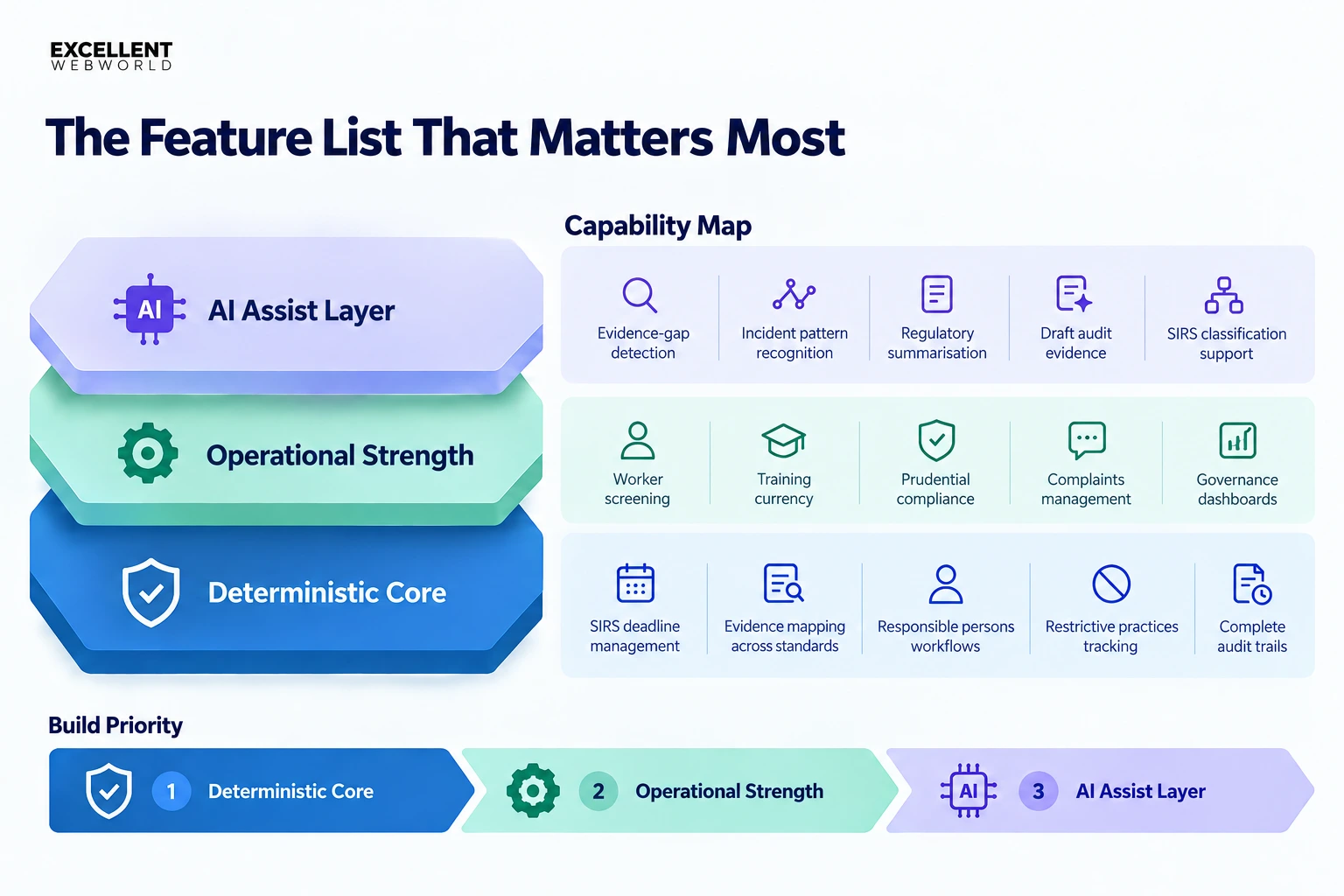
Here are the build priorities and their capabilities at a glance.
| Priority | Must-have capabilities |
|---|---|
| Deterministic core | SIRS deadline management, evidence mapping across the seven Strengthened Standards, Responsible Persons workflows, Restrictive Practices tracking, and complete audit trails. |
| Operational strength | Worker screening, training currency, Prudential compliance, complaints management, governance dashboards, and board skills tracking. |
| AI assist layer | Evidence-gap detection, incident pattern recognition, regulatory summarisation, draft audit evidence, and SIRS classification support. |
The sequence matters. I would build the deterministic rule engine first, then bring the AI layer on top once every compliance decision remains fully traceable.
The Core Modules Every Compliance Platform Needs
I will say that every module should contribute to one final outcome, i.e., producing audit-ready evidence without forcing staff to reconstruct compliance later on.
These seven core modules form the foundation of an audit-ready compliance platform.
| Module | Core Function |
|---|---|
| SIRS & Incident Management | Priority classification, deadline tracking, and ACQSC notification workflows. |
| Quality Standards Evidence | Standard-specific evidence mapping and continuous improvement tracking. |
| Responsible Persons & Governance | Suitability tracking, 14-day notification management, and board oversight. |
| Workforce Compliance | Worker screening, training records, and Code of Conduct attestation. |
| Prudential & Financial Compliance | RAD, liquidity, and accommodation pricing evidence. |
| Complaints & Feedback | Complaint logging, resolution workflows, and trend analysis. |
| Reporting & Dashboards | Real-time compliance visibility and board-ready reporting. |
One module that is still overlooked, I would say, is Responsible Persons Management. With too many platforms, it is treated like an HR record when it’s actually a separate governance obligation under the Act.
Architecture Designed for Audit-Ready Compliance
This is where the architectural boundary matters most; AI can assist workflows, but the compliance determinations must always come from explicit & auditable rule logic, not from any model inference.
Here is the 4-layer architecture with its purposes.
| Layer | Purpose | Key Decision |
|---|---|---|
| Data Capture | Incidents, policies, workforce records, and compliance evidence. | Capture information at the point of activity. |
| Deterministic Rule Engine | SIRS deadlines, Standard-by-Standard mapping, and notification triggers. | Every compliance status remains traceable to explicit rules. |
| AI Assist Layer | Evidence-gap detection, pattern recognition, and draft evidence compilation. | AI reads from the rule engine but never writes compliance status directly. |
| Access Layer | Compliance console, board reporting, and mobile capture. | Clearly differentiate system-determined from AI-suggested information. |
The Technical Foundation
A compliance-first architecture keeps the deterministic controls at the core, with AI development extending the platform by a clearly separated assist-layer system.
| Component | Technology/ Architecture |
|---|---|
| Compliance Officer Console | React-based console for compliance management, evidence review, and governance workflows. |
| Mobile Incident Capture | Flutter app with offline resilience for reliable field capture in facilities with limited connectivity. |
| Deterministic Rule Engine | Dedicated, versioned business-logic service for SIRS deadlines, Standards mapping, and compliance decisions—fully traceable and testable. |
| AI Assist Service | Separate peer service, commonly Python-based, for evidence-gap detection, pattern recognition, and draft evidence compilation. |
| Database & Audit Trail | PostgreSQL with an append-only audit log structurally separated from mutable operational data. |
| Hosting & Data Sovereignty | AWS or Azure in an Australian region, supporting sensitive governance and incident data under the Privacy Act 1988 / Australian Privacy Principles |
| Government Pathway Integrations | Clearly differentiate live API connections from export-and-upload workflows for SIRS, quality indicators, and funding submissions. |
Our custom software development practice has built dual service architectures where deterministic systems & bounded AI layers operate independently with auditability built into the foundation.
The Implementation Roadmap
A phased build establishes the deterministic compliance core first, then adds AI assistance, integrations, testing, and controlled rollout.
| Step | Stage | Focus |
|---|---|---|
| 01 | Discovery & Standards Mapping (Weeks 1–3) | Map evidence gaps across all seven Strengthened Standards, Responsible Persons, prudential compliance, and SIRS workflows. |
| 02 | Rule Engine Architecture (Weeks 4–6) | Build versioned, testable logic for SIRS deadlines, Standard-by-Standard evidence mapping, and Responsible Persons notifications before AI. |
| 03 | Core Compliance Modules (Weeks 7–14) | Build SIRS, Quality Standards evidence, Responsible Persons, and workforce compliance on the deterministic core. |
| 04 | AI Assist Layer (Weeks 15–18) | Add evidence-gap detection, pattern recognition, and draft evidence compilation as a separate, logged AI service. |
| 05 | Government Pathways & Testing (Weeks 19–21) | Validate SIRS, quality indicator, and Responsible Persons submissions, including live API versus export-and-upload workflows. |
| 06 | Staged Rollout (Weeks 22–24) | Launch with one facility or Standard domain before organisation-wide deployment. |
| 07 | Ongoing Tuning | Maintain evolving regulatory rules and recalibrate the AI layer against real-world outcomes. |
What It Costs and How Long It Takes
A custom compliance platform that combines deterministic compliance engineering, AI assistance, government integrations, and audit testing.
Here is the build cost breakdown for the custom development.
| Component | Estimated AUD Cost |
|---|---|
| UI/UX Design | $10,000–$18,000 |
| Compliance Officer Console | $30,000–$50,000 |
| Mobile Incident Capture-Offline-Resilient | $22,000–$40,000 |
| Deterministic Rule Engine-SIRS, Standards, Responsible Persons | $28,000–$50,000 |
| AI Assist Layer-Gap Detection, Pattern Recognition, Draft Compilation | $20,000–$38,000 |
| Government Pathway Integrations | $15,000–$28,000 |
| Compliance & Audit-Trail Testing | $12,000–$22,000 |
| Total | $137,000–$246,000 AUD |
Timeline: An MVP covering SIRS & core standard evidence takes approximately 14–18 weeks. A full platform with responsible persons, prudential compliance standards, and AI assistance takes around 22–26 weeks.
Build vs. Buy: The published market pricing commonly ranges from $8–$25+ per bed/month for residential providers and $10–$25+ per client/month for home care, plus $3,000–$10,000 implementation and $2,000–$5,000 data migration.
For a 100-bed facility at $15/bed/month, the software basically costs $18,000/year prior to implementation, which is used to compare the 3–5 year total cost of ownership (TCO) against custom development.
Our solutions team can assess the build vs. buy trade-offs across compliance, integrations, scalability, and long-term TCO.
Existing Platforms in the Market
There are several established platforms in the market that already address aged care compliance, governance, risk & incident management. Their coverage mainly differs in terms of regulatory depth, module specialization, & workflow flexibility.
| Platform | Focus | Key Consideration |
|---|---|---|
| AssurePlus | Enterprise GRC, AI, governance | Broad GRC scope; aged-care workflows are adapted rather than native. |
| Complispace / Ideagen Policy Logic | Policy, training, risk, regulatory currency | Strong Standards and regulatory tracking; less specialised for prudential compliance. |
| Sentrient | Compliance, risk, aged-care modules | Broad coverage, with varying depth across specialised areas. |
| SaferMe | Safety, incidents, risk | Strong incident workflows, but narrower governance coverage. |
| Statura Care | Aged-care compliance, Aged Care Act 2024 | Purpose-built and Act-aligned, but SaaS workflows remain generalised across providers. |
The key gap, I think, is the custom development relevance that is associated with providers needing organisation-specific workflows & deeper SIRS, Strengthened Standards, Responsible Persons, prudential standard compliance, evidence & integration capabilities other than a standard module.
The Mistakes That Actually Cost Providers
The biggest compliance risks that I think come from system design choices, not from any missing features.
- Treating compliance as one unified workflow instead of considering the seven Strengthened Standards, as each standard has its own evidence trails.
- Managing the responsible persons manually and the 14-day notification requirement makes automation essential.
- Letting AI determine the compliance status is another mistake. Keep decisions tied to auditable rule logic, not with AI inference.
- Also, assuming government connectivity means live API integration, clearly distinguish live APIs from export & upload workflows.
Build Your Aged Care Compliance Platform With Excellent Webworld
For single-facility providers, a purpose-built platform may offer the regulatory depth needed without the expense of custom development. For multi-facility providers, the mixed residential & support-at-home operations or any gaps across SIRS, Responsible Persons & prudential compliance, a tailored platform can actually provide you with deeper workflows & evidence management.
The priority is architectural discipline so that each standard compliance decision remains traceable to auditable rule logic, with AI support, not determining compliance. Our team has helped organizations build audit-grade platforms that shape a practical solution around your facilities, integrations & seven strengthened standards evidence requirements.
Frequently Asked Questions
Aged care compliance software connects regulatory requirements with evidence, policies, incidents, workforce obligations, governance, workflows, and audit trails in one platform.
Compliance-ready aged care software should support Standards mapping, SIRS, complaints, workforce compliance, governance, evidence tracking, alerts, reporting, and auditable records.
Aged care compliance software in Australia can be designed around Australian aged care requirements, including the Strengthened Quality Standards, SIRS obligations, governance, and evidence management.
Awards & compliance software for aged care can help providers manage workforce obligations alongside compliance workflows, including employee records, training requirements, responsibilities, and supporting evidence.
Yes. AI can assist with evidence gap detection, incident pattern recognition, regulatory change summaries, and draft evidence preparation, while compliance determinations remain governed by auditable rules.
Compliance-ready aged care software can connect each requirement to its responsible party, completed actions, supporting evidence, and compliance status, creating a traceable record for assessment preparation.
Yes. A purpose-built aged care compliance software platform can map requirements across the seven Strengthened Quality Standards to policies, actions, evidence, and responsible teams.
The decision depends on facility numbers, existing systems, regulatory complexity, integration requirements, and whether existing products can provide the required level of compliance coverage.

Article By


Mahil Jasani began his career as a developer and progressed to become the COO of Excellent Webworld. He uses his technical experience to tackle any challenge that arises in any department, be it development, management, operations, or finance.