I have 15+ years of experience working with logistics operations. Being in the field for so long has helped me serve all types of clients, from regional 3PLs to billion-dollar fulfillment networks. Throughout the journey, I have observed a pattern.
Businesses hire more personnel, but clearly that is not something that solves warehouse bottlenecks. Competitors fulfill orders in hours, and you are still there, completing them in days. Around 40% of your budget is consumed by labor. Picking error rate stays at 3-5%, return volume increases, and margins shrink.
You made the investment in automation. Conveyors, warehouse management systems, and basic robotics are in place. But most of these operate with static rules. Everything stalls even if one layout is changed, demand spikes, or equipment fails.
The logistics leaders are not scaling headcounts. Instead, they take a different approach to AI and robotics in warehouse automation. These leaders prioritize engineering systems that learn, adapt, and make autonomous decisions without human involvement. The gap between them and everyone else is operational intelligence, not technology.
Here is the guide that shows you how that shift works. More importantly, you will get to know what it means for your warehouse, along with the concrete steps to start building it now.
The Warehouse Automation Problem Nobody’s Fully Solved (Yet)
Let’s be straightforward and start with reality.
- 73% of warehouse operators are unable to find enough workers to fully staff operations.
- 5-7% annual increase is seen in labor costs, eating margins.
- Delivery expectations are getting tight, with 24-hour delivery becoming the baseline.
- Manual picking error rates hover at 3-5%.
This data convinced companies to invest in automation. Conveyors cut walking, while robotic arms increased picking speed faster than human workers. But these systems come with a limitation; it optimizes specific tasks. With changing conditions, they struggle to operate. When I worked with logistics leaders, I found out that the problem is the limitations of the legacy systems. One demand spike and the optimization breaks.
The companies winning aren’t deploying more robots; instead, they are deploying AI systems that identify and resolve supply chain bottlenecks in real time. That’s where intelligence changes everything. Here is what has changed:
| What Automation Solved | What It Created |
|---|---|
| Storage density challenges | Rule-based decision-making that fails under novel conditions |
| Labor shortage for repetitive tasks | Inflexible systems that break under volatility |
| Manual speed limits | Inability to adapt to layout changes or demand spikes |
| Walking time | Equipment rigidity, one failure halts workflows |
The breakthrough systems work, until they don’t. They’re rigid. Let’s say demand spikes at 3 PM or equipment fails unexpectedly; rigid automation struggles to keep up. Your team has to intervene to decide what to do next and reconfigure workflows manually.
You know what the real problem is today? Yesterday’s automation was built to reduce dependency on labor. Now, the priority is resilience: keeping operations running through volatility and unexpected disruptions.
This became clearer when I was engineering an AI freight forwarding platform that reoptimizes routes, capacity allocation, and pricing in real-time. There is no fixed plan to follow. Every 15 minutes, the system reassesses live conditions and adjusts accordingly. The system reduces the rate of recalculation time, and shippers get better prices. Instead of chasing volume, the platform protects margins by reducing operational inefficiencies.
What Is AI and Robotics in Warehouse Automation?
Robotics and AI in warehouse automation combine intelligent software with robotic systems to automate physical repetitive tasks and make autonomous operational decisions. AI analyzes warehouse data to identify bottlenecks and adjust workflows, while robotics manages tasks like picking, moving, sorting, and packing. Here is why warehouse automation is important.
- Identifies where work stalls and automatically redirects workflow around bottlenecks.
- WMS, robotics, and conveyors communicate and feed optimization loops.
- The same system manages 1000 or 10,000 orders/day without human reconfiguration.
- Routes, layouts, inventory placement, and worker schedules all run on logic.
Types of Warehouse Robots: The Toolkit Your Business Requires to Know
Different warehouses have different needs. eCommerce fulfillment centers operate at different velocity and complexity than automotive parts distribution, which operates differently than cold-chain pharmaceutical warehouses. Understanding the robot types helps decision-makers align technology to their actual workflows.
| Robot Type | What It Does | Best For | AI/Autonomy Level |
|---|---|---|---|
| AMRs (Autonomous Mobile Robots) | Navigate freely, avoid obstacles, adapt routes in real-time based on conditions | Dynamic warehouses, peak demand scaling, layout changes | High (machine learning-driven) |
| AGVs (Automated Guided Vehicles) | Follow pre-defined paths with cargo between stations | Repetitive pallet moves, defined zones, stable layouts | Low (pre-programmed routes) |
| Robotic Picking Arms | Vision-guided articulated arms picking items with precision across SKU variety | Order fragmentation, high SKU counts, complex items | High (computer vision + ML) |
| AS/RS (Automated Storage & Retrieval Systems) | Vertical robotic cranes storing and retrieving pallets or boxes from high-density storage | High-volume inventory, space-constrained facilities, goods-to-person workflows | Medium (rule-based optimization) |
| Collaborative Robots (Cobots) | Work safely alongside human workers in shared spaces | Mixed human-robot zones, packing lines, quality checks | Medium (safety constraints + task coordination) |
| Sorting/Vision Robots | Identify SKUs via vision, route packages to destinations, sort at scale | Fulfillment centers, e-commerce hubs, parcel distribution | High (machine learning pattern recognition) |
The trend is clear: AMRs and vision-guided robots are where AI integration runs deepest. They’re not following paths or executing pre-set rules. They’re perceiving their environment, learning from it, and adapting in real time. This capability is precisely what separates resilient warehouses from brittle ones.
How AI Allows Robotics in Warehouse Automation to Observe, Understand, Learn, and Adapt
For a robot to think, it needs data, processing power, and algorithms that learn. Modern AI in warehouse automation runs on 5 core technologies:
1. Machine Learning & AI Algorithms
Instead of hard-coded “IF condition THEN action” logic, advanced robots use models trained on historical data. A picking robot learns from thousands of previous picks:
- Which items require special handling
- Which items are fragile
- Which are frequently ordered together
What you get as a result: Faster, more accurate decisions. Over time, the system catches edge cases humans would miss.
2. Computer Vision
Cameras equipped with AI give robots sight. This isn’t barcode scanning; it’s true visual understanding. A computer vision system can:
- See a shelf with 50 similar items and identify the exact one needed
- Track inventory in real-time
- Flag misplaced items
- Detect damage
- Quality-check packs before they ship
The robot doesn’t just execute commands; it perceives its environment, learns what variations look like, and adapts its grip, speed, and handling based on what it sees. What you see is not barcode scanning. It’s recognition; the robot understands what it’s looking at.
3. Sensor Arrays & Live Data Processing
Here are the continuous data feeds you will observe from multiple sources:
| Sensor Type | What It Detects |
|---|---|
| Proximity Sensors | Nearby equipment, collision risks |
| LiDAR | Obstacles, navigation hazards |
| Environmental Sensors | Temperature, humidity (for cold-chain) |
| Weight Sensors | Pick verification, load confirmation |
In just milliseconds, all of these data flows to a central orchestration system. The warehouse becomes a data-generating organism. Every movement, every action feeds back into optimization.
I have built a real-time fleet telematics platform that ingests exactly this kind of multi-sensor data from hundreds of connected devices simultaneously. The technical challenge here is processing the data fast enough to make decisions before the moment passes.
Fleet Telematics Platform & Driver App
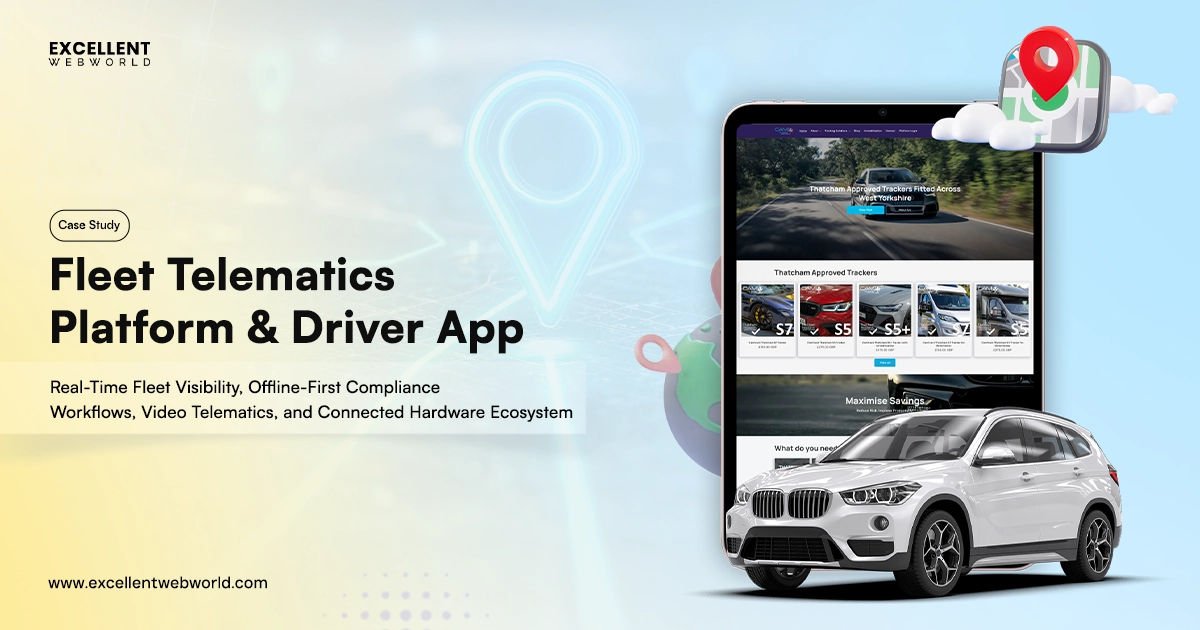
A GPS fleet management platform with real-time vehicle tracking, telematics, and driver insights. Cuts idle time and improves fleet efficiency.
4. Predictive Maintenance
AI forecasts equipment failures before they happen. If you look at the old way, a conveyor breaks at midnight, which leads to operations halting, and as we know, emergency response costs 5x normal repair in such a situation. If you look at the AI way, the system detects degradation patterns. Maintenance is scheduled during planned downtime, and unexpected downtime is cut by 60-70%.
5. WMS/WES Integration
If you want to understand it in an easy way, the warehouse management system is the brain, automated warehouse robots are the hands, and AI is the nervous system.
- When one AMR reaches a bottleneck → the system reroutes it
- When pick volume surges → the system allocates tasks dynamically
- When an order changes → the system adjusts without human touch
I designed and engineered ConnectKargo, a transportation shipment app, to handle exactly this orchestration challenge, managing dynamic workflows where clients, shipments, and capacity constraints are constantly in flux. The system doesn’t wait for human intervention to resolve conflicts. ConnectKargo uses real-time data about vehicle location, capacity, and delivery windows to make routing and prioritization decisions autonomously.
That’s what makes robotics in warehouse automation more adaptive and capable of responding to changing warehouse conditions.
Business Benefits of AI in Warehouse Robotics in Modern Operations
The business case isn’t theoretical anymore. Logistics leaders are seeing real numbers:
| Benefit | Impact | What This Means |
|---|---|---|
| Speed & Throughout | 2-3x faster order fulfillment vs. manual picking | 100 orders/hour → 250-300 orders/hour |
| Accuracy | 99%+ order accuracy; <1% error rate | 1000 daily picks → fewer than 10 errors (vs. 50+ manual) |
| Labor Optimization | 40-50% fewer workers needed for repetitive tasks; staff shifted to higher-value roles | 50-person team → 20-25 operators + supervisors handling quality and exceptions |
| Warehouse Space Efficiency | 40-60% more inventory in same footprint | 10,000 sq ft facility can handle inventory that previously needed 16,000 sq ft |
| Safety | 30-50% reduction in workplace injuries | Automated warehouse robots handle heavy lifting and hazardous zones; fewer muscle strain injuries |
| Scalability | Easy to add robots during peak demand, return to baseline post-season | Black Friday: deploy 15 additional AMRs; remove after January |
| Cost Control | 15-25% reduction in operating costs by year 2 | ROI achieved in 3-5 years; ongoing cost reduction thereafter |
Companies implementing robotics and AI in warehouse automation gain something harder to quantify but invaluable, which is data visibility. For the first time, you see what’s actually happening in your warehouse in real-time. You know bottlenecks are not guesses, and even decisions are not reactive.
Everything is informed by data flowing from your robots, your inventory, your orders. This is where AI agents create their highest value in logistics operations. These agents don’t just report what happened; they act on it autonomously, within your defined business rules.
What Leaders Must Consider When Implementing Robotics in Warehouse Automation
Here are the key questions you must consider before you invest in AI-powered warehouse robotics in supply chain and logistics.
Evaluate Your Current Warehouse Operations:
Set Clear Goals for Your Robotics in Warehouse Management:
Assess Your Facility for Robotics Deployment:
Pick the Right Warehouse Robotics Technology & Vendor:
Plan a Phased Rollout Strategy:
Most successful implementations follow this cadence. Rushing to full deployment rarely pays off.
How Industries Benefit From AI and Robotics in Warehouse Automation
| Industry | Challenges | AI + Robotics Solution | Key Outcomes |
|---|---|---|---|
| eCommerce & Retail | High SKUs + Seasonal spikes + Same-day delivery | Picking robots + AMRs + vision-guided verification | 2-3x faster fulfillment + <1% error rate + 300+ orders/hour |
| 3PL & Contract Logistics | Multiple clients + Conflicting priorities + Changing layouts | AI-powered WES manages multi-client workflows in real-time | Serves 10+ clients per facility without manual reconfiguration |
| Pharmaceuticals & Life Sciences | 100% accuracy required + compliance non-negotiable | Vision-guided robotics with audit trails and AI validation | 100% pick accuracy + Accurate recalls + lower regulatory risk |
| Food & Beverages Distribution | Cold-chain limits + Rapid turnover + Spoilage losses | AI-optimized thermal picking + Predictive spoilage detection | 30-40% less shelf-life losses + ROI within 2-3 years |
| Automotive Parts | High-mix low-volume SKUs + Zero tolerance for missing parts + Costly assembly disruption | Vision-guided picking + predictive demand coordination | Zero missed picks + 15-20% improvement in assembly + lower overtime |
Challenges with AI & Robotics in Warehouse Management & Different Ways to Address Each
Let’s understand each of the challenges faced with warehouse robotics and practical solutions to address each one.
Challenge 1. Significantly High Upfront Investment
The investment is substantial. A mid-sized warehouse automation project costs around $1M-$2.5M, with larger facilities reaching $3M-$8M+. For many businesses, this feels like a barrier to entry.
Solution
- Explore lease-based or outcome-based pricing models where vendors share risk.
- Pilot with 1 workflow in 1 zone first; validate ROI before full commitment.
- Use “pay-per-pick” arrangements to align costs with actual productivity gains.
Challenge 2. The Complexity of System Integration
New AI warehouse robots must sync with legacy Warehouse Management System (WMS), Enterprise Resource Planning (ERP), and Transportation Management System (TMS) that weren’t designed to communicate with each other. Poor integration creates data silos and operational friction.
Solution
- Partner with a systems integrator who understands both your legacy stack and modern AI-powered systems.
- Request reference sites already running your exact tech stack from vendors, and budget 2-4 weeks for thorough integration testing before full rollout.
- I have found that proper AI integration services make the difference between a 6-month stumble and a smooth 4-week deployment.
Challenge 3. Managing Workforce to Adapting Warehouse Robotics
Staff resistance is real when they believe robots will eliminate jobs. This fear kills adoption from the ground up.
Solution
- Communicate transparently before deployment.
- Launch reskilling programs 3-6 months before robots arrive
- Celebrate early wins publicly to shift perception from “replacement” to “elevation”
Challenge 4. Equipment Maintenance & Downtime
Robots require ongoing care. A broken conveyor or failed AMR halts an entire line, cascading delays through your operation.
Solution
- Maintain a strategic spare parts inventory for critical components
- Implement predictive maintenance using AI to detect issues before failure occurs.
- Negotiate vendor SLAs that guarantee response times during peak hours
Challenge 5. Change Management & Adoption
The technical deployment is only 40% of the battle. The other 60% is cultural, getting teams to embrace new workflows and believe in the system.
Solution
- Track adoption metrics weekly and team sentiment monthly
- Involve warehouse floor staff in system design from day one; their input shapes usability
- Create a warehouse automation center of excellence with cross-functional ownership (ops, IT, finance, floor staff)
How Excellent Webworld Supports Warehouse Automation with AI & Robotics
At Excellent Webworld, I have spent 15+ years helping enterprises build logistics infrastructure that scales. Our AI agent development services for logistics are specifically positioned to guide warehouse transformation projects from strategy through deployment.
As a reliable logistics software development company, we don’t just integrate robots or AI in warehouse management; we architect the autonomous decision-making layer that makes them adaptive.
- 2-3x faster order fulfillment
- Ability to scale during peak season without hiring 100+ temporary workers
- 3-5 year ROI through labor cost reduction and error elimination
- 99%+ order accuracy within 90 days of deployment
- Real-time visibility into warehouse operations, with data flowing
Your warehouse transformation doesn’t have to feel uncertain. If you are ready to explore what AI and robotics in warehouse automation could mean for your specific operation, let’s start a conversation.
Contact our team to schedule a 30-minute strategy session. We will audit your facility, identify your efficiency gap, and show you the exact path to 3-hour fulfillment windows and sub-1% error rates.
Frequently Asked Questions
Warehouse robotics automation combines physical robots (picking arms, AMRs, sorting systems) with AI-powered software to automate warehouse tasks. It’s not like older conveyor automation; modern systems use AI to make real-time decisions, adapt to layout changes, and learn from data. The result is a self-optimizing system that maintains speed and accuracy.
The cost of robotics in warehouse automation depends on different factors like warehouse type. Small warehouses ($300K-$500K), mid-sized facilities ($1M-$2.5M), and large distribution centers ($3M-$8M+) have different investment ranges. If you look for ROI, it arrives in 3-5 years through labor reduction and error elimination.
AGVs follow fixed, pre-marked paths and also require expensive infrastructure changes if layouts change. AMRs use AI, cameras, and LiDAR to navigate freely, avoid obstacles, and adapt routes in real time. AMRs are more flexible and better for dynamic warehouses; AGVs suit stable environments.
The timeline includes Pilot (2-4 months) → Assessment (1-2 months) → Full Rollout (12-24 months). The total timeline to expect is 15-30 months, still depending on facility size and complexity. Rushing under 12 months rarely pays off; teams need time to optimize and learn.
Robots bring shelves or totes to stationary workstations where workers pick. It reduces walking time by 70-80%, increases picking throughput 2-3x, and improves safety. Since labor is the highest cost in picking, this ROI is unbeatable. Most new fulfillment centers now use G2P.
Ask about WMS integration roadmap, agentic vs. rule-based capabilities, post-sale support frequency, equipment uptime SLAs, reference sites in your industry, and multi-warehouse optimization features. Vendors with battle-tested answers to these questions are worth your time.

Article By


Paresh Sagar is the CEO of Excellent Webworld. He firmly believes in using technology to solve challenges. His dedication and attention to detail make him an expert in helping startups in different industries digitalize their businesses globally.