As enterprise applications are now becoming more interconnected, transferring data between systems is only part of the challenge. The bigger question is actually what happens after the data arrives, like which task runs next, what depends on it, how should the process respond when something goes wrong?
With the introduction of AI agents & distributed application architectures in enterprises, the need for reliable connectivity has become much more urgent. Salesforce 2026 Benchmark Report, based on a survey of 1,050 enterprise IT leaders, found that 96% says that the AI Agent success totally depends on seamless data-integration across systems, while 27% of are those that are already integrated.
This is where the distinction between data integration vs workflow orchestration becomes crucial. Data integration generally moves & synchronizes data across systems via APIs, ETL/ ELT, CDC, connectors, and other integration patterns, while workflow orchestration actually manages the execution of a work process across systems, determining what runs, what depends & when a step fails.
Simply, data integration is moving the data, while workflow orchestration generally coordinates the workflow.
However, both can utilize the same connectors while operating and having the same architecture; they serve different purposes. This comprehensive guide blog explains the difference between data integration & workflow orchestration, where data orchestration & workflow processes actually fit, and also how enterprises can utilize the capabilities together.
What Is Data Integration?
You can say that data integration is a process that actually combines, transfers & synchronizes datasets across different systems so that they can be utilized consistently from different sources like CRM, ERPs, databases, SaaS apps, flat files & IoT devices. The goal is quite simple; it is mainly to deliver data in the right format and to the right destination within the required time.
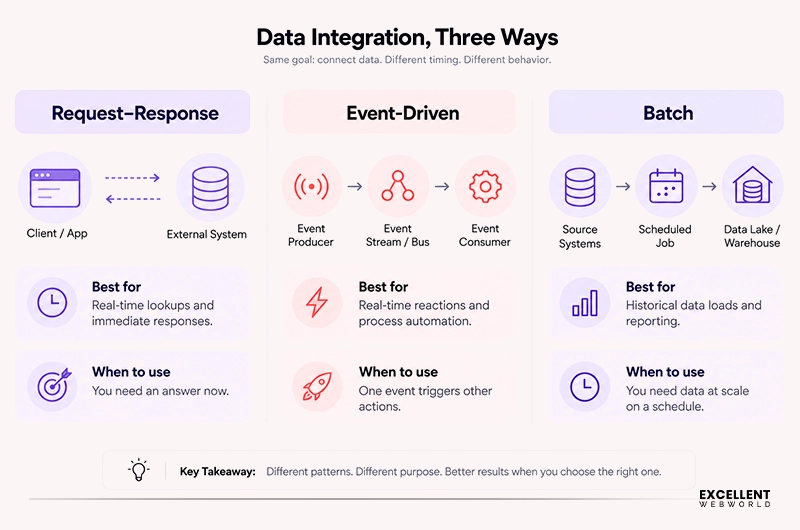
Data integration commonly follows these 3 patterns;
- Request-Response: It is like one system sends a request & wait for a response. A BNPL checkout system that is requesting a real-time credit score from a bureau can be said to be a typical example. This interaction commonly utilizes REST or GraphQL APIs, where a well-defined API layer actually helps to determine how reliably & quickly systems actually exchange information.
- Event Driven: This is basically a pattern that systems follow while publishing any events when something happens, allowing other systems to react continuously & asynchronously without any waiting for any responses. For example, a telematics feed can stream a truck’s GPS system or even delay events so that a logistics platform can promptly respond in real time.
- Batch: The datasets actually move in scheduled, high-volume loads rather than in any continuous manner. You can take a nightly extract of the previous day’s transactions into a data warehouse for reporting, for example.
These patterns generally support different kinds of data integration workflows and can be implemented through ETL, ELT, iPaaS, change data capture (CDC), reverse ETL, APIs, replication, and event streaming.
While they all share the same goal- getting datasets where it actually needs to be- the engineering process behind that is totally different. A nightly warehouse load & real-time fraud detection system both have data integration workloads, but the latency, scalability, and reliability needs are quite different.
The practical unit of data integration is the record, dataset, or streaming process. It is, in particular, a role that helps to ensure that the data arrives in the right format, at the right destination, at the right time. As reliable integration needs dedicated transformation, synchronization & data quality, organizations modernizing fragmented systems often rely on data engineering expertise prior to layering the workflow orchestration on top of it.
What Is Workflow Orchestration?
Workflow Orchestration is said to be the coordination layer that actually governs execution, not the data itself, but determines the sequence of tasks that act on it. Platforms like Apache Airflow, Prefect, Temporal, Dagster, Kestra & n8n are the ones that help coordinate workflows across systems through dependencies, scheduling, retries & execution state.
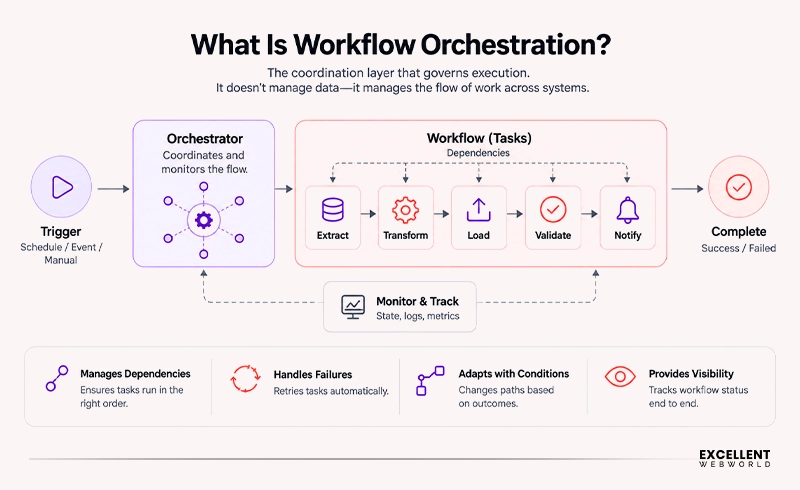
The core capabilities are;
- Sequencing and dependencies: This basically ensures that the downstream tasks run only after upstream tasks are successfully completed.
- Scheduling and triggering: Helps in executing workflows based on schedules, events, or dependency-based triggers.
- Retries and failure handling: With this as a core capability, it basically retries tasks automatically & applied recovery policies for better management.
- Conditional branching: It helps in changing execution paths as per the outcomes and any kind of business rules.
- End-to-end visibility: Manages the tracking process, where basically a multi-system workflow is in running, waiting, or failing status.
The workflow orchestration extends beyond the data pipelines into IT operations, infrastructure provisioning, business process automation, and increasingly agentic AI, where an agent can multiply services, wait for a human approval process, retry failed actions, and also choose different execution pathways. This is where agentic app development intersects with the production workflow architecture.
So, the practical unit of workflow orchestration is the task, workflow, or process. And its main purpose is to coordinate what runs, when it runs, and what’s in order while maintaining dependencies & failures to keep downstream processes more reliable.
Two Related Terms You Should Know
There are two adjacent terms that often blur the distinction between data integration & workflow orchestration, i.e., data orchestration & workflow automation.
Data orchestration is basically defined as the essential workflow orchestration that is applied to data domains, thus involving coordinating ingestion, transformation & delivery within data pipelines. It actually represents the data-focused aspect of orchestration, rather than any kind of broader business coordination in terms of IT and application workflows.
On the other hand, workflow automation is much narrower than orchestration. This basically triggers a task when an event occurs, like sending an email after a form submission process. Workflow orchestration generally coordinates multiple tasks across systems, manages their dependencies, and also helps to proceed when a task fails. In terms of automation, it runs a task, and the orchestration coordinates the process.
RPA is such a common example of task-level automation, where actions like extracting fields or submitting any form can become a broader aspect of the workflow when an orchestration layer coordinates RPA use cases by industry.
What Is the Difference Between Data Integration and Workflow Orchestration?
The easiest way to understand data integration vs workflow orchestration is to compare what each layer is designed to do in particular areas.
| Area | Data Integration | Workflow Orchestration |
|---|---|---|
| Core question | Did the data arrive, correctly formatted? | Did the right steps run, in the right order? |
| Unit of work | Record, dataset, stream | Task, workflow, process |
| Primary tools | ETL/ELT, iPaaS, MDM, CDC | Airflow, Prefect, Temporal, Dagster, Kestra, RPA/agent layers |
| Failure handling | Validation, deduplication, reconciliation | Retries, recovery logic, conditional branching, alerting |
| Scope | Data movement and transformation | Execution across data, infrastructure, and business processes |
| Typical trigger | A source system change or scheduled extract | A dependency, event, schedule, or upstream task completing |
You can simply think of it like this: data integration provides the instruments, while the workflow orchestration actually acts as a conductor, which generally ensures that every step runs in the right order, at the right time & also recovers properly when something goes wrong.
Why Does Data Integration Become Harder in Production?
Connecting the systems is usually considered easier, but the harder challenge actually is keeping the same information consistent across the systems that store a copy.
Three failure modes that define this problem and sit under the data integration architecture are;
- The Dual Write Problem: So, writing to two different systems, such as a database & a message queue, is not atomic by default. If one succeeds and the other fails, the system actually falls apart with out-of-sync data.
- Exactly Once is Mainly a Myth: Most streaming platforms tend to provide an at-least-once delivery process, then rely on idempotent processing that helps in establishing effective once behavior, rather than truly having one guarantee.
- Out-of-Order & Duplicate Events: Events can be delivered almost twice or sometimes out of order, thus creating a need for downstream systems to manage both safely.
This is why patterns such as change data capture (CDC), the transactional outbox pattern & reconciliation jobs exist, which simply answer complicated questions like, “Did the data arrive?” They ensure the dataset arrives in the correct way, at the scheduled time, and also with agreement with every other copy.
The required guarantees also depend on the workload conditions. A real-time payment feed system has almost no such tolerance for any inconsistency, while a nightly warehouse load system can actually withstand hours of latency. So treating every integration as if it needs the same guarantee is quite common, and sometimes gets costly due to architectural mistakes, especially during a move to cloud native infrastructure, in terms of scaling quickly exposing pipelines that are not meant for the production-level standard.
How Data Integration and Workflow Orchestration Work Together
Most enterprise systems actually rely on data integration and workflow orchestration together, rather than treating them as separate entities.
A typical workflow looks like;
- Workflow orchestration triggers a data extraction from a source system
- A data quality check validates the incoming datasets
- The validated data is loaded into the warehouse/operational system
- Downstream actions involving reports, model retention, or notifications run automatically, with retries or recovery logic if a step fails
Data integration moves and tends to reshape the information, while workflow orchestration, I would say, helps to determine when, why, and also what type of sequence those integration tasks run.
You can consider an example, like a supplier onboarding workflow system, which shows workflow orchestration that actually spans multiple systems, consisting of vendor management & validation, contract updates, and also the compliance screening, which can coordinate in parallel before procurement approval activates the supplier in the ERP system. Similarly, this same pattern also applies to AI agents in transportation management systems, where clean carrier & shipment datasets from the integration layer enable orchestration to manage routing & informed decisions rapidly.
Industry Use Cases: From Data Integration to Workflow Orchestration
So, I will say that the distinction mainly gets clearer when you see how integration & workflow orchestration actually work together across real-world enterprise workflows.
| Industry | Data Integration | Workflow Orchestration |
|---|---|---|
| Financial Services / BNPL | It unifies transactions, repayment, & bureau data for real-time credit decisions. | Helps run risk checks, implements models, routes gray zones, and also logs decisions. This reflects AI agents for loan approval & also supports the fintech app development process. |
| Healthcare / Disability Services | Helps in synchronizing participant plans, funding, services, bookings & billing across care systems. | It verifies workers’ eligibility, books services, triggers billing, and also escalates rejected claims. This is quite relevant to NDIS software development for the Australian market, which involves PRODA and PACE data standards alignment with service delivery. |
| Government / Public Sector | Here, it connects identity, eligibility, application, and department records into a unified applicant view. | Routes applications by approvals, enforces SLA deadlines, and also escalates stalled cases while maintaining an audit trail. As a result, it calls for compliance-driven engineering from the initial phase. |
| Logistics & Supply Chain | It unifies the telematics process, warehouse operations, customs, & also shipment datasets into a single operational view. | Generally, it triggers custom work processes, reroutes delayed shipments, sends notifications & retries failed carrier API calls. AI agents in logistics can add some contextual decision-making on top of the orchestration layer, along with logistics software development for a broader scope. |
| Retail / E-commerce | Synchronizes inventory management, orders, & payment datasets across sales channels to maintain accurate stock levels. | It coordinates the payment verification process, inventory reservation, fulfillment, and rollbacks when there is an out-of-stock situation. Modern warehouse automation technology adds another orchestration layer coordinating eCommerce development. |
| Workforce / Staffing (FIFO Recruitment) | It consolidates the candidates’ profiles, certifications, and also site rotation schedules across client systems. | Helps in matching the candidates to the rotations, validates certifications before placement, and also triggers rechecks & alternate candidate searches when compliance needs change. |
Key Takeaway: Integration makes the right set of data available to you, and orchestration then brings you what happens after that. In enterprise systems, these two work collaboratively: integration connects systems & data, while orchestration coordinates the decisions, actions, exceptions & approvals that build on top of that.
When Orchestration Needs to Reach Beyond Data
Enterprise teams have traditionally managed separate coordinators for the data pipeline system, infrastructure automation, business processes, and IT scheduling. This transformative shift is towards a shared orchestration layer that actually coordinates the workflow with unified visibility & governance.
Agentic AI is accelerating a lot and creating this change because a single agent can generally read, call APIs, update records, and also wait for approvals across multiple systems. That is the reason why orchestration tools like Airflow, Dagster, Temporal, Camunda, Pega & Terraform are increasingly converging, while open-source AI agent frameworks generally bring AI-native workflows into the same ecosystem.
It also needs to be noted that orchestration is not a replacement for the data integration aspect. Higher-volume data movements, connectors, schema handling & transformations are the ones that still belong in the integration layer, a lesson I would say that every team needs to learn during legacy system modernization.
Why the Distinction Matters More With Agentic AI
It can be said that the integration orchestration distinction is no longer just a theoretical concept. With the increase in AI agents executing multiple workflow steps beyond fixed pipelines, orchestration becomes the controlling layer that actually governs decisions, approvals, execution, & great auditability.
Some of the few industry signals that I think make some dynamic shifts are;
- Gartner projects that up to 40% of enterprise applications will include task-specific AI agents by 2026, up from less than 5% today, signaling the shift from AI that answers questions to AI that can act.
- Deloitte’s 2026 research report observed that nearly three-quarters of organizations expect to utilize agentic AI within 2 years, while 21% have mature governance models for the AI agents. This matters in regulated use cases such as AI agents for KYC and AML, where informed decisions produce an auditable trail.
- The industry benchmarking is quite clear: data integration moves the datasets, orchestration determines the pathways. With agentic AI systems in ERP, agents can now decide which system to query and which integrations to trigger.
So, keeping these layers different gives enterprises much greater control, observability, and reliability in agentic workflows.
Lineage Starts With the Architecture
Lineage is something where you can make the integration-orchestration distinction tangible.
- Data Lineage tracks data origin and the process of how it is transformed across integration pipelines.
- Process Lineage generally tracks which tasks actually ran, in which order, and across which systems during a specific execution.
So, both actually need to be designed into the architecture, and basically not treated as an automatic feature of individual tools. An open standard like OpenLineage can simply unify events across integration & orchestration platforms into a shared independent platform catalog system.
Start With the Problem, Then Choose the Layer
In terms of selecting the right architecture, you should start by identifying whether the challenge is migrating datasets, coordinating processes, or both.
- If the problem is like, “Our systems can’t share data,” data integration can connect the siloed systems via API events or in terms of batch pipelines.
- In terms of “Our processes fail or run in the wrong direction,” workflow orchestration tends to manage the dependencies and execution with end-to-end visibility.
- While having both present challenges that most of the mature enterprises face, integration enables moving and transforming data, while orchestration coordinates the utilized process.
So, keeping the two layers separate makes your architecture much easier to govern, scale, and maintain lots of processes in a streamlined manner.
From Connected Data to Intelligent Workflows With Excellent Webworld
Data integration & workflow orchestration actually solve different but connected problems, starting with integration, which connects systems and data transfers; while orchestration coordinates the processes that use it. Keeping these layers separate with the right consistency, lineage, error handling, retries, and human oversight creates a stronger foundation for enterprise automation & agentic AI systems.
Excellent Webworld brings these capabilities together, thus connecting siloed CRM, ERPs, and legacy systems while developing orchestration layers that coordinate business processes, handle exceptions, and support human-in-the-loop decisions. For enterprises that are moving beyond the pipelines, our data engineering services & agentic AI development services can help turn connected datasets into scalable smart workflows.
The goal is simply not to choose between integration and orchestration, but to architect both so that they can work together.
- Data integration connects the systems; orchestration connects the steps.
- APIs and events move data and trigger actions, while orchestration manages what happens next.
- Reliable integrations are the foundation of dependable workflows.
- Orchestration becomes critical when workflows involve dependencies, decisions, retries, approvals, or long-running tasks.
- Data lineage explains the data journey; process lineage explains the workflow journey.
- Integration and orchestration should be designed as complementary architectural layers, not competing approaches.
- Agentic AI can make orchestration more adaptive, but it still depends on governed data and reliable system integrations.
FAQs
Data integration connects systems and moves or transforms data, while workflow orchestration coordinates tasks, dependencies, decisions, and execution across those systems.
Yes. Integration connects systems and makes data available, while orchestration determines when and how that data is used within a business process.
An API is primarily an integration mechanism for exchanging data or triggering actions. Orchestration coordinates multiple APIs and tasks into an end-to-end workflow.
Popular tools include Apache Airflow, Prefect, Temporal, Dagster, Kestra, and n8n. The right choice depends on workflow complexity, event handling, scheduling, and observability needs.
Orchestration is valuable when workflows involve multiple systems, dependencies, conditional logic, retries, approvals, or long-running tasks.
Agentic AI can dynamically choose actions and next steps based on context, making workflows more adaptive. This also increases the need for governance, monitoring, and reliable integrations.
Data lineage tracks where data comes from and how it changes. Process lineage tracks which tasks ran, in what order, and across which systems.

Article By


Mayur Panchal is the CTO of Excellent Webworld. With his skills and expertise, he stays updated with industry trends and utilizes his technical expertise to address problems faced by entrepreneurs and startup owners.