Building a React Native app in 2026 typically costs between $10,000 and $300,000, depending on your app’s complexity, features, and the team you hire. For businesses evaluating “React Native app development cost,” that’s a wide range — and knowing what drives it makes all the difference between a well-planned budget and an expensive surprise.
React Native has become a go-to framework for cross-platform development because it lets teams build once for both iOS and Android. This single-codebase approach cuts development time and cost by 30–40% compared to native apps, making it a strong choice for startups and enterprises alike.
But cost isn’t just about the framework. Developer location, app design, third-party integrations, and ongoing maintenance all shape the final number. Understanding these variables before you commit is what separates smart product decisions from reactive ones.
This guide breaks down every cost factor, shares practical budgeting tips, and explains why React Native remains one of the most cost-efficient choices for mobile app development in 2026.
What is React Native?
React Native is an open-source mobile application framework developed by Meta (formerly Facebook). Entrepreneurs can create their own cross-platform apps using JavaScript and React while getting native-like performance and user experience for their audiences.
The most significant benefit of using React Native is that it allows you to create apps for Android as well as iOS with the same codebase. A single-time coding saves costs as well as development time. In fact, this is one of the crucial reasons which makes React Native popular among entrepreneurs.
In 2024, React Native introduced the New Architecture, which comprises features such as Fabric renderer, TurboModules, and the JavaScript Interface (JSI). It became the default and stable version after React Native 0.76. With the new architecture coming into play, performance was significantly boosted, overhead was reduced, and the skills required of developers changed. So, when you’re estimating the cost of React Native apps, make sure you factor in teams with experience with the new architecture.
As we mentioned, the React Native framework is popular. Check out its current rating and stats below, which prove entrepreneurs really like it.
React Native Popularity Stats
| Popularity Metrics | React Native |
|---|---|
| Stack Overflow Questions | 140,838 |
| GitHub Stars | 126K |
| GitHub Forks | 25.1K |
| GitHub Issues | 27,637 |
| Reddit Members | 56K |
| X Followers | 241.7K |
React Native App Development Cost Breakdown
To give you a better understanding of where your money goes, let’s break down the roles and responsibilities wise costs associated with building a React Native app.
1. Developer Rates
The hourly rate is a crucial variable in the overall cost of app development. If you hire React Native developers with years of experience and marvellous expertise in expensive living regions, then it will cost you a lot. The developer’s rate varies based on experience, skills, and location.
Updated 2026 developer rate estimates:
- North America (USA/Canada): USD 60 to 150 per hour
- Western Europe (UK/Germany/France): USD 60 to 130 per hour
- Eastern Europe (Poland/Ukraine/Romania): USD 30 to 80 per hour
- Asia (India/Philippines/Vietnam): USD 20 to 50 per hour
- Middle East (UAE/Saudi Arabia/Qatar): USD 30 to 100 per hour
2. Design and User Experience Costs (UI/UX Designers)
Good UI/UX design equals a successful application. The design process involves wireframing, prototyping, and crafting the final visual design. Given the React Native app’s design complexity, expect 20% to 30% of your total budget to be allocated to design costs.
3. Testing and Quality Assurance (App & QA Testers)
You can’t miss the testing step in the mobile app development process. You have to test your application across various devices. This includes manual testing, automated testing, and bug fixing. Testing may account for 15% to 20% of the development budget.
4. Project Management (Project Managers)
The proper project management ensures that the development process stays on track, meets timelines, and maintains quality standards. Skilled project managers generally charge between USD 30 and USD 100 per hour, and their fees will typically make up 10% to 15% of the total project cost.
If you need a consultant who can deliver your project as per your expectations, then you must connect with experienced project management consultants like Excellent WebWorld. Professionals at EWW won’t let you down for sure.
Top 7 Factors Influencing React Native App Development Cost
When it comes to understanding how much a React Native app costs, several factors matter to the total price. Let’s break down some of the most important ones.
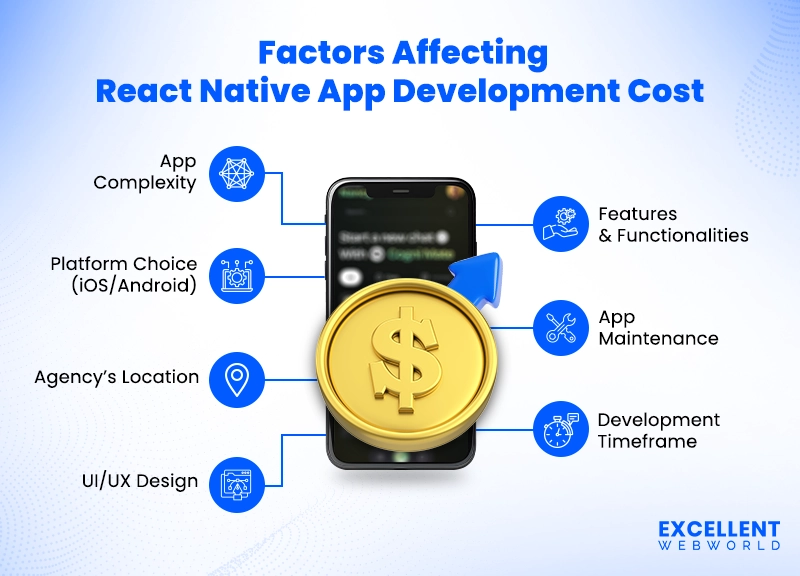
1. App Complexity
Among all, the complexity of the application is the primary factor that influences the React Native app development cost.
The application can be divided into three different levels – Basic (simple informational app or a basic service app), Moderate (integrations, database, etc.), and High (e-commerce platform, social media app, etc.). According to that, React Native app cost varies:
| App Complexity | Average Cost | Development Time |
|---|---|---|
| Basic | USD 18,000 to 35,000 | 2 to 4 Months |
| Moderate | USD 45,000 to 80,000 | 4 to 8 Months |
| High | USD 90,000 to 300,000 | 8 to 12 Months |
- Basic apps typically include simple UI, limited functionality (like push notifications), and no complex integrations.
- Medium complexity apps have features like API integrations, database management, use of native modules, advanced UI/UX, or custom user authentication.
- High-complexity apps generally include multiple user roles, advanced security features, complex integrations, and scalable infrastructure.
2. Platform Choice (iOS/Android)
If you plan to launch your application on iOS and Android, the cost will definitely be higher compared to just creating an app for one single platform.
And that’s the most liked benefit of the React Native framework: it lets you create apps with a single codebase. But platform-specific customizations and native modules still require additional effort, thereby increasing the total development cost of the React Native app.
3. Agency’s Location
The location of your React Native app development company also plays an important role in determining the React Native App development cost. Typically, agencies situated in countries with higher living costs (such as the United States, Canada, or Western Europe) will charge more for their services.
Besides, offshore development companies in countries like India, Ukraine, or the Philippines tend to charge lower rates while still delivering quality work.
Let’s see how much a React Native app costs country-wise:
| Country / Region | Hourly Rates (2026) |
|---|---|
| North America | USD 120 to 150 |
| South America | USD 30 to 120 |
| Eastern Europe | USD 30 to 80 |
| Western Europe | USD 70 to 150 |
| Asia | USD 20 to 90 |
| Australia | USD 45 to 150 |
| Middle East | USD 30 to 80 |
4. UI/UX Design
The app design outcome is directly connected to user experience, that’s why it plays a key role in the overall success of the app. If you want a visually stunning and highly interactive app design, then expect to do more revisions and allocate more resources to design. You can save yourself from multiple revisions by hiring experienced UI/UX designers from reputed mobile app design service providers like Excellent WebWorld.
With React Native, UI/UX design can range from simple and straightforward to highly complex, you can add custom animations, transitions, and intricate layouts.
5. Features and Functionalities
Some advanced features and integrations, such as payment gateways, geolocation services, push notifications, and social media integrations, can increase the cost of React Native app development. Advanced functionalities such as real-time chat or artificial intelligence integration will also increase development time and costs.
Here are some features and their estimated integration cost. Have a look:
| Features | Average Cost |
|---|---|
| Login Interface | USD 2,000 to 4,000 |
| Admin Panel | USD 4,000 to 6,000 |
| API Integrations | USD 5,000 to 5,500 |
| Notification Panel | USD 5,000 to 7,500 |
| Geolocation | USD 15,000 to 20,000 |
| IoT Integration | USD 25,000 to 30,000 (varies by protocol) |
| Streaming Portal | USD 5,000 to 10,000 |
| E-Commerce | USD 10,000 to 15,000 |
Note: The cost of IoT Integration varies depending on the complexity of your use case and the hardware protocol (e.g., BLE, Zigbee, MQTT). The above-mentioned range can be a starting point for you. For detailed cost estimation, connect with our industry experts.
6. App Maintenance
Maintaining an app is not something you can skip after a launch. An app developed with the React Native framework or any other framework must be tested completely across multiple devices to ensure it keeps functioning as planned.
Because of this, it is recommended to hire a React Native app development company like Excellent WebWorld that meticulously tests your application to enhance its performance.
App updates, design changes, and bug fixes are an integral part of the app maintenance costs, which are considered under React Native app development expense.
7. Development Timeframe
The 7th crucial parameter affecting React Native app development cost is the total time required to craft an application. The React Native application with more complexity, API integrations, and features needs more time to develop than a simple one.
Moreover, testing and debugging also add more time to the development process. Therefore, you must define your app scope clearly and ensure your development team sticks to the timeline.
New Architecture: Cost & Complexity Implications
So far, we have seen the common factors that influence the cost of the React Native app development process. However, there’s one more point you need to take into account: React Native’s new architecture (stable since RN 0.76 in 2024).
The new architecture introduces three pillars: the Fabric UI renderer, TurboModules, and the JSI (JavaScript Interface). These pillars together aim to eliminate the asynchronous JS bridge, which used to create performance bottlenecks.
Here’s how the new architecture influences the React Native app development cost:
- If you migrate your existing React Native application to the new architecture, you need additional development time, which will increase the project’s upfront cost.
- If you opt for the new architecture, developers will definitely need a new skill set to work with it, thereby increasing hiring costs or requiring paid training before the project begins.
- In addition to all that, new architecture will introduce incompatible third-party tools that you’ll need to replace, adding unplanned costs and delaying your delivery timelines.
- In the long term, the new architecture provides better performance, so fewer bugs and optimization efforts are needed, thereby reducing the operational costs.
- Lastly, the new architecture will introduce smoother development workflows, enabling you to ship features more quickly and lowering the overall cost per feature.
Expo Managed vs Bare Workflow — Cost Comparison
There are two major approaches to starting a React Native app development project: (a) Through Expo Managed Workflow and (b) Using Bare Workflow.
React Native’s official documentation advises you to use the Expo Managed workflow for building any application. However, you also have the option to opt for Bare Workflow.
First, let’s briefly understand both development approaches before we examine how they affect the cost of React Native app development.
(a.) Expo Managed Workflow: Here, Expo manages the entire native build layer. You just have to write JavaScript/TypeScript code. No need for managing Xcode or Android Studio.
Perfect for MVPs, startups, and small teams. Cost stays low because you need fewer engineers and less infrastructure, but customization is limited.
(b.) Bare Workflow: Here, you have complete access to iOS and Android code. You can integrate any third-party SDK, write custom modules, and fine-tune performance.
You need experienced native app developers to use this option. Cost here can increase significantly due to specialized developers, self-hosted CI/CD pipelines, and maintenance.
Now, let’s look at how both approaches impact the React Native application development cost:
| Factor | Expo Managed Workflow | Bare Workflow |
|---|---|---|
| Setup Time | Low (Minutes) | Moderate-High (Days) |
| Developer Skill Cost | Low | High |
| Build Infrastructure | EAS Build | Self-Hosted |
| OTA Updates | Included | Requires Extra Setup |
| Cost Impact | Lower (faster dev) | Higher (more control) |
| Third-Party Native SDKs | Limited Access | Full Access |
| Custom Native Modules | Not Possible | Fully Supported |
| App Store Submission | Automated | Manual |
| Long-Term Maintenance | Low | High |
| Team Size Needed | Small | Large |
| Best For | MVP & Startups | Complex/Scaled Apps |
AI-Assisted React Native Development — Cost Savings
With the introduction of AI coding assistants like GitHub Copilot, Lovable, Cursor, Bolt, Claude Code, and more, the dynamics of app development costs have changed dramatically over the last 3-4 years. According to a McKinsey survey, teams using AI in software development increase productivity and time-to-market (16 to 30 percent) and software quality (31 to 45 percent).
By that same logic, the team that uses AI-assisted React Native app development will be able to reduce development effort for standard, repeatable tasks, such as component scaffolding, unit test generation, API integration boilerplate, and documentation.
For example, if a moderate-complexity app with a traditional approach costs you around USD 60,000, the AI-assisted approach can save you USD 9,000-15,000.
React Native vs Flutter vs Native — Cost Comparison
If we’re talking about React Native app development costs, you would also be interested in how it compares to Flutter, a major competitor to React Native and native app development.
Here’s a factor-by-factor comparison of React Native, Flutter, and native apps:
| Factor | React Native | Flutter | Native (iOS+Android) |
|---|---|---|---|
| Codebase | Single (JS/TS) | Single (Dart) | Two separate codebases |
| Avg. Cost (Moderate App) | USD 45K–80K | USD 40K–75K | USD 80K–160K |
| Dev Speed | Fast | Fast | Slow |
| Talent Pool | Large (JS devs) | Growing | Platform-specific |
| Performance | Near-native (New Arch) | Near-native | Native |
Freelancer vs Agency vs In-House — Which Is Right for You?
Another perspective from which you should evaluate the cost of React Native app development is the hiring model you choose. Now, there are three most prevalent hiring models that you can opt for: freelancer, agency, or in-house. Based on that, the cost varies as follows:
| Factor | Freelancer | Agency | In-house |
|---|---|---|---|
| Cost | Low ($20–$80/hr) | Medium–High ($50–$200/hr) | High (salary + benefits) |
| Quality Consistency | Variable | Structured & consistent | High (if well hired) |
| Speed to Start | Fast | Medium (onboarding) | Slow (hiring takes time) |
| Best For | MVPs, small features | Full product builds | Long-term product ownership |
Hidden & Post-Launch Costs to Budget For
Many businesses overlook ongoing costs after launch.
Here are the key post-launch expenses to plan for:
| Cost Item | Estimated Cost |
|---|---|
| Apple Developer Program | USD 99/year |
| Google Play Developer | USD 25 one-time |
| Server/Cloud Hosting | USD 200–5,000/month |
| Third-party API Subscriptions | USD 50–2,000/month (varies) |
| Annual App Maintenance | 15–20% of original dev cost/year |
| EAS Build (Expo) | Free tier available; USD 99–449/month (paid) |
Why Do Businesses Choose React Native App Development?
React Native has gained widespread popularity among entrepreneurs, but do you know why it is often the preferred choice for app development? Here are some key reasons why businesses are opting for React Native app development.
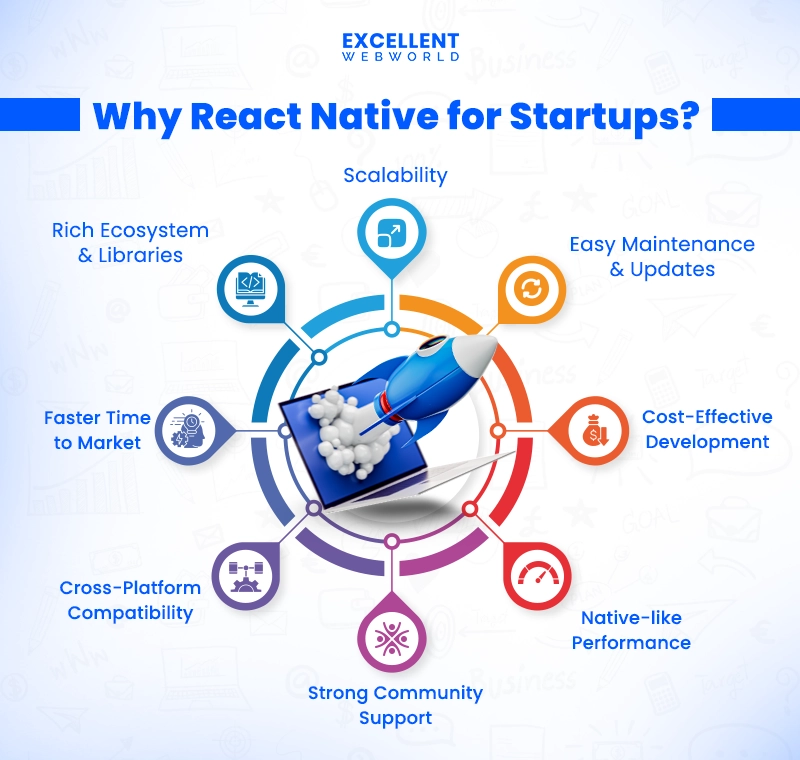
- Cost-Effective Development: Developed with a single code for both iOS & Android — typically 30–40% cheaper than native.
- Faster Time to Market: Speed up the development process with reusable components and a shared codebase.
- Cross-Platform Compatibility: Ensures consistent user experience across multiple devices and operating systems.
- Strong Community Support: React Native community provides a wealth of resources, libraries, and frameworks.
- Performance Close to Native Apps: With the New Architecture, React Native delivers excellent performance for most app categories.
- Easy Maintenance and Updates: App maintenance is more straightforward than native apps.
- Rich Ecosystem and Libraries: A wide range of libraries, plugins, and tools allows businesses to integrate advanced features easily.
- Scalability: Allow businesses to grow the app’s functionality without rewriting large portions of code.
Well-known Brands That Trust React Native Framework
Because of its efficiency, scalability, and cross-platform capabilities, many leading companies across different industries have adopted React Native for mobile app development. Here are some of the well-known brands that trust React Native: Facebook, Instagram, Tesla, Puma, Pinterest, SoundCloud, Flipkart, Bloomberg, Discord, Coinbase, Uber Eats, and many more.

Don’t skip the next section because it contains some pro tips that help you save money on React Native app development costs. Scroll Down!!
Budgeting Tips for React Native App Development
While React Native app development can be expensive, there are some escapes on costs without compromising quality:
Outsource to Countries with Lower Labour Costs
Hire React Native app developers from regions where hourly rates are lower, which saves you a considerable amount of money. With companies like Excellent WebWorld, you can receive quality work at affordable prices.
Build a Minimum Viable Product (MVP)
Start your project by building an MVP with core features and try to launch early. You can then work on enhancing app features and performance based on user feedback.
Use Open-Source Libraries and Pre-built Components
Take advantage of a wide range of React Native open-source libraries, tools, plugins, and pre-built components to speed up mobile application development and reduce costs.
Leverage Expo for Faster Builds
You can use Expo’s managed workflow to reduce development time upfront. It will also help you to simplify CI/CD pipeline management and app store submission, thereby reducing DevOps overhead and enabling faster development.
Prioritize Core Features
Make sure that your application only consists of the most important features at the initial stages. By prioritizing the core functionalities, you can launch the app faster and at a lower expense. Later, you can work on additional app features in new versions based on the direct demand of users.
Keep an Eye on Project Scope Creep
Scope creep occurs when new features or requirements are added without proper planning, which causes delays and budget overruns. To avoid this, set clear expectations with your development team from the beginning. If you see a need for any new feature, assess its impact on both cost and timeline before taking any further steps.
Final Words
React Native remains one of the smartest investments for mobile app development in 2026. The final cost depends on your app’s complexity, design, feature set, team location, and ongoing maintenance needs. Understanding these factors early gives you the clarity to budget confidently and avoid mid-project surprises.
Whether you’re building an MVP or a full-scale enterprise app, React Native’s cross-platform efficiency continues to deliver real cost advantages over native development. Plan strategically, prioritize the right features, and partner with an experienced team — and your investment will drive measurable business results.
Ready to get an accurate estimate for your project? Connect with Excellent WebWorld and turn your app idea into reality..
FAQs
Yes, React Native is definitely 30-40% cheaper than native app development, as you can develop apps that run on both iOS and Android from a single codebase, thereby reducing development and maintenance costs.
Based on the app type, complexity, and features, development time varies. A basic mobile app can take 2–4 months, a moderate app 4–8 months, and a high-complexity app 8–12 months or longer.
With the New Architecture (React Native 0.76+), performance is near-native. However, if you’re developing a computation-heavy app (such as a game, AR, or real-time video processing) or a highly graphics-intensive app, native development is still a preferred option.
Yes, ongoing costs include maintenance (15–20% of dev cost/year), updates, server hosting, bug fixes, App Store fees, and adding new features based on user feedback.
React Native is ideal for most mobile apps, particularly those that are required to launch on both iOS and Android. However, for highly complex or performance-intensive apps, native development may be preferred.
React Native and Flutter have similar cost profiles. Flutter apps are slightly cheaper because Dart performs better in benchmarks. However, because React Native has a large talent pool, you can hire more cost-effectively. For most projects, the cost difference is under 10%.
Common hidden costs include: Apple Developer Program ($99/year), Google Play registration ($25 one-time), cloud hosting ($200–$5,000/month), third-party API subscriptions, EAS Build plans (if using Expo), and ongoing maintenance (15–20% of original dev cost per year).
Plan for approximately 15–20% of your original development cost annually. For example, if your app costs USD 60,000 to build, budget USD 9,000–12,000 per year for maintenance, updates, and bug fixes.

Article By


Paresh Sagar is the CEO of Excellent Webworld. He firmly believes in using technology to solve challenges. His dedication and attention to detail make him an expert in helping startups in different industries digitalize their businesses globally.


