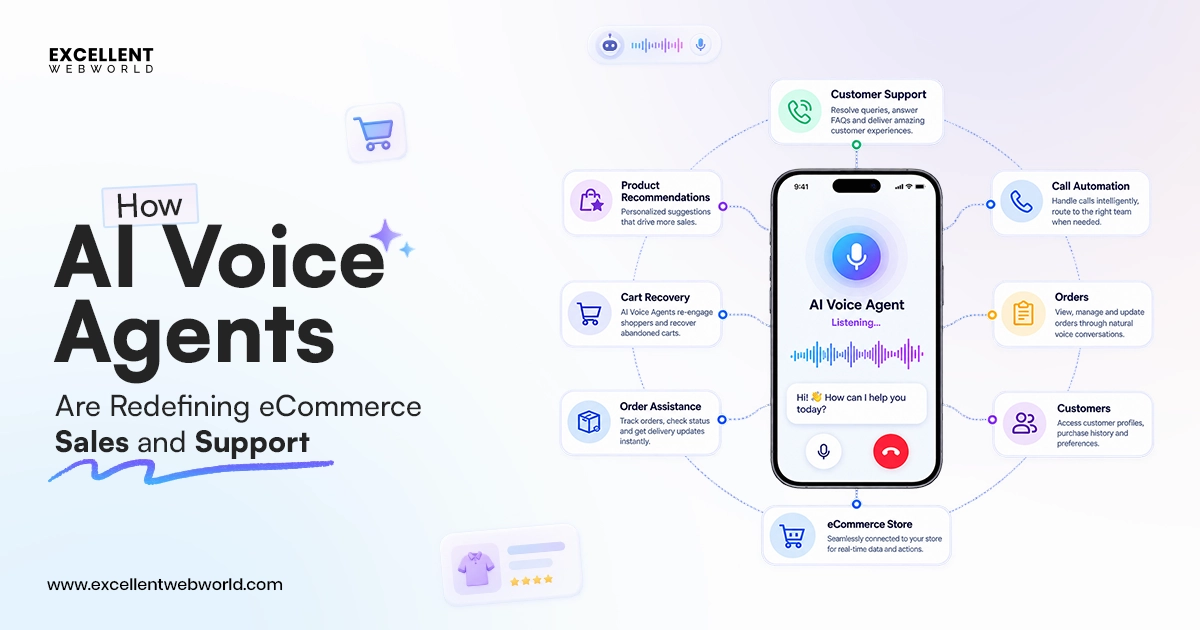
Why do most AI tools for eCommerce still stop at suggestions? They recommend a product; however, these tools do not place an order. I argue that this gap is where enterprises and businesses worldwide are falling behind in 2026.
AI agent use cases for eCommerce go far beyond chatbots. Businesses can now use AI agents for product discovery, abandoned cart recovery, order management, personalization, inventory, pricing, fraud detection, order tracking, and post-purchase support.
Gartner indicates that 40% of enterprise applications will integrate AI agents by the end of 2026. In my experience, eCommerce is evolving at a tremendous pace, as AI agents handle essential tasks such as returns and stock checks.
I have over 15 years of experience in building successful eCommerce projects for enterprises and businesses. These projects involve connecting platforms and business workflows, and therefore, I believe that the value of AI agents is far more than that of standalone AI tools. Today, that work shapes the eCommerce development services we deliver, where AI agents are part of the plan, not an afterthought.
In this blog, I will explain the most relevant AI agent use cases, the KPIs they influence, and when building an AI agent is a suitable choice.
What is an AI Agent in eCommerce and How Is It Different from a Chatbot?
An AI agent for eCommerce goes beyond basic conversation. An AI agent understands the goal of a shopper or a business system, analyzes the context, accesses approved data and systems, and takes actionable steps to resolve the task or request. This is the foundation for how AI agents work in eCommerce.
A chatbot is primarily conversational. An AI agent combines conversation, reasoning, tools, and action to check orders, verify return eligibility, recommend products, or trigger a replenishment task according to defined permissions. Its autonomy varies according to the task, risk, and controls involved.
| Factor | Traditional Chatbot | AI Agent |
|---|---|---|
| Primary Role | Answers Questions | Completes goals or tasks such as conversation, reasoning, and action |
| Context | Limited | Maintains task context |
| Data access | Usually restricted | Can access approved business systems and tools |
| Decision-making | Limited, follow fixed rules | Can reason within set boundaries |
| Actions | Can’t complete tasks itself | Executes approved tasks |
| Multi-Step Workflows | Not supported | Can handle multi-step tasks |
The difference between these technologies plays a vital role, as eCommerce now requires AI to connect conversations with business workflows.
A chatbot can explain the return policy, while a modern AI agent can fetch an order in real time, check eligibility, and process the return. This ability of AI agents to reason, use multiple tools, and execute different workflows shows why they are better suited for complex commerce operations. Therefore, enterprises and businesses now consider AI agent development as an alternative to a scripted chatbot flow.
AI Agent Use Cases for eCommerce: From Automation to Autonomy
AI agents can support eCommerce across customer experience, revenue generation, and core operations, extending the broader benefits of AI in eCommerce through systems that can also take action. But keep in mind that not every use case has a similar business value or requires the same level of investment.
The use cases for eCommerce are divided into four categories: speed of deployment, revenue and customer impact, operational impact, and the level of autonomy required. This helps enterprises distinguish quick-win workflows from higher-value agentic applications that need deeper integration and greater decision-making autonomy.
Quick-Win AI Agent Use Cases You Can Deploy Now
The AI agent use cases can usually be deployed with comparatively limited integration and defined levels of autonomy, which makes them a great option for businesses beginning their journey of AI agents for eCommerce.
1. Order Tracking and WISMO
The Problem: Customers often contact support to ask “Where is my order?” Support teams spend their time fetching data across carriers and shipment systems to answer this question. Delivery delays can further generate additional inquiries.
How an AI Agent Helps: An AI customer support agent starts by pulling the order details and checking in with carrier systems. It then interprets the shipment status and delivers a contextual response. It can even identify exceptions, such as a lost package, route delay, or unusual orders, and escalate complex cases to human support.
Business Impact: This reduces repetitive support workload while enhancing response speed and visibility.
Key KPIs: WISMO ticket volume, resolution time, support handling time, and CSAT.
2. AI Agent for Abandoned Cart Recovery
The Problem: Generic abandoned cart reminders through email or other channels treat customers the same way. They don’t consider why a customer abandoned the cart in the first place, whether it was due to price, product fit, shipping, or another reason. A shopper who left due to shipping costs needs a different message than a shopper who just got distracted.
How the AI Agent Helps: An AI agent for abandoned cart recovery analyzes the cart and understands the context behind it, such as pricing, product availability, and customer browsing history. It then determines a suitable follow-up, answers likely objections, recommends alternatives, or triggers personalized communication according to predefined rules.
Business Impact: Highly relevant intervention can improve conversion rates and recover otherwise lost revenue.
Key KPIs: Cart recovery rate, recovered revenue, conversion rate, and average order value.
3. Returns and Refund Orchestration
The Problem: Returns require complete synchronization between inventory, payment systems, policy rules, and customers. Coordinating these processes manually creates delays and increases support workload.
How the AI Agent Helps: This is where agentic AI for eCommerce demonstrates its capabilities. The AI agent retrieves the order, checks eligibility, validates applicable policies, initiates the return or refund, updates the connected order management systems, and alerts the customer. Human approval may still be required in the case of exceptions or high-value refunds.
Business Impact: This helps reduce return resolution time and lower support workload, while enhancing the customer experience.
Key KPIs: Return resolution time, refund processing time, cost per return, and CSAT. It also shows why more retailers now invest in agentic AI development rather than relying on one-off return automation, even when they first implement RPA in eCommerce to cover the rule-based steps.
Revenue and Personalization AI Agent Use Cases
These AI agent use cases emphasize enhancing product discovery, personalization, customer engagement, and pricing decisions. They can directly affect conversion, basket size, retention, and revenue when connected to relevant commerce and customer data.
1. AI Shopping Agent for Product Discovery and Digital Shopping Guidance
The Problem: Traditional search depends heavily on keywords, filters, and predefined product categories. This approach can be limiting for customers who have complex needs or cannot easily describe what they want.
How an AI Agent Helps: An AI shopping agent interprets natural-language intent rather than relying only on filters. It asks clarifying questions, searches catalog data, compares products, and uses customer context (purchasing history and browsing data) to narrow down the options and provide suitable guidance — one of the more common agentic RAG use cases in commerce today.
Using multimodal AI, AI agents can interpret images in addition to text to enhance product discovery. This is similar to what our AI visual search module does for image-based discovery. In the end, it creates a smooth path from product search to purchase.
Business Impact: AI-guided discovery reduces friction during product selection, which helps customers find relevant products quickly and improves the likelihood of purchase.
KPIs: Search conversion rate, discovery time, overall conversion rate, and AOV.
2. Personalized Product Recommendations
The Problem: Rule-based recommendation engines usually depend on limited customer signals. They may suggest products based on past purchases or browsing behavior without understanding what the customer actually wants at that moment.
How an AI Agent Helps: An AI agent can analyze browsing behavior, purchase history, stated preferences, customer intent, live product availability, and contextual signals before determining what to recommend.
Compared to static recommendation rules, agentic systems can evolve and deliver relevant suggestions as customer intent changes. This extends the principles behind eCommerce personalization into adaptive and agent-based experiences.
Hence, an AI agent for product recommendations works well for large catalogs where relevance affects conversion and basket size.
Business Impact: Context-aware recommendations improve product discovery throughout the shopping journey, which leads to more upsell and cross-sell opportunities without feeling forced.
KPIs: Recommendation CTR, conversion rate, AOV, and revenue per visitor.
3. Personalized Marketing and Loyalty Optimization
The Problem: Traditional marketing depends on predefined customer segments and campaign rules. These approaches cannot react when an individual’s customer behavior, buying signals, and engagement change in the middle of the shopping journey.
How an AI Agent Helps: An AI agent can identify customer segments, detect buying signals, and decide on a suitable action for that shopper. It can even deliver tailored offers and content, trigger campaigns, and analyze the results. It ensures complete synchronization with marketing, CRM, commerce, and loyalty systems within defined business policies.
Business Impact: An AI agent for personalization allows businesses to turn loyalty programs into something that adapts to each customer, rather than following a blanket discount calendar. This enables businesses to improve and measure repeat purchase rate, retention rate, customer lifetime value, and campaign conversion rate.
KPIs: Repeat purchase rate, CLV, campaign conversion rate, and retention rate.
4. Dynamic Pricing
The Problem: Pricing decisions should give equal importance to demand, inventory, competitor activity, margins, active promotions, and customer behavior. Managing all these factors manually at a catalog scale is not realistic.
How an AI Agent Helps: An AI agent for dynamic pricing can analyze market signals in real time, identify pricing opportunities, and recommend or modify prices within a set of business rules. Enterprise deployments should implement guardrails, approval thresholds, margin floors, and auditability before enabling agents to affect pricing decisions.
Business Impact: AI-assisted pricing results in faster responses to market conditions while protecting margins and maintaining commercial boundaries. It also creates opportunities to improve margins and sell-through by responding to changes in demand, inventory, and market conditions.
KPIs: Gross margin, conversion rate, revenue per product, and sell-through rate.
Operations and Backend AI Agent Use Cases
These use cases focus on the operational side of eCommerce, where AI agents can support inventory, supply chain, logistics, and fraud management. They allow businesses to respond to changing conditions while reducing manual intervention across connected systems.
1. Inventory Forecasting and Replenishment
The Problem: Demand velocity, evolving customer behavior, a single viral promotion, or a regional shift can make inventory planning very difficult. Static forecasting models can struggle when conditions evolve rapidly.
How an AI Agent Helps: An AI agent can evaluate sales, demand patterns, inventory levels, promotions, seasonality, and other real-time signals. It can forecast demand, identify low- and high-stock risks, calculate replenishment requirements, and suggest or trigger actions within predefined inventory policies.
Therefore, an AI agent for inventory management in eCommerce can work well for enterprises handling dynamic product catalogs and broader AI in retail operations.
Business Impact: Agent-driven inventory decisions help reduce stockouts and overstocking, along with improving inventory availability and working capital efficiency. This is similar to our approach to AI inventory management systems, designed specifically for real-time decision-making.
KPIs: Forecast accuracy, stockout rate, inventory turnover, and carrying cost.
2. Supply Chain and Logistics Orchestration
The Problem: Supply chain exceptions rarely stay in one system, and they need synchronization with suppliers, warehouses, carriers, and order management systems. Manual intervention can slow down resolution and increase fulfillment costs.
How an AI Agent Helps: In supply chain and logistics use cases, an AI agent tracks fulfillment events, identifies delays and exceptions early, and coordinates the right set of actions across connected systems in real time. It can escalate complex or unresolved issues depending on service levels and predefined workflows. In short, it supports real-time exception management across complex logistics operations.
Business Impact: Autonomous exception handling can improve fulfillment reliability, shorten resolution times, and decrease operational effort needed to manage complex logistics networks.
KPIs: On-time delivery, fulfillment time, exception resolution time, and logistics cost.
3. Fraud Detection
The Problem: eCommerce fraud rarely shows up as a single signal. It comprises various behavioral, transactional, and customer signals. Rule-based systems can find it difficult to manage all of these things at the same time.
How an AI Agent Helps: An AI agent evaluates transaction behavior, order patterns, customer history, and risk signals in real time to identify suspicious activity. According to predefined rules, AI agents can flag transactions, request additional verification, check supporting signals, or escalate cases to humans wherever required. AI agents for fraud detection in eCommerce can support faster risk assessment while maintaining human oversight.
Business Impact: Agent-assisted fraud detection can speed up risk assessment, reduce investigation effort, and improve fraud detection without unnecessarily disrupting legitimate customer transactions.
KPIs: Fraud loss rate, false-positive rate, and chargeback rate.
Advanced and Custom-Built AI Agent Use Cases
Modern AI agent applications have shifted from isolated workflows toward connected agentic commerce architecture. The most crucial thing is that agents can understand business context, coordinate systems, and execute multi-step workflows across APIs and headless eCommerce architecture.
1. Agent-to-Agent Commerce
The Problem: Shoppers now rely more on AI assistants to find products instead of traditional search engines. ChatGPT and Google’s AI Mode now deliver product results from structured merchant feeds. That forces eCommerce businesses to improve their product data and presentation and ensure their results are visible in machine-driven discovery.
How AI Agent Helps: In this model, the shopper doesn’t always have a direct interface, and the AI assistant acts as an intermediary. AI assistants can discover products based on the shopper’s intent, analyze structured product information, and interact with eCommerce systems using APIs and structured data. This ensures that machine-readable catalogs, accurate product features, stock, pricing, and transaction-ready infrastructure are valuable for agentic AI ecommerce examples.
Business Impact: AI-agent-assisted discovery opens new channels for qualified shoppers while reducing dependence on traditional search and navigation.
KPIs: Agent-driven referral traffic, product discovery rate, conversion rate, API interaction success rate.
2. Multi-System Merchandising Agents
The Problem: Merchandising decisions require data from catalogs, inventory, pricing, customer data, analytics, CMS, and commerce platforms to make informed decisions. Disconnected workflows make it really hard to detect issues and act accordingly.
How an AI Agent Helps: An AI agent can identify signals across diverse systems, detect an underperforming product, evaluate current inventory, assess pricing against competitors, and check real customer demand.
It further recommends a merchandising action, requests product approval, and updates every essential system in one pass instead of requiring teams to work across six separate tools. Custom AI agent development for ecommerce can ensure that the entire decision chain is an adaptive workflow, especially in complex models such as a multi-vendor super app marketplace.
Business Impact: Multi-system agents can reduce merchandising decision cycles while enhancing coordination across teams and reducing manual effort.
KPIs: Merchandising decision time, conversion rate, sell-through rate, and inventory turnover.
How to Choose the Right AI Agent Use Case for Your eCommerce Store?
Start your journey of choosing the right AI agent use case based on business value tied to your eCommerce business model, not the most impressive AI capability.
As eCommerce moves toward autonomous, agentic operations, AI agents can make data-backed decisions, act across systems, and provide measurable outcomes. Assess every AI agent use case using the factors below before committing engineering resources and time.
| Factor | Ask this Question |
|---|---|
| Business impact | Can it improve revenue, costs, or experience? |
| Frequency | Does the problem occur frequently enough to justify automation? |
| Data availability | Can the agent access required data reliably? |
| Integration | Can it connect to required systems to complete the task? |
| Complexity | Does the workflow involve decisions or multiple steps? |
| Risk | What happens when an AI agent makes a wrong decision? |
| Measurement | Which KPI will prove its value? |
| Autonomy | Can it run independently or need human approval? |
AI Agent Build vs. Buy: Which Approach Is Right?
Buying proven agent infrastructure, including open-source AI agent frameworks, can speed up deployment, but it won’t always bend to fit every workflow in your stack
Building an AI agent offers greater control over workflows and integrations, though it requires custom AI agent development. The right approach should align with your business requirements and long-term scalability.
| Factor | Build | Buy |
|---|---|---|
| Best For | Unique Workflows | Standard, well-defined workflows |
| Control | Full | Limited |
| Customization | High | Vendor-dependent |
| Deployment | Longer | Faster |
| Cost | High Upfront | Low Upfront |
| Ideal Choice | Differentiation | Speed and ROI |
How Excellent Webworld Builds Custom AI Agents for eCommerce
Most AI agent projects fail due to vague scope, not weak technology. Here is the step-by-step process we follow to build custom AI agents for eCommerce.
- Identify the Workflow: State the problem, inputs, decisions, and expected outcome before building an AI agent.
- Design Architecture: Select models, memory, orchestration, tools, and logic for execution.
- Connect Commerce Systems: Integrate eCommerce platforms, CRM, ERP, OMS, inventory systems, and custom software systems.
- Integrate APIs and data: Give agents access to databases, APIs, and tools.
- Define Permissions and Guardrails: Set permissions, approvals, data boundaries, and autonomous actions through our AI development services.
- Add Human Oversight: Route high-risk decisions to a human before execution.
- Test behavior: Validate accuracy, reliability, security, edge cases, and failure scenarios.
- Monitor and Optimize: Track behavior, business KPIs, cost, latency, and outcomes through continuous monitoring and optimization.
Strategy → Architecture → Integration → Development → Deployment → Optimization
Conclusion
AI agents are shifting eCommerce beyond individual enhancements across customer experience, revenue, and backend operations. The real shift is toward agentic commerce, where intelligent systems can understand intent, make decisions, coordinate tasks, and act across the buying journey. Businesses that embrace this shift can transform AI from an experimental technology into an operational advantage.
At Excellent Webworld, we develop AI agent use cases for eCommerce as part of a single, connected architecture rather than as separate tools. We turn this vision into reality through AI agent development, eCommerce integrations, intelligent automation, and scalable architectures built around real business needs. Our team combines expertise in AI and eCommerce technologies to deliver connected, autonomous, and future-ready eCommerce ecosystems.
Frequently Asked Questions
AI agents in eCommerce are intelligent systems that can understand goals, analyze context, make informed decisions, and execute appropriate actions across connected business systems. Unlike standalone AI tools, they can execute workflows within predefined permissions and guardrails.
A traditional chatbot mainly offers information or responds to customer queries. An AI agent combines conversation, reasoning, tools, and actions to complete tasks such as checking orders, processing returns, or recommending products.
Start with a high-volume and measurable workflow, such as order tracking, abandoned cart recovery, or returns. These AI agent use cases for eCommerce can demonstrate clear business value before businesses invest in advanced agentic workflows.
Yes, AI agents can analyze demand, inventory, pricing, and market signals in real time to recommend or execute actions. However, enterprises should set safety rules, approval thresholds, and human oversight for high-impact inventory and pricing decisions.
AI agents access store, order, and inventory data using APIs, databases, and connected commerce platforms. They can also integrate with ERP, CRM, OMS, inventory systems, and other approved business tools based on defined permissions.
Buying an AI agent tool can accelerate deployment for standard workflows. Custom AI agent development for eCommerce is an ideal choice when workflows need deeper integrations, greater customization, or specific business logic.
AI agents and AI shopping systems rely on structured product information, APIs, and machine-readable commerce data to discover and evaluate products. Agent-accessible workflows can also help prepare stores for AI-driven product discovery and commerce interactions.
Deploying an AI agent for an eCommerce store can take anywhere from a few hours to a few weeks, depending on whether you use a pre-built platform or build an agent from scratch. Deployment time also depends on the use case, integrations, data access, and level of autonomy required. Simple AI agents can be deployed quickly, while custom AI agent development may take longer.
No, AI agents can sometimes give customers incorrect information. This can happen when the underlying data is outdated or incomplete, the agent misinterprets customer intent, or connected systems return inaccurate information. Approved data sources, validation, guardrails, and human oversight can help reduce these errors.

Article By


Mayur Panchal is the CTO of Excellent Webworld. With his skills and expertise, he stays updated with industry trends and utilizes his technical expertise to address problems faced by entrepreneurs and startup owners.