AI SaaS ideas turn your existing business problems into software opportunities by applying AI to workflows, data & decision-making. For the founders, the opportunity lies in identifying where AI can deliver measurable value, not just simply adding any AI features to conventional software.
A discussion in the r/indie_startups community invited founders to share their SaaS & software products that they are building. Their ideas spanned AI agents, trading systems, project management, cybersecurity, SEO, customer support, developer tools, & creator platforms. These concepts actually provide a practical starting point for exploring how AI can improve existing products or enable new capabilities.
However, a promising concept alone does not guarantee a viable business. With successful AI SaaS products, there is a need for validated demand, clear differentiation, a reliable technical foundation, and a sustainable business setup.
This comprehensive guide examines 43 AI SaaS product ideas that are reimagined as AI native solutions. Each idea covers the problem it addresses, potential AI capabilities, essential features, target buyers, recommended technology stack, estimated MVP cost & development, & development timeline.
Use these ideas to evaluate opportunities & prioritize concepts worth validating prior to investing in development. So, when you are ready to assess the engineering requirements, explore our AI development services.
43 Real SaaS Concepts Reimagined as AI-Native Products
These 43 AI SaaS product concepts are categorized by industry to help you compare the opportunities & identify relevant markets. Each concept covers the problem it solves, how AI improves the solution, core features, target buyers, tech stack & estimated development budget.
The development costs & timelines are indicative estimates for an initial commercially usable product. The actual requirements depend on the scope, integrations, security, infrastructure, team location, AI model usage, & production scale.
1. Business Operations & Productivity
| AI SaaS Product/ Concepts | Problem & AI Opportunity | Features, Industry & Target Buyers | Tech Stack, Timeline & Estimated Cost |
|---|---|---|---|
| 1. AI Business Operations Platform | Tracks projects, identifies delays and dependencies, and generates task updates using AI. |
|
|
| 2. AI Household Assistant | Centralizes household tasks and information through conversational memory and natural-language commands. |
|
|
| 3. AI Project Delivery Manager | Automates project updates, converts conversations into tasks, and identifies delivery risks and dependencies. |
|
|
| 4. AI Writing Workspace | Provides contextual writing, research, and editing assistance without interrupting the writing process. |
|
|
| 5. AI Accountability & Deadline Agent | Tracks commitments, predicts missed deadlines, and adapts reminders based on progress and risk. |
|
|
2. Healthcare, Wellness & Nutrition
| AI SaaS Product/ Concepts | Problem & AI Opportunity | Features, Industry & Target Buyers | Tech Stack, Timeline & Estimated Cost |
|---|---|---|---|
| 6. AI Personal Wellness Coach | Personalizes hydration and wellness routines using user behavior, adaptive reminders, and progress patterns. |
|
|
| 7. AI Meal Planning & Nutrition Assistant | Creates personalized meal plans using dietary needs, food preferences, available ingredients, and household habits. |
|
|
| 8. AI Cognitive Training Platform | Adapts cognitive exercises and difficulty levels to individual performance and learning progress. |
|
|
| 9. AI Toddler Screen-Time Assistant | Helps parents manage age-appropriate screen time through content analysis and personalized activity recommendations. |
|
|
3. Software Engineering & Developer Tools
| AI SaaS Product/ Concepts | Problem & AI Opportunity | Features, Industry & Target Buyers | Tech Stack, Timeline & Estimated Cost |
|---|---|---|---|
| 10. AI Distributed Systems Engineering Assistant | Generates distributed-system architectures, code, configurations, tests, and documentation from technical requirements. |
|
|
| 11. AI Software Evaluation Platform | Benchmarks AI tools against standardized tasks to compare performance and track changing capabilities. |
|
|
| 12. AI Software Release Assistant | Converts merged code changes into clear, audience-specific release notes and changelogs. |
|
|
| 13. AI Autonomous QA Platform | Uses AI agents to explore applications, generate tests, simulate user workflows, and investigate failures. |
|
|
| 14. AI Prompt Engineering Workspace | Helps teams organize, version, test, and improve prompts by evaluating outputs across models. |
|
|
| 15. AI Software Engineering Agent | Automates software development tasks from repository analysis and code generation to testing and pull request creation. |
|
|
| 16. Multi-Agent AI Workspace | Coordinates multiple AI agents and models in one environment with shared context and task routing. |
|
|
4. Marketing, SEO & Sales Intelligence
| AI SaaS Product/ Concepts | Problem & AI Opportunity | Features, Industry & Target Buyers | Tech Stack, Timeline & Estimated Cost |
|---|---|---|---|
| 17. AI Link-Building & Outreach Platform | Finds relevant backlink prospects, evaluates domain quality, and personalizes outreach campaigns. |
|
|
| 18. AI SEO Growth Agent | Analyzes search, analytics, crawl, and ranking data to prioritize SEO actions with growth potential. |
|
|
| 19. AI Pricing Intelligence Platform | Monitors competitor prices, detects pricing patterns, and identifies opportunities for pricing adjustments. |
|
|
| 20. AI SEO Audit & Remediation Platform | Detects SEO issues and prioritizes fixes by potential business impact rather than presenting an unranked checklist. |
|
|
| 21. AI Social Media Operations Agent | Turns natural-language instructions into social content planning, approvals, publishing, and performance tracking. |
|
|
| 22. AI B2B Buying-Signal Agent | Combines hiring, funding, technology, website, and content signals to identify companies showing buying intent. |
|
|
5. Customer Support & Professional Services
| AI SaaS Product/ Concepts | Problem & AI Opportunity | Features, Industry & Target Buyers | Tech Stack, Timeline & Estimated Cost |
|---|---|---|---|
| 23. AI Customer Support & Product Intelligence Platform | Resolves customer queries while identifying recurring issues, sentiment, churn signals, and product feedback. |
|
|
| 24. AI Document Collection & Verification Agent | Automates document collection, data extraction, validation, missing-information checks, and follow-ups. |
|
|
6. Finance, Pricing & Strategic Intelligence
| AI SaaS Product/ Concepts | Problem & AI Opportunity | Features, Industry & Target Buyers | Tech Stack, Timeline & Estimated Cost |
|---|---|---|---|
| 25. AI Investment Research & Signal Platform | Analyzes market data, detects patterns, and explains potential trading signals alongside supporting evidence and risks. |
|
|
| 26. AI Strategic Intelligence Platform | Connects business, technology, energy, and geopolitical information to identify relationships and explain emerging developments. |
|
|
| 27. AI Prediction-Market Strategy Platform | Analyzes prediction-market probabilities and supports strategy development, risk assessment, and historical backtesting. |
|
|
7. Cybersecurity, Privacy & AI Infrastructure
| AI SaaS Product/ Concepts | Problem & AI Opportunity | Features, Industry & Target Buyers | Tech Stack, Timeline & Estimated Cost |
|---|---|---|---|
| 28. AI Privacy-First Bot Protection Platform | Detects automated abuse through behavioral analysis and risk scoring, reducing reliance on intrusive CAPTCHA systems. |
|
|
| 29. AI Email Infrastructure Assistant | Diagnoses email authentication and deliverability problems & recommends DNS configuration fixes. |
|
|
| 30. Private AI Memory Platform | Stores and retrieves persistent AI context across models while maintaining user control, privacy, and permissions. |
|
|
| 31. AI Attack-Surface & Breach Intelligence Platform | Correlates exposed assets, vulnerabilities, leaked credentials, and external threat signals into prioritized security actions. |
|
|
8. Consumer, Home, Social & Pet Applications
| AI SaaS Product/ Concepts | Problem & AI Opportunity | Features, Industry & Target Buyers | Tech Stack, Timeline & Estimated Cost |
|---|---|---|---|
| 32. AI Life Memory & Social Timeline Platform | Organizes photos, conversations, and life events into searchable timelines to preserve & rediscover personal memories. |
|
|
| 33. AI Pet Personalization Platform | Generates personalized pet-and-owner product designs with AI-created visuals and previews before purchase. |
|
|
| 34. AI Home Knowledge Assistant | Organizes household manuals, receipts, warranties & appliance records into a searchable knowledge base. |
|
|
9. Search, Knowledge & Career Discovery
| AI SaaS Product/ Concepts | Problem & AI Opportunity | Features, Industry & Target Buyers | Tech Stack, Timeline & Estimated Cost |
|---|---|---|---|
| 35. AI Career Search Agent | Matches jobs to user skills, identifies skill gaps, ranks opportunities, and personalizes applications. |
|
|
| 36. AI Semantic Search Platform | Understands natural-language queries and user intent to retrieve specialized information beyond exact keyword matches. |
|
|
10. Media, Music & Entertainment
| AI SaaS Product/ Concepts | Problem & AI Opportunity | Features, Industry & Target Buyers | Tech Stack, Timeline & Estimated Cost |
|---|---|---|---|
| 37. AI News & Intelligence Agent | Monitors news sources, removes duplicate coverage, tracks entities, and explains important developments. |
|
|
| 38. AI Music Production Platform | Generates or adapts music to match video timing, mood, and brand requirements, accelerating content production. |
|
|
| 39. AI Interactive Storytelling Platform | Creates interactive mysteries and branching stories with AI-generated characters, clues, dialogue, and plotlines. |
|
|
| 40. AI Visual Media Platform | Uses AI to organize, search, enhance, edit, or generate visual assets; the specific workflow needs validation. |
|
|
| 41. AI Sports Creator Platform | Converts sports content into clips and social posts, helping creators publish & distribute content across channels. |
|
|
11. Mobility, Rental & Enterprise Device Management
| AI SaaS Product/ Concepts | Problem & AI Opportunity | Features, Industry & Target Buyers | Tech Stack, Timeline & Estimated Cost |
|---|---|---|---|
| 42. AI Fleet Availability & Booking Platform | Synchronizes rental inventory across booking systems, detects availability conflicts, and supports pricing & demand forecasting. |
|
|
| 43. AI Android Fleet Management Platform | Monitors Android device fleets, detects anomalies & recommends configuration changes to reduce manual IT work. |
|
|
What Makes an AI SaaS Product Actually Valuable?
The strongest AI SaaS opportunities satisfy five conditions that tend to connect real customer needs with measurable business value & technical defensibility.
1. The Problem Already Exists
Customers should already be spending time and money solving the problem. AI can provide a better solution, rather than creating an artificial need. Even when building an AI native app becomes faster with AI tools, the product must still solve a validated customer problem to deliver lasting value.
2. AI Reduces Human Work
In strong use cases, AI tends to automate meaningful human efforts that include research work, classifications, in-depth analysis, writing, testing, monitoring, triage, documentation, customer support & data interpretation. And if AI only changes the interface system, then the product may have limited defensibility. To turn these AI capabilities into lasting business value, founders must move beyond prototypes & build production-ready software that delivers reliable results.
3. The Output Is Measurable
AI SaaS should connect its value to clear outcomes like;
- AI testing: Fewer production bugs
- AI support: Fewer support hours
- AI document processing: Fewer manual operations hours
- AI sales intelligence: More qualified opportunities
- AI engineering agents: Faster software delivery
- AI security monitoring: Faster detection and remediation
With these measurable outcomes, it helps to make recurring SaaS spend much easier to justify. For these outcomes to remain reliable, AI governance tends to establish accountability, oversight & controls around AI-driven decisions.
4. The Product Gets Better With Context
It can be said that a defensible AI SaaS actually learns from the customer-specific historical datasets, workflows, terminology, preferences, systems, users, business rules & previous decisions.
As a result, this accumulated organizational context can create switching costs. Other than a generic AI assistant that basically starts from scratch, a deeply integrated product builds potential value from the customer's existing knowledge & operations. The same principle applies to specialized solutions in Braive, where the product is designed around the specific needs of mental healthcare rather than generic AI interactions.
Braive
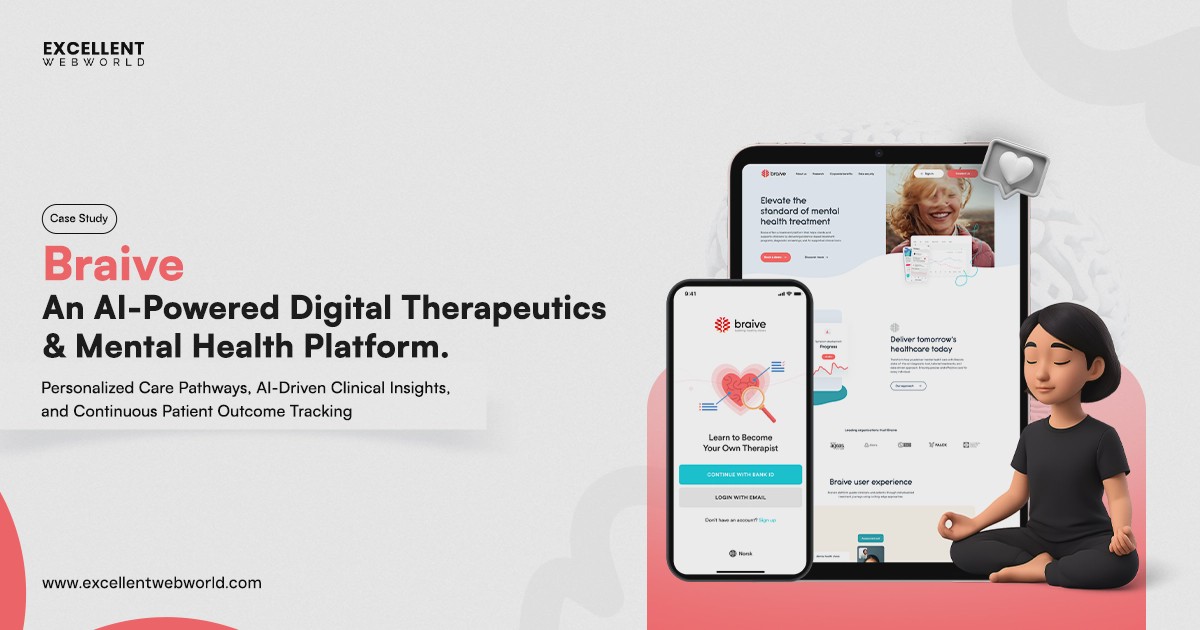
A digital mental health platform with guided programs, clinician tools, and progress tracking. Expands access to care and improves patient...
5. AI Has Permission to Take Action
There is a fundamental difference between AI recommending actions & AI execution process. The action-taking AI can provide greater value, but needs stronger technical & security controls that include;
- Permissions and tool access
- Audit logs and validation
- Retries and rollback
- Human approval where necessary
- Observability
Building these capabilities needs a structured agentic AI development approach that balances autonomous execution with security & control.
The 5 AI SaaS Concepts I Would Investigate First
The strongest AI SaaS ideas tend to solve expensive, recurring problems with measurable business outcomes. I would prioritize the concepts that actually combine clear customer pain, technical feasibility, recurring demand & opportunities to build a defensible product. Understanding how to build an AI native app can also help the founders evaluate how the AI capabilities translate into practical product value.
These five concepts stand out for further CTO-led validation. They are not ranked by the projected revenue or the sophistication of their AI features. Each of them addresses a meaningful operational challenge with opportunities for defensible products and, where relevant, AI-enabled marketplace development.
1. AI Software Engineering Agent
The CTO question
Can an agent complete the engineering work reliably, turning the developers into full-time supervisors?
Code generation is increasingly becoming accessible, while the harder challenge is the context. With a production-ready engineering agent, it is a must to have a proper understanding of repositories, architecture, coding standards, tickets, dependencies, tests, CI/CD pipelines, security requirements, and previous engineering decisions. Additionally, it must also recognize when not to act.
Workflow: Task → Context → Plan → Code → Test → Review → Human approval → Merge
The competitive advantage actually lies in the engineering workflow, contextual understanding, validation & also in controls, rather than just the model alone. Reliable workflow orchestration coordinates each stage, manages dependencies, and ensures human approval where required before changes move forward.
So, other than building another generic coding chatbot, I would say you should start with a focused use case such as dependency remediation, security reviews, test generation, or small-ticket implementation. You should expand towards autonomous software delivery once the reliability is proved & validated.
A focused AI agent development approach can help you turn these use cases into reliable, workflow-specific solutions.
What I would validate:
- Tasks completed without human intervention.
- Human review time per AI-generated pull request (PR).
- Test failure and rollback rates.
- Developer acceptance rate.
- Cost per completed engineering task.
Key metric: Engineering work completed, not tokens generated.
2. AI Autonomous QA Platform
The CTO question
Can AI discover bugs that conventional automated tests don’t even know to look for?
An autonomous QA platform could explore an application utilizing its URL, test credentials, and the defined business expectations. Also, it could generate realistic user journeys, test application states & authenticated experiences, detect broken flows & visual anomalies, reproduce failures, attach evidence to bug reports, and run regression checks.
But the core challenge is mainly distinguishing unexpected behavior from a product defect. With that, exploration alone simply can’t be enough; there is a need for an effective evaluation layer that helps with verification and minimizing false positives to build trust. Integrating validated test results into CI/CD pipelines and release workflows also requires reliable deployment and operations.
This led to establishing autonomous QA as a promising opportunity for technically differentiated SaaS products.
What I would validate:
- Defect detection and false-positive rates.
- Reproducibility of reported bugs.
- Critical user-journey coverage.
- Investigation time and cost per validated defect.
Key metric: Meaningful defects detected with reliable evidence, not the volume of tests executed.
3. AI Customer Support and Product Intelligence
The CTO question
Why stop after answering the customer if the conversation can reveal business improvement?
AI customer support system can deliver more than just automated responses. Customer conversations contain product intelligence consisting of recurring problems, missing features, onboarding difficulties, documentation gaps, churn signals, pricing objections, and differences between customer segments.
An AI native platform could transform unstructured conversations into structured insights like;
Conversation → Intent → Problem → Frequency → Customer impact → Product insight
This creates a continuous feedback loop among the customers, support, product, and engineering. The product teams can identify recurring issues, understand affected customers & prioritize improvements utilizing evidence from real conversations.
And the opportunity is not as simple as replacing any support agents; rather, it is to connect customer feedback with product decisions & engineering priorities. Similar workflow-driven approaches also apply to AI recruiting agents, where information gathered across recruitment stages helps inform subsequent decisions.
What I would validate:
- Issue-classification accuracy.
- Time saved analyzing customer feedback.
- Evidence supporting generated insights.
- Adoption of recommendations by product teams.
- Reduction in recurring support issues and impact on retention.
Key metric: Actionable customer insights that improve product decisions.
4. AI Attack-Surface and Breach Intelligence
The CTO question
Can your product reduce security risks rather than simply generating more alerts?
The security teams already manage the disconnected asset inventories, vulnerability scanners, credential-monitoring systems, and threat intelligence feeds. Additionally, the dashboard adds little value unless it helps to prioritize actions.
An AI native cybersecurity platform could correlate external assets, domains, services, vulnerabilities, exposed credentials & breach signals, identifying actionable risks.
For example, it could flag an exposed production service that is mainly related to a known vulnerability & also the credentials that were found in a recent breach, with supporting evidence for analyst review. Addressing these risks requires a proactive security approach supported by cybersecurity services that help identify vulnerabilities & also strengthen threat detection.
The core technical requirements include;
- Continuous discovery of authorized external assets.
- Data normalization and entity resolution.
- Credential and vulnerability intelligence.
- Context-aware risk scoring.
- Secure integrations and evidence management.
- Auditable workflows and clear authorization boundaries.
It is likely that the product should optimize for risk reduction, not for any information volume. Reliable correlation, evidence quality & prioritization can create some meaningful differentiation.
What I would validate:
- Asset discovery and correlation accuracy.
- High-priority findings confirmed by analysts.
- Investigation and remediation time.
- False-positive rates and evidence traceability.
Key metric: Confirmed security risks remediated, not alerts generated.
5. AI Document Operations Agent
The CTO question
How many employee hours are spent requesting documentation, checking submissions, resolving inconsistencies, and moving information between systems?
An AI document operations agent can automate this repetitive workflow seamlessly rather than simply storing files.
It could:
- Determine required documents and information.
- Contact customers and explain missing requirements.
- Receive and classify submissions.
- Extract structured information.
- Validate completeness and identify inconsistencies.
- Request corrections when necessary.
- Update the system of record.
- Escalate exceptions for human review.
This creates a measurable commercial opportunity, and the organizations that are spending significant employee time chasing the documentation have a clear target for reducing processing costs & delays.
The potential markets include financial services, insurance, professional services, healthcare administration, real estate, logistics, and compliance-heavy operations.
The strongest AI SaaS ideas in this particular category target repetitive, standardized workflows with measurable processing costs. Access controls, retention policies, audit trails & validationals aspects are quite essential in terms of managing sensitive information.
When document workflows require retrieving and connecting information across multiple sources, agentic RAG use cases illustrate how retrieval and reasoning can support more context-aware AI applications.
Mainly, the positioning matters: where AI document management stores information, AI system documentation moves work operations further forward.
What I would validate:
- Processing time and cost per case.
- Cases completed without manual intervention.
- Document extraction and validation accuracy.
- Incorrect approvals and missed exceptions.
- Reduction in follow-up effort.
Key metric: Cost and time required to complete a document workflow, not the number of documents processed.
What I Would Not Build From This List
So, a CTO-level assessment must identify weak product bets, not just the promising opportunities. I would say that technical feasibility does not guarantee differentiation, adoption or sustainable revenue.
1. Generic AI Wrappers
The products are built around input → LLM → output, without any proprietary workflows, data or integrations, and are difficult to differentiate & defend. Focus should be on solving deeper workflow problems, not just adding any AI interface. The shift toward AI-native software illustrates how embedding intelligence into the product itself can create more meaningful differentiation.
2. Commodity Productivity Tools
The basic task management, note-taking setup, & writing tools are quite easy to build up. Their primary challenges basically come in distribution, user retention, & differentiation, not in any engineering complexity.
3. AI Tool Directories Without Proprietary Evaluation
A directory system is easy to replicate often, but it requires continuously maintained evaluation infrastructure backed by meaningful benchmarks & reliable comparisons. This tends to provide much greater technical details & defensibility.
4. AI Features Without Measurable ROI
“AI-powered” cannot be said to be a business case. If buyers cannot quantify what AI actually saves, generates, prevents or even improves, determining value & justifying recurring SaaS spend becomes difficult. Evaluating AI-assisted software development also needs weighing productivity gains against quality, reliability, and long-term costs.
How Much Does It Cost to Build an AI SaaS Product?
The 43 SaaS ideas/concepts demonstrate why AI SaaS development costs vary by productivity complexity. A simple AI writing or prompt management tool may require a small team, while an autonomous engineering agent or any cybersecurity platform needs more engineering expertise.
| AI SaaS Complexity | Typical MVP Cost (USD) | Typical Timeline |
|---|---|---|
| AI productivity tool | $15K–$40K | 1–3 months |
| AI workflow automation | $25K–$70K | 2–4 months |
| AI vertical SaaS | $35K–$100K | 3–6 months |
| AI intelligence platform | $50K–$150K | 3–6 months |
| AI developer infrastructure | $60K–$180K | 4–8 months |
| AI cybersecurity/fintech platform | $80K–$250K+ | 5–10+ months |
| Autonomous AI agent platform | $80K–$250K+ | 5–10+ months |
These are indicative development cost estimates, not the market prices or any guaranteed budgets.
The major cost drivers include;
- AI architecture
- Engineering team size
- Integrations
- Data pipelines
- Infrastructure
- Security
- Authentication and authorization
- Evaluation systems
- Observability
- Compliance
- Model usage
- Production scale
Managing these cost drivers effectively requires a clear SaaS product development strategy & reliable AI integration services that actually balance essential features, budget & scalability.
The Bigger Pattern Across These 43 Concepts
I would say that the biggest key takeaway is not just that more AI products are emerging a lot. It is that the founders are identifying the specific workflows where AI can actually move beyond simple assistance to execution processes.
The recurring pattern is like;
- Information interpretation: AI interprets information that humans previously analyzed.
- Workflow execution: AI handles repetitive processes instead of requiring constant manual effort.
- Continuous monitoring: AI monitors multiple systems and identifies relevant changes.
- Intelligent prioritization: AI determines which issues or opportunities deserve attention.
- Tool orchestration: AI coordinates information and actions across connected systems.
This, you can say, is a shift from conventional SaaS to AI-native SaaS. Other than helping people perform several tasks, the software is increasingly able to execute parts of those by itself, thus creating new opportunities for automation, measurable business value & defensible products.
Build Valuable AI-Native SaaS with Excellent Webworld
The 43 founder submissions highlight real problems worth solving. The bigger opportunity is to rethink these ideas/concepts with AI at their core, creating products that do more than simply add AI features & solve problems more smartly & efficiently.
A hydration tracker can become an adaptive wellness coach. A product management tool can become an AI delivery manager, an SEO crawler can become an AI growth agent, a document management system can become an AI operations agent, and a testing platform can become an autonomous QA engineer.
For all, the common thread is workflow transformation, not any technology alone. For CTOs & founders, the question is no longer just: “Where can we add AI?”, but “What valuable work can software reliably take off the customer’s plate?”
At Excellent Webworld, we combine deep workflow understanding, robust engineering, & measurable business outcomes to turn promising ideas into production ready AI native SaaS products that solve real problems & deliver lasting value.
- Start with a real problem, not an AI feature. The strongest AI SaaS ideas address recurring customer pain points and deliver measurable business value.
- Build beyond basic AI wrappers. Proprietary data, domain-specific knowledge, workflow integration, and reliable execution can make an AI SaaS product harder to replicate.
- Prioritize workflows with clear ROI. Customer support, software testing, document operations, and business intelligence offer opportunities to reduce manual work and improve decisions.
- Validate before investing in development. Assess customer demand, competitive differentiation, data availability, technical feasibility, and willingness to pay before committing to an MVP.
- Choose the right level of AI autonomy. Start with assistance and recommendations where appropriate, then introduce automated actions with suitable permissions and human oversight.
- Budget for production, not just the prototype. Model usage, integrations, security, monitoring, maintenance, and ongoing evaluation all affect the cost of building an AI SaaS product.
- Treat the 43 concepts as starting points, not validated businesses. Customer research and real-world testing should determine which ideas deserve further investment.
Frequently Asked Questions
Promising AI SaaS ideas include software engineering agents, autonomous QA, customer-support intelligence, cybersecurity, document automation, sales intelligence, and vertical AI workflow products that automate costly, recurring tasks.
A basic AI SaaS MVP may cost $15,000–$40,000, while advanced AI workflow platforms can cost $50,000–$150,000. Complex agentic, cybersecurity, and infrastructure-heavy products can exceed $200,000.
A simple AI SaaS MVP may take 1–3 months, AI workflow platforms 2–6 months, and complex agentic, fintech, cybersecurity, or developer-infrastructure products 5–10 months or longer.
A strong competitive advantage comes from proprietary workflows, customer-specific context, integrations, accumulated data, domain expertise, reliable execution, evaluation systems, and switching costs. A generic LLM interface alone rarely provides a strong moat.
No. AI makes sense when it measurably improves a workflow or customer outcome. Adding a chatbot without solving a meaningful problem does not automatically create a better SaaS product.
An AI wrapper provides a relatively thin interface around an existing model. AI-native SaaS combines AI with business logic, proprietary workflows, integrations, data, automation, evaluation, and execution.
CTOs should assess problem severity, buyer willingness to pay, workflow frequency, AI reliability, data requirements, integrations, security, infrastructure costs, model dependency, measurable ROI, and MVP scope.

Article By


Mayur Panchal is the CTO of Excellent Webworld. With his skills and expertise, he stays updated with industry trends and utilizes his technical expertise to address problems faced by entrepreneurs and startup owners.