Having a website for your business has become super normal nowadays. If you want to reach a vast audience, create your brand, and compete hard, website development is the first step. But how do you build one? Is the website development process tough?
Here’s the good news: if you follow a structured process to build a website, your journey will be smooth for sure, and you can create a powerful digital presence.
Whether you’re developing a website in-house or have outsourced to a website development company, understanding these key steps helps you make informed decisions as a startup, a growing business, or an established enterprise.
From Discovery and Design to seamless Development and Deployment, we will explore every phase of a well-structured web development life cycle. So, without wasting any time, let’s move forward towards exploring everything involved in the process of website development.
Why Is a Structured Website Development Process Important?
A structured website development process is important to make sure the project gets completed within the allotted timeline, budget, and to a high quality. A well-planned website design and development strategy reduces errors and miscommunication, leading to a consistent user experience and improved search engine optimization. This methodological approach to custom website development for small and large businesses includes proper planning, UI/UX design, development, testing, & secure launch. Ultimately, leads to a scalable, professional, and functional website solution.
- A clear plan prevents misunderstandings and unnecessary efforts.
- Step-by-step development & testing make sure a stable, error-free, high-performing website.
- Well-defined phases lead to better control of project milestones, timeline, and allocated budget.
- A structured website layout enhances online visibility by improving how search engines crawl and rank.
- Clean code makes updates and maintenance easy.
- Proper planning ensures all stakeholders are aligned with their goals and needs.
What Are the Website Development Phases? Step-by-Step Guide
The website development phases are a structured and multi-stage method that transforms business ideas into a functional online site. This process, which includes 7 key phases and various website development stages, ensures all technical, aesthetic, and user experience requirements are met. Let’s understand the website development process steps in detail.
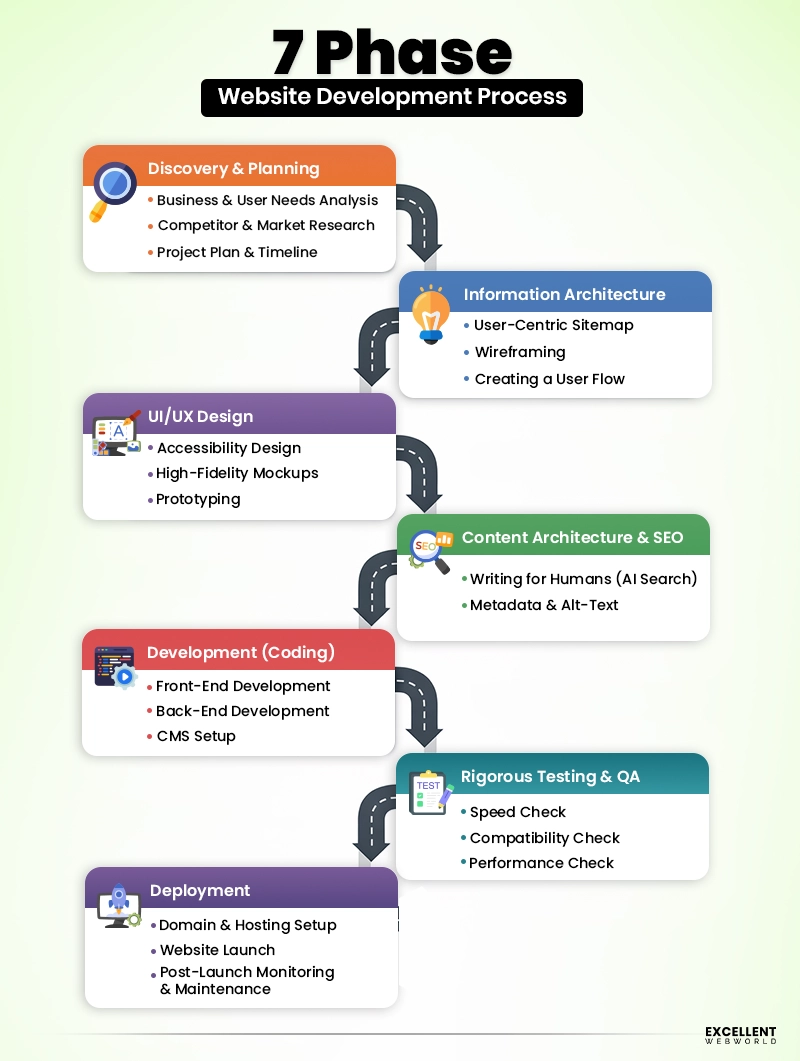
Phase 1: Discovery & Strategic Planning
When building a website from scratch, it is important to understand the project goals, target audience, and business requirements. The discovery phase in the website development life cycle is all about analyzing the market and creating a project plan with a timeline. Here are the four crucial stages of the discovery phase:
Stage 1: Business and User Needs Analysis
This stage prioritizes learning the “why” behind the website development and identifying the end-users. It includes stakeholders’ interviews and workshops. In which you have to collaborate with business owners and team members to decide the main purpose of the website building.
Whether you want to develop a website for brand awareness, lead generation, or e-commerce purposes, you must decide at this stage. Along with that, target audience identification, user journey mapping, and functional requirements analysis should also be completed.
Pro Tip: Leverage tools like Miro for visual mind maps and FullStory to do user research & behavior analytics.
Stage 2: Competitor and Market Research
In this stage of the web development process, you have to do competitor analysis and market research as per current trends. Review competitor websites and identify where they stand out and where they fall.
A SWOT analysis is crucial to determine the Strengths, Weaknesses, Opportunities, and Threats of the business with respect to the market. Also, researching current industry standards for design, mobile responsiveness, top technology trends, and SEO for the new website is important to ensure a modern and effective appearance.
Stage 3: Defining Project Scope, Goals, and Success Metrics
This stage is meant to define the “what” part of your business. Leverage the SMART method to set goals for your website, establish Specific, Measurable, Achievable, Relevant, and Time-bound aims. In this early stage, determine how you will calculate your success in terms of traffic, higher conversion rates, lower bounce rates, or faster load times.
Define scope and deliverables, and clearly document what is included and what is not included (out of scope) in the website. Additionally, make sure to define the MVP development of the website, which indicates the core features required to launch.
Stage 4: Creating a Strategic Project Plan and Timeline
This step in the website development phases of discovery defines the “how” and “when” for the project. The best approach is to break the project tasks into smaller and manageable milestones in the beginning. Establishing a realistic deadline for launch will work better. As per the various phases, set a timeline.
Before heading any further, ensure you finalize the web development team structure, tools, and budget required for each phase. Also, list out potential challenges early and create your strategies according to them.
Phase 2: Information Architecture (IA): Sitemap, Wireframing, & User Flow
Information Architecture is about creating the foundational structure of your website. It organizes content to make it more intuitive and accessible to users. Informational Architecture needs to create the following:
Stage 5: Creating a User-Centric Sitemap
It’s a visual and hierarchical diagram of the website that maps out all of the web links (pages). It defines the pathway of main pages to subpages, making sure that all content is accounted for.
Stage 6: Wireframing (Low-Fidelity Layouts)
Wireframing is meant as the “skeletal framework” in the web development process. It focuses on the layout and functionality of the website without having any distractions like color, fonts, or images.
Generally, it is built with low-fidelity, with simple black-and-white sketches, mostly using boxes and placeholders. The main goal of Lo-fi wireframing is to get a quick and easy way to modify ideas on paper.
Stage 7: Creating a User Flow
This one is the diagram structure that maps out the specific user steps that will be taken on the website to achieve a goal, such as signing up or purchasing a product.
Phase 3: UI/UX Design (High-Fidelity Mockups & Prototypes)
In this web development phase, you have to create the visual and functional blueprint of your website. Leveraging various UI/UX design tools, you have to create a website design that keeps your audience engaged and makes them stay longer.
Stage 8: Designing for Accessibility (WCAG 2.2 Standards)
Here, you are bringing the wireframes into reality by applying visual styling and interactive UI elements. Make sure you prioritize accessibility as per WCAG 2.2 Standards in web design over any fancy or complex UI.
Stage 9: High-Fidelity Mockups & Prototypes
- High-Fidelity Mockups: This one is about showing a detailed and pixel-perfect visual representation of the website that includes color schemes, typography, images, and brand elements.
- Prototyping: In these steps for designing a website, you have to turn mockups into a clickable and interactive simulation or prototype of the final website. This way, stakeholders can experience the real navigation and functionality before website development.
Pro Tip: Hire a leading app design services provider with a great portfolio of website UI/UX design creations to make your design journey smooth for sure. Their team of experts not only helps you with the architecture but also takes care of every step of the design phase.
Phase 4: Content Architecture & SEO
Website content is like the “voice” of your online site and should not be considered an afterthought. It includes the following approach to create fruitful content for your website:
Stage 10: Writing for Humans, Optimizing for AI Search (SGE/AEO)
- Content Inventory/Audit: Review if you have any existing content to keep, update, or remove.
- Content Strategy: Creating a plan for which content type you need from text, images, video, and that will align with your target audience.
- Content Creation: This step includes writing a copy for every web page. Headlines, body text, and calls-to-action (CTAs) should be written considering SEO. Follow the Answer-First Framework and conversational tone to optimize your web content in SGE and AEO.
Stage 11: Essential Metadata & Alt-Text (On-Page SEO)
First of all, create a checklist for on-page SEO tasks that includes tasks such as keyword research and meta details creation.
- Metadata: The metadata of your site is the “hook” which encourage number of clicks. Create Title Tags within 50 to 60 characters and meta descriptions in 150 to 160 characters.
- Image Alt-Text: Create image “alt-text” within 125 characters. Try to insert keywords naturally, but make sure they reflect the image’s role on the web page. Skip writing text like “image of” or “picture of.”
Phase 5: Development (Coding)
As of now, the project plan, content, and website design are ready. So, you have to move forward with the development step. Build the actual website with the best web development languages, considering the UI/UX design.
Stage 12: Front-End Development (HTML, CSS, JavaScript)
In the process of developing a website, this stage involves real coding of the visual interface of the website, where the user directly interacts with it. Web developers prefer popular frontend technologies such as HTML for structure, CSS to style, and JavaScript for interactive elements and to show dynamic content. Check the following table to get better clarity with the frontend development of the website.
| Aspect | What does it include? |
|---|---|
| Front-End Technologies |
|
| Resources Required |
|
| Best Tools to Use |
|
Stage 13: Back-End Development (Server, Database, APIs)
This stage in the web development process focuses on the server-side logic and the “invisible” part of the site that actually manages data and functionality in the background. Key tasks in backend development include server setup, managing database creation (e.g., MySQL, MongoDB), AI integrations, and API building. This way, you can establish seamless communication between frontend and backend systems. Here’s the backend table of the website to understand better:
| Aspect | What does it include? |
|---|---|
| Back-End Technologies |
|
| Resources Required |
|
| Best Tools to Use |
|
May You Want to Check On Frontend vs Backend: What’s the Difference?
Stage 14: Content Management System (CMS) Setup
If you have decided to leverage a CMS like WordPress, Drupal, or Sitecore, then it should be integrated at this stage of the website development process. With the CMS setup, site managers can easily manage website content.
It provides an admin portal to manage content without needing to interact with any type of underlying code. Many popular firms provide CMS development services to build interactive websites in a budget-friendly way.
Phase 6: Rigorous Testing & QA (Cross-Browser, Responsive, Performance)
After completing website development, the next step in the web development process is quality assurance and testing. In this stage, you have to ensure that your developed website is functioning correctly as you had planned in the prototype.
Stage 15: Speed, Compatibility, & Performance Check
To test your website with accurate results, you should follow the testing types listed below:
- Functional testing to validate that all links, forms, and features work seamlessly as decided.
- Cross-browser/compatibility testing to ensure the website displays and functions properly throughout the various web browsers and operating systems.
- Responsive testing to verify user experience on different devices, including desktops, tablets, and mobile phones.
- Performance testing to make sure the website loading speed is not slow, and overall performance is optimal for the user experience.
Phase 7: Deployment (Launch & Post-Launch Maintenance)
This one is the last phase of the website development process. In this role, you have to launch the website for users and keep monitoring it to ensure it works properly as intended.
Stage 16: Domain and Hosting Setup
This stage is about configuring the website infrastructure that allows users to access the website through various web browsers and operating systems. By doing domain configuration (DNS), you are linking the domain name (e.g., www.example.com) to the web host. Then, you have to do the hosting setup and server configuration for the website. You can choose shared, VPS, or cloud hosting for your site.
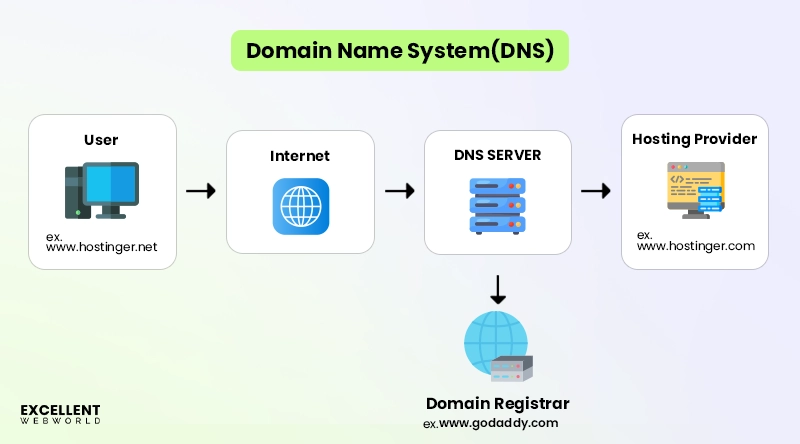
After that, install the SSL certificate, which enables HTTPS. This is important for your website’s security, user trust, and better SEO rankings. At last, you have to transfer all website files and databases from the staging environment, or we can say the local host, to the live production server.
Stage 17: Website Launch
In the website development process, this is the official Go-Live stage. From here, your website becomes available to the public. By performing:
- Final pre-launch audit,
- Installing tracking tools like Google Analytics 4 (GA4),
- Submitting the XML sitemap to Google Search Console for indexing,
- Updating DNS settings to ensure website accessibility worldwide,
You can now officially go live with your website.
Stage 18: Post-Launch Monitoring and Maintenance
Yes, the website development process does not really end with the final launch. Ongoing monitoring and maintenance are required. So, whenever you plan a website, do not forget to add website maintenance costs to your budget. This is not your last step, but the ongoing step to keep the good health of your site.
- Start with immediate health monitoring in the first 48 hours. Actively track any immediate downtime, server errors, or user-reported issues, and take actions accordingly.
- Use tools like Google PageSpeed Insights, GTmetrix, Pingdom, and UptimeRobot to track site speed and uptime.
- Regularly take security checks for CMS plugins and themes to prevent them from any kind of vulnerabilities.
- Schedule automated and regular backups for files and databases to ensure easy and quick recovery in case of data loss.
- Make sure to update content and fulfill SEO needs to maintain or improve search engine rankings.
How Much Does Website Development Cost?
The website development cost and timeline vary depending on various factors such as complexity level, number of pages, feature integration, website type, development team location, and more. Here’s the estimated cost table for you to get an idea of the web development cost and timeline.
| Website Complexity Level | What Does It Include in Most Cases? | Estimated Website Development Cost | Estimated Timeline |
|---|---|---|---|
| Basic | Portfolio, brochure, 5-10 pages | USD 2,000 to 10,000 | 4 to 8 Weeks |
| Medium | Business, blog, CMS, integrations | USD 10,000 to 30,000 | 8 to 16 Weeks |
| Complex | E-commerce, custom web app, APIs | USD 30,000 to 100,000+ | 16 to 32+ Weeks |
***Please note that the above-listed prices are an estimated price; website development cost and timeline may vary based on pre-discussed factors.
Like website development from scratch, if you are just redesigning it, then the website redesign cost is affected by similar factors. Number of pages, size of the pages, and complexity are some of the aspects that are responsible for the website redesign timeline and final cost.
Custom Website Development vs. CMS Development: Which One is Best to Choose?
Selecting any one from the custom website development and a CMS platform like WordPress, Drupal, or Joomla is completely dependent on your business needs, allotted budget, technical expertise, and long-term goals. Here’s the comparison table for you to get better clarity between custom and CMS web development.
| Criteria | Custom Web Development | CMS Development |
|---|---|---|
| Development Time | Slower than CMS, as everything needs to be coded and built from scratch. | Faster than custom web development. |
| Initial Cost | Initial investment is higher, but it doesn’t incur any large expenses in the long term. | Upfront cost is low as some CMS are available for free or cheaper. |
| Technical Expertise | Requires great technical expertise or professional developers. | Beginner-friendly, as mostly coding is not required. |
| Customization | Unlimited control over website design and functionality, as everything is custom-built. | Limited to the platform, available plugins, and themes. |
| Scalability | Highly scalable option for complex websites and high traffic. | Good for small to medium sites, but it can also hit a limitation with scalability. |
| Performance | Best, as it is optimized for specific business needs. Lean code ensures web speed. | Possibilities to slow down with multiple plugin integrations. |
| Maintenance | Needs dedicated maintenance and updates. | Easier, as the CMS platform handles the core updates. |
| Security | Allows implementing customized and strong security measures. | More vulnerable and need to face security risks due to popularity. |
That means, if you are an individual or small business owner with limited budget availability, then CMS development is best for you. On the other hand, if you are an enterprise and need a unique functionality in your website with complete control, then opting for a custom website development will be great.
What is the Role of AI in Web Development Process?
AI in web development transforms the process by automating repetitive tasks, accelerating workflows, powering security, and enhancing user experience through personalization. In the website development process, artificial intelligence helps your team with code generation, debugging, website testing, and SEO.
Key Roles of AI in Web Development
- AI analyzes user behavior and gives suggestions to deliver a personalized experience through content and design to each user.
- AI-powered tools help in analyzing search patterns and content optimization for improving rankings and generating leads.
- AI enables real-time threat detection, identifies anomalies and data breaches that are not possible to detect manually.
- Helps your team to write automated code, suggest improvements, and debug code; this way, it can speed up the process of time-to-market.
- Improve testing and quality assurance by automating UI, function, and performance testing.
What Are the Common Mistakes to Avoid in the Website Development Process?
Check out the most common tasks underestimated by founders during the website development process, and later it costs a lot.
- Not taking market research seriously and not defining the target audience before beginning the web development.
- Overcomplicating the design with a hope of creating something aesthetic mostly leads to cluttered layouts and poor user experience.
- Using generic and low-quality content for a website does not engage or convert users.
- Not selecting the right platform or tech stack for scalability and maintenance.
- Ignoring the proper implementation of security measures.
- Immediate website launch without testing bugs and broken links.
Final Thoughts
The website development process is a multifaceted approach that requires careful planning, thoughtful design, and ongoing optimization. By avoiding common mistakes such as neglecting user experience and skipping market research, you can create a website that generates consistent leads for your business. Remember, your website is the first brand impression to your customer, so invest time and resources in it to achieve long-term success.
If you are looking for expert guidance and seamless development, Excellent Webworld stands out as one of the most trusted website development service providers. Whether you are launching a new website for your brand or revamping an existing one, our experts help you craft a customized platform that boosts your digital presence. Reach out today to transform your dream vision into reality!
Frequently Asked Questions (FAQs)
The web development timeline depends on the complexity and scope of your website. A simple website may take 4 to 6 weeks; on the other hand, custom-built or e-commerce sites can take 3 to 6 months or more.
Planning and research are the most critical phases in the web development process. Defining your goals, target audience, and site structure is responsible for setting the foundation for success.
A website development cost may vary based on various factors, including complexity and website type. A basic site typically ranges from USD 2,000 to 10,000, a medium range site costs USD 10,000 to 30,000, while a complex AI-powered website may cost USD 30,000 to 100,000+.
A typical web development tech stack includes:
- Frontend: HTML, CSS, JavaScript, React, or Vue.js
- Backend: Node.js, Python (Django/Flask), PHP, or Ruby on Rails
- Database: MySQL, PostgreSQL, or MongoDB
- Hosting & Deployment: AWS, Google Cloud, or Vercel
The tech stack choice depends on your project’s needs, scalability, and budget.

Article By


Mahil Jasani began his career as a developer and progressed to become the COO of Excellent Webworld. He uses his technical experience to tackle any challenge that arises in any department, be it development, management, operations, or finance.