Summary
RPA in finance automates repetitive, rule-based tasks like invoicing, reconciliation, KYC, reporting, and compliance – cutting costs, errors, and delays. Combined with AI, OCR, and APIs, it becomes intelligent automation. This guide covers use cases, implementation steps, costs, ROI calculation, challenges, trends, and how to choose the right RPA partner.
If I were sitting across a CFO roundtable, I wouldn’t ask, “How much of your finance function can we automate?” I’d ask: “Which tasks are your teams doing manually that are keeping them away from doing high-value work?” These tasks can be related to invoices, reporting, data entry, reconciliation, and moving information between banking, ERP, accounting systems, and spreadsheets.
That’s where Aaron Zhou, Global Finance Transformation Director at ALS, sees a role for RPA in finance. In the Inside the CFO Office podcast, Episode 26, he describes RPA as technology well-suited for high-volume, rule-based processes and recommends starting with high-benefit, low-complexity processes to register quick wins.
However, speed alone is not the end goal. In the Treasury Leaders podcast, Episode 288, Philip Costa Hibberd and Jan-Willem Attevelt highlight that aspect: automating a complicated process can make the problem bigger. That’s why they suggest that finance leaders should consider RPA alongside APIs and AI in fintech.
Robotic process automation in finance is evolving into a broader automation ecosystem where RPA handles repetitive tasks, OCR extracts information, ML identifies patterns, APIs connect various systems, and agentic AI/generative AI manage complex workflows and exceptions. Deloitte’s 2026 CFO Signals survey reinforces the shift: 50% of CFOs ranked finance digital transformation as a top 2026 priority, while 54% prioritized integrating AI agents.
In this guide, you’ll learn which finance processes are worth automating, how to design and implement RPA in finance, what it costs, which risks to manage, how to calculate realistic ROI, and how an experienced fintech app development company can help connect RPA with your existing financial ecosystem.
What is RPA in Finance?
RPA in financial services means using software bots to handle repetitive, rule-based finance tasks that employees otherwise have to perform manually. These software bots can log into your systems, copy/validate data, reconcile financial records, generate reports, update accounts, and move information between various applications by following predefined rules.
Which Finance Processes are Best for RPA?
- Repetitive: Finance teams spend most of their time on tasks that are repetitive in nature, making them a strong candidate for automation.
- Rule-based: Tasks that follow clear business rules, allowing bots to execute them consistently, without any human intervention.
- High-volume: Processing large transaction volumes manually is very costly, and that’s where automation comes in handy.
- Structured: Structured data has a predictable format, making it easier for bots to capture, validate, and process accurately.
- Stable: The tasks where the workflow never changes are ideal candidates for automation.
- Error-prone: The tasks where manual intervention can cause data-entry or reconciliation errors should be automated.
Note: RPA is particularly useful for various fintech API use cases as it can complement APIs when legacy systems aren’t able to exchange data. Also, if you’re building a fintech app, you can use RPA alongside APIs to automate back-office processes.
Why does RPA Matter for Financial Services?
RPA matters for financial services as fintech leaders can’t always have the option of scaling operations by adding more people, as it is very expensive. Finance process automation aims to resolve this issue by shifting the manual workload to software while improving consistency, speed, and control for day-to-day operations.
| Business Impact | How RPA Helps | What It Means for Finance Leaders |
|---|---|---|
| Reduces Manual Work | Financial process automation automates data entry and repetitive administrative tasks. | Finance teams spend less time on repetitive tasks and more on strategic activities. |
| Improves Accuracy | Standardizes repetitive processes and reduces manual data entry. | More consistent data means less rework and fewer reconciliation issues. |
| Lowers Operational Costs | Automates high-volume workflows and improves resource utilization. | Teams can handle growing workloads without increasing the headcount. |
| Speeds Up Financial Operations | Processes transactions, reconciliations, reports, and invoices faster. | Faster processing reduces bottlenecks during month-end or financial year closing. |
| Strengthens Compliance | Maintains consistent records, creates audit trails, and supports compliance checks. | Financial leaders gain better visibility and stronger controls into regulated processes. |
| Improves Customer Experience | Speeds up onboarding, loan processing, responses, and transactions. | Faster back-office workflows enhance customer experience, especially important for projects related to mobile banking app development or neobank app development. |
| Supports Finance Transformation | Connects RPA with your existing financial ecosystem and modernization initiatives. | RPA provides a digital transformation in finance initiative with an automation layer, helping firms modernize repetitive workflows while keeping financial operations efficient as transaction volume grows. |
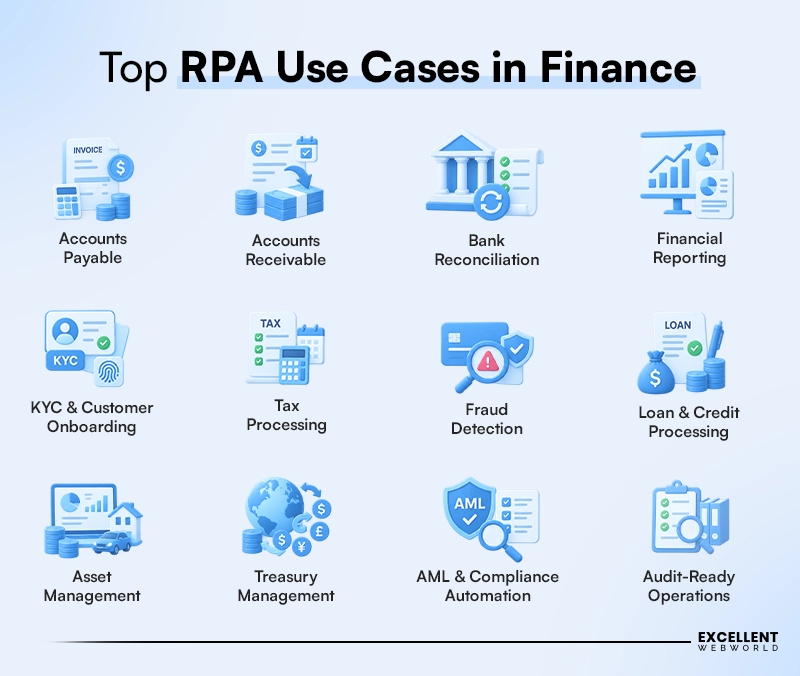
What are the Top RPA Use Cases in Finance?
The best RPA use cases in finance are not the ones that automate the easiest tasks; they’re the ones that reduce manual effort, errors, and delays while handling growing transaction volume to create measurable business value.
Here are the top RPA finance use cases you should be aware of:
1. Accounts Payable
What RPA Automates:
- RPA for accounts payable fetches invoice data, validates invoices, matches them with purchase orders, routes approvals, schedules payments, and tracks status.
Operational Impact:
- Reduces invoice backlogs, manual entry, and payment delays.
Why It Matters To Finance Leaders:
- Fewer errors, lower processing fees, and better visibility into outgoing payments.
Where to Start:
- High-volume invoice processing and matching.
Real-Time Example:
- Hitachi Vantara automated procedure-to-pay processes that comprise 80,000+ invoices annually, thereby achieving 75% straight-through processing and 100% error reduction.
2. Accounts Receivable
What RPA Automates:
- RPA for accounts receivable generates invoices, matches payments, tracks balances, sends reminders, and prepares AR reports.
Operational Impact:
- Reduces manual follow-ups and improves payment tracking.
Why It Matters To Finance Leaders:
- Improves payment collection and gives leaders better visibility into incoming cash flow.
Where to Start:
- Payment matching and reminders.
Real-Time Example:
- EY automated payment matching for 1.5 million payments annually, thereby increasing the automatic matching and clearance ratio from 30% to 80%, while also saving approximately 230,000 hours.
3. Bank Reconciliation
What RPA Automates:
- RPA for bank reconciliation matches bank transactions with internal records, identifies disputes, and escalates exceptions to the support team.
Operational Impact:
- Speeds up reconciliation and reduces month-end workload.
Why It Matters To Finance Leaders:
- Strengthen financial controls and shorten closing cycles.
Where to Start:
- High-volume bank accounts.
Real-Time Example:
- Formica Group, a global manufacturer, automated its European cash-management processes to achieve more than 95% automation of bank reconciliation across Europe, with bank accounts reconciled weekly to improve cash control.
4. Financial Reporting & P&L Automation
What RPA Automates:
- RPA for financial reporting collects, consolidates, classifies, and distributes recurring reports.
Operational Impact:
- Reduces reporting effort and manual consolidation.
Why It Matters To Finance Leaders:
- Provides leaders with faster access to financial information.
Where to Start:
- Recurring reports that require data from multiple systems.
Real-Time Example:
- Primanti Bros. uses IBM RPA to automate daily sales and labor reporting and turns the reporting process into a hands-free task, eliminating work that previously required around 2,000 hours per year.
5. KYC & Customer Onboarding
What RPA Automates:
- RPA for KYC collects customer information, extracts document data, validates details, and updates multiple systems.
- AI agents for KYC and AML use this as a base to coordinate multiple checks, analyze information across sources, identify missing or inconsistent data, and route high-risk cases to human reviewers.
Operational Impact:
- Reduces onboarding delays and manual verification while keeping customer records consistent.
Why It Matters To Finance Leaders:
- Faster onboarding improves customer experience without adding headcount to the operations team as translation volume grows.
Where to Start:
- Document-heavy onboarding tasks.
Real-Time Example:
- State Street Bank uses RPA for KYC and onboarding, thereby reducing the time from account opening to trading by 49%.
6. AML & Compliance Automation
What RPA Automates:
- RPA for AML gathers compliance information, supports screening, generates reports, and maintains records.
Operational Impact:
- Reduces time analysts spend collecting information and preparing AML investigations.
Why It Matters To Finance Leaders:
- Automating repetitive compliance work offers analysts more time to focus on high-risk cases and complex investigations.
Where to Start:
- Repetitive data collection and investigation preparation activities.
Real-Time Example:
- CSOB deployed 15 digital workers for AML investigations, thereby reducing data-gathering time by 45%, saving 26,000+ hours in 2.5 years, and cutting case processing time from 45 minutes to 25 minutes.
7. Fraud Detection & Transaction Monitoring
What RPA Automates:
- RPA for fraud detection automates repetitive alert-handling and transaction-monitoring tasks, while AI financial fraud detection can analyze transaction patterns and detect anomalies that require further investigation.
Operational Impact:
- Reduces manual monitoring efforts and speeds up repetitive fraud review workflow.
Why It Matters To Finance Leaders:
- Faster alert handling allows compliance and fraud teams more time to investigate high-stakes cases.
Where to Start:
- Repetitive fraud checks, alert routing, and initial review activities.
Real-Time Example:
- Marginalen Bank deployed RPA to automate fraud-detection checks, thereby saving 8 hours of manual work per day.
8. Loan & Credit Processing
What RPA Automates:
- RPA for loan processing collects customer applications, verifies documents, gathers credit data, and moves applications through predefined workflows.
- AI agents for loan approval provide support for underwriting by gathering this relevant information, checking predefined criteria, and routing exceptions to human underwriters.
Operational Impact:
- Reduces manual coordination and application processing time across lending.
Why It Matters To Finance Leaders:
- Faster processing helps lenders handle more applications without adding headcount.
Where to Start:
- Credit-data retrieval, document verification, workflow routing, and application-data collection.
Real-Time Example:
- Provident Financial Romania automated credit checks and loan-related workflows, thereby saving 10,000 hours per year and achieving 30x faster processing times.
9. Investment & Asset Management
What RPA Automates:
- RPA for investment management fetches financial information, consolidates portfolio data, updates investment systems, and supports recurring investment reporting.
Operational Impact:
- Reduces manual effort required to gather, consolidate, and prepare data.
Why It Matters To Finance Leaders:
- Automation helps investment teams scale reporting and administrative work without increasing headcount.
Where to Start:
- Recurring portfolio-data collection, consolidation, and reporting.
Real-Time Example:
- Schroders uses 300 digital workers across five core business functions related to investment and asset management, thereby saving 5000 hours every month and supporting 120+ portfolios.
10. Cash Flow & Treasury Management
What RPA Automates:
- Aggregates cash positions, monitors account balances, automates recurring account updates, and generates cash flow reports.
Operational Impact:
- Reduces manual treasury reporting and monitoring.
Why It Matters To Finance Leaders:
- Gives treasury teams in-depth visibility into liquidity and potential cash shortfalls.
Where to Start:
- Repetitive treasury reporting and cash position updates.
Real-Time Example:
- Sonae Arauco uses RPA to automate the reconciliation of transitory bank accounts and prepare a monthly report on the company’s cash position in one day, which the manual process previously took 3–4 days/month.
11. Tax Processing & Reporting
What RPA Automates:
- RPA for tax processing collects and validates tax information, generates recurring tax reports, and supports tax-filing workflows. RPA for compliance can help in standardizing documentation and related checks.
Operational Impact:
- Shortens tax-filing cycles and reduces manual tax-processing efforts.
Why It Matters To Finance Leaders:
- Standardized tax workflows reduce administrative efforts, helping teams meet recurring tax-filing deadlines.
Where to Start:
- Recurring tax filing, data collection, reconciliation, and report preparation.
Real-Time Example:
- Tech Mahindra automated the Brazilian tax-filing process using attended and unattended bots, thereby reducing manual effort by 80%, increasing efficiency by 30%, achieving 100% compliance with filing deadlines, and saving $1 million in direct costs.
12. Audit-Ready Finance Operations
What RPA Automates:
- Records automated actions, retrieves supporting evidence, maintains transaction histories, and organizes financial reports and documentation for audit review.
Operational Impact:
- Reduces manual effort required to gather financial records and audit evidence.
Why It Matters To Finance Leaders:
- Reduces the disruption finance teams face during audit cycles and keeps audit evidence easier to retrieve.
Where to Start:
- Recurring financial documentation tasks and audit evidence retrieval.
Real-Time Example:
- DLF Finance deployed RPA bots for audit evidence and financial report retrieval, saving 3,000+ hours per audit cycle and another 1,200+ hours through financial report retrieval.
How does RPA Work in Finance?
RPA in finance is basically financial services automation that helps you convert predefined finance workflows into a repeatable digital process. Here’s how it works:
| Step | What Happens |
|---|---|
| Step 1: Identify the Financial Process | Map the workflow from beginning to the end and identify repetitive tasks, manual work, bottlenecks, and unnecessary handoffs. |
| Step 2: Collect and Extract Financial Data | Fetch information from emails, banking systems, ERP, CRM, spreadsheets, and financial documents.
With AI development services, you can enable intelligent document processing and OCR, which extract data from PDFs and scanned documents, while data engineering services can connect fragmented data sources. |
| Step 3: Apply Business Rules | Validate information, match records, classify transactions, and perform calculations using predefined business rules. |
| Step 4: Execute Automated Actions | Finance automation solutions enter data, update financial systems, generate reports, send notifications, and trigger approvals or payments. |
| Step 5: Handle Exceptions | Identify missing, inconsistent, or unusual information; route complex cases to the support team via human-in-the-loop controls. |
| Step 6: Monitor and Optimize | Track processing time, errors, bot performance, and failure ratios. Teams can improve workflow and scale successful automation with this feedback. |
How to Implement RPA in Finance?
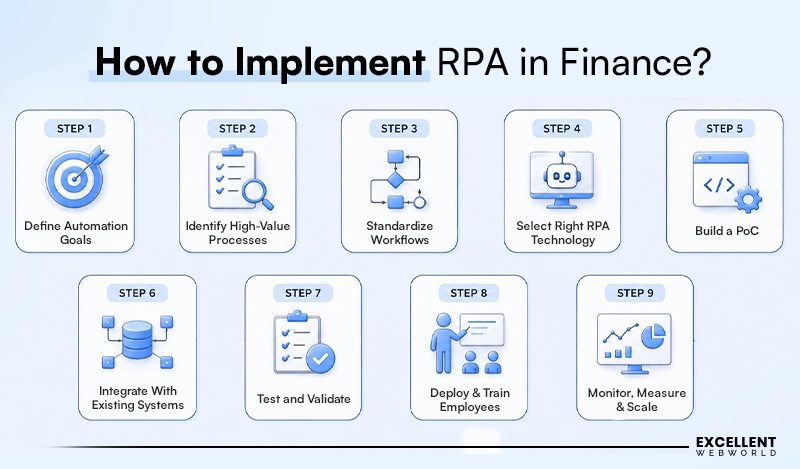
Successful RPA implementation in finance starts by identifying the business problem first, and not the underlying technology. Here’s a step-by-step RPA implementation process you should be aware of:
| Step | What To Do |
|---|---|
| Step 1: Define Your Automation Goals | For successful finance RPA implementation, first set your measurable goals around processing speed, cost reduction, error reduction, compliance, and employee productivity. |
| Step 2: Identify High-Value Processes | Prioritize repetitive, high-volume workflows and assess their complexity, error rate, business impact, and automation feasibility. |
| Step 3: Analyze and Standardize Workflows | Document the current process, remove unnecessary steps, standardize inputs, and define consistent business rules before moving to automation. |
| Step 4: Select the Right RPA Technology | Compare various platforms based on scalability, integrations, licensing, security, support, and compatibility with your existing financial ecosystem. Your RPA implementation strategy should account for both today’s and future needs. |
| Step 5: Build a Proof of Concept | Choose one low-risk, high-value workflow for an RPA proof of concept. Validate processing accuracy, technical feasibility, exception handling, and early financial results. |
| Step 6: Integrate With Existing Financial Systems | RPA integration with legacy systems is vital when you can’t replace those systems. Connect RPA with banking platforms, accounting software, CRM, ERP, APIs, databases, and legacy applications. For example, if you’re dealing with projects related to money lending app development, you need to connect automated workflows with loan origination, payment systems, credit, and KYC. |
| Step 7: Test and Validate | Conduct functional, performance, security, exception, and compliance testing to validate that RPA financial system integration works reliably across expected edge cases and transaction volumes. |
| Step 8: Deploy and Train Employees | Move validated bots to production, train finance employees, define ownership, and establish human oversight controls for sensitive decisions and expectations. |
| Step 9: Monitor, Measure, and Scale | Track error rates, processing time, automation rates, cost savings, and exceptions. Use this feedback to fine-tune your RPA automation strategy. For example, if you’re dealing with projects related to wealth management software development, you need to scale automation across reconciliation, client data updates, portfolio reporting, and other recurring options. |
RPA Architecture & Technology for Finance
A robust RPA architecture provides finance teams with a controlled way to automate repetitive work without creating another technology slio. Here’s how the RPA architecture works and which underlying technologies are empowering it:
Core Components of RPA Finance Architecture
The RPA finance architecture requires distinct layers for data, control, execution, monitoring, and security. Each layer here has a specific role to keep automation reliable as transaction volume and finance workload grow.
| Component | What It Means For Finance Leaders |
|---|---|
| RPA Bots | Execute repetitive tasks such as account updates, reconciliation, invoice entry, and report preparation across existing applications. |
| Orchestrator/Control Center | Centralizes bot orchestration, allowing finance teams to schedule bots, distribute workloads, monitor failures, manage credentials, and control production automation. |
| Workflow Engine | Coordinates multi-step processes across various systems, such as moving an invoice from data extraction through validation, approval, and payment. |
| Business Rules | Defines the conditions that bots use to match transactions, validate data, approve routine cases, or escalate exceptions. |
| Data Layer | Provides controlled access to information from accounting platforms, banking systems, databases, spreadsheets, ERP, and other financial sources. |
| Security Layer | Protects sensitive financial information via access controls, role-based permissions, encryption, and credential management. |
| Monitoring & Analytics | Tracks processing times, transaction volumes, failures, exceptions, and execution. Creates audit trails to provide leaders with visibility into automation performance and control. |
Technologies That Facilitate RPA
RPA becomes more powerful when it works alongside technologies that can understand documents, connect apps, analyze data, and identify process improvements.
| Technology | How It Strengthens Finance Automation |
|---|---|
| OCR | Converts text from forms, PDFs, checks, invoices, and scanned documents into machine-readable data that bots can process. |
| Intelligent Document Processing | Uses AI to understand document structure and fetch relevant fields from various invoices, statements, and other financial documents. |
| APIs | Enable reliable API integration with modern-day applications and services, including payment gateway integration, without just relying on screen-based automation. |
| AI/ML | Helps in classifying transactions, recognizing patterns, identifying anomalies, and supporting intelligent exception handling. |
| NLP | Enables automation to interpret information in emails, notes, customer messages, and other text-based financial communications. |
| Cloud Computing | Cloud services & solutions provide scalable infrastructure for automation workloads and make it easier to expand capabilities as transaction volumes grow. |
| Process Mining | Process mining uses actual workflow data to detect bottlenecks, rework, delays, and high-value opportunities before automation gets deployed. |
RPA Architecture: Human-in-the-Loop
Every finance decision shouldn’t be automated. A practical architecture is one where bots can handle predictable work while finance teams have control over judgment-heavy cases, exceptions, and high-impact financial decisions.
| Layer | Responsibility in Finance |
|---|---|
| Automated Execution | Bots handle repetitive, rule-based activities such as validation, report generation, data entry, system updates, and reconciliation. |
| Exception Detection | Automation identifies policy violations, missing data, unusual transactions, mismatches, or cases that fall outside predefined rules. |
| Human Review | Finance employees review exceptions and make decisions where approval, judgment, or context is required. |
| Approval & Decision Controls | High-impact decisions such as credit decisions, payments, or compliance decisions need approval from respected authorities. |
| Audit & Feedback Loop | Systems record actions and decisions through audit trails, while human-in-the-loop automation keeps critical financial decisions under human oversight. |
RPA vs BPA vs Traditional Automation vs AI-Powered Automation
Not every finance workflow requires the same type of automation. The right choice depends on how repetitive the process is, how much human judgement is needed, and how often the conditions change. Here’s a parameter-based comparison of four major automation approaches:
| Parameter | RPA | BPA | Traditional Automation | AI-Powered Automation |
|---|---|---|---|---|
| Best For | Repetitive tasks | End-to-end workflows | Fixed system tasks | Complex, variable workflows |
| How It Works | Replicates user actions | Connects processes and teams | Uses predefined roles | Uses AI to interpret and adapt |
| Finance Example | Invoice processing | Procure-to-pay | Data transfers | Exception handling |
| Data | Structured | Structured | Structured | Structured + Unstructured |
| Decision-Making | Rule-based | Workflow rules | Fixed-logic | Context-aware AI |
| Exceptions | Route to humans | Escalates through workflows | Predefined handling | Detects and prioritizes exceptions |
| Integration | Existing applications | Multiple systems | Direct system integration | Apps, data, AI & tools |
| Implementation Effort | Relatively quick | Moderate-high | High for custom work | Higher due to AI and governance work |
| Scalability | Scales well for stable, repetitive tasks | Scales across connected business processes | Scales when underlying systems support it | Scales across more complex and variable workflows |
| Advanced Capability | An experienced AI agent development company can add intelligent capabilities when basic RPA reaches its limits. | Extends automation across approval workflows and departments. | Automates predictable system-level processes. | An experienced agentic AI development company can build multi-step workflows that reason, use tools, and adapt. |
| When To Use | High-volume manual work | Cross-team processes | Fixed-system processes | Complex decisions and exceptions |
How to Choose the Right RPA Software Provider for Finance
Choosing an RPA provider is not about the licensing fees and features. You should evaluate an RPA software provider for finance based on these parameters:
| What To Evaluate | What To Look For |
|---|---|
| Industry Experience | Always choose a provider that understands your micro-niche within fintech.
For the banking sector, choose a provider with experience related to RPA in banking, as automation here must handle high-volume transactions, strict controls, compliance needs, and complex legacy environments. |
| Integration Capabilities | Ensure your provider can connect legacy systems, banking, APIs, ERP, CRM, and accounting systems to support seamless financial data processing. |
| Security | Check whether your provider follows a stringent security posture by enforcing encryption, role-based access controls, auditability, and credential management. |
| Scalability | Confirm if your partner has the experience of handling a higher number of bots and transaction volume as business grows. |
| Pricing & Licensing | Compare licensing, infrastructure, implementation, usage, and maintenance costs; do not rely only on the upfront cost given by the provider. |
| Support & Maintenance | Check if your provider offers reliable monitoring, bot maintenance, exception handling, upgrades, and ongoing support. |
| AI Capabilities | Verify if your provider offers intelligent automation capabilities with OCR, ML, AI workflows, and document processing.
For example, if you’re exploring AI agents in banking, ensure the provider can connect agents with existing systems and human oversight controls. |
| Future Readiness | Choose a provider that can adapt to emerging fintech trends and your evolving automation roadmap. |
RPA Challenges in Finance and How to Overcome Them
RPA can definitely reduce repetitive workload, but scaling it across financial workflows is not as simple as plug-and-play. Legacy systems, security gaps, and weak governance can turn a promising automation project into an operational nightmare. Here are some of the key challenges of RPA in finance and ways to overcome them:
| Challenge | What It Means for Finance Leaders | How to Overcome It |
|---|---|---|
| Data Security & Privacy | Bots handle sensitive financial and customer data. So, weak controls can increase security and compliance risks. |
|
| Legacy System Integration | Older accounting and banking platforms lack modern APIs, thereby making it hard to automate workflows across disconnected systems. |
|
| Poorly Standardized Processes | If you’re following different steps for the same tasks, bots can automate inconsistent processes and increase exceptions. |
|
| Employee Resistance | Employee fear that automation may replace their roles, thereby creating resistance during implementation. |
|
| Bot Maintenance | Application updates can cause bots to break, thereby causing failed transactions and processing delays. |
|
| Scaling Automation | Managing multiple bots across finance becomes harder when standards, ownership, and governance are unclear. |
|
RPA + AI: The Future of Finance Automation
AI and RPA in finance are changing what automation can handle. By combining RPA and artificial intelligence, firms can move toward intelligent automation in finance while continuing to use their existing financial systems.
How does AI Enhance RPA?
- Understand unstructured data: AI-powered RPA can interpret documents, emails, and non-standard information.
- Extract information: Intelligent process automation can capture related financial data and feed it into financial workflows.
- Identify patterns: RPA with machine learning can detect unusual payment and transaction patterns.
- Support decisions: AI provides recommendations while keeping critical judgment under human oversight.
- Handle exceptions: AI automation in financial services assesses complex cases and routes those to the appropriate finance teams.
How does RPA Work With Intelligent Document Processing?
- Invoice processing: OCR and RPA extract invoice details from scanned documents and PDFs, validate that information, and send it to the respective finance workflow.
- KYC extraction: RPA captures customer information from KYC documents and transfers verified data into various systems, thereby reducing repetitive data entry.
- Contract analysis: AI identifies relevant information and clauses in financial contracts, while RPA moves the extracted data into downstream workflows.
- Financial statements: RPA collects information from financial statements and organizes it for reconciliation, reporting, and further analysis.
How does RPA Work With Machine Learning?
- Anomaly detection: Machine learning identifies unusual transaction patterns, while RPA automatically routes flagged transactions for review.
- Suspicious activity: ML models identify potentially suspicious transactions, and RPA collect relevant information from there and creates investigation workflows.
- Payment predictions: ML algorithms analyze historical payment patterns to detect transactions that may be delayed, allowing finance teams to act earlier.
- Financial forecasting: Machine learning analyzes historical and current financial data, while RPA collects required inputs and distributes forecast reports.
How do AI Agents Change RPA?
- Understand requests: AI agents interpret natural-language requests from finance employees and decide what action or workflow is needed.
- Choose workflows: AI agents evaluate requests and context before choosing the relevant RPA workflow instead of relying on rule-based fixed triggers.
- Coordinate tasks: Agents coordinate multiple RPA tasks across financial systems to accomplish more complex workflows from beginning to end.
- Handle context: Hyperautomation in finance combines RPA, AI, APIs, and other technologies so workflows can respond according to changing business needs.
- Escalate decisions: Agents identify situations that require approval or judgment and route them to relevant finance teams instead of acting autonomously.
How to Measure RPA ROI in Finance
RPA ROI should answer a simple question: Did automation save money and productive time to justify the amount we invested? Here are key metrics that will give you the answer:
- Processing time saved: Demonstrates how much faster the automation completes financial workflows compared to manual processes.
- Labor hours saved: Measures the hours saved for employees as they shift from repetitive tasks to higher-value work.
- Cost savings: Estimates the reduction in operational costs post financial automation.
- Error reduction: Demonstrates whether automation is reducing costly mistakes, rework, and reconciliation issues.
- Transaction volume: Tracks how many transactions the automation can support without adding headcount.
- Bot utilization: Measures how effectively bots are being used against their available operating capabilities.
- Productivity improvement: Shows whether finance teams are able to complete more valuable work with the same resources post-automation.
How to Calculate RPA ROI
RPA ROI = [(Annual Benefits − Annual RPA Costs) ÷ Annual RPA Costs] × 100
For correct calculation of ROI, you need to account for labor savings, measurable productivity gains, and reduced error-related costs as the annual benefits. You also need to consider licensing, infrastructure, development, integration, maintenance, and support costs.
Suppose your finance team is spending $120,000/year on manual invoice processing. After implementing RPA, you’re saving $70,000 in labor costs due to the reduction of manual efforts and another $20,000 due to fewer data-entry and reconciliation errors. So, your total annual benefit becomes $90,000.
Now, if the development, licensing, infrastructure, and maintenance spending behind RPA setup is $50,000, then your RPA ROI = [($90,000 − $50,000) ÷ $50,000] × 100 = 80%.
How Much Does RPA Implementation Cost in Finance?
RPA implementation cost in finance can range from $50,000-$150,000 for a focused implementation, while large enterprise programs can exceed $500,000.
The final number depends on various factors such as integrations, licensing, security, process complexity, and the number of workflows you need to automate.
RPA Cost by Project Size
Here is an approximate estimate of RPA implementation cost according to the project size:
| Project Size | Typical Cost | What You Get |
|---|---|---|
| Small Proof of Concept | $18,000–$50,000+ | One focused workflow for validating business value, feasibility, and technical compatibility. |
| Department-Level Automation | $50,000–$150,000+ | Multiple interconnected workflows, integrations, testing, training, and production deployment. |
| Enterprise-Wide Automation | $500,000+ | Multiple processes, bots, enterprise-level integration, infrastructure, governance, security, and support. |
Factors That Determine RPA Implementation Cost
- Number of processes: More workflows mean more analysis, development, testing, and maintenance, which adds to the overall budget.
- Workflow complexity: Exception-heavy and complex processes require more sophisticated automation than simple, rule-based workflows.
- Number of bots: The number of bots increases orchestration, monitoring, licensing, and support requirements, which increases the cost.
- Integration requirements: Connecting CRM, ERP, accounting, banking, or legacy systems can increase the development efforts.
- Platform licensing: Cost here varies depending on users, environments, attended/unattended bots, and vendor pricing.
- AI/OCR requirements: OCR, ML, AI, and document processing capabilities add technology and implementation costs.
- Security requirements: Financial institutions require stronger logging, compliance testing, access controls, and credential management capabilities, which adds to the overall budget.
- Infrastructure: On-premises, cloud, virtual machines, networking, and disaster recovery affect the total budget.
- Maintenance: Bots require updates, monitoring, troubleshooting, and optimization after launch.
How to Reduce RPA Implementation Costs
- Start with high-ROI processes: Always start with repetitive, high-volume workflows where savings are easy to measure.
- Build a PoC: Validate the business use cases before investing a major budget.
- Reuse automation components: Reusable workflows, connectors, and business rules reduce development effort.
- Automate incrementally: Expand proven use cases instead of trying to automate the entire finance function at one go.
- Match licensing to actual usage: Avoid paying for capacity that your team doesn’t need.
- Avoid unstable processes: Standardize your frequently changing workflows before automating them.
RPA in Finance: Key Trends to Watch
Here are some of the key trends of RPA in finance that financial institutions should be aware of:
| Trend | What It Means for Finance Leaders |
|---|---|
| AI-Powered Intelligent Automation | RPA combined with generative AI and ML can handle complicated workflows. It is especially valuable for projects related to digital wallet app development where growing transaction volume needs faster back-office processing. |
| Agentic Automation in Finance | AI agent can coordinate multi-step finance processes while humans oversee critical decisions. It can help financial institutions respond to changing mobile banking trends without adding more manual work. |
| Hyperautomation | RPA, process mining, AI, APIs, and workflow automation can connect multiple processes. It is especially useful for projects related to BNPL app development where you need to handle the entire lifecycle from customer onboarding and credit assessment to payment processing and collections. |
| Intelligent Document Processing | You can process statements, invoices, contracts, and financial forms with minimal human review. It is useful for insurance mobile app development projects, where policy and claim documents create a massive processing workload. |
| Cloud-Based RPA | Cloud infrastructure facilitates faster deployment, bot management, and easier scaling as transaction volume grows. |
| Process Mining | Process mining helps financial leaders find unnecessary steps, roadblocks, and high-value automation opportunities before investing in new workflows. |
| Human-in-the-Loop Automation | Bots can handle repetitive processes, while humans manage high-impact decisions and exceptions. It’s useful for projects related to money transfer app development, where speed is important but financial controls are even more valuable. |
How Excellent WebWorld Can Help You Implement RPA in Finance
RPA can help financial institutions automate repetitive workflows like invoice processing, KYC, payments, account updates, reconciliation, and reporting. However, to implement RPA in finance successfully, you need an experienced partner who identifies the right processes, connects RPA with your financial ecosystem, and tells you the areas where there’s maximum RPA ROI.
That’s where the role of Excellent Webworld, a leading robotic process automation services provider, comes into the picture. Here’s what you will get by partnering with Excellent Webworld for RPA:
- Tailored financial automation solutions: Analyze your workflow, identify high-value opportunities, and build RPA around your specific processes and business rules.
- Integrate RPA with AI and existing systems: Connect RPA with CRM, ERP, APIs, accounting software, legacy systems, banking platforms, AI/ML and OCR/IDP to remove fragmented manual workflows.
- Secure & scalable automation: Create a scalable & secure architecture with access control, data security, and compliance monitoring so automation can grow without adding operational risks.
- Proven fintech expertise: Experience delivering 100+ fintech platforms, 120+ payment and banking API integrations, 65+ core banking modernizations, and 300+ automated financial workflows.
Want to automate your day-to-day financial operations? Connect with our industry experts who identify the highest-ROI opportunities and devise a practical RPA implementation roadmap.
Frequently Asked Questions
You should start with high-volume repetitive processes that have clearly defined rules, like reconciliation, data entry, invoice processing, and reporting. Analyze processing time, error rates, employee workload, and potential savings you can get by automating a particular process. The best candidates are those that deliver maximum business value based on KPIs.
Oh YES! RPA can handle increasing transaction volumes without adding more members to the team. You need clear governance, centralized management, reusable automation components, regular monitoring, and regular bot maintenance to make scaling successful.
You should track processing time, operating cost, transaction volume, bot utilization, labor hours saved, error rate, and employee productivity. You should establish the baseline of these metrics before automation and then compare the performance against these benchmarks to know whether your automation efforts are worth it or not.
YES, you can integrate RPA into existing financial systems using APIs, connectors, or UI automation. With successful integration, RPA can work with ERP platforms, accounting software, CRM systems, banking platforms, spreadsheets, databases, and legacy applications, thereby allowing businesses to automate workflows without replacing their core financial ecosystem.
You should establish clear automation standards, access controls, security policies, centralized ownership, and approval processes. Assign owners for each bot and monitor their performance. A governance framework will help you prevent duplicate automation, operational issues, and security gaps as automation expands across departments.

Article By


Mayur Panchal is the CTO of Excellent Webworld. With his skills and expertise, he stays updated with industry trends and utilizes his technical expertise to address problems faced by entrepreneurs and startup owners.