UAE E-Invoicing ERP Integration means configuring or extending your ERP so it creates structured PINT-AE XML invoices and exchanges them through an accredited service provider (ASP) on the Peppol network. The UAE e-invoicing mandate applies to B2B and B2G transactions and rolls out in phases by annual revenue.
- Large businesses (AED 50 million or more): appoint an ASP by 30 October 2026 (now passed) and go live on 1 January 2027.
- Smaller businesses (below AED 50 million): appoint an ASP by 31 March 2027 and go live on 1 July 2027.
- Government entities: appoint an ASP by 31 March 2027 and go live on 1 October 2027.
The dates come from the Ministry of Finance's phased timeline as reported by KPMG. Your ERP creates the invoice data, and your ASP validates and transmits it. If the ERP cannot produce complete, correctly structured data, no ASP can fix the problem, which is why UAE E-Invoicing ERP Integration decides most go-lives.
This guide covers both groups in one place. I run EWW's UAE operations and work with finance and IT teams across the GCC, and the pattern is consistent: large groups struggle with multi-entity architecture and data quality, while smaller businesses struggle with choosing a route and a provider. Each section below says which group it applies to.
In this guide:
- Deadlines and phases: the ASP appointment and go-live dates for large businesses, smaller businesses, and government entities, plus how the AED 50 million revenue test works.
- How it works: PINT-AE, the Peppol network, and the five-corner model, and what your ERP does versus what your ASP does.
- What changes inside your ERP: outbound and inbound invoices, credit notes, corrections, and record retention.
- Integration routes and architecture: ASP portal, vendor module, middleware, or custom build, and when each one fits.
- Data readiness: the master data gaps that delay go-lives, with a checklist to test against.
- Choosing an ASP: what to ask providers and how to compare them.
- Implementation plans: an 8-week plan for large businesses and a month-by-month plan for smaller ones.
- Testing, cutover, and governance: validation, go-live, and who owns it afterward.
- FAQ and penalties: 13 direct answers, including the fine amounts.
Deadlines and phases for UAE E-Invoicing ERP Integration
The UAE e-invoicing deadline depends on your annual revenue. The Ministry of Finance set two dates per phase: a deadline to appoint an ASP and a mandatory go-live date. The table below is a reference for UAE E-Invoicing ERP Integration planning.
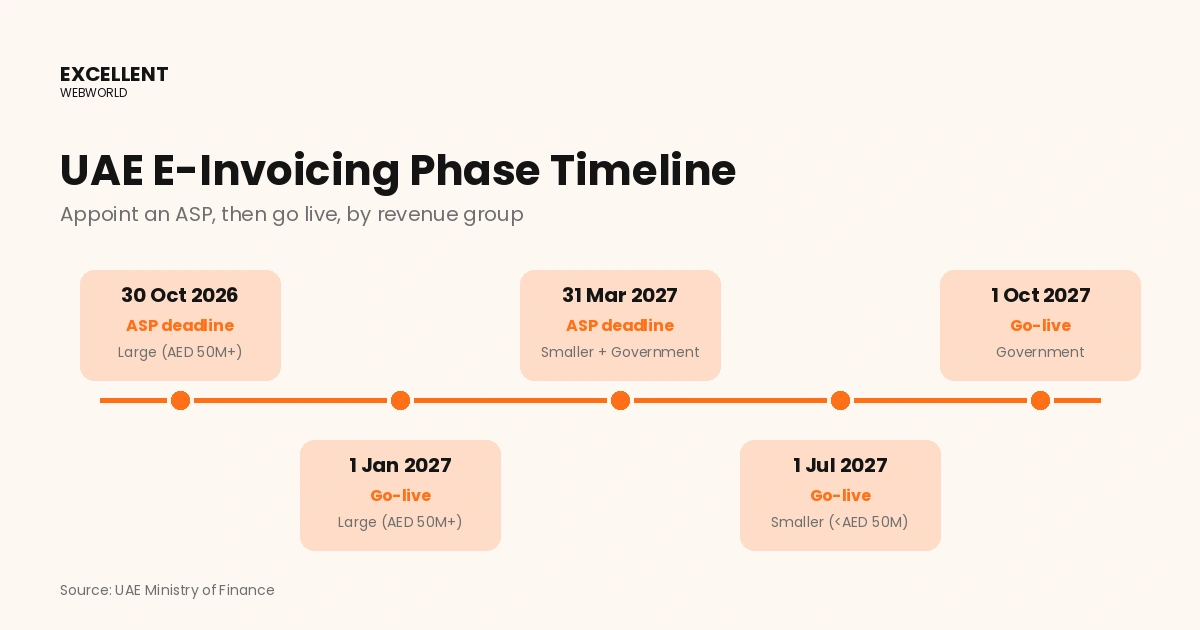
| Group | Annual revenue | ASP appointment deadline | Mandatory go-live |
|---|---|---|---|
| Phase 1: large businesses | AED 50 million or more | 30 October 2026 (passed) | 1 January 2027 |
| Phase 2: smaller businesses | Below AED 50 million | 31 March 2027 | 1 July 2027 |
| Phase 3: government entities | Not applicable | 31 March 2027 | 1 October 2027 |
Sources: KPMG, July 2026. Pilot and voluntary adoption opened on 1 July 2026, so any VAT-registered business can start early.
How the revenue test works. The threshold is annual turnover, not VAT group size or headcount. Grant Thornton UAE reports that it counts revenue from all business activities, including B2C sales, even though the mandate itself covers B2B and B2G invoices. If your revenue is near AED 50 million, plan for the Phase 1 timeline and confirm your status with your tax adviser.
The deadline history. The Ministry originally set the Phase 1 appointment deadline at 31 July 2026. Amendments announced on 10 May 2026 moved it to 30 October 2026 and left the 1 January 2027 go-live unchanged (e-invoice.app). The Ministry has shown it will move appointment dates when the market needs more time, but it has held the go-live date so far, so I would not plan around a go-live extension.
If you missed the 30 October 2026 ASP deadline (large businesses):
- Appoint an ASP this week. Shortlist two or three from the Ministry's pre-approved list and decide on ERP connectivity first and price second.
- Ask your tax adviser and your ASP how the Ministry treats late appointments. I do not know of a published grace period, so confirm it directly rather than assuming one.
- Start the ERP gap analysis in parallel. The mandatory fields are the same for every ASP, so the work does not depend on which provider you pick.
Scope notes. Free zone companies are not automatically exempt. The Ministry's Electronic Invoicing Guidelines V1.1, published on 1 June 2026, address VAT groups, investment holding companies, non-resident suppliers, self-billing, advance payments, and retention billing (e-invoice.app). B2C-only invoicing is outside the mandatory scope for now. Confirm any edge case with your adviser before you build around it.
How UAE e-invoicing works
An e-invoice in the UAE is a structured XML data file in the PINT-AE format, exchanged between accredited service providers over the Peppol network. It is not a PDF, Word file, Excel sheet, or emailed attachment.
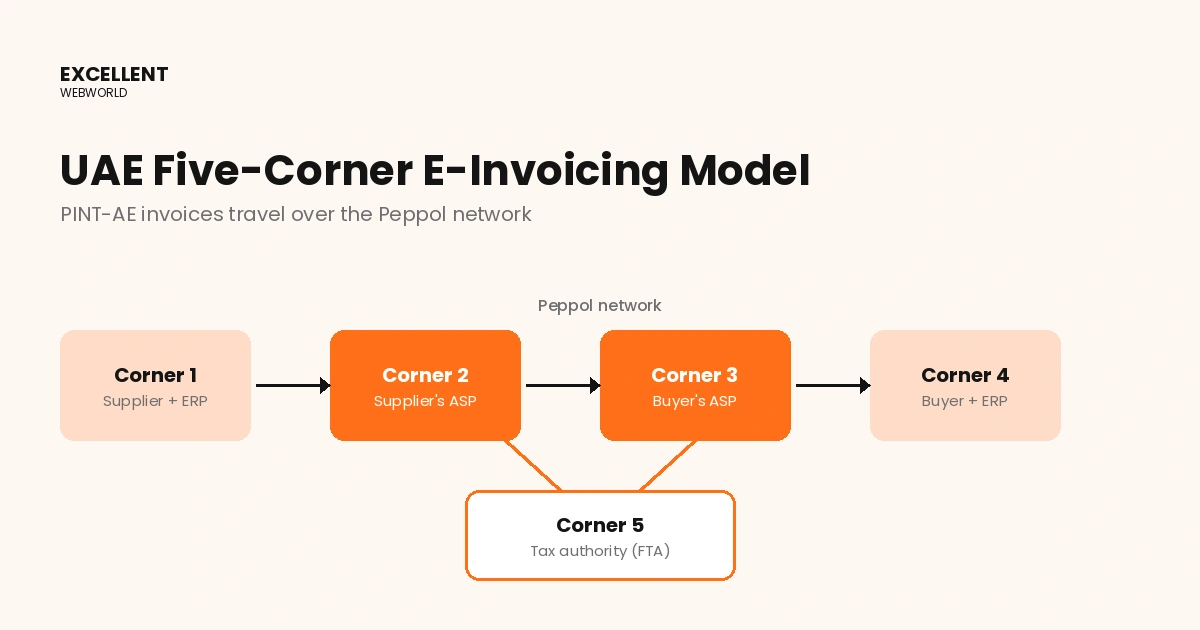
PINT-AE is the UAE's implementation of the Peppol International Invoice specification, built on UBL 2.1 (e-invoice.app). It defines the data model, the mandatory fields, and the validation rules every invoice and credit note must meet.
The five-corner model. The UAE adapts the Peppol four-corner model by adding a government node (Zoho):
- Corner 1: the seller creates the invoice in its ERP or accounting system.
- Corner 2: the seller's ASP validates the data and sends it across the Peppol network.
- Corner 3: the buyer's ASP receives the invoice and delivers it.
- Corner 4: the buyer receives the invoice in its own system.
- Corner 5: the Ministry of Finance and the Federal Tax Authority (FTA) receive the validated invoice data.
Both issuers and recipients need an ASP, so the mandate affects accounts payable as much as accounts receivable.
What the ERP does and what the ASP does. Most confusion comes from unclear responsibility:
| Responsibility | ERP | ASP |
|---|---|---|
| Create the invoice record and line items | Yes | No |
| Populate every PINT-AE mandatory field | Yes | No |
| Validate against the mandate rules | Partly (pre-checks) | Yes |
| Transmit over the Peppol network | No | Yes |
| Report to the Ministry and the FTA | No | Yes |
| Handle rejections and retries | Fix source data | Return status, log errors |
The pre-approved ASP list stood at 41 providers in June 2026; check the Ministry's e-invoicing portal for the current list.
UAE E-Invoicing ERP Integration: What Changes Inside Your ERP
UAE E-Invoicing ERP Integration touches every system that creates, receives, corrects, or stores an invoice, and most organizations have more of those systems than finance realizes. It is a data project first and a connectivity project second.
Outbound (invoice to cash). Your ERP, billing platform, or subledger must produce a PINT-AE invoice for each B2B and B2G sale. Check every origination point, not only the main ERP. Subscription billing, project billing, e-commerce platforms, field service, and legacy systems often issue invoices outside the core finance system. For smaller businesses the equivalent list is shorter but still matters: accounting software, spreadsheets, point-of-sale, mobile apps used by field staff, or billing apps.
Inbound (procure to pay). Suppliers in scope will send structured invoices to your ASP. Your accounts payable process has to ingest XML data, match it against purchase orders and receipts (the same data that AI inventory management systems depend on), and handle rejections. If your AP team works from PDFs today, this is the largest process change in the program. RPA development can take over repetitive matching and exception routing once the data is structured, and our guide to RPA in finance covers use cases and ROI.
Corrections and special cases. Credit notes, debit notes, self-billing, advance payments, retention billing, and intercompany transactions each need a defined path in the ERP. The Ministry's guidelines address several of these directly, so list the ones your business actually uses and map each to a PINT-AE document type.
Records and audit. Decide where the XML, the ASP's acceptance status, and the original ERP document are stored, and how an auditor can trace one to the other. Confirm retention requirements with your tax adviser. To see the standards we hold ourselves to, read about the compliances we follow.
Where the ERP work sits in the project. The table shows what UAE E-Invoicing ERP Integration usually involves, in the order teams tackle it.
| Workstream | What it covers | Typical owner |
|---|---|---|
| Gap analysis | Compare current invoice data with PINT-AE mandatory fields | Finance and IT |
| Field mapping | Map each ERP field to a PINT-AE field and document gaps | IT and tax |
| Export build | Generate PINT-AE XML from the ERP or billing system | IT or integration partner |
| ASP connection | Authenticate, send, and receive through the ASP | IT |
| Inbound AP | Ingest supplier XML, match, and post | Accounts payable |
| Exceptions | Route rejections to an owner and reissue corrected invoices | Finance operations |
UAE E-Invoicing ERP Integration Routes and Architecture
The right route for ERP integration for e-invoicing in the UAE depends on how many systems issue invoices and how customized their invoice logic is, not on the ERP brand. EWW's ERP development team works across SAP, Oracle NetSuite, Odoo, Zoho, and custom ERPs, and the same pattern repeats on all of them.
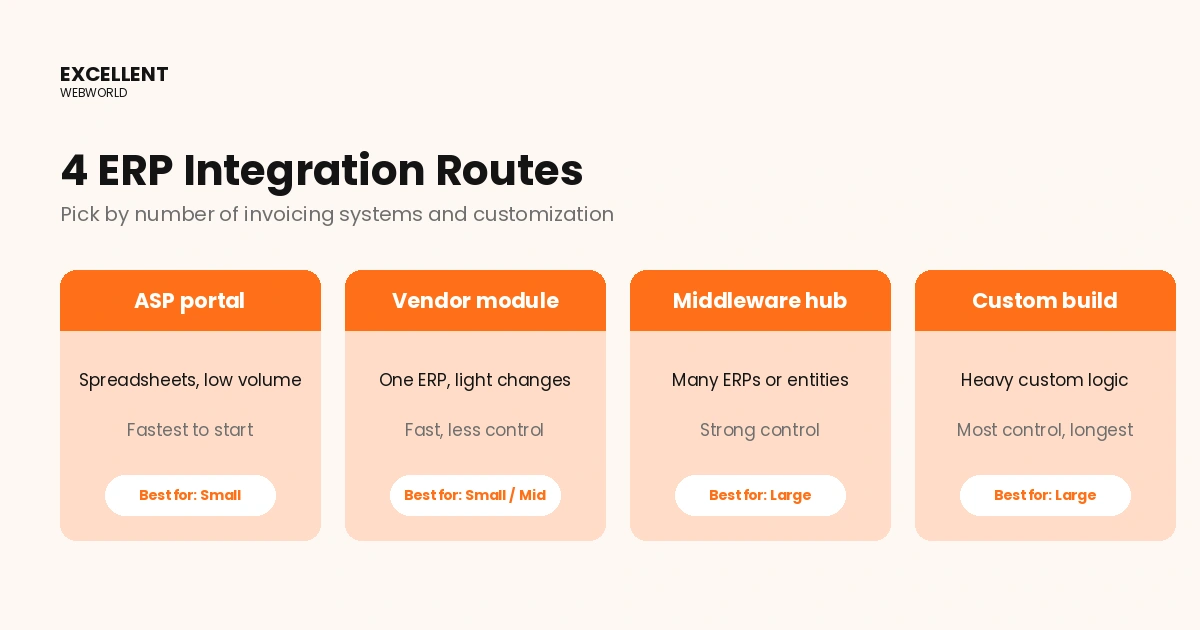
| Route | Best fit | Speed | Control | Ongoing effort |
|---|---|---|---|---|
| ASP portal (no ERP change) | Spreadsheets or manual invoicing, low volume | Fastest | Lowest | Low |
| Software vendor's built-in module | One ERP or accounting product, light customization | Fast | Lower | Track vendor updates |
| Central integration hub or middleware | Several entities, ERPs, or billing platforms | Medium | High | One mapping layer to maintain |
| Custom export per ERP | Heavily customized ERP with no certified module | Slowest | Highest | Highest; every ERP change can affect it |
For large and multi-entity groups. A central integration layer (API integration services) is usually the safer choice, because it gives you one place to map fields, validate data, and monitor the ASP connection. Three questions settle most decisions:
- How many systems originate invoices? More than two usually justifies a hub.
- How customized is your invoice logic? Heavy customization breaks standard modules, so test a vendor module against your real invoices before you commit.
- Who maintains it after go-live? A custom export needs a named owner and a regression test plan for every ERP upgrade.
Separate from the integration design (see data integration versus workflow orchestration for how the two differ) is the question of how many ASPs your group uses and whether each legal entity appoints its own. Confirm the group-level approach with your adviser and your ASP before you design around it. If your ERP needs heavy rework to meet the mandate, application modernization may be the better route, and for on-premises ERPs cloud migration is a related option.
For smaller businesses. You do not need to buy an ERP to comply. You need a reliable way to produce valid PINT-AE invoices. Match the route to your situation:
| Your situation | Likely route | What to check |
|---|---|---|
| Cloud accounting software, a few hundred invoices a month | Use the software's UAE e-invoicing integration | Which ASPs it connects to and whether it is certified for the UAE |
| Spreadsheets or manual invoicing, low volume | Use an ASP's invoice portal, or a custom web portal | Portal cost and how you export records |
| ERP or billing system, thousands of invoices a month | Integrate the system with your ASP | A field-mapping review and a sandbox test before you sign |
| Several systems that each issue invoices | Consolidate invoice creation, or add an integration layer | A list of every system that issues invoices |
If you run your own software platform, a SaaS development team can build the PINT-AE export into the product; AI SaaS product ideas shows what other founders are building. If your own software cannot be updated, software development services can build the missing export. Businesses whose invoices come from operational apps, such as dispatch or delivery platforms, should also check how those apps feed billing; see AI-powered logistics apps in Dubai and AI agents for last-mile deliveries. Online sellers that also invoice businesses should check how their ecommerce platform issues invoices; digital commerce versus e-commerce explains how connected systems work.
Questions to ask your software vendor, in writing:
- Do you support PINT-AE today, and in which version of the product?
- Which accredited providers are certified with your product?
- What does the integration cost, and is it included in my subscription?
- What happens to my invoice history if I switch providers?
UAE E-Invoicing ERP Integration Data Readiness: where go-lives slip
Data quality, not XML, is what delays most UAE E-Invoicing ERP Integration projects. The ERP can only produce a valid invoice if every mandatory field exists, is in the right format, and is correct at the time of posting.
The wider evidence points the same way. A December 2025 survey by Hannover Research of 365 finance decision-makers found that 93% of finance teams struggle with poor data management, and that the average team uses four or more separate tools to manage data. The sample covered companies with more than 250 employees in five Western countries, so treat it as a signal, not a UAE benchmark.
The Ministry publishes a mandatory field requirements document alongside its guidelines. Use it as your checklist and test your last 12 months of invoices against it.
The gaps to check first:
- Customer and supplier master data. Missing or inconsistent tax registration numbers, legal names that differ from the registered name, and incomplete addresses.
- Legal entity data. Each entity's registered details must match across the ERP, your tax registration, and your ASP setup.
- Tax categories and codes. Line-level tax treatment, exemptions, zero-rated supplies, and reverse charge cases mapped consistently.
- Units, currencies, and rounding. Different rounding rules between the ERP and the validation rules cause rejections that look random until you find the cause.
- Document linkage. Credit notes and debit notes that reference the original invoice reliably.
- Free-text overrides. Fields that users edit manually at posting time, which produce one-off values that fail validation.
A practical method, supported by data engineering work: run a data profile on the last 12 months of issued invoices, count how many would fail the mandatory field check, and rank the causes by volume. Fix the top causes at the source, in master data or posting rules, rather than patching them in the export. A fix in the export hides a problem that will return in the next system you connect.
Name an owner for each cause. Master data problems usually belong to finance operations or sales operations, not IT. Smaller businesses can apply the same method on a smaller scale: clean the customer list first, and keep customer details in one CRM record. Once the data is clean, agentic AI in ERP systems becomes a realistic next step, and financial institutions already apply agentic AI to similar workflows.
Choosing an ASP and UAE e-invoicing software
Choose the ASP that connects reliably to your ERP, handles rejections well, and gives you support you can reach; price comes third. An ASP is part of your invoice-to-cash chain, so treat the choice as a critical supplier decision, not a software purchase. Many ASPs sell UAE e-invoicing software as a platform with ERP connectors, so compare the connector and the exception handling, not only the feature list.
Use this checklist when you compare providers:
- Status. Is the provider on the Ministry's current pre-approved list, and will it confirm its accreditation in the contract?
- Peppol connectivity. Does it operate a certified Peppol access point?
- Native PINT-AE generation. Does the platform generate PINT-AE XML itself, or depend on a third party?
- ERP connectors. Does it have a tested connection to your specific ERP version, or a portal if you have no ERP?
- Exception handling. How are rejections, retries, and integration failures logged, reported, and resolved?
- Support. Is support available during UAE working hours, in English and Arabic, and what is the response time?
- Pricing. Get the full price in writing: setup fees, monthly fees, per-invoice charges, connector fees, and what happens as volume grows.
- Contract terms. What is the minimum term, and how do you export your invoice records if you leave?
- References. Can it connect you with a client of similar size on the same ERP?
Vendor risk for large enterprises. Ask for service levels with remedies, escalation paths that match UAE working days, a clear process for rule and format changes, and confirmation that your ERP vendor has certified the integration. Review how invoice data is secured in transit, with cybersecurity specialists if needed. If you add AI to invoice handling, read our guide to enterprise AI security.
Smart buying for smaller businesses. Get quotes from at least three providers, using your actual monthly invoice count. Ask each to run your own sample invoices through its sandbox before you sign. Avoid long lock-in contracts in the first year of a new mandate, because features and prices will shift. Aim to appoint by mid-March 2027 so that a signing delay does not push you past 31 March.
UAE E-Invoicing ERP Integration Implementation Plans
A UAE E-Invoicing ERP Integration project follows the same five steps for every business: gap analysis, field mapping, build, connect and test, then parallel run and go live. Only the calendar differs between Phase 1 and Phase 2.
UAE E-Invoicing ERP Integration Plan for large businesses: eight weeks to 1 January 2027
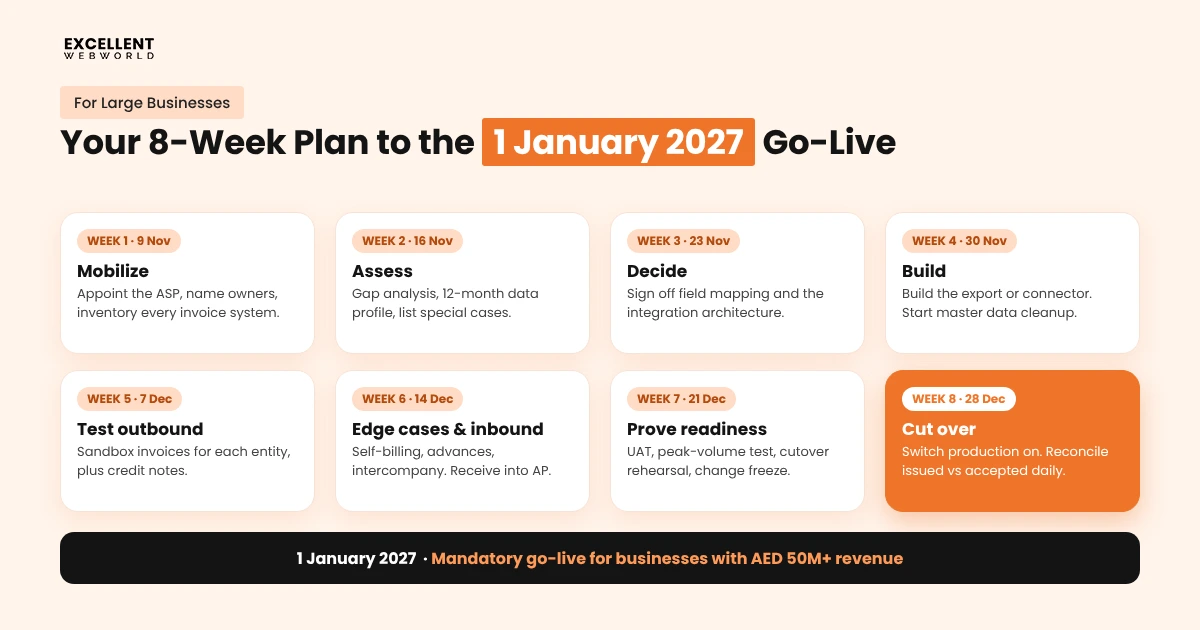
From Monday 9 November 2026 to go-live you have eight working weeks. The plan assumes you appoint your ASP in week one. UAE National Day falls in early December, so build slack into weeks four and five.
- Week 1 (9 November): Mobilize. Appoint the ASP if you have not. Name a program owner in finance and a technical lead in IT. Inventory every system that issues or receives invoices. Request sandbox access.
- Week 2 (16 November): Assess. Run the gap analysis against the Ministry's mandatory fields. Profile 12 months of invoice data. List the special cases you use: credit notes, self-billing, advances, retention, intercompany.
- Week 3 (23 November): Decide. Sign off the field mapping. Choose the architecture: vendor module, central hub, or custom export. Open the data-fix backlog with named owners.
- Week 4 (30 November): Build. Develop the outbound export or connector. Start master data cleanup in parallel. Confirm the inbound AP process with your ASP.
- Week 5 (7 December): Test outbound. Send sample invoices through the ASP sandbox for each entity. Test credit notes and corrections. Log every rejection with its cause.
- Week 6 (14 December): Test edge cases and inbound. Cover self-billing, advances, retention, and intercompany flows. Receive test invoices into AP. Run negative tests with deliberately bad data.
- Week 7 (21 December): Prove readiness. Run user acceptance testing with finance, a volume test at peak daily load, and a cutover rehearsal. Document the support runbook. Freeze invoice logic.
- Week 8 (28 December): Cut over. Complete final checks, switch production on, and begin hypercare with daily reconciliation of invoices issued versus invoices accepted.
If this schedule looks impossible, do not assume the date will move. Cut scope instead: go live with your highest-volume entities and invoice types first, and keep a documented plan for the rest. Ask your ASP and adviser what the Ministry expects for partial readiness before you rely on that approach.
UAE E-Invoicing ERP Integration Plan for smaller businesses: month by month to 1 July 2027
This plan gives you a buffer before each legal date.
- November 2026: Confirm and inventory. Confirm you are in Phase 2. List every tool that creates invoices: accounting software, spreadsheets, point-of-sale, or billing apps. Count your monthly invoices.
- December 2026: Clean your data. Fix customer records first: legal names, addresses, and tax registration numbers. Decide who owns master data from now on; business and IT consulting can help if no one in-house does.
- January 2027: Shortlist. Choose three providers. Request demos and written quotes using your real invoice volume.
- February 2027: Test and select. Ask each finalist to run your sample invoices in its sandbox. Check references. Select your provider.
- March 2027: Appoint. Sign and complete the appointment by mid-March. The legal deadline is 31 March 2027, so treat 15 March as your own.
- April 2027: Connect. Configure your software or portal, map your invoice fields, and agree how credit notes and corrections will work.
- May 2027: Test. Send test invoices end to end. Train the people who issue invoices and the people who handle customer questions, including any AI voice agents that answer invoice queries.
- June 2027: Run in parallel. Issue real invoices through the new route alongside your old process, fix problems, and write a one-page procedure for staff.
- 1 July 2027: Go live. Issue all in-scope invoices as e-invoices and check every rejection on the first day.
Voluntary adoption has been open since 1 July 2026, so starting with a few customers early is a low-risk way for smaller businesses to learn.
UAE E-Invoicing ERP Integration Testing, Cutover, and Governance
A go-live that passes happy-path tests can still fail on day one, because production brings volume, odd data, and rejections nobody planned for. Test for those before cutover. This applies to a 20-invoice-a-month business as much as to a multi-entity group, only at a different scale.
| Test type | What it proves | Pass signal |
|---|---|---|
| Sandbox, outbound | Invoices validate and reach the ASP | Zero unexplained rejections on the sample set |
| Credit and debit notes | Corrections link to the original invoice | Every note references a valid parent |
| Negative tests | Bad data is caught and routed to the right owner | Each deliberate error produces a clear, logged rejection |
| Inbound AP | Supplier e-invoices arrive and match purchase orders | Test invoices post without manual re-keying |
| Volume | The connection holds at peak load | Peak daily volume processes within the agreed window |
| Cutover rehearsal | The switch and the rollback both work | Team completes both in the planned window |
Design the rejection workflow before go-live. Decide who sees a rejection, how fast they must act, how the corrected invoice is reissued, and how the original is canceled or credited. Agree these rules with your tax team, since the right correction method depends on the Ministry's rules. A rejection queue with no owner is the most common cause of late invoices in the first month. Business process management tooling can route each exception to its owner.
Reconcile daily during hypercare. Compare invoices issued in the ERP with invoices accepted by the ASP. A gap means invoices are stuck, rejected, or never sent. Keep a manual fallback ready, and agree with your adviser how it would be documented.
Monitor after hypercare. Track the rejection rate, time to acceptance, and ASP availability weekly on a business intelligence dashboard, and review them with finance leadership.
Governance for larger organizations. E-invoicing crosses finance, tax, IT, procurement, and your suppliers' systems, so the program fails without one accountable owner. Give one executive the mandate and make the others contributors. Choosing between embedded and traditional delivery for the build is covered in forward deployed engineering versus traditional software development.
| Role | Owns |
|---|---|
| Executive sponsor (CFO or finance director) | Go-live decision, budget, escalation |
| Program owner (finance or tax) | Plan, scope, status, special-case decisions |
| Technical lead (IT or ERP team) | Architecture, build, testing, release |
| Master data owner (finance operations) | Fixing the data gaps found in profiling |
| AP lead | Inbound process and supplier communication |
| Vendor manager (procurement) | ASP contract, service levels, ERP vendor support |
Change control. Freeze invoice-related changes in your ERP from the start of week seven, and require a regression test (our guides to DevOps automation and AI tools for CI/CD pipeline automation cover how) for any later change to tax codes, document types, or master data structures. Tell customers which ASP you use and when you start, and ask key suppliers for their plans.
Common mistakes to avoid in UAE E-Invoicing ERP Integration, especially for smaller businesses:
- Waiting for the go-live date. The appointment deadline comes first.
- Choosing on price alone. The cheapest plan can charge extra for connectors, support, or volume.
- Skipping the data cleanup. A missing customer tax number or mismatched legal name causes rejections.
- Assuming your software is ready. Ask the vendor for written confirmation of PINT-AE support and the accredited providers it works with.
- Ignoring credit notes. Decide how you will issue them before go-live, not after the first customer complaint.
- Forgetting inbound invoices. You will also receive e-invoices from suppliers in scope. Businesses that track stock should check how stock data matches supplier invoices.
- Not training the team. The person who issues invoices on a busy Friday needs a one-page procedure and a named contact. Where staff re-key invoice data between systems, see how RPA in ecommerce automates routine entry.
- Treating the mandate as a one-off. Rules and formats will change. Teams building regulated products already plan for this, as in compliance-first money transfer app development.
- UAE E-Invoicing ERP Integration means your ERP creates PINT-AE XML and your ASP validates and transmits it over Peppol. Both must work.
- Large businesses (AED 50 million or more) go live on 1 January 2027; their ASP appointment deadline of 30 October 2026 has passed. Smaller businesses appoint by 31 March 2027 and go live on 1 July 2027.
- Data quality decides most go-lives, so profile 12 months of invoices and fix causes at the source.
- Choose the integration route by the number of invoice-issuing systems and how customized they are, not by ERP brand.
- Treat inbound supplier invoices and the rejection workflow as equal workstreams to outbound.
- Appoint early, test with your own invoices, and keep a named owner for every exception.
Need help with UAE E-Invoicing ERP Integration? Book a free ERP gap analysis or e-invoicing readiness check with EWW.
Frequently Asked Questions
UAE E-Invoicing ERP Integration is the work of making your ERP produce structured PINT-AE XML invoices and exchange them through an accredited service provider on the Peppol network, so your invoices meet the UAE e-invoicing mandate.
Businesses with annual revenue of AED 50 million or more go live on 1 January 2027, and businesses below AED 50 million go live on 1 July 2027. Government entities follow on 1 October 2027.
Appoint a provider immediately and ask your tax adviser how the Ministry of Finance treats late appointments. The go-live date did not move when the appointment deadline was extended earlier in 2026, so plan to meet 1 January 2027.
Usually not. Most ERPs can produce compliant data through a certified module, a middleware layer, or a custom export, and smaller businesses can use an ASP portal. Replace the ERP only if it cannot produce the mandatory fields at all.
No. You need a reliable way to create valid PINT-AE invoices, which can be your accounting software with an integration, an ASP’s invoice portal, or an ERP you already own.
Not for in-scope B2B and B2G transactions. A PDF is not a compliant e-invoice, although you can still send PDF copies to customers alongside the structured invoice.
B2C is outside the mandatory scope for now, but B2C sales still count toward your revenue when determining your phase.
The answer depends on your entity structure and the Ministry’s rules. Confirm the group-level approach with your adviser and your ASP before you design the integration.
Your ASP receives them over the Peppol network as structured XML. Your accounts payable process must ingest that data, match it to purchase orders, and handle rejections.
Not automatically. Check your entity’s facts against the Ministry’s guidelines with your adviser.
Choose one on the Ministry’s current list, with certified Peppol connectivity, native PINT-AE generation, tested connectors for your ERP, clear pricing, local support, and a sandbox that runs your own sample invoices.
Penalties apply, but published amounts differ between sources, so confirm the current figures with the Ministry of Finance or your tax adviser before you build a risk case.
It depends on the number of systems that issue invoices, how customized they are, and the quality of your master data. A single-system business with clean data can move quickly; a multi-entity group should plan for the eight-week program above at minimum.

Article By


Mayur Panchal is the CTO of Excellent Webworld. With his skills and expertise, he stays updated with industry trends and utilizes his technical expertise to address problems faced by entrepreneurs and startup owners.