Three years ago, businesses started conversations with Managed Service Providers (MSPs) around uptime SLAs, ticket response times, and monthly costs. Since then, the nature of IT has changed completely. AI adoption, hybrid cloud environments, rising cyberattacks, stricter compliance requirements, and growing operational complexity have made it difficult for internal IT teams to manage everything alone.
Businesses now rely on MSPs to protect business continuity while enabling technology transformation, not just to resolve IT issues. The risk of getting this wrong is now higher and more expensive for executives.
The statistics back this up. The global managed services market is expected to grow from $437.3 billion in 2026 to $847.4 billion by 2033, at a CAGR of 9.9% (Source: Grand View Research). More importantly, 91% of businesses rely on managed services to deploy AI effectively and at scale (Source: KPMG). These statistics show businesses now expect MSPs to manage infrastructure, implement stronger security, streamline operations, modernize cloud infrastructure, and build an environment where AI initiatives can succeed without disrupting existing workflows.
This evolution has redefined how businesses evaluate an MSP. Organizations now assess automation maturity, AI readiness, cybersecurity expertise, cloud capabilities, governance, and the provider’s ability to proactively manage IT operations while collaborating with internal teams on strategic decisions.
I have seen this shift reflected in conversations with businesses evaluating managed IT services. CFOs and COOs now ask about AI readiness, automation capabilities, and long-term technology strategy, questions rarely raised a few years ago. Pricing still matters, but it is no longer the primary question.
This guide covers what managed IT services are today, how they work, pricing models, AIOps, AI transformation, future trends, and how to evaluate an MSP for modern business needs.
What are Managed IT Services?
Managed IT services involve handing over the day-to-day management of critical IT operations to a Managed Service Provider (MSP) through a subscription or long-term service agreement, instead of building that capability internally. The value extends beyond outsourcing routine tasks. Businesses gain specialized expertise to manage infrastructure, strengthen security, optimize cloud environments, and support secure AI adoption without the hiring risk of building that bench in-house.
Most mid-to-large-scale enterprises don’t outsource every IT operation to one MSP. Instead, they work with a managed IT services provider to support specific functions such as cloud operations, cybersecurity, infrastructure, compliance, and AI operations, based on the capability gaps within their internal IT teams.
The scope of the managed IT services has changed completely as enterprise IT has become more complex. Beyond network monitoring, help desk, and tech support, which is now the bare minimum. Today, businesses also expect AIOps and Intelligent automation to route incidents and streamline routine infrastructure scaling, managing regulatory compliance requirements (such as HIPPA/SOC 2), aligning tech roadmaps to core business objectives, identity and access management across a sprawling SaaS stack, and governance over enterprise AI tools employees are using.
The bigger change is where MSPs sit in the organization. Traditionally, MSPs managed the IT stack from the outside. Today, they operate as an integrated part of it. That means controlling who can access AI tools internally, governing how the models are used, catching anomalies before they escalate, resolving issues automatically without waiting for a ticket, rolling out Copilot or AI agents across departments, and handling security risks unique to AI systems.
How Do Managed IT Services Work?
The process starts much the way it always has. A Managed Service Provider (MSP) audits the organization’s existing environment, along with its systems, network architecture, cybersecurity posture, cloud environment, business objectives, and compliance requirements. Based on the evaluation, the MSP defines service scope, onboarding plans, and Service Level Agreements (SLAs).
What happens after onboarding is where the process begins to differ from how it worked just a few years ago. MSPs now connect infrastructure with centralized monitoring, observability, and AIOps platforms that constantly collect telemetry from the network, servers, endpoints, cloud environments, applications, and user devices.
From there, the workflow is completely flipped. In the traditional model, if something broke, an alert got triggered, and a human triaged and resolved it, regardless of the routine nature of the issue. In 2026, AI constantly analyzes infrastructure data and patterns, correlates related events, identifies anomalies, and resolves routine issues on its own, such as alert prioritization, ticket routing, patch deployment, and infrastructure scaling. AI only escalates cases to a human that require judgment, governance, security investigation, or architectural decisions.
The result is an MSP that spends less time on reactive firefighting and more on continuous tuning, adjusting for scale, tightening security posture, and catching drift before it becomes an incident. The strongest MSPs pair this automated layer with regular strategic check-ins, so the technical work stays tied to where the business is actually headed, not just whatever the monitoring tools happen to catch.
7 Signs Your Business is Ready to Transition to an MSP
Every growing business reaches a point where internal IT can no longer scale with evolving technology demands. Here is what that typically looks like in 2026.
1. Your IT Team Is Firefighting Instead of Building
When your internal team spends most of its time resolving password resets, login issues, and routine support requests, strategic initiatives take a back seat. An MSP takes over the routine workload, freeing the internal team to focus on modernization, innovation, security upgrades, and business-critical technology projects.
2. Downtime Is Now a Revenue Problem, Not an IT Problem
Every outage cascades into missed deadlines, stalled sales cycles, reduced employee productivity, and a support experience customers notice directly. Predictive monitoring and AIOps identify failure patterns early and reduce disruptions before they turn into major outages.
3. Cybersecurity Has Outgrown What Your Security Team Can Cover
Cyber threats are increasingly automated and constant, while compliance requirements become more demanding every year. Most internal teams lack round-the-clock visibility across their environment. MSPs provide continuous threat detection, vulnerability management, incident response, and compliance support to strengthen organizational security.
4. Your Technology Environment Has Become Too Complex
Every new cloud platform, SaaS application, or hybrid infrastructure adds an extra layer to monitor and another integration to maintain. An MSP brings the specialized expertise to maintain security, performance, governance, and operational consistency before it becomes a blind spot.
5. IT Costs Are Difficult to Predict
Unexpected hardware failures, emergency upgrades, licensing changes, and reactive support requests increase IT costs and make budgeting difficult. A structured subscription-based IT model gives leadership better financial visibility and greater cost control.
6. Business Growth Is Outpacing Your IT Capacity
Every expansion comes with new offices, new hires, devices, and security needs, which increase the operational load. As technology demands grow faster than internal capabilities, MSPs provide scalable expertise and operational capacity without the delays associated with hiring and training in-house teams.
7. AI Adoption Is Moving Faster Than Your IT Strategy
Employees are already using AI tools across different teams, whether formally approved or not. Without proper governance, infrastructure, security controls, and data readiness, AI adoption introduces operational and compliance risks. MSPs with real AI and automation expertise help businesses establish secure AI environments, implement governance frameworks, strengthen security controls, and support long-term automation and digital transformation initiatives.
Managed IT Services Vs. Internal IT Staff
The honest answer for most medium and large organizations in 2026 is no longer choosing between an MSP and running everything internally; it is a combination of both through a co-managed IT model. Internal teams continue to own strategy, vendor relationships, and business-specific decisions, while the MSP handles security operations, cloud management, AI operations, and round-the-clock monitoring support.
In some cases, organizations that need additional technical expertise without fully outsourcing IT operations or hiring full-time staff turn to IT staff augmentation as a complementary engagement model.
Rather than asking which approach is the winner, the real question is where each delivers the greatest value. The table below shows where each approach genuinely holds the edge, along with where the internal IT team takes an advantage.
| Factor | Managed IT Services | Internal-IT Staff |
|---|---|---|
| Cost | Predictable monthly costs with a subscription-based model. | Higher fixed costs due to salaries, training, infrastructure, and employee benefits, but no per-incident vendor markup. |
| Expertise | Access to specialists across cloud, cybersecurity, AI, networking, and compliance. | Deep institutional knowledge of proprietary and legacy systems that outside providers take time to learn. |
| Approach | AI-assisted monitoring and proactive issue resolution before problems affect operations. | Greater flexibility for business-specific decisions and unique operational scenarios. |
| Availability | 24/7 monitoring and support backed by clearly defined SLAs. | Typically available during business hours, with immediate on-site support when required. |
| Control & Accountability | Shared operational responsibility through governance frameworks and service agreements. | Complete ownership with direct accountability, no vendor layer between the issue and IT resolution. |
| Data Sovereignty | Suitable for most organizations, although highly regulated industries, such as defense, gov, and healthcare contracts may require additional | Greater control over sensitive data, making it suitable for environments with strict regulatory requirements. |
| Scalability | Quickly scales resources and expertise without expanding internal headcount. | Scaling often requires hiring, onboarding, and training additional staff. |
| AI Readiness | Built-in AIOps and automation; which help teams manage AI governance, automation, and agentic workflows at scale. | Most internal teams lack hands-on experience with AI governance, model access controls, or agentic workflows. |
| Best Fit | Growing organizations that need specialized expertise, scalability, and continuous IT support. | Organizations with highly customized environments, strict compliance requirements, or mature internal IT capabilities. |
Most organizations don’t need to pick a side; they need to decide which of these rows matter enough to keep in-house and hand the rest to a partner built to run it at scale.
AI-Native Managed IT Services vs. Traditional MSPs: What’s the Difference?
Traditional MSPs rely on structured processes and human oversight through rule-based monitoring, engineer-led workflows, manual ticket triage, and reactive issue resolution. This model worked well for years, but today issues are often identified only after they have already started affecting business operations.
AI-native MSPs build on this foundation by integrating AI, Automation, and AIOps into everyday IT operations, rather than adding it on top. This approach changes the nature of the work itself, allowing detection, prioritization, and routine resolution to happen before a human ever needs to step in.
| Area | Traditional MSPs | AI-Native MSPs |
|---|---|---|
| Monitoring | Triggered by predefined rules and threshold-based alerts. | Identifies issues using historical and real-time data before they impact business operations. |
| Incident Handling | Manual ticket assignment and engineer-led resolution for routine issues. | AI prioritizes, routes, and resolves routine incidents automatically while specialists handle complex cases. |
| Reporting | Scheduled reports focused on historical performance. | Real-time operational dashboards with predictive insights and continuous visibility. |
| Response Time | Slower MTTR due to manual triage. | Faster MTTR through intelligent automation, although results depend on provider maturity. |
| Automation | Limited automation for predefined workflows. | AIOps automates repetitive operational tasks, ticket routing, and routine remediation. |
| Decision Making | Most operational decisions rely on manual analysis and engineer intervention. | AI supports operational decisions, while critical business and governance decisions remain under human oversight. |
Please keep in mind that “AI-native MSP” has become a common marketing claim. While some providers actually deliver advanced automation and operational maturity, others add AI to their service offerings without introducing meaningful operational improvements. Before accepting such claims, ask which operational decisions AI performs autonomously, how automated actions are governed, whether the provider can demonstrate measurable outcomes such as lower MTTR, and how exceptions or AI-driven errors are handled.
AI-driven operations work efficiently because of the data, controls, and implementation behind them. Poorly configured automation can lead to false recommendations and incorrect actions, not just slower ones. The strongest AI-native MSPs combine intelligent automation with an experienced internal team, so AI handles repetitive operational work while experts ensure proper governance, security, and strategic decision-making.
Top Benefits of Managed IT Services
Partnering with a managed IT services provider is far more beneficial than reducing the workload of the IT teams. They enable businesses to improve operations, strengthen security, and optimize tech investment, which allows them to build an environment that ensures long-term growth.
Many of these advantages also align with the broader benefits of IT consulting services, where strategic technology guidance supports long-term business growth and informed decision-making. Here are some of the benefits of managed IT Services.
1. Cost Optimization and Predictable Forecasting
One of the major issues with traditional in-house IT management is unpredictable expenses, such as a severe system failure, a cybersecurity attack, or a hardware emergency, for which the organization is not prepared.
Managed IT services replace unpredictable IT expenses with a fixed, subscription-based model. This enables finance teams to forecast tech budgets across all departments, reducing expenses and optimizing IT investments for the entire year.
2. Proactive 24/7 Monitoring and Support
MSPs track systems round-the-clock to identify and resolve issues before they escalate and disrupt business operations. This 24/7 support ensures efficient business operations, improved system availability, and reduced downtime across departments, regardless of time zone or location.
3. Robust Cybersecurity and Compliance Protection
Managed IT service providers enforce advanced security controls, real-time threat detection, vulnerability management, incident response, and compliance support. With this, businesses can maintain a robust security posture along with meeting industry and regulatory requirements with confidence.
4. Freeing In-House Teams to Focus on Core Competencies
Routine IT administration takes away valuable time and effort across organizations worldwide. By allocating this task to an MSP, internal teams can redirect their time to strategic initiatives. This shift results in higher productivity, accelerated digital innovation, and long-term business growth.
5. Seamless Business Scalability
Business growth usually involves adding new infrastructure, expanding offices, remote teams, applications, and security requirements. With managed IT services, businesses gain the flexibility to scale technology resources without investing in hiring, training, or onboarding internal staff or adding new infrastructure.
6. Improved AI Readiness
Successful AI adoption depends on robust infrastructure, reliable data governance, strong controls, and secure IT operations. MSPs help organizations achieve all these requirements alongside AI integration, automation, and technology modernization, without straining internal resources or compliance frameworks. For businesses building custom AI initiatives, partnering with an experienced AI development services provider ensures these systems are built securely and scaled effectively.
Common Types of Managed IT Services
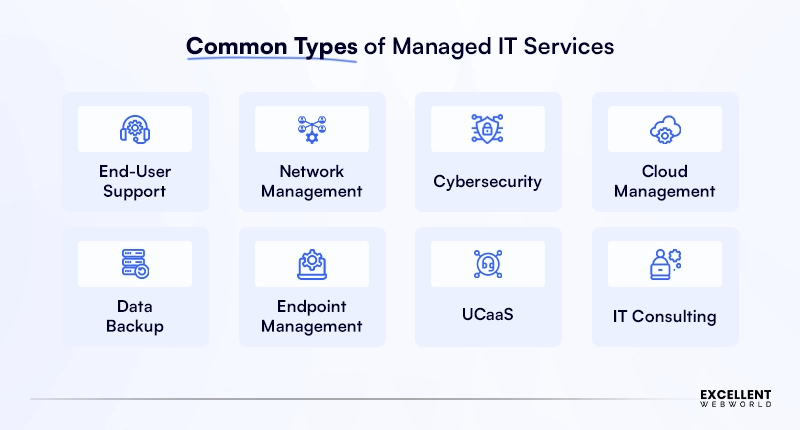 The types of managed IT services your business requires depend on its size, industry, technology landscape, and long-term business goals. Although every Managed Service Provider (MSP) offers a different service portfolio, the following services form the foundation of a modern managed IT infrastructure.
Help Desk & End-User Support
Help-desk and end-user support is one of the most common and widely used managed IT services for businesses. It assists your employees with everyday issues, such as login failure, adding new users, software glitches, email access, and application troubleshooting.
Most MSPs provide remote assistance through email, chat, or specialized software. Faster issue resolution enhances employee productivity and minimizes operational disruptions across the organization. For ongoing technical assistance, businesses can consider managed IT support services to resolve issues faster and maintain employee productivity.
Network Management
A stable network is the most essential part of any digital business. MSPs constantly track the routers, switches, firewalls, VPNs, wireless access points and other network devices to ensure better reliability, security, and connectivity across the organization.
Network management even comprises tracking network performance and traffic, bandwidth optimization, fault detection, capacity planning, and configuration. This proactive approach helps businesses prevent outages, reduce network congestion, and ensure business-critical operations remain available across multiple locations.
Cybersecurity & Threat Management
Cyber threats continue to evolve, which makes cybersecurity a strategic business priority rather than just an IT responsibility. A managed IT service provider will include multiple security layers to protect your users, applications, networks, endpoints, and business data.
These services consist of threat detection, endpoint protection, vulnerability management, firewall management, security monitoring, incident response, identity and access controls, email security, compliance support, and security awareness training for your employees. An MSP also helps your business comply with regulations such as GDPR, HIPAA, or PCI DSS, depending on your industry and geographic region.
Many MSPs now use AI-driven threat detection to identify suspicious activities before they escalate into security incidents or data breaches. Businesses with advanced security requirements can also benefit from managed security services to strengthen enterprise security beyond day-to-day IT management.
Cloud & Infrastructure Management
Managing cloud environments is becoming highly complex as your business integrates hybrid infrastructure, SaaS applications, and various cloud platforms. An MSP helps you manage servers, data centers, databases, networking, virtual machines, and overall infrastructure from a single location.
Cloud management consists of performance optimization, infrastructure tracking, cloud security, capacity planning, system configuration, cloud migration, and cost optimization, which lead to a reliable managed IT infrastructure across your on-premises, cloud, and hybrid environments. This ensures your IT environment remains secure, scalable, and highly available as your business grows.
Businesses that are modernizing legacy systems or scaling hybrid environments can also benefit from dedicated managed infrastructure services built to support performance, security, and long-term scalability
Backup, Disaster Recovery & Business Continuity
Some unexpected events, such as ransomware attacks, system failures, natural disasters, or accidental data deletion, can affect day-to-day business operations. This service allows you to keep business data secure and recoverable.
An MSP builds robust backup strategies, disaster recovery plans, failover mechanisms, and recovery testing approaches. This gives businesses the ability to restore operations quickly while minimizing data loss and business disruption. Businesses that need a structured recovery strategy can partner with a provider offering IT disaster recovery services designed to support faster recovery and business continuity.
Unified Communications & Collaboration (UCaaS)
Seamless communication is non-negotiable in the case of distributed and hybrid workforces. An MSP deploys and manages a Unified Communications as a Service (UCaaS) platform by combining voice, video, messaging, and file-sharing tools into a centralized platform. This results in efficient communication across teams, devices, and office locations.
Endpoint Management & Patch Management
Your employees work on different devices across the network, such as laptops, desktops, mobile devices, and workstations, to conduct their everyday tasks. An MSP centrally manages all endpoints to ensure consistent performance, security, compliance, access controls, and device health across locations.
The service comprises device provisioning, OS updates, patch management, software deployment, policy enforcement, endpoint protection, and asset monitoring and configuration. When all endpoints stay updated and secure, you avoid vulnerabilities that arise from outdated software, without relying on additional assistance from an internal IT team.
Strategic IT Consulting & vCIO Services
Strategic IT Consulting and Virtual Chief Information Officer (vCIO) services provide businesses with executive-level technology guidance without the need to hire a full-time, in-house CIO.
Rather than reacting to isolated technical services, a vCIO works with the leadership team to ensure the tech stack and investment align with business goals. They even provide you with long-term IT roadmap planning, modernize infrastructure, optimize budget alignment, enhance cybersecurity, manage vendors, support compliance initiatives, and prepare your business for next-gen tech, such as AI and automation.
Limitations of Managed IT Services
Managed IT services provide significant operational and strategic value. However, businesses should understand a few practical limitations before selecting an MSP.
Less Direct Control: A Managed Service Provider handles daily operations according to the agreed processes and SLAs. Organizations should establish effective governance and communication to maintain visibility and oversight.
Service Quality Varies by Provider: Not every information technology managed services company has the same level of expertise, automation, and security capabilities. Evaluating their technical experience, industry knowledge, and SLA agreements is non-negotiable.
Transition Needs Planning: Migrating IT operations from one provider to another requires proper onboarding, documentation, and knowledge transfer. A seamless transition reduces disruption and ensures better value in the long term.
Customization Limits: Various MSPs deliver a standard set of services in a package. Hence, infrastructure modernization, custom software development, or cloud migration might require additional scope. In such cases, software development consulting can help organizations plan and execute specialized technology initiatives beyond the standard managed services agreement.
What Is AIOps and How Does It Fit Into Managed IT?
As IT environments are getting complex, traditional monitoring tools find it hard to process the increasing volume of operational data. AIOps (Artificial Intelligence for IT Operations) helps Managed Service Providers analyze this data, streamline tasks, and resolve incidents faster through AI and machine learning.
What is AIOps?
AIOps stands for Artificial Intelligence for IT Operations. It combines Artificial Intelligence, machine learning, big data analytics, and automation to automate and improve IT operations management.
Rather than blindly trusting human tracking, it analyzes data across your managed IT infrastructure, detects patterns, predicts potential failures, and recommends or automates resolving issues before any business operations get affected. In short, AIOps strengthens managed IT infrastructure by detecting patterns human teams would otherwise miss.
How does AIOps work?
AIOps follows a structured workflow to collect operational data, analyze system behavior, identify risks, and automate routine actions. Here is the step-by-step process below that explains how AI continuously improves IT operations.
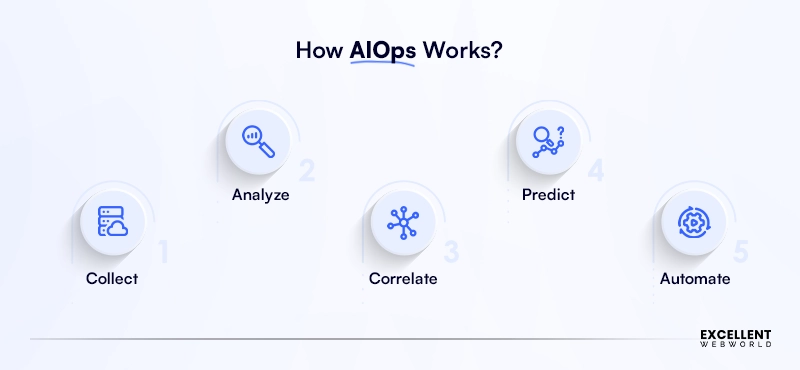
Here is the step-by-step process of how AIOps works:
- Collect: Fetches relevant telemetry and operational data from servers, networks, applications, cloud platforms, and endpoints.
- Analyze: Uses AI to analyze a massive amount of operational data and identify performance baselines and anomalies.
- Correlate: Connect related events across multiple systems to identify the real incident from the noise.
- Predict: Detect trends and potential failures before they affect business operations.
- Automate: Executes a set of actions, raises tickets, and resolves routine issues without any human intervention.
What Does AIOps Enable?
With the usage of AI and automation together, AIOps transforms traditional IT operations into a proactive and smart operating model. Rather than reacting to the incidents that take place, your IT teams can prevent issues, reduce downtime, and improve operational efficiency.
Automated Incident Detection and Root Cause Analysis Instead of investigating many alerts in isolation, AIOps identifies the main source of any issue by correlating signals across different systems in your IT department. This shortens the time spent on tracking symptoms and improves operational efficiency.
Self-Healing IT Infrastructure As soon as an issue is detected, AIOps platforms streamline routine actions, such as restarting services, reallocating resources, or applying a set of remediation workflows. This reduces human intervention and ensures service is available round-the-clock.
AIOps vs. Traditional IT Operations
The table below breaks down how AIOps changes IT operations management across the areas that matter most to enterprise decision-makers.
| Factor | Traditional IT Operations | AIOps |
|---|---|---|
| Monitoring | Manual monitoring and alerting, dependent on human review | Automated, continuous analysis across the entire IT environment |
| Troubleshooting | Reactive, addressing issues only after they are reported | Predictive, resolving potential failures before they escalate |
| Data Visibility | Siloed tool data, viewed separately across systems | Correlated insights unified across systems and platforms |
| Incident Response | Manual root cause investigation, often time-consuming | Automated root cause analysis through event correlation |
| Remendiation | Requires manual intervention for most fixes | Self-healing capabilities resolve routine issues automatically |
| Scalability | Limited by team size and manual capacity | Scales efficiently as data volume and complexity grow |
How is AI Transforming Managed IT Services?
Artificial Intelligence is transforming managed IT services by enabling faster operations, stronger security, intelligent automation, and proactive decision-making across IT environments.
1. AI-Powered Predictive Monitoring & Maintenance
Traditional monitoring detects anomalies when predefined thresholds are crossed. AI-powered predictive monitoring reviews historical and real-time operational data to flag potential failures before they disrupt operations. This shifts MSPs from reactive fixes to proactive prevention.
This enables your MSP to identify hardware failures, application performance issues, storage limitations, and infrastructure risks before they disrupt business operations. Hence, your business benefits from reduced downtime, better system availability, and lower maintenance costs.
2. Automated Ticket Triage and Resolution
AI now streamlines ticket classification, prioritization, and routing without manual intervention according to business impact and urgency. Most IT support requests involve password resets, software installations, and similar repetitive tasks.
This does not eliminate the need for technicians. The process reduces response times, frees technicians from repetitive work, and enables engineers to focus heavily on complex technical challenges rather than repetitive support tasks.
3. AI-Driven Threat Detection in Cybersecurity
Cyber threats are becoming harder to detect through manual security processes. AI-powered detection analyzes user behavior, network activity, endpoint telemetry, and authentication patterns in real-time to detect anomalies before they lead to serious breaches.
Unlike conventional security tools, AI detects subtle anomalies that might indicate ransomware, insider threats, credential compromise, or unauthorized access. Earlier detection reduces the impact of security incidents and improves security posture through managed IT services and support.
Businesses looking to understand more advanced AI-powered defense strategies can explore how generative AI in cybersecurity is transforming modern threat detection and incident response.
4. Smarter Patch Management with Risk Scoring
Applying the latest software update instantly is not the right move every time. Some patches may have compatibility issues, while others address low-risk vulnerabilities.
AI-based smart patch management scores vulnerabilities based on severity, business impact, exploitability, and asset criticality, which enables the team to set proper deployment priorities. This risk-based approach allows your business to enhance security and reduce operational disruptions.
5. AI Agents in IT Operations: What’s Changing in 2026
Traditional AI tools mainly evaluate data and suggest next steps, while leaving the actual issue resolution to the technician. AI agents are changing the entire scenario. AI agents can understand context, make data-driven decisions within a set of boundaries, and execute multi-step operational tasks.
An AI agent can investigate alerts, gather diagnostic information, craft incident summaries, recommend correct steps, and start approved workflows. IT professionals are in charge of control and strategic decisions, while AI looks after any repetitive operational tasks.
According to Gartner, 40% of enterprise applications will have task-specific AI agents by 2026, up from 5% in 2025. For businesses, this means quick resolution and consistent service, even as MSPs manage a wide range of client environments without increasing headcount. However, successful AI agent development depends on strong governance, secure integrations, and business-specific workflows.
Human oversight does not disappear entirely. Complex, multi-system issues and high-risk actions still require help from experienced technicians.
6. Generative AI for IT Documentation and Knowledge Bases
Technical documentation gradually becomes outdated as engineers don’t have enough time to maintain it. Using generative AI, managed IT service providers can create, organize, and update documentation, runbooks, and client reports with operational data and completed support cases.
Generative AI even helps with troubleshooting guides, SOPs, configuration summaries, onboarding documents, incident reports, and other essential knowledge base articles. For enterprises and businesses, this results in faster employee onboarding, quick issue resolution, and consistent service delivery across the support team.
Can AI Alone Run Your IT Infrastructure?
No. AI enhances managed IT services; however, it cannot replace the expertise, governance, and strategic oversight of a highly specialized Managed Service Provider (MSP).
AI is a no-brainer for automating repetitive tasks, analyzing operational data, identifying anomalies, and accelerating issue resolution. These capabilities enhance operational efficiency, but they do not replace business judgment or technical leadership.
AI cannot understand business priorities, make governance decisions, handle compliance exceptions, manage vendor relationships, or lead digital transformation on its own. It can provide recommendations; however, it still requires context, accountability, and human expertise to make critical decisions that align with business objectives.
The future of managed IT services for business is not AI versus humans. It is AI working alongside IT professionals to deliver faster execution, strategic insights, stronger security, and smarter operations. Businesses navigating this shift often benefit from working with an experienced AI consulting services company to align AI adoption with broader business goals.
Human Expertise + AI = Modern Managed IT Services This combination represents where the industry is heading. AI helps build a resilient, scalable, and intelligent managed IT infrastructure, while IT teams provide judgment, governance, trust, and long-term strategic direction.
How Are Managed IT Services Priced?
Pricing varies depending on business size, IT complexity, compliance requirements, cloud footprint, support availability, automation maturity, and AI-enabled service capabilities.
Compared to traditional IT services, managed IT services pricing does not involve a one-time implementation cost. Instead, businesses pay a recurring monthly fee based on the scope of services, IT environment, compliance requirements, cloud footprint, support requirements, and Service Level Agreements (SLAs).
The right pricing model depends on your business size, technology requirements, operational complexity, and long-term IT strategy.
Common Managed IT Services Pricing Models
Most Managed IT Service Providers (MSPs) consider one of the three pricing models given below. Each model offers different benefits depending on your business requirements.
Per-User Pricing Model
It is one of the most widely adopted managed IT services pricing models. Under this model, you have to pay a fixed monthly fee for every employee receiving IT support, regardless of the number of devices a user has.
It costs around $100 to $150 per user, per month, and covers services such as help desk support, endpoint security, user management, and productivity platform administration(such as Microsoft 365). This model comes with predictable monthly expenses and is well-suited for organizations with standardized environments.
Per-Device Pricing Model
This model charges a fee separately for every managed device, such as desktops, laptops, servers, workstations, and firewalls. Each device is priced according to its complexity and support requirements. Usually, the price range is $30 to $100 per workstation and $100 to $500 per server monthly. The cost increases as the number of managed devices grows.
Per-device pricing is great for organizations with shared devices or a higher device-to-user ratio, such as manufacturing, healthcare, or retail.
Tiered/ Flat-fee Pricing Model
Various MSPs provide predefined service packages (Basic, Standard, or Premium) or a flat monthly fee depending on the scope of services. Each package includes different levels of monitoring, cybersecurity, cloud management, compliance, technical support, and Service Level Agreements (SLAs).
For a typical 25-person business, standard managed IT services pricing translates to around $3,000 to $7,500 per month, based on the model and security depth selected.
Comparison of the Managed IT Services Pricing Models
| Pricing Model | How it Works | Best Fit | Primary Advantage | Typical Pricing |
|---|---|---|---|---|
| Per- User | Fixed monthly fee for each employee | Standardized, employee-focused environments | Predictable budgeting as per business dollar | $100–$150 per user/month |
| Per-Device | Monthly fee for every managed device. | Shared-device or device-heavy environments, such as Manufacturing, retail, healthcare, etc. | Pay only for managed infrastructure. | $30–$100 per workstation; $100–$500 per server |
| Tiered / Flat-Fee | Fixed monthly package based on services and SLA. | Growing businesses and enterprises wanting predictable, bundled coverage. | Extensive coverage with predictable costs. | Often $80–$300+ per user/month |
Does AI Actually Make Managed IT Services Cost-Effective?
Yes, but only to a certain extent. AI helps to reduce the labor-heavy costs involved in ticket triage, tracking, and routine remediation. It does not eliminate the need for compliance expertise, security judgment, or human escalation during complex incidents. These services remain premium offerings because they rely on human expertise rather than automation.
What’s Often Left Out on the Plate?
Advertised per-user or per-device pricing does not include every service. Onboarding costs and any out-of-scope work, such as infrastructure upgrades or cloud migration. These services usually fall outside the standard managed IT services agreement and are billed separately.
What Factors Affect Managed IT Services Pricing?
Many factors affect the pricing of managed IT services. Generally, different providers follow different approaches; here are several essential business and technical factors that directly affect managed IT services cost.
- Number of users and managed devices
- Cloud infrastructure and hybrid IT environments
- Cybersecurity depth
- Regulatory compliance requirements
- AI workloads and automation maturity
- 24/7 monitoring and support coverage
- Service Level Agreements (SLAs) and response times
- Business locations and operational complexity
Steps to Select the Right Managed IT Provider
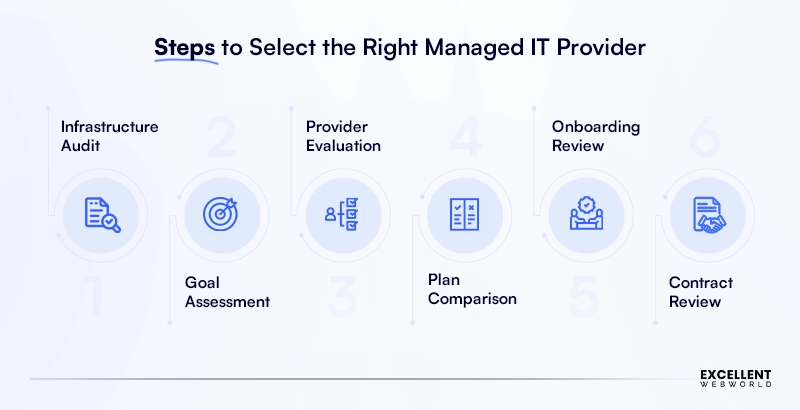
Choosing the right MSP is a long-term business decision and requires a detailed evaluation and should not be based on price alone. A structured evaluation enables you to make a data-driven choice that aligns well with your technology, security requirements, and future business growth.
1. Conduct an Audit of Your Current IT Infrastructure
Start by assessing your existing IT systems, such as your network architecture, servers, endpoints, cloud environments, applications, and security controls. A detailed assessment allows you to identify operational issues, performance gaps, and areas that need assistance from a managed IT service provider.
2. Identify Your Technical Gaps and Business Goals
Define the technical gaps your organization wants to resolve and the business goals it wants to achieve in the near future. Whether your priority is advanced security, cloud modernization, AI readiness, or reducing downtime, clearly defined objectives simplify provider selection.
3. Shortlist and Evaluate Providers
Assess providers based on their industry experience, customer references, technical expertise, security practices, AI and automation capabilities, SLA commitments, and response times. Choose a Managed Service Provider (MSP) that demonstrates technical expertise and a strong understanding of your business environment.
4. Compare Service Plans, Pricing Models, and Proposals
Request detailed proposals that outline response times, pricing models, service scope, support, and optional add-ons before making a decision. Compare these proposals against your budget and the managed IT services cost factors that matter most to your business.
Often, the most cost-effective model delivers long-term business value rather than simply offering the lowest monthly price.
5. Review the Onboarding and Transition Process
A highly organized onboarding process reduces disruptions that occur during the transition. Verify how providers outline their onboarding timeline, manage knowledge transfer, data migration, infrastructure documentation, security configuration, and service deployment before the engagement begins. For complex transitions, dedicated IT project management consulting services can help keep the migration on schedule, within scope, and aligned with business objectives.
6. Review Contracts, SLAs, and Long-Term Partnership Terms
Carefully examine the contract period, Service Level Agreements (SLAs), response times, renewal terms, and exit clauses before making a long-term commitment. A strong long-term partnership between your business and the MSP depends on clear terms, not just competitive pricing.
The Evolution and History of Managed IT Services
Managed IT support emerged during the early 1990s, when Application Service Providers (ASPs) offered limited remote hosting and IT management services. At that time, businesses primarily relied on the traditional break-fix model. They reached out to IT technicians only after systems failed, which resulted in unpredictable downtime, reactive support, and higher IT costs.
During the early 2000s, remote monitoring tools, centralized management platforms, and early automation laid the foundation for the modern MSP model. Managed Service Providers (MSPs) gradually shifted from reactive fixes to proactive support. Instead of waiting for failures, they continuously monitored systems and resolved issues before they disrupted business operations.
Several technology shifts further accelerated this evolution:
- Cloud computing introduced hybrid and multi-cloud environments.
- Rising cybersecurity threats, which demanded constant tracking and proactive protection.
- Remote and hybrid workforces needed secure access and always-available IT support.
- Stricter regulatory and compliance requirements, which required stronger governance, risk management, and audit readiness.
As technology evolved, MSPs expanded their services well beyond basic IT support. Their service portfolio now includes:
- Strategic IT consulting
- Cloud management
- Cybersecurity
- Business continuity
- Compliance management
- Complete technology lifecycle management
- Full-stack IT management
Today, managed IT services for business have entered an entirely new phase. MSPs combine AI, automation, AIOps, predictive monitoring, and intelligent threat detection to deliver proactive support. Rather than simply resolving IT issues, they help businesses build secure, resilient, and future-ready IT operations.
Future Trends in Managed IT Services
Managed IT services continue to evolve with the adoption of the latest technologies, such as AI, automation, and AIOps, which are transforming the way businesses build, secure, and manage new-age IT environments.
- Multi-Agent & Autonomous Operations: AI agents will constantly coordinate with teams to monitor infrastructure, investigate incidents, and resolve issues on their own. This reduces manual intervention and decreases the load on IT teams in complex environments.
- Hyperautomation: Organizations will continue to streamline day-to-day workflows by combining AI, robotic process automation, and machine learning. This approach works well for both routine and complex processes, as it reduces manual effort, speeds up service delivery, and ensures seamless operations.
- AI SOC: AI-driven security systems analyze and prioritize threats, correlate alerts, and accelerate incident response. Human analysts will focus on investigation, strategy, and high-risk security decisions.
- AI Governance: As AI adoption grows, businesses will define governance frameworks to ensure proper model usage, security, compliance, and accountability. Strong AI governance also supports transparent decision-making across IT operations.
- FinOps: Businesses will adopt FinOps practices to optimize cloud and IT spending. AI-driven cost analysis helps them ensure optimal technology investments while maintaining the same performance and stability.
- Zero Trust: Zero Trust assumes no user or device should be trusted by default, and it will be essential for businesses expanding cloud adoption and remote work. Continuous verification of access requests will strengthen an organization’s security posture.
- AI-Powered Observability: Observability tools will leverage AI to correlate logs, metrics, applications, and network telemetry in real time. This allows teams to perform faster root cause analysis and achieve better performance optimization.
- Digital Employees and Green IT: AI-powered digital employees will streamline day-to-day operations while working alongside humans. On the other hand, Green IT initiatives will encourage MSPs to adopt energy-efficient, sustainable infrastructure across organizations.
The Future of Managed IT Services Starts With the Right Partner
Managed IT services have moved far beyond traditional IT support. Modern Managed Service Providers combine technical expertise, cybersecurity, AI, scalability, automation, and goal-oriented consulting to help businesses develop resilient, competitive, and scalable technology environments in the AI era. Choosing the right MSP now creates long-term business value, not just lower day-to-day operational costs.
The need for AI-native, proactive IT management is becoming non-negotiable for growing businesses. If your organization is evaluating its technology roadmap, managed IT services should be an essential part of your growth strategy. You should also understand how IT consulting, AI integration, and cybersecurity will play a vital role in achieving your long-term business goals.
At Excellent Webworld, we offer Business IT Consulting Services to organizations across different industries, regardless of their size or location. Our professionals build the right technology strategy that aligns with your infrastructure and supports long-term business growth.
Frequently Asked Questions
AI is used in managed IT services to automate routine tasks, enable predictive monitoring, strengthen cybersecurity, enhance IT operations, and analyze network data in real time. It also enables MSPs to identify errors, prioritize incidents, automate ticket resolution, perform patch risk scoring, and provide proactive support through AIOps and intelligent automation. This reduces human error and ultimately lowers IT support costs.
A Managed Service Provider (MSP) is an outsourced third-party company that remotely manages an organization’s IT infrastructure, systems, and networks on a subscription or long-term contractual basis. Rather than waiting for a system to break down, an MSP manages network infrastructure, cybersecurity, cloud environments, help desk support, backups, and strategic IT consulting.
Managed IT services involve outsourcing the management, monitoring, security, and maintenance of your IT environment to a Managed Service Provider (MSP). The service shifts businesses from a reactive model to a proactive one by providing real-time issue detection, continuous monitoring, and faster issue resolution.
AI-native managed IT services refer to a support model where AI and automation are integrated from the beginning rather than added later. These AI capabilities enable businesses to implement predictive issue monitoring, automated incident resolution, enhanced cybersecurity, and real-time insights across IT operations.
Managed IT services are used across virtually every industry, though they are especially suited to businesses seeking predictable IT costs, strong compliance, robust security, and scalable infrastructure. Top industries include healthcare, financial services and accounting, manufacturing, retail and eCommerce, real estate, and construction.
Managed IT services typically cost between $100 and $150 per user, per month. Costs vary based on business size, cybersecurity requirements, cloud infrastructure, compliance needs, and support levels. Most Managed Service Providers offer per-user, per-device, or tiered pricing aligned to the agreed scope of services.
AIOps, or Artificial Intelligence for IT Operations, uses AI, machine learning, and automation to streamline IT operations. Within managed IT services, it helps organizations shift from reactive support to proactive operations by predicting potential failures, identifying root causes, and resolving routine IT issues. This improves system reliability and reduces downtime.

Article By


Mahil Jasani began his career as a developer and progressed to become the COO of Excellent Webworld. He uses his technical experience to tackle any challenge that arises in any department, be it development, management, operations, or finance.