Talking about the current scenario, JavaScript frameworks continue to dominate web development. It’s leading everything from simple landing pages or single-page websites to complex enterprise web applications.
Even the 2025 survey by JS found that over 13.7 million developers worldwide are actively building with JavaScript-based frameworks.
These numbers are proof that JavaScript is here to stay. The main reason for the popularity of JavaScript frameworks is the flexibility and versatility they provide. Further, there are dozens of frameworks available in the market, and selecting one out of all is difficult.
If I ask you to list the most popular JavaScript frameworks for mobile apps, you will end up uttering the names like React, Angular, and Vue.
But how trending are they at present? The recent trends show:
- React maintains the largest market share with over 18 million weekly npm downloads.
- Vue.js has surpassed 208,000 GitHub stars.
- Angular continues its adoption in enterprise environments with its latest v19 release.
So let’s explore each of the JavaScript frameworks and tools in detail.
Latest JavaScript Frameworks You Need to Watch in 2026
Here are the advanced JavaScript frameworks to consider for your project.
1. React for Frontend Development
 ReactJS is a popular JavaScript UI library with over 18 million weekly npm downloads. If your prime focus is on building web apps with an alluring User Interface (UI), then React JS development is the perfect option for you.
In scenarios where small businesses want to develop web applications really fast with fewer bugs, ReactJS helps them by dividing common UI design elements with well-defined interfaces.
React was originally developed for Meta (formerly Facebook) as a lightweight library that only deals with the view layer. It is very simple to learn, as it requires only a minimal understanding of HTML and JavaScript.
ReactJS is being used by several big enterprises like Facebook, Instagram, Airbnb, Netflix, and TikTok, among several others. So, if you are also planning to hire a ReactJS developer to build your web or mobile app, then you are on the right track.
Benefits of Hiring a React Developer
React is basically used for interactive interfaces from startups to enterprises. If you hire a React developer, it leads you to work with someone comfortable in handling dynamic UI patterns and the structure of components. Let’s have a look at the benefits associated with React.
- ReactJS is a framework that provides seamless SEO integration. The React sites can easily compete for organic traffic by allowing rendering for either client-side or server-side. That’s why Google effectively crawls even “heavy” React sites.
- React provides efficient and simple debugging. React offers 3 developer tools available to debug: Console, Network, and React Developer Tools.
- ReactJS allows reusing code. With the ReactJS framework, developers can break down complex components and reuse the code to complete their projects faster.
- React provides fast rendering with the Virtual DOM. Usually, with frameworks, with any change in code, the whole page is rendered, whereas the React library only renders the components that actually change.
Most Popular React Development Services
Here are the most popular services that the best ReactJS development company provides:
- ReactJS Web Portal/Application Development
- ReactJS Front-end Development
- Mobile Application Development
- UI Development Using ReactJS
- 3rd Party API Integration
- Migration Service
- Maintenance & Support
2. Angular for Single-Page Applications
 Angular is an open-source, TypeScript-based JavaScript framework released by Google in 2016. It was released as a complete rewrite of the original AngularJS. As of version 19, Angular powers enterprise-scale single-page applications across organizations worldwide, from startups to Fortune 500 companies.
The modern Angular framework has evolved in recent versions. It introduces signals-based reactivity in v17 and standalone components that dramatically improve performance and developer experience. Some of the most prominent companies using it are Google, Forbes, Wix, Weather.com, and several government bodies (Sources: madewithangular, Google Open Source).
Angular has solid backing from Google. Angular has a huge community support that is always ready to assist and provide proper guidance on any query. Notably, it creates a great opportunity to learn from certified open source professionals and solve queries by professional community members.
Benefits of Hiring an Angular Developer
Businesses opt for Angular development when it comes to projects that demand structure. Developers working on Angular follow a framework approach. This approach helps teams stay aligned as the application grows. Here is what you get when you go to Angular.
- Angular has two-way data-binding. It performs automatic synchronization of data between model and view components.
- Angular offers dependency injection. A built-in dependency injection subsystem in Angular makes the development and testing easier for the development team, which stands out among core Angular features.
- Angular’s pipe system provides built-in transformations. These are for dates, currency, percentages, and custom data formatting. It keeps presentation logic separate from business logic and makes templates cleaner and maintainable.
- Angular follows a component-based architecture. Here, each component encapsulates its template, logic, and styles. This creates clear separation of concerns that scales effectively across large application structures.
- Angular develops across all platforms. Learn one way to build apps with Angular and reuse your code to build apps for any deployment format, web, web-based mobile, native mobile, or native desktop.
Most Popular Angular Development Services
Here are the most popular services that the best Angular development company provides:
- Real-Time Web App Development
- Backend & Dashboard Development
- MEAN Stack Development
- Single-Page App Development
- Angular Frameworks Development
- Angular Cross-Platform App Development
- Custom Widget Development
- Angular UI Development
- Plugins Development
- Angular Code Migration
- Development Support & Maintenance
3. VueJS for Web Interfaces
 Vue.js is a robust JavaScript-based software development framework used to build user interfaces. If you’re familiar with HTML, JavaScript, and CSS, it will be easy to get started with the Vue.js framework. It follows the MVVM (Model-View-ViewModel) architectural pattern, which creates separation between business logic and presentation layers.
With over 208,000 GitHub stars as of 2026, Vue.js ranks among the most popular frontend frameworks and consistently scores as one of the most loved frameworks in the State of JS survey. This frontend framework will let developers seamlessly develop a single-page application with support libraries and modern tools.
VueJS is proving to be more compatible than Angular and React. Some of the top websites using Vue.js are Grammarly, Behance, Xiaomi, Adobe Portfolio, and many more. Among the developers, Vue is famous for its reactive nature. The data flow in Vue.js is more efficient with the help of the virtual DOM.
Benefits of Hiring a Vue.js Developer
Every project does not need heavy complexity. This gap is filled perfectly by Vue.js. Developers can easily move forward with Vue.js development while keeping the codebase organized and structured. The following points outline why modern businesses are hiring VueJS developers.
- Vue 3’s runtime is remarkably lightweight at approximately 40KB gzipped. This makes it an excellent choice for performance-critical applications and progressive web apps targeting users on slower networks.
- Flexible to develop web applications. In fact, it is the main reason for the popularity of the Vue.js JavaScript framework.
- With Vue.js, two-way communication is possible with the MVVM architecture. This architecture makes it easy to handle the HTML blocks.
- Simple integration with the existing applications. It means that you can build an application from scratch and can even alter the present application.
Most Popular Vue.js Development Services
Here are the most popular services that the best VueJS development company provides:
- Single Page Applications
- Custom Applications
- Web Apps
- Video Streaming Apps
- Interactive & Social Apps
- Migration Services
- Front-end Architecture
- Real-Time App Development
4. Next.js for Web Applications
 Next.js is the most popular React framework in 2026. It is transforming how developers build production-ready React applications. It is created by Vercel. Next.js has become the go-to choice for over 70% of new React projects. Something that’s surpassing Create React App as the standard way to start React development.
Next.js solves the problems React deliberately leaves open from server-side rendering to image optimization. Companies like TikTok, Hulu, Nike, Notion, and Twitch rely on Next.js. The reason is that it easily handles millions of users while maintaining exceptional performance.
The App Router was introduced in Next.js 13 and stabilized in version 15. This is something that brings React Server Components to production. It allows components to render on the server, reducing JavaScript bundles by 60-70% while maintaining interactivity. When the Server Actions are combined for form handling, Next.js provides a complete full-stack framework built on React.
Benefits of Hiring a Next.js Developer
When performance and rendering strategy are concerns for you, then Next.js is what you require. Developers skilled in Next.js framework know how to balance speed, SEO, and user experience. Let’s check out the advantages you get if you hire a Next.js specialist.
- File-system-based routing eliminates configuration. Create files in the app directory, and they automatically become routes. Nested folders create nested routes, and special files define layouts and loading states without any routing library setup.
- Server Components reduce bundle sizes. React Server Components execute on the server and send HTML to clients. This reduces JavaScript sent to browsers and improves Core Web Vitals scores that impact SEO.
- Server Actions simplify form handling. Define server-side functions directly in components for handling submissions and mutations. This process is carried out without building separate API endpoints, maintaining type safety from frontend to backend.
- Built-in optimization without manual work. The Image component automatically handles responsive sizing, modern formats (WebP, AVIF), and lazy loading.
- Hybrid rendering strategies for every use case. Next.js supports static generation for blogs, incremental static regeneration for periodically updated content, and client-side rendering. All of these are in the same app.
Most Popular Next.js Development Services
Here are the most popular services that the best Next.js development companies provide:
- SaaS Application Development
- Marketing Website & Landing Page Development
- Content Management System Integration
- Static Site Generation with Dynamic Updates
- Server-Side Rendering Implementation
- E-Commerce Platform Development
- Multi-Tenant Application Development
- Migration from Create React App
- API Route Development
- Performance Optimization & Core Web Vitals
5. Node.js for Backend Development
 With the Node.js application run-time environment, a developer can write server-side applications in JavaScript. Node.js excels at the sort of scalable and real-time situations that we keep demanding of our servers, all thanks to its unique I/O model.
There have been several big names that have used Node.js in production, some of the most popular ones being LinkedIn, Uber, Walmart, Airbnb, and even NASA. Following these big shots, many smaller enterprises and startups are also leveraging Node.js in building applications.
If you are considering Node.js for your server-side development needs, there are a few things you should make sure of before hiring a Node.js developer for your backend development needs.
The back-end developer should know the basics of logic and algorithms, design thinking, etc. So you don’t end up hiring a code-cut-and-paste kind of developer. Your Node.js developer should also have experience in different protocols like WebSocket for real-time communication, Server-Sent Events for live updates, HTTP/2 for improved performance, and gRPC.
Benefits of Hiring a Node.js Developer
You will find Node.js backend handling behind most of the fast and responsive applications. Hiring a Node.js developer is what will help you ensure server side logic is built for scale. Here are the reasons why hiring a Node.js developer is a strong backend choice.
- Node.js has high community support. NPM (Node Package Manager) is an online archive where you can find open-source Node.js projects and use them as per your requirements.
- Consistency in language with Node.js. Node.js as your server technology gives your team a great boost that comes from using the same language on both the front end and the back end.
- Node.js is easy to code. NPM makes coding easy in Node.js by providing several packages of re-usable codes which can be assembled as per your requirements.
- Node.js is efficient in data handling. Node.js provides a different set of APIs and is lightweight in nature, making it highly efficient.
- Node.js offers high scalability with multiple tools and modules.
Most Popular Node.js Development Services
Here are the most popular services that the best Node.js development company provides:
- Real-Time Application Development
- Node.js With a React.js for Web Development
- Backend Development
- Frontend Development
- Node.js Migration
- Cloud Development
- Plug-in Development
- API Development and Integration
- Support & Maintenance
6. Svelte for Interactive User Interfaces
 When compared to the existing or traditional frameworks, Svelte takes a different approach. It’s a compiler. When you build a Svelte app, the framework compiles components to optimized vanilla JavaScript, and the framework code completely disappears at build time.
Svelte applications achieve bundle sizes 40-60% smaller than equivalent React applications. Also they consistently score highest in Core Web Vitals benchmarks. The framework has been voted the “most loved” in the State of JS survey for 3 years.
SvelteKit is the official application framework for Svelte. It is similar to how Next.js extends React. It provides routing, server-side rendering, API endpoints, and deployment optimization while maintaining Svelte’s performance philosophy. Top companies like The New York Times and 1Password use Svelte for apps where performance and responsiveness are top priority.
Benefits of Hiring a Svelte Developer
Svelte takes a different path compared to traditional frameworks. Developers who work with Svelte reflect that approach of being ideal. Rather than relying more on browsers, most of the work is managed earlier in the process. Let’s check out the benefits associated with it.
- Built-in state management eliminates external libraries. Svelte stores provide a simple, reactive global state without Redux or MobX.
- Smallest production bundle sizes. Svelte applications ship no framework runtime to browsers, resulting in dramatically smaller bundles. For mobile users on slow networks, this translates to seconds of improved load time.
- True reactivity without complexity. Svelte’s reactivity works through compile-time analysis. Simple assignment updates the UI automatically without useState, useEffect, or dependency arrays that complicate React development.
- First-class animation and transition support. Svelte includes built-in functions for fading, sliding, crossfading, and physics-based animations. These are the capabilities that require external libraries in other frameworks.
- Minimal learning curve for faster onboarding. Developers familiar with HTML, CSS, and JavaScript write productive Svelte code immediately. The framework introduces minimal new concepts. This allows beginners or junior developers to contribute from the start.
Most Popular Svelte Development Services
Here are the most popular services that the best Svelte development companies provide:
- Data Visualization & Interactive Graphics
- Progressive Web App Development
- Rapid Prototype & MVP Development
- Embedded Widget & Component Development
- SvelteKit Full-Stack Applications
- Performance-Critical Mobile Applications
- Animation-Heavy Interactive Experiences
- Internal Tool & Dashboard Development
- Component Library Development
- Migration from Other Frameworks
7. Astro for Fast Websites
Astro represents a fundamental shift in how we build content-focused websites. Its philosophy is to ship zero JavaScript by default and add interactivity only where needed. This approach delivers performance traditional frameworks cannot match for blogs, documentation sites, marketing pages, and content platforms.
Sites built with Astro routinely achieve perfect 100/100 Lighthouse scores across performance, accessibility, best practices, and SEO. The framework automatically optimizes images, minifies CSS, and eliminates unused code while starting at zero JavaScript baseline. Consider that you only add what your features actually require.
What makes Astro unique is its framework-agnostic “islands architecture.” Use React components alongside Vue components in the same project. Companies like GitHub Docs, The Guardian, Netlify, and Firebase use Astro for content-heavy sites requiring exceptional speed.
Benefits of Hiring an Astro Developer
Astro has become a practical option for businesses looking to build content focused platforms and where speed is the priority. Developers use Astro to deliver lighter pages with minimal client side load. Check out the benefits you receive with hiring an Astro developer.
- Native Markdown and MDX support for content. Write in Markdown, embed interactive components with MDX, and author documentation with live examples. The framework understands content workflows natively.
- Unmatched performance for content sites. When your site is primarily text and images, Astro renders everything to HTML and CSS, delivering instant page loads regardless of network speed or device capability.
- Automatic image optimization out of the box. Astro’s Image component generates responsive images in modern formats (WebP, AVIF), creates multiple sizes for different screens, and implements lazy loading without configuration.
- Framework agnostic architecture maximizes flexibility. Don’t choose between frameworks. Instead you can use all of them. Each component independently selects its framework, and Astro handles integration seamlessly without conflicts.
- Built-in view transitions for smooth navigation. Navigate between pages with SPA-like animations while maintaining static HTML performance. Shared elements persist while new content loads smoothly.
Most Popular Astro Development Services
Here are the most popular services that the best Svelte development companies provide:
- Documentation Site Development
- E-Commerce Product Catalog Sites
- Multi-Page Application Development
- Static Site Generation with Islands
- Blog & Content Platform Development
- Headless CMS Integration, often as part of a WordPress to Sanity Migration
- Marketing Website & Landing Pages
- Migration from WordPress/Jekyll
- Portfolio & Showcase Websites
- SEO-Optimized Content Sites
8. Remix for User-Friendly Websites

Remix built its reputation on a controversial but powerful premise, “the web platform already solved most frontend problems”. Instead of fighting browsers with complex client-side state management, Remix leverages web standards to build applications that work before JavaScript even loads.
The framework, created by the team behind React Router, recently merged with React Router v7, bringing Remix’s full-stack capabilities to the routing library millions already use. This means you can adopt Remix’s architecture incrementally, starting from React Router and adding server features when needed.
Companies choose Remix when resilience matters. NASA uses Remix for internal tools that must function in challenging network environments. Delivery platforms rely on Remix for interfaces that work even when JavaScript execution is slow on lower-end devices. The framework’s progressive enhancement ensures functionality under adverse conditions.
Benefits of Hiring a Remix Developer
Remix focuses on improving how web applications handle data and navigation. Specialized Remix developers tend to prioritize smooth interactions and faster loading experiences. Let’s look at what makes hiring a Remix developer valuable.
- Forms work without fetch or API routes. Remix mutations use HTML forms enhanced with React. The framework handles form data server-side, updates databases, and revalidates data automatically without manual POST requests or cache management.
- HTTP caching integration with web standards. Remix respects standard Cache-Control headers, and CDN caching, browser caching, and revalidation work as HTTP specifies without custom implementation.
- Error boundaries that keep apps functional. When server actions fail, Remix renders error boundaries with context while the rest of the application continues working. No white screens when APIs are temporarily unavailable.
- Nested routing with efficient data loading. Parent routes load shared data once, while child routes inherit it. This hierarchy eliminates redundant fetching.
Most Popular Remix Development Services
Here are the most popular services that the best Remix development companies provide:
- Multi-Page Business Application Development
- Internal Tool & Admin Panel Development
- E-Commerce & Transactional Site Development
- Progressive Enhancement Implementation
- Form-Heavy Application Development
- Content Management Platform Development
- Resilient Application Architecture
- Migration from Next.js or Create React App
- Full-Stack React Development
- Server-Side Data Fetching Optimization
9. Ember.js for Enterprise Applications
 With Ember.js as an MVC (Model-View-Controller), you can develop an enterprise-level client-side application. It enables developers to write structured and organized code for web applications.
Let me give you a glimpse of MVC,
- Model Layer: It is built with a combination of Ember.js and model data.
- View Layer: A combination of views and templates.
- Controller Layer: Built with a combination of controllers and routers.
Ember.js is a perfect choice for you if you are planning to build a single-page application for your business. In a way, we can even say that Ember.js is a new age of Ruby-on-Rails to build astonishing Front-end for web apps. To explain further, it is a great framework if you want to build an ambitious web app. You can form a complete development stack using Ember.js and other important tools.
One of the biggest advantages of using Ember.js is that it allows developers to make any assumptions about the application. That is not the case with Angular and React. So, if you’re planning to build an enterprise-level web application, then make sure that you hire an Ember.js Developer with good experience.
Benefits of Hiring an Ember.js Developer
Businesses select Ember.js for apps that require stability along with consistency. Even the Ember.js developers follow a convention driven structure. This is what reduces guesswork during development. Here is why hiring a Ember.js developer is worthwhile.
- Ember.js templates are written in Handlebars templating language, hence it’s more appealing and innovative. With that, it even reduces the code for the project.
- Ember.js is the future of web apps. As it is reducing the block of errors in the pile of codes, its flexibility is off the ground.
- Ember.js has well-structured code. Alongside, it lets developers focus more on functionality rather than code.
- Ember.js Data provides sophisticated client-side data management. This happens with automatic relationship handling and smooth API integration that eliminates manual state synchronization.
Most Popular Ember.js Development Services
Here are the most popular services that the best Ember.js development company provides:
- URL Support
- Client-Side Rendering
- Multi-Page Application
- Convention over configuration
- Web and Mobile Development
- Support & Optimization
- Single Page Application
Read More: SPA vs MPA – Key Differences Explained
So, these are the top five frameworks that many businesses opt for to develop their business online.
Best Tools to Use for JavaScript Development
Fortunately, JavaScript is rich with so many existing tools that you can make use of. Here we have made a useful list of tools you can use for efficient web & mobile app development.
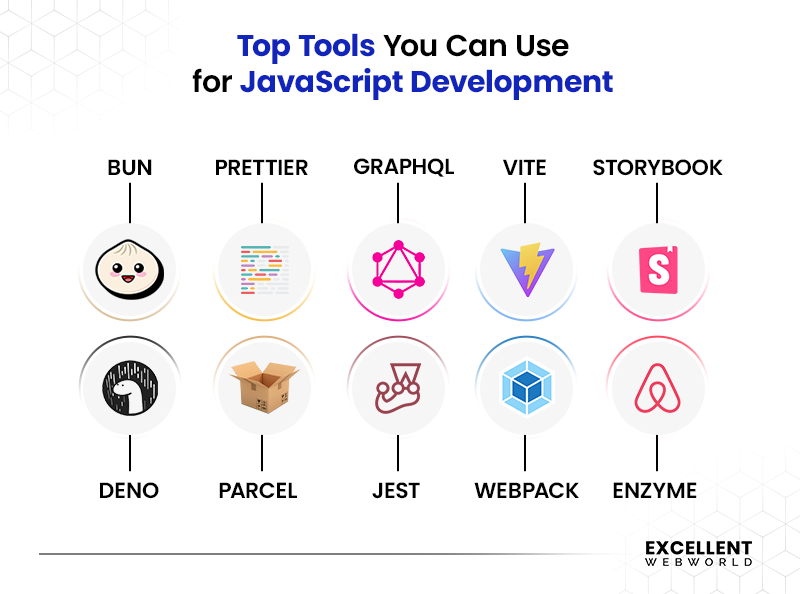
1. Bun & Deno – The “All-in-One” Tooling
Node.js faces competition from runtimes promising better performance. Bun, written in Zig, claims 3-4x faster startup times and includes bundler, test runner, and package manager in one binary. Deno, created by Node.js’s original author, prioritizes security through explicit permission requirements.
For production applications, Node.js remains safer due to ecosystem maturity. However, Bun’s speed makes it compelling for building scripts and tooling, while Deno’s security model appeals to teams with strict compliance requirements.
These alternatives push Node.js to improve—recent versions adopted native test runners, better module resolution, and improved TypeScript support inspired by Deno’s innovations.
2. Prettier – An Opinionated Code Formatter
Prettier is an ultimate tool for formatting your code and making it even more competent, flawless, and useful. It supports many languages and integrates with most editors. It has become the de facto code formatting standard with over 50,000 GitHub stars, automatically formatting code to enforce consistent style across teams without configuration debates.
Prettier is used by some of the big projects like React, Babel, WebPack, Next.js, etc. More and more developers prefer Prettier for enhancing their coding skills and the quality of their code. This leads it to become one of the best frameworks among all.
3. Vite – Enhancing Developer Experience (DX)
Vite has revolutionized JavaScript build processes. Created by Evan You (Vue’s creator), Vite delivers instant server startup and near-instantaneous Hot Module Replacement. Change a file, and updates reflect in milliseconds rather than seconds—transforming development experience on large codebases.
Vite achieves speed through native ES modules during development. Instead of bundling everything before previewing, Vite serves modules directly and transforms only changed files. For production, Rollup creates optimized bundles with tree-shaking and code splitting.
With over 8 million weekly npm downloads, Vite has become the default build tool for Vue, Svelte, Solid, Astro, and increasingly React projects. The plugin ecosystem supports TypeScript, MDX, Tailwind CSS, and hundreds more transformations.
4. Storybook – UI Development Environment
Storybook has matured into the industry-standard tool for developing and documenting UI components in isolation, with over 80,000 GitHub stars and tens of millions of monthly npm downloads.
Storybook is an incredibly useful and fun JavaScript framework allowing you to create and test UI components separately.
It looks like a UI style guide that essentially provides real value to the developer. Major design systems from companies like Airbnb, GitHub, and Microsoft use Storybook to develop, test, and document their component libraries, making it essential infrastructure for modern UI development.
5. GraphQL – Query Language for APIs
The past year was great for GraphQL (a query language for APIs) since big companies, including Yelp, Spotify, Walmart, GitHub, NYTimes, etc.
All now have GraphQL-based APIs. The majority of APIs are even completely GraphQL, without any REST option available.
Large companies are putting a bet on GraphQL. In addition, more startups will be impressed with it and opt for it to start their new project. GraphQL will be one of the top JavaScript programming trends.
6. ReScript (Formerly ReasonML) – Choice of Big Brands
ReScript is a robustly typed language. This language compiles to highly optimized JavaScript. It was originally developed at Facebook and guarantees zero runtime type errors. In case your code compiles, type-related bugs are eliminated entirely.
The compiler is exceptionally fast. It rebuilds projects in under 100 milliseconds. It also generates clean JavaScript that performs as well or better than hand-written code.
While ReScript maintains a smaller community compared to TypeScript, teams building high-reliability software appreciate it. For most projects in 2026, TypeScript remains more practical due to its massive ecosystem and hiring pool. ReScript is worth considering when absolute type safety justifies the learning curve.
7. Jest and Enzyme – Strong React Applications Testing
A Jest is basically a testing tool for JavaScript. Whereas Enzyme is a JavaScript Testing utility for React. Modern testing frameworks like Vitest and Jest provide snapshot testing, code coverage reporting, and watch mode that re-runs only affected tests, making test-driven development practical even on large codebases.
React Testing Library encourages testing components from the user’s perspective rather than implementation details, leading to more maintainable tests that don’t break when refactoring internal component structure.
Therefore, a combo of Jest and Enzymes’ simple API for testing React components renders a great testing platform.
8. Parcel – A Competing Bundler
Bun promises 3-4x faster startup times than Node.js and includes a bundler, test runner, and package manager in a single binary, making it compelling for build scripts and development tooling. Deno’s security-first approach requires explicit permissions for file and network access, appealing to teams building applications with strict compliance requirements or handling sensitive data.
Features & functionalities like automatic code transfer, hot module replacement, and easy error logging makes the framework even more accurate. In no time, Parcel will come with improvements like simplified configuration and improved speed.
9. Webpack – Asset Bundler
While Webpack remains widely used in production applications, newer tools like Vite and Turbopack are increasingly preferred for new projects due to dramatically faster development server startup and build times.
In the initial year, Webpack hardly even had documentation for guiding developers to start with it. However, this framework proved its potential by raising $15,000 in 3 months as the funding amount to support the project. It is considered to be the future of open-source. Due to its well-managed community and the huge support, it is the leading tool in the latest JavaScript frameworks for 2026.
Which Platform Will You Go For?
So, these were our selections from the big assortment of JavaScript frameworks. One thing I would say here is that JavaScript will always remain the heart of mobile and web app development.
Henceforth, what’s your thought about these JavaScript frameworks? Do you think these latest JavaScript framework trends are worth trying for your project?
Contact us to know which framework is best for your next project and get the most trending solution for it.
FAQs about JavaScript Frameworks
What you can do is to match frameworks strengths to your requirements.
- Angular for enterprise structure
- React for maximum flexibility and ecosystem
- Vue for small teams
- Astro/Next.js for content sites with SEO priority
What else you need to consider is the performance requirements, hiring needs, team expertise, and whether you need SSR or static generation.
First of all, try to learn React as it comes with a gentler learning curve and teaches transferable component concepts. Along with that, it consists of the largest job market and provides a huge library of tutorials. On the other hand, Angular requires learning TypeScript and RxJS. Also, dependency injection is used simultaneously, which makes it better as a second framework after React.
It depends on what you require and what output you are expecting. Svelte is fastest for runtime with 40-60% smaller bundles, and Astro is fastest for content sites. Framework speed matters less than proper optimization. A well-written code in any framework performs excellently.
Here is what you can choose as per your requirement for mobile app development.
- Next.js, Nuxt, or SvelteKit for progressive web apps (PWAs).
- React Native for cross-platform native iOS/Android apps with code sharing between web and mobile.
- Ionic with Angular/React/Vue for hybrid apps, combining web technologies with native capabilities.
Here is what you can choose from based on your website or web app development needs.
- Next.js for production React apps and content sites.
- Vue/Svelte for rapid development with smaller teams.
- Astro for marketing/content-heavy sites with perfect SEO.
- Next.js has become the industry standard in 2026.
- Angular for enterprise applications.

Article By


Paresh Sagar is the CEO of Excellent Webworld. He firmly believes in using technology to solve challenges. His dedication and attention to detail make him an expert in helping startups in different industries digitalize their businesses globally.


