I always keep a mental list of business valuations that don’t quite add up to me.
- Take Superpower, for instance. $30 million raised in a Series A round, and the company came out on the other side worth more than $300 million.
- Function Health even blew past it, raising $298 million at a valuation pushing $2.5 billion.
Both these companies fall under the healthcare sector, specifically biomarker testing platforms built on modern diagnostics. But surprisingly, neither of them owns even a single lab of their own.
You might assume that concierge medicine and blood tests are driving this financial momentum. That’s not quite the full picture. Each of these companies follows a healthcare subscription model, i.e., they’re selling a subscription service wrapped around a blood draw. These companies are more “software” than “healthcare” and are being priced by investors as such.
Call it preventive health, call it longevity medicine, call it biomarker membership — ultimately, it’s the same idea. A recurring fee has replaced the old system of paying per visit and per test, with the software being the actual product. Collectively, these companies raised a total of $307M across 14 deals in 2025 itself.
The new frontier of digital healthcare has already found its footing here in the U.S. and I think the Gulf is next. Health groups there are sitting on sovereign capital, with the government now beginning to prioritize preventive healthcare over treatments.
How The Healthcare Subscription Model Actually Works
Understanding the economics of it all helps put things in perspective. When I say “healthcare subscription model”, I am simply describing a model that charges an annual fee for continuous, data-driven care instead of billing patients for individual tests or appointments. The diagnostic tests bring members into the platform, while ongoing software services generate recurring revenue and drive long-term retention.
It’s the same model that Netflix used to pioneer the streaming era; the model behind Software-as-a-Service (SaaS).
We tend to fixate on the blood test because that’s what companies put front and center. And I have a hunch that this is where the confusion starts. The point to understand is that the diagnostic report is just a one-time transaction. Every time a member comes back to review new biomarkers, track biomarker trends, or act on updated recommendations, the platform becomes part of their ongoing care instead of just another preventive diagnostics service.
From a business perspective, the health membership business model changes far more than pricing. Each renewal provides another year of steady revenue without having to reacquire the same customer. Plus, every additional health assessment enriches the member’s longitudinal health record, making the platform more relevant over time.
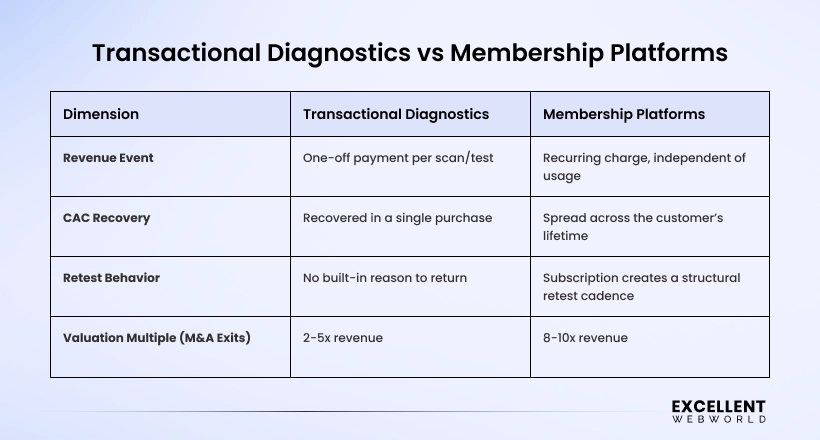
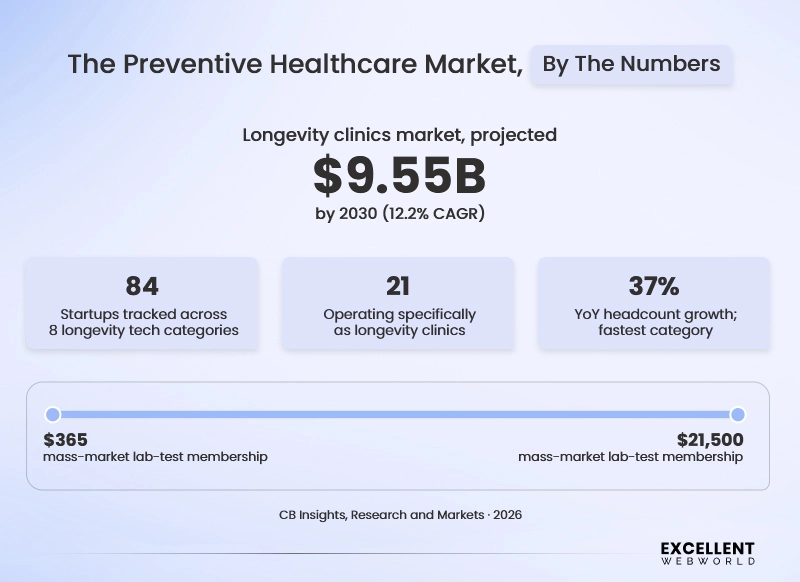
That’s why I don’t see companies like Function Health and Superpower as diagnostics businesses that happen to sell memberships. Their annual healthcare subscription plans, currently priced at $365 and $199 respectively, are simply the commercial entry point. The real product and the center of investors’ attention is the digital health platform: one that keeps members engaged, compounds health data over time, and generates the kind of recurring economics traditionally associated with software rather than episodic healthcare.
Note: Building these platforms require much broader capabilities than just a mobile app, often demanding custom software development with meticulous focus on complex clinical, operational, and compliance requirements.
The Five-Layer Modern Health Membership Stack
I genuinely believe that most people underestimate why these platforms command software-like valuations. The fact that they offer more biomarkers or have better-looking dashboards has very little to do with it. The real difference lies in the capabilities they’ve assembled over time. When I analyze the companies leading the longevity tech category, I keep seeing the same five layers emerge:
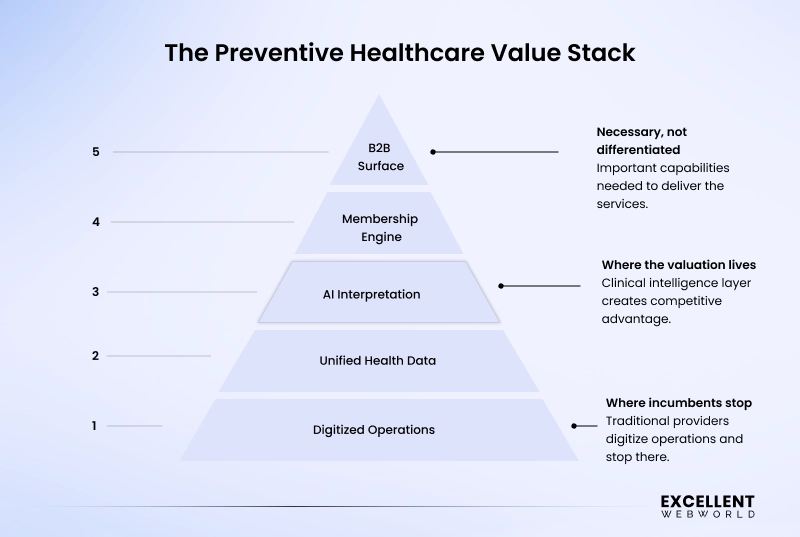
1. Digitized Operations
Whether it’s a physical facility or a digital platform, a healthcare service provider needs an admin layer to execute the functions that keep the service functional. This layer fulfills that requirement. Scheduling, identity management, digital consent, provider workflows, lab logistics, and medical billing remove operational friction in preventive health platform development before even a single biomarker is collected. These foundational capabilities are common across healthcare app development, regardless of whether the end product is a patient app, provider platform, or membership ecosystem.
Honestly speaking, there’s nothing glamorous about this layer. And yet, every capability you integrate above it heavily depends on getting these fundamentals right.
2. Continuous Unified Health Data
It is at this layer in the health membership stack that the model starts to differentiate itself from traditional healthcare platforms.
By its nature, conventional care is episodic, meaning it produces one-off reports based solely on that visit. Health membership platforms prioritize continuous care by creating structured, longitudinal health records. These preventive health platforms combine digital biomarker data with wearable health data from Whoop, Oura, Apple Health, and other connected sources, illustrating how IoT in healthcare enables continuous remote patient monitoring beyond the clinical setting.
Our CTO at Excellent Webworld, Mayur Panchal, put it very elegantly:
“Think of a report in PDF format as a photograph. It’s useful, but frozen in time. A structured health record is more like a movie. Every new data point adds another frame to the overall narrative.”
 Mayur PanchalCTO, Excellent Webworld
3. Clinical Intelligence Layer
Raw health data has limited value until it supports meaningful decisions. This is why leading platforms invest in AI integrations, protocol engines, clinical guardrails, and evidence-based workflows that translate data into personalized recommendations while keeping clinicians involved. These capabilities represent some of the most practical examples of AI in healthcare, where artificial intelligence supports clinical decision-making instead of replacing it. Technology matters here, but disciplined clinical logic matters even more.
4. Membership Engine
As I pointed out earlier, healthcare has traditionally been built around episodes of care. Wellness membership businesses focus on relationships.
This is why they invest in patient engagement solutions, behavioral nudges, renewals, clinician follow-ups, and personalized care journeys that deepen the relationship beyond the initial assessment. This approach also generates predictable revenue and expands each member’s longitudinal health record.
5. B2B Platform Layer
Employer dashboards, HRIS integrations, benefits administration, population health reporting, and enterprise analytics allow the same platform to serve organizations at scale, enabling a health membership platform for employers while opening entirely new revenue channels beyond consumer memberships.
Taken individually, none of these layers is especially difficult to understand. Combined, they create something very different from a diagnostics company. That’s why I see preventive health platforms as software businesses with healthcare capabilities, and not healthcare businesses that happen to use software.
Why This Subscription Healthcare Model Thrives in the U.S. and the Gulf
The five-layer stack is not an abstract theoretical notion. Several U.S. companies use that very infrastructure to build commercially-viable healthcare subscription models.
Other developed healthcare markets, such as those in the EU/UK region, have also begun adopting the health membership business model, although at a much slower, regulation-controlled pace. The major movements are in the two markets moving fastest, in opposite directions: one is already in the process of proving its validity, while the other is developing the infrastructure for it from scratch.
The U.S. market has already validated the fact that health subscriptions work, and more importantly, they are in demand. The valuation numbers we saw at the very beginning are indicative of that market position. The competition today is driven by what more these platforms can do.
You can already see this happening. Function Health acquired Ezra back in May 2025, expanding from blood biomarkers to AI-powered preventive imaging. With this acquisition, the company added new revenue streams in the form of five new imaging solutions for its members. Even Superpower is gradually extending its membership model to employer-sponsored health programs for entire organizations. Different products, different customers, but the underlying business model stays exactly the same.
There’s no debate among the U.S. companies whether the model works. They are now in a race to build the most valuable preventive health platform above it.
The Gulf is entering the same race, although from a different starting point.
Governments across the UAE and Saudi Arabia are investing heavily in preventive healthcare through initiatives like Vision 2030, while organizations including M42 and PureHealth continue expanding digital health capabilities alongside. Interest in longevity clinics is growing across Dubai and Riyadh. Capital is available. Clinical infrastructure continues to improve. But the biggest gap I still see is the scarcity of product engineering talent.
That creates a very different opportunity. Clinical expertise alone isn’t enough. Building a preventive health platform also requires teams that can deliver the technology behind unified health data, clinical intelligence, membership operations, and enterprise services while navigating regional regulatory frameworks such as Saudi Arabia’s Personal Data Protection Law (PDPL) and healthcare data requirements established by authorities including the Dubai Health Authority (DHA) and the Department of Health Abu Dhabi (DoH).
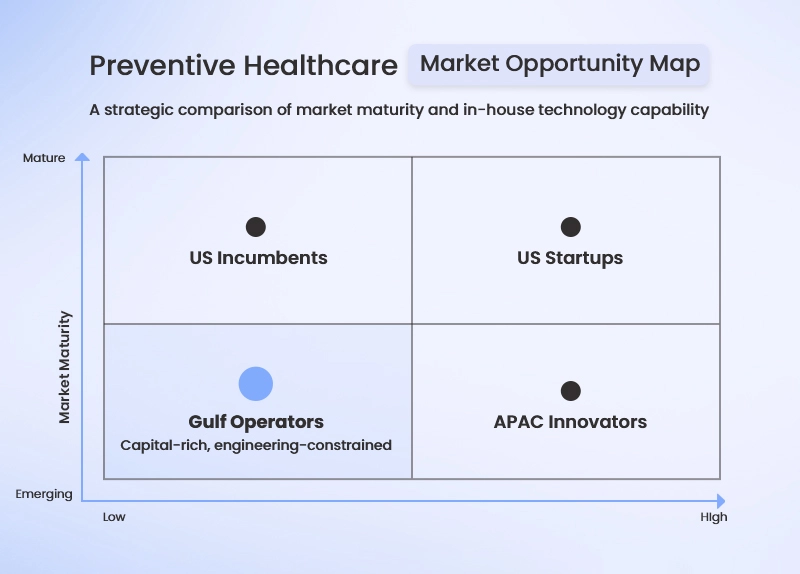
To me, that’s why the U.S. and the Gulf shouldn’t be viewed as separate stories. One market has largely validated the business model. The other is creating the conditions for its next phase of growth.
The Build Math Nobody Puts in the Pitch Deck
Ask most founders where the engineering complexity lies, and 9 times out of 10, the answer is AI. Investors ask about it, the founders pitch it, even product roadmaps often put it front and center. But from what I’ve seen, that’s only a fraction of the engineering challenge.
Standardizing lab results from vendors using different formats and reference ranges is a mammoth of a task. Different lab vendors often report results in different formats, making normalization one of the earliest engineering challenges teams must solve. The same goes for wearable integration because the APIs evolve independently and they rarely remain static, if ever.
Health membership business model also demands data architectures that meet regulations like HIPAA compliance and SOC 2 in the U.S. or regional frameworks like PDPL compliance across the Gulf markets.
Also Read: The engineering considerations behind HIPAA Compliant App Development for preventive healthcare platforms.
This includes developing access controls, embedding governance, and producing documented audit trails, as expected of modern clinical platforms. AI itself requires additional layers of engineering. Large language models don’t become healthcare products until protocol engines, evidence-based clinical guardrails, escalation workflows, and human oversight are built around them, all of which subsequently contribute to the time and cost of implementing AI in healthcare technology solutions.
It might seem paradoxical, but these are the engineering challenges of preventive health platforms that consume the majority of development effort. The features everyone gets excited about are usually the smallest part of the engineering effort.
This also surfaces an opportunity cost that you might’ve overlooked before.
Every month that your team spends on normalizing lab data or maintaining wearable integrations or extending compliance architecture is another month they aren’t building clinical intelligence, improving member experiences, or developing new features.
The fundraising decks don’t reveal this build math but, your development strategy and the resources you allocate for it are practically dictated by these numbers.
On Building Preventive Health Platforms
“Every month your best engineers spend building Layer 2 of the health membership stack is another month a competitor spends advancing Layer 3.”
 Paresh SagarCEO, Excellent Webworld
Where Your Engineering Team Should Actually Focus Their Time
The answer to that question depends entirely on where you are in the market.
Your engineering team shouldn’t be spending its best months rebuilding infrastructure that already exists. You don’t have unlimited time, and you certainly don’t have unlimited runway.
My advice is simple: keep layer 3 in-house.
That’s where you get the maximum opportunity to make the product yours. It’s the layer in which your clinical intelligence, care protocols, and member experience come together. It’s also the story you’ll tell investors when they ask why your platform deserves to win.
You do need solid data infrastructure, integrations, compliance, and everything else that keeps the platform running. Just don’t let those become the work that consumes your best engineers. Deciding whether to build or buy software for these foundational capabilities can determine how quickly your team reaches the differentiating layers.
You already own the infrastructure that startups spend years assembling from scratch: clinics, labs, patient relationships, specialists, and years of clinical data. The missing piece is the software layer needed to turn those assets into a functioning membership platform.
Building that software layer can take upwards of 18 months, and trying to import an entire Silicon Valley engineering enterprise can extend the timeline (and costs) even further.
I’d focus your internal teams on what only they can do: clinical strategy, operations, and patient experience. Then bring in experienced product engineering teams to accelerate the software foundation. It’s a much faster approach to preventive health platform development than trying to build every capability yourself.
One thing is certain: the market is only just beginning to gain momentum. Grand View Research estimates that the global preventive healthcare technologies and services market will reach $585.6 billion by 2030, with Asia Pacific expected to be the fastest-growing region.
That creates a window of opportunity. The companies building today have a chance to shape the category before it reaches full maturity.
From where I stand, the biggest challenge isn’t validating the business model or deciding what features to include. More often than not, it’s finding the engineering bandwidth to build everything that doesn’t differentiate you: the Layer 2 work of normalizing health data, integrating wearable ecosystems, building compliance-ready data architecture, and connecting fragmented clinical systems before you can focus on Layer 3.
If you’d like to explore the engineering side of the healthcare subscription model or discuss preventive health platform development in greater detail, I’d be happy to share how I’d approach its architecture.
Frequently Asked Questions
A healthcare subscription model charges an annual or recurring fee for continuous, preventive care instead of billing patients for individual visits or tests. Members typically receive diagnostics, personalized health insights, biomarker testing, and ongoing monitoring through a preventive health platform that continuously evolves with their health data.
Preventive health platform development typically costs between $20,000 and $350,000+, depending on the platform’s complexity. The biggest cost drivers include clinical workflows, diagnostic and wearable integrations, AI capabilities, regulatory compliance, and the number of user roles. Enterprise-grade platforms with advanced interoperability and security requirements sit at the higher end of that range.
Preventive health platforms operating in the UAE and Saudi Arabia must comply with data privacy regulations such as PDPL compliance, along with healthcare authority requirements from organizations like DHA and DoH where applicable. In practice, compliance affects digital health platform architecture from day one, including data storage, patient consent, access controls, and audit logging.
Build the capabilities that differentiate your platform, particularly the clinical intelligence layer and the member experience. The foundational engineering, including integrations, compliance, and health data infrastructure, can often be delivered faster with an experienced engineering partner. This allows internal teams to focus on creating long-term competitive advantage.

Article By


Paresh Sagar is the CEO of Excellent Webworld. He firmly believes in using technology to solve challenges. His dedication and attention to detail make him an expert in helping startups in different industries digitalize their businesses globally.